




















A Peterborough neighbourhood association has discovered you really can’t fight city hall — unless you have very deep pockets.
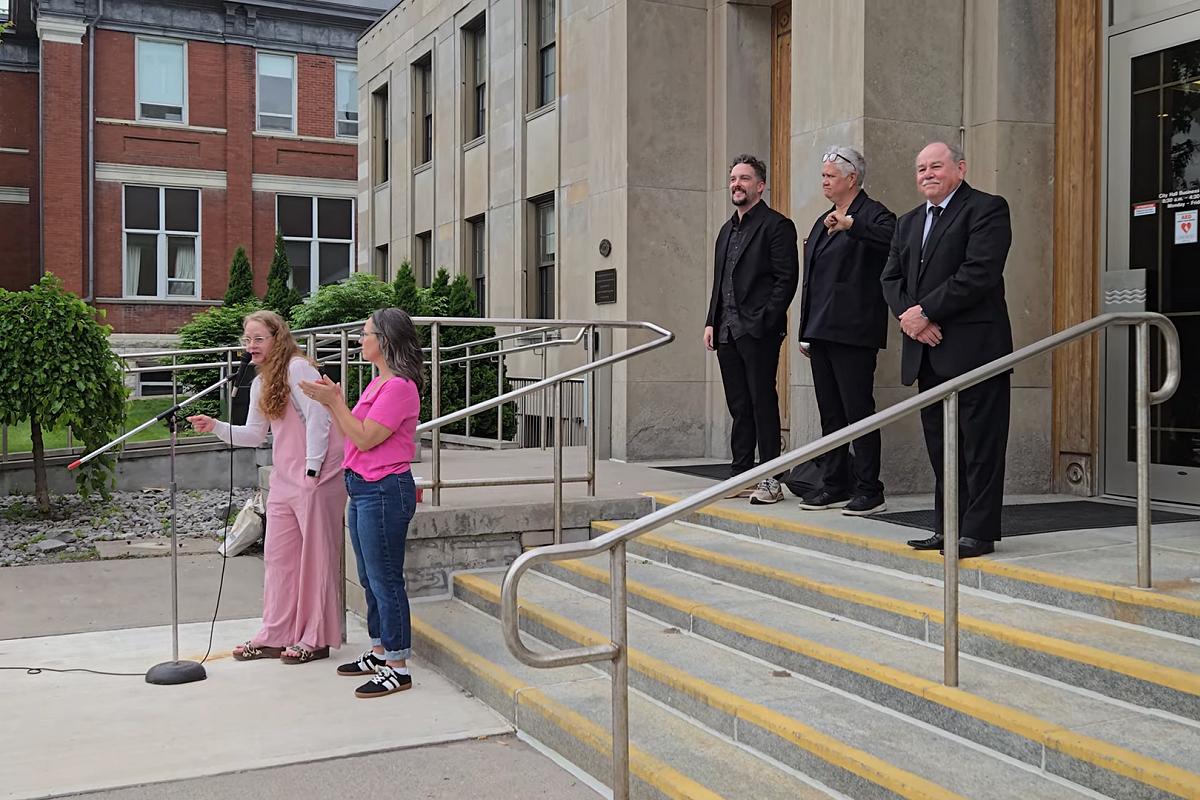
Northcrest Neighbours for Fair Process (NNFP) announced on Wednesday (December 10) that it is dropping its legal challenge against the City of Peterborough’s use of strong mayor powers to expedite Brock Mission’s transitional housing project.
The decision to withdraw the challenge comes after an Ontario Superior Court judge ruled on November 20 that, before the case could proceed, the association must first post a $30,000 security deposit within 30 days to cover the legal costs of the city and Brock Mission.
In addition to requiring the $30,000 security deposit, Justice Susan Woodley also ruled the city and Brock Mission could seek additional security deposits from NNFP as the case proceeds and costs increase.
As a volunteer-run resident association without substantial financial backing, NNFP says the required $30,000 deposit makes continuing the case impossible.
“We’re devastated,” says NNFP chair Sarah McNeilly in a media release. “This ruling prevents our case from ever being heard on its merits. It’s a travesty, in my opinion, that a multi-million-dollar municipal corporation has used vast legal resources — funded by taxpayers — to force ordinary, rate-paying residents out of court.”
Back on February 3, Peterborough Mayor Jeff Leal issued a statement that he would, in deference to a request from Brock Mission, be using his strong mayor powers to expedite a proposed six-storey 52-unit transitional housing complex at 738 Chemong Road adjacent to Cameron House, a women’s shelter also operated by Brock Mission.
Under the strong mayor powers of the Municipal Act provided by the provincial government in 2023 to 45 municipalities, including Peterborough, heads of council can propose municipal by-laws under provincial legislation — including the Municipal Act and the Planning Act — if they believe the proposed by-laws could potentially advance the provincial priority of housing.
In his statement, Mayor Leal said he would use his strong mayor powers to amend the city’s zoning by-law to allow the project to proceed and would exempt the project from the existing site plan requirements, a process that ensures development projects comply with municipal policies and minimize negative impacts on the environment and surrounding community.
The mayor noted Peterborough’s “critical need for housing,” adding he will do “whatever is within my authority as mayor to support those (housing) projects moving forward for the benefit of our community.”
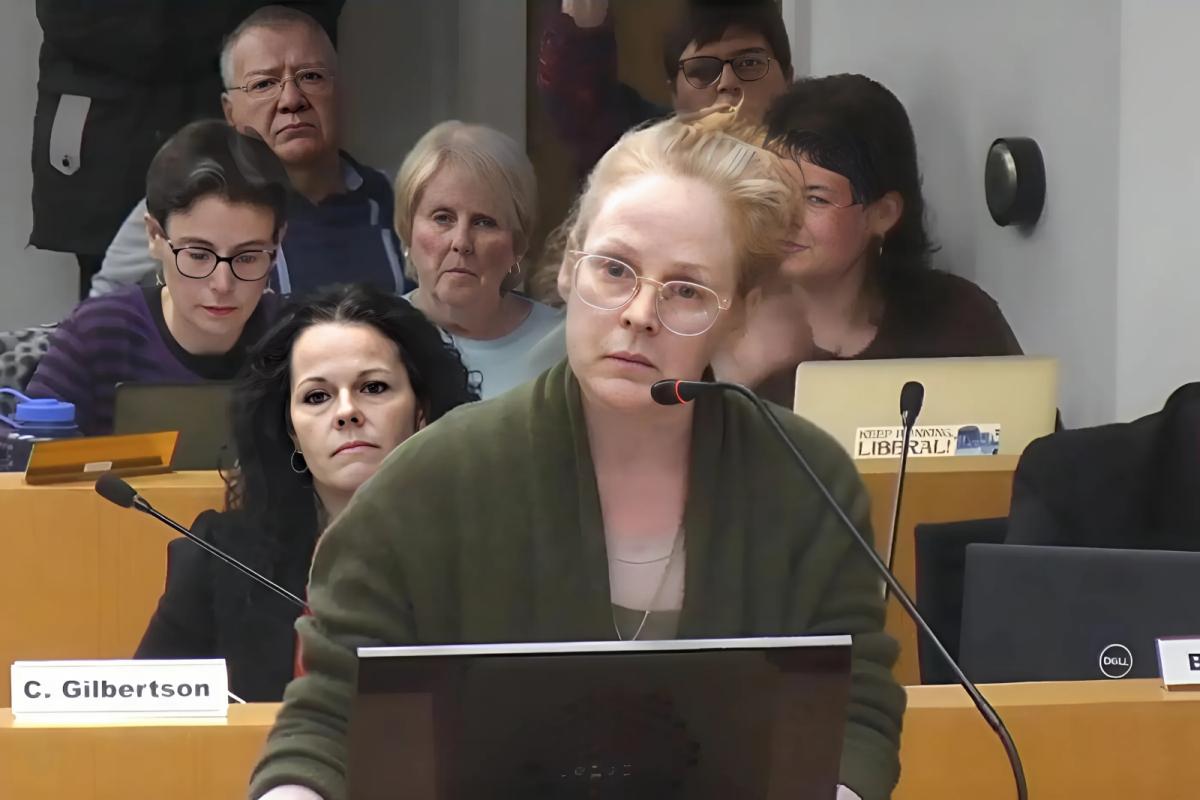
Fast forward to the February 24 meeting of city council where Mayor Leal made good on his vow. While seven of the 11 members of council voted against Mayor Leal’s motion, three councillors — Gary Baldwin, Kevin Duguay and Lesley Parnell — joined the mayor in supporting it. For a strong mayor powers motion to pass, only one third of a council (which can include the head of council) must support it.
During the heated and often confrontational five-hour public meeting under the Planning Act, both city councillors and the 15 public delegations, which included McNeilly, were forbidden from addressing the use of strong mayor powers — only the proposed zoning by-law amendment — and the normal rules of procedure for council meetings were suspended under the strong mayor powers legislation.
“I care about the homeless, but I have to ask a fundamental question: do we still care about democracy?” McNeilly said during the meeting. “Because that’s what at stake here, not transitional housing. This is about whether we, as a city, as a council, as a people, still believe in the bedrocks of democracy.”
In response to council’s decision, NNFP was formed in March as an unincorporated association to represent approximately 100 local residents of the Teacher’s College and Brookdale neighbourhoods in Peterborough’s Northcrest Ward. NNFP subsequently announced its intention to issue a legal challenge of the decision, providing a statement to kawarthaNOW in early April that the proposed project is being “rushed through without proper oversight, transparency, or consultation.”
NNFP’s argument is that Brock Mission’s proposed transitional housing build doesn’t qualify as “housing” within the definition of the provincial rules governing the use of strong mayor powers. The group argues that the building “more closely resembles an institutional facility (in terms of its planned use), therefore falling beyond the scope of strong mayor powers conferred by the Municipal Act.”
While NNFP says it supports transitional housing, neighbours have raised serious concerns about the proposed project’s close proximity to Cameron House, a long-established women’s homeless shelter and transitional housing facility serving some of the most vulnerable women in the city, noting that placing a large co-ed transitional facility immediately beside an existing women’s shelter posed obvious safety issue and trauma-informed-care concerns for the women sheltering there.
“Cameron House has been operating in our neighbourhood for decades,” says McNeilly. “Rather than address the risks, Brock Mission and the city floated the idea of relocating Cameron House entirely. That suggestion alone shows how little consideration was given to the women already living on the property.”
NNFP created a separate incorporated entity, Northcrest Neighbours for Fair Process Ltd., for the sole purpose of filing the court application and retaining legal counsel. As NNFP chair, McNeilly volunteered to be the sole director and member of the incorporated entity named in the proceedings.
After NNFP moved forward with the legal challenge, the City of Peterborough responded by filing a notice of motion on May 27 for security of costs in the amount of $10,000.
“The Applicant is a shell corporation without operations and it does not have any assets in Ontario or elsewhere to pay the costs of the Respondent,” stated the motion from city solicitor Scott Seabrooke. “The Applicant was incorporated for the purpose of insulating Sarah McNeilly from being exposed to a cost award in her personal capacity and thus there is good reason to believe that the Applicant will try to avoid paying any order for costs.”
In addition, the city’s motion claimed that NNFP’s legal challenge “was brought for an ulterior motive, namely Sarah McNeilly’s personal opposition” to the section of the Municipal Act that defines strong mayor powers “which she views as undemocratic.”
As an alternative to $10,000 in security costs, the city requested an order “piercing the corporate veil” — a legal concept where a court disregards the separate legal entity of a corporation and holds its shareholders, directors, or officers personally liable for the corporation’s actions.
After the motion, NNFP launched a GoFundMe campaign appealing to the public for help with legal costs, which raised over $13,000.
During the summer, NNFP also filed a motion for injunctive relief in response to the removal of mature trees from the 738 Chemong Road property. The motion essentially asked the court to prevent construction from proceeding until a decision was made on whether the zoning by-law amendment made under strong mayor powers was valid.
Also during the summer, Brock Mission was added as a respondent to the legal application.
In the fall, the city filed a second motion for security of costs seeking $30,000 from NNFP — triple the amount originally requested.
“The city chose to play legal hardball with its own taxpayers — an approach more often seen in corporate litigation than in matters involving residents acting in the public interest,” McNeilly says.
NNFP, the City of Peterborough, and Brock Mission appeared before Ontario Superior Court Justice Susan Woodley on October 1 to argue their motions. It was decided that the city’s security for costs motion would be heard first and, following the release of the judge’s decision on that motion, either NNFP’s motion for injunctive relief or the entire case would proceed.
On November 20, Justice Woodley released her decision, which supported the city’s motion for $30,000 in security costs.
She found that NNFP met the criteria for a security for costs order because it is a nominal corporate applicant with no income, assets, or business interests, incorporated solely to bring the legal challenge forward, and that the group provided no evidence that it or its members could satisfy a future costs award.
She also found that NNFP failed to demonstrate impecuniosity (having a lack of funds), which would have required a disclosure of all income, assets, expenses, liabilities, and borrowing ability with supporting documentation.
Justice Woodley determined that, since NNFP has neither assets nor proof of impecuniosity for paying potential legal costs, it would be required to demonstrate a strong likelihood of success of its case based on the merits — a threshold she concluded NNFP could not meet.
“While I find the Applicant’s argument to be interesting, I do not find it to be compelling,” she wrote, noting that she was unconvinced by the group’s argument that the transitional housing project was “institutional” rather than “residential.”
She also stated that the Municipal Act contains an immunity cause for decisions made using strong mayor powers if a decision was made legally and in good faith, and observed that Mayor Leal exercised his legal authority and acted in good faith when invoking strong mayor powers.
Justice Woodley also found that access to justice as not compromised, as the members of NNFP could have brought the challenge personally but chose instead not to disclose any assets or assume financial risk.
The judge also rejected the notion that the case constituted public interest litigation, characterizing it instead as a local dispute driven by neighbouring property owners concerned about potential impacts on property values and lifestyle.
“Municipalities and charitable/not-for-profit organizations should not be unnecessarily exposed to litigation by nominal corporate applicants simply because the implementation of municipal powers is questioned,” Justice Woodley wrote. “Such litigation does not necessarily qualify as public interest litigation, and this is especially true in the present case where the merits are questionable and there is evidence that any costs and/or damages assessed will be unrecoverable.”
Because she found the merits of the case questionable and that any costs order would likely be unrecoverable, Justice Woodley ruled that the interests of justice would be served by requiring NNFP to post $30,000 in security within 30 days of the order, and also allowed the respondents to seek additional security costs from NNFP as the case proceeds and costs increase.
According to NNFP, the outcome “reflects a broader democratic failure: a tax-funded municipal corporation used its legal might to overwhelm citizens with limited means.”
“Justice is expensive, and the city knows it,” McNeilly says. “If everyday people cannot afford to challenge their local government — especially when democracy and public trust are at stake — then access to justice becomes a privilege reserved for the wealthy.”
NNFP says that, because it is unable to afford to proceed with the case, the mayor’s use of strong mayor powers will go untested “and legitimate questions about governance, transparency, and due process will never be reviewed by a judge.”
Despite being forced to discontinue its legal challenge, NNFP says it will continue advocating for fairness and accountability in municipal decision-making.
“Our goal has always been simple: to ensure that major decisions affecting our city are made lawfully, transparently, and democratically,” McNeilly says. “We remain committed to that mission.”
With files from Paul Rellinger.