




















The Ontario government has taken the next step towards building the world’s largest nuclear power plant in Wesleyville just west of the Town of Port Hope.
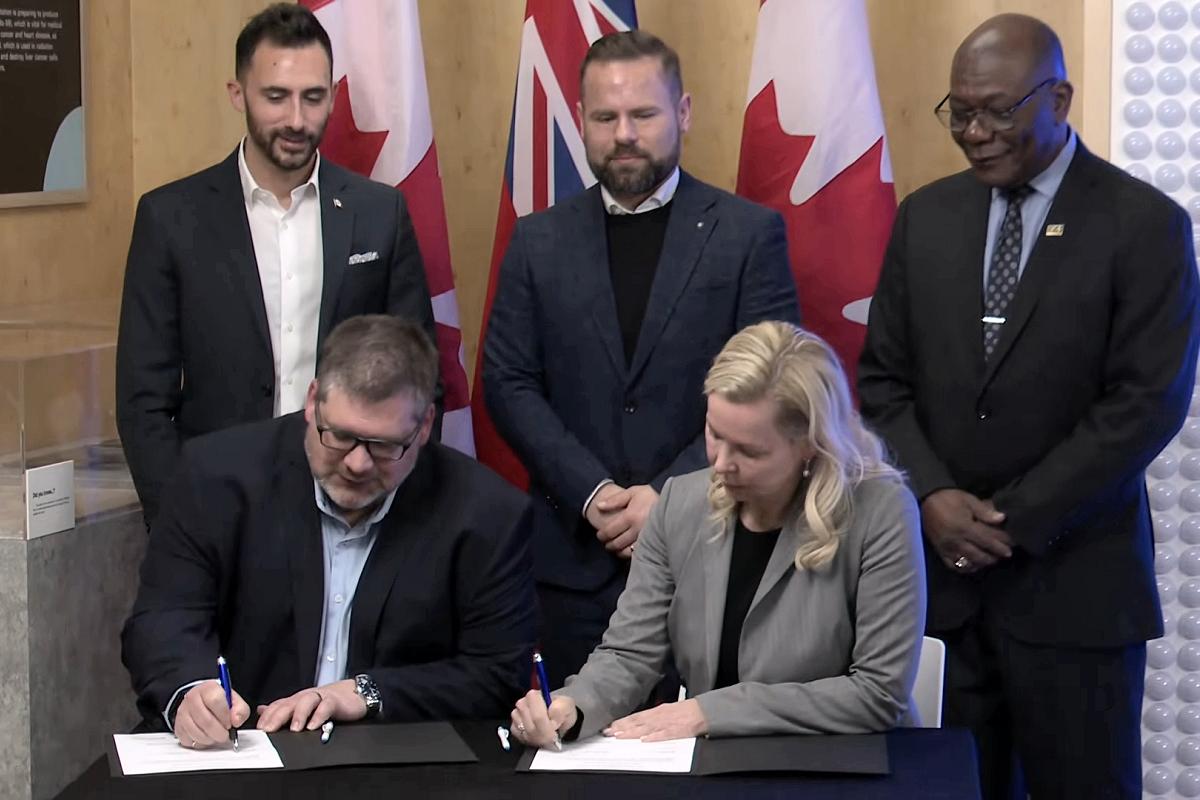
At a media event Thursday morning (February 12) at the Nuclear Discovery Centre at 115 Toronto Road in Port Hope, Ontario energy minister Stephen Lecce announced the signing of a partnership agreement between Ontario Power Generation (OPG) — whose sole shareholder is the Ontario government — and the Municipality of Port Hope to move the project forward.
Minister Lecce was introduced by Paul Séguin, who is OPG’s senior vice president responsible for leading new nuclear development at the Wesleyville site, overseeing all aspects of the next phase of project development, including project planning, environmental stewardship, the impact assessment, First Nations and community engagement, and financing.
“The backdrop of today’s announcement is that our country is under continuous attack by the U.S president and the erratic behaviour of the White House,” Lecce said. “What can we do as Canadians in this community today to help protect and inoculate us from the foreign shocks, from the chaos happening and emanating from the U.S.?”
“The greatest weapon against the chaos is to build more here at home, to get more Canadians working, to leverage Canadian technology, Canada’s supply chain, and to be proud that we are one of six nations on Earth with our own civilian nuclear technology.”
“We’re proud of that, and we’re proud that a quarter of the world’s uranium is processed in this community today,” Lecce said, referring to Cameco Corporation, one of the largest global providers of uranium fuel. “We are flexing our muscles as a true energy superpower but, to achieve that potential, we’ve got to build. We’ve got to get on with building and partnership, and that’s why we’re here today,”
After stating that the refurbishment of the Darlington nuclear station, which generates over 20 per cent of Ontario’s electricity needs, was completed below budget and four months ahead of schedule, Lecce noted that 93 per cent of investments made to date in nuclear power stay in Ontario and Canada, and that the same percentage would likely apply to the Wesleyville project as well..
“Following months of engagement and good faith partnership with the community and council of Port Hope, today Ontario Power Generation and the Municipality (of Port Hope) will be signing a MOU (memorandum of understanding) that will allow us to collaborate and help move this project forward, take it to the next level, and help us to get through the next phase of permitting so we can see what could represent as the world’s largest nuclear generator being built in this community,” Lecce said.
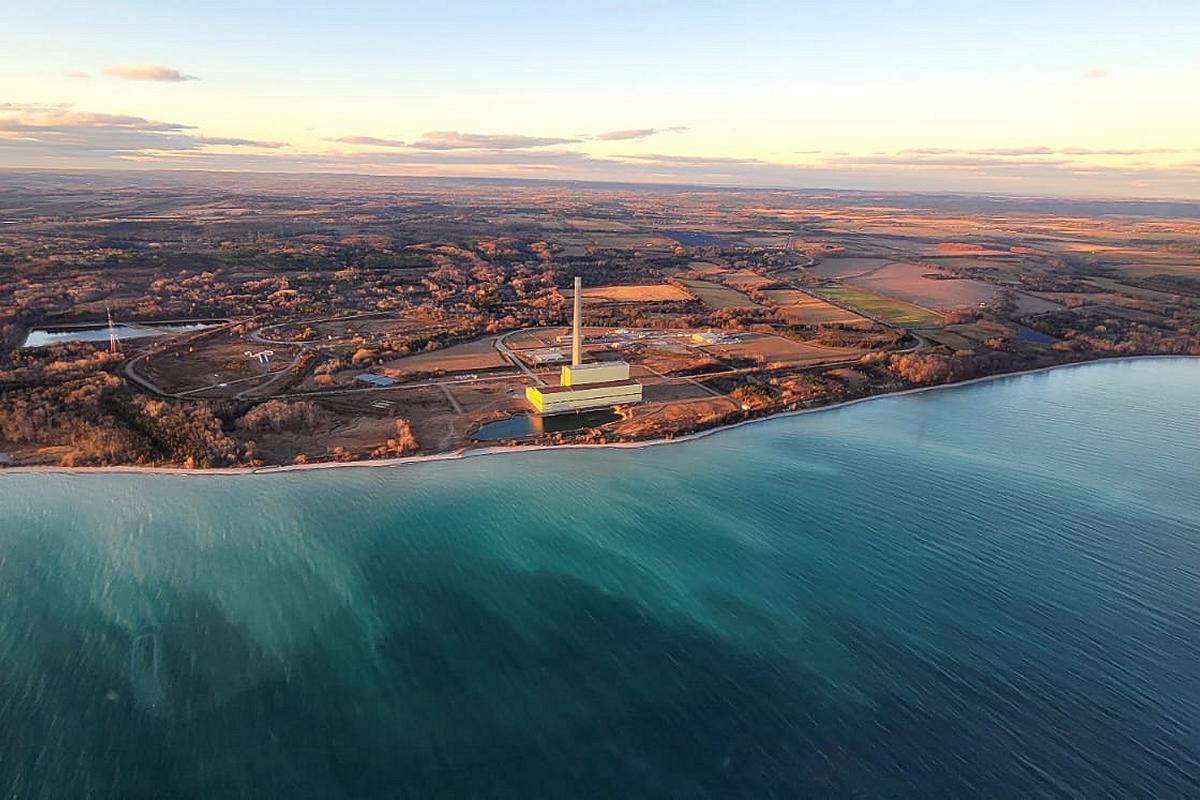
Last January, the province announced it was exploring the potential of developing a new nuclear power plant at OPG’s 1,300-acre Wesleyville site, located on the Lake Ontario waterfront around seven kilometres west of the Town of Port Hope. The site was originally intended to be an oil-fired power generation station before the 1979 oil shock and a recession brought construction to a halt.
Since then, the site with its powerhouse and smokestack has sat dormant and has been maintained by OPG, which said the site could be an ideal location for a new large nuclear power plant as it is also zoned for electricity generation and is close to existing existing transmission, road, and railway infrastructure. Based on OPG’s early assessments, the site could host up a nuclear power plant producing up to 10,000 megawatts of electricity, which could power the equivalent of 10 million homes.
The Conference Board of Canada estimates that the new nuclear power plant would contribute $235 billion to Ontario’s gross domestic product over an estimated 95-year project life, including design, construction, operation, and maintenance. The new facility would also generate 10,500 permanent jobs across Ontario, including 1,700 new jobs in Port Hope. The Municipality of Port Hope would also benefit from an estimated $10.5 million in increased municipal property taxes from the site.
On January 12, OPG submitted its initial project description to the Impact Assessment Agency of Canada for approval. OPG and Port Hope will work together throughout the impact assessment phase and any additional regulatory approvals and licensing processes, with OPG providing Port Hope with $4 million in growth-readiness funding.
The funding will be used by the municipality to prepare for the workload of the impact assessment process and the beginning stages of the proposed nuclear facility. OPG has also provided Port Hope with an additional $500,000 for specific staffing requirements related to project work.
Thursday’s media event was also attended by Northumberland–Peterborough South MPP David Piccini and Port Hope mayor Olga Hankivsky, who both spoke to the project.
“I’m thrilled that this is happening right here in my home community of Port Hope,” MPP Piccini said, adding that the project would provide a 15 to 20 per cent boost to local employment, including opportunities in the skilled trades and for college and university graduates.
For her part, Mayor Hankivsky thanked Minister Lecce and MPP Piccini for their support.
“This MOU represents a first step in a very long process, and represents exactly the kind of investment that we need to continue in our path towards growth readiness,” she said. “This agreement strengthens our collective capacity to enhance community engagement to support sustainable development and to advance economic growth.”
“It empowers a deeper and more meaningful connection with residents and with partners, ensuring that people have a real true voice in shaping the future of our community. It supports thoughtful and sustainable planning, respects our environment, uses our resources wisely, and sets us up for long-term success, and it positions us to attract the kind of staff and leadership in order for us to build a strong and resilient community.”
“By investing in readiness today, we are building a foundation that will help us to attract and retain the highest level of human resource excellence and ensure that we remain competitive and ready as a municipality for the task in front of us.”
The media event concluded with a signing of the MOU after remarks from Arnaud Raymond, director of automation global at Belden Inc. and president of the Northumberland Manufacturers’ Association, who said the manufacturing sector depends on clean and reliable energy to sustain operations, remain competitive, and support long-term employment.
“We believe Port Hope and Northumberland County are well positioned to contribute meaningfully to this initiative,” Raymond said. “The region has a strong and capable local supply chain, with the expertise to support major infrastructure projects while creating long-term employment opportunities.”
“While our members support a range of energy solutions, and many facilities already use solar power and other renewable energy and other technology, we believe a diversified energy mix is essential to meeting future demand. To achieve federal emissions reduction targets while ensuring reliable large-scale power to support economy growth and community development, nuclear energy represents unnecessary and responsible component for Ontario’s long-term and energy strategy.”
“In this context, we welcome and support the MOU between Port Hope and the Province of Ontario, including the growth-readiness funding that will enable the community to prepare and explore nuclear energy development in a thoughtful and informed manner. This initiative represents an opportunity to deliver sustained economic benefits, including skilled employment, construction activity, and long-term investment in the region. It also strengthens future prospects for local youth by supporting meaningful career pathways close to home, an outcome that is vital to the long-term resilience in our communities.”
There are some community concerns with the proposed new nuclear facility, including from environmental grassroots group Blue Dot Northumberland and the volunteer Port Hope Community Health Concerns Committee (PHCHCC).
Launched by the David Suzuki Foundation in 2014, the Blue Dot Movement is a grassroots environmental campaign with the goal of enshrining the right to a healthy environment. Blue Dot Northumberland is urging federal regulators to pause the proposed Wesleyville nuclear project, citing major gaps in information related to costs, health and safety risks, and project alternatives.
PHCHCC was formed in 1995 as an incorporated non-profit organization of current and former residents concerned about health issues relating to the potential health and environmental impacts of the contaminants from two nuclear industries operating in the community, as well as the presence of 1.9 million cubic metres of radioactive and heavy metal wastes in more than 1300 locations within the town
Port Hope has the largest volume of historic low-level radioactive wastes in Canada, produced between 1933 and 1988 from uranium and radium refining operations of former Crown corporation Eldorado Nuclear Ltd. In 1988, both Eldorado and another Crown corporation, Saskatchewan Mining Development Corporation, were merged and privatized as the Canadian Mining and Energy Corporation (now known as Cameco Corporation).
In 2001, the Government of Canada and the municipalities of Port Hope and Clarington signed a legal agreement known as the Port Hope Area Initiative to clean up the radioactive waste in both communities.
In 2012, the federal government committed spending $1.28 billion on what was originally a 10-year initiative, increasing the amount in 2022 to $2.6 billion to carry the initiative through to completion, including long-term monitoring.