




















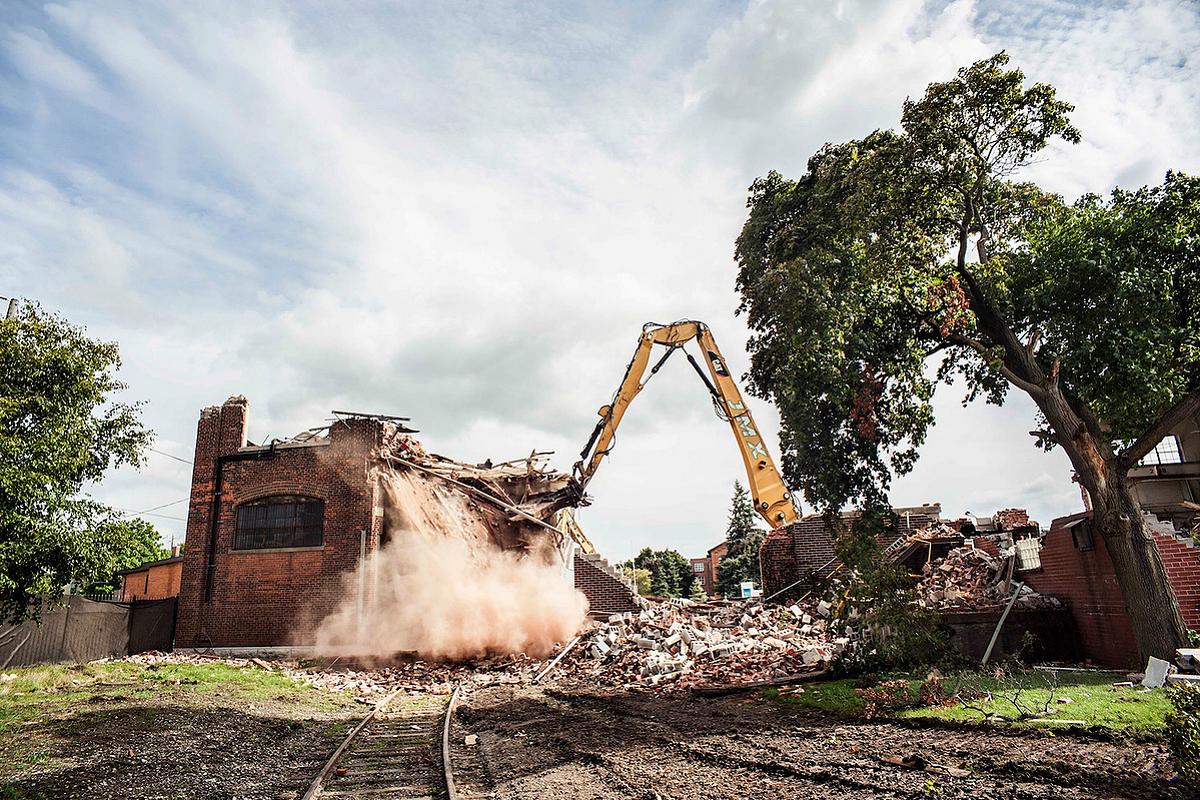
At its next meeting, Peterborough city council will be considering two items related to the historic General Electric (GE) factory complex at 107 Park Street North in downtown Peterborough, including a staff recommendation to exclude two buildings from heritage designation and the outline of a health and safety plan for the proposed demolition of most of the buildings.
Meeting as general committee on Tuesday night (February 17), council will review a report from Blair Nelson, the city’s commissioner of infrastructure, planning and growth management, about two objections to the city’s notice of intention to designate eight of the complex’s buildings under the Ontario Heritage Act.
The report also includes a draft heritage designation by-law that would exclude two of the buildings originally considered for designation.
Objections filed to proposed heritage designation
On November 25, GEPR Energy Canada Inc., a subsidiary of GE Vernova that owns the factory complex, filed a notice of objection to the city’s proposed heritage designation. The objection followed city council’s November 4 decision to allow GE Vernova to demolish a large number of vacant buildings at the factory complex with the exception of eight buildings that would receive heritage designation.
Council’s decision to designate buildings 2, 2A, 8A, 21, 24A, 26, 28, and 30 was based on a 154-page heritage impact assessment report prepared by ERA Architects Inc. for GE Vernova. On November 6, the city’s notice of intention to designate the buildings was served to GE Vernova as the property owner and also published as a public notice.
In addition to GE Vernova’s objection, BWXT Nuclear Energy Canada Inc. — a tenant that leases buildings in the complex from GE Vernova — filed its own notice of objection on December 3, citing the hindrance the heritage permit process could place on future development and alteration on the site. All four buildings leased by BWXT — 21, 24A, 26, and 28 — were included in the city’s notice of intention to designate.
Under the Ontario Heritage Act, the City of Peterborough has 90 days after receiving a notice of objection to decide whether to uphold the notice of intention to designate by passing a by-law or to withdraw the notice. That means the city would need to make a decision on heritage designation by February 23.
Staff recommend excluding two buildings from heritage designation
According to Nelson’s report, city staff consulted with legal counsel for GE Vernova and BWXT after receiving the two notices of objection and decided to exclude two of the buildings leased by BWXT from heritage designation.
“Through this consultation, staff has determined that it is appropriate to exclude buildings 24A and 28 from the list of heritage attributes detailed in the draft heritage designation by-law despite being included in the city’s notice of intention to designate dated November 6, 2025,” reads the report, noting the neither building is “ascribed any specific heritage value.”
While legal counsel for GE Vernova and BWXT agreed to this approach, BWXT vice president of fuel and fuel handling Andy Collyer subsequently wrote a letter to city council on January 26 expressing concern with the proposed heritage designation of any BWXT building, stating that doing so “carries significant risk to our business and future in the community.”
BWXT currently employs over 400 workers in high-paying skilled manufacturing and engineering positions at its Peterborough facility.
“We want to continue to grow our operations in this community as we have done so for many years,” Collyer writes. “However, with a looming heritage designation, we do not feel that this allows us to have flexibility to modify our buildings to meet our growing business needs.”
In Nelson’s report, city staff “acknowledge that council must balance the city’s interest in heritage preservation with other interests including the community’s long-term economic sustainability” and suggest that council could recommend that buildings 21 and 26 also be removed from the proposed heritage designation “should council wish to directly address the concerns raised by BWXT” in the January 26 letter.
City staff are recommending that council proceed with the heritage designation of buildings 2, 2A, 8A, 21, 26, and 30 by passing the designating by-law (with buildings 21 and 26 excluded if council decides to do so).
If the city passes the by-law, a second 30-day objection period will begin where the by-law’s passage can be appealed to the Ontario Land Tribunal, which will issue a binding decision to either dismiss the appeal or allow it by repealing or amending the by-law.
Report outlines proposed demolition health and safety framework
Council will also consider a report from municipal operations commissioner Ilmar Simanovskis that provides a high-level outline of a health and safety approach for the demolition of buildings at the GE Vernova site.
In October, council had directed city staff to develop the report in response to community concerns about the demolition given the long history of toxic substances used at the factory complex. City staff subsequently consulted with the Ministry of Environment, Conservation and Parks (MECP), Lakeland Public Health, and GE Vernova.
“Staff understands that council’s motivation to request for additional information from GE concerning its proposed building demolitions is a desire to limit the potential risk of environmental and adverse impacts related to the fears about historic contamination and contaminants being on the site,” the report states, before providing information about which agencies could be involved in the demolition and what their regulatory authority is.
That includes the City of Peterborough’s chief building official (who will issue a demolition permit according to the Ontario Building Code Act and without the involvement of city council), MECP (which is the lead agency in ensuring GE Vernova complies with provincial environmental legislation), and Lakelands Public Health (which is the lead agency for protecting public health and, as such, would notify MECP of a health hazard complaint relating to environmental health).
In December 2025, the city, MECP, and Lakelands Public Health began meeting bi-weekly to ensure that each agency understands its roles and responsibilities, and to provide a forum to share information regarding GE Vernova’s actions.
“Although the city has no legislated authority to require the completion of a HASP (health and safety plan) before demolition is started, GE is aware of the city’s request to provide a HASP,” the report states.
“Should GE adopt a HASP approach, it is expected that it will pay all costs for the HASP in addition to any costs that may be required to retain independent third-party oversight of the process and related community consultation and engagement, if required.”
Guideline document proposed joint oversight table, including an independent environment monitor
The city staff report also includes a guideline document for a community health and safety approach, which proposes a “joint oversight table” that would include the city, MECP, Lakelands Public Health, GE Vernova, the demolition contractor, and an independent environment monitor hired by the city and funded by GE Vernova.
There could also be sub-groups established “depending on the stage and complexity of the project,” including a technical review team, as well as a “community engagement group” that addresses specific concerns of the residents, businesses, and broader community.
The guideline also describes a number of technical documents that may be required and technical controls during demolition, as well as ongoing public communication including plain-language summaries of technical documents, live data dashboards, public meetings, and a 24/7 hotline and email address.
According to the guideline documents, the proposed demolition would be conducted in four phases: pre-mobilization (when the joint oversight table would be formed and the independent environment monitor hired), early works and abatement (when hazard removals would be verified, including asbestos and PCBs), structural demolition (on a per building basis, including three-day notifications of adjacent residents), and post-demolition (where the site is stabilized).
Items endorsed by general committee on February 17 will be considered by council for final approval the following Monday, when registered delegations will be allowed to speak.