


















Those who still doubt that high-speed rail will come to Peterborough had best pay attention: things are happening, and they’re happening fast.
Just a few days after Peterborough city council endorsed funding for a Coldsprings secondary planning study with an eye toward Peterborough’s future Alto high-speed rail station being located in the former hamlet southeast of the city, Alto CEO Martin Imbleau updated city and county business leaders on the rail network that will ultimately span 1,000 kilometres between Toronto and Quebec City.
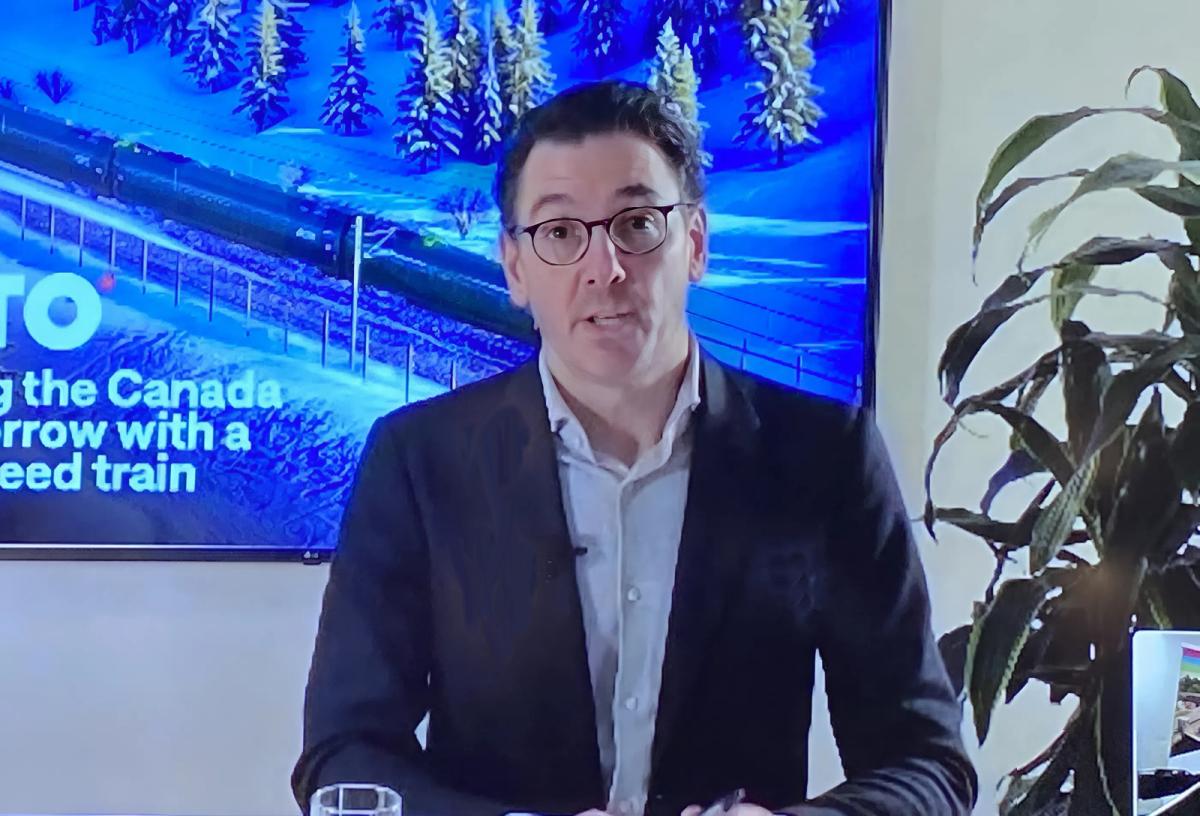
In an event hosted by the Peterborough and Kawarthas Chamber of Commerce at The Stonehouse Hall west of Peterborough on Thursday morning (February 19), Imbleau spoke virtually to the audience — a move necessitated by his flight being grounded due to weather concerns. However, his enthusiasm for, and firm commitment to the success of, the largest Canadian public infrastructure project in recent history jumped off the jumbo screen.
‘Peterborough is at the heart of this project, not on the sidelines’
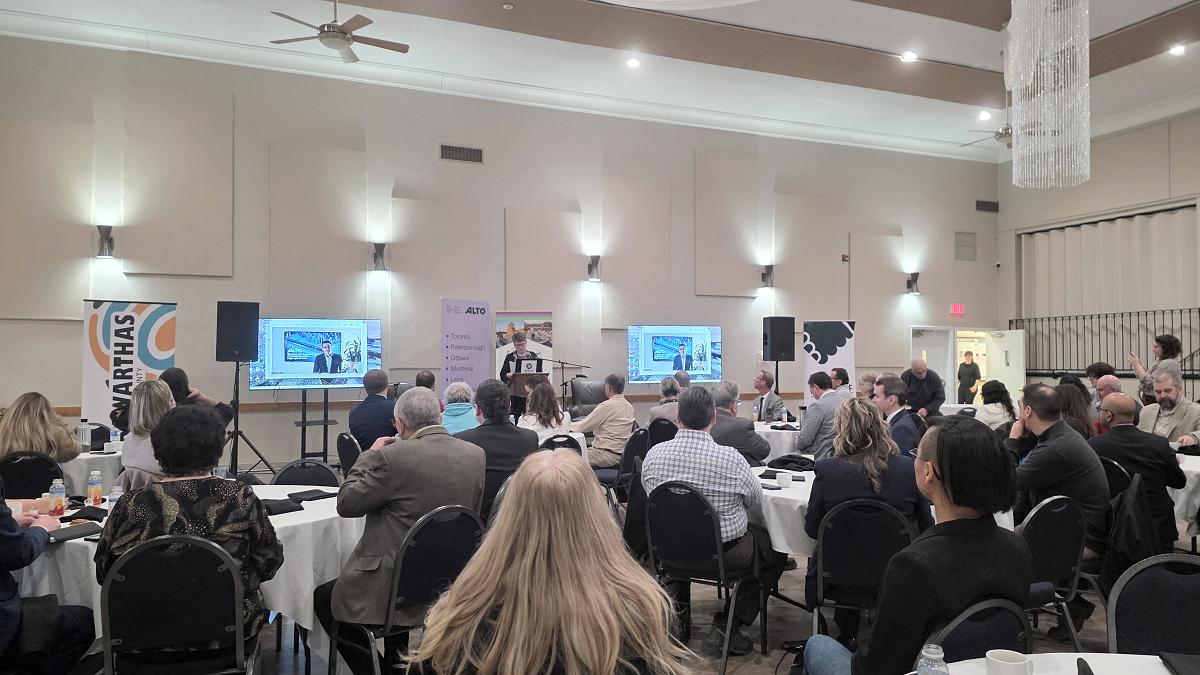
“To quote Rick Mercer, ‘Canada is a world leader in high-speed rail reports,'” said Imbleau.
“He’s right. For a decade, high-speed rail showed up on wish lists, was debated, was studied, and shelved again and again. But around this time last year, it all became real when (the federal) government moved forward with Alto, Canada’s first high-speed rail network connecting Toronto to Quebec City.”
“Today, my message is simple. It’s a clear call to action to prepare together to build it.”
Noting the initial phase of the project will see the rail corridor connecting Ottawa with Montreal developed, Imbleau said there’s good reason for that.
“Ottawa to Montreal is a distance we can manage responsibly and use as a learning ground, because that segment brings together most of the challenges we’ll face across the (entire) corridor,” he explained.
“It’s still a very large-scale project with 200 kilometres of track and three stations. But I want to be absolutely clear on one thing: Peterborough is at the heart of this project, not on the sidelines. This city is a key driver of the corridor’s future.”
‘It’s too early to present specific station locations’
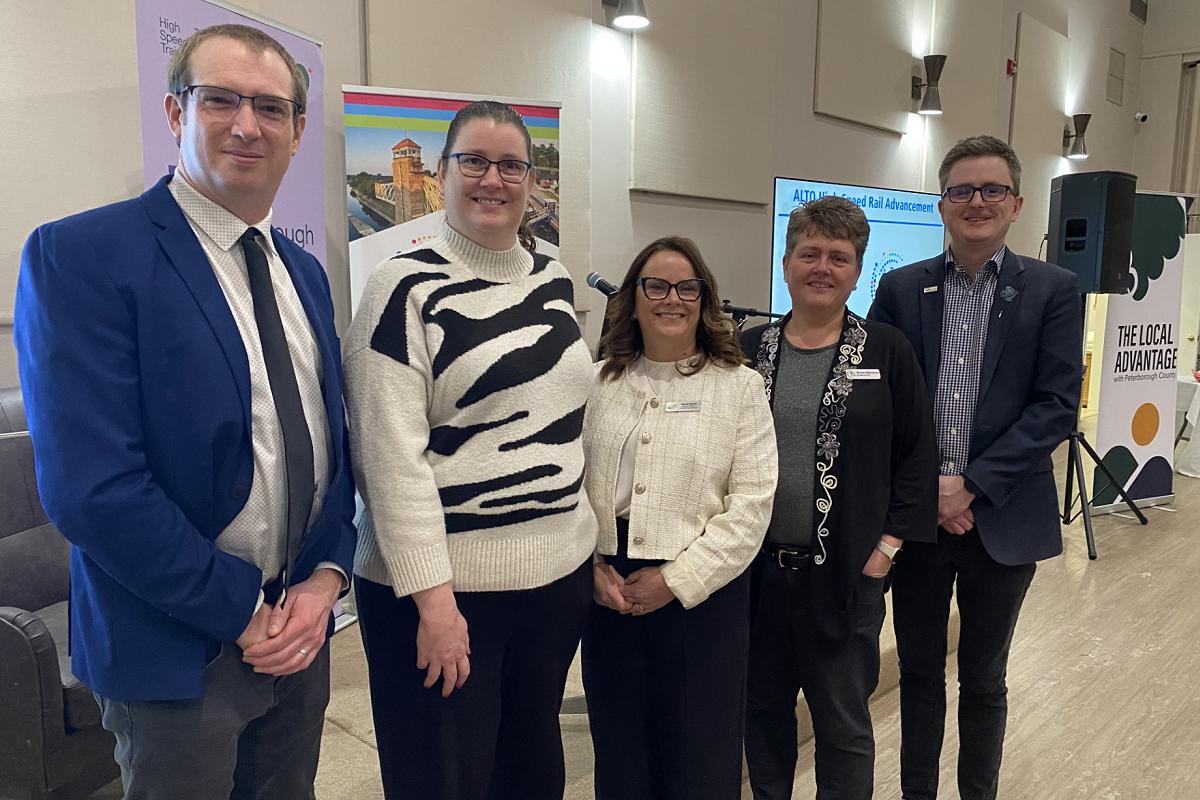
That message was welcomed by those gathered to hear Imbleau speak — an audience that included Peterborough Mayor Jeff Leal, Peterborough County Warden Bonnie Clark, most of the township mayors, and several local economic development leaders.
Of note, in light of Peterborough city council’s approval of the Coldsprings secondary planning study, Imbleau said “it’s too early to present specific station locations.”
“We’re exploring different options in each of the seven cities. A station is not just a dot on a map. Once you build it, it defines how a city connects for decades. The right (station) site must serve three things at once: the city, the regional network, and the long-term performance of the corridor.”
“I know there’s a lot of anticipation, and that’s understandable. I’m asking you for just a little bit more patience. After all, Petes fans have mastered patience since, what, 1979?” Imbleau joked, referring to the one and only time the hockey club won the Memorial Cup.
Following Imbleau’s remarks, Mayor Leal said Peterborough has answered Alto’s “clarion call” to start preparations now for what’s to come — hence the approval of the Coldsprings secondary planning study with an eye toward Peterborough’s high-speed rail station being located there.
“We want to be proactive, so we’re starting that planning process as we speak,” said Mayor Leal. “We always felt that the narrowest point for a crossing (of the Otonabee River) is the southeast corner of the city that is known locally as Coldsprings, so we want to be in position to get our planning work completed as soon as possible.”
‘It will be built largely by Canadian workers, with Canadian materials’
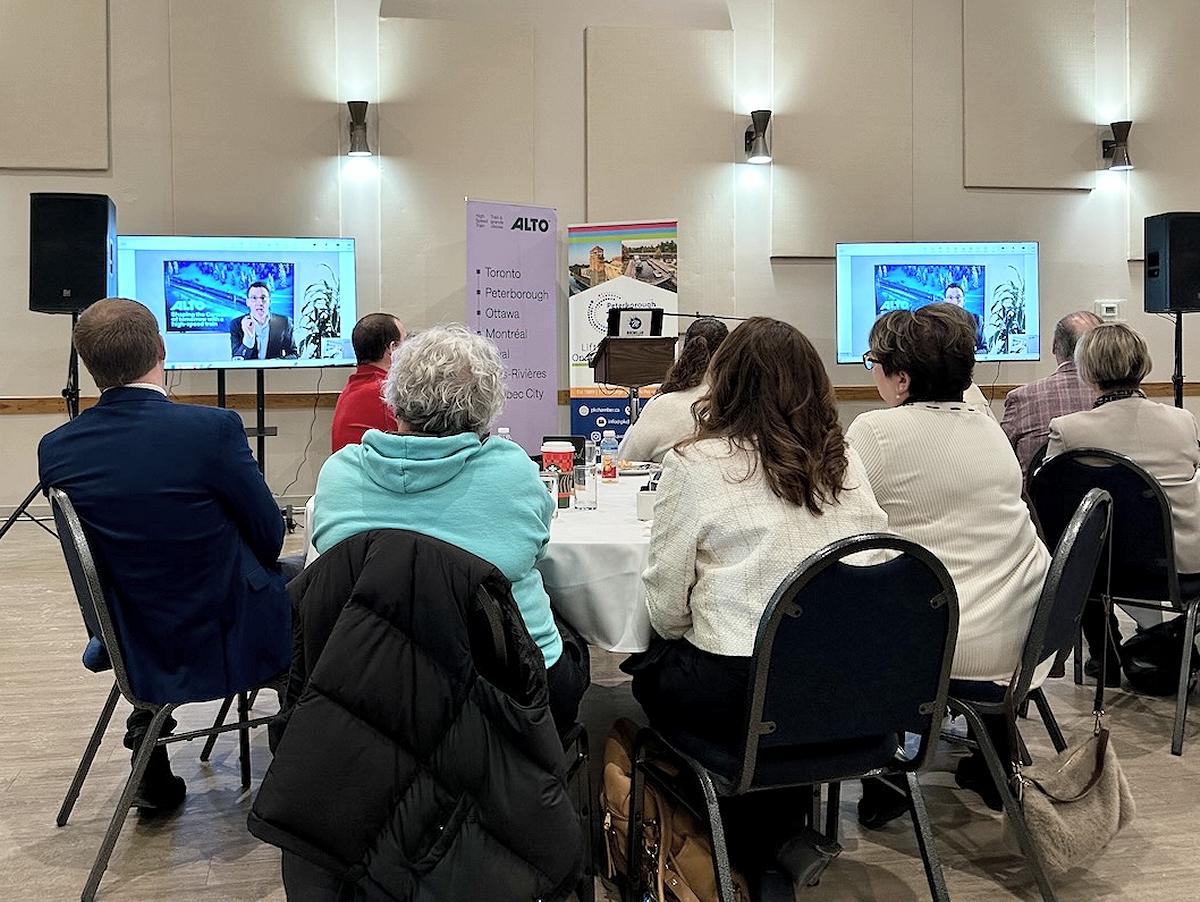
Meanwhile, Imbleau also spoke at length of the logistics of what he termed “a weapon of mass construction.”
“It will be built largely by Canadian workers, with Canadian materials, and drawing on best practices from around the world,” he said. “Building a 1,000-kilometre network requires tons of materials, crazy levels of engineering, and people. Lots of people. Because of that, Alto will set entire sectors in motion.”
“We need 4,000 kilometres of steel tracks — the equivalent of five round-trips to the International Space Station. For the first segment alone, we’re talking thousands of tons of steel, but also concrete, copper, and aluminum. That’s why we’ve already begun direct outreach to the Canadian steel industry. We’re engaging producers now to understand the readiness of the domestic supply chain.”
As for jobs created by the project, Imbleau noted “50,000 people will be required, enough to fill the Peterborough Memorial Centre about 12 times over. We’re talking welders, surveyors, electricians, signal and communication technicians to keep trains running safely at full speed, and construction crews to build bridges, tunnels, and electrified tracks.”
“The time to start preparing is now. That’s why I hope we’ll work closely with universities, colleges, and professional schools to develop training capacity. And with Cadence, we will soon start meeting with construction firms, construction associations, and union partners to assess their readiness to answer our coming calls to market.”
Cadence is an alliance of Canadian and international private partners with expertise in the design, financing, construction, operation and maintenance of large-scale, complex rail infrastructures. Cadence will co-develop the project with Alto, formerly known as VIA HFR, which is a Crown corporation formed in 2022 to oversee the high-speed rail project.
‘Alto will succeed if, and only if, it is built in collaboration with communities’
Imbleau also reaffirmed that Alto is wholly committed to connecting with residents, listening closely to questions and concerns, and ensuring perspectives from Peterborough and communities across The Kawarthas inform every stage of planning.
To that end, Alto has launched an initial three-month public consultation process that includes a drop-in open house in Peterborough on Thursday, February 26 between 11 a.m. to 3 p.m. and 5 to 9 p.m. at the McDonnel Street Community Centre at 577 McDonnel Street.
Alto’s first two open houses, held in Ottawa and Montreal on January 21 and 22, collectively saw more than 1,000 attendees.
At the Peterborough open house, there will be a variety of booths set up to share stories of how high-speed rail will revolutionize mobility and quality of life across communities along the corridor.
In addition, members of Alto’s community engagement team will be available to share why high-speed rail is a groundbreaking project for Canada, what the project timeline looks like, how the trains will work, and how they will transform mobility between Toronto and Quebec City. Attendees will also be able to meet experts from the Alto team who can speak to engineering, design, environmental consultations and more,
“I’ve said since day one that Alto will succeed if, and only if, it is built in collaboration with communities,” said Imbleau.
“Obviously, we cannot give all the answers on day one. A consultation where everything is already decided is not a consultation — it’s a sales pitch. Listening now before decisions are made is what creates clarity going forward. In 2026, it’s about consultation, refining the alignment and coming back to communities by year-end with a very precise proposal.”
‘This is a very ambitious timeline but, if we do it properly, it’s a doable one’
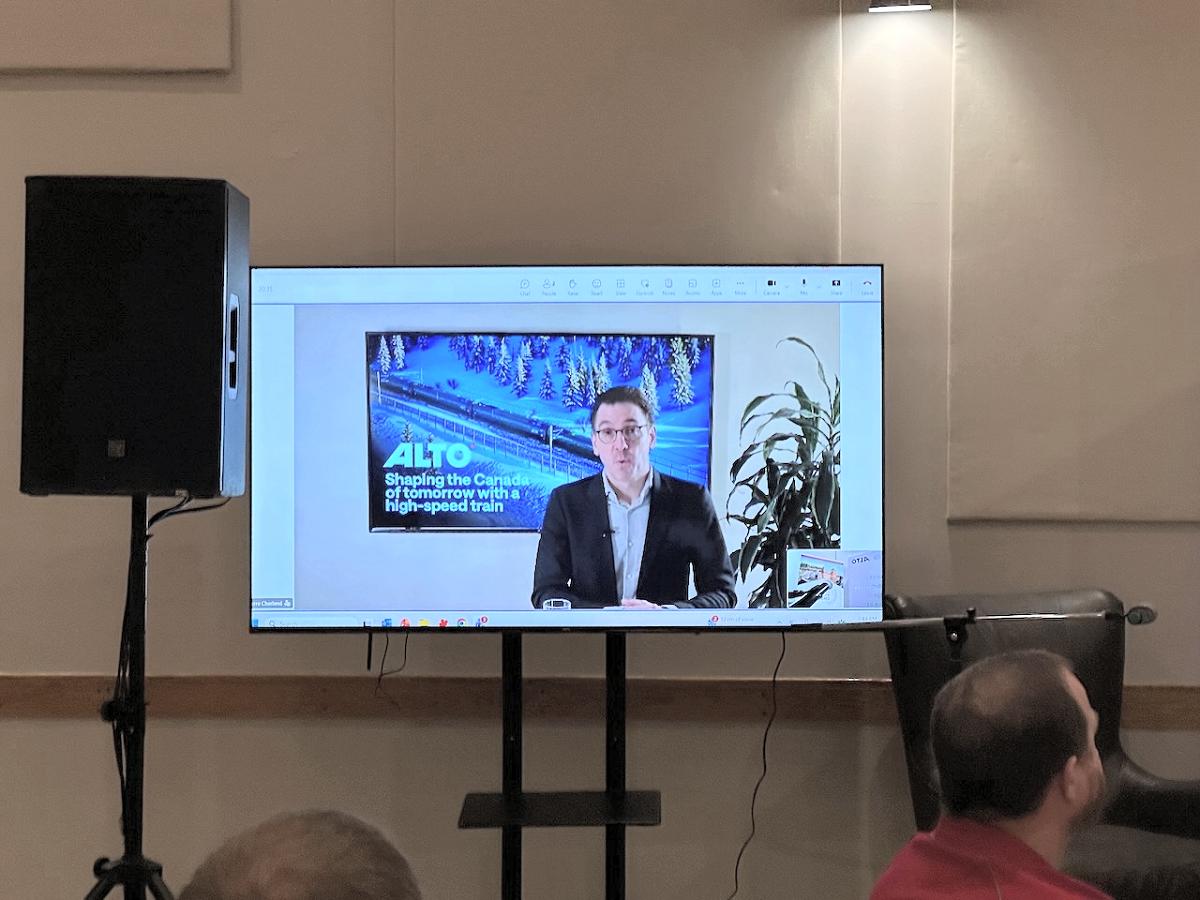
“In 2027-28, we’ll focus on detailed design and environmental work,” Imbleau said. “By 2029, market preparation will start translating into contracts being awarded, work utilities and the first on-the-ground activities. By the end of 2030, construction will be underway between Ottawa and Montreal.”
“I’m not going to lie. This is a very ambitious timeline but, if we do it properly, it’s a doable one.”
“Of course, building responsibly also means being honest about the challenges. There will be questions. There will be skepticism. It will test our coordination across jurisdictions, and our capacity to stay the course over many years.”
“It’s not going to be easy. Projects like this never are, but challenges do not make this project less necessary.”
‘High-speed rail has the potential to redefine how people and businesses move’
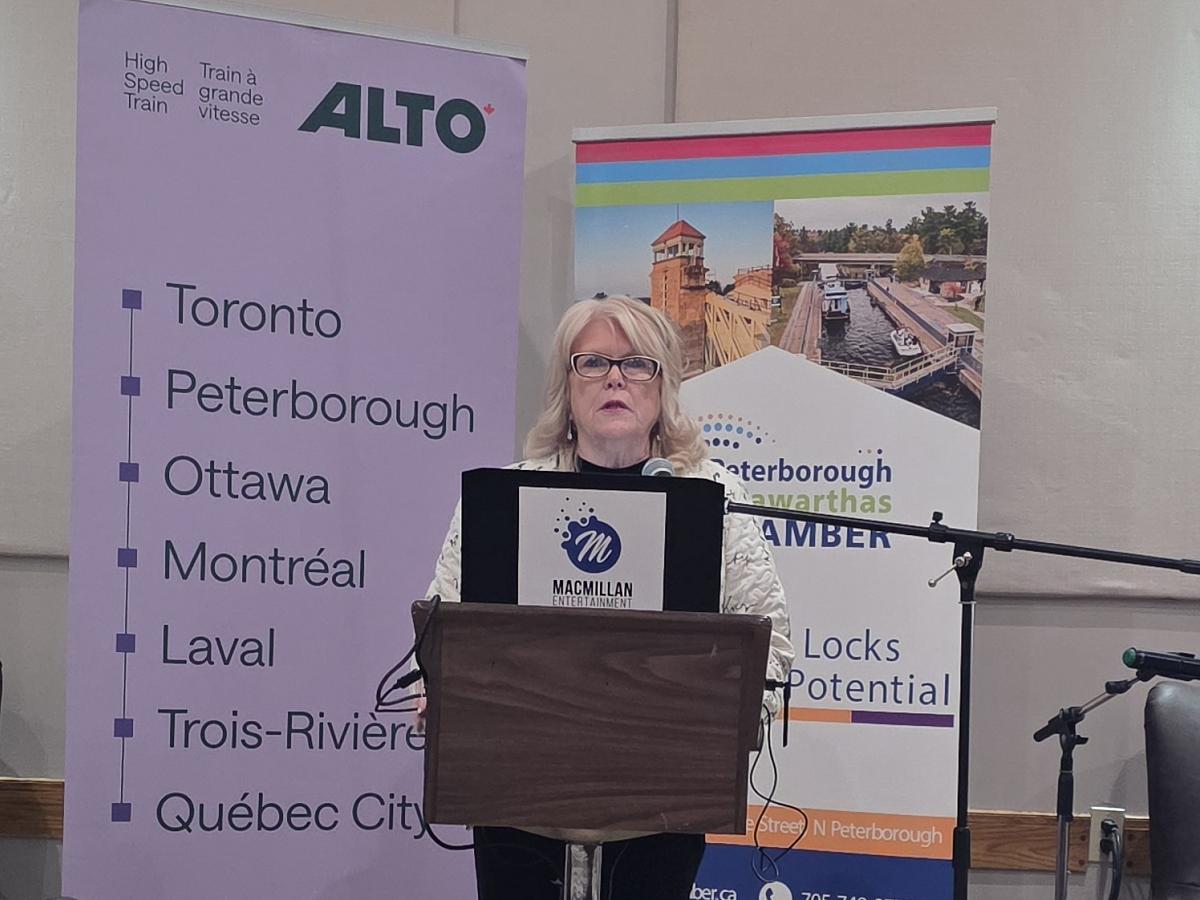
One challenge that Alto doesn’t have to overcome is convincing the leaders of those communities the high-speed rail line will connect of its need, its benefits, and its value.
“Today we’re talking about how we shape the future of economic growth, workforce, mobility, environmental sustainability, and regional competitiveness,” said Warden Clark in her opening remarks. “High-speed rail has the potential to redefine how people and businesses move, connecting communities like ours more effectively to major urban centres and opening new doors for opportunity.”
“Getting this right matters. As a county, we know that meaningful infrastructure decisions require partners at the table — municipal, provincial, federal, Indigenous, industry, and most importantly, our residents. High-speed rail will only succeed if it is planned with care, is grounded in community needs, and is developed in a way that respects local context, protects our environment, and strengthens our rural and urban fabric.”
For more information on Alto’s public consultation process, visit www.altotrain.ca/en/public-consultation. To stay informed about upcoming milestones and additional opportunities to engage, sign up for Alto’s monthly newsletter at www.altotrain.ca/en/stay-updated.