






















Federal officials have confirmed that the Ottawa–Montreal corridor will be the first segment to move forward as part of Alto’s planned high-speed rail network, marking a key milestone in what is being billed as one of the largest infrastructure projects in Canadian history.
At an announcement in Gatineau, Quebec on Friday (December 12), federal transport minister Steven MacKinnon and Alto president and CEO Martin Imbleau said the initial phase of the project will see high-speed rail built between Ottawa and Montreal, a route of roughly 200 kilometres spanning Ontario and Quebec, including a stop in Laval.
According to MacKinnon, it is “logical” to begin with the Ottawa–Montreal segment as it is the shortest and straightest segment of the corridor, since high-speed trains “don’t like curves.” It is also intended to deliver early benefits to travellers and communities while allowing work to begin simultaneously in both provinces. Construction on the segment is expected to begin in 2029.
“This announcement marks an important step forward in delivering faster, cleaner, and more connected transportation for Canadians,” MacKinnon said in a media release. “By working closely with Alto and our partners across governments and communities, we are laying the groundwork for a high-speed rail network that will put Canada firmly on the global map for modern rail innovation, strengthening the economy, creating good jobs, and connecting people across this vital corridor.”
The Ottawa–Montreal segment is part of a broader vision for Canada’s first high-speed rail network, which would eventually stretch approximately 1,000 kilometres from Toronto to Quebec City. Planned stops between Toronto and Quebec City include Peterborough, Ottawa, Laval, Montreal, and Trois-Rivières.
Trains are expected to reach speeds of up to 300 km/h, cutting travel times in half and connecting regions that are home to nearly half of Canada’s population. For example, the estimated travel time between Peterborough and Toronto would be 40 minutes — 45 per cent faster than the 90 minutes required when travelling by road with normal traffic.
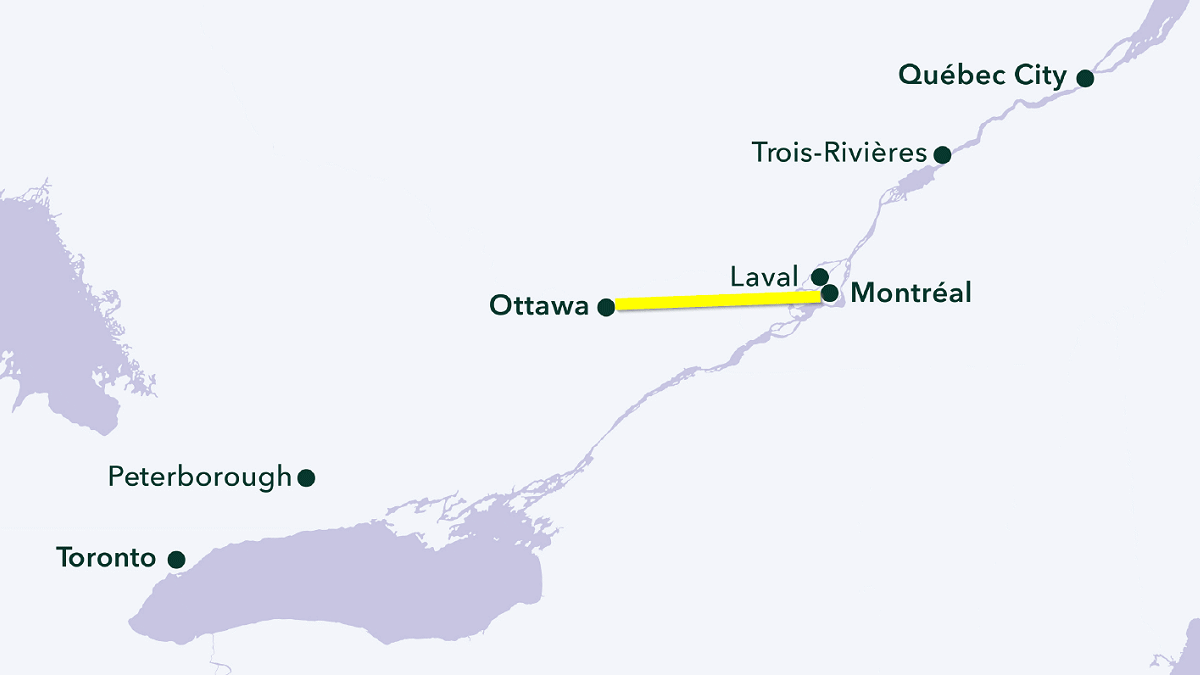
According to Alto, which is the Crown corporation overseeing the project, focusing on the shorter and cross-provincial Ottawa–Montreal segment first will help accelerate delivery and build the skilled workforce needed to expand the network to Toronto in the west and Quebec City in the east.
“Undertaking one of the biggest infrastructure projects in Canada’s history requires multi-stage planning,” said Imbleau. “Focusing first on the Ottawa–Montreal segment is a logical step to optimize the project, accelerate delivery, and generate tangible local economic benefits.”
Imbleau added that the approach will allow Alto to mobilize teams more quickly in both provinces while continuing work on the remaining segments of the corridor. With each segment estimated to take six to eight years to build, the entire Toronto–Québec City rail corridor would be completed in the early 2040s.
Beginning in January, Alto will launch a three-month consultation process with the general public as the first phase of a longer-term consultation that will inform the selection of preferred routes and station locations, with a second public consultation process early in 2027.
The initial consultation process will include an online engagement platform, virtual sessions, and in-person open houses, including one scheduled to take place in Peterborough at McDonnel Street Community Centre on Thursday, February 26. Full details on consultation dates and participation options are available on Alto’s website at www.altotrain.ca/en/public-consultation/.
In addition to the public consultations, Alto will also continue engagement with Indigenous communities, municipalities, and public institutions throughout design, environmental studies, construction, and long-term operations. Alto says the project will be guided by commitments to reconciliation and sustainability.

The Canadian government has identified the high-speed rail project as a transformative national initiative and confirmed it will receive support from the Major Projects Office, which means the project will begin four years earlier than the original timeline. Pre-procurement activities are expected to begin in 2026, with Alto and its partner Cadence providing information to industry participants.
The federal government estimates the project could boost Canada’s GDP by up to $35 billion, create approximately 51,000 jobs during construction, and support tens of thousands more across sectors including steel manufacturing, concrete production, electrical systems, digital technologies, and skilled trades.
Beyond direct economic impacts, the project is also expected to boost tourism, support more affordable housing development along the Toronto–Québec City corridor, and reduce greenhouse gas emissions by potentially removing 100,000 cars from roads.