









Amongst the varied conversations and widespread debate following the City of Peterborough’s recent approval of two proposed high rises, one resident is exploring the implications through art.
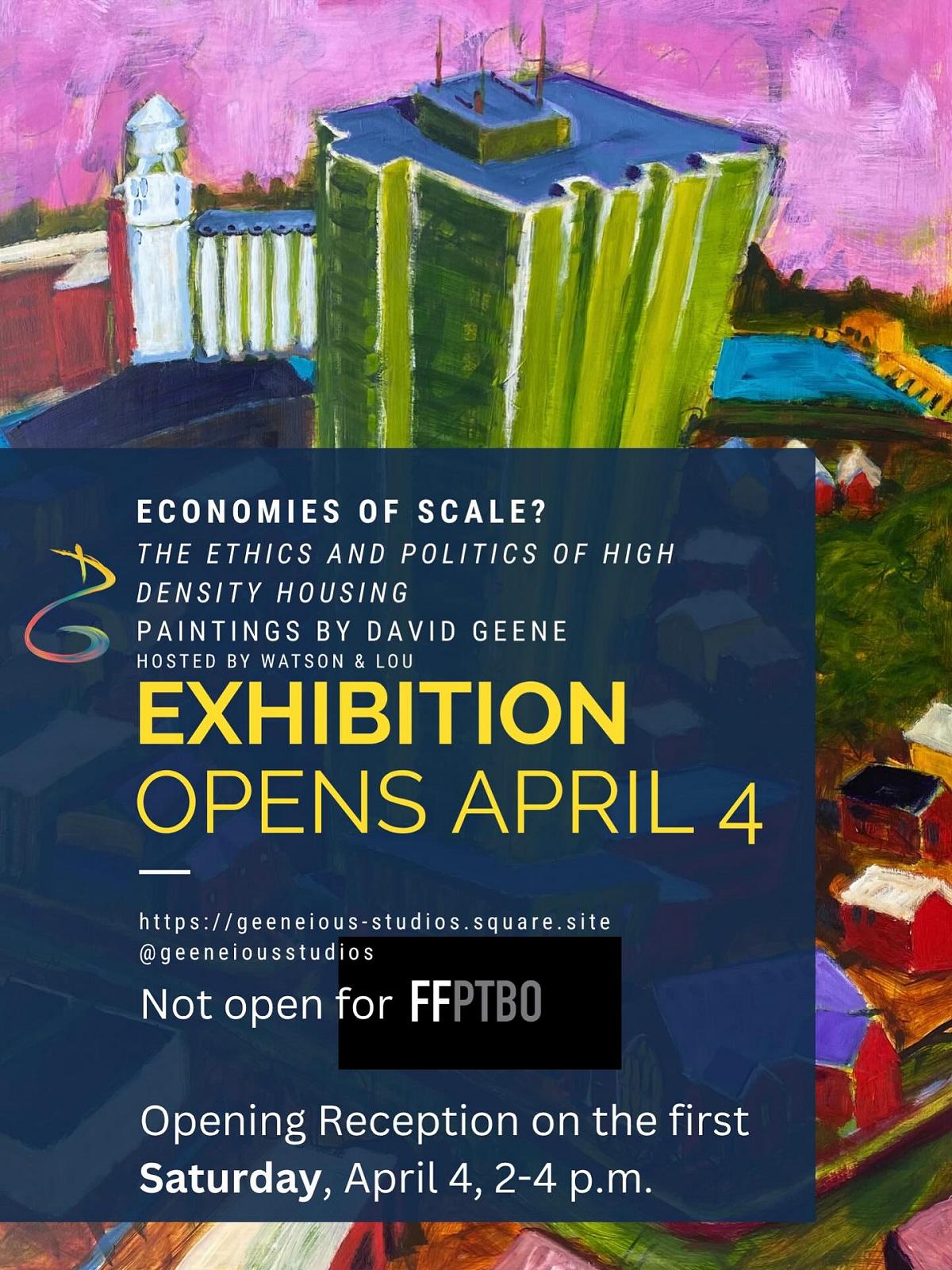
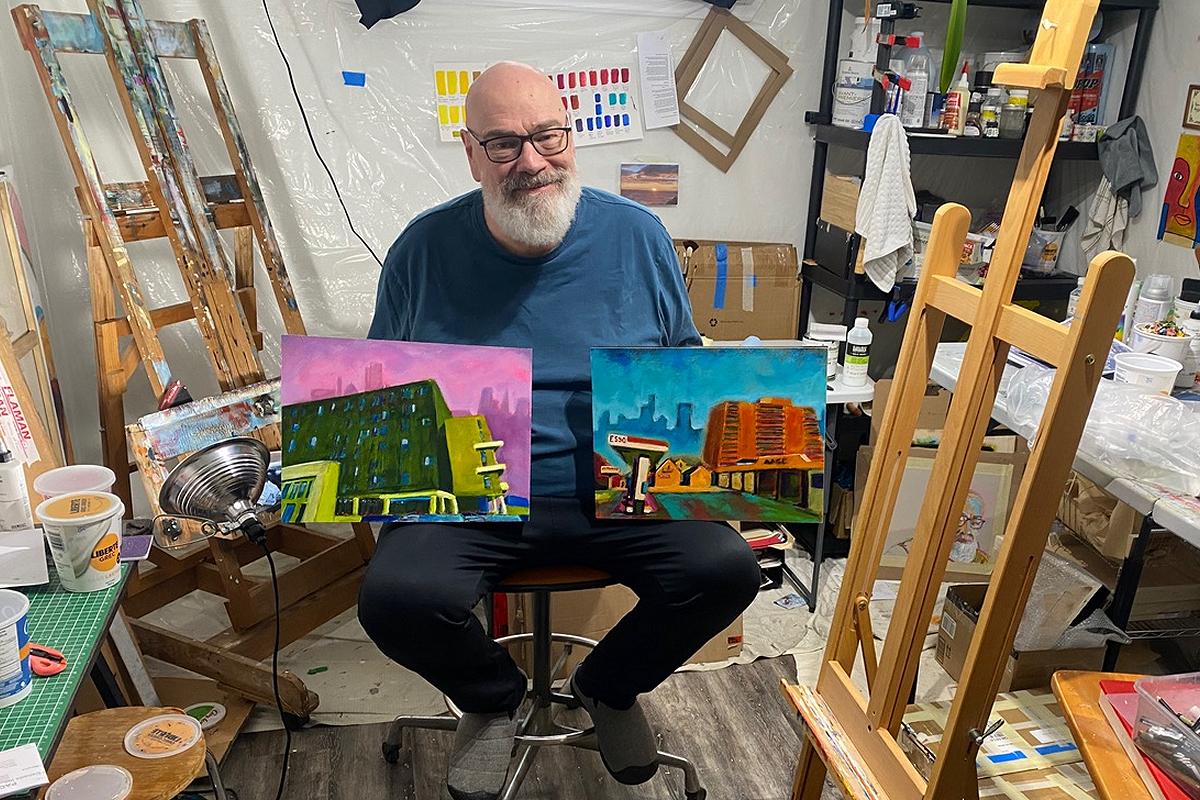
Multi-disciplinary artist David Geene’s new “Economies of Scale? The Ethics and Politics of High Density Housing” interactive solo exhibit will be on display at Watson & Lou at 383 Water Street in downtown Peterborough until Saturday, April 25, following an opening reception on Saturday, April 4 from 2 to 4 p.m.
It’s not the first time Geene, who is a visual artist, set designer, actor, and retired educator, has explored historical and contemporary architecture in his visual works. Rather than just portraying the buildings, he aims to express how he feels about the structures, as he did in a series called “Blockade” that was exhibited last year.
“I think there’s something about the shapes, forms, and the interesting ways those angles interact with other buildings and the shadows that they cause,” Geene says. “It’s an attraction to the heritage of buildings, what role they played when they were built and what role they play now, how they fit in with their neighbourhoods, the impact they have on the neighbourhood — all that stuff has always intrigued me.”
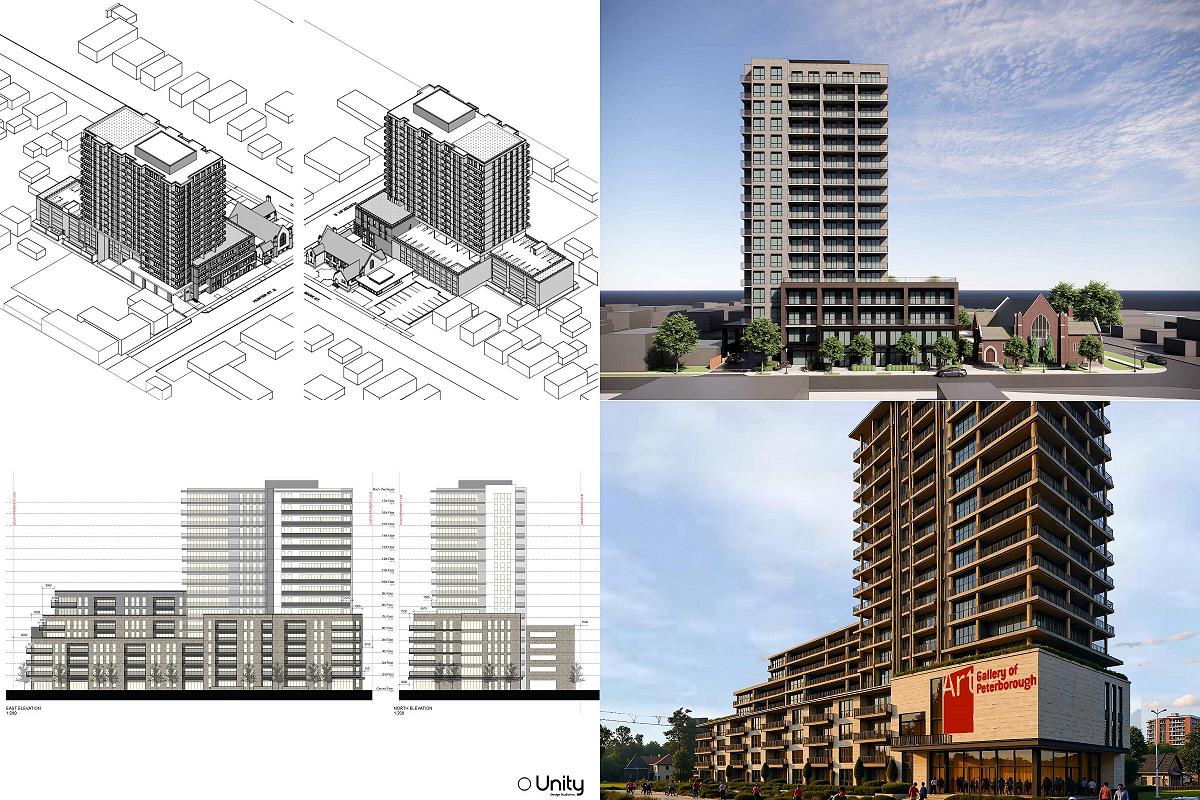
Given this innate interest, Geene was listening closely to the conversations around a 17-storey residential development proposed by TVM Group for a site at 90 Hunter Street East beside the historic Mark Street United Church.
In September, city council voted 7-4 in support of the zoning by-law amendment for the building, which will be visible from Geene’s home in East City. Less than two weeks after it was approved, Ashburnham Realty proposed a 17-storey mixed-use building on Crescent Street behind the Art Gallery of Peterborough beside Del Crary Park. Once built, both will be the tallest buildings currently in the city.
“I started thinking this is an efficient way of housing people, to build an apartment building. You can put a lot more people on a smaller footprint. It’s more economical to build,” Geene says, before pointing to arguments against the build.
“What is it that we value? Does the city have the infrastructure to support that many people living in those spaces?”
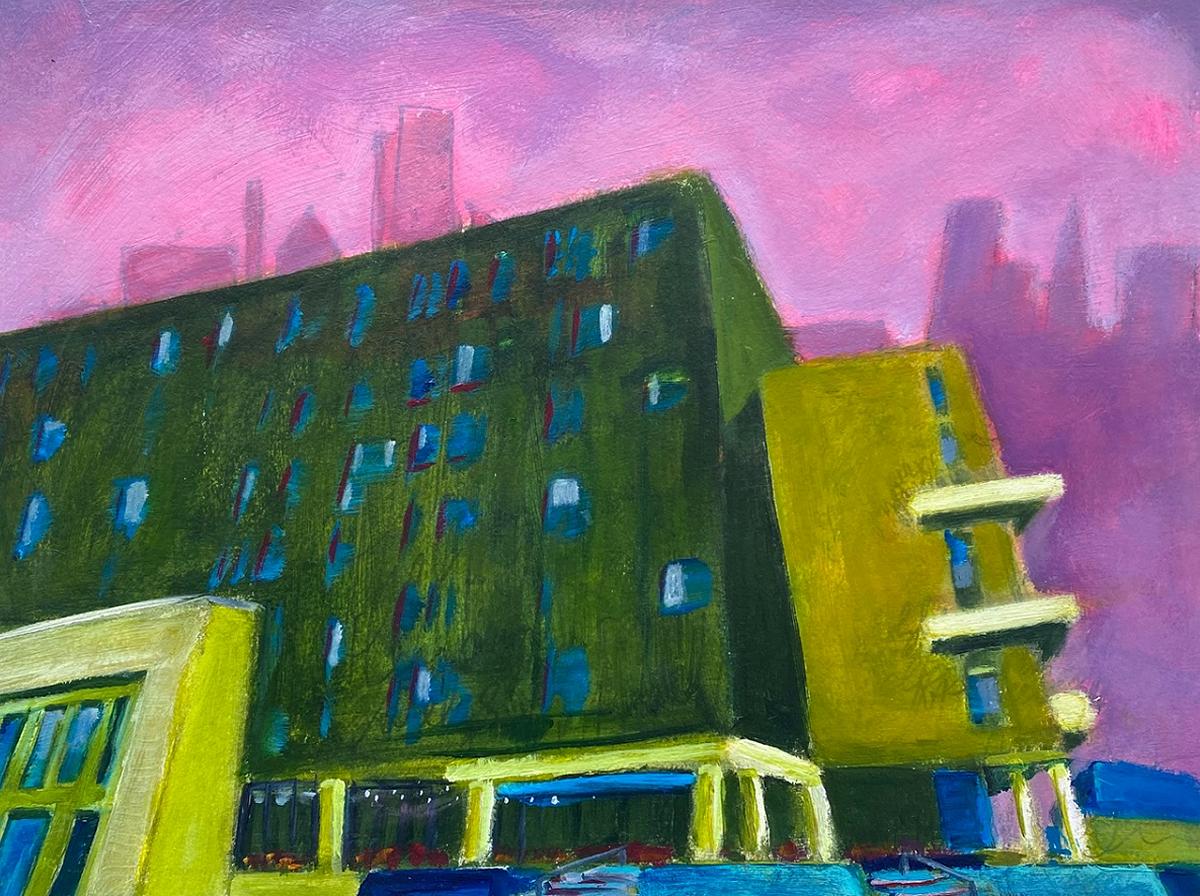
Grappling with the concerns being discussed in public consultations and forums — which include shadows in neighbouring yards, the aesthetics of the builds, the capacity for parking, traffic, and services, among many more — led Geene to think about the buildings already in Peterborough. He started taking photos and painting these buildings.
“I walk the dog a lot and we go into the city and walk around, and I had never noticed that one (building) before or this building or how that one sits beside it,” Geene says. “These are here, they house a lot of people, and they’re integrated in their neighbourhoods now. Maybe people didn’t want them at first, but they’re there now and we’ve all adjusted.”
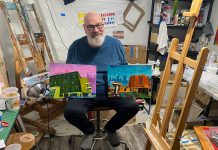
Geene’s exhibit will feature 12 by 16 inch paintings of existing buildings, alongside three larger 48 by 36 inch works of the proposed buildings (two of 90 Hunter Street and one of 223 Crescent Street). Each painting is vibrantly coloured, taking liberties with proportions and finding creative angles to abstractly “interpret” the buildings, rather than representing them in precise detail based on their architectural renderings.
“While I’m doing this and painting, I’m processing all this stuff,” he says. “I’m not saying we don’t need this, or that it should or shouldn’t be there. I have all these questions and, by painting them, I guess it’s a way for me to explore the positives and negatives.”
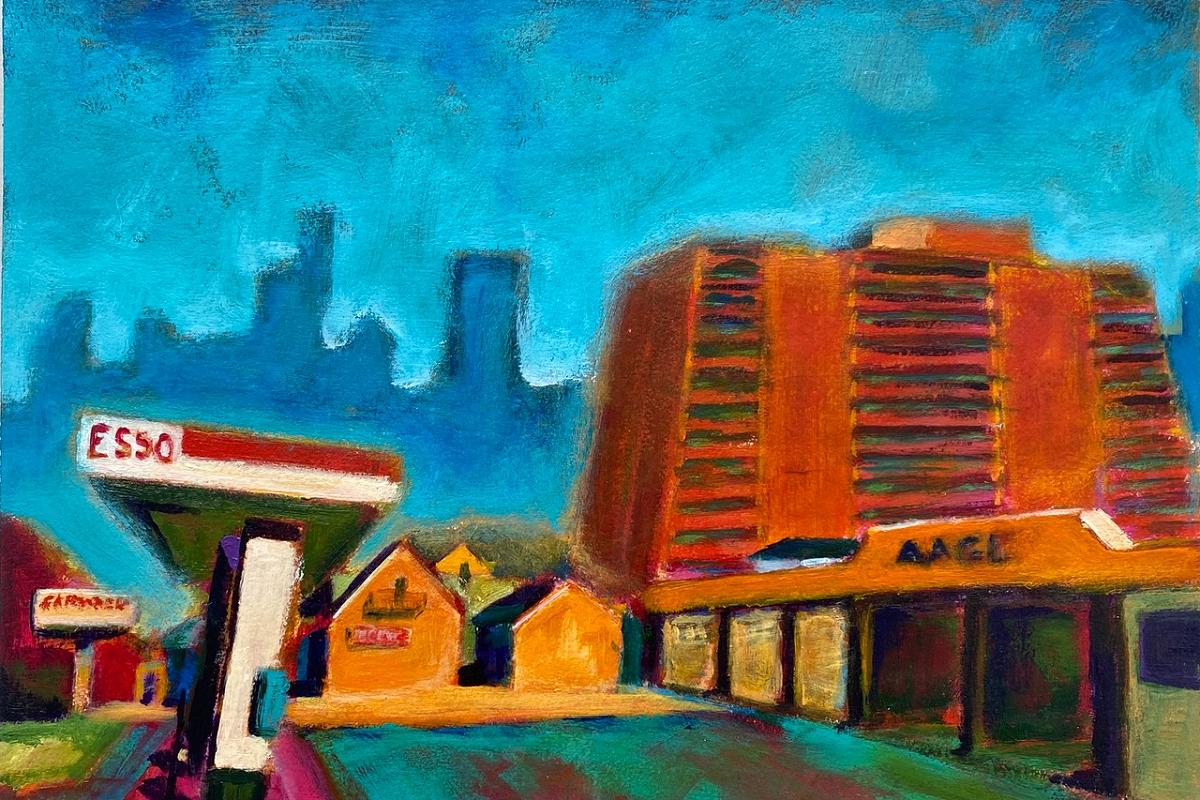
As he has done in other works, Geene has combined his visuals with script. Each painting integrates a 1932 poem written by James J. Ryan called “Towers.” With lines like “Now the great city glimmers in the sun / Stretching gold-ledged into gray distances,” the poem, Geene says, represents his own ambivalence about Peterborough’s proposed high-rise structures.
“The poem portrays them as these, not beautiful exactly, but powerful things that are reaching up to the gods and comparing them to ‘flame-tipped pines upon a (cliff’s sheer) ledge,'” he says.
“We need places for people to live, we also need jobs for them to have, and all that kind of stuff, so maybe we could think about these buildings differently and that poem kind of did that. That’s part of why I chose it, because it wasn’t saying ‘These are awful things.’ They become part of our environment.”
His paintings represent this, too, as Geene intentionally painted a cityscape horizon layered behind the focal point.
“I added that to sort of say ‘Maybe in Peterborough, we need to start envisioning this city a little bit differently and finding more beauty in some of these things,'” he says.
Also integrated into the paintings are quotes from academic works and articles about economies of scales, including work by Adam Smith, the Scottish economist credited with describing the phrase Geene has used to title his exhibit.
The question mark in the title of Geene’s exhibit, however, represents his admission that he doesn’t have all the answers.
“Wherever there’s a question, there’s curiosity and there’s lack of certainty, and I’m not certain what the answer is,” he says. “I think certainty is kind of an evil thing in this day and age. We need to live with ambivalence, uncertainty, find a way through it, talk about it, negotiate it. But when you’re on this side or this side, then that creates tension.”
At Watson & Lou, Geene will also have an interactive component set up where visitors can read through information packages about the proposed developments and can offer their own responses, thoughts, and questions.
Though Geene is not sure what he will do with the responses, his only goal right now is to get people thinking by sharing how he sees the towers.
“A democracy is supposed to be individual voices that come together and find a compromise that works for the benefit of the most people,” Geene says. “That’s not necessarily the way democracy works these days, but it’s how it’s supposed to work. I think art does that because it connects not only with what you’re thinking but also with your emotions, with the way you feel.”
Through his artist’s eye, Geene hopes to offer a different perspective on buildings.
“You might see something that you never thought of as beautiful become beautiful all of a sudden — just because angles changed, or the colour has changed, or there’s something different about it. That’s part of why I make what I make, so I can show people at least how I see something and maybe urge them to consider looking at things from a different angle too.”
For more information about David Geene and his art, visit geeneious-studios.square.site.