




















For the Ontario NDP, cuts to college and university funding are representative of not only a devaluing of education, but a push by the Ford government to privatize public systems and download the costs onto students.
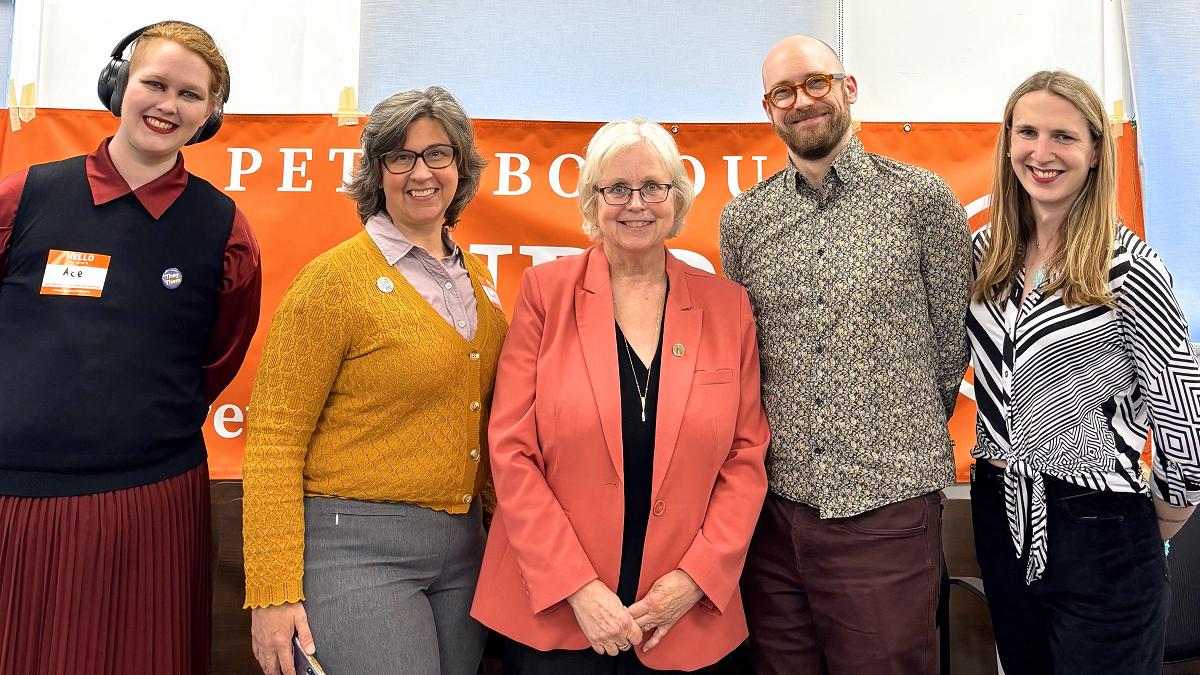
Peggy Sattler — NDP MPP for London West, shadow minister for colleges, universities, research excellence and security, and the chief opposition whip — visited the new OPSEU Peterborough regional office at 69 George Street North on Friday night (May 29) as part of her town hall series on universities and colleges.
“We’re very concerned about the creeping privatization that we see within the post-secondary sector,” Sattler told kawarthaNOW on Friday.
MPP Sattler: Ford government continuing underfunding started by previous Liberal government
Sattler was joined on the panel by Ace Martin-Graham, a Trent University student and president of the Peterborough-Kawartha Youth NDP; Dwayne Collins, Trent University Faculty Association president and librarian; and Carmen Gelette, formerly a Fleming College library technician at the Sutherland Campus in Peterborough.
Hosted by the Peterborough-Kawartha NDP Riding Association and emceed by association president Morgan Carl, the event brought together labour union leaders, frontline workers, students, and other stakeholders to discuss the state of the post-secondary education system within Ontario and to establish how the Ontario NDP intends to address the problems seen within the system.
Sattler, who was first elected as MPP for London West in 2013 and re-elected four times, opened the event by providing attendees with a history of what she called “chronic underfunding” of the post-secondary system by not only the Ford government but also during the Liberal government of Premier Kathleen Wynne from 2013 to 2018.
“It was under the Liberals we first saw that change,” said Sattler.
In 2013, Ontario recorded the highest tuition for students and the lowest per student funding of all Canadian provinces. Sattler said that this remains largely true in 2026 with Ontario placing second to last in tuition cost affordability.
For Sattler, post-secondary education is now publicly assisted rather than publicly funded, because “the proportion of revenues that they (students) got from the government was low and declining.”
Sattler further indicated that decreased public funding was accompanied by a push for post-secondary institutions to engage in entrepreneurial activities such as contract training and private-public partnerships under the province’s Skills Development Fund.
During the Q&A portion of the event, Will Dowkes, president of OPSEU Local 365 at Trent University and vice president of the Peterborough and District Labour Council, also spoke to the increase in private-public partnerships.
“There have been instances of college locations closing in the northern communities on a Friday, and then on a Monday a private partnership has opened up,” said Dowkes.
This recently happened in Thunder Bay with the closure of the Culinary Management program at Confederation College.
For Sattler, this is representative of “the Ford government’s complete disregard of the intrinsic value of post-secondary education in cultivating skills and cultivating citizenship.”
Speaking to kawarthaNOW following the event, Sattler further said that the Skills Development Fund is “the most viable example” of increased privatization of public systems under the Ford government.
“The Skills Development Fund is shifting public dollars from investing in colleges and universities into investment in private training,” she said.
For both panellists and attendees, privatization of education is a growing concern, as for many it is diametrically opposed to the founding principles of public colleges and universities.
“Because education is more than a labour pipeline,” said Gelette. “Colleges were designed to support the full ecosystem of local economies, not just churn out workers to whatever sector is politically prioritized in the moment,”
Gelette identified the many students and potential students that are passionate about and skilled in the areas of arts, culture, Indigenous studies, and community organizing, and said that they “deserve to try for their dreams.”
‘Cuts to staffing and services directly affect the student experience’
It was noted that provincial funding cuts to colleges and universities have had a real impact across the sector, to staffing, service availability, and program enrolment opportunities for students.
Collins spoke about his own experience in the Trent University library department, where funding cuts of 12 per cent led to service reductions.
“We are not open on weekends in the summer because of this,” said Collins.
Martin-Graham identified reductions in services at Trent University, highlighting financial services, custodial staff, and student accessibility services.
“Right when OSAP is being cut and more people are going to be needing to contact student financial services at Trent, their budget is being cut,” Martin-Graham said.
Martin-Graham also spoke about the upcoming development of Trent University’s new college residence, Gidigaa Migizi College, which is due to open in 2028 alongside a new residence building for the existing Otonabee College.
Due to a lack of custodial staff and their capacity to meet the needs of the current number of students on campus, Martin-Graham said the new building will have negative impacts on student health.
“These are not only tough times, but also can be very dangerous, especially to students living on campus.”
Gelette spoke to her own experience of being laid off as a library technician at Fleming College when the Sutherland Campus reduced the library team from four to one.
Faculty and staff members from Fleming College and Trent University, both on the panel and in the audience, spoke about an increased reliance on contract and part-time staff, who typically split their time between multiple institutions.
“Cuts to staffing and services directly affect the student experience,” said Gelette.
This is especially a concern for faculty and staff at Fleming College due to the recent announcement of the college’s upcoming merger with St. Lawrence College, which has received backlash from students, staff, and community members alike.
Both Fleming and St. Lawrence have seen significant cuts to program availability in recent years and stakeholders have indicated concern that the merger will lead to further program cuts and therefore increase job loss.
Collins and Gelette both spoke to the widespread nature of this problem among unions and faculty communities across the province, with Collins saying, “This isn’t a Trent thing — this is not happening in isolation.”
For Sattler, strong public services are “the key to ensuring Ontario’s well-being and future where every person in this province can build a good life for themselves.”
She went on to say that the Ford government has undermined the healthcare system, the education system, and post-secondary institutions through increased privatization.
OSAP changes raise concerns about education accessibility and student debt
Martin-Graham spoke about being a student in light of recent changes to the Ontario Student Assistance Program (OSAP), which now permits a minimum of 75 per cent of OSAP funding to be provided in repayable loans, with a maximum of 25 per cent being in forgivable grants.
“This is a drastic change,” Martin-Graham said. “It is already going to add on to the massive student loan debt that most students have.”
Announced in February 2026, the change replaced a system that favoured grants over repayable loans in an 85/15 split.
Statistics Canada found in 2020 that the average college graduate debt was $14,000 by the time of graduation, with 18 per cent of all college graduates saying they were in major debt, meaning they had $25,000 or more in debt by the time of their graduation.
University bachelor’s degree graduates reported an average of $24,000 in debt by the time they graduated, with 49 per cent of undergraduate alumni having major debt.
Martin-Graham said that the increased loan responsibility of OSAP means that more students will be facing long-term significant, debt increasing their monthly expenses during a cost-of-living crisis.
Later, Sattler said that the Ontario NDP is committed to providing, “any student in financial need” with grants to access post-secondary education, eliminating loans and reducing financial pressure.
Many in the post-secondary education sector have spoken out about how changes to the OSAP system will prevent potential students from low- and moderate-income families from attending post-secondary education, as they cannot afford or do not wish to take on debt to do so.
For Collins, students should be able to have access to “a higher quality and accessible education that doesn’t mean mortgaging their future.”
Over-reliance on international student tuition a result of chronic underfunding
Tuition costs continue to be a point of tension in the post-secondary system as this is the single largest funding source for post-secondary institutions.
Sattler spoke about how changes to federal immigration policy significantly reduced the number of student visas that Ontario colleges and universities were allocated.
“This meant a real decline in enrolment of international students in our colleges and universities,” she said. “But it also meant a real decline in those tuition dollars that universities and colleges had grown so accustomed to.”
International student enrolment was identified by the Auditor General in 2018 as a threat to the stability and security of Ontario’s post-secondary system due to over-reliance on international fees, as these are significantly higher than domestic student fees.
Sattler further noted that the Ford government imposed a 10 per cent cut to tuition fees across the post-secondary sector and subsequently froze tuition levels. She said this played a role in the over-reliance on international students and subsequent financial struggles seen following reduced enrolment.
Collins also spoke about the significance of enrolment numbers, which have declined across the sector in line with program cuts and course availability reductions.
“The only reason that we were so reliant on international students was because there was no funding, and the only way to get funding was to do that,” said Collins.
enrolment numbers are one of the primary sources to receive funding from the provincial government, and as such, reduced enrolment numbers leads to reduced funding for institutions.
However, Collins emphasized that international student enrolment or cuts to tuition cannot be viewed in isolation, but rather that they “compound the problems that we see in the sector.”
As the panel finished and attendees continued the conversation over pizza, one attendee neatly summarized the event as he asked: “With the continuing devaluing of education, how do you change that whole idea?”
To that end, Carl encouraged attendees to engage with the Peterborough-Kawartha Riding Association through door-knocking campaigns, petitions, and volunteering to advocate for increased public funding for colleges and universities.