



















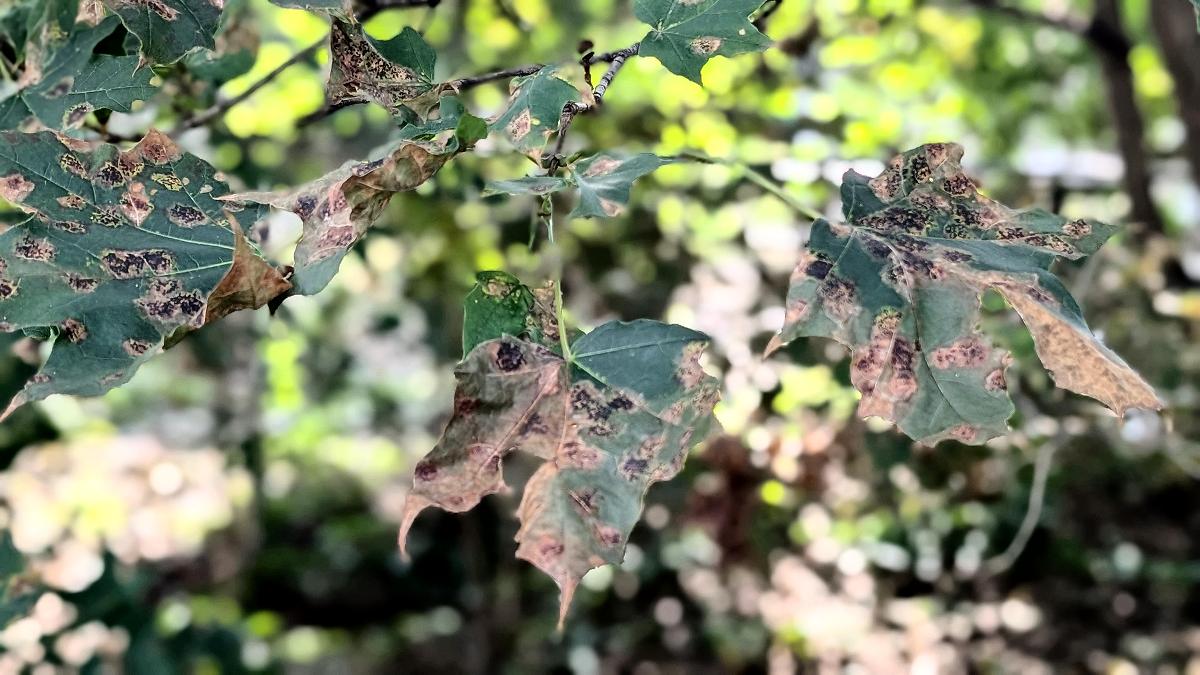
Judging from recent posts on social media, many residents in the Kawarthas region have been noticing that some maple trees — especially Norway maples — are already dropping their leaves, which are covered with black spots like somebody dripped tar on them.
No, your maple tree is not dying. It’s a disease called tar spot that’s caused by a fungus.
Although tar spot looks terrible, it’s a cosmetic disease and does not usually affect the long-term health of a tree.
The fungus that causes tar spot survives the winter on fallen leaves. In spring, activated by warmth and moisture, the fungus releases tiny spores that are carried by the wind to healthy new leaves. The spores have a sticky coating that helps them attach to the leaves, where they grow and enter through tiny openings in the leaves, resulting in yellow spots.
During the summer, the centres of these spots turn brown or black, making them look like drops of tar surrounded by yellow borders. Because the leaves are no longer as efficient at photosynthesis, the tree will stop directing water to them and they may turn brown and drop to the ground.
The fungus overwinters again in the fallen leaves and releases its spores in the spring. As moisture facilitates the release of spores, tar spot tends to be worse when there is lots of spring rain.
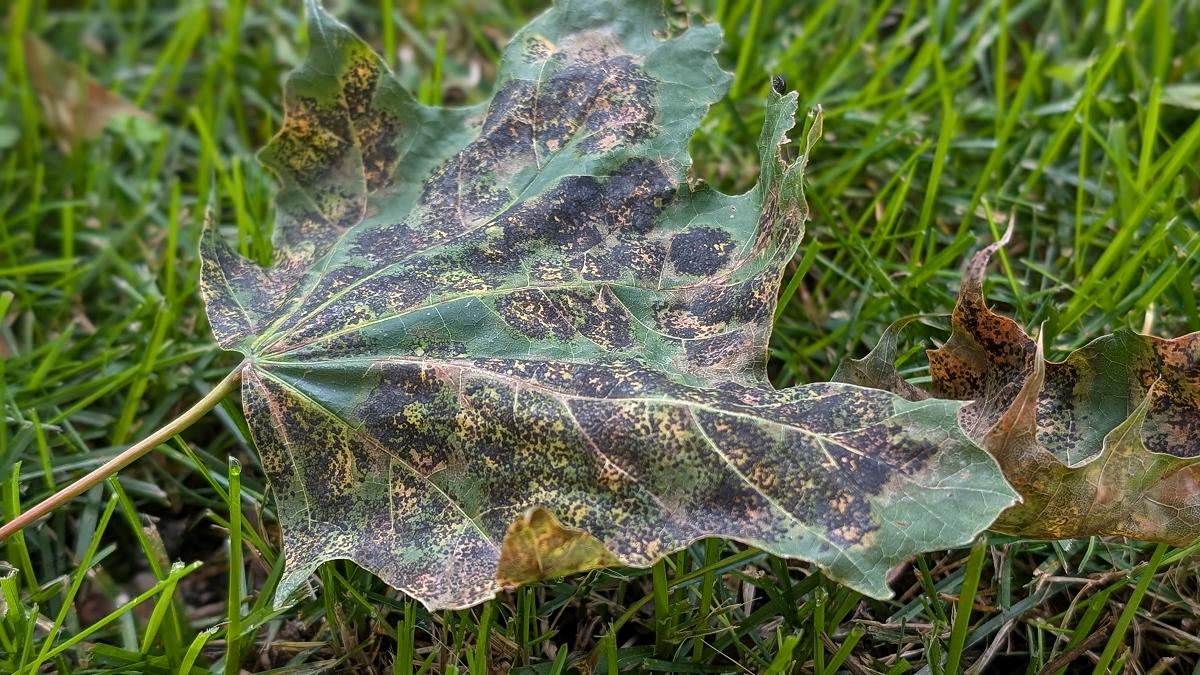
Scientists estimate that fungi have existed for at least 1.2 billion years, colonizing the land over 500 million years ago, and could have been the dominant form of life around 250 million years ago. There are three related species of the fungus that causes tar spot, and each infects different species of trees.
Rhytisma americanum infects native maples including sugar and red maple. Rhytisma punctatum infects at least seven native maple species as well as sycamore maple. Rhytisma acerinum infects the non-native Norway maple and sycamore maple, as well as the native silver maple.
Both Norway and sycamore maples were imported to North America from Europe, and Rhytisma acerinum was imported along with them. Norway maples are common throughout Ontario, partly because they were extensively planted to replace shade trees lost to Dutch elm disease in the mid-1900s.
Rhytisma acerinum was first described scientifically in 1778 by South African-German mycologist Christiaan Hendrik Persoon, who named it Xyloma acerinum, with the Swedish mycologist Elias Magnus Fries giving the fungus its current name in 1823.
Once healthy leaves have been infected with the tar spot fungus, there’s nothing you can do. However, you can help prevent the fungus from spreading the following spring by raking up diseased leaves and bagging them for curbside green waste collection, if you have it, or taking them to a municipal landfill site.
You’ll want to encourage your neighbours with infected maple trees to do the same. This only works if everyone does it, as the fungal spores can be carried for long distances by the wind.
Composting or mulching the diseased leaves will not prevent the fungus from reproducing. Home composts won’t normally reach the very high temperatures needed to kill the fungal spores, and mulching the leaves won’t destroy all the tar spots, meaning they’ll release their spores in the spring.
After publishing this story, kawarthaNOW was contacted by Ethan Benson, owner of Elevated Arboriculture in Peterborough.
“In the arborist industry, we have been receiving a lot of calls about maple browning and defoliation this year,” Benson writes in an email.
“Based on our local assessments and investigations over the past month, tar spot has not fully explained the level of early leaf drop we’re seeing this year. We’ve investigated several of these cases in Peterborough, the Kawarthas, and even Cobourg, and while tar spot is occasionally present and may certainly be contributing in some cases, we’re also seeing that environmental stress is contributing to this year’s abnormal level of leaf drop, especially on urban trees dealing with other compounding site and growth stressors.”
Benson notes that his business has been following the issue locally and nationally over the past several weeks, including a recent story from CTV News about maple trees in Halifax shedding their leaves in mid-August.
“Heat stress and in some cases low soil moisture do appear to be contributing factors this year, especially after the extreme heat we experienced in late spring and early summer,” he says.
Benson adds various factors may affect the health of an individual tree, and an assessment by a certified arborist will provide the most accurate information for homeowners.
The original version of this story has been updated with information from Ethan Benson of Elevated Arboriculture in Peterborough.