












As the fall municipal election in Peterborough approaches, residents are asking candidates hard questions about their most pressing issues — including their financial priorities.
Councillors are responsible for making decisions on the city’s annual budget, including priorities for services ranging from the police to the library and much more. For voters, understanding a candidate’s position on funding needs and priorities is central to making a decision on whether to support a candidate.
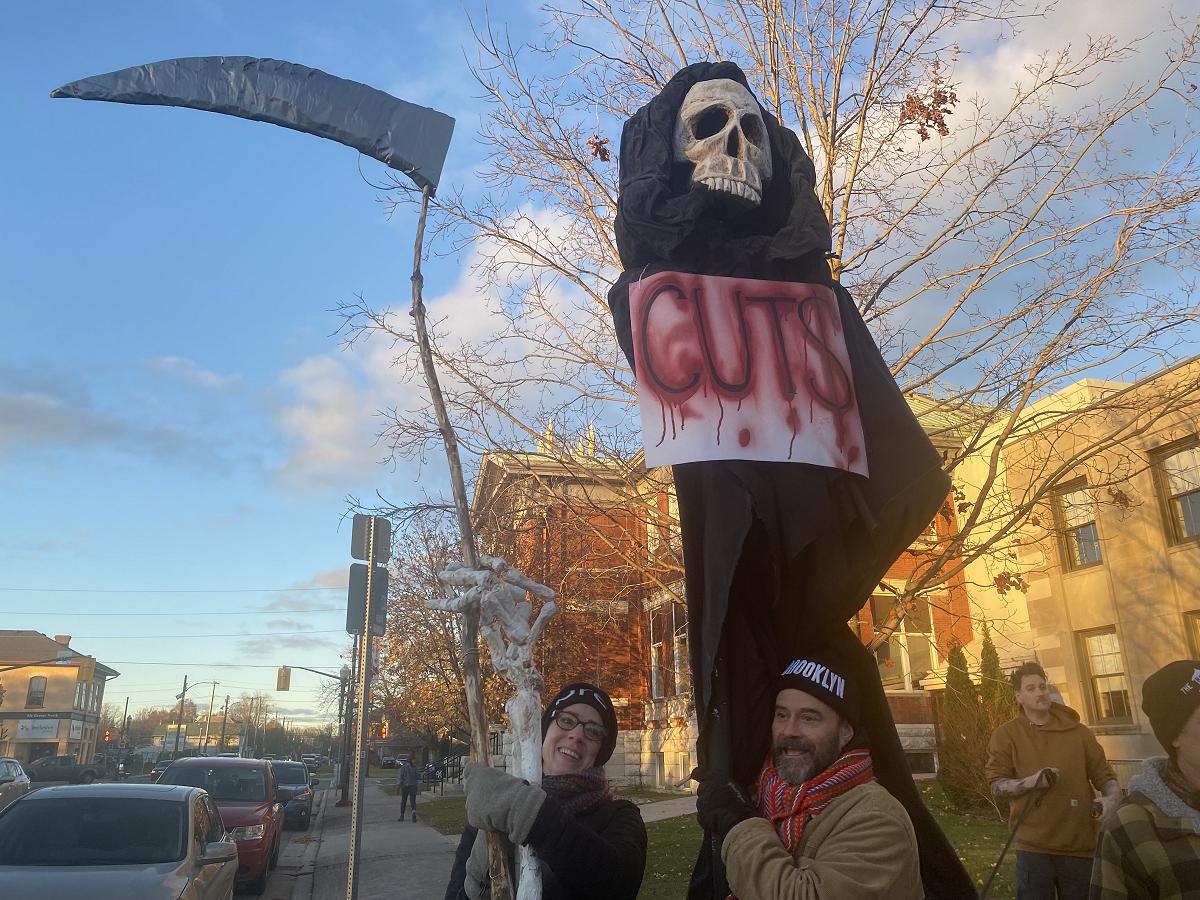
In recent years, the annual budget process has drawn significant criticism from residents. For example, when city staff proposed a 25 per cent cut in funding for 75 arts and social services organizations in the 2025 draft budget as a way to reduce costs, council heard from 33 public delegations before voting to maintain 2024 funding levels
Municipal elections across Ontario will take place on Monday, October 26. As residents of a single-tier municipality, Peterborough voters will elect a mayor, two city councillors in each of the city’s five wards, and school board trustees.
Although incumbent mayor Jeff Leal has yet to declare whether he intends to run for re-election, six candidates have filed their nomination papers so far seeking the mayor’s chair: Michael Eamon, Brian Lumsden, Jacob Méthot, Neil Morton, incumbent councillor Keith Riel, and Rebecca Schillemat.
Meanwhile, seven incumbent councillors have already begun their campaign for re-election. With 18 first-time or repeat candidates fighting to take their roles, each seat will be hotly contested. The nomination period is still open until Friday (August 21), so it’s possible even more candidates may decide to throw their hats in the ring.
As part of a multi-story series on the Peterborough municipal election, kawarthaNOW has already asked registered candidates in each of the city’s five wards to introduce their campaigns by answering three questions — why they are running, what the biggest challenge is in their ward, and what makes them a unique candidate for councillor — and has published their responses verbatim: Ward 1 (Otonabee), Ward 2 (Monaghan), Ward 3 (Town), Ward 4 (Ashburnham), and Ward 5 (Northcrest).
kawarthaNOW has now contacted all registered ward candidates to ask for their position on key election issues, including the question “What are your financial priorities and how will you balance funding needs across city services?”
kawarthaNOW asked each of the ward candidates to respond in email, and is publishing their answers verbatim with no editing.
kawarthaNOW asked each of the ward candidates to respond in email, and is publishing their answers verbatim with no editing. Responses were not received by publication date from Jessica Correa (Ward 1 – Otonabee), Andrew MacGregor (Ward 4 – Ashburnham), or Charmaine Magumbe and Debbie Halstead (Ward 5 – Northcrest). Jessica Correa has since withdrawn from the race. Charmaine Magumbe, Andrew MacGregor, and Lucas Graham provided responses after publication.
kawarthaNOW has reached out to Aris Metaxakis, a Ward 2 – Monaghan candidate who registered after kawarthaNOW sent its questions to candidates, and will include his answers to the questions if he responds.
Ward 1 – Otonabee
Kevin Duguay
City’s are facing considerable challenges arising from the downloading of responsibilities from upper levels of government. Community residents’ needs and requirements also continue to evolve, change and expand.
My responsibility as a City Councillor is to ensure the prudent and use of tax dollars addressing the wide-range of City programs, services and facilities.
For the next Council term, I will ensure that the overall City Budget achieves a proper balance between the taxpayers ability to accommodate the operating and capital budgets while ensuring that the City continues to grow and prosper.
The City’s Effectiveness and Efficiency Review Report is scheduled for public release in September 2026. This Report will provide Council and the community with various options to shape the financial parameters of future budgets.
Lucas Graham
My financial priority is making sure residents get better value from what they already pay, without confusing short-term cuts with long-term savings.
That means protecting essential services, keeping up with maintenance before small problems become expensive ones, and looking at the full lifecycle cost of major projects before Council commits to them. The cheapest option on paper can become the most expensive once you include financing, staffing, maintenance, and replacement.
I also want regular reviews of programs and service delivery, not as an excuse to cut for the sake of cutting, but to ask whether money is actually producing the result it was meant to. If something isn’t working, we should fix it or redirect those dollars. If it is working, we shouldn’t weaken it just to make the next budget look better on paper.
We also need to grow the commercial and industrial tax base and pursue outside funding where it makes sense, so residential taxpayers aren’t carrying so much of the load. To me, responsible budgeting means being honest about trade-offs, spending carefully, and not handing the next Council a bigger bill because we avoided dealing with something today.
Lesley Parnell
The municipal tax dollar has specific, mandated responsibilities. There are the “must dos” in order of priority and with balance, versus the “nice to dos”. We have embarked on a fulsome “Effectiveness and Efficiency Review” of all municipal services. This will highlight areas of opportunity to improve the delivery of services, in the most financially and priority driven way, to be efficient and sustainable moving forward. A Master Plan to help us stay focused and achieve the priority goals first — if the plan is adopted by the new council.
Chris Potter
My financial priority is discipline.
Residents are tapped out, and that has to be the starting point.
I do not support municipal tax increases beyond the rate of inflation. If council wants residents to pay more, council needs to be able to clearly explain why, what the money is for, and what has already been done to find savings first.
That doesn’t mean cutting recklessly. It means asking tougher questions before spending more.
We need to look closely at service delivery, staffing costs, capital planning, debt, reserves, outside boards and agencies, and whether programs are actually delivering what they’re supposed to deliver.
The City still has to fund core services, including roads, transit, housing-related pressures, emergency services, parks, waste, and infrastructure. None of that disappears because the budget is difficult. But the answer can’t always be to raise taxes and move on.
I want to see a stronger focus on value for money, clearer reporting, better long-term planning, and a budget process residents can actually understand.
Ward 2 – Monaghan
Matt Crowley
At the end of the day, every budget comes down to making choices.
My priority has always been to make sure taxpayers receive value for the money they pay while ensuring the City continues to provide the services people rely on every day.
Bottom line, that starts with looking after the infrastructure we already have. Roads, bridges, water and sewer systems, parks, and public facilities are very expensive to replace if we don’t maintain them properly. If we continue to invest in them now, it helps avoid much larger costs tomorrow.
It also means continuing to grow our commercial and industrial tax base through economic development. The more businesses we attract, the more we broaden the tax base and reduce pressure on residential property taxpayers over the long term.
One of the biggest financial challenges we face today is that we’re increasingly responding to downloaded issues that extend beyond traditional municipal responsibilities. Housing, homelessness, addictions, and mental health all have a direct impact on our community, but they also require strong partnerships with the provincial and federal governments. Local property taxes were never designed to fund every challenge a community faces.
My approach is fairly straightforward in that we spend responsibly, plan for the long term, invest where it makes the biggest difference, and continue advocating for Peterborough to receive its fair share from other levels of government.
Ashley Flynn
Many dollars our city spends comes from the taxpayers, so I think they need to be treated with respect.
I would like to ensure we’re getting value for every tax dollar while protecting the services our residents rely on. That means setting clear priorities, looking for efficiencies, and making long-term investments that reduce costs down the road instead of simply reacting year to year. We need to think further into the future instead of just focusing on the now.
Again, this comes down to the need to grow our revenue through economic development, not by continually asking homeowners to shoulder higher taxes. Expanding our commercial and industrial tax base, is one of the best ways to strengthen city finances over the long term.
Rose Kitney
Economic development and growth by attracting business and families to Peterborough, resulting in an increase in employment opportunity and therefore increased tax revenue to support other priorities such as affordable housing, social services, transportation, traffic and road improvement.
Jen Lacey
My financial priority is to ensure every tax dollar delivers value to residents. Families across Peterborough are making difficult financial decisions every day, and City Hall should demonstrate the same discipline, clarity, and accountability. Property taxes have increased significantly. It’s not sustainable and many feel that the service they receive is not adequate.
I believe the City’s first responsibility is to maintain the core services residents rely on every day: safe roads, clean water, emergency services, parks, recreation, reliable public transit, housing, community safety, and infrastructure because delaying those investments often costs more in the long run.
Balancing funding across city services starts with setting clear priorities, measuring outcomes, and regularly reviewing programs to ensure they are delivering results, before asking taxpayers to pay more, Council should look for efficiencies, reduce duplication, strengthen partnerships with other levels of government, and pursue available provincial and federal funding opportunities whenever they are available. Whenever I hear the response “We can’t do that”, I always ask “show me why you can’t”
I also believe Council should be clear about financial decisions. Residents deserve to understand where their tax dollars are going, why investments are being made, and what outcomes they can expect — the good and the bad. It is their money and they deserve to know all information.
AJ Shearer
Every decision council makes has a financial impact on residents, so we have a responsibility to spend taxpayers’ money wisely.
That starts with getting the basics right. We need to look after our roads, bridges and other infrastructure before they become much more expensive to fix, and we need to make sure any new spending is worthwhile.
At the same time, we can’t keep asking homeowners to shoulder more of the cost. We also need to grow Peterborough’s economy by attracting new businesses and investment as the broader our commercial and industrial tax base becomes, the less pressure there is on residential taxpayers.
To me, good financial management is about finding that balance. Spend responsibly, invest in the services people rely on, and grow the economy so we can keep Peterborough affordable over the long term.
Ward 3 – Town
Alex Bierk
People want to feel confident that their tax dollars are being managed responsibly. We are in a difficult position, trying to meet growing community needs within our financial capacity. I believe there is still a great deal we can do to improve things internally at City Hall to become more efficient — rather than repeatedly looking to cut discretionary investments in areas like arts, culture, and community organizations to balance the budget.
Jenni Cathcart
My priorities are threefold: protect funding for the core services residents rely on every day, pursue strategic investments that grow our tax base and reduce long-term costs, and invest in transitional housing that helps get people back on their feet.
Jessica Kuhlmorgen-Hille
I want to freeze property tax, as stands at current rates, and work within our budgetary means. Our citizens are not bottomless wells of cash, and need relief during these unprecedented times. I aim to ensure not one cent more is asked of them, at the very least until our city and citizens are more financially stable. Council need to buckle down and tighten their waistbands like everyone else — which is where experience in poverty, stretching cents into dollars, comes in very handy. If we are in need of more funds, I will not look to our citizens, but to our MPP & MP for assistance. We all need to work together, closely, to ensure a secure fiscal future for Peterborough, and I am confident we can accomplish this with the right efforts.
Joy Lachica
My goal would be to see a Multi-year Budget template presented to Council to implement. Stepping back from the canvas to address systemic operational issues in every division and setting strategic (budget) priorities early in a council term is essential and should be a driver in the Strategic Planning. Operationally, both social infrastructure and physical infrastructure deficits require front and centre discussion and highlighting early as well.
Our 2025 Asset Management Plan highlights a $132 million annual shortfall to eliminate the backlog. Our road network is ranked in “fair” condition, with $1.4 billion in replacement costs for roads, bridges and related assets. These realities prompt a sober second thought for council and taxpayers as proposed luxury capital projects present themselves when much-needed maintenance and scaffolding of our current infrastructure requires attention.
I believe our public budget consultation process should be reassessed for format, accessibility reasons. I consider my fiduciary responsibility as councillor around budget-setting to be paramount in these challenging economic times — times, when each and every tax dollar matters immensely and municipal priorities ought to be carefully and collaboratively set.
Nigel Lister
I have a background in business with managing revenue and growth for several different companies. I believe we can find alternative ways to create revenue for the City without having to massively increase taxes on our people to meet our budgets. I will be going into that in more detail over the next few months while campaigning.
Ward 4 – Ashburnham
Gary Baldwin
That is the million-dollar question. How do we continue to fund the services the Corporation provides at the same or better service level, and how do we pay for those services. Council works collaboratively during budget deliberations to make those decisions. My priorities for the coming term include investing in public safety (fire, ambulance police), public transportation, housing, the arts, parks and recreations, and advocating for investments in sensible and sustainable infrastructure improvements.
Ashley Bonner
My financial priorities are rooted in fiscal responsibility, transparency, and a commitment to protecting our taxpayers. With year-over-year property tax increases, many residents aren’t seeing the value of those increases reflected in their daily lives.
Our top priority must be funding our foundational, everyday city services. Before we allocate millions to flashy, new capital projects, we need to ensure our roads, existing transit systems, public safety, and core neighbourhood maintenance are fully and properly funded. Clean, safe, and functional streets are the true backbone of our community and local economy.
We cannot treat council spending like a moving target. Every single growth and economic strategy we fund moving forward must explicitly link back to the Master Plan. This prevents standalone, reactive projects from draining our budget, ensuring that when we do spend money on growth, it focuses on cost-saving infill development and the affordable, supportive solutions our community actually need.
Andrew MacGregor
In business, and in Municipal Finances, you can adjust money in one of two ways: earn more or spend less. Cutting services is a race to the bottom, leaving impoverished families behind as relied-upon services vanish, only exacerbating poverty challenges. Instead, the city should focus on earning more, and not by increasing taxes, but by increasing the tax base. Adding a thousand tax paying homes to the tax base is better than raising taxes on the existing base, and has the benefit of addressing the housing shortage crisis.
Jason Stabler
Providing the services required by a thriving community while ensuring that property tax increases are minimized is one of the core tasks of City Council. The City should continue to invest in the infrastructure (parks, roads etc) and services that improve the quality of life of our community. We should also make investments that will increase our tax base by attracting new residents and businesses and continue to seek funding from the provincial and federal government to help pay for infrastructure, rent-geared to income housing and social services.
Ward 5 – Northcrest
Andrew Beamer
My financial priorities include controlling spending, fighting to keep taxes in check, and always respecting the taxpayer’s purse. With so many individuals and families struggling today, controlling spending and keeping taxes low must be a top priority at City Hall. Fiscal responsibility must be the focus at City Hall. I have developed a strong reputation while on City Council as being a voice for responsible spending and low taxes. As mentioned, there is a balance. We need to respect the taxpayer’s ability to pay while also investing in the services that residents expect and enjoy. We need to continue to invest in roads, public safety, safe streets, parks and recreation, and housing.
Phillip Jolicoeur
My financial priority would be ensuring residents receive good value for every dollar the City spends while protecting the services and infrastructure they rely on.
Families, seniors, and local businesses are already facing affordability pressures. Council cannot treat taxpayers as though they have an unlimited ability to absorb increases. At the same time, repeatedly delaying road repairs, infrastructure renewal, and other necessary work often makes those costs much higher later.
I would focus first on essential services, maintaining what the city already owns, and examining whether programs are delivering the results residents were promised. I would support finding efficiencies, reviewing outside agency requests, pursuing grants and partnerships, and growing our commercial and industrial tax base.
Cities also need to make calculated investments in their future. Not every investment is guaranteed, but continually deferring important decisions creates risks and costs of its own.
I will not promise taxes will never increase because that would not be honest. However, I will question increases, challenge assumptions, and expect clear evidence before asking residents to pay more. People deserve to understand where their money is going and what results they should expect.
Paul Lawton
My financial priority is responsible spending. Every dollar City Hall spends came from someone who had to earn it.
That does not mean neglecting core services. It means setting clearer priorities, controlling costs, and being honest about trade-offs. Roads, sidewalks, parks, snow clearing, water, sewer, waste collection, public safety, and basic infrastructure should come before nice-to-have projects.
Major spending decisions should come with plain-language explanations, real business cases, lifecycle costs, operating costs, debt implications, and a clear explanation of what other priorities may be delayed.
Residents deserve careful budgeting, not automatic tax increases and not blank cheques.
Charmaine Magumbe
My view on financial priorities is that City Council must be financially responsible and accountable to Peterborough taxpayers. We need to be efficient, transparent, and have affordability measures in place.
To balance financial priorities, we should avoid funding large projects — such as Multi-Use Sport Entertainment Center MUSEC — with municipal tax dollars unless there are committed funds from provincial, federal, and private sources. For major projects like MUSEC, we should consider public-private partnerships and refrain from relying on local taxpayers to shoulder the costs. Any major project of this kind should be deferred until adequate external funding is secured.
My priority is to direct public money to essential public services that residents use every day: libraries, police, community services, arts and culture, housing and shelters, emergency services, public transit, road maintenance, and waste management. These are the foundations of a healthy, vibrant community.
We can generate more revenue for the city by:
- Increasing the Municipal Accommodation Tax (MAT) from 4% to 5%. In 2023, the City collected approximately $863,000 in net MAT; the City retains 50% as general revenue to support the capital program and remits the remaining 50% to the eligible tourism entity (Peterborough Tourism Municipal Services Corporation).
- Negotiating a higher revenue share from the OLG Peterborough casino. In the fiscal year ending March 2026, the City received a total of $2,651,125, including a fourth-quarter payment of $597,293.
- Adjusting user fees and service charges by increasing them by 1-2%. In 2024, these generated almost $75 million.
- Modestly increasing revenue from government grants and partner municipalities (e.g., a 0.7% increase). According to the 2024 Treasurer’s report, the City received about $155 million from these sources.
- Introducing Municipal Vacant Home/Unit Taxes (VHT/VUT), implemented by cities like Toronto, Ottawa, Hamilton, Vancouver, and Sault Ste. Marie. These typically charge 1% to 3% of the property’s assessed value.
Gavin Muir
My starting point is revenue: our residential tax base can’t carry this city’s future on its own, so growing our economic base — through the partnerships I’ve talked about elsewhere, with the county, our post-secondary institutions, and the business community — has to be a real financial priority, not an afterthought. But new revenue only works alongside real discipline on the spending side.
My approach is “smarter spending, real results”: every dollar the city spends, whether on a major capital commitment or day-to-day municipal services, should be spent where it delivers the greatest result for residents. That means having a clear picture of what we’re committing to, why, and what we’re getting in return, before council commits public money — not after. The days of “build it and they will come” are over. We need to build actual muscle that moves this city forward, not bloat for the sake of a headline.
Jim Wasson
Economic growth is easier when municipalities manage their finances while growing the commercial and industrial tax base to reduce pressure on residential taxpayers.
kawarthaNOW has reproduced written responses from candidates verbatim. Any errors, factual or otherwise, or any use of AI-generated content originate with the candidate.
This story was updated on September 1 to include a response from Town Ward candidate Nigel Lister, who filed his nomination papers after the story was originally published.
This story was updated on September 10 to include a response from Northcrest candidate Charmaine Magumbe.
This story was updated on September 18 to include a response from Ashburnham Ward candidate Andrew MacGregor.
This story was updated on September 24 to include a response from Otonabee Ward candidate Lucas Graham.