
















The federal government has directed Alto to develop a southern corridor option that includes a station in Kingston for the Peterborough-Ottawa section of the proposed 1,000-kilometre high-speed rail (HSR) network between Toronto and Québec City, with further public consultation on the Peterborough-Ottawa section now set for 2027.
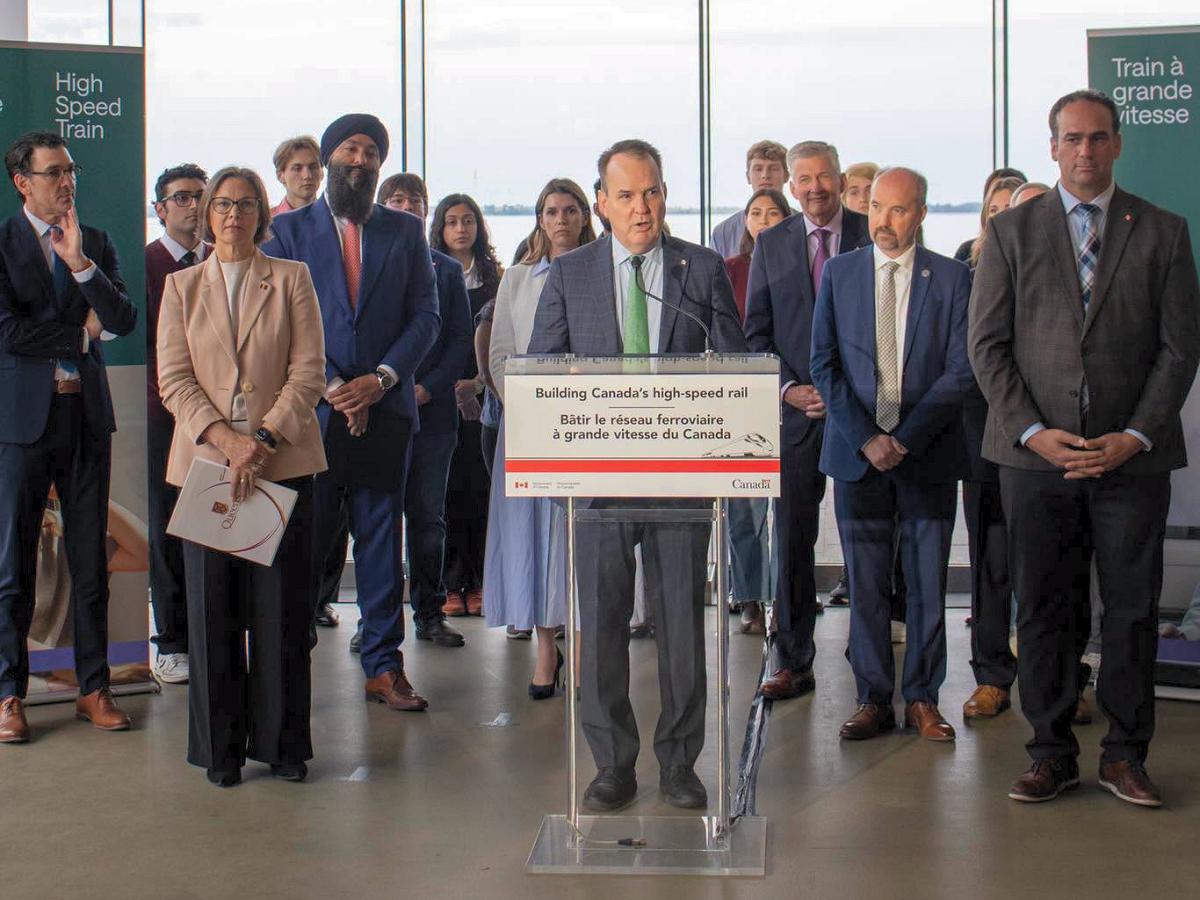
Minister of Transport Steven MacKinnon made the announcement at Queen’s University in Kingston on Monday (June 22) where he was joined by Alto president and CEO Martin Imbleau to release the What We Heard Report, which documents the results of Alto’s public consultations from March to April as well as the results of Indigenous consultation.
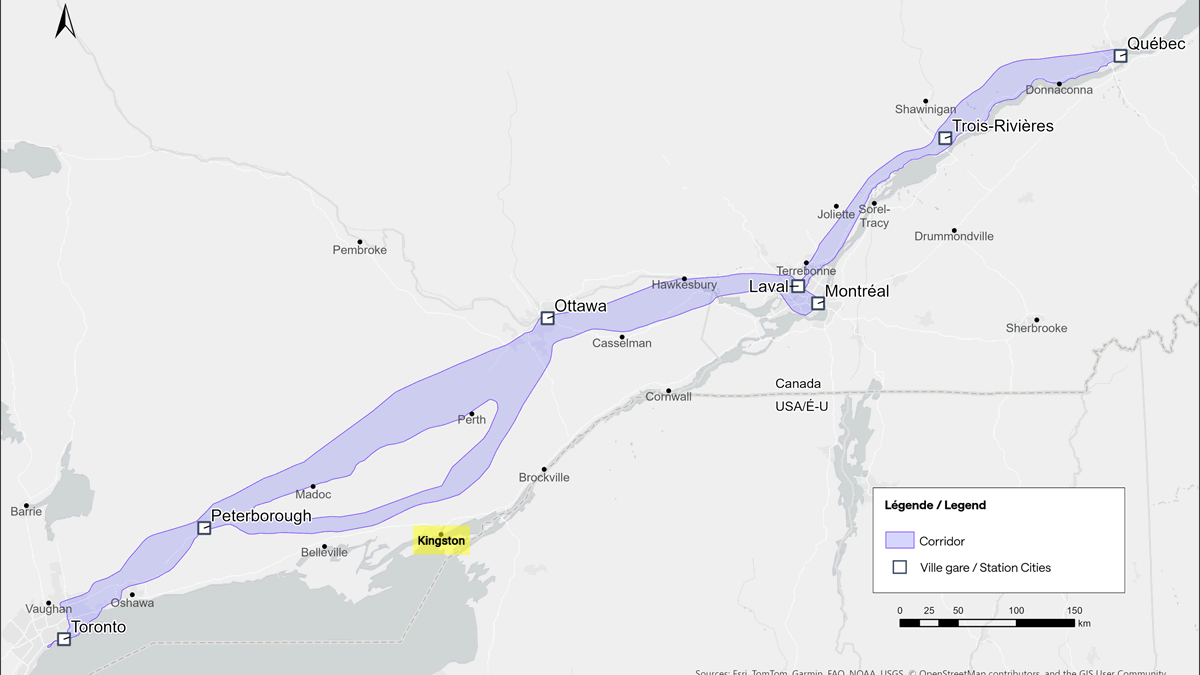
While Alto had said in April that it would be announcing a “more precise corridor” for the Peterborough-Ottawa section by the fall, the Crown corporation is now saying that consultation this fall will focus on a narrower corridor for the Ottawa-Montréal segment, with subsequent consultation for the western and eastern segments of the project taking place in 2027.
Advocates for a high-speed rail station in Kingston successfully make their case
Following a review of the findings of Alto’s public consultation report, Minister MacKinnon has directed Alto to develop a plan to assess a southern route option between Peterborough and Ottawa that includes a potential stop in Kingston that would interconnect with VIA Rail services, “subject to technical feasibility and project requirements.”
The 134-page report includes a section on Kingston, which was excluded from Alto’s originally proposed southern corridor.
“Although a station is not currently proposed in Kingston, municipal, stakeholder, resident and community support has emerged for the project, contingent on the inclusion of a Kingston station,” the report states. “The existing VIA Rail station was a suggested location for a Kingston HSR station.”
According to the report, advocates for a Kingston station pointed to the city’s strategic location between Toronto and Ottawa/Montréal alongside its importance as an existing rail hub serving a wider eastern Ontario population, noting it is in the fourth-busiest VIA Rail station in Canada.
“Canadians shared valuable perspectives through Alto’s consultation process, and we are acting on what we heard,” Minister MacKinnon said. “I have asked Alto to further assess an alignment option that could include Kingston as a potential stop as we continue advancing this transformative project for communities across the Toronto-Québec City corridor.”
According to a media release from Transport Canada, adding a high-speed rail station in Kingston would reduce travel times between Kingston and Toronto to around 90 minutes “while establishing Kingston as a key regional mobility hub, improving connections and placing up to 80 per cent of residents between Peterborough and Ottawa within a 25-minute drive of a station.”
For his part, Imbleau said the announcement of a potential stop in Kingston “demonstrates that Kingston’s voices were thoughtfully considered throughout this important consultation process,” adding that the decision “reflects the strength of local engagement and advocacy.”
Public feedback highlights both global and local concerns with proposed high-speed rail
Alto’s public consultation report summarizes feedback gathered during 26 in-person open houses, 10 virtual sessions, and 31 stakeholder roundtables, engaging more than 10,000 people, as well as nearly 45,000 comments through online questionnaires and an interactive map from over 324,000 visits on Alto’s online consultation platform.
The report identifies key global themes heard during consultation — including cost and timeline, value for taxpayers, environmental considerations, land acquisition and expropriation, farmland protection, ridership, affordability, construction impacts, integration with existing public transportation, impact on VIA rail, and more — as well as local themes for each of the sections of the proposed rail line.
That includes 17 pages of the report dedicated to the section between Toronto and Peterborough, the location of an Alto station in Peterborough, and the southern and northern corridor options between Peterborough and Ottawa. While there was broad interest in the project’s potential to improve regional connectivity and economic development, there were significant concerns about the impacts on farmland, rural communities, environmentally sensitive areas, and existing transportation networks.
Toronto-Peterborough segment
For the Toronto-Peterborough segment, many participants said high-speed rail could support job creation, tourism, business connectivity, and commuting, with some suggesting it could make Peterborough and the Kawarthas a more attainable place to live for people working in Toronto. Participants also noted that communities in Kawartha Lakes such as Lindsay are underserved by transit and could benefit from better connections to a future Peterborough station.
However, respondents also raised concerns about the route’s potential effects on rural landowners, farmers, emergency access, property values, and seasonal residences. Agricultural concerns included the loss and fragmentation of farmland, reduced access across right-of-ways, and the need for agricultural impact assessments comparable to environmental assessments.
Environmental concerns in the Toronto-to-Peterborough section included potential impacts on environmentally sensitive areas including Oak Ridges Moraine and its headwaters, the Cavan Swamp Wildlife Area, Ganaraska Forest wetlands, the Trent-Severn Waterway, Rice Lake, the Otonabee River, and more, as well as species at risk such as the Blanding’s turtle, western chorus frog, monarch butterfly, eastern hog-nosed snake, and northern map turtle.
Peterborough station
For Peterborough, the report states many participants support a high-speed rail station because the city is not served by VIA Rail or GO Transit rail services. Some participants said a station could encourage transit-oriented development, create jobs, attract tourism, and improve access for students and employees at Trent University and Fleming College, while others said expanding VIA Rail or GO Transit would be a better option.
Participants were divided on where a Peterborough station should be located, with some advocating for a downtown station as a way to support local businesses, investment, housing, and a more walkable urban core, but others pointing to higher construction costs and possible impacts on the city’s historic character.
Supporters of a greenfield station south of the city, including the Cold Springs area near Highway 115 and Highway 7 that the City of Peterborough has identified as its preferred location, identified the benefits of establishing a new economic hub that could include housing development, while other participants raised concerns about a station lacking public transit service that would require users to travel by car and increase parking requirements, as well as the potential loss of agricultural land.
Peterborough-to-Ottawa northern corridor
For the Peterborough-to-Ottawa northern corridor, participants suggested considering routes north of Highway 7 or along existing infrastructure corridors to reduce impacts on farmland and rural communities. Respondents questioned whether the project’s long-term benefits would outweigh its impacts, while noting possible opportunities for rural employment through maintenance facilities, rail yards, and local procurement.
Impacts on the environment and wildlife with a northern corridor were prominent among participants, with concerns raised about several sensitive areas, including wetlands, wells, and waterways, as well as at-risk species. Many participants emphasized the need to preserve farmland and had a large number of questions about land acquisition, including compensation, how land values will be assessed, and differences between market and replacement value.
Participants also raised construction concerns related to building a route through the granite bedrock of the Canadian Shield, including technical challenges and potentially higher costs due to blasting and elevation changes with the topography.
Peterborough-to-Ottawa southern corridor
The Peterborough-to-Ottawa southern corridor included even stronger opposition from some rural residents, with major concerns involving community fragmentation and the impact on rural life including agriculture.
“Some have formed organized groups that are very active in both traditional and social media,” the report notes. “Among these residents, emphasis was placed on the importance of preserving rural character and way of life, citing strong ties to farmland and nature, as well as concerns related to land acquisition and potential impacts on property values.”
According to the report, many participants said they could support a southern corridor option if it included a station in Kingston, as that would require the alignment of the route to move further south. There was a preference to align the route with existing infrastructure, such as Highway 401 to minimize potential impact on land.
Across both northern and southern corridor options, participants repeatedly called for Alto to use existing infrastructure where possible, protect farmland and sensitive environmental areas, provide clear information about land acquisition and compensation, maintain emergency access, and integrate high-speed rail with local transit, VIA Rail, bus services, airports, parking, and last-mile transportation.
No decisions have been made yet on a preferred corridor
Although Alto has been directed to develop a southern corridor with a stop in Kingston, the original southern corridor and the northern corridor options are still being considered.
“No corridor has been formally confirmed or excluded at this stage,” according to a statement on Alto’s social media. “Both northern and southern options, including variations such as a potential stop in Kingston, remain under consideration. Work continues on identifying the option that delivers the greatest collective benefit, while reducing the impacts.”
Alto also states that no decision has been made on a stop in Kingston.
“Alto has been asked by the government to study its technical feasibility, and any future decision will be informed by further analysis and consultation.”
Consultation reports available for download
The complete public consultation report is available at www.altotrain.ca/sites/default/files/2026-06/public-consultation-report-june-2026.pdf.
Meanwhile, the Indigenous consultation report identified interests and concerns with the project’s process and timelines, land claims and potential overlap with the project corridor, socio-economic benefits and impacts, archeological heritage, watershed and river systems (including spiritual, cultural, and harvesting practices), impacts on Aboriginal and treaty rights (especially hunting, harvesting, and fishing rights), protection of species valued by Indigenous peoples and their habitats, cumulative effects and impacts, and mitigation, offsetting, and restoration opportunities.
The complete Indigenous consultation report is available at www.altotrain.ca/sites/default/files/2026-06/indigenous-relations-consultation-report-june-2026.pdf.