












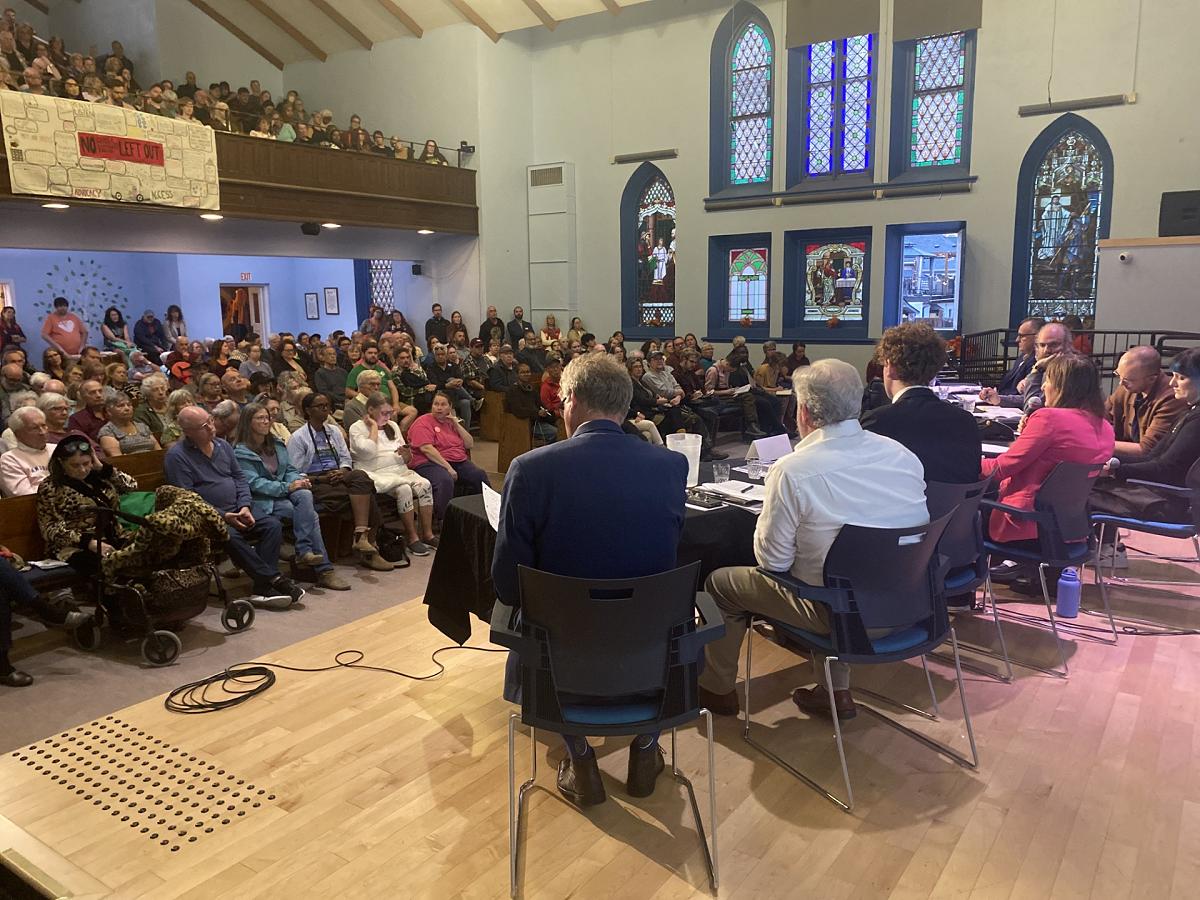
What was billed as a community discussion focused on social issues facing Peterborough saw the city’s seven mayoral candidates express their positions on a wide range of challenges the city is experiencing.
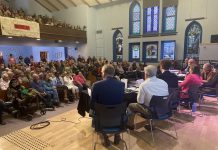
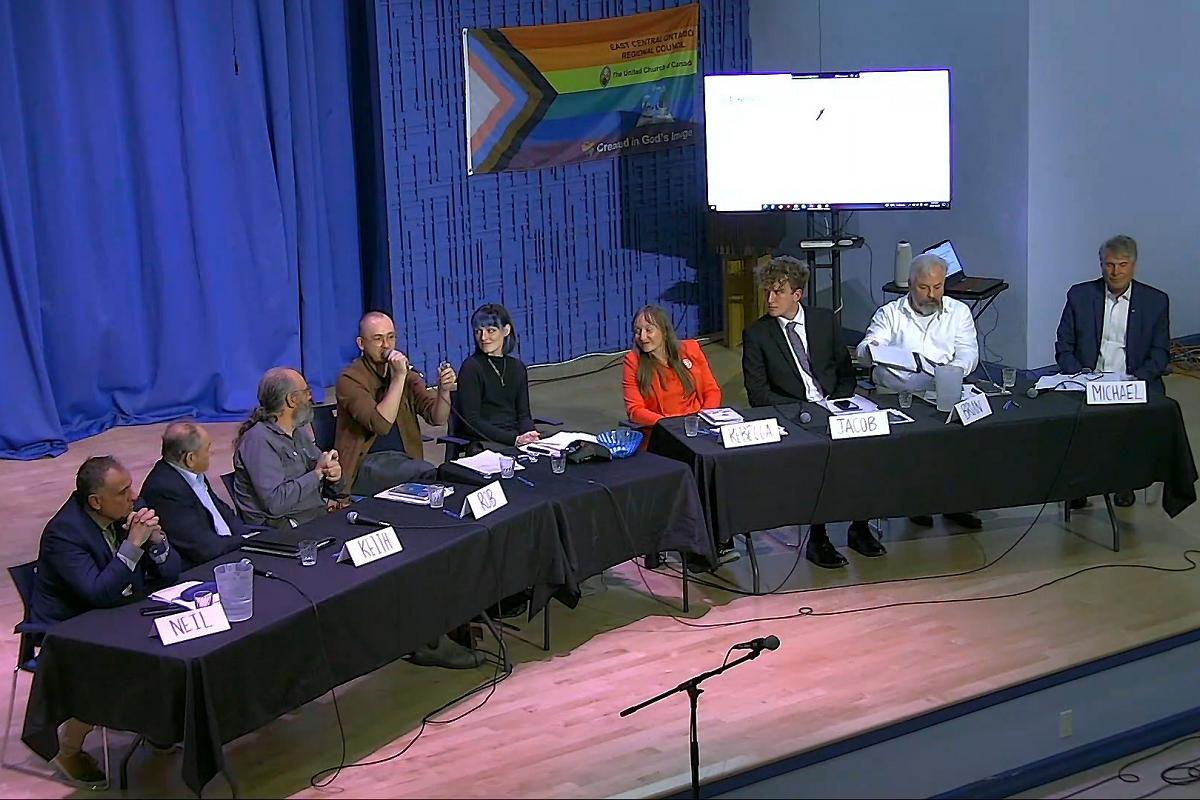
Held Wednesday night (October 7) at the New Canadians Centre, “Together: From Individual Uncertainty to Collective Action” brought together Michael Eamon, Rob Hailman, Brian Lumsden, Jacob Méthot, Neil Morton, Keith Riel, and Rebecca Schillemat before hundreds of people both at the Romaine Street location and online.
For six of the seven candidates, it was their second debate of the day, having come together earlier for a recorded debate at Cogeco YourTV’s studio on Goodfellow Road. Hailman, who had publicly announced earlier in the week that he was suspending his campaign activities although his name remains on the ballot as a mayoral candidate, was not invited to participate in that debate.
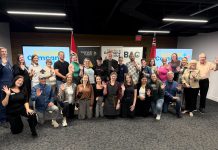
Wednesday night’s debate was presented by seven organizations — the United Way of Peterborough and District, the New Canadians Centre, the Peterborough Community Health Centre, the Basic Income Peterborough Network, the Community Resilience Action Network, Trent University’s Research for Social Change Lab, and One City Peterborough — and was moderated by Research for Social Change Lab manager Collin Chepeka and Jazmine Raine, a One City Peterborough board member and former federal election Green Party candidate.
The debate format saw each candidate make an opening statement before responding to a specific question drawn at random by the moderators. The candidates were provided all the questions in advance but did not know which question they would be asked. After that, three questions from the audience were fielded before each candidate made a closing statement.
Below is a summary of each candidate’s positions and views gleaned from their opening and closing statements, and their responses to moderator and audience questions.
Michael Eamon
In his opening statement, Eamon expressed his aim to “create a spirit of openness, of transparency, of greater communication and, of course, greater accountability at City Hall.”
Terming Peterborough “a great place full of great people,” Eamon said local expertise has to be tapped into — “We’re sitting on a wealth of experts; a wealth of intellect, a wealth of lived experience.”
To the moderators’ question of his approach in supporting all levels of the arts and sports cultures in Peterborough, Eamon questioned moving forward on a proposed new multi-use sports and entertainment complex when “we have unique spaces that have crumbled,” such as the former Musicfest stage in Del Crary Park.
“It’s an expensive proposition … there are some serious needs that also need city attention and funding. I’d push the pause button (on the proposed complex), and get the council and mayor up to speed but, most importantly, get you (city residents) up to speed. Big things need vision. A lot of people don’t see themselves in this vision.”
“What is the business case? What is the revenue generation case? These things are key. We have the highest per capita debt load of any municipality in Ontario (but) we have third lowest average household income. I have a fiduciary responsibility to the entire community and I I’m not going to jump in with both feet.”
To a question from Avery Trenholm of Peterborough Leaders of Tomorrow, a group she founded after the city disbanded its youth council, Eamon pledged to re-establish the council and move to create internship and co-op opportunities at city hall.
In closing, Eamon described Peterborough as “a great city, a compassionate city, my chosen city,” but a city that’s at “a bit of a crossroads. Many of the issues we did not create. When the provincial and federal governments drop the ball, it lands on the municipality.”
“We need to have our heads up and look towards the future with a shared vision.”
Brian Lumsden
Lumsden’s opening remarks centred on what have been his consistent aims: tackling “the drug epidemic plaguing our city” and “promoting affordability by keeping taxes low” by “cutting spending and demanding more efficiency from every (city) department.”
“Every candidate here should have this (drug) crisis at the top of their priority list,” said Lumsden, citing the need for housing and treatment beds and the money to fund both.
“It’s a tall order. It’s won’t be easy. I’m not willing to throw in the towel and accept our current situation as normal. We must come up with a long-term plan, not only for the addicts but for the community, and for our safety.”
Asked by the moderators how he would strike a balance between creating employment lands while ensuring the city remains committed to equity and sustainability values, Lumsden harkened back to his now-familiar platform theme.
“There are people dying in the streets,” he said, adding “I think we can do better. (The former) Trinity Church (owned and operated by One City) would be better purposed for some other use rather than a drug hub.”
Asked twice by Chepeka to answer the question posed, Lumsden continued to speak to the drug issue before saying “I’m not here to get interviewed. I’m here to do something about the drug use.” Pressed yet a third time to answer, Lumsden did says there’s plenty of land in the city, but much of it is toxic and has be “cleaned up.”
In closing, Lumsden called more “love, kindness and respect.”
“I’d like to see a city where families can go to the library without having to witness outdoor drug use where needles are spread out on the ground. We need the parks to be safe for our kids. I’d like to see our kids able to walk down the street without having to witness the tragic human suffering.”
Rob Hailman
Saying there has been “no direction” at city hall for the past four years, Hailman opened by taking aim at what has been.
“City council has been retreating from their accountability. City council has been retreating from their own capacity to make decisions, and to have informal conversations around the table. You could say that city council has been retreating from reality. We need to turn that around by having some vision about what reality we live in and what reality we want to live in.”
Action on housing and climate change, said Hailman, is needed, as is a change to the procedural bylaw to increase public engagement at council meetings.
“We need to go back to having three budget books instead of one so that the public and council can actually know what the bloody budget says. And we need to engage renters as first-class citizens in the consultation process.”
In response to the moderators’ question as to how he would help those struggling to afford housing, whether they’re unhoused, homeowners, renting, or hoping to purchase, Hailman said the money is there for the city to lead the effort.
“We’re spending hundreds of millions of dollars on things that maybe are the wrong priority. The (new) police station, the $57 million committed to the downtown arena … don’t say there’s no money, say we’re choosing to not have the money. If I’m mayor, I’ll choose to have the money (for housing).”
In his closing remarks, Hailman spoke to the suspension of his election campaign, noting “This is the last campaign event I intend to participate in.” He added he was excluded from the YourTV debate — something he alleged was “misrepresented” to the media.
Addressing criticism from some that he’s not “a serious candidate,” Hailman asked what “serious” means, noting he’ll continue his work advocating for a better Peterborough well after the election.
“My name will be on the ballot and you’re free to a choice about me in whatever way you choose.”
Jacob Méthot
The youngest of all the candidates, Méthot used his opening statement to address the limited number of people that can address city councillors at their meetings, noting “when they do speak, they get ignored.”
“We need to have the ability to fight for what is right in our community. Everybody’s an expert in their own community about what they think is the right fit for the future of Peterborough.”
Méthot also took aim at the use of strong mayor powers that “completely ignore anybody’s actual opinion about a situation, and completely remove people from the democratic process which, I think, is very gross.”
Asked by the moderators what he would do to support those new to the city and ensure Peterborough is a safe and welcoming community, he said current mayor Jeff Leal’s use of a racial slur in a lecture at Trent University was “one of the reasons that made me realize that students my age are really engaged in a lot of ways that people underestimate us, and our ability to reach out for social change when we see an obvious wrong in our community.”
Méthot says besides working closely with organizations like the New Canadians Centre, he’d ensure there’s an open-door policy for anyone “struggling with anything Peterborough-related.”
“We need to look at hiring practices as a city,” added Méthot when asked how he would advance DEI (Diversity Equality Inclusion) at the municipal level.
In closing, Méthot noted “too many are just one terrible week away from losing it all.”
“I’m not afraid of those struggling and talking to them. I want to do what others won’t and open the doors for direct communication, and reduce barriers people face while trying to access or discover care.”
“I want accountability while doing so. What’s the point of this event if you can’t later say ‘You lied and you are facing the consequences of that.'”
Neil Morton
Referencing his communications background, Morton said he’ll use his skills in that area to ensure city residents “feel like they’re active stakeholders in community building.”
“I’m going to be doing regular neighbourhood town halls with councillors in every ward. We’ll switch to a committee of the whole model, so there will be unlimited delegations and people can speak for however long they want. People are going to be heard again.”
In response to the moderators’ question of how much his perception and support of a potential employer for Peterborough hinge on what they build and how they treat their employees, Morton first defended One City Peterborough in the wake of Lumsden’s earlier criticism — “They save lives in this city … they’re doing God’s work with the shelter and housing.”
To the question at hand, Morton said the city “isn’t doing a good job” attracting new businesses or encouraging existing businesses to expand.
“The more wealth we have here, the bigger the social safety net. Aggressively, as mayor, I’ll be working with economic development and be the chief ambassador for the community to bring as much business here as possible.”
Admitting the lack of employment lands “is a big hurdle” to overcome, Morton referenced the serviced but vacant Clean Tech Commons land that is available for lease at Trent University, terming it “an albatross hanging over the city.”
“I would figure out a path forward. Bring Trent to the table. Bring the City of Peterborough to the table.”
Asked what kinds of businesses he would like to see locate here, Morton listed clean tech, aerospace, advanced manufacturing, and tech and aging.
In closing, Morton said Peterborough is “at a defining moment in its history.”
“We have to tackle this moment. We need a leader, a collaborator, a consensus person, and someone who has relationship capital and political capital, and can work to create solutions rather than point out problems.”
Keith Riel
As the only mayoral candidate with political experience, Riel gave his take, as an incumbent Ashburnham Ward councillor, on what has transpired this council term.
“I’ve watched people come to city hall who just wanted to be heard and were turned away instead,” he said, adding “Neighbours were told they couldn’t speak on decisions that affected their own streets.”
“People noticed and they stopped trusting city hall. I want to earn your trust back. Big decisions will happen in public; in front of the council you elected. Once a year, I’ll stand in front of you, in a public meeting, and tell you what we promised, what we got done, what we didn’t get done, and I’ll take your questions and answer every one of them. City hall belongs to you. I want to make sure that it works again for you.”
Asked by the moderators what his approach to generating revenue for the city would look like, and what influence “felt human impact” would have on how dollars are spent, Riel said “Real efficiencies mean the same or better service for less. Cutting services and calling it efficiency is wrong.”
“We’ve had a couple of people up here talk about the arena. The city promised to put $57 million into that. We were expecting the federal and provincial governments, and private money, to come to the forefront to make up $114 million. To date, that money is not forthcoming. If the city was on the hook to build a $200 million arena, your taxes would be 4.9 per cent before we start anything, and you would have double-digit taxes for the next 30 years to pay for a $200 million arena.”
Confirming the city is in negotiations with Cavan-Monaghan for employment land, and that a mediator has been assigned by the province, he also referenced the Clean Tech Commons property.
“We’ve got $12 million of your money invested in a piece of land that has been sitting there that needs to be attended,” said Riel, noting he was told by Trent that “the city has not darkened our doors. That’s one of the first trips I’m going to make (as mayor).”
In closing, Riel said “Good ideas are easy. Getting it done is the hard part.”
“I grew up here, I found work here, I bought a home here and I raised a son and daughter here, Ss when people tell me they can’t afford a place to live, or that city hall doesn’t listen to them, I take it personally.”
“Before anything goes ahead, you’ll see what the cost is and how we will pay for it. Peterborough has been good to me and my family. I want it to be that kind place for everyone in this room, whether your family has been here for generations or arrived last month.”
Rebecca Schillemat
Schillemat introduced herself as a candidate who, when mayor, will “exist to listen to residents and build a community for everyone.”
“Limiting speaking (before council) to four people per item is not enough to get active input from our community. It should go back to 10. When we have an item that a lot of people want to speak about, we should have a special meeting so that everyone can speak on that one item.”
“Listening to residents is the first thing that the mayor and the council should be doing. I will listen. I’m going to have our council come together and share what our goals are, and update the progress on those goals, being very transparent with the community, and making sure that we are spending our money wisely.”
Schillemat fielded a question from the moderators around public safety, and what needs to be done to ensure our neighbourhoods, streets, and public spaces are safe for all.
“The police say there are less crimes, but I think the reporting is down,” she said, adding “We need to work with police so it’s easier for people to report crimes.”
“Downtown is the biggest thing I’ve heard about while door-knocking. I want to see it cleaned up. I literally mean the garbage needs to be cleaned up. The graffiti needs to be cleaned up. The broken windows at businesses need to be repaired quickly. I really want to work with the DBIA (Downtown Business Improvement Area) so business owners don’t have to spend the first hour of their day cleaning the street in front of their business, because it’s done by that city.”
All good things, and fewer instances of public insecurity, will stem from more people having shelter, said Schillemat. That includes shelter of some kind for the estimated 500 people on Peterborough’s streets.
“Like Rob (Hailman) said, if we have $100 million to spend on arenas and facilities, why do we not have $100 million to house people in our community?”
Schillemat closed by noting that while each candidate for mayor is well aware of the challenges and agree they need to be addressed, Peterborough needs “a leader with a clear, realistic plan and the technical expertise to execute it.”
“I’m not asking for your vote to maintain the status quo or represent the political establishment. I’m running as a practical and independent leader focused on local solutions and results.”
Following the debate, Chepeka told kawarthaNOW that those who attended — some 250 people in person and another 200 who took in the livestream on the New Canadian Centres’ Twitch account — “have a lot to chew on.”
“I think the interview style allowed us to dig a little deeper into the specifics of how the candidates view their vision and how they plan to execute it,” he said.
Speaking to an audience question that asked the candidates how humanity would be part of their leadership, Chepeka said the answers were revealing.
“The most successful mayors are those who are able to communicate a clear vision, and that is based in their personal values. I’m really happy we had an opportunity to hear a little less about the pragmatics of policy and what is driving these candidates to be on this stage tonight.”
As Chepeka also told the audience at the conclusion of the debate, he said Peterborough is “spoiled for choice” when it comes to the number of mayoral candidates.
“There are many municipalities struggling to find candidates. I’m really grateful at a time when democracy might be teetering that we have a community willing to step up and try and fill that role.”