

















Following the municipal election on October 26, Peterborough residents have voted in five incumbent councillors and five new faces on council, in addition to the new mayor-elect Michael Eamon.
In Otonabee Ward, incumbent councillor Lesley Parnell was re-elected for her fifth consecutive term with 2,677 votes.
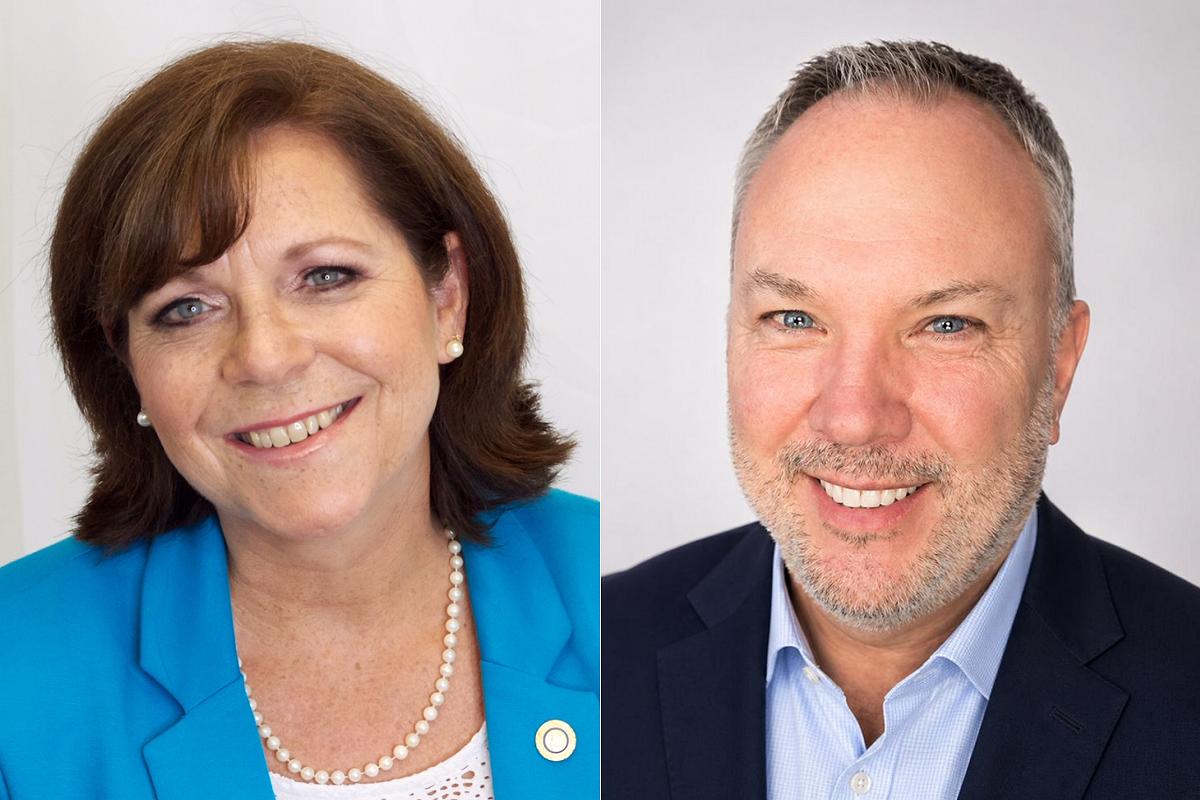
Parnell will now serve alongside newcomer Chris Potter, who received 2,318 votes, defeating incumbent councillor Kevin Duguay by just 24 votes.
Before the new council is inaugurated on Thursday (November 19), kawarthaNOW asked councillors-elect in each of the city’s five wards to explain how they will take action to address the most pressing issues raised by residents during the campaign period, by asking them three questions:
- The draft 2027 budget will be presented on November 30. What are your financial priorities at this stage?
- Once council enters session, what will your priorities be and how will you take action on these?
- Throughout the campaign period, many residents identified housing shortages as a primary concern. How will you directly address the homelessness crisis?
Each councillor-elect was also asked two further questions, based on their incumbency status and previous comments made to kawarthaNOW throughout the campaign period.
Parnell brings council experience to tax pressures and infrastructure priorities
Parnell was first elected to Peterborough city council in 2010 and has represented Otonabee Ward for the past 16 years. Returning to a council with a new mayor and five first-time councillors, Parnell says residents will benefit from her institutional knowledge and council experience.
With the draft 2027 budget being presented on November 30, Parnell says her financial priority at this stage is to “help constituents on an individual level,” particularly regarding rising property tax rates for residents.
“We cannot keep taking on more costs that more appropriately belong on provincial or federal budgets, such as mental health, addiction, public health, homelessness, and housing,” Parnell said.
Speaking further to her priorities when council enters session, Parnell looks to capital infrastructure programs already in motion as important areas of continued investment.
“We need to continue to invest in capital infrastructure programs and prioritize the most critical projects first to help the greatest number of people in the community,” Parnell said.
Housing development and advocacy for provincial funding remain priorities for Parnell
On the issue of housing, Parnell spoke about initiatives undertaken by the previous council such as creating transitional housing and shelter spaces. She also noted the Community Planning Permit System (CPPS) and Development Charge Reduction Program (DCRP) as part of ongoing work to increase the building of market-rate and affordable units.
“Specifically, the Community Planning Permit System really tightened up the procedure to get to that building permit stage to help our local builders create the jobs and build the necessary housing that we need,” said Parnell.
While she said there are “a significant number of approved housing projects in the pipeline,” she added that “the market is not cooperating with us and it’s still very, very expensive to build just regular market housing, never mind affordable housing.”
Going forward, Parnell said that council must “keep pushing the province on tax ratios, proper jurisdictional spending, so that they’re funding what they’re supposed to fund versus trying to have the municipal tax dollar pay for things that really should be paid for by the province.”
“We have to keep lobbying our MPP and our MP and beyond them to make sure that we are getting our fair share of those other tax dollars to help us with our community,” she added.
When asked about a previous comment she made to kawarthaNOW about social media being a challenge to democracy and stability on council, Parnell declined to comment further.
Potter focuses on property taxes and provincial partnerships to address homelessness
Bringing new representation to Peterborough’s south end is political newcomer Potter, who is known locally for his community-organizing initiatives including a popular Facebook group.
In terms of his financial priorities, Potter said he has not yet seen the draft budget but that, based on conversations with residents, he is focused on residential property tax rates.
“I’m obviously concerned with where we’re at financially as a city,” Potter said. “I have heard over and over and over again at the door that people don’t want to see property tax increases, and I think people are going to be extremely upset with this budget that’s coming to the table.”
Potter said that the “offloading” of costs from the province onto the municipal budget is a cause for concern when it comes to finding savings, and that council will need to work with the provincial government to address structural problems.
“With all the offloading that comes from the province — which isn’t an excuse, it’s just the reality — we have a lot of things that we have to do, that we pay for now, that the province used to participate in. There certainly need to be conversations with our provincial and federal partners on how we can really best serve Peterborough’s community.”
On the topic of the homelessness crisis, Potter described himself as “cautiously optimistic” about the recent establishment of the Homelessness and Addictions Recovery Treatment (HART) Hub.
“I feel like there’re still some gaps in that solution directly, but we should start seeing results from that,” he said. “We can then build on the main focuses there: housing and addiction and mental health challenges.”
“We’re going to have to work arm in arm with the province to make sure that, when we recognize that there are gaps in that system, they then come back to the table and adjust as needed.”
Affordable housing and greater transparency round out Potter’s agenda
Potter also said that he wants to secure support to advance the work being done by Peterborough Housing Corporation to establish 1,500 new affordable units. He said this would address housing needs while widening the residential tax base and reducing the burden on individual taxpayers.
“We want to start really solving some of our problems by increasing our tax base and doing it in a way that is good for the city. By putting these affordable units in, we solve multiple problems when we start doing that.”
Potter made “accountability” and “transparency” key facets of his campaign and he said they will remain priorities for his work on council.
“I certainly feel like I’m going to be able to bring some new ideas and really start a new layer of communication with the electorate. It’s felt to me for quite a long time like there’s a bit of a brick wall between city hall and everybody (in the community).”
To promote transparency and public engagement, Potter said he supports rescinding the procedure by-law’s limits on citizen delegations.
He also questioned the frequency of closed sessions, but admitted he has to learn more about the procedural requirements around closed sessions and privacy and disclosure.
“Depending on what the parameters are around closed sessions, I would move to maybe make some of those things a little bit more transparent,” said Potter.