

















Vital mobile harm reduction services provided by PARN (Peterborough AIDS Resource Network) are taking a huge step forward with not just one but two new outreach vehicles entering service.
Since 2016, PARN has used a decommissioned ambulance — wrapped with a design by Peterborough illustrator and muralist Jason Wilkins — to provide harm reduction supplies and naloxone kits to drug users throughout the city and county of Peterborough, the City of Kawartha Lakes, Northumberland County, and Haliburton County.
However, with some 340,000 kilometres of wear and tear on its big V10 engine and high fuel costs and increasing maintenance needs, that vehicle is being retired for much more efficient options.
PARN recently took possession of a Dodge Caravan from Kawartha Chrysler that’s expected to go into service the first week of March. As well, another van is on order and should be in PARN’s possession later in March.
According to PARN executive director Dane Record, when funding provided under Health Canada’s Substance Use and Addictions Program (SUAP) became available in 2024, he worked with City of Peterborough project manager Jessica Penner to ensure PARN’s need was known.
“They (Health Canada) had emergency funding that was being made available to municipalities,” recalls Record, crediting Palmer for her role.
“PARN was approached and asked if we wanted to get a vehicle,” Record explains. “I said ‘Yes.’ They said ‘OK, what type of vehicle are you looking for? Give us some more information.’ I asked ‘Can we think big here?’ So we shot for the stars and we got the stars. We were able, with a hell of a lot of collaboration, to obtain the funding to purchase not just one vehicle but two.”
“Being able to have two vehicles means PARN can route back to a full-service mobile reach right across the four counties. We are commissioning art from people with lived experience — local artists. It’ll be a modernized design. But, in being modern, we don’t want to diminish the legacy of the current truck, so we’re going to see we if can keep an element of the familiar design.”
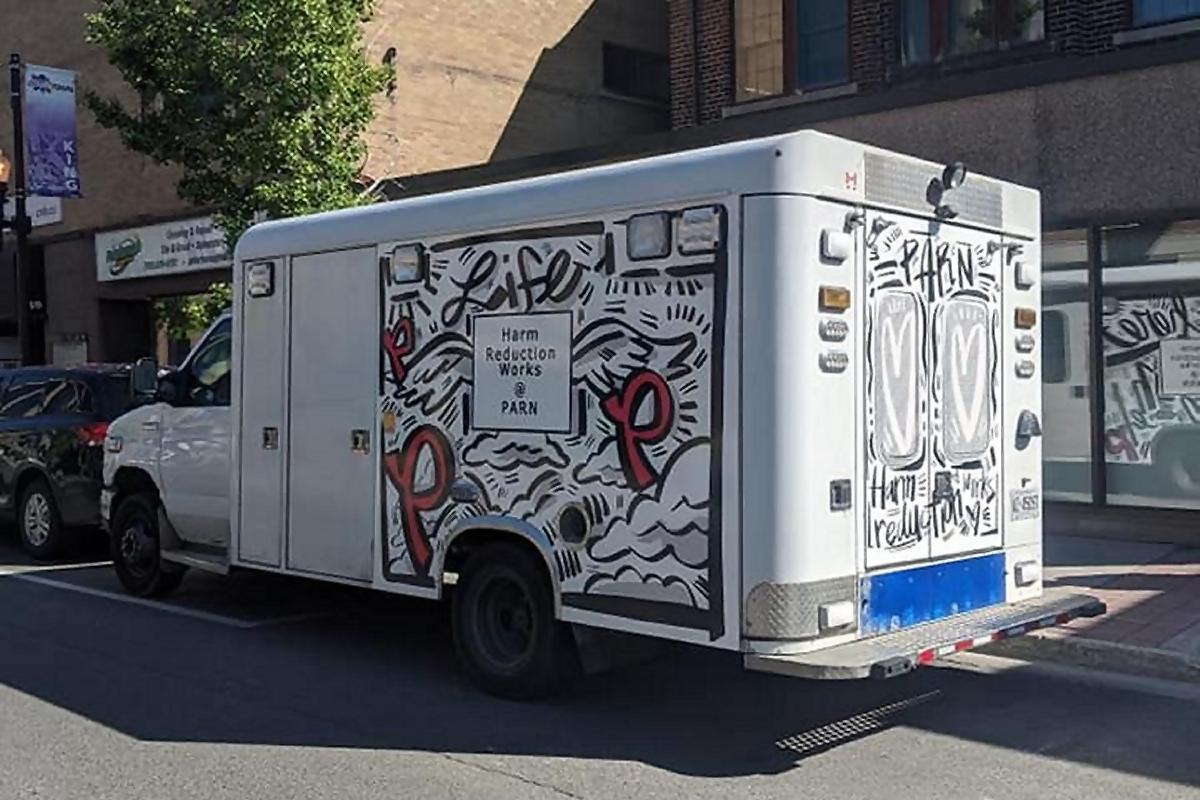
That legacy, notes Record, goes back to 2016 when PARN took possession of a donated ambulance-style vehicle and was used to service rural areas — “Some of the spots that PARN was not able to reach on a steady basis, number one, but two, wasn’t able to get our name out to.”
“We got some artwork commissioned by a community member (Wilkins) that was really helpful in getting PARN’s name out. When we’re out and about, and folks see the truck, they know they’re going to be connecting with folks who get it. They have a clear understanding of who they’re working with. Many of our friends in the communities we serve look to us as their first contact if ever anything is going on in their lives.”
Record credits the vision of former PARN executive director Kim Dolan and the late Charles Shamess with, through the mobile outreach initiative, “finding a way to not only market PARN’s visibility but also be intentional in meeting people where they are at, which was vital at that time.”
“What it did was make the overall work efficient,” adds Record. “At the beginning, it took a bit of time but that consistent presence — letting folks know who we are, what we do and why we do it — and what the truck signifies is where we were able to see enhancement in program outreach.”
“It also helped with enhancing some of our agency partnerships. Being able to work with (Peterborough) Street Medicine and some of the CHCs (community health centres) at the time, we were able to utilize the truck to not only reach people as PARN to do HIV and hepatitis C prevention work, but also bring agency partners with us — medical and clinical staff who would track behind us in their vehicles or even ride along with us.”
“From day one right up to today, people see the truck and know that it’s PARN staff. They’re wearing branded gear the majority of the time. And if there’s somebody tagging long, be it a clinician, a nurse, or any other clinical professional, they know they’re legit; they can be trusted because they’re riding with PARN. ”
Not unlike the outgoing mobile unit, the new vehicles will be stocked with harm reduction equipment, and will accommodate the distribution of HIV and hepatitis C prevention tools as well as safer sex resources and drug use supplies. Record notes yellow disposal bins for used sharps (needles) are also part of the mobile unit’s arsenal.
“When we’re out in the counties and folks see the truck, if there’s a place where there’s a lot of sharps that have been used that needs to be safely disposed, they know we’ll come and get them,” he explains.
“We have a number of kiosks scattered around the city and the counties. For those who might not make that walk to dispose of their contents, they see the truck and they know their yellow bin is going to be taken, and that they’ll receive a new one.”
Also carried by the mobile unit are naloxone injectable and nasal kits.
“Folks trust us to give them what works,” says Record.
Asked if PARN’s mobile unit has led directly to the saving of lives, Record says PARN’s role “is to prevent harms historically connected to HIV and hepatitis C infection, diagnosis and prevention, and harms associated in the broader community with accidental drug poisonings and substance-related injectable or inhalation harms.”
“The organization can’t put a number on the lives saved, and I’m not going to take a guess. But I can say, quite confidently, that PARN plays a major role, especially in Peterborough, alongside our partners. We, with them, play a vital role in preventing accidental drug poisonings, drug-related harms and, ultimately, drug use mortality.”
Not lost of Record, along with anyone involved in this work, is the fact that local deaths related to poisoned drug use dropped dramatically in 2025 from the year prior.
In the city of Peterborough in 2023, 78 deaths were attributed to poisoned drug use and, in 2024, 60 deaths were reported. That number dropped to 42 last year.
“There’s no luck involved,” says Record of the decrease in deaths. “That’s hard work, and it’s work that continues to be improved upon with the role that PARN plays in harm reduction (and) a major role by Fourcast with the CTS (Consumption and Treatment Services) site where their skilled team of staff provide addiction and treatment options.”
“The fact that folks are able to, and are willing to, work with trusted collaborators to address their drug journeys, whether they want to taper down, use less, or (when) maybe stopping is a goal. They’re trusting organizations such as PARN, Fourcast, CMHA, 360 (Degree Nurse Practitioner Led Clinic), and One City, and their continued advocacy and work. All that put together is contributing to the reduction in mortality rates. Absolutely.”
While Record admits to being “very excited” for the new vehicles’ taking to the road, he’s “more excited for our friends in the community and our teammates on the front lines to be able to continue the work, and now, expand and enhance the work.”