





















The school year remains marred with uncertainty for elementary teachers, parents, and students as bargaining between the Elementary Teachers’ Federation of Ontario (ETFO) and the Ontario government has stalled before it truly began.
“We would have liked to bargain earlier,” said Mike De Rose, president of the Trillium Lakelands Elementary Teacher Local (TLETL), in an interview with kawarthaNOW. “We would have liked to be further down the path.”
ETFO represents around 84,000 members that include public elementary teachers, occasional teachers, education support personnel, professional support personnel, and designated early childhood educators. Based in Lindsay, TLETL is an a local union affiliate of ETFO that represents around 700 qualified teachers working in kindergarten to grade eight in 40 elementary schools operated by the Trillium Lakelands District School Board (TLDSB) in the Muskoka, Kawartha Lakes, and Haliburton regions.
Dispute over provincial and local responsibilities stalls bargaining
In August, ETFO reported that bargaining stalled over which issues would be negotiated provincially and which would remain at local bargaining tables. Members’ contracts have since expired, students and teachers have returned to school, and bargaining is at a standstill with a strike vote looming.
Under the School Boards Collective Bargaining Act (2014), bargaining operates on a two-tier system where the central tables negotiate with the province and the local tables negotiate with the school boards they represent. The previous four-year collective agreement with the province expired on August 31.
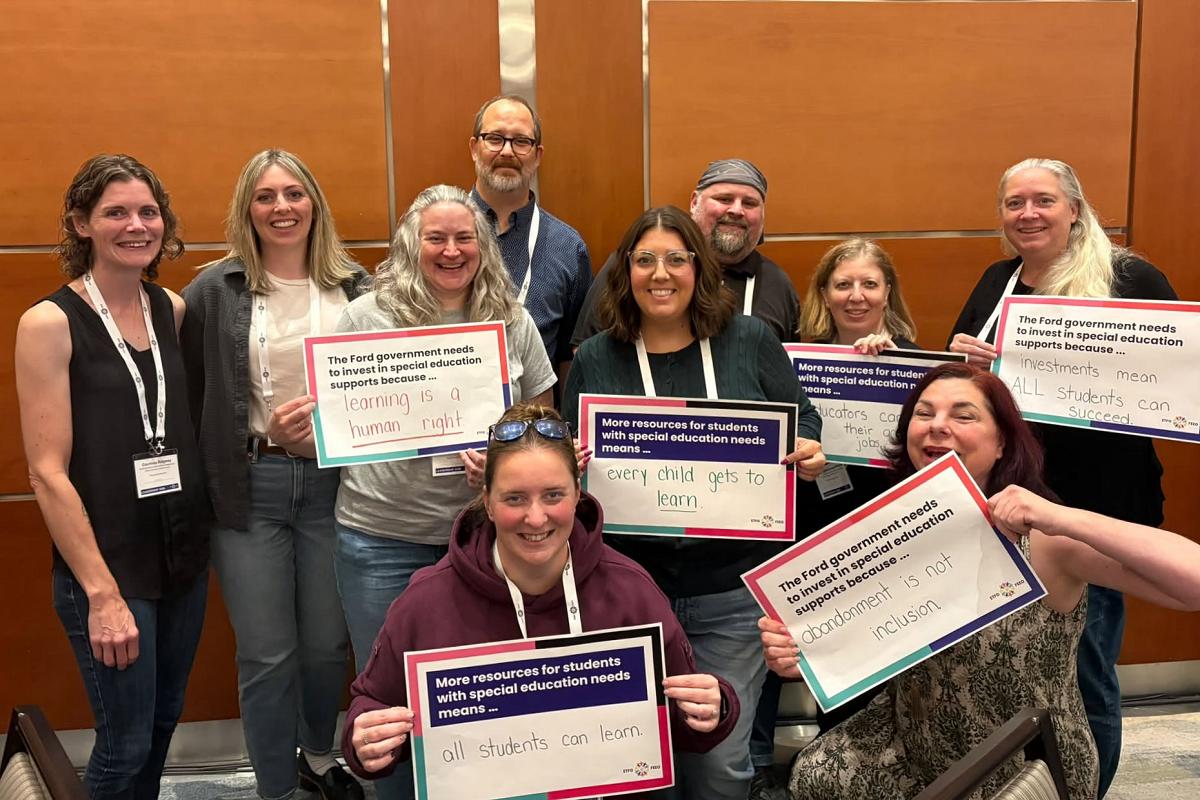
ETFO maintains that issues with a genuinely local impact should continue to be addressed locally. Some of the issues being discussed include classroom sizes, special education programming, professional development funding, and staffing timelines related to transfer, surplus, and redundancy.
“Local bargaining allows us to be creative and have local homegrown solutions to problems that might be quite specific to Kawartha Lakes,” De Rose said.
He explained that TLETL and ETFO are particularly concerned about the negative impacts of centralizing decision-making and the limitation on the ability of their organizations and members to be proactive and reactive to unique local problems as they arise.
“The access to resources is different and therefore the internal procedures at a school or school board should look different,” De Rose said.
Geography and school size create different staffing and student-support needs
TLETL highlights that one staff absence or one unexpected student-support need in a small school can affect schedules for the entire school. While a larger school has more staff, it may face crowded classrooms, greater enrolment pressures, and more complex supervision demands.
“Class size is not an abstract number when you are the child waiting for feedback, the parent hoping someone notices a change, or the teacher trying to reach every student before a small struggle becomes a larger one,” De Rose said. “Smaller, manageable classes give educators a better chance to know students well and respond early.”
Looking at the direct impact of the stalled bargaining in Kawartha Lakes and Haliburton, TLETL and De Rose highlight the disparate communities that make up the school board’s catchment area.
For example, a school in Dunsford in Kawartha Lakes may face challenges including long travel distances, access to specialized services and the difficulty of attracting substitute teachers or other qualified staff. For a larger Kawartha Lakes school, the challenge may be different, such as several students needing intensive support at the same time.
“We can come up with processes here that can better triage students or provide services in a way that accounts for our geography,” explained De Rose.
Provincial oversight of school boards adds to concerns about local autonomy
ETFO says that the government’s push to centralize decision making during this round of bargaining is not a surprise given the province’s recent actions affecting school boards.
“We have seen the attempt to eliminate trustees altogether and certainly a clipping of their wings in legislation,” De Rose said. “That’s another mechanism to centralize and consolidate power out of Toronto, rather than allow local autonomy, local voice, and local conversation.”
Last August, education minister Paul Calandra said he would consider eliminating trustees from boards and the election ballot if it allowed the province to “deliver the product better.”
This came shortly after Calandra introduced Bill 33, which gave the minister the authority to replace a board with an appointed supervisor in cases of “public interest,” such as financial mismanagement and divisive student issues.
MPP Chandra Pasma, who is the education critic for the official opposition, has criticized Bill 33 as an attempt to “take over” the public school system.
To date, eight school boards have been placed under provincial supervision: the Toronto District School Board, Toronto Catholic District School Board, Ottawa-Carleton District School Board, Dufferin-Peel Catholic District School Board, Thames Valley District School Board, Near North District School Board, Peel District School Board, and York Catholic District School Board.
“Our fear is that if all this power is centralized, then that would take away the autonomy of local school boards,” De Rose said. “It prevents us as a whole system, not just as a union, but as a school board, as trustees, as community members, to really mobilize and make local changes.”
November strike vote planned as unions await labour board ruling before any job action can take place
The teachers’ unions appealed to the Ontario Labour Relations Board (OLRB) for a ruling on what items will be on the central table and the local table. However, a ruling could be months away.
In the meantime, ETFO has announced a strike vote for members will take place in November.
Votes have also been announced by the Ontario English Catholic Teachers’ Association and Canadian Union of Public Employees’ Ontario School Board Council of Unions. The Ontario Secondary School Teachers’ Federation and the Association des enseignantes et des enseignants franco-ontariens have not announced votes.
“Premature strike threats do not serve the interests of students and do nothing but create unnecessary panic for parents,” the Ontario Ministry of Education said in a statement after ETFO announced its intention to have a strike vote. “Our focus is where it should be — getting to the table and reaching a deal that keeps students in the classroom.”
Despite the strike votes, any job action cannot take place prior to the OLRB ruling. In its statement, the Ministry of Education says the unions’ OLRB appeal is the reason bargaining has stalled.
“We respect their right to do so, but this process has delayed the start of bargaining. Once the OLRB process has concluded, we will be ready and willing to negotiate whenever the unions are ready to begin.”
Although teacher strikes are not imminent, De Rose said he recognizes the uncertainty this can cause for students and families as they await information.
TLETL said it is not arguing that every education issue should be negotiated locally — noting that some matters require consistent provincial standards and provincial investment — but maintains that bargaining works best when decisions are made at the level where they can be understood and addressed most effectively.
“We want a constructive bargaining process that respects provincial responsibilities while still leaving room for local people to solve local problems,” De Rose said.