


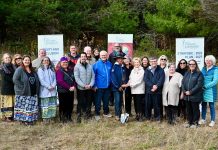



















YES Shelter for Youth & Families is strengthening its internal and staff capacity to better support unhoused and at-risk youth and families in the community with the support of a $40,700 seed grant from the Ontario Trillium Foundation (OTF).
On October 22, YES released a short video featuring Peterborough-Kawartha MPP Dave Smith and the non-profit organization’s executive director Aimée Le Lagadec that explains how the grant has been used.
“We decided to pursue the Ontario Trillium Foundation grant because we were seeing some gaps in the system and the way that we collect data as an agency which helps us understand the complexities of homelessness and how to improve our service delivery,” Le Lagadec said in an interview with kawarthaNOW.
Updated case management and training systems for YES staff
The grant supports eight YES programs, from homelessness prevention and the emergency shelter to RISE Youth Housing and life skills. About 225 young people and family members each year will benefit through faster help, fewer times retelling their story to a new worker, and fewer people falling through the gaps between programs.
In late 2025, YES received the $40,700 OTF seed grant to support new ideas and capacity-building projects for up to 12 months. Le Lagadec said that, internally, YES had identified gaps in their client database that prevented accurate and effective reporting on all areas of service and analysis.
Through the grant funding, YES’s client and case management database was configured to its full capacity by Bonterra Tech to ensure that everything a worker needs to know about a young person’s situation is current and in one place. Thirty-five staff were trained on the new system.
“With the improvements with the data system, we’re hoping to eventually be able to pull reports and data that is cleaner (and) gives us a more accurate depiction of what homelessness looks like for our clients,” said Le Lagadec.
Additional training for outreach workers to help youth before they need emergency shelter
In addition, 13 outreach staff completed a three-day course in case management and best practices through A Way Home Canada, said Le Lagadec. A Way Home is a national coalition reimagining solutions to youth homelessness through transformations in policy, planning, and practice.
La Lagadec explained that the training also involved new best practices and sector-wide goals on diverting and preventing youth homelessness through family and natural supports.
“We do think that it’s really important, especially when you’re working with young people, to try to prevent them from coming into emergency shelter,” Le Lagadec said. “Living rough or living in a shelter can be really impactful on a young person in their life.”
To further support the use and implementation of software upgrades and training, 11 laptops set up by ReBOOT are now with outreach staff who carry caseloads, so they can update files and make referrals at the shelter, in transitional housing, or out in the community.
Le Lagadec said that the ability to better track and predict trends and causes of youth homelessness will be a primary outcome of the grant investment and will guide the organization’s work going forward.
“We are seeing a trend upwards in youth experiencing homelessness much sooner, so we are looking at ways as an agency to try to meet that need,” she said.
YES working with schools and children’s aid to help identify young people and families at risk of homelessness
For example, Le Lagadec said schools are beginning to identify youth experiencing or at-risk of homelessness, both in cases of a lone youth leaving home and whole families experiencing homelessness due to financial instability and related issues.
“The trend has been for a while, especially in the city of Peterborough, that families are experiencing homelessness with young children,” said Le Lagadec.
According to the Government of Canada, in 2025 accompanied children (infants to 16 years of age) represented 4.4 per cent of shelter users, while youth aged 13 to 24 made up 10.7 per cent of shelter users.
To further support young people at-risk of homelessness, Le Lagadec said YES works closely with the Kawartha-Haliburton Children’s Aid Society and their youth-in-transition program.
In 2024, the United Way Peterborough and District stated in its Point of Time report that 35 per cent of surveyed individuals identified as having had past or current involvement with the child welfare system.
Le Lagadec said YES will use this data to consider expanding its mandated age of involvement to further support young children and those in the school system, with guidance from the Upstream programming provided by A Way Home.
“I really can’t say enough how important school is for young people, especially young people experiencing difficulties at home, because school can be a diversion strategy out of homelessness,” said Le Lagadec.
Beyond emergency shelter, YES offers transitional housing, a youth trustee program, and more
Le Lagadec spoke further to the wide range of programs and services that YES provides, in addition to the emergency shelter located at 196 Brock Street in Peterborough.
YES operates several scattered sites of transitional housing for youth and families, employs youth outreach workers including workers specifically tasked with working with clients aging out of the care child welfare, and offers a youth trustee program that supports clients in receiving funds from a variety of sources. The organization also provide a food box program, community drinks and snacks, and an alternative classroom in partnership with Peterborough Alternative and Continuing Education (PACE).
Le Lagadec explained that it is the combination of these services that allow YES to support youth and families at all stages of the housing journey from prevention to relocation to permanent housing.
As an agency of the Ontario goverment through the Ministry of Tourism, Culture and Gaming and one of Canada’s leading grant-making foundations, OTF provides grants to eligible not-for-profit and charitable organizations in the areas of arts and culture, human and social services, the environment, and sports and recreation.
YES’s project falls under OTF’s priority of enabling economically vulnerable people to meet their basic needs and strengthen their financial stability.
In 2025-26, OTF invested nearly $107 million into 746 community projects that aim to enhance economic well-being, foster more active lifestyles, support child and youth development, provide spaces for people to come together and connect, and create a more sustainable environment.
For more information about YES Shelter for Youth & Families, visit yesshelter.ca.