The Port Hope Drive-In will be opening for the season on June 12, 2020 but, due to public health restrictions during the COVID-19 pandemic, the drive-in will be operating at half its normal capacity and the concession stand will be closed. (Photo: Shaney Cannon / Google Maps)
The Port Hope Drive-In is finally opening for the 2020 season on Friday, June 12th.
The drive-in, located at 2141 Theatre Road South in Cobourg, made the announcement on its Facebook page on Monday afternoon (June 1).
Details are to come on what movies will be shown.
Advertisement - content continues below
Last Friday (May 29), the Ontario government amended its emergency order under the Emergency Management and Civil Protection Act, that requires the closure of non-essential businesses during the COVID-19 pandemic, to exclude drive-in theatres.
However, the government also listed several public health restrictions that drive-ins must have in place when opening.
The Port Hope Drive-In is following the same rules as the Lindsay Drive-In, which reopened on Sunday (May 31):
there must be one empty parking space between each vehicle (two metres apart)
only members of the same household can be in the same vehicle
customers must remain in their vehicles except when leaving to use the washroom
convertibles are not allowed, and patrons cannot sit in the beds of pick-up trucks.
no food or beverages can be sold.
Any customers not following the rules will be asked to leave.
The closure of the concession stand means the drive-in is temporarily allowing customers to bring in their own food.
“Truthfully, this is a devastating requirement as our actual profit comes from these sales,” the drive-in writes on its Facebook page. “Without them we won’t be able to survive long — we hope this gets amended soon.”
Washrooms will be open at the drive-in but with restricted use. Children must be accompanied by a family member.
Like the Lindsay Drive-In, the Port Hope Drive-In must operate at half its normal capacity to allow for the required physical distancing between vehicles. That means only 200 vehicles will be allowed into the drive-in at any time.
The Port Hope Drive-In will only be accepting cash until further notice.
The inaugural Youth Science Canada Online Science, Technology, Engineering and Mathematics (STEM) Fair was held this spring after the 2020 Canada-Wide Science Fair, along with most of the 103 regional science fairs across the country, was cancelled due to the COVID-19 pandemic. (Graphic: Youth Science Canada)
Three Peterborough students have been recognized for their science projects at the inaugural Youth Science Canada Online Science, Technology, Engineering and Mathematics (STEM) Fair.
Students in grades 7 to 12 across Canada participated in the virtual fair, which was created after the Canada-Wide Science Fair 2020 (originally scheduled to take place in Edmonton, Alberta) and most of the 103 regional science fairs across the country (including the Peterborough Regional Science Fair scheduled to take place at Trent University) were cancelled due to the COVID-19 pandemic.
Judges reviewed 631 student projects and awarded 275 virtual ribbons at three levels as part of the online showcase.
Advertisement - content continues below
Holy Cross Secondary School Grade 12 student Jacob Bowman and Kenner Collegiate Grade 9 student Shaun Plassery each won a national, regional, and challenge ribbon, while St. Catherine School Grade 7 student Calvin Karthik won a regional ribbon.
Bowman used a GoPro camera to sample the urban brook trout population of Harper Creek in Peterborough and projected the effect of climate change on the brook trout populations in four creek sections up to 2100. He concluded that urban brook trout could be protected from the impacts of climate change by restoring tree cover along stream banks.
VIDEO: Climate change implications for an urban brook trout stream
Plassery studied how rhizobiuma (a bacteria found in soil that helps in fixing atmospheric nitrogen and converting it into ammonia that plants use for growth) and kelp extract (a saltwater seaweed comprised of algae) affect the growth of plants in soil that has been contaminated by oil. He found that, while rhizobiuma and kelp did not improve plant growth in oil-contaminated soil, they did improve plant growth in non-contaminated soil.
VIDEO: Phytoremediation of Crude Oil: Effect of Rhizobium and Kelp on Soybean & Wheat under Oil Stress
Karthik examined what types of animal manure (sheep manure, cow dung, or a mixture of both) produced the most biogas when combined with mushroom substrate (a waste material from mushroom cultivation). He discovered that a mixture of cow dung and sheep manure produced the most biogas.
VIDEO: A Mighty Mushroom and the Power of Poop: Testing Biogas Production using Spent Mushroom Substrate
The complete list of the Youth Science Canada Online STEM Fair ribbon recipients is available at youthscience.ca.
The Peterborough Science Fair is scheduled to return to Trent University on April 8, 2021, with the Canada-Wide Science Fair scheduled to take place in Ottawa from May 15 to 21, 2021.
In addition, Youth Science Canada plans to host another Online STEM Fair from October to February, featuring projects eligible to participate in regional science fairs in March and April.
kawarthaNOW is providing a daily report of COVID-19 cases in the greater Kawarthas region.
Here’s today summary: there are 89 confirmed positive cases in the Peterborough area, 151 in the City of Kawartha Lakes, 17 in Northumberland County, 8 in Haliburton County, and 43 in Hastings County and Prince Edward County.
There are 4 new cases reported today, including 1 in the Peterborough area, 2 in Kawarthas Lakes, and 1 in Haliburton. Outbreaks at Kawartha Lakes Retirement Residence in Bobcaygeon and Empire Crossing Retirement Home in Port Hope were declared over on June 1.
There has been a total of 39 deaths. The most recent death was reported on May 7 by Hastings Prince Edward Public Health.
Province-wide, there are 28,263 confirmed cases, an increase of 404 from yesterday. A total of 22,153 cases are resolved, an increase of 343 from yesterday. There have been 2,276 deaths, an increase of 10 from yesterday, with 1,445 of the deaths being residents in long-term care homes, an increase of 7. A total of 732,720 tests have been completed, an increase of 14,379 from yesterday, with 6,427 tests under investigation, a decrease of 3,220.
This report is based on data supplied by the province’s integrated Public Health Information System (iPHIS), as well as any additional information supplied by health units and hospitals. This information is at least 24 hours old, so it is not real-time data.
We publish the daily report, usually by late afternoon, with the most current information released by health units. Note that each health unit reports the information in a different way.
Peterborough Public Health’s service area is the City and County of Peterborough and the Hiawatha and Curve Lake First Nations.
Confirmed positive: 89 (increase of 1) Deaths: 2 (no change) Resolved: 76 (increase of 1) Total tests completed: Over 8,650 (increase of 200+) Institutional outbreaks: None (no change)
Haliburton, Kawartha, Pine Ridge District Health Unit
The Haliburton, Kawartha, Pine Ridge District Health Unit’s service area is the City of Kawartha Lakes, Northumberland County, and Haliburton County.
Confirmed positive: 176, including 151 in Kawartha Lakes, 17 in Northumberland, 8 in Haliburton (increase of 3) Probable cases: 0 (no change) Hospitalizations: 11 (no change) Deaths: 32 (no change) Resolved: 148 (increase of 1) Institutional outbreaks: None (decrease of 2)*
*Outbreaks at Kawartha Lakes Retirement Residence in Bobcaygeon and Empire Crossing Retirement Home in Port Hope were declared over on June 1.
Hastings Prince Edward Public Health
Hastings Prince Edward Public Health’s service area is Hastings County (including Bancroft) and Prince Edward County.
Confirmed positive: 43 (no change) Probable cases: 182 (no change) Deaths: 5 (no change) Hospitalized: 0 (no change) Hospitalized and in ICU: 0 (no change) Hospitalized and in ICU on ventilator: 0 (no change) Recovered: 32 (no change) Total tests completed: 7,435 (increase of 183) Institutional outbreaks: None
Advertisement - content continues below
Province of Ontario
Confirmed positive: 28,263 (increase of 404) Hospitalized: 781 (no change) Hospitalized and in ICU: 125 (increase of 7) Hospitalized and in ICU on ventilator: 89 (decrease of 1) Deaths: 2,276 (increase of 10) Deaths of residents in long-term care homes: 1,445 (increase of 7, 63.5% of all deaths) Total tests completed 732,720 (increase of 14,379) Tests under investigation: 6,427 (decrease of 3,220) Resolved: 22,153 (increase of 343)
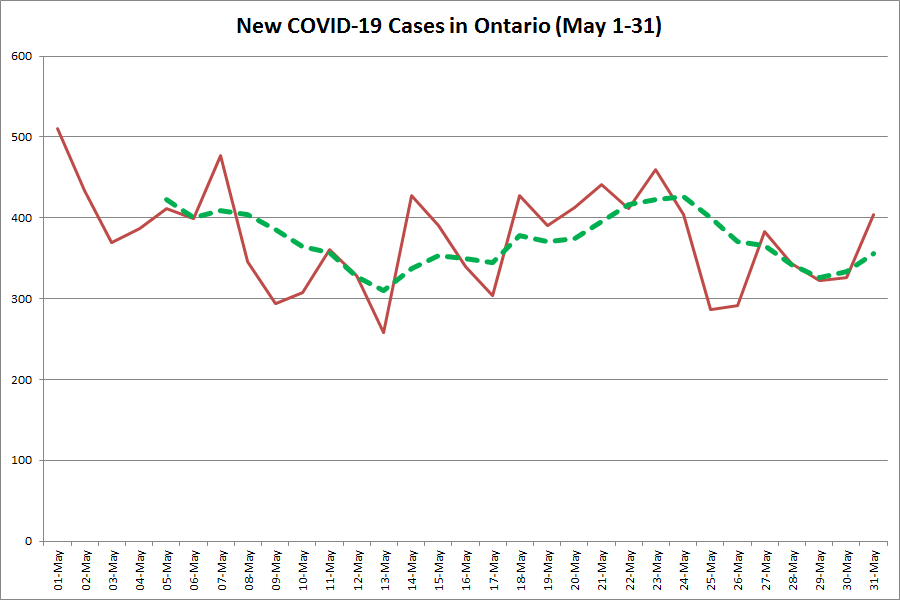
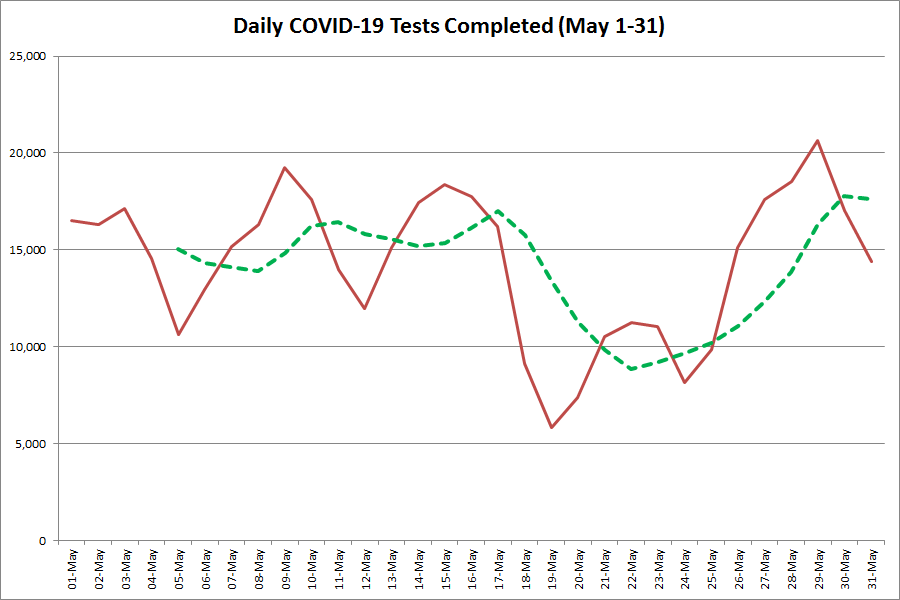
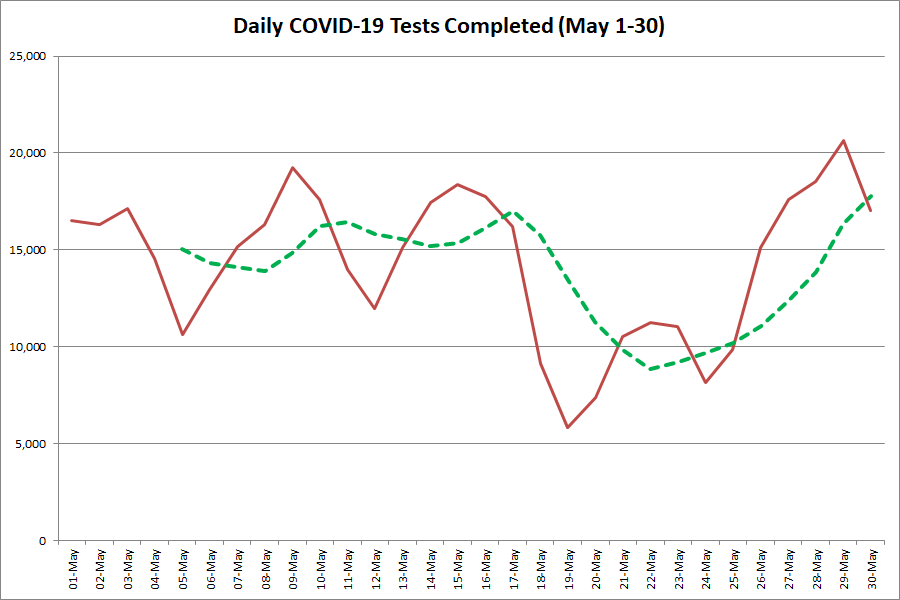
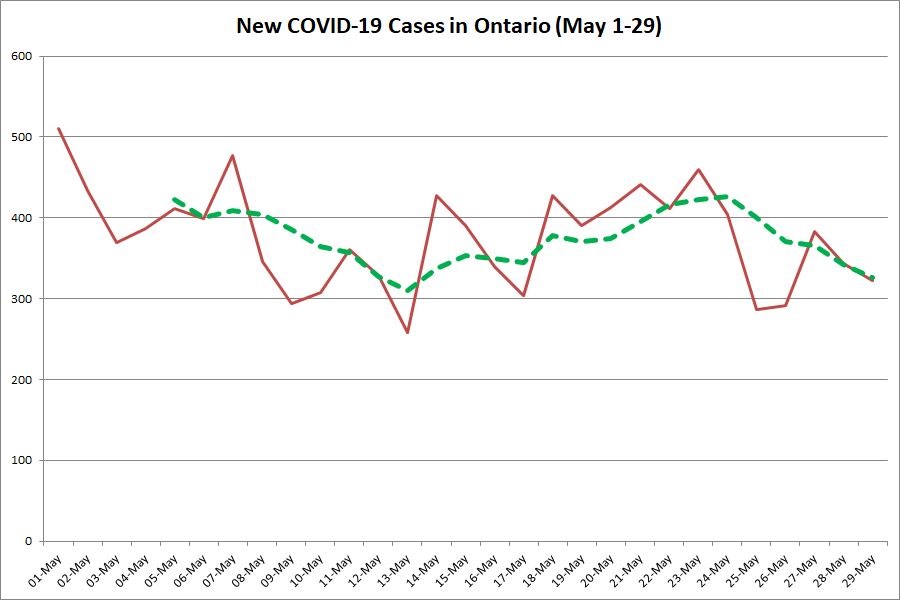
New COVID-19 cases in Ontario from May 1 – 31, 2020. The red line is the number of new cases reported daily, and the dotted green line is a five-day moving average of new cases. (Graphic: kawarthaNOW.com)COVID-19 tests completed in Ontario from May 1 – 31, 2020. The red line is the number of tests completed daily, and the dotted green line is a five-day moving average of tests completed. (Graphic: kawarthaNOW.com)
This story has been updated with news that COVID-19 outbreaks at Kawartha Lakes Retirement Residence in Bobcaygeon and Empire Crossing Retirement Home in Port Hope were declared over on June 1.
Ontario Premier Doug Ford with health minister Christine Elliott at a media briefing at Queen's Park on June 1, 2020. The stage of emergency in Ontario, which is set to expire on June 2nd, will be extended until June 30th. (Screenshot / CPAC)
On Tuesday (June 2), Premier Doug Ford will ask the Ontario legislature to extend the province’s state of emergency for another 28 days, until Tuesday, June 30th.
On Tuesday, June 3rd, the Ontario legislature voted to extend the state of emergency until Tuesday, June 30.
Ford confirmed the plan to extend the state of emergency in response to reporter questions during a media briefing at Queen’s Park on Monday (June 1).
“That will hopefully get us over the hump, per se,” Ford explained.
“That’s another four weeks. We just want to make sure everyone’s safe and healthy. We want to get the economy going and we need that tool to make that happen.”
Advertisement - content continues below
He also didn’t rule out a further extension after June 30th.
“It all depends on the situation we’re facing,” Ford said. “If we’re seeing that everything is moving in the right direction, the numbers are going down, then we don’t need to. But if we see that the movement hasn’t happened, then the option’s on the table.”
Ford also didn’t commit to easing emergency orders, although he said “a lot of things can happen in four weeks, especially if we see the numbers come down.”
“We working very aggressively on coming up with a plan to get the economy going based on the numbers,” he said. “That goes back to our testing strategy — we have a great strategy that we’re rolling out. We’ll be looking at other stages, and a regional approach. I want to get this economy going, but I have to do it safely.”
Health minister Christine Elliott added that further reopening of the province depends on four factors: a continued decrease in the number of new cases, sufficient capacity in hospitals if there is any surge in COVID-19 cases, and adequate testing and contact tracing.
“We still need to go some distance yet before we are ready to start stage two,” Elliott said.
COVID-19 tests completed in Ontario from May 1 – 31, 2020. The red line is the number of tests completed daily, and the dotted green line is a five-day moving average of tests completed. (Graphic: kawarthaNOW.com)
The provincial government first declared a 14-day state of emergency under the Emergency Management and Civil Protection Act (ECMPA) on Tuesday, March 17th.
Under the provisions of the ECMPA, the state of emergency could be extended for one additional 14-day period (until April 14th) with further 28-day period extensions requiring the support of the legislature.
On April 14th, the legislature approved an extension of the state of emergency until Tuesday, May 12th and then, on May 12th, extended it again until Tuesday, June 2nd.
Ashburnham Ale House owner Scott Wood and the Village DBIA have contributed around half of the $50,000 cost to install lighting on the section of the Rotary Greenway Trail between Hunter Street and Douro Street in Peterborough's East City. Donations are being sought to fund the other half of the project cost. (Photo: Bruce Head / kawarthaNOW.com)
Ashburnham Ale House owner Scott Wood is leading a project to light up the Rotary Greenway Trail between Hunter Street and Douro Street in Peterborough’s East City.
Many residents use this section of the trail, which runs beside Ashburnham Ale House, at night.
Recent surveys have indicated that trails are the top priority for recreation for Peterborough residents.
“As someone who loves to walk and cycle, I think it’s great to see so many people using the trails,” Wood says. “Lighting improves their safety and extends the time that people feel safe using the trails. I am excited to be leading this project.”
Wood and the Village Business Improvement Area of East City have contributed around half of the $50,000 cost of the project, and are encouraging others to donate.
Construction of the Rotary Greenway Trail lighting project will begin once fundraising is completed.
The Rotary Greenway Trail, which runs from Roger’s Cove in the south to past Trent University in the north, is a popular route for cyclists. (Photo: Bruce Head / kawarthaNOW.com)
Two other Peterborough residents, Haig Kelly (owner of Kelly Fuels) and his friend Barron Cowan, are funding construction of a new trail through Roper Park.
The trail between Roper Drive and Firwood Drive, which will allow people to get from one neighbourhood to the other more easily, will also connect to Parkhill Road near the access to The Great Trail (formerly known as the Trans Canada Trail). The trail will be paved so that it can be maintained in the winter.
“The trail donations announced are wonderful gifts and, at this time, such positive news is especially appreciated,” says Peterborough city councillor Lesley Parnell, who is the chair of the arenas, parks and recreation portfolio chair on city council.
Kelly and Cowan are well known in the community for their support of local trails, beginning with the Rotary Greenway trail to Lakefield, as well as the Parkway Trail, Crawford Trail, BEL Rotary Bridgenorth Trail, and the Lang Hastings Trail section of The Great Trail — to which Kelly and Cowan donated $240,000.
Construction on the new Roper Park Trail is expected to be underway very soon.
Southern Ontario's 66 destination marketing organizations, including Peterborough & The Kawarthas Tourism, are eligible for $30 million in federal COVID-19 relief funding that will be delivered through the Tourism Industry Association of Ontario. The funding will be used to help encourage visitors to return to local communities as Ontario's economy reopens, supporting tourism-dependent businesses and helping local economic recovery. (Photo: Peterborough & The Kawarthas Tourism)
On Sunday (May 31), federal minister of economic development Mélanie Joly announced $30 million in federal funding to support tourism and recovery efforts across southern Ontario.
In Ontario, tourism accounts for $39.4 billion of GDP and directly and indirectly supports more than 820,000 jobs.
The funding, which is part of the federal government’s national $962-million Regional Relief and Recovery Fund, will flow through FedDev Ontario to the Tourism Industry Association of Ontario (TIAO). The funding is intended to provide financial relief to destination marketing organizations (DMOs) across southern Ontario that have experienced significant revenue shortfalls.
Advertisement - content continues below
DMOs are not-for-profit organizations that help promote and market local attractions, accommodation options, tourism services, transportation, associated retail stores, restaurants, and events. Members of the organizations typically include hotels, restaurants, transportation organizations, tourism operators, retailers, and other tourism-dependent businesses in a local community.
There are 66 DMOs in southern Ontario, including Peterborough & The Kawarthas Tourism, Kawartha Lakes Tourism, and Northumberland Tourism in the Kawarthas region.
“The tourism sector is vital to the economic fabric of southern Ontario and has suffered tremendously by the COVID-19 pandemic,” says TIAO president and CEO Beth Potter. “We are pleased to deliver this fund in partnership with FedDev Ontario, to support destination marketing organizations during these difficult times and to continue to promote tourism in communities across southern Ontario.”
The relief funding will be used by DMOs to help encourage visitors to return to local communities as Ontario’s economy reopens, supporting tourism-dependent businesses and helping local economic recovery.
DMOs can apply for the relief funding beginning on Friday, June 5th through the TIAO’s website at tiaontario.ca/cpages/rrrf.
The amount of funding available to individual DMOs will be determined by TIAO, based on each DMO’s annual operating budget. TIAO will be releasing additional details on the project in the coming days.
kawarthaNOW is providing a daily report of COVID-19 cases in the greater Kawarthas region.
Here’s today summary: there are 88 confirmed positive cases in the Peterborough area, 149 in the City of Kawartha Lakes, 17 in Northumberland County, 7 in Haliburton County, and 43 in Hastings County and Prince Edward County.
There are 5 new cases reported today, including 2 in the Peterborough area, 2 in Kawarthas Lakes, and 1 in Northumberland. An outbreak at Fenelon Court Long Term Care Home in Fenelon Falls was declared over on May 30. Note: Hastings Prince Edward Public Health does not issue reports on weekends; the next update is June 1.
There has been a total of 39 deaths. The most recent death was reported on May 7 by Hastings Prince Edward Public Health.
Province-wide, there are 27,859 confirmed cases, an increase of 326 from yesterday. A total of 21,810 cases are resolved, an increase of 457 from yesterday. There have been 2,266 deaths, an increase of 19 from yesterday, with 1,438 of the deaths being residents in long-term care homes, an increase of 15. A total of 718,341 tests have been completed, an increase of 17,014 from yesterday, with 9,647 tests under investigation, a decrease of 3,113.
This report is based on data supplied by the province’s integrated Public Health Information System (iPHIS), as well as any additional information supplied by health units and hospitals. This information is at least 24 hours old, so it is not real-time data.
We publish the daily report, usually by late afternoon, with the most current information released by health units. Note that each health unit reports the information in a different way.
Peterborough Public Health’s service area is the City and County of Peterborough and the Hiawatha and Curve Lake First Nations.
Confirmed positive: 88 (increase of 2) Deaths: 2 (no change) Resolved: 75 (increase of 1) Total tests completed: Over 8,450 (increase of 400+) Institutional outbreaks: None (no change)
Haliburton, Kawartha, Pine Ridge District Health Unit
The Haliburton, Kawartha, Pine Ridge District Health Unit’s service area is the City of Kawartha Lakes, Northumberland County, and Haliburton County.
Confirmed positive: 173, including 149 in Kawartha Lakes, 17 in Northumberland, 7 in Haliburton (no change) Probable cases: 0 (no change) Hospitalizations: 11 (no change) Deaths: 32 (no change) Resolved: 147 (increase of 2) Institutional outbreaks: Kawartha Lakes Retirement Residence in Bobcaygeon, Empire Crossing Retirement Home in Port Hope (decrease of 1)*
*The health unit has declared the outbreak at Fenelon Court Long Term Care Home in Fenelon Falls over on May 30. The outbreak was declared on May 18 after one asymptomatic staff person tested positive for COVID-19 during enhanced surveillance testing.
Hastings Prince Edward Public Health
Hastings Prince Edward Public Health’s service area is Hastings County (including Bancroft) and Prince Edward County.
Confirmed positive: 43 (no change)* Probable cases: 182 (no change)* Deaths: 5 (no change)* Hospitalized: 0 (no change)* Hospitalized and in ICU: 0 (no change)* Hospitalized and in ICU on ventilator: 0 (no change)* Recovered: 32 (no change)* Total tests completed: 7,252 (increase of 100)* Institutional outbreaks: None*
*These numbers are from May 29. The health unit does not issue reports on weekends. The next update is on June 1.
Advertisement - content continues below
Province of Ontario
Confirmed positive: 27,859 (increase of 326) Hospitalized: 781 (decrease of 20) Hospitalized and in ICU: 118 (decrease of 3) Hospitalized and in ICU on ventilator: 90 (increase of 6) Deaths: 2,266 (increase of 19) Deaths of residents in long-term care homes: 1,438 (increase of 15, 63.5% of all deaths) Total tests completed 718,341 (increase of 17,014) Tests under investigation: 9,647 (decrease of 3,113) Resolved: 21,810 (increase of 457)
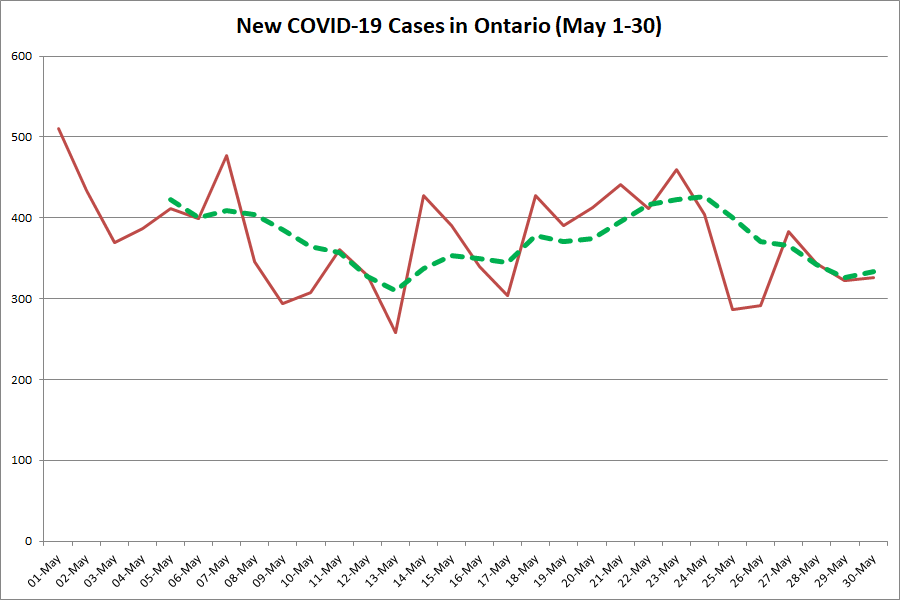
New COVID-19 cases in Ontario from May 1 – 30, 2020. The red line is the number of new cases reported daily, and the dotted green line is a five-day moving average of new cases. (Graphic: kawarthaNOW.com)COVID-19 tests completed in Ontario from May 1 – 30, 2020. The red line is the number of tests completed daily, and the dotted green line is a five-day moving average of tests completed. (Graphic: kawarthaNOW.com)
The Lindsay Drive-In is reopening for the 2020 season on May 31, 2020, with government-mandated restrictions in place due to the COVID-19 pandemic. Pictured is a 1955 Buick Super owned by David Vahey of Omemee at the Lindsay Drive-In in 2017. Drive-in theatres, which were at the height of their popularity in the late 1950s, have experienced a resurgence in popularity during the pandemic, as they provide a shared social experience that still allows people to maintain physical distancing. (Photo: Lindsay Drive-In / Facebook)
The Lindsay Drive-In is opening for the season on Sunday night (May 31), but it won’t be the traditional drive-in experience.
While the Ontario government has amended the emergency order prohibiting drive-in theatres from opening, stringent public health measures are now in place.
One of those measures includes a prohibition on selling food and beverages, so drive-ins are not allowed to open their concession stands — which generates a lot of their revenue.
Because Ontario government restrictions require vehicles at the drive-in to remain two metres apart, the Lindsay Drive-In will operate at half its normal capacity — meaning only 185 vehicles will be allowed into the theatre.
As a result, the Lindsay Drive-In is temporarily raising its admission prices to $15 per person ($5 for children between 3 and 12, free for kids 2 and under).
Advertisement - content continues below
The other big difference is that, because cinemas remain closed, Hollywood isn’t releasing new movies. So the Lindsay Drive-In will be screening older releases.
For the time being, the Lindsay Drive-In is open Friday to Tuesday. There will be no Carload Tuesdays (discount night).
From Sunday (May 31) to Tuesday (June 2), the drive-in will be playing Trolls World Tour (PG) and The Invisible Man (18A) on both screens.
The box office opens at 7 p.m. and the movies begin at dusk.
“This could result in being turned away at the box office,” owner Danny Zita writes on the drive-in’s website. “While we can’t predict our numbers, we will try to update asap if we are close to selling out. Since we are open 5 days a week, there will be lots of chances to get in.”
The following government-mandated rules are in place at the Lindsay Drive-In:
there must be one empty parking space between each vehicle (two metres apart)
only members of the same household can be in the same vehicle
patrons must remain in their vehicles except when leaving to use the washroom
convertibles are not allowed, and patrons cannot sit in the beds of pick-up trucks.
Zita says that any patrons who do not follow these rules will be asked to leave.
Advertisement - content continues below
While washrooms are open (cleaned and disinfected regularly), the concession stand and kids’ playground are closed.
Debit, credit, and mobile pay options are accepted at the box office.
“It’s a stressful time for everyone,” Zita writes on the drive-in’s website. “We all know the drill. Let’s be nice to our friends, visitors and staff at the Drive In. Please stay home if you have any symptoms … Let’s all do our part to be responsible.”
The other drive-in in the Kawarthas, the Port Hope Drive-In in Cobourg, has not released any information about its re-opening plans as of the publication date of this story.
kawarthaNOW is providing a daily report of COVID-19 cases in the greater Kawarthas region.
Here’s today summary: there are 86 confirmed positive cases in the Peterborough area, 147 in the City of Kawartha Lakes, 16 in Northumberland County, 7 in Haliburton County, and 43 in Hastings County and Prince Edward County.
There are no new cases to report. Note: Hastings Prince Edward Public Health does not issue reports on weekends; the next update is June 1.
There has been a total of 39 deaths. The most recent death was reported on May 7 by Hastings Prince Edward Public Health.
Province-wide, there are 27,533 confirmed cases, an increase of 323 from yesterday. A total of 21,353 cases are resolved, an increase of 370 from yesterday. There have been 2,247 deaths, an increase of 17 from yesterday, with 1,423 of the deaths being residents in long-term care homes, an increase of 11. A total of 701,327 tests have been completed, an increase of 20,640 from yesterday, with 12,760 tests under investigation, a decrease of 591.
This report is based on data supplied by the province’s integrated Public Health Information System (iPHIS), as well as any additional information supplied by health units and hospitals. This information is at least 24 hours old, so it is not real-time data.
We publish the daily report, usually by late afternoon, with the most current information released by health units. Note that each health unit reports the information in a different way.
Peterborough Public Health’s service area is the City and County of Peterborough and the Hiawatha and Curve Lake First Nations.
Confirmed positive: 86 (no change) Deaths: 2 (no change) Resolved: 74 (no change) Total tests completed: Over 8,050 (increase of 350+) Institutional outbreaks: None (no change)
Haliburton, Kawartha, Pine Ridge District Health Unit
The Haliburton, Kawartha, Pine Ridge District Health Unit’s service area is the City of Kawartha Lakes, Northumberland County, and Haliburton County.
Confirmed positive: 170, including 147 in Kawartha Lakes, 16 in Northumberland, 7 in Haliburton (no change) Probable cases: 0 (no change) Hospitalizations: 11 (no change) Deaths: 32 (no change) Resolved: 145 (no change) Institutional outbreaks: Kawartha Lakes Retirement Residence in Bobcaygeon, Fenelon Court Long Term Care Home in Fenelon Falls, Empire Crossing Retirement Home in Port Hope (no change)
Hastings Prince Edward Public Health
Hastings Prince Edward Public Health’s service area is Hastings County (including Bancroft) and Prince Edward County.
Confirmed positive: 43 (no change)* Probable cases: 182 (no change)* Deaths: 5 (no change)* Hospitalized: 0 (no change)* Hospitalized and in ICU: 0 (no change)* Hospitalized and in ICU on ventilator: 0 (no change)* Recovered: 32 (no change)* Total tests completed: 7,252 (increase of 100)* Institutional outbreaks: None*
*These numbers are from May 29. The health unit does not issue reports on weekends. The next update is on June 1.
Advertisement - content continues below
Province of Ontario
Confirmed positive: 27,533 (increase of 323) Hospitalized: 801 (decrease of 25) Hospitalized and in ICU: 121 (decrease of 8) Hospitalized and in ICU on ventilator: 84 (decrease of 16) Deaths: 2,247 (increase of 17) Deaths of residents in long-term care homes: 1,423 (increase of 11, 63.3% of all deaths) Total tests completed 701,327 (increase of 20,640) Tests under investigation: 12,760 (decrease of 591) Resolved: 21,353 (increase of 370)
New COVID-19 cases in Ontario from May 1 – 29, 2020. The red line is the number of new cases reported daily, and the dotted green line is a five-day moving average of new cases. (Graphic: kawarthaNOW.com)COVID-19 tests completed in Ontario from May 1 – 29, 2020. The red line is the number of tests completed daily, and the dotted green line is a five-day moving average of tests completed. (Graphic: kawarthaNOW.com)
kawarthaNOW.com offers two enews options to help readers stay in the know. Our VIP enews is delivered weekly every Wednesday morning and includes exclusive giveaways, and our news digest is delivered daily every morning. You can subscribe to one or both.
Submit your event for FREE!
Use our event submission form to post your event on our website — for free.
To submit editorial content or ideas, please contact us.