



















As Remembrance Day draws nearer, we’re going to hear much about the sacrifice of thousands of Canadians who marched to war in Europe, to the Korean peninsula and, more recently, to Afghanistan.
What we won’t hear much about is the friendships forged and the dreams dashed, and the love and emotions experienced by those who answered the call. And we’ll hear even less about the courage, compassion, and resilience of the women who tended to the wounded.
Vern Thiessen’s play Bluebirds, which opens on Friday, October 30 for 10 performances at the Guild Hall on Rogers Street in East City, fills the void via its relation of the experiences of three women serving as Canadian military nurses during the First World War.
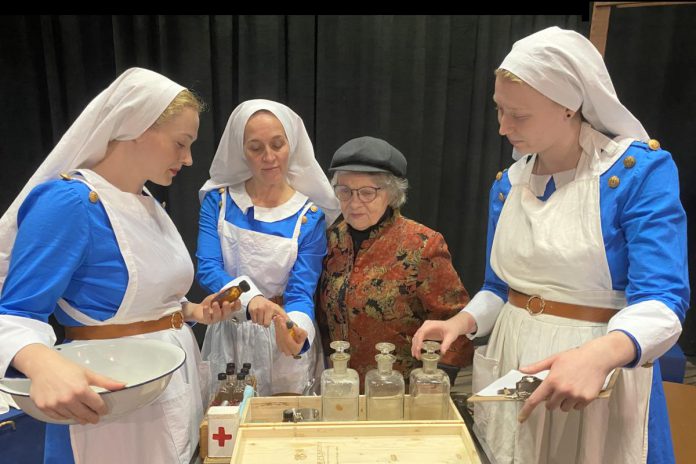
The second production of the Peterborough Theatre Guild’s six-play 2026-27 season, the award-winning Canadian playwright’s drama is set in Étaples, France where nurses Christy (Emily Kelly), Maggie (Laura Lawson), and Bab (Rebecca Birrell) toil during the final year of what was described at the time, failingly as things turned out, as “the war to end all wars.”
Finding moments of humour, companionship, and relief in each other, the three women — nicknamed “Bluebirds” for their strikingly bright blue nurse uniforms — form a deep connection.
Through conversations, letters home, and quiet reflection, we learn Christy wrestles with the expectations of her marriage and her sense of self, Maggie longs for the life and love she left behind, and Bab yearns for connection and a future that feels out of reach.
A sequel of sorts to Thiessen’s 2007 acclaimed play Vimy, about four wounded Canadian soldiers in 1917 France in the wake of the battle for Vimy Ridge who are recovering in a field hospital with the help of a young nurse from Nova Scotia as they wait to find out whether they will be sent home or back to the front, Bluebirds had its world premiere at Theatre New Brunswick in the fall of 2022 to sold-out shows.
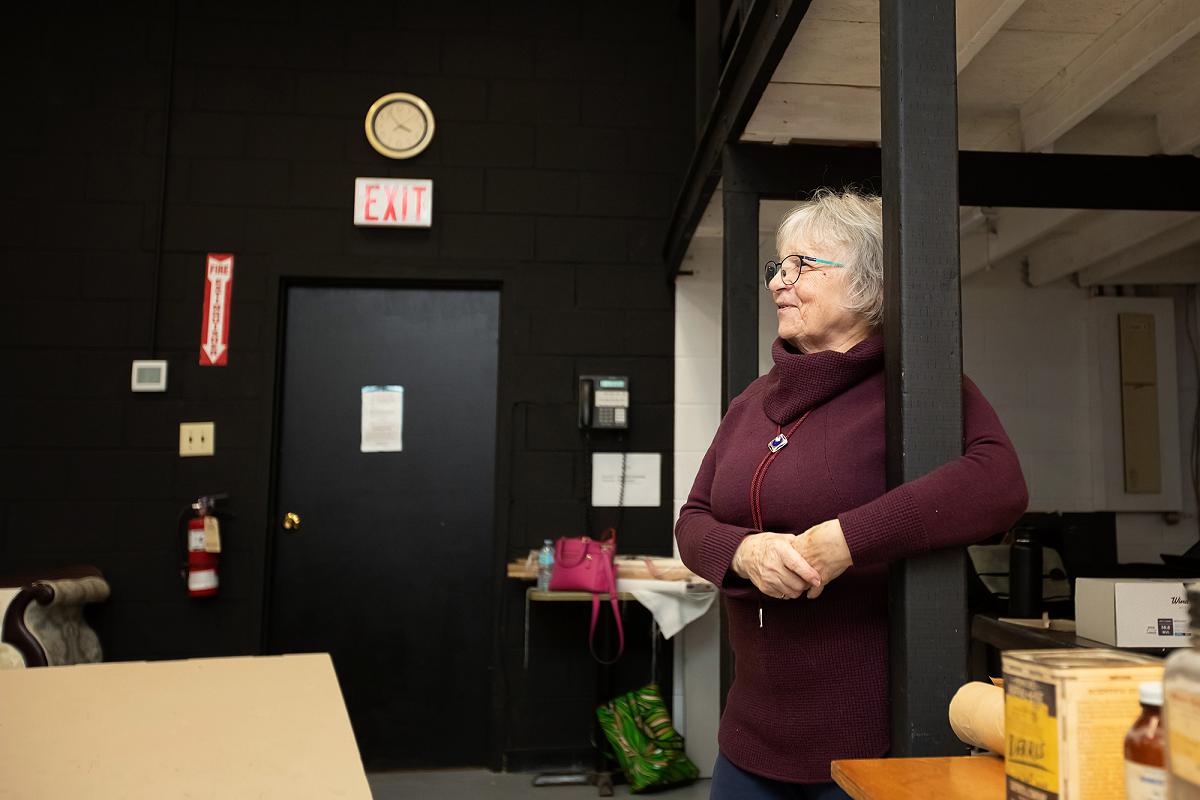
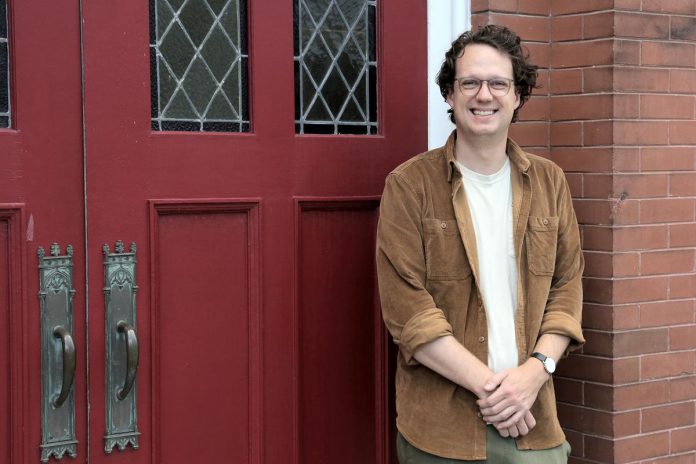
Noting the play is based on three real-life nurses who died when the hospital they toiled in was bombed, director Bea Quarrie says Thiessen “has taken that and fictionalized it.” The result, she adds, “is about the joy of survival, the need to live … to want to win over all of the difficulties and still have a reasonably normal life.”
“It’s this desire, the way he captures the essence of young women wanting to go on in life and not be defeated by all the obstruction that’s in front of them and all the things that are standing in their way, that attracted me,” says Quarrie of her desire to direct the Peterborough Theatre Guild production.
“He did the same thing with Vimy,” she adds. “He took archetypal characters and made them into really lovable human beings who struggle. It’s about the struggle, not the capitulation, and not about the fact that they died. It’s not a war story as such. It’s about their overcoming that, or at least to whatever degree they could.”
Quarrie notes Thiessen’s story also brings to light the contributions of Canadian women to the war effort, and the fact that nurses were very well trained in comparison to their colleagues.
“Most of the nurses from the other continents didn’t have a three-year nursing degree. (The Canadian nurses) had studied their subject. They knew more than what to do with a scraped knee. Canada was ahead of the curve in that sense.”
Quarrie terms the work and commitment of her three actors as “extraordinary.”
“It’s a gift to a director when actors come as curious human beings; as people who are empathetic, as people who want to do the best job that they can, and as people who do everything that they can in order to be here and be present in the moment and create,” she says.
“The three of them bring such a totally different kind of background and yet they’re all at the same level when it comes to the intensity of defining these characters and making it work on stage in a way that challenges them.”
“My job is to make it possible for them to feel safe so that they can do that; they can do a face flop on stage and not feel bad about it. When a play opens, the director disappears if they’ve done their job properly.”
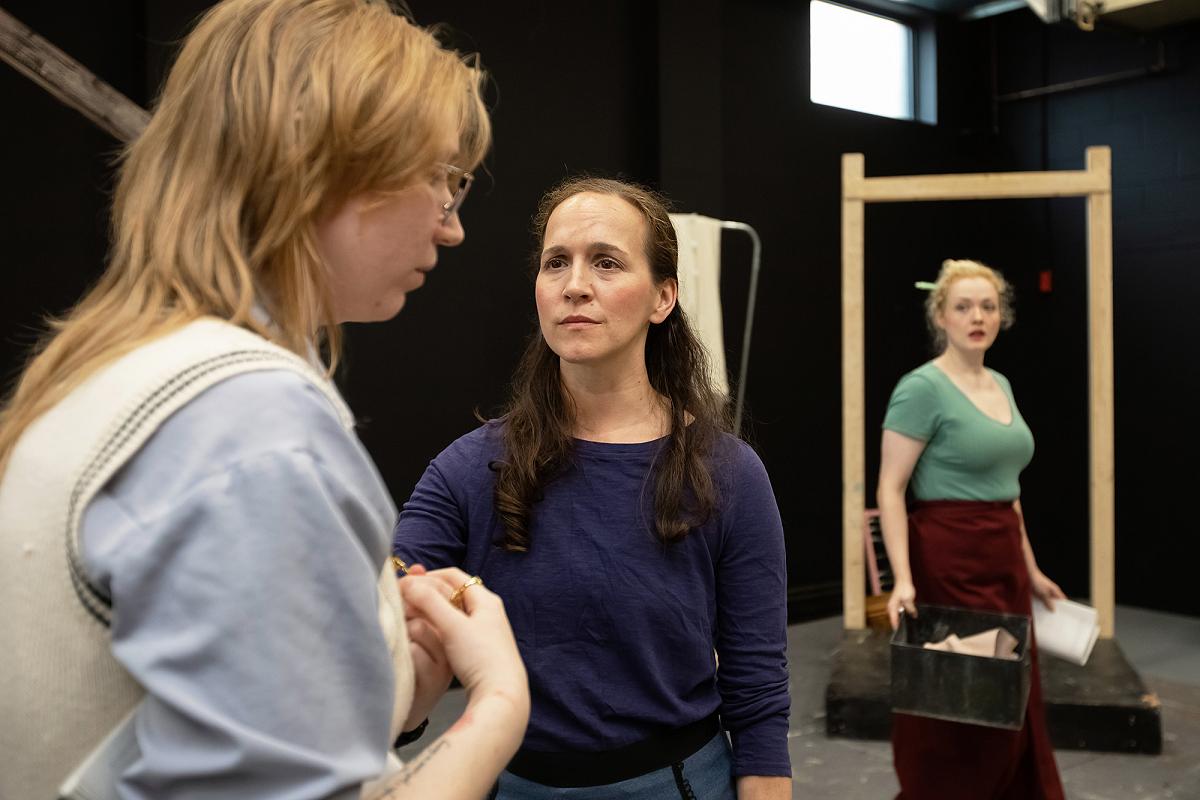
The story’s sometimes heavy subject matter, says Quarrie, has the potential to weigh heavily on each of her actors. That has made her especially cognizant of countering that.
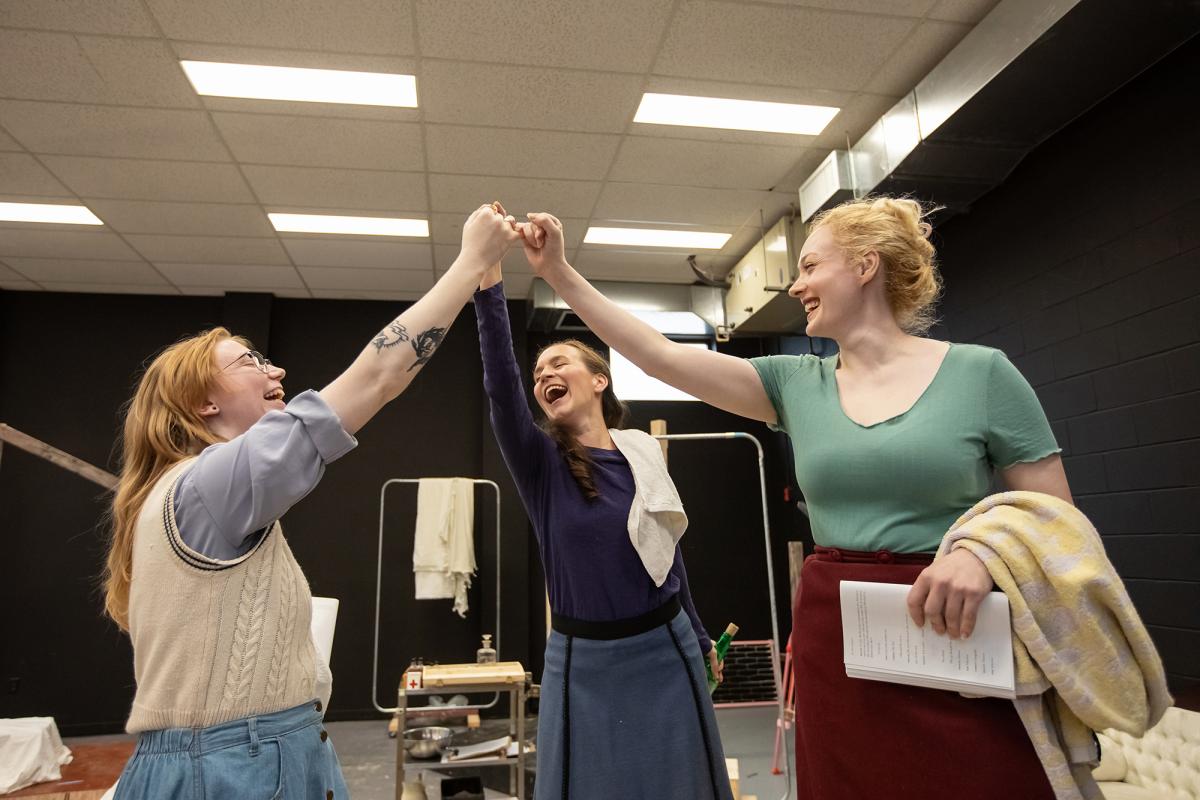
“You can’t have light if you don’t have darkness. They’re seeing the darkness, but I remind them to not let that weigh them down. So, they tackle the scenes that are full of effervescence and discovery and ‘Oh, they’re in love.’ It makes all the difference in the world when they lose that, or there’s the potential that they might lose that.”
“As I’ve grown through the rehearsal process, I’ve seen them grow as well. We have different insights on things. We have different challenges. It’s not a smooth road to get to the top, but we’re helping each other.”
Of note, the set for Bluebirds is abstract as opposed to the more common box set that has three walls with the audience’s view being the fourth wall.
“It’s not confining — it’s representational,” explains Quarrie. “The characters in the play put boxes together to make a bed. Then they change something and it becomes a screen, and then they change something else and it becomes a podium.”
From a lighting and sound viewpoint, Quarrie describes the set as “a dreamscape.”
“The three characters are actually ghosts. They’re coming back and landing here, telling us their story, and they evanesce again. They start the whole thing by saying ‘Here we are, here we are, here we are again, here we go … we haven’t learned a damn thing.'”
“That’s to remind us we haven’t learned anything from wars. When I submitted this play to the Guild last year, they were bombing hospitals in Gaza. Have we learned anything? No, we haven’t. We’re the stupidest species on the Earth.”
Quarrie is hopeful that audiences will come away from Bluebirds with plenty of food for thought.
“One of the signs of a really good production is when people walk away and talk about their lives, and talk about what they saw and heard and how it affected them,” she says, adding “Then there’s a connection.”
“Reflect, think, cogitate, but not dismiss as ‘Oh, that was nice’ and then go on to the next thing. I don’t want it to be consumerist theatre, where they just chew up the whole thing and digest it and, that’s it, done. I want it to get to the point where the audience feels that something has changed.”
“You’re paying money to be taken on an experience that somehow will help you. Sometimes social change can happen through this kind of thing. I’m all for entertainment with no T for theatre. People love it. They come back feeling better about themselves and the world. Fair enough, but not something I’m interested in being involved with. I want something more. I want something that will set me to thinking about the world in general. That’s what fires me.”
Produced by Diane Théberge, Bluebirds runs for 10 performances with evening shows at 7:30 p.m. on October 30, November 5 to 7, and November 12 to 14, and 1:30 p.m. matinee shows on October 31 and November 1 and 8.
Tickets are $30 ($27 for seniors and $20 for students) and are available at www.peterboroughtheatreguild.com/upcoming-plays/bluebirds. A special two-for-one ticket promotion is available for opening night on October 30 and the matinee performance on October 31.
Other members of the creative team are stage manager Lyn Braun, set designer David Geene, sound designer Esther Vincent, projections and lighting designer Nate Axcell, costume designer Gwen Hope, hair and makeup designer Hayley Griffin, and director assistants Kory Gavin and Francine Kelly.
As Bluebirds includes themes of war, injury, and loss, it is recommended for those aged 16 and up.
kawarthaNOW is proud to be a media sponsor of the Peterborough Theatre Guild’s 2026-27 season.