






Peterborough city council has endorsed a tourism growth strategy for the city for the next four years, despite concerns from some councillors about the city’s in-house service model and the lack of a completed economic development strategy and municipal cultural plan.
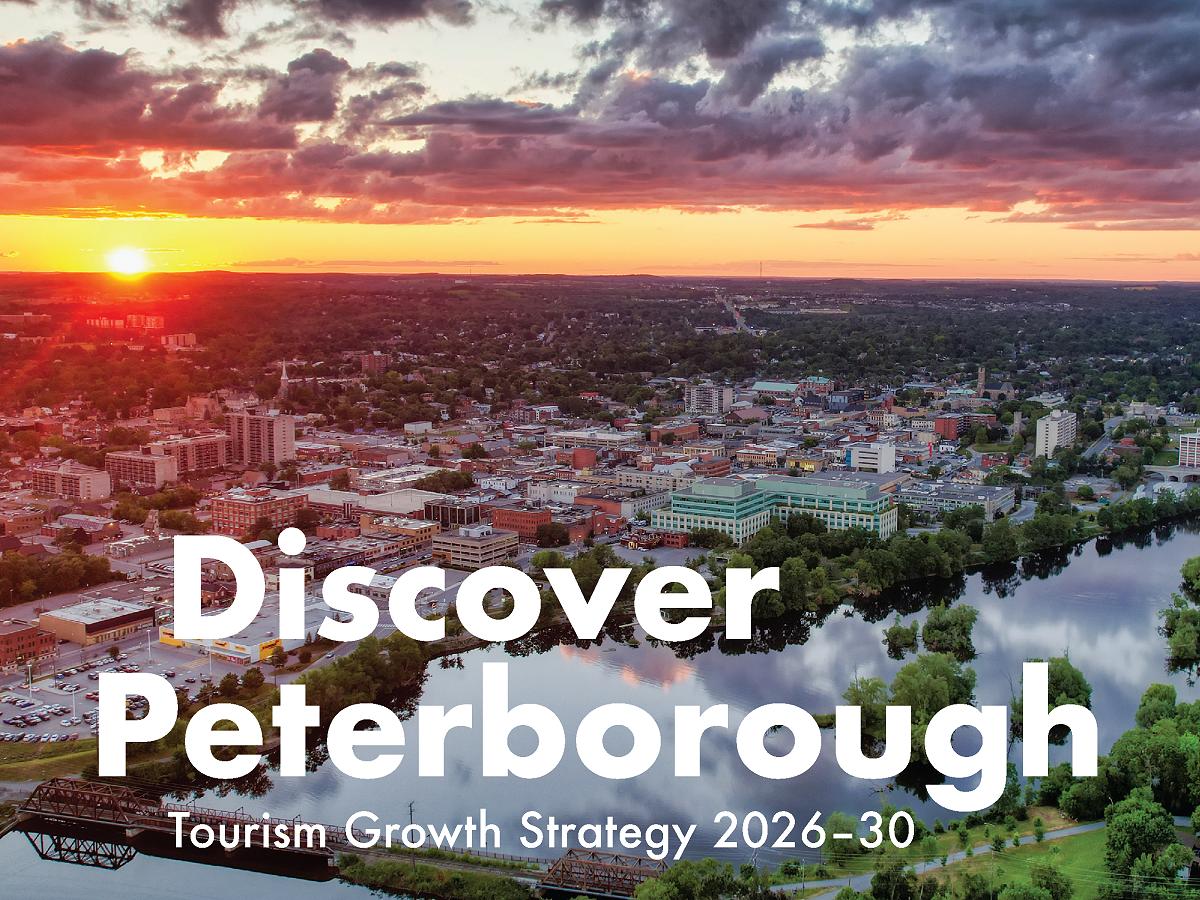
At its general committee meeting on Monday night (June 8), councillors considered a joint report from finance and corporate support services commissioner Richard Freymond and community services commissioner Sheldon Laidman that recommended council endorse the strategy, entitled “Discover Peterborough: Tourism Growth Strategy,” which would guide the city’s tourism service delivery and activities from 2026 to 2030.
The City of Peterborough began delivering economic development and tourism services in-house in January 2025, after Peterborough & The Kawarthas Economic Development dissolved at the end of 2024 following a decision by the City and County of Peterborough to not renew their tri-party funding agreement with the not-for-profit corporation, which had delivered economic development and tourism services on behalf of both municipalities for 25 years.
City’s first tourism strategy to guide Peterborough Tourism for next four years
At Monday night’s meeting, commissioner Laidman provided an overview of the 56-page strategy, noting it is the city’s first tourism strategy and that it will help inform development of annual workplans for Peterborough Tourism, the city’s tourism services and destination marketing program which is led by recreation, parks and cultural services director Rob MacAulay and strategic communications and Service Peterborough director Brendan Wedley.
Laidman’s introduction was followed by a presentation by Trevor Jonas Benson, managing partner of Bannikin Travel & Tourism, which the city hired as a consultant to develop the strategy.
After Benson’s presentation, councillor Joy Lachica noted that the city’s economic development and tourism services are under two different commissioners and asked Benson if the tourism strategy had been integrated with economic development, calling the two “inseparable.”
Benson said that the strategy should align with the city’s economic development strategy as well as its new municipal cultural, both of which are “coming to fruition.”
Calling the strategy “modern and current and representative of the culture here,” councillor Alex Bierk asked Benson whether the strategy had specific investments, programs, policy changes to strengthen sectors and whether it could help the city encourage development of modern hotel facilities. Benson said specific actions arising from the strategy would depend on how the city uses revenue from the municipal accommodation tax (MAT) to implement the strategy.
“There would be a direct dovetail with economic development,” Benson said.
Councillor Keith Riel called the strategy “very boilerplate” and questioned the value of the public consultations, which involved just over 500 Peterborough residents, with Benson replying that the responses were of high quality.
After councillor Gary Baldwin asked him whether the strategy considered the impacts of a potential events centre and Alto high-speed rail, Benson said that neither was within the scope of the strategy.
Councillor Kevin Duguay, who said he was pleased with the strategy, asked a similar question with respect to the new visitor centre on the Trent-Severn Waterway, and also about opportunities to showcase Peterborough, while councillor Joy Lachica asked about the Rainbow designation mentioned in the strategy.
In his second question, councillor Bierk asked about whether there were any recommendations in the strategy that would increase funding capacity for artists, arts organizations, or cultural producers.
Benson referred to two actions in the strategy, one to “provide stable, multi-year funding and practical support to arts and cultural organizations as informed by the Municipal Cultural Plan,” and the other to “collaborate with community organizations to support and grow inclusive and diverse cultural celebrations and community events that reflect the diversity of Peterborough.”
Councillor Bierk raises concerns about city’s in-house service model
Councillors then debated the report, with councillor Riel commenting that “Tourism is an economic driver,” before asking the city’s director of economic development Darryl Julott “What is the projected economic return on every dollar invested?”
“I don’t have that number handy,” Julott replied, noting that it changes frequently. “I can absolutely look at providing that.”
After Riel asked Julott how success would be measured and reported to council, he deferred the question to MacAulay as he is implementing the strategy. MacAulay said the city will be completing an economic impact study of Peterborough Musicfest in 2026 as an example of return on investment, as well as the Telus Cup for the fall and the CANCAST fishing show for next year.
“We’ve had an economic development director for almost a year and I haven’t seen any presentation to council on economic development,” Riel said. “I believe that tourism is economic development.”
After councillor Don Vassiliadis asked how the MAT revenue of $850,000 is being allocated across marketing, events, and infrastructure, commissioner Laidman said it is spent generally on tourism-related activities.
When Vassiliadis asked if the city was going to increase the four per cent MAT rate and if a report would come to council to recommend an increase, Laidman said a report would be coming forward in the fall.
“We are in anticipation of not only increasing the rate but also expanding the scope of the short-term accommodations it applies to,” Laidman said.
In his remarks, councillor Bierk expressed concern about the city’s organization of economic development and tourism services.
“I understand that staff are completely sold on this idea on how tourism and economic development is structured, where the municipal cultural plan plays in, but it’s really strange to me, the conversation, how it’s gone so far with some of the questions,” Bierk said. “There’s been some long expanses of silence and staff looking at each other, unsure of who to answer what.”
“Commissioner Laidman started off with the presentation and started off to kick us off — he’s in community services — but then Richard Freymond’s name is on the report. We’re tagging in Darryl Julott, so if it’s confusing to me as a councillor, I think it’s going to be greatly confusing to the public as to where this strategy applies, who to go to, what division is responsible.”
“We’re also asking questions about how tourism is benefiting the economy, but we’re being given sort of vague answers … I think we should have some hard numbers because we’re going to be asked, from this (strategy), to invest in certain areas.”
Bierk also expressed concerns that the strategy doesn’t indicate how the city will support the arts organizations that create visitor experiences or the downtown, such as strengthening downtown businesses, animation, streetscapes, public spaces, and cultural programming.
“That, in my view, is the central weakness of the report,” he said. “It is very strong on vision and language and values, but it’s weak on implementation, funding commitments, and measurable outcomes.”
MacAulay said he would provide council with a list of actions that support the downtown.
Bierk then asked for details on how much the city is spending to deliver tourism services and where the money is going.
“Since tourism services were brought in-house, how much has been spent on consultants, staffing, branding, strategy, development, and administration compared to direct investments into festivals, arts organizations, and other visitor experiences?” he asked.
Commissioner Laidman replied that approximately half of the MAT revenue has gone towards operations “to ensure tourism as a strategy is implemented with all our partner agencies, organizations, and groups,” with the other half going to destination marketing.
“I think there’s an example that was sent around to council of probably at least 100 events and opportunities that have been supported already, but those types of events require infrastructure in terms of the operation, the staffing of the visitor centres that are being provided to pursue those opportunities, to provide supports to the events,” Laidman said.
“There’s various levels of events and supports that are being provided to each event that’s supported. Some are fully operated by the city, such as Canada Day, some are provisionally supported in terms of providing supports, like public works supports, recreation staff helping their event go on, and then there’s others that we’re just directly providing funding to.”
Responding to Laidman’s comments, councillor Bierk said “That’s always been the case.”
“We’ve always managed arenas, we’ve always helped with events, we’ve always helped with parades. If this was a different position where it was still a third party and this tourism wasn’t in-house, I think these would be fair questions to ask. But it seems like they’re getting lost in the fog now that we’ve had this in-house.”
“It’s becoming definitely less clear for me as a councillor to figure how much we’re spending on new staff, how much we’ve spent on the consultants thus far, and what that looks like in terms of the money that’s actually going into the downtown, the money that’s actually going into the arts organization’s hands, the money that’s actually going to support independent businesses.”
“This is where the report falls apart, because the report emphasizes all those things. We’ve always supported those things in a way as a city, of course we have, especially through community services, but it’s becoming a little gray for me to understand how we’re supporting them any differently by bringing tourism in-house, and it’s becoming very gray to understand how they would be supported any differently from this tourism strategy.”
Councillor Lachica: ‘We have a structural issue here, and it’s going to lead to further confusion’
For her part, councillor Lachica raised concerns about considering a tourism strategy outside of the context of an economic development strategy.
“This tourism strategy is happening before we have created our economic development strategic plan,” she said. “How can we do this in isolation from each other? How can we not have our director of economic development informing and help guide and managing and overseeing the subdivision — under the umbrella of economic development — of tourism?”
After she asked city CAO Jasbir Raina whether the city’s economic development director would have oversight of tourism services, Raina said the current model was approved by council and he is waiting for the results of the city’s services review before deciding whether tourism should be segmented or under one umbrella.
Lachica noted that, while councillors receive an update on economic development under infrastructure planning and growth management, “it’s isolated from any information on tourism, which is under another portfolio and commissioner Freymond.”
“I think that we have a structural issue here, and it’s going to lead to further confusion unless we solidify the fact that, even though monies are being generated through the MAT tax and various things from different parts of our budget towards economic development, we need to have a clear structural hierarchy and an understanding of how staffing will be executing the items that are going to be actionable here.”
“I feel that it’s premature to be endorsing a tourism strategy without a municipal cultural plan, that needs to emphasize all aspects of culture and the arts and sports and everything that is essential, and before we have an economic development strategy.”
Motion to defer strategy until the fall defeated
Lachica then put forward a motion to defer endorsing the tourism strategy until the city’s economic development strategy and municipal cultural plan have been completed.
Laidman said that ideally the tourism strategy and the economic development strategy would be completed at the same time, but noted council approved the model for in-house tourism which is being delivered by MAT tax and not taxpayer dollars. In response to a question from Mayor Leal, Laidman said the municipal cultural plan would be completed in the fall and Julott said the economic development strategy would also be completed in the fall.
Councillor Lachica’s deferral motion lost 5-5, with her and councillors Dave Haacke, Bierk, Riel, and Mayor Leal voting in favour and councillors Vassiliadis, Beamer, Parnell, Duguay, and Baldwin voting against. Councillor Matt Crowley was not present at the meeting.
Debating the main motion, Mayor Leal spoke about being “on the road” for the last three weeks to talk about the benefit of an events centre for downtown Peterborough, noting that an event centre could be adapted to accommodate conventions, something that only Kingston and Ottawa in east-central Ontario can currently do.
“We know that downtown Peterborough has our highest-value assessment, and we do know that ancillary activities that will be associated with a new events centre will pay handsome dividends for our downtown area,” Leal said, adding that “It wouldn’t surprise me” if the proponents who responded to the request for quotations for the events centre will include hotel or hotels as part of their vision.
Council voted 9-1 in support of receiving the tourism strategy and endorsing its recommendations, with only councillor Riel voting against it.
Items endorsed by general committee will be considered by council for final approval next Monday (June 15), when registered delegations will be heard.
Council meetings are streamed live at www.peterborough.ca.