












Families, friends, and supporters of people lost to drug-related deaths in Peterborough and across the world are recognizing 25 years of calling for better care for people who use substances.
“We have been at this for 25 years, yet people are still needlessly dying,” said Aizha Pollock, manager of harm reduction at Peterborough AIDS Resource Network (PARN), in a recent interview with kawarthaNOW.
The 2026 theme for International Overdose Awareness Day (IOAD) is “25 Years On. Still Needed.”
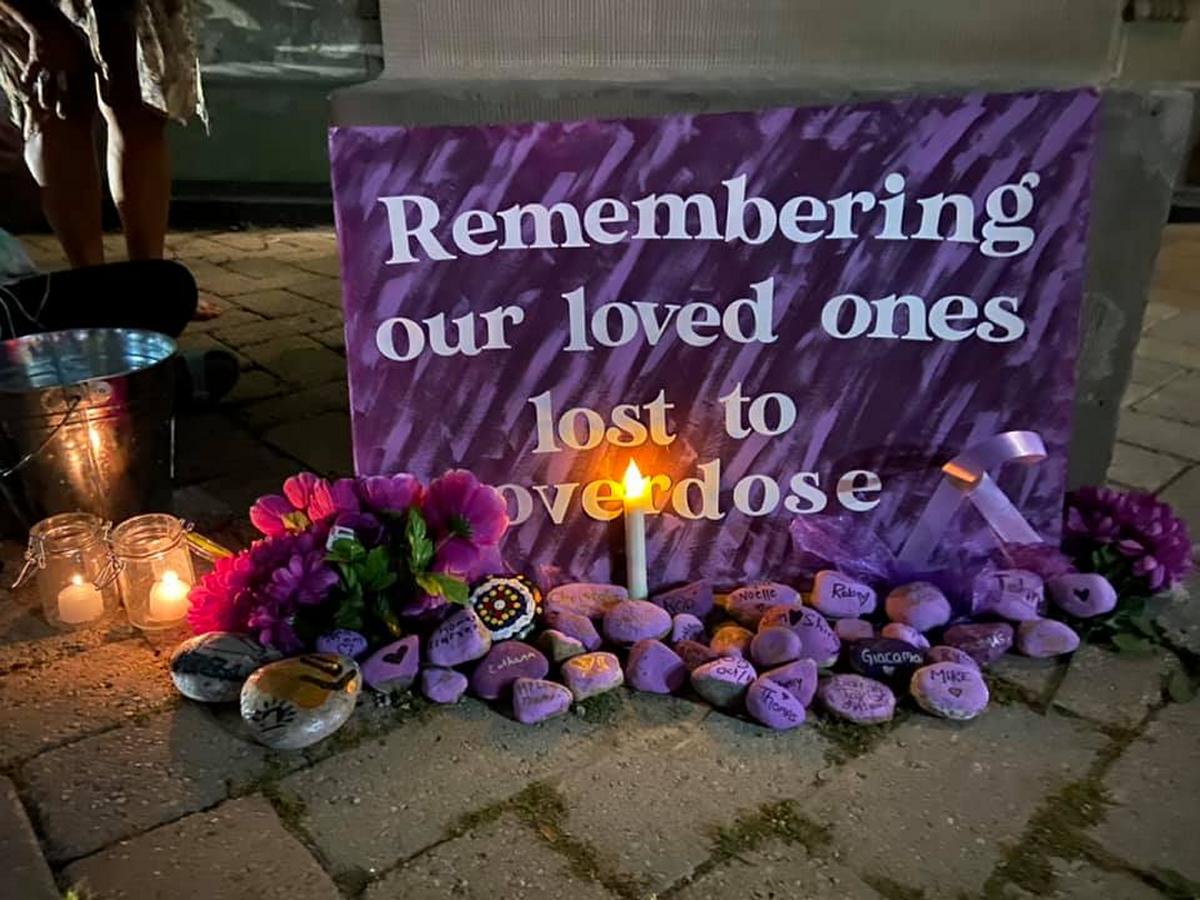
August 31 gathering at Millennium Park will remember those lost to drug-related harms
IOAD was first recognized in Melbourne, Australia in 2001 and is now recognized in over 40 countries annually on August 31 as a day both of remembrance and prevention advocacy.
In Peterborough, IOAD was first recognized in 2016 but the event gained momentum in 2018 with the support of local mother Gail Parry and Canadian advocacy and support network Moms Stop the Harm.
“What began with one mother’s grief grew into something much larger. Gail created space for other families to honour the people they had lost,” said Pollock at a flag-raising ceremony at Peterborough City Hall on August 18.
This year, PARN will host its annual August 31 IOAD gathering in Peterborough’s Millennium Park at 131 King Street from noon to 4 p.m. The event will bring together people affected by overdose deaths, supporters, and community members interested in learning more.
Attendees can expect a free barbeque provided by M&M Food Market, music, community partners and information about local programs, services, and supports, speakers with a range of perspectives and experiences, naloxone training, harm reduction information and resources, and a memorial banner recognizing people who have been lost to accidental drug poisoning.
“I encourage everybody to come to show their support for people who use drugs, for people who have lost loved ones to drug-related harms, and to honour and remember and tribute people lost to drug-related harms,” said Pollock.
Naloxone pop-up events aim to equip community members
Ahead of the Millennium Park gathering, PARN is hosting free pop-up naloxone events where community members can receive free naloxone kits, be trained on how to provide naloxone, and learn more about overdose prevention and harm reduction.
The next pop-up event will be on Wednesday, August 26 at Peterborough Square Mall (360 George Street North) from 1 to 4 p.m. and the final event will happen on Friday, August 28 at Peterborough Public Library (345 Aylmer Street North) from 1 to 4 p.m.
“It’s so important to get naloxone in the hands of the broader community and to make sure they’re trained and comfortable if they come across somebody who’s in need of help,” said Pollock.
Community members can receive a free naloxone kit at any time from local providers including PARN, Four Counties Addictions Services Team (Fourcast), Lakelands Public Health, and most pharmacies.
Speaking to the importance of these events, especially in light of the 25th anniversary internationally, Pollock said that there is still lots of stigma and misconceptions about drug use, addictions, and overdoses.
“The big misconception right now is that people should just stop (using drugs), that it’s just that easy,” said Pollock. “In order to support people that use drugs, we need to provide a spectrum of supports and those spectrum of supports need to be all of the four pillars of drug strategy.”
The Peterborough Drug Strategy uses a four-pillar approach consisting of prevention and education, treatment, community safety, and harm reduction.
“It can’t be one or the other — it can’t be (just) treatment or (just) harm reduction,” Pollock added.
Culture of judgment around harm reduction, overdoses, and unhoused people
In relation to the recent closure of Peterborough’s consumption and treatment site (CTS), Pollock said this demonstrates a fundamental misunderstanding of harm reduction services and that simply removing a service does not remove the need for the service.
“Drugs are a fact of life and people are always going to use drugs. People don’t use drugs because we hand out supplies and because we have harm reduction services,” said Pollock. “Harm reduction services exist because people do use drugs.”
Pollock also said that the term “overdose” can lead to a misunderstanding about what causes drug-related deaths, which she said are primarily caused by tainted drug supply rather than excessive use.
“The reason more often than not why people tend to experience drug-related harms and lose their lives isn’t because they’re doing too much, it’s because the supply is so erratic,” said Pollock.
For Pollock, there is a pervasive culture of judgment against unhoused people regardless of if any one individual uses substances.
“People will look at somebody who’s living unhoused and instead of feeling bad for the person that’s in that position they feel bad for themselves for having to look at it,” she said.
Unhoused individuals face unique challenges and lack the same access to privacy and dignity that people who have housing enjoy, said Pollock.
“People that have the privilege of being housed, who have the privilege of using behind closed doors, aren’t stigmatized and judged the way people who are living outside or are unhoused are,” Pollock said.
“The fact of the matter is, for the most part people do the best they can with the hand they’ve been dealt and the circumstances they’re in.”
Challenging stigma around drug use and drug-related deaths
Furthermore, due to the stigma around both homelessness and drug use, there is often little opportunity for people to mourn their lost loved ones, as blame is often assigned to the person most harmed.
“People were losing dozens of people and there was no opportunity or allowability for these people to openly mourn their friends and family because of the stigma towards people that use drugs,” said Pollock.
Rather than criticizing an individual for using substances or for being a victim of the drug-poisoning crisis, there should be more recognition of the complex causes of addiction and the lack of support for those experiencing it, said Pollock.
“It is not the failure of somebody who uses substances — it is our failure in not supporting them and doing everything that we can with evidence-based research and evidence to prevent these preventable deaths,” she said.
“People have the right to use drugs and to do so without the risk of dying.”
IOAD calls on all members of the community to be allies and advocates for those with lived and living experience of drug use and drug-related deaths.
“To be good allies, educate yourself and don’t spread judgment, misinformation, or stigma,” said Pollock.
For Pollock, part of allyship is to recognize that everybody has a unique relationship with substance use and, rather than “impressing” specific goals or ideals onto people, the focus should be to provide resources and information to allow them to make informed decisions about their own health and goals.
“People who use drugs are a part of this community, they deserve compassion, they deserve to be treated with dignity no matter where they are in their journey,” she added.
For more information about International Overdose Day, visit www.overdoseday.com.