


















Home Blog Page 10

‘You just can’t live like this’: Peterborough native Chloë Black on life in Ukraine amid her sixth humanitarian trip

Peterborough native Chloë Black in front of a sign that reads "Hero City Kharkiv" during her sixth trip to Ukraine since Russia launched its full-scale invasion in 2022. Black is currently in Kharkiv volunteering with a local animal shelter and will soon be returning to Kyiv to support the Ukrainian Patriot organization in helping children who have been impacted by the war. (Photo: Chloë Black)

In the four years since Russia launched its full-scale invasion of Ukraine, Peterborough native Chloë Black has embarked on six humanitarian aid trips to the war-torn county.

“I didn’t anticipate how much you fall in love with the country and the people,” Black tells kawarthaNOW over Zoom from Kharkiv. “You realize once you go back (home to Canada), no matter how good or bad things are going over here (in Ukraine), there’s just this constant pull to want to come back and help.”

When Black thinks back to when Russia invaded Ukraine in 2022, there was a culmination of factors that led to her decision to leave the comfort of home to visit Ukraine the first time — despite having no ancestral connections to the country and no military background or experience in a war zone.

Advertisement - content continues below


“Although I’ve never had any desire to be in the military, at all, I’ve always had a lot of admiration for those generations whose incredible sacrifices I always feel like we all got to profit off of,” Black says. “They were sort of a societal sacrifice, unlike a lot of wars that came after.”

A former competitive cyclist and Peterborough Sports Hall of Fame inductee, Black was in Tucson, Arizona during the pandemic working alongside someone who came from a small town in Ukraine that had been under occupation for about one month. He hadn’t had any contact with his family, and Black says she kept waiting for the world to respond in the way she imagined they did during World War II — but that didn’t happen.

“I remember having these conflicting moments in my head where everything changed,” she says. “I kept yelling at the world like, ‘Why aren’t we doing anything? Why is nobody doing anything?’ We’re watching, saying it’s terrible, and we’re reporting it, but nobody’s doing anything.”

Peterborough native Chloë Black at an animal shelter in Myrnohrad, Ukraine, which has since been evacuated as Russian forces advance. Watching online videos of everyday people having to evacuate animals from shelters after Russia invaded Ukraine in 2022 inspired Black to help rescue and house animals before volunteering with Ukrainian Patriot, where she helped deliver humanitarian aid packages to frontline soldiers and civilians living with the constant threat of shelling. (Photo courtesy of Chloë Black)

Then, a switch flipped when Black realized she couldn’t be upset at the rest of the world if she wasn’t prepared to do something herself.

“I had those moments where I think I’ve got a good life and things are comfortable and I’m starting to get ahead in life, and then I would feel guilty because so did the people here (in Ukraine),” she recalls. “They didn’t choose this. They didn’t plan for their house to be destroyed, or their children to get killed, or their city to be occupied.”

Though initially Black thought she’d do humanitarian aid, seeing many people in animal rescues trying to move pets to avoid the bombings struck a chord with her.

“That’s when my heart just completely jumped out of my chest. I hadn’t even really thought about the fact that there’s all these animals that have no idea what’s going on — and that’s just domestic animals. I think it’s hard enough to get help for stray animals when there’s not a war.”

Advertisement - content continues below


That’s what Black is doing now in Kharkiv, living in the apartment of a friend whose daughter she met in Peterborough. She provides care in an animal shelter but, in a few weeks, she’ll be returning to Kyiv where she will work once again with Ukrainian Patriot, an organization that provides aid to frontline defenders and civilians living with the constant threat of shelling.

“A lot of their focus has been just trying to bring some of the kids a little bit of trauma therapy, and really just helping them to get out of the mindset that they have to be in in order to be in an area that’s so close to the front lines,” Black says.

“There are some kids that since COVID have not actually been into a physical classroom. Some kids can, if they have a bomb shelter, but especially kids in the east — it’s too easy to target a school. So, they either have to have a bomb shelter in the school or they just do online learning.”

Peterborough native Chloë Black with frontline defenders in Ukraine while on a humanitarian aid mission. Though she has no military background, Black always held a deep appreciation for and respect for people who serve for their country. She felt inspired to begin her volunteer efforts after Russia's first attacks in Ukraine in 2022 when the world wasn't quickly responding in the way she thought they would. (Photo courtesy of Chloë Black)
Peterborough native Chloë Black with frontline defenders in Ukraine while on a humanitarian aid mission. Though she has no military background, Black always held a deep appreciation for and respect for people who serve for their country. She felt inspired to begin her volunteer efforts after Russia’s first attacks in Ukraine in 2022 when the world wasn’t quickly responding in the way she thought they would. (Photo courtesy of Chloë Black)

Through Ukrainian Patriot, Black will be engaging kids in dance and art activities, English classes, and opportunities to just interact with each other. Prior to her departure from Peterborough, she reached out to the community to collect toques, mittens, colouring books, crayons, pencils, and other gifts she could bring for the children.

“It was pretty amazing actually. I had people literally walking up to me in social settings and just handing me a bag full of stuff,” she says. “They (Ukraine Patriot) have what’s called a tickle trunk with all the kids’ stuff in it, and basically I was able to take all the stuff from that suitcase and just fill the tickle trunk.”

During her first trip to Ukraine, Black says she “couldn’t have imagined it getting darker” but was proven wrong during subsequent trips. However, she says she has since seen progress in Ukraine, including a “more confident and self-assured” military.

Advertisement - content continues below


As for what Black is seeing on the ground during this trip, she says the Ukrainian people remain resilient, though they’re exhausted and worn out from the power failures that make it hard to plan anything.

“These are things that could happen anywhere, but it happens here all the time and every day,” she points out. “While I’ve seen every level of exasperation in people that are normally very resilient and normally very ‘I can figure this out’ or ‘We’ll do something else’, they just look done.”

As for Russia’s constant bombing with missiles and drones, Black says “It’s a tactic and it’s working in that it’s wearing people down,” but that Ukraine is not going to give in.

“I just don’t think anyone can really understand how they won’t quit, and they won’t stop fighting to get their territory back or their children back, or their prisoners of war back,” she says. “This is just so unnecessary — so much unnecessary death and destruction — because it’s never going to end that way that Putin wants it to. It’s just not. It’s just going to be a long, death-filled process, that’s all.”

Missile and drone attacks outside Peterborough native Chloë Black's apartment while living in Ukraine in the summer of 2025. Black explains that, in some of urban centres, air-raid alarms have become so commonplace that most people don't run to shelters anymore. Though she continues to see resilience from Ukrainians, she notes that the constant attacks and related power outages are wearing people down. (Photo: Chloë Black)
Missile and drone attacks outside Peterborough native Chloë Black’s apartment while living in Ukraine in the summer of 2025. Black explains that, in some of urban centres, air-raid alarms have become so commonplace that most people don’t run to shelters anymore. Though she continues to see resilience from Ukrainians, she notes that the constant attacks and related power outages are wearing people down. (Photo: Chloë Black)

Black explains that life near the front lines has become so normalized that most people don’t even seek refuge in bomb shelters when the air-raid alarms sound anymore. Last year, Kharkiv averaged about five alarms per day (an alarm even sounded during Black’s Zoom call with kawarthaNOW).

“If there’s an air alert, you go ‘Well, I hope it’s not here’ because it’s just so much that you can’t possibly just keep running downstairs every single time,” Black says. “It’s been over a year of these really heavy attacks in the big urban centres, and it’s been four years of these alerts going off constantly. You can’t live like that. Running for the shelter is not really what people do, and it’s not because they’re trying to be stoic about it — you just can’t live like this.”

If you want to show support to Ukraine, Black suggests telling your elected officials you approve of their support and, even though it sounds small, don’t stop flying your Ukrainian flags. Another way to offer aid from home is to purchase Ukrainian products.

Advertisement - content continues below


“The stores are operating as best they can and they’re pretty well stocked,” Black says. “They’ve done a fantastic job. Even with all these power outages, you hear generators every morning so the coffee shops can open. No matter what, they will get their generator going and serve you a hot cup of coffee.”

To anyone thinking about volunteering in Ukraine, Black says “you won’t regret it.”

“It’s really amazing thing to be part of a volunteer community, especially in a place where it needs you so desperately,” she says. “When I first came here, I didn’t know anything about Ukraine. I (still) don’t know how to speak the language — I’m learning very slowly how to say a few things. This shows how naive I was, but I wasn’t expecting it to be so much like home.”

When entering Ukraine on what is her sixth humanitarian trip to the war-town country, Peterborough native Chloë Black (fourth from right) connected with an organization that brings vehicles that have been donated or purchased from across Europe to the country. After driving from Copenhagen to Kyiv, she met with a battalion to pass along the vehicle to use in defence efforts. (Photo courtesy of Chloë Black)

If Black has one message to send back home, it’s to warn Canadians to be careful about making assumptions, noting “The bottom line is we don’t want anyone outside of our country telling us how to run our country” and that Ukrainians feel the same.

“Democracies are complex, and they’re complicated and they’re ugly at times, and they don’t always look pretty,” she says. “When people look at Ukraine they should think about themselves, because all they are wanting is what we would want — which is a right to have self-determination.”

If you’d like to hear more about Black’s work, she will be doing a presentation during a fundraiser for Ukraine on Thursday, June 11 at the Market Hall Performing Arts Centre in downtown Peterborough. Her father Alan Black will be performing, as well as Tony D (Guitarro) from MonkeyJunk. More details and ticket sales will be announced soon.

Selwyn Township partners with GreenUP and Peterborough Transit to teach rural youth how to ride transit

GreenUP education program coordinator Melanie Ellison and education and active transportation program manager Ashley Burnie Seeds in front of the Peterborough Transit bus that served as a classroom for Grade 7 and 8 students from St. Paul Catholic Elementary School in Lakefield on February 12, 2026. The students experienced hands-on education to familiarize them with riding transit safely and with confidence. (Photo: Melanie Ellison / GreenUP)

Following successful pilot transit workshops in the City of Peterborough, Selwyn Township has partnered with GreenUP and Peterborough Transit to bring hands-on transit education to intermediate students using The Link rural transit service as their classroom.

On Thursday, February 12, Grade 7 and 8 students from St. Paul Catholic Elementary School in Lakefield stepped aboard a city transit bus not just as passengers, but as learners.

During the workshop led by GreenUP staff, students practised reading schedules, planning routes, and boarding safely. They also learned about accessibility features, paying fares, and understanding rider etiquette — the practical skills needed to ride transit on their own.

Advertisement - content continues below


“Learning how to ride transit fosters independence, confidence, and transferable skills for youth and community members,” says Lily Morrow, sustainability coordinator for Selwyn Township.

At a pivotal age when young people begin expanding their world beyond home and school, knowing how to navigate public transit can mean access to after-school programs, volunteer experiences, recreation, and social opportunities. More than that, with each complete trip, youth become empowered with real-world skills and self-reliance.

In rural communities, especially, transit literacy matters even more.

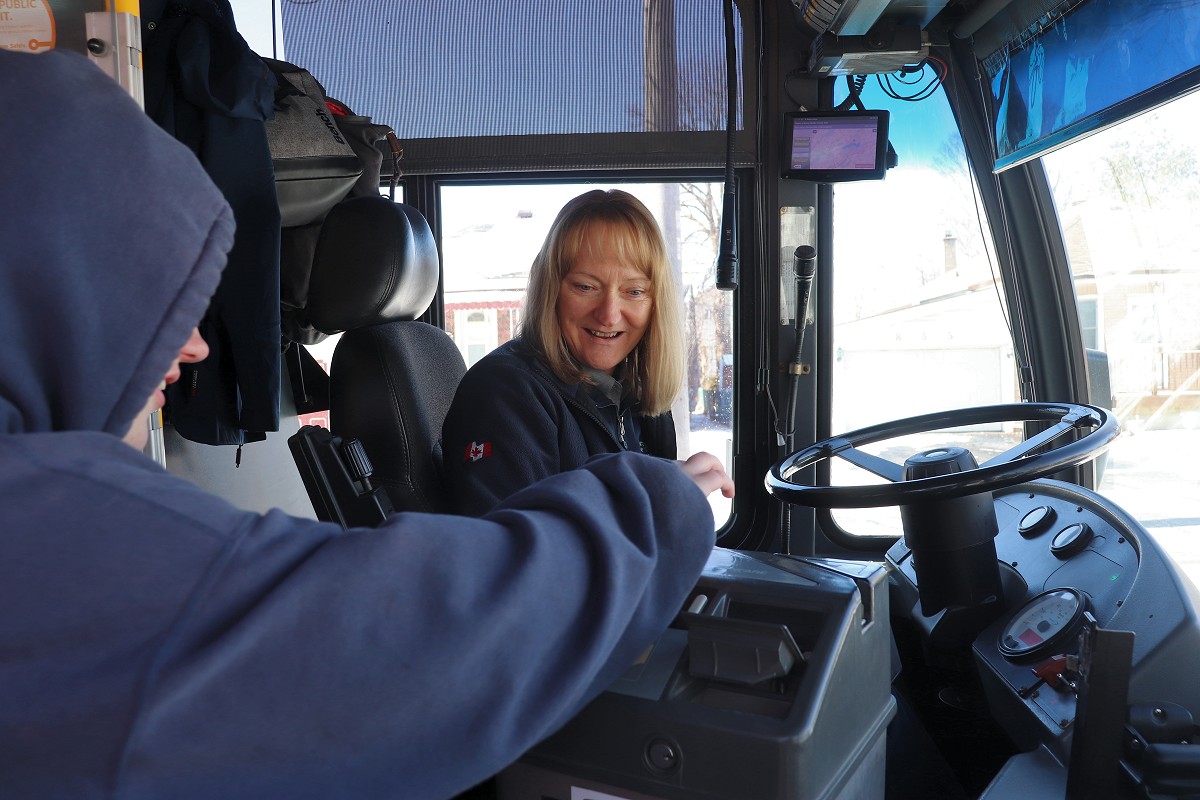
Peterborough Transit driver and trainer Sue accepts a transfer from a rider. Rural transit remains an important lifeline for residents who don't have access to a personal vehicle and opens doors for youth who live outside of the city. Understanding how and when to use transfers is an important part of the transit workshops delivered by GreenUP in partnership with Selwyn Township. (Photo: Jessica Todd / GreenUP)
Peterborough Transit driver and trainer Sue accepts a transfer from a rider. Rural transit remains an important lifeline for residents who don’t have access to a personal vehicle and opens doors for youth who live outside of the city. Understanding how and when to use transfers is an important part of the transit workshops delivered by GreenUP in partnership with Selwyn Township. (Photo: Jessica Todd / GreenUP)

“In a rural community, public transit is an essential service, especially for residents who don’t drive or have access to a vehicle,” says Morrow. “The Link has built a dedicated ridership, demonstrated the need for local transit, and helped residents of all ages gain experience with public transportation.”

This local effort reflects a broader national trend. According to the Canadian Urban Transit Association (CUTA), Canadians took 1.92 billion transit trips in 2024, up from 1.76 billion in 2023, marking the second highest service levels since 2014. Ridership across Canada increased by nine per cent between 2023 and 2024, signalling growth that goes well beyond pandemic recovery.

Peterborough is playing a leading role in that momentum. In 2024, Peterborough Transit recorded 3.7 million rides and was recognized by CUTA as the top transit system in Canada for ridership among communities under 100,000 population.

Advertisement - content continues below


Evidence from other Ontario municipalities reinforces why youth-focused transit initiatives matter. In Kingston, a youth transit pass program launched in 2012 and has demonstrated measurable long-term results.

Between 2012 and 2019, an independent evaluation found the program generated approximately 196,000 additional youth transit rides annually, replacing an estimated 72,000 caregiver-driven car trips each year. The economic impact translated into roughly $2 million in annual societal benefit, with a return of $3.60 for every $1 invested.

Importantly, the Kingston findings showed that providing access alone was not enough. Training youth to confidently navigate the system was just as critical as making transit affordable. Equipping young riders with practical knowledge significantly increased long-term ridership uptake.

Intermediate aged youth are at a pivotal age to begin expanding their world beyond home and school. A study from Kingston's youth transit program found 72,000 fewer caregiver car rides per year were needed for youth to access sports, volunteering, programs and socializing. In spring 2026, the City of Peterborough will begin a phased rollout of its new youth transit pass program, which will provide complimentary transit access for youth aged 13 to 18 during evenings, weekends, and summer months. (Photo: Jessica Todd / GreenUP)
Intermediate aged youth are at a pivotal age to begin expanding their world beyond home and school. A study from Kingston’s youth transit program found 72,000 fewer caregiver car rides per year were needed for youth to access sports, volunteering, programs and socializing. In spring 2026, the City of Peterborough will begin a phased rollout of its new youth transit pass program, which will provide complimentary transit access for youth aged 13 to 18 during evenings, weekends, and summer months. (Photo: Jessica Todd / GreenUP)

Peterborough’s approach recognizes that lesson: confidence builds capacity.

In spring 2026, the City of Peterborough will begin a phased rollout of its new youth transit pass program. The program will provide complimentary transit access for youth aged 13 to 18 during evenings, weekends, and summer months. This, paired with annual registration, structured pass distribution, and orientation sessions, will emphasize education and confidence-building.

The phased pilot will allow Peterborough Transit to align the initiative with current operations by focusing on off-peak periods, building system capacity responsibly while evaluating program impacts. Over time, the program will expand and adapt alongside service enhancements, using data and community feedback to guide continuous improvement.

Advertisement - content continues below


When young people learn to ride transit, they aren’t just learning how to get from point A to point B. They gain independence, reduce reliance on caregiver driving, support local businesses, and strengthen the long-term sustainability of transportation systems — all of which benefits the community as a whole.

To learn more about the City of Peterborough’s youth transit pass program, read the September 2025 report to council below.

For more information on active and sustainable travel for youth, visit Active School Travel Peterborough at greenup.on.ca/active-school-travel-peterborough

PDF: Youth Transit Pass Program, Report MOTR25-005
Youth Transit Pass Program, Report MOTR25-005

Pilot uninjured after light aircraft crashes at Kawartha Lakes Municipal Airport in Lindsay

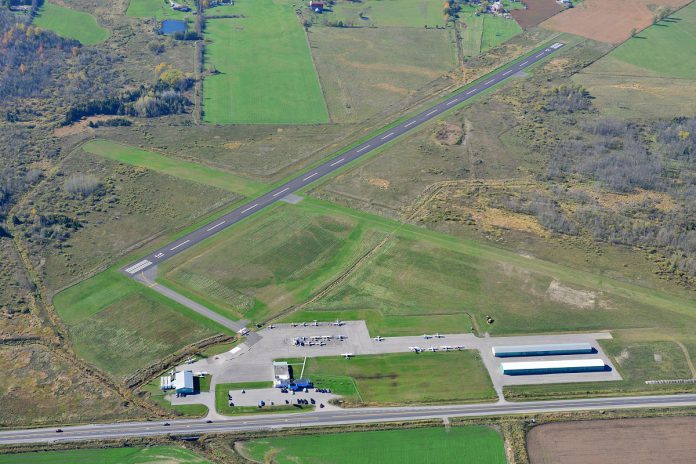
Located just west of Lindsay off Highway 35, the Kawartha Lakes Municipal Airport has a main asphalt runway and a secondary grass runway. (Photo: Kawartha Lakes Municipal Airport)

The pilot of a light aircraft that crashed at the Kawartha Lakes Municipal Airport in Lindsay on Wednesday night (March 4) was not injured.

At around 9 p.m., Kawartha Lakes Police, Kawartha Lakes Ontario Provincial Police, Kawartha Lakes Fire and Rescue Service, and Kawartha Lakes Paramedic Service responded to a report of a single-engine Cessna that had crashed and was found lying on its roof just off the runway.

The initial investigation found the pilot lost control of the aircraft during landing, causing the tail to lift and flip the plane onto its roof.

Advertisement - content continues below


The pilot, who was able to exit the plane and report the crash, was transported to Ross Memorial Hospital as a precaution.

There were no other injuries or damage. The aircraft has been removed from the runway, and no significant delays to airport operations are expected.

Police say the Transportation Safety Board of Canada has been notified of the incident.

Lindsay & District Chamber of Commerce announces finalists for 2026 Awards of Excellence

Globus Theatre in Bobcaygeon is one of the three finalists for the Tourism Excellence Award for the Lindsay & District Chamber of Commerce's 2026 Awards of Excellence. The winners of 17 awards will be announced at the awards gala at the Victoria Park Armoury in Lindsay on Saturday, April 25, along with Business Person Of The Year, Legacy Leader Of The Year, and Citizen Of The Year. (Photo: Globus Theatre)

The Lindsay & District Chamber of Commerce has announced the finalists for its 2026 Awards of Excellence.

The Chamber says it had a record number of nominations this year, and only the top three in each of the 17 award categories became finalists.

Award winners will be announced during the awards gala, along with Business Person Of The Year, Legacy Leader Of The Year, and Citizen Of The Year.

Advertisement - content continues below


The awards gala takes place from 5 to 11 p.m. on Saturday, April 25 at the Victoria Park Armoury (210 Kent St. W., Lindsay), with cocktail hour and entertainment from 5 to 6 p.m., dinner by Franz Catering from 6 to 7 p.m., and the awards presentation from 7 to 10 p.m.

Tickets for the awards gala are $130 for Chamber members and $145 for non-members (plus tax) and are available at www.lindsaychamber.com.

A list of all finalists, by award category, is provided below.

Advertisement - content continues below


Arts & Culture Award Of Excellence

  • The Grove Theatre
  • Shine African And Caribbean Store
  • Kawartha Lakes Pride – Pride Week

Give Back Award Of Excellence

  • Jami Joy – Secret Santa For Seniors
  • BioPed Footcare – Soles4Souls
  • Rizzan Delos Santos – Community Support/Volunteerism

Board Member Of The Year (Volunteer)

  • Skyler Boadway – Big Brothers Big Sisters of Kawartha Lakes
  • Mike Giese – United Way Haliburton Kawartha Lakes
  • Shirley Norman – Women’s Resources

Customer Service Award Of Excellence

  • Brittany The Doula
  • Financially Organized
  • Days Inn & Suites Lindsay

Design Excellence

  • McDonald’s Highway 7, Lindsay
  • Hōm Drafting & Design
  • Home By Tim + Chris

Diversity & Inclusion Award Of Excellence

  • Shine African And Caribbean Store
  • Hope Valley Healing
  • Kawartha Lakes Pride
Advertisement - content continues below


Employee Of The Year

  • Rajib Sutradhar – Osmow’s Shawarma (Lindsay)
  • Dawn Cox – McDonald’s (Lindsay)
  • Amber Riopelle – Kindred Coffee

Health & Wellness Award Of Excellence

  • At The Core Home Health
  • Nurse Next Door
  • Five Counties Children’s Centre

Tourism Excellence Award

  • Flato Academy Theatre
  • The Grove Theatre
  • Globus Theatre

Rebrand Of The Year

  • Di Bello Real Estate Group
  • LP Movers
  • Kindred Coffee

New Business Of The Year

  • Hope Valley Healing, Addiction And Wellness
  • The Loaded Spud
  • Osmow’s Shawarma (Lindsay)

Marketing Award Of Excellence

  • Home By Tim + Chris
  • LP Movers
  • Riz Digital01
Advertisement - content continues below


Social Butterfly Award

  • The Loaded Spud
  • Rizzan Delos Santos (Riz Digital01)
  • Ian McKechnie – Kawartha Art Gallery

Rising Star Award Of Excellence

  • Salvaged And Seamed
  • Riz Digital01
  • Brittany The Doula

Volunteer Of The Year

  • Rosanne O’Neill – Kawartha Lakes Food Source
  • Herbert Paisley – Ziggy’s Fish & Chips And Caribbean Food
  • Angus McNeil – Big Brothers Big Sisters of Kawartha Lakes

Not-For-Profit Award Of Excellence

  • John Howard Society Of The Kawarthas
  • Five Counties Children’s Centre
  • A Place Called Home

Skilled Trade Award Of Excellence

  • Broken Dreams Garage
  • Dyson Alarm Tech Systems Limited
  • Bills Quality Pest Control

TSB investigation finds driver underestimated risk before fatal train collision at Cramahe Township crossing

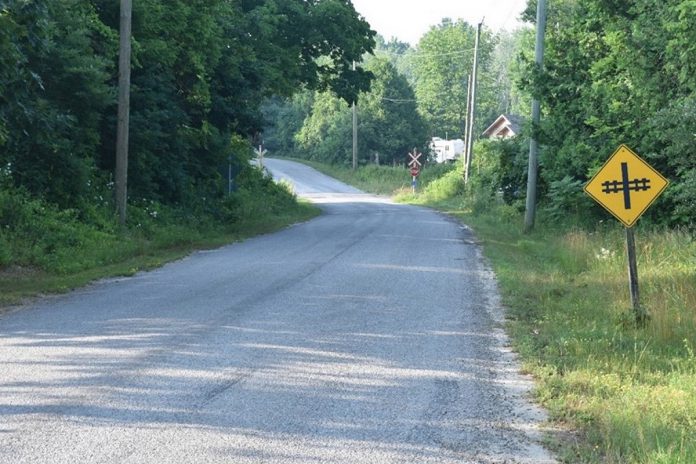
The southbound approach to the CPKC Hunt Road grade crossing in the Township of Cramahe where a 69-year-old Frankford man was killed on July 14, 2025 after his pickup truck was struck by a westbound Canadian Pacific Kansas City freight train. This photo was taken on July 16, 2025 in environmental conditions similar to those at the time of the collision. (Photo: Transportation Safety Board of Canada)

The Transportation Safety Board of Canada (TSB) has released its investigation report into last summer’s collision between a freight train and a pickup truck in the Township of Cramahe in Northumberland County that killed a 69-year-old man from Frankford.

In the report released on Wednesday (March 4), the TSB concludes the driver underestimated the risk of a collision and did not see the approaching train until it was too late — a situation that was aggravated because of obscured sightlines.

The crash happened shortly after 8 a.m. on July 14, 2025, when a westbound Canadian Pacific Kansas City (CPKC) intermodal freight train travelling about 90 km/h struck a southbound pickup truck at the Hunt Road grade crossing.

Advertisement - content continues below


The passive public grade crossing features a standard retroreflective railway crossing sign supplemented with a stop sign. Passive public crossing systems do not warn drivers of an approaching train, but instead rely on the vehicle driver to take the necessary steps to avoid a collision.

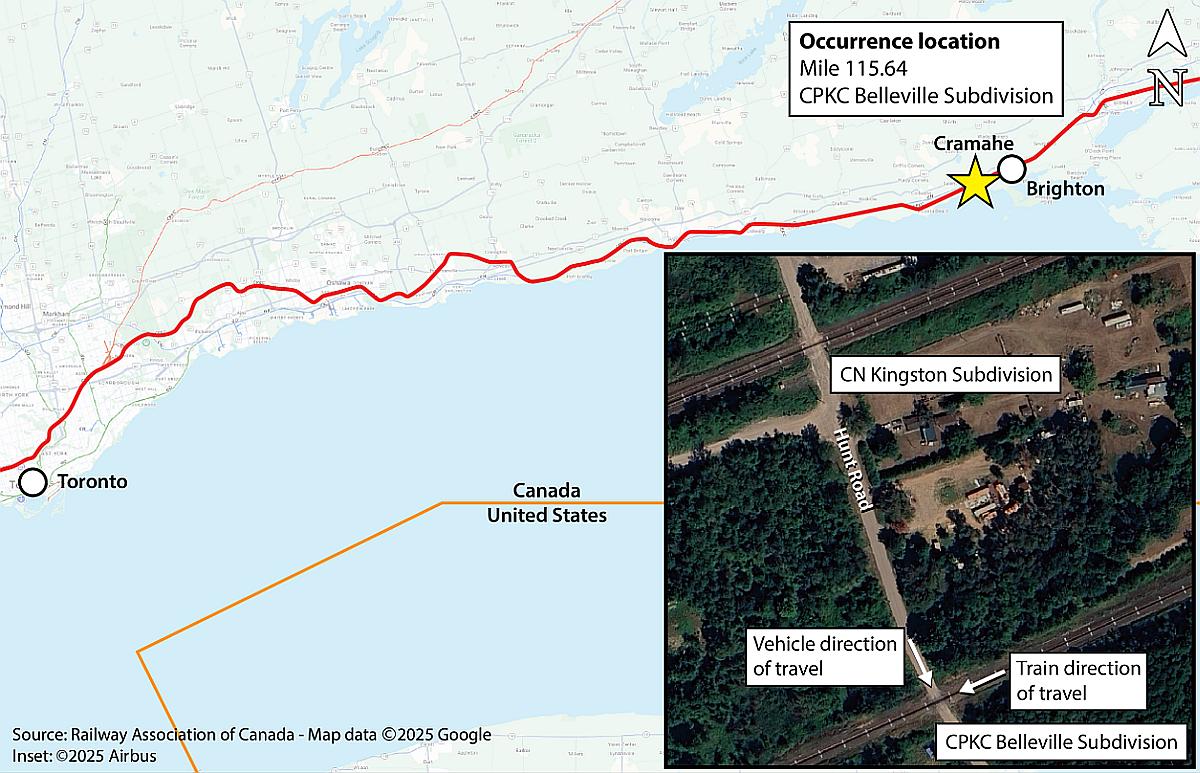
About 200 metres to the north, Hunt Road crosses another double-track CN railway line that does have automated protection, warning drivers of approaching trains. Vehicles travelling southbound must cross that active CN rail line first before reaching the CPKC crossing where the collision occurred.

The TSB report states that the vehicle driver routinely used the road and was familiar with both crossings.

Main image showing the collision location in relation to Toronto, with the inset image showing an aerial view of the Hunt Road grade crossing where the collision took place. (Graphic: Railway Association of Canada, Canadian Rail Atlas, Google Maps)

According to the report, data from the pickup truck’s event data recorder indicates the vehicle was travelling around 26 km/h, under the road’s 80 km/h speed limit, when it entered the CPKC crossing just before the collision.

The approaching train only became visible to the driver around two seconds before the collision. Upon seeing the train, the driver attempted to accelerate clear of the crossing, possibly hesitating for a moment.

The TSB report also concludes the driver did not have sufficient time to stop his vehicle once he saw the approaching train. On impact, the vehicle was thrown to the southwest and the driver, who was the sole occupant, was fatally injured.

Advertisement - content continues below


While the train horn was sounded multiple times as the train approached the crossing, the vehicle’s windows were closed and the engine was running.

According to the report, previous investigations have found that a train horn may not be audible to a vehicle driver under such circumstances until the train is less than two seconds from the point of collision.

“The vehicle driver’s behaviour was consistent with him not hearing the train before it became visible,” the report states.

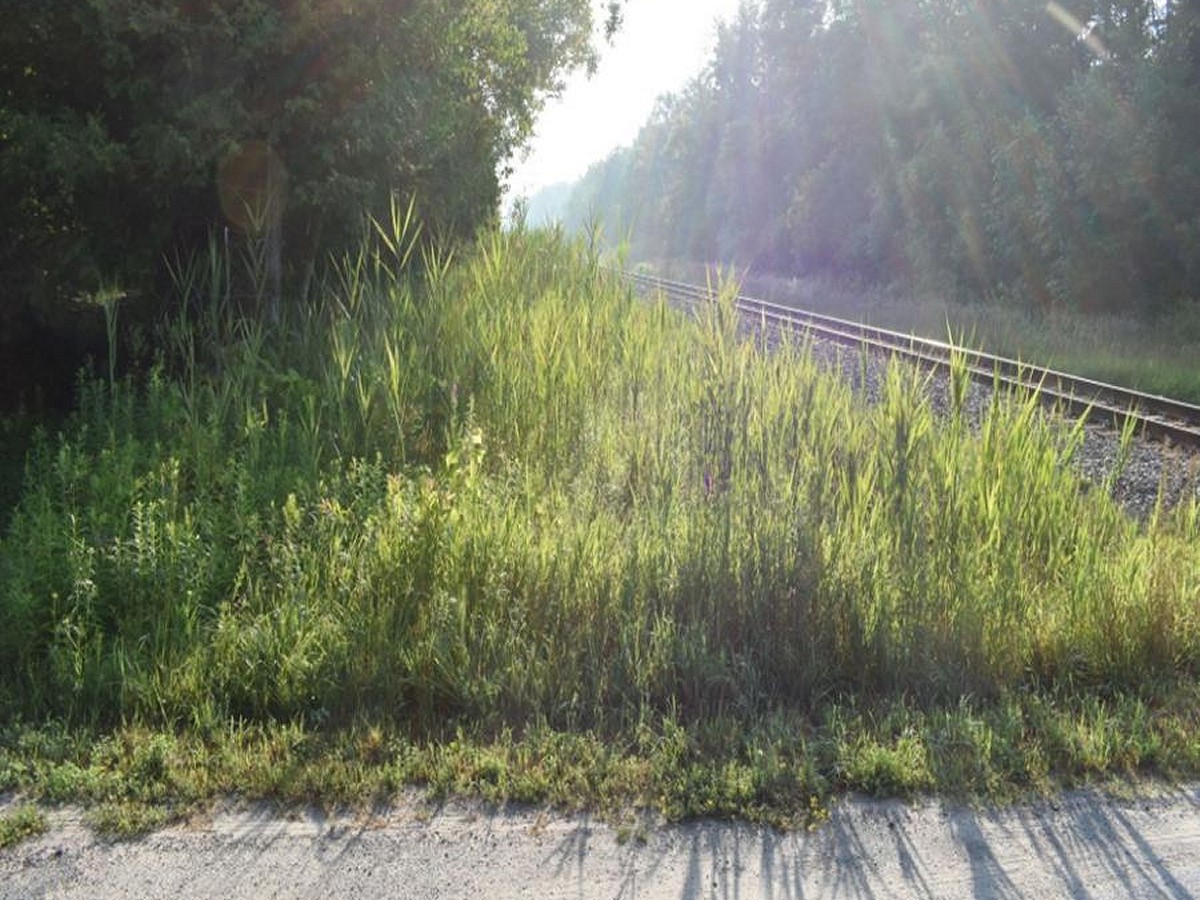
Southeast view of the CPKC Hunt Road grade crossing in the Township of Cramahe where a 69-year-old Frankford man was killed on July 14, 2025 after his pickup truck was struck by a westbound Canadian Pacific Kansas City freight train. The photo, from a position approximating that of a driver of a southbound vehicle, was taken on July 16, 2025 in environmental conditions similar to those at the time of the collision. (Photo: Transportation Safety Board of Canada)

As for why the driver did not stop at the CPKC crossing, the TSB concludes he underestimated the likelihood of a collision.

“Given his familiarity with the crossing, the vehicle driver would have observed that trains did not travel along that track very frequently,” the report states. “Therefore, a scenario where a train arrived at the same time as his vehicle was occupying the crossing likely would have been perceived as an extremely rare event. Even rarer still would have been a scenario where a collision occurs.”

“The perceived extreme unlikelihood of these scenarios would have been reinforced by the fact that the crossing where the collision occurred had less protection than the crossing immediately to the north, which had higher activity.”

Advertisement - content continues below


The day after the collision, Transport Canada inspected the crossing and identified concerns about sightlines and vegetation obscuring warning signs, which are the responsibility of the railway and the road authority.

Also on the day after the collision, CPKC performed brush cutting activities to improve sightlines and also cleared brush partially obstructing northward and southward advance warning signs for the crossing.

The week following its inspection of the CPKC crossing, Transport Canada issued a letter of non-compliance to the Township of Cramahe identifying issues related to signage and crossing surface conditions, along with a concern for sightlines at the crossing.

Advertisement - content continues below


On August 24, Transport Canada conducted a follow-up inspection and found the township had taken no action, resulting in a letter of insufficient action. On September 12, the township advised Transport Canada that vegetation had been cleared and, the following month, completed pavement markings at the crossing.

The TSB notes that its investigation into the incident is for the purpose of advancing transportation safety, not to assign fault or determine civil or criminal liability.

“It is important that railways — in conjunction with road authorities, regulators responsible for grade crossing safety, and other stakeholders — assess whether the defence built on the requirement to stop at a passive crossing equipped with a stop sign can be supplemented to improve rail crossing safety,” the report concludes.

Get a sweet taste of maple syrup season across the Kawarthas region

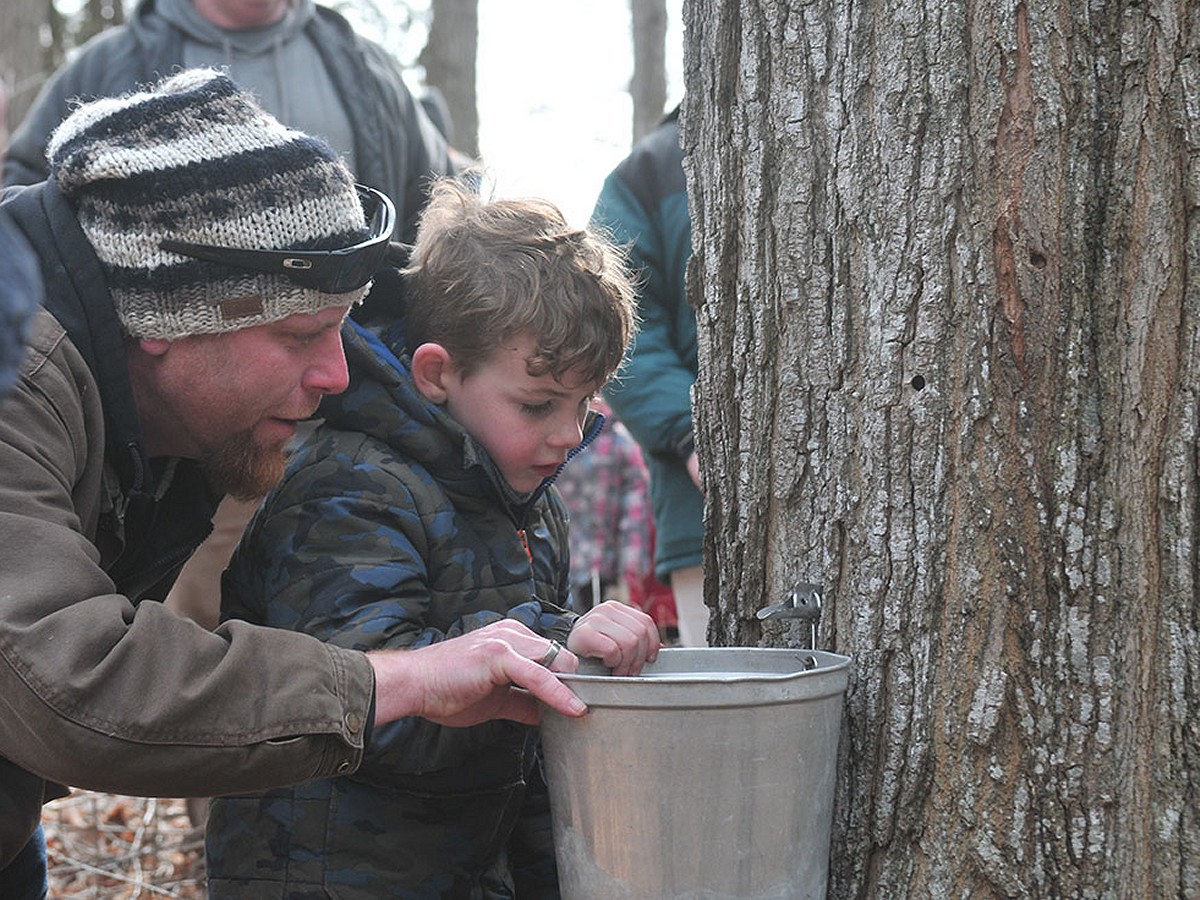
With all the snow this winter insulating maple trees, Red Mill Maple Syrup is predicting a good maple syrup season. The Millbrook producer is one of 10 maple syrup producers in the Kawarthas region that are participating in Maple Weekend on April 4 and 5, 2026, where the public is invited to learn about the process, enjoy maple-flavoured products, and see why pure Ontario maple syrup is unmatched. (Photo: Red Mill Maple Syrup)

Maple syrup fans can rejoice because, according to Red Mill Maple Syrup in Millbrook, it’s going to be a good season this year — and you can tell because they had to wear snowshoes to tap the trees.

“We’re happy about all the snow and we’re happy about this winter because, to us, this is a normal winter,” says Julie Vallieres. “This is how it should be. Maple syrup season will be so much better just because we have so much more snow.”

According to Vallieres, snow is a good sign for maple syrup producers because it acts as an insulator that protects tree roots from freezing solid and cools the air to stall the trees from budding too early, even in warmer temperatures.

Advertisement - content continues below


To start tapping, the tree sap must begin to flow, which only happens when temperatures are above freezing in the daytime but still below freezing at night.

This typically occurs between February and April in Ontario though, in unseasonably warm years, Red Mill Maple Syrup has had to tap as early as late January. Early tapping can result in a short collection season and, if the weather remains warm, less sugar production and poor-quality syrup.

“I was so happy about having a normal winter because in previous years, mother nature was all over the place,” says Vallieres. “When it’s too hot too soon it’s not good, because once it’s not freezing anymore, that’s when the sap goes all the way up the trees to the branches. When the birds are coming out, it’s too late. Even if it’s cold again after, it’s too late.”

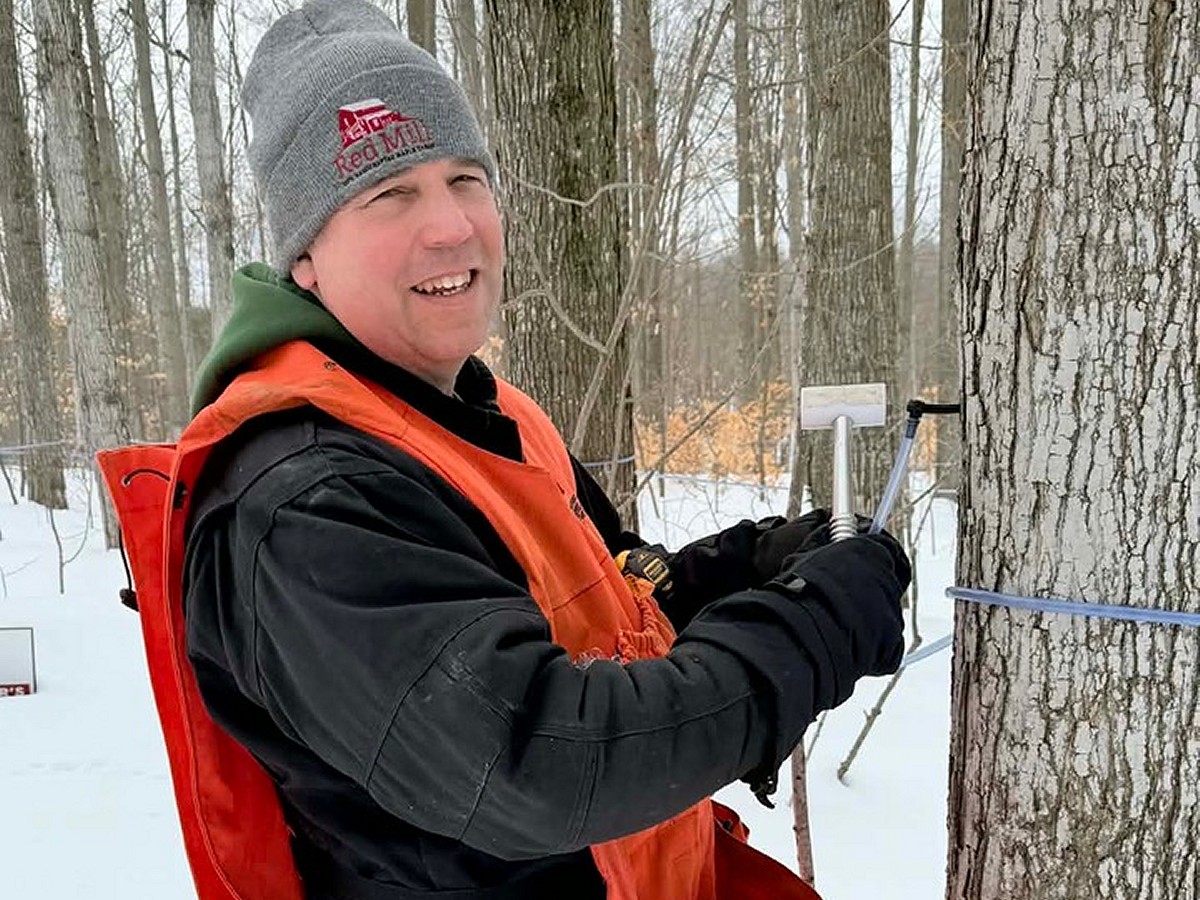
Sebastien Poulin of Red Mill Maple Syrup taps a tree on his and his wife Julie Vallieres's 10-acre property in Millbrook. Vallieres says the couple has "maple syrup in our blood" having been raised on sugar shacks in Beauce, Quebec, a region well-known for producing maple syrup. Poulin's grandfather Victor started making maple syrup at age 15 to help support his family in the small town of St-Victor, Quebec. (Photo: Red Mill Maple Syrup)
Sebastien Poulin of Red Mill Maple Syrup taps a tree on his and his wife Julie Vallieres’s 10-acre property in Millbrook. Vallieres says the couple has “maple syrup in our blood” having been raised on sugar shacks in Beauce, Quebec, a region well-known for producing maple syrup. Poulin’s grandfather Victor started making maple syrup at age 15 to help support his family in the small town of St-Victor, Quebec. (Photo: Red Mill Maple Syrup)

Vallieres and her husband Sebastien Poulin have been tapping on their 10-acre property since they purchased it in 2011. She says they both “have maple syrup in our blood,” having been raised on sugar shacks in Beauce, Quebec, a region well-known for producing maple syrup.

“It’s not just maple syrup equals pancakes (in Quebec). It’s maple syrup everywhere. We have maple drinks. We have meats that are marinated with maple. We’re trying to show people and educate people that maple syrup is so much more. You can use it in so many other ways than just maple syrup and pancakes.”

Although she’s predicting this season will offer a long collection period, Red Mill Maple Syrup — named in honour of the local Needler’s Mill — did have to navigate some additional challenges this season, due to last year’s severe ice storm that impacted much of central and eastern Ontario. There was a lot of damage done to the tree canopies and destruction to the tubes in their collection pipelines.

Advertisement - content continues below


“Because there was so much damage, we wanted to make sure we’re ready when the season hits,” Vallieres says. “We’re almost all tapped but the parts that are not tapped, it’s because the lines are broken. We need to replace them, install them again, and then tap.”

Vallieres says that’s just one example of the behind-the-scenes steps of the production process that people don’t realize when they’re enjoying their maple syrup.

“Even with the new technology, there’s so much work to do every night,” she says. “It looks easy to make — just take sap and boil it — but it’s so much science. There’s so much respect to make sure that your syrup is well done and (has) the right consistency.”

On March 15, 2026, the Sunderland Maple Syrup Festival will officially launch the season with its annual first tapping ceremony at Harlaine Farms in Sunderland, when dignitaries, festival organizers, maple producers, and local residents will gather to witness the tapping of the first maple tree. (Photo: Susan Wright)

Kawarthas region residents will have the opportunity to see how maple syrup is made during several upcoming events celebrating the season.

On Saturday, March 14 and Sunday, March 15, the Warkworth Maple Syrup Festival is being held in Trent Hills for its 38th year. Hop on a free shuttle bus from the village of Warkworth to Sandy Flat Sugar Bush to enjoy demonstrations, a pancake breakfast, horse and wagon rides, maple taffy in the snow, and live music.

Back in the village, Maplelicious will be in full swing, bustling with maple-themed fun including a beer garden, mini putt, an artisan sale, an art exhibit, and a whole lot more. For a full schedule, visit warkworthmaplesyrupfestival.ca.

Advertisement - content continues below


On Sunday, March 15 from 1 to 3 p.m., the Sunderland Maple Syrup Festival will officially launch the season with its annual first tapping ceremony at Harlaine Farms (1015 Brock Concession Rd 1, Sunderland). Dignitaries, festival organizers, maple producers, and local residents will gather to witness the tapping of the first maple tree.

The 29th annual Sunderland Maple Syrup Festival takes place on Saturday, April 11 and Sunday, April 12 just 30 kilometres outside of Lindsay in Durham Region. Hop on a bus to travel to the Harlaine Farms sugar shack to learn about historical and contemporary methods of production. Throughout the town, there will be a petting zoo, demonstrations, live music, a tractor pull, a vendor market, and so much more.

To learn more, visit maplesyrupfestival.ca.

On April 4 and 5, 2026, Abbey Gardens in Haliburton will be one of the restaurants and businesses in the Haliburton Highlands participating in Maple Weekend, with maple butter tarts, cookies, and cupcakes available on the special limited-time menu. Pictured is maple syrup from Colour of Wood in Minden, which will be hosting tours during the weekend. (Photo: Abbey Gardens)

In early April, the Ontario Maple Syrup Producers Association presents the annual Maple Weekend, a province-wide celebration of maple season when producers invite guests to learn about the process, enjoy maple-flavoured products, and see why pure Ontario maple syrup is unmatched.

This year’s celebration takes place on Saturday, April 4 and Sunday, April 5. Over the weekend, Red Mill Maple Syrup will be inviting visitors to its new maple syrup bar for a taste of traditional French Canadian crepes, taffy, and unique maple-flavoured products.

In the Haliburton Highlands, not only are producers hosting experiences during Maple Weekend, but restaurants will be serving up maple-flavoured entrées, treats, and drinks. From maple-glazed salmon to maple-dusted wings, and maple cookies, there will be no escaping the sweetness of the season. To learn more, visit myhaliburtonhighlands.com/maple-weekend/.

Advertisement - content continues below


Here are the maple syrup producers in the Kawarthas region taking part in this year’s Maple Weekend:

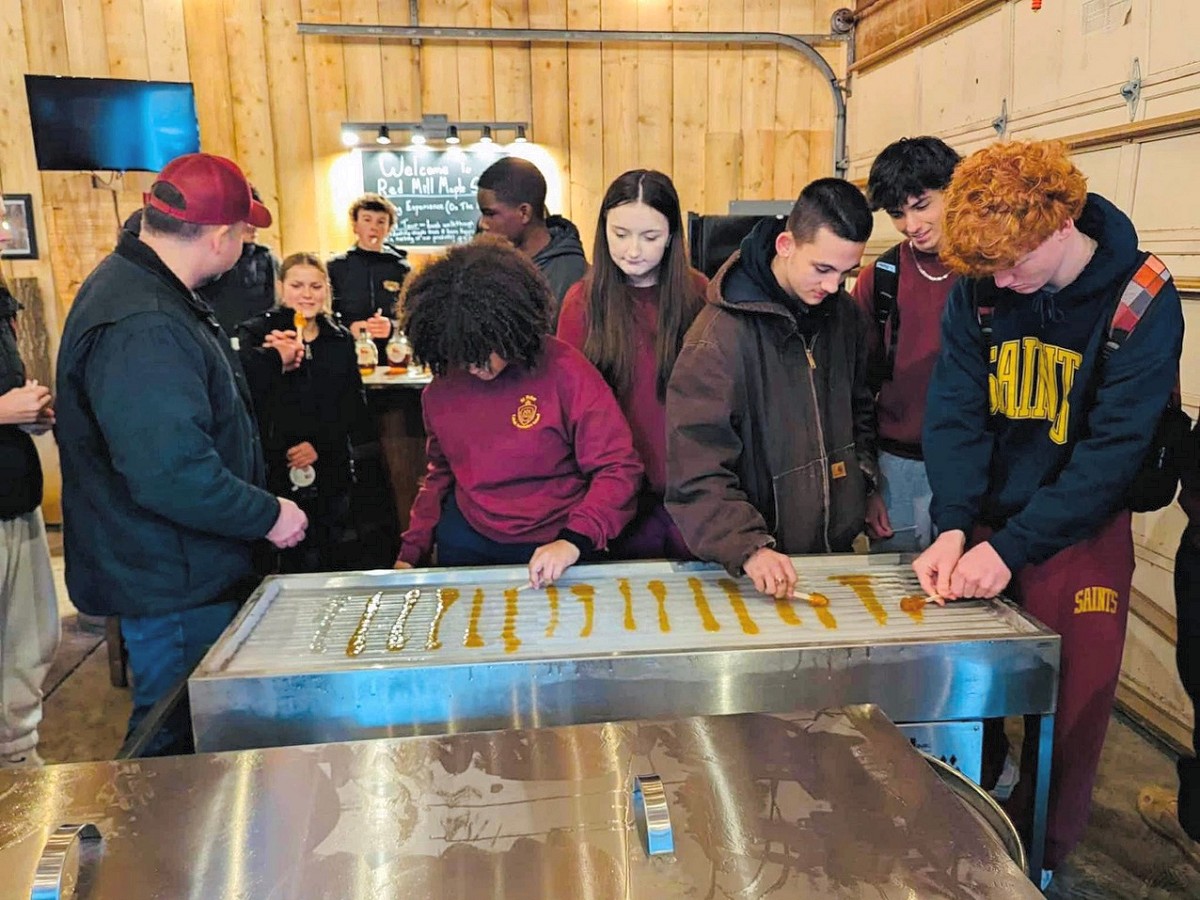
During Maple Weekend on April 4 and 5, 2026, Red Mill Maple Syrup in Millbrook will be hosting tours of the sugar bush and inviting guests to learn about maple syrup production, make their own taffy, and taste other maple-flavoured treats. (Photo: Red Mill Maple Syrup)

For more information about Maple Weekend, including the days when the listed producers are participating, visit mapleweekend.ca.


The original version of this story has been updated to correct the size of the Red Mill Maple Syrup property.

Tickets now on sale for Peterborough and the Kawarthas Chamber of Commerce’s second annual Luminary Awards for Women in Business

Organizers, sponsors, and some of the 60 nominees for the second annual Luminary Awards for Women in Business during a nominee announcement at the Peterborough and the Kawarthas Chamber of Commerce offices on February 11, 2026. (Photo: Jordan Lyall Photography)

Tickets are now on sale for the second annual Luminary Awards for Women in Business, with the awards luncheon taking place on May 7 at Trent University.

Presented by the Peterborough and the Kawarthas Chamber of Commerce with the support of sponsors Sullivan Law Ptbo and kawarthaNOW, the Luminary Awards are intended to celebrate the valuable contributions of women in the local business community, including those named in leadership positions as well as women who lead from behind the scenes.

“We are surrounded by extraordinary women whose contributions often go unrecognized,” says Chamber president and CEO Brenda Whitehead. “The Luminary Awards is about shining a light on their leadership, resilience, and generosity. Each year, this event reminds us of the power of women supporting women and the profound impact that has on our entire community.”

Advertisement - content continues below


First launched by the chamber in September 2024 with five categories, the awards were expanded for 2026 with two new categories: Building Belonging and Community Catalyst.

A total of 60 women have been nominated in seven award categories, with some nominated in multiple categories for a total of 71 nominations: Barrier Buster – Employee (9 nominees), Community Catalyst (19 nominees), One to Watch – Employee (6 nominees), Building Belonging (7 nominees), Trailblazer – Entrepreneur (11 nominees), Emerging Entrepreneur (8 nominees), and Legacy (11 nominees).

Last year’s sold-out inaugural celebration drew more than 200 attendees and honoured five inspiring recipients: Sheena Howard, Jenisha Sanjit Arora, Rachel Stark, Tiffany Arcari, and Jeannine Taylor.

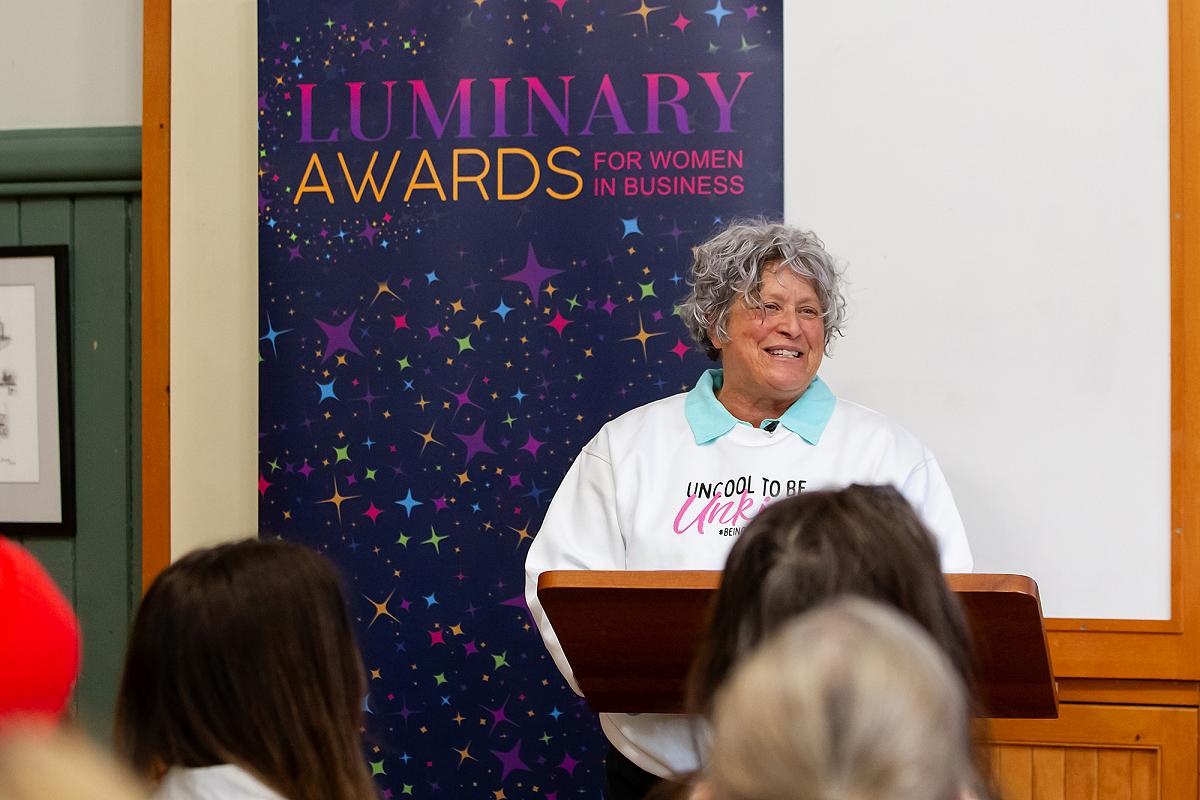
Peterborough and the Kawarthas Chamber of Commerce board chair and Luminary Awards committee chair Susan Dunkley during the nominee announcement for the second annual Luminary Awards for Women in Business at the Chamber's offices on February 11, 2026. (Photo: Jordan Lyall Photography)
Peterborough and the Kawarthas Chamber of Commerce board chair and Luminary Awards committee chair Susan Dunkley during the nominee announcement for the second annual Luminary Awards for Women in Business at the Chamber’s offices on February 11, 2026. (Photo: Jordan Lyall Photography)

“It is an honour to help create a space where women are seen, celebrated, and elevated,” says Susan Dunkley, Chamber board chair and Luminary Awards committee chair. “The Luminary Awards are more than an event — it’s a movement. While we proudly recognize our nominees, we also celebrate one another and the collective strength of women in our community. It’s a chance to honour the courage, determination, and heart women bring to our businesses, organizations, families, and to each other every day.”

This year’s award luncheon takes place from 11 a.m. to 2 p.m. on Thursday, May 7 at the Great Hall at Trent University. Along with celebrating the 60 nominees and announcing the award winners, guests will enjoy an inspiring program, meaningful connections, and a delicious lunch.

Early bird tickets are available now to purchase at www.luminaryawards.ca at a cost of $85 per person, with the price increasing to $100 on Friday, March 13. Due to the expected demand for tickets and to ensure as many nominees as possible can attend with a guest, ticket purchases are limited to two per person.

A sold-out crowd of 200 people attended the Peterborough and Kawarthas Chamber of Commerce's inaugural Luminary Awards celebration at the Great Hall of Trent University's Champlain College on May 8, 2025, which saw awards in five categories that recognize women at all stages of their careers presented to Sheena Howard, Jenisha Sanjit Arora, Rachel Stark, Tiffany Arcari, and Jeannine Taylor. (Photo: Jordan Lyall Photography)
A sold-out crowd of 200 people attended the Peterborough and Kawarthas Chamber of Commerce’s inaugural Luminary Awards celebration at the Great Hall of Trent University’s Champlain College on May 8, 2025, which saw awards in five categories that recognize women at all stages of their careers presented to Sheena Howard, Jenisha Sanjit Arora, Rachel Stark, Tiffany Arcari, and Jeannine Taylor. (Photo: Jordan Lyall Photography)

The names of the nominees for the 2026 awards in each category are listed below in alphabetical order by surname.


Barrier Buster – Employee

Celebrating the achievements of a remarkable woman who has excelled in her field/place of employment, embraced new ideas, technologies or ways of working, and demonstrated exceptional skill, dedication, and perseverance when faced with adversity.

  • Jane Bischoff
  • Kayley Duggan
  • Ashley Flynn
  • Marsha Gaulton
  • Jordan Lyall
  • Nour Mazloum
  • Bridget McCluckie
  • Tori Silvera
  • Stephanie Wilson
Advertisement - content continues below


Community Catalyst

Celebrating a woman whose leadership, collaboration, and vision have sparked positive change in the community. A Community Catalyst brings people together, builds partnerships, and drives meaningful progress on local priorities. Nominees can be paid staff or volunteers of a not-for-profit organization, or be an employee or owner of a business or enterprise.

  • Chelsey Carberry
  • Ashley Collins
  • Emma Featherstone
  • Michelle Ferreri
  • Sheridan Graham
  • Betty Halman-Plumley
  • Dana Hetherton
  • Tonya Kraan
  • Nour Mazloum
  • Kat McCartie
  • Amy Muir
  • Rebecca O’Rourke
  • Marcia Steeves
  • Meryn Steeves
  • Rosalea Terry
  • Lois Tuffin
  • Ashley Woollacott
  • Susan Zambonin
  • Abby Zotz


One to Watch – Employee

Future leader known for innovative, meaningful contributions to their workplace, proven professional success, and outstanding potential for the future. Nominee may hold entry- to mid-level management positions in their workplace.

  • Allison Adam
  • Bethan Bates
  • Amanda Bedford
  • Lindsey Brodie
  • Michelle Nguyen
  • Rosalea Terry
Advertisement - content continues below


Building Belonging

Celebrating a woman whose inclusive leadership and equity-driven innovation have reshaped how business is done—demonstrating that building for belonging is not just the right thing to do, it’s a strategic advantage. Nominees may focus on workplace culture, employee experience, and/or customer-facing innovation.

  • Mackenzie Annis
  • Marsha Gaulton
  • Akshana Katoch
  • Jennifer Lawson
  • Peggy Shaughnessy
  • Danielle Turpin
  • Patricia Wilson


Trailblazer – Entrepreneur

Celebrating a business owner who has created innovation and success through her leadership, vision, courage, and commitment.

  • Winter Barringer
  • Kinjal Shukla Clement
  • Lisa Couture
  • Leanne Crump
  • Ashley Flynn
  • Marsha Gaulton
  • Richa Grover
  • Catherine Hanrahan
  • Tracy Minnema
  • Rebecca O’Rourke
  • Danielle Turpin
Advertisement - content continues below


Emerging Entrepreneur

The Tiffany Show's Tiffany Arcari (left), who won the Emerging Entrepreneur award at the inaugural Luminary Awards for Women in Business in 2025, takes a selfie with some of the nominees for the second annual Luminary Awards for Women in Business during a nominee announcement at the Peterborough and the Kawarthas Chamber of Commerce offices on February 11, 2026. (Photo: Jordan Lyall Photography)
The Tiffany Show’s Tiffany Arcari (left), who won the Emerging Entrepreneur award at the inaugural Luminary Awards for Women in Business in 2025, takes a selfie with some of the nominees for the second annual Luminary Awards for Women in Business during a nominee announcement at the Peterborough and the Kawarthas Chamber of Commerce offices on February 11, 2026. (Photo: Jordan Lyall Photography)

A business owner engaged in a new, successful, innovative, and inspiring business venture that shows outstanding potential for the future. Nominee must have been in business for a minimum of two years and no more than five years.

  • Kara Ainsworth
  • Ashley Flynn
  • Marsha Gaulton
  • Chasley Keepfer
  • Karen Kerr
  • Erin Shannon
  • Elena Thomas
  • Ashley Woollacott


Legacy

kawarthaNOW's Jeannine Taylor (right), who won the Legacy award at the inaugural Luminary Awards for Women in Business in 2025, reacts during the nominee announcement for the second annual Luminary Awards for Women in Business at the Peterborough and the Kawarthas Chamber of Commerce offices on February 11, 2026. (Photo: Jordan Lyall Photography)
kawarthaNOW’s Jeannine Taylor (right), who won the Legacy award at the inaugural Luminary Awards for Women in Business in 2025, reacts during the nominee announcement for the second annual Luminary Awards for Women in Business at the Peterborough and the Kawarthas Chamber of Commerce offices on February 11, 2026. (Photo: Jordan Lyall Photography)

She has spent her successful business career inspiring others and giving back to her community. She strives for business excellence, and through realizing her vision, the nominee has provided opportunities for others for employment, growth, and philanthropy.

  • Judy Byrne
  • Monika Carmichael
  • Betty Halman-Plumley
  • Dr. Kristy Hiltz
  • Vanessa Oake Hogan
  • Dr. Jenny Ingram
  • Jenni Johnston
  • Cathy Olley
  • Anne Ryan
  • Susan Tung
  • Wendy Kelly


kawarthaNOW is proud to be the presenting media sponsor of the Luminary Awards.

Peterborough city council endorses 12-month pilot program for on-street parking permits

Peterborough city council has endorsed a 12-month pilot program that would offer on-street parking permits in three areas of the city.

At its general committee meeting on Monday night (March 2), council spent almost an hour discussing a report from Blair Nelson, the city’s commissioner of infrastructure, planning and growth management describing the pilot program, which would be used to inform and help design a permanent on-street parking permit program for the city.

Nelson’s report states that, while the need for an on-street parking permit program like that available in other cities has been identified for many years, the city’s application for the federal government’s Housing Accelerator Fund (HAF) identified the program as a solution to facilitate new development where there is a lack of space for on-site parking. The HAF requires the city to begin selling permits under the pilot program by the end of March.

Advertisement - content continues below


To establish the pilot program, the city hired engineering and urban planning consultant CIMA+, which reviewed the city’s available on-street parking infrastructure and recommended three pilot study areas.

“The three pilot study areas capture all five of the current parking zones established within the city’s official plan,” the report states. “The pilot study areas are intended to capture a mix of operational conditions expected to be encountered throughout the city.”

Currently, the city only offers a single $53 monthly pass for the city’s surface parking lots. The pilot program would provide each address in the three pilot study areas with up to 10 free 24-hour permits per year, with each subsequent 24-hour permit costing $20.

The cost for a 48-hour permit would be $35 and the cost for a seven-day permit would be $120. The first monthly permit would cost $50, and $150 for subsequent monthly permits, with six-month permits costing $200 and annual permits costing $250.

Although with providing proof of residency within a pilot study area, permit applicants would also have to provide proof of ownership of the vehicle, and the city would verify that there are no unpaid parking infractions for the vehicle owner.

CIMA+ is recommending the city use its current parking supplier Hot Spot as an online seller of on-street parking permits.

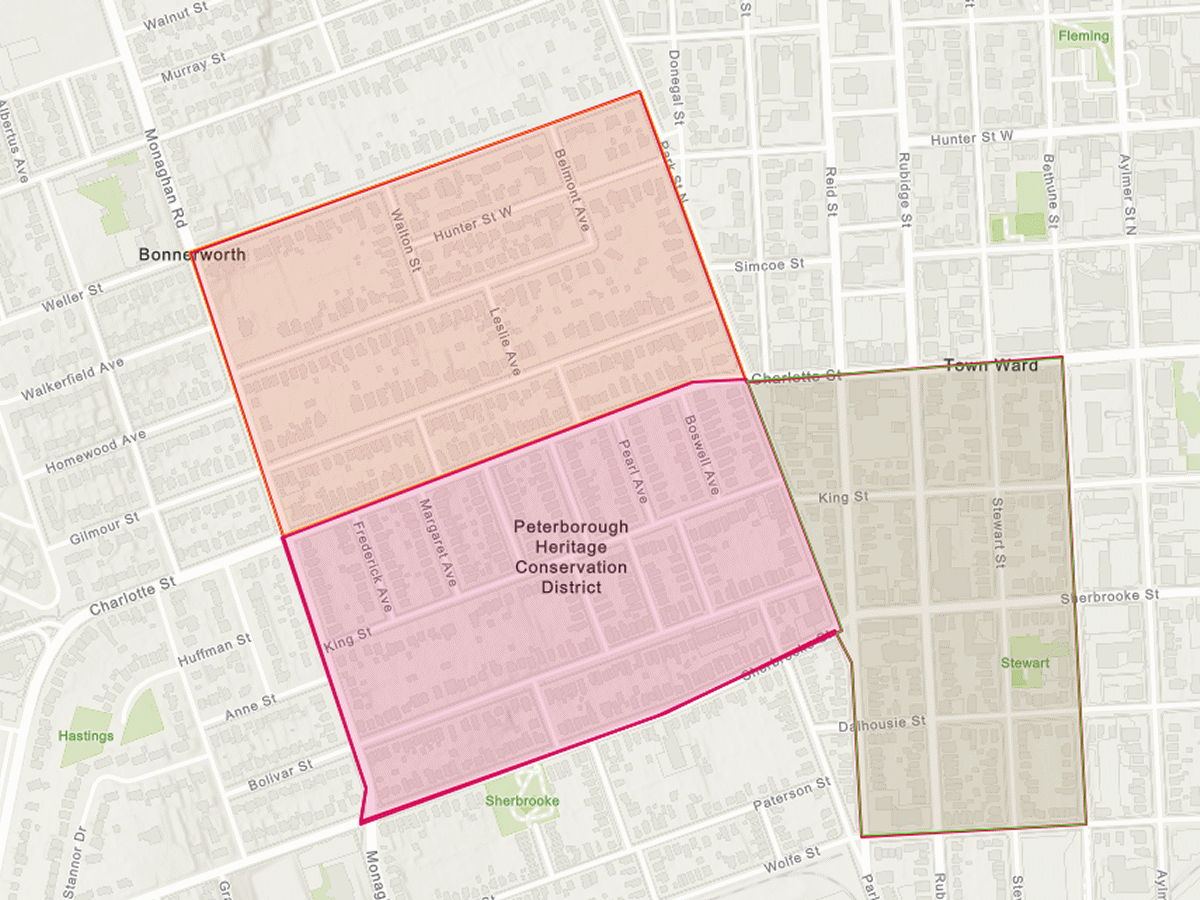
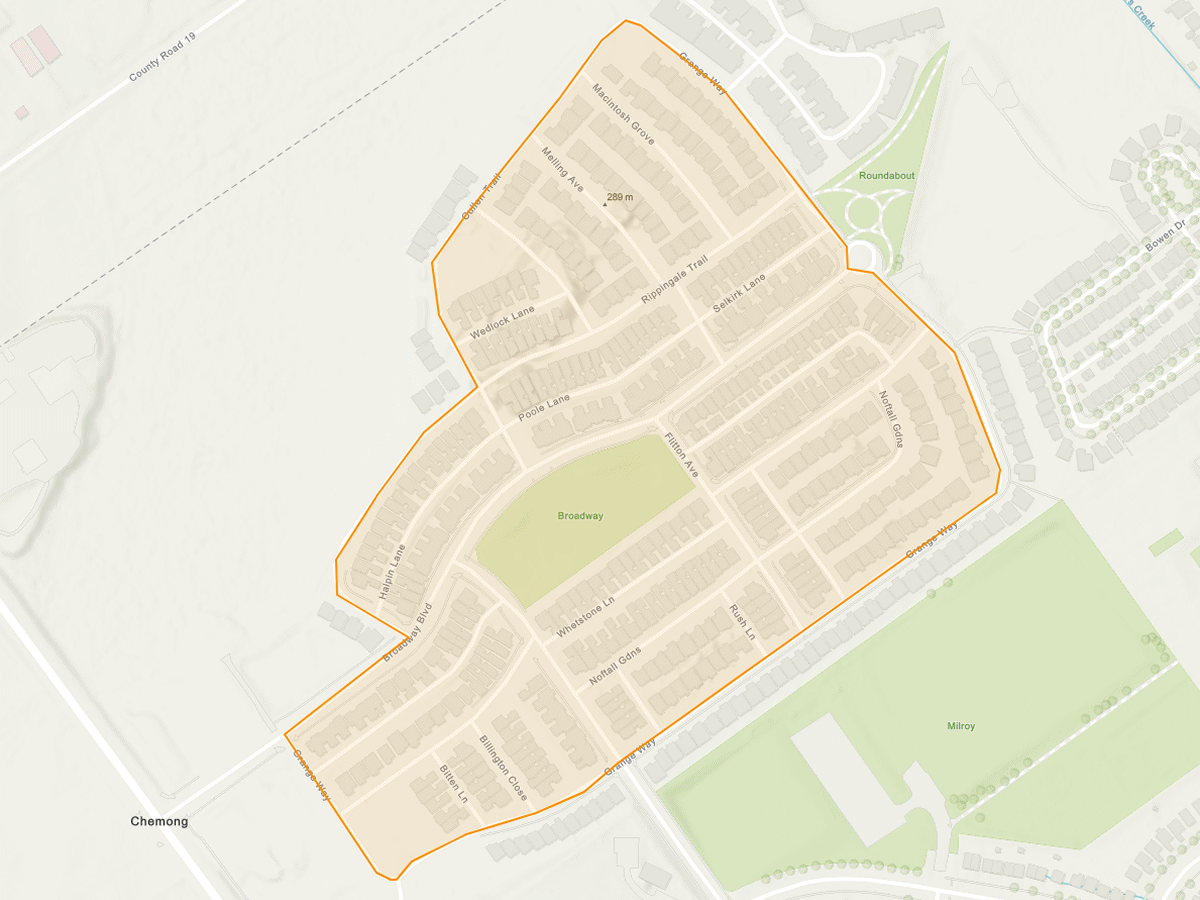
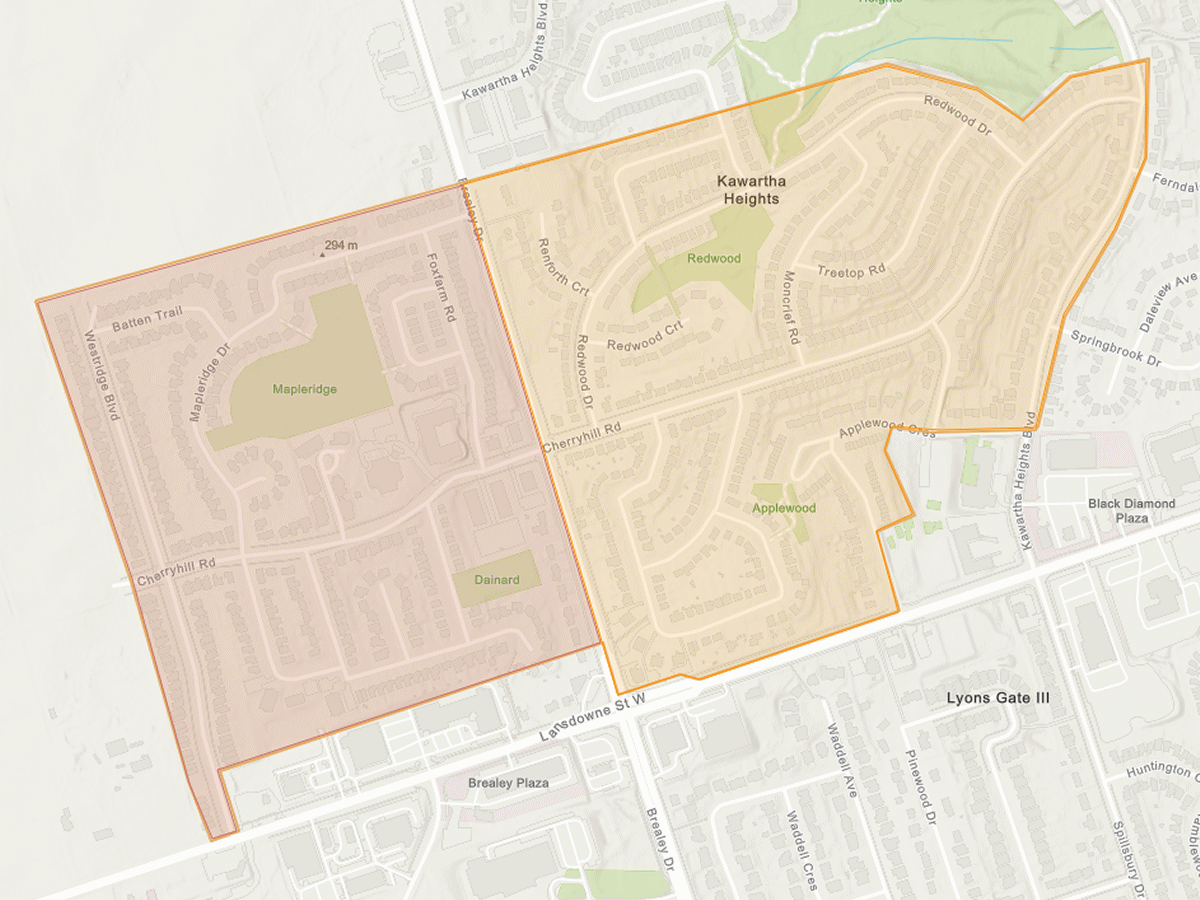
On-street parking permit pilot study areas

On-street Parking Permit Program - Pilot area #1. (kawarthaNOW screenshot of City of Peterborough map)
On-street Parking Permit Program – Pilot area #1. (kawarthaNOW screenshot of City of Peterborough map)
On-street Parking Permit Program - Pilot area #2. (kawarthaNOW screenshot of City of Peterborough map)
On-street Parking Permit Program – Pilot area #2. (kawarthaNOW screenshot of City of Peterborough map)
On-street Parking Permit Program - Pilot area #3. (kawarthaNOW screenshot of City of Peterborough map)
On-street Parking Permit Program – Pilot area #3. (kawarthaNOW screenshot of City of Peterborough map)

During Monday night’s meeting, Town Ward councillor Alex Bierk put forward a motion to extend the northern boundary of pilot program area #1 — which is located in Town Ward and consists of three zones — from Weller Street to McDonnel Street between Monaghan Road and Park Street North, to evaluate parking concerns in the area.

Acting commissioner of infrastructure, planning and growth management Ian Boland noted that the intention of the pilot program areas was to provide additional information for a future program and that the consultant chose the proposed areas based on the evaluation of criteria including available parking.

Councillor Bierk also expressed concern that he didn’t have the opportunity to provide feedback on the pilot program area in Town Ward.

Bierk’s fellow Town Ward councillor Joy Lachica proposed an additional amendment that council have the opportunity to review the initial data of the pilot program before zones are finalized for all three pilot study areas, which was deferred until Bierk’s motion was dealt with.

Advertisement - content continues below


Councillor Kevin Duguay said a report will come back to council on the results of the pilot program and, in the interests of the city’s HAF application, the pilot program should proceed as presented. He noted that Otonabee Ward does not have a pilot study area.

Councillor Gary Baldwin said extending the pilot study area in Town Ward “I don’t believe is fair” when other wards like Ashburnham Ward do not even have a pilot study area and constituents have expressed an interest.

“I’ve simply told the constituents with whom I have spoken, ‘It’s a pilot. When we get the information back, Ashburnham will be considered at that time,'” he said.

Mayor Jeff Leal noted that the federal government is auditing the HAF program in other municipalities, which have lost funding as a result.

“I’m not sure we can risk losing one dollar of our Housing Accelerator Fund,” the mayor said, before suggesting that the city could address concerns raised by councillor Bierk when evaluating the results of the pilot program.

Advertisement - content continues below


Bierk’s amendment lost 3-6, with councillors Bierk, Matt Crowley, and Don Vassiliadis voting in favour, and Mayor Leal and councillors Lachica, Andrew Beamer, Kevin Duguay, Gary Baldwin, and Keith Riel voting against. Councillors Dave Haacke and Lesley Parnell were absent from the meeting.

With respect to her motion, councillor Lachica asked Boland whether initial data from the pilot program would come back to council prior to a final report on the program, which he said could be done.

Councillor Duguay questioned the need for Lachica’s amendment as the report already indicated city staff will report back to council with results of the program. She clarified that the amendment was intended to provide feedback to city staff from councillors about parking “hot spots” in their wards.

Councillor Bierk said there would be value in councillors seeing the results of the pilot project and providing feedback before a final report is presented to council.

Advertisement - content continues below


As chair of the meeting, councillor Beamer asked Boland whether city staff could accept councillor feedback as proposed in Lachica’s amendment.

“Absolutely, and I don’t even know if it needs a motion, but we can certainly organize, perhaps, ward meetings with the ward councillors,” Boland said. “We are looking for that feedback. If you have that feedback, you hear from your constituents, it would be very helpful for us and for the study, so we’d be happy to organize that.”

Councillor Baldwin noted that, since Ashburnham Ward is not included in the pilot program, he would not be able to provide any specific feedback on the program.

Lachica’s amendment passed unanimously with a 9-0 vote.

After further discussion on the main motion, including by Northcrest Ward councillor Beamer who expressed the concerns of his constituents in the Parkland subdivision located in pilot program area #1 because of very narrow streets and on-street parking issues, council voted 7-2 to endorse the report, with councillors Vassiliadis and Beamer voting against it.

Items endorsed by general committee will be considered by city council for final approval on Monday (March 9) when registered delegations will be allowed to speak.

‘Spring forward’ this weekend when daylight saving time returns

The second Sunday of March is almost here, which means it’s time once again to “spring forward” as daylight saving time (DST) begins at 2 a.m. on Sunday, March 8 and clocks move forward an hour.

Whether you call it “daylight savings” or “summer time” or “cottage time,” the good news is we’ll get more daylight in the evening hours (the sun will set at 7:11 p.m. on Sunday night). The bad news is that we’ll lose an hour of sleep and it will be darker in the morning (the sun will rise at 7:38 a.m. on Sunday morning).

If you still have any manual clocks, remember to set them forward an hour before you go to bed on Saturday night.

The time change is also when you should replace the batteries in your smoke alarms and carbon monoxide detectors and check whether the devices need to be replaced (if they are more than 10 years old, they probably do).

Here’s everything you should know about DST:

Advertisement - content continues below


Who invented DST and why?

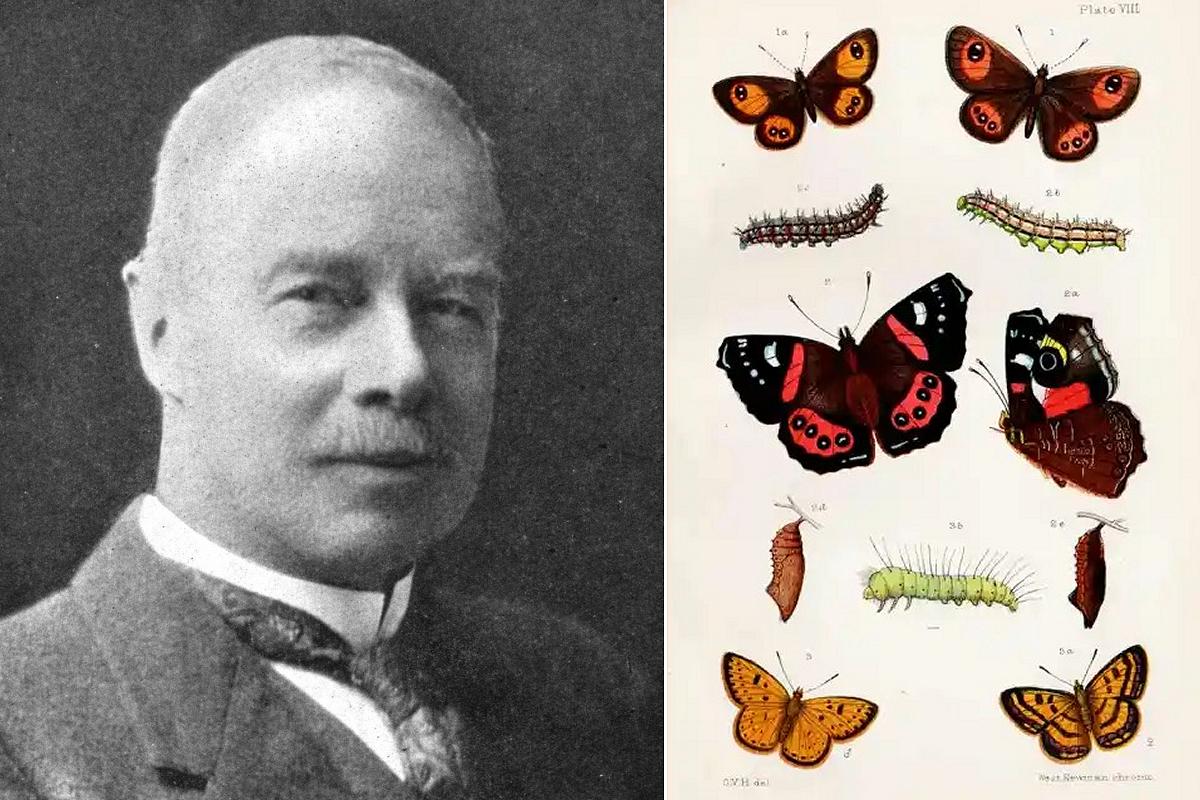
If you find daylight saving time annoying, you can blame New Zealand entomologist George Hudson. He first proposed "saving daylight" in 1895 so he could have more time during the day to collect insects. (Public domain photos)
If you find daylight saving time annoying, you can blame New Zealand entomologist George Hudson. He first proposed “saving daylight” in 1895 so he could have more time during the day to collect insects. (Public domain photos)

Although it’s commonly believed Benjamin Franklin came up with the idea for DST, it was actually New Zealand entomologist George Hudson.

In 1895, Hudson proposed a two-hour shift in the clocks (he wanted more daylight to collect insects).

“The effect of this alteration would be to advance all the day’s operations in summer two hours compared with the present system,” Hudson wrote in 1898, explaining his original proposal. “In this way the early-morning daylight would be utilised, and a long period of daylight leisure would be made available in the evening for cricket, gardening, cycling, or any other outdoor pursuit desired.”

A few years later, English outdoorsman William Willett also proposed advancing the clocks during the summer months (he wanted more daylight to golf).

The first governments to implement DST were Germany and Austria-Hungary in 1916, as a way to conserve coal during World War I. Britain and most other European countries adopted it shortly after, with the United States and Canada adopting it in 1918.

DST used to begin the first Sunday of April and end the last Sunday of October, but in 2007 the U.S. decided to change it to begin the second Sunday of March and end the first Sunday of November in an attempt to conserve energy.

To avoid issues with economic and social interactions with the U.S., the Canadian provinces that observe DST followed suit.

Advertisement - content continues below


What are the health effects of changing time twice a year?

While the evidence is mixed, some research has found that “falling back” results in more accidents involving pedestrians, while “springing forward” increases the risk of heart attacks and traffic accidents.

In any case, moving clocks forward or backward changes our exposure to daylight and affects our circadian rhythm (the body’s natural internal clock).

In the spring, having to get up an hour earlier can distrupt your sleep patterns. In the fall, having an extra hour of sleep can actually make you feel jet lagged.

In either case, it can take up to a week to adjust your internal clock to the shift in daylight hours.

Advertisement - content continues below


Why don’t we just get rid of DST?

It’s possible that we’ll eventually end the practice of changing our clocks twice a year, but by making DST permanent rather than getting rid of it.

On November 25, 2020, the Ontario government gave royal assent to The Time Amendment Act, a private members’ bill tabled by Ottawa-West Nepean MPP Jeremy Roberts that proposed making “the time now called daylight saving time the standard time year-round.”

The bill would only come into force if the province of Quebec and the state of New York also make DST permanent. While the Quebec government has previously said it is open to the idea of making DST permanent if neighbouring jurisdictions do the same, the province launched a survey in October 2024 asking residents in western Quebec whether to keep the time change or not and, if not, whether they’d prefer to have DST or EST year round (communities in eastern Quebec currently observe Atlantic time with no time change).

On March 2, 2026, British Columbia premier David Ebey announced the province was permanently adopting DST. In 2019, B.C. introduced legislation to allow the switch to permanent DST, following initiatives by California and Washington state to do the same. Originally, Ebey said he would wait for the American states to make the switch before doing the same.

“We are done waiting,” Eby said. “British Columbia is going to change our clocks just one more time, and then never again.”

Surrounded by school children, British Columbia premier David Ebey announced on March 2, 2026 that the province would change its clocks for the final time, permanently adopting daylight saving time. (kawarthaNOW screenshot)

British Columbia’s northern neighbour, Yukon, already ditched the switch in 2020, permanently adopting DST.

In 2022, it looked like the U.S. was on the verge of ending the bi-annual time change. On March 16, 2022, the U.S. Senate passed the Sunshine Protection Act, which would make DST permanent beginning in spring 2023. Despite passage in the Senate, the bill stalled in the House, where it remained in a committee until it died with the expiration of the previous Congress. In March 2023, then Florida senator Marco Rubio reintroduced the bill into the 118th Congress, where it also died in committee with the U.S. election.

In January 2025, two Republican Florida senators reintroduced the bill into both the House and Senate, where it was again referred to committee. Although U.S. President Donald Trump said prior to his inauguration that DST “is inconvenient, and very costly to our nation,” in March 2025 he said it’s “hard to get excited” about changing DST and called it a “50-50 issue,” adding “a lot of people like it one way, a lot of people like it the other way.”

Advertisement - content continues below


Is making DST permanent a good idea?

The primary argument for adopting DST permanently is that, by increasing the amount of daylight at the end of the day, it would lead to more economic activity and reduce vehicle collisions, energy usage, and robberies.

But researchers in chronobiology — the study of biological rhythms — disagree that DST should be made permanent. While they also want to get rid of the bi-annual time change, they say we should be permanently adopting standard time rather than DST.

“Based on current chronobiology knowledge, permanent Standard Time (ST) would be a wiser, healthier choice,” the Canadian Society for Chronobiology has said.

Chronobiologists say adopting permanent standard time would move sunrise closer to our body’s internal clock, while permanent DST would move it further away. It’s the light in the morning that is most important in resetting our biological clocks, they say.

And it’s not just the Canadian Society for Chronobiology advocating for the permanent adoption of standard time. The U.S.-based Society for Research on Biological Rhythms, the European Biological Rhythms Society, the British Sleep Society, and the European Sleep Research Society have all issued statements supporting it.


How can we reduce the health effects of the time change?

Here are some suggestions for how you and your family can adapt more quickly to the time change:

  • Each morning leading up to the time change on Sunday, try waking up 15 minutes earlier than normal.
  • Also try going to bed 15 minutes earlier than normal each night. You can help prepare your body for an earlier bedtime by not eating two hours before you go to sleep, and put down your devices an hour before bed.
  • Eat a healthy breakfast when you first wake up, as food is one way to tell your body it’s the beginning of the day.
  • After the time change, expose yourself to daylight during waking hours as much as possible.
  • Reduce your use of caffeine and alcohol during the day and increase your physical activity.

The Local Advantage with Peterborough County: Farms at Work grows future farming potential with local support

Farms at Work, a non-profit organization based in the Peterborough region, supports agricultural growth by providing education and hands-on support to new and existing farmers and keeping farmland in production. Peterborough County is supporting Farms at Work as it develops a community farm in Otonabee-South Monaghan that will offer shared infrastructure, mentorship, and opportunities for hands-on learning, and also continues to support agricultural growth in the region through the Kawartha Local Food Wholesale program and the Kawartha Choice FarmFresh initiative. (Photo courtesy of Peterborough County)

For more than 15 years, Farms at Work has been strengthening farm resilience and supporting community food security across east central Ontario, including Peterborough County.

Since its establishment in 2010, the non-profit organization based in the Peterborough region has helped both new and experienced farmers thrive while encouraging landowners to keep agricultural lands in productive use.

As climate change shapes the future of food production, Farms at Work’s commitment to environmental stewardship and sustainability has become increasingly important. Through education and hands-on support including tours and workshops, the organization helps farmers enhance soil health, improve biodiversity, reduce erosion, and strengthen pollination, ensuring long-term productivity and ecological resilience.

According to Pat Learmonth, founder and board member of Farms at Work, expanding local food production is key to ensuring community food security in east central Ontario as the population continues to grow. That includes in Peterborough County, which is well positioned for continued agricultural growth.

While Peterborough County has more than 180,000 acres of farmland in active production, the Ontario Ministry of Agriculture, Food, and Agribusiness estimates almost another 200,000 acres of land in the county could be used for farming. This aligns well with the Ontario government’s goal to increase the production and consumption of Ontario-grown foods by 30 per cent by 2032.

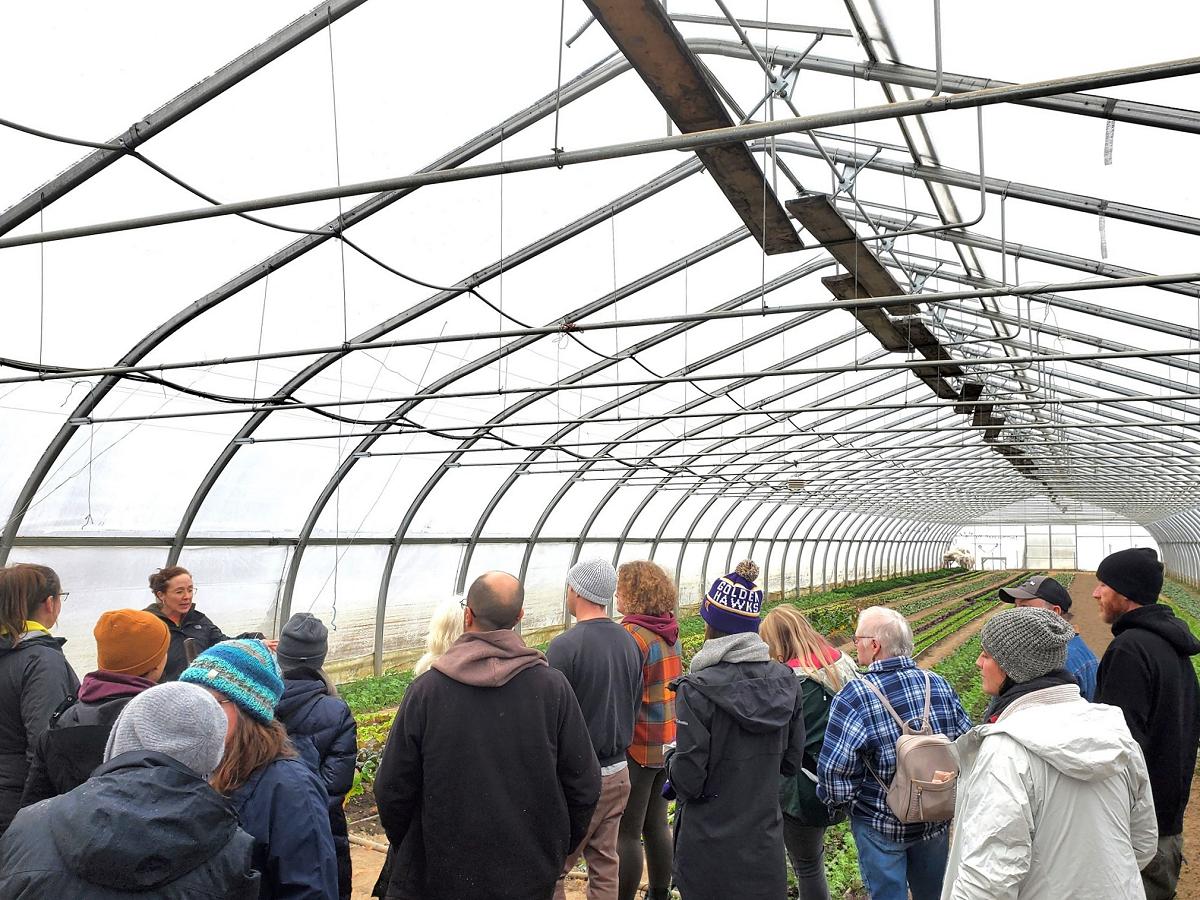
In November 2024 at Circle Organic in Cavan-Monaghan Township, Farms at Work led a hand-on tour of the farm's season-extending greenhouse, cold storage, and contoured beds. A non-profit organization based in the Peterborough region, Farms at Work supports the growth of resilient and thriving farms that contribute to community food security in east central Ontario, including by regularly hosting tours, workshops, and other events. (Photo courtesy of Farms at Work)
In November 2024 at Circle Organic in Cavan-Monaghan Township, Farms at Work led a hand-on tour of the farm’s season-extending greenhouse, cold storage, and contoured beds. A non-profit organization based in the Peterborough region, Farms at Work supports the growth of resilient and thriving farms that contribute to community food security in east central Ontario, including by regularly hosting tours, workshops, and other events. (Photo courtesy of Farms at Work)

Access to farmland remains one of the most important factors for agricultural growth. To help new and expanding farmers find affordable and secure farmland, including in Peterborough County, Farms at Work has developed FindFarmland.ca, a free tool that connects aspiring farmers across Ontario with non-farming landowners who are offering their land for rent, lease, or collaborative use.

“We could actually keep farmland in production that would otherwise sit idle,” Learmonth says.

Alongside the efforts of Farms at Work, Peterborough County is also supporting agricultural growth in the region through the Kawartha Local Food Wholesale program and the Kawartha Choice FarmFresh initiative.

Funded in part by the Ontario Ministry of Agriculture, Food and Agribusiness, the Kawartha Local Food Wholesale aims to increase the capacity for local food distribution by supporting expanded production and procurement within Peterborough County, as well as the City of Peterborough and the City of Kawartha Lakes, by connecting farmers with local food buyers such as restaurants, retail, food services, tourist attractions, golf courses, and more.

Peterborough County also continues to partner with the City of Peterborough and the City Kawartha Lakes to deliver the Kawartha Choice FarmFresh initiative, a free-to-join regional economic development program that provides a brand identity for local food and farm products grown and produced in The Kawarthas, a network for members to share ideas and access resources, and an online database for buyers to find local producers.

The county is also supporting Farms at Work as it develops a community farm in Otonabee-South Monaghan. Designed as a collaborative space for new farmers, students, and small agricultural businesses, the farm will offer shared infrastructure, mentorship, and opportunities for hands-on learning.

“Some folks may stay in that collective space and decide this is how they want to continue their business,” says Heather Thoma, operations manager at Farms at Work. “For others, it may be a jumping-off point, which will support them to practice, learn and build confidence before purchasing their own land.”

For more information on Farms at Work, visit farmsatwork.ca or email contact@farmsatwork.ca.


The Local Advantage in Peterborough County is a branded editorial feature series celebrating the farmers, food producers, food retailers, and agri-tourism businesses that make The Kawarthas thrive, created in partnership with Peterborough County’s Economic Development & Tourism Division.

The Local Advantage in Peterborough County logo

Agriculture is a key economic driver and a point of pride for Peterborough County, with local farms producing a wide variety of high-quality goods, from traditional crops and livestock to organic and specialty products, reflecting the strength and diversity of this vital sector. With a growing focus on sustainability, local food systems, agri-innovation, and agri-tourism, agriculture offers strong potential for growth and diversification.

The Local Advantage with Peterborough County series spotlights the Kawartha Choice FarmFresh and Kawartha Local Food Wholesale initiatives, which aim to strengthen connections from farm to table across our region.

For more information about economic development and tourism in Peterborough County, visit www.ptbocounty.ca/ecdev and The Kawarthas Tourism at thekawarthas.ca.

Become a #kawarthaNOW fan

34,229FollowersLike
25,930FollowersFollow
17,472FollowersFollow
4,848FollowersFollow
4,044FollowersFollow
3,211FollowersFollow

Sign up for kawarthNOW's Enews

Sign up for our VIP Enews

kawarthaNOW.com offers two enews options to help readers stay in the know. Our VIP enews is delivered weekly every Wednesday morning and includes exclusive giveaways, and our news digest is delivered daily every morning. You can subscribe to one or both.


Submit your event for FREE!

Use our event submission form to post your event on our website — for free. To submit editorial content or ideas, please contact us.