Peterborough-Kawartha MPP Dave Smith was at the Peterborough police station on May 2, 2022 to announce a $2,947,380 grant over three years for the Peterborough Police Service to support its special victims unit. (Photo: Office of Dave Smith)
The Ontario government is providing the Peterborough Police Service with more than $2.9 million over three years, with most of the funding going to support the police service’s special victims unit.
Peterborough-Kawartha MPP Dave Smith made the announcement at the Peterborough police station on Monday morning (May 2).
“This funding will bring significant support to victims of crime — helping them heal and bring criminals to justice,” Smith said.
Advertisement - content continues below
Peterborough police will use most of the $2,947,380 grant for its special victims unit, which will focus on investigating crimes related to human trafficking, child exploitation and sexual abuse, elder abuse, domestic violence, and sexual violence and harassment.
The funding will also be used for a new major crime investigator to assist with unit’s investigations and projects, a situation table coordinator to assist the police service’s community development and engagement coordinator, assist with the service’s data analysts, and provide advanced training courses for officers.
“The funding allows the service to work on more proactive projects, provides advanced training courses, allows officers in the major crime unit to work on investigating overdose deaths which may lead to more positive outcomes for for our community and more connections to our victims services unit for victims of crime,” said Inspector John Lyons of the Peterborough Police Service.
Advertisement - content continues below
The funding is part of the province’s $267 million Community Safety and Policing Grant Program, announced last November.
A total of 90 police service boards across Ontario are receiving funding under the program for 147 public safety initiatives focusing on local and provincial priorities such as gun and gang violence, sexual violence and harassment, human trafficking, mental health and addictions, and hate-motivated crime.
Police services will be required to report twice a year on the financial activities and outcomes of their initiatives.
The much-loved miniature train ride at Peterborough's Riverview Park and Zoo runs during the zoo's summer season, which begins on the Victoria Day weekend. (Photo: Riverview Park and Zoo)
With just three weeks to go before the opening of the summer season at Riverview Park and Zoo in Peterborough, staff have discovered the zoo’s much-loved miniature train has been damaged by vandals.
In a Facebook post on Saturday morning (April 30), zoo manager and curator Jim Moloney said vandals broke into the train tunnel — where the train was being stored over the winter.
Along with damaging the train, the vandals stole the train’s signature brass bell.
Advertisement - content continues below
“In addition to the cost of repair/replacement, thoughtless acts like this really have a negative impact on our team of dedicated and passionate staff,” Moloney said.
The zoo has also been subject to other acts of vandalism in March, which have been reported to police. It is not known if the train was vandalized and the bell stolen during that time.
The popular miniature train ride runs during the zoo’s summer season, which begins on the Victoria Day weekend. Until the extent of the damage to the train has been evaluated, it’s not clear whether the train ride will be ready for the beginning of the summer season.
Some days at the Park and Zoo are more challenging than others. As you know, we've been working hard to have all of our…
The zoo is asking anyone with information about the vandalism or the theft of the bell to contact Peterborough Police at 705-876-1122 x555. If you prefer to remain anonymous, you can contact Crime Stoppers at 1-800-222-8477 or online at www.stopcrimehere.ca.
Riverview Park and Zoo is Peterborough’s largest park and Canada’s only free-admission, CAZA-accredited zoo.
Established in 1974 by James Hamilton, the miniature train ride features a miniature replica of an 1860 locomotive (nicknamed “Rosco”). Last fall, the zoo began a $300,000 fundraising campaign to replace the aging locomotive by 2023, and raised almost $20,000 in 2021.
First launched in 2004, Shifting Gears is an annual challenge hosted by Peterborough GreenUP and partners that invites workplaces and individuals to track their emissions reductions by making sustainable commuting choices for the month of May. (Photo courtesy of GreenUP)
Shifting Gears, an annual challenge that encourages people in the Peterborough area to make the shift to more sustainable transportation choices during May, is back for its 18th year.
Shifting Gears was originally launched in 2004 by Peterborough GreenUP, the City of Peterborough, and other partners as a month-long commuter challenge for workplaces, encouraging employees to walk, cycle, take transit, carpool, and work from home.
In 2015, the May challenge was expanded to encourage everyone in the community — employees, students, and more — to make the shift towards walking, biking, and taking transit for daily trips to work, school, the store, an appointment, and elsewhere.
Advertisement - content continues below
Share on Bluesky
“Participating in Shifting Gears is a great way to get moving again,” says the City of Peterborough’s Sue Sauve, a long-time coordinator and participant in Shifting Gears. “It’s like having a free gym membership, plus added incentives and prizes.”
Shifting Gears partners include GreenUP, the City of Peterborough including Peterborough Transit, the County of Peterborough, Peterborough Public Health, B!KE: the Community Bike Shop, Wild Rock Outfitters, and more.
By registering for the Shifting Gears Challenge at greenup.on.ca/shifting-gears/, participants can track their sustainable transportation choices during May, racking up points and winning prizes.
Advertisement - content continues below
Brianna Salmon of GreenUP, Kieran Andrews of Wild Rock Outfitters, and Sue Sauve of the City of Peterborough during the kick-off of the 2014 Shifting Gears Challenge. Until 2015, when it was expanded to the entire community, Shifting Gears was a workplace challenge. (Photo courtesy of GreenUP)
In addition, participants get access to exclusive bike maintenance workshops, group rides, and the Rack ‘n’ Roll program at B!KE, which provides cycling gear and riding tips.
“We recognize that commuter trips are often rolled in with other activities,” explains B!KE volunteer coordinator Jean Grieg. “You might need to grocery shop on your way home from work, or drop off your children at school. Rack ‘n’ Roll seeks to help make these essential, real-life bike trips more comfortable and more efficient. The ease of travel will help make every-day cycling more of a no-brainer.”
People can join the challenge at greenup.on.ca/shifting-gears/ as individuals or sign up alongside co-workers as a workplace team for added support and motivation.
Morgan Johnson will wear half masks to portray three different characters in "Care," a 15-minute spoken word and movement performance that explores the invisibility of care work that was created and developed by Johnson, Peyton Le Barr, and Alexandra Simpson. "Care" will be performed 12 times during the two weekends of Public Energy Performing Art's Erring at King George multidisciplinary arts festival from May 6 to 8 and May 13 to 15. (Supplied photo)
If there’s a silver lining to be found in a COVID-19 world, heightened appreciation for the service and dedication of frontline workers certainly fits the bill.
While that hasn’t been lost on performance creators Peyton Le Barr, Alexandra Simpson, and Morgan Johnson, the trio collectively saw something else — a shared realization that led to their creation of a performance piece that will premiere in May at a Peterborough multidisciplinary arts festival.
“We saw where there were gaps in the system where care was needed and was not being provided,” explains Simpson who, with Johnson, founded the Animacy Theatre Collective in Toronto.
Share on Bluesky
“We started talking about this two or three years ago,” Simpson recalls. “There was a teachers’ strike going on in Ontario at the time. We were thinking about the care work that goes into education that isn’t necessarily visible. That interest expanded from education to all sectors of care, including health and social work.”
The result of their collaboration is Care, a 15-minute performance piece that will have its first public staging as part of Erring at King George at the former East City public school, 220 Hunter Street East at Armour Road.
Presented by Public Energy Performing Arts and sponsored in part by kawarthaNOW, festival dates are May 6 to 8 and May 13 to 15. Tickets range in price from $5 to $30, can be purchased online at eventbrite.ca/e/erring-at-king-george-tickets-311827001957. Tickets will also be available at the door.
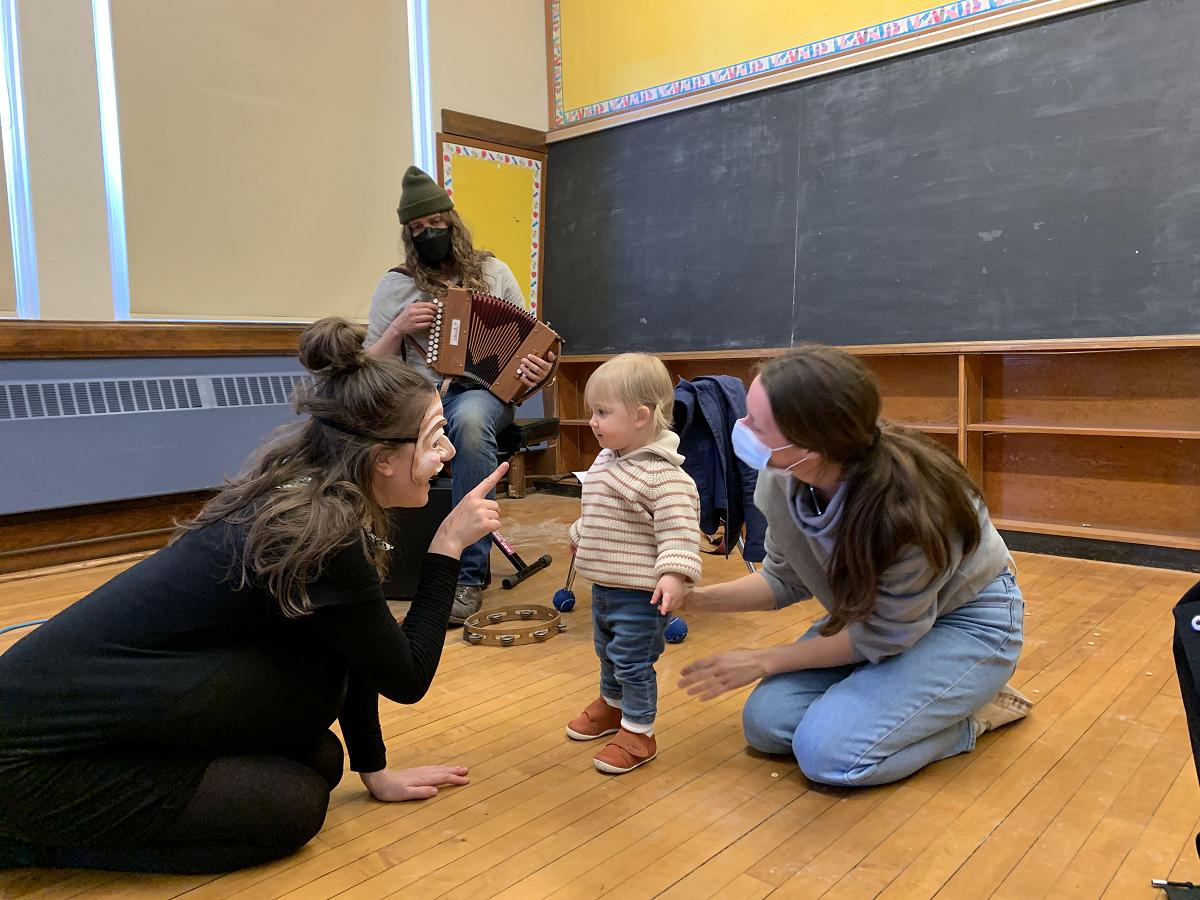
Morgan Johnson with Peyton Le Barr and her daughter Abigail during a rehearsal for “Care” for Public Energy Performing Art’s Erring at King George multidisciplinary arts festival from May 6 to 8 and May 13 to 15. Le Barr gained a new understanding of unpaid care work after she became a mother and after her husband had a serious health issue. The 15-minute performance will be accompanied with music performed by Peterborough’s Benj Rowland. (Supplied photo)
With musical support from Peterborough’s Benj Rowland, Johnson will perform the piece — a combination of spoken word and movement that will see her, wearing half masks designed and made by Simpson, portray a total of three characters.
“The way that we collaborated and created the script together was through the characters that were developed out of the masks,” explains Johnson. “We did a lot of improvisation and character development. That’s really where the material came from.”
“It’s a form that really lends itself to collaboration. If I’m improving and creating the characters, we need to be together in finding what works and create it together; full-on collaboration where everything is entwined together.”
Share on Bluesky
Le Barr, who co-founded Peterborough’s Grassroots Theatre Company before the pandemic with Chris Whidden, says Care “has been a slow burn in the best of ways.”
“It started off with an interest in looking at teachers and the invisible care work that exists within their work,” she explains. “We then broadened it to something that can exist outside of Erring as well. I interviewed lots of social workers and people who work in care work — nurses, palliative care workers, all different fields, and also teachers — compiled that research, and really looked at what care work is and what makes it so invisible. What makes it difficult for us to understand and how is it compensated or not compensated?”
“It’s been quite a blessing to have this much time to sit with this knowledge so we can do service to the people that we’re exploring. We’re hoping to give them something that celebrates the work that is so undervalued within their day-to-day lives.”
Alexandra Simpson, Peyton Le Barr, and Morgan Johnson (right) in August 2020 when they first began working on “Care” with their mentor Martha Ross, second from right. (Supplied photo)
The opportunity to premiere Care as part of the extensive Erring at King George menu of performances is “a wonderful opportunity” on a couple of levels, says Le Barr.
“I’ve always been drawn to performing in places that are public or have any element of free accessibility,” she says, adding “There’s nothing I love more than performing for people who are not in the theatre.”
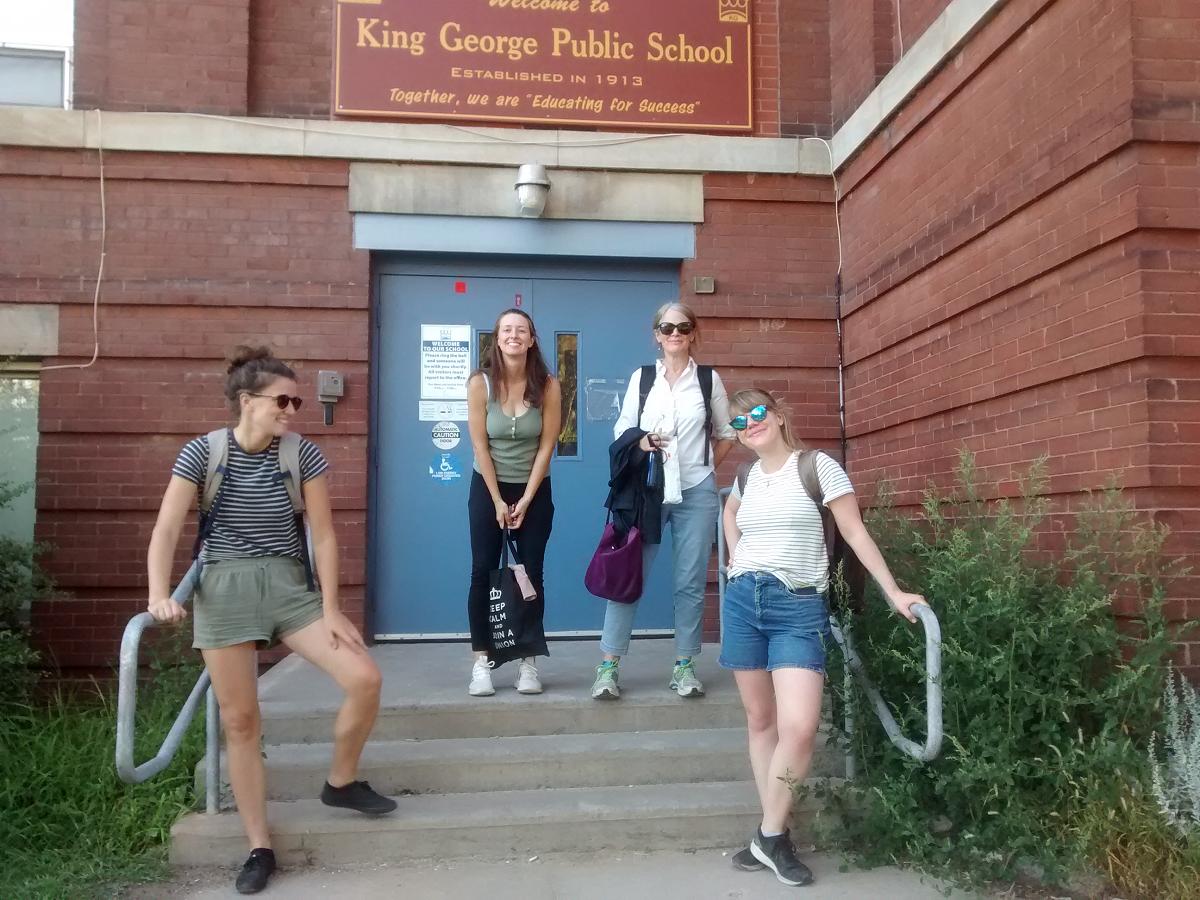
People attending Erring at King George will most definitely not be in traditional theatre. The heritage building was constructed in 1913 and served as an elementary school until it was closed 106 years later.
Share on Bluesky
“There are lots of reasons people don’t feel welcome in a theatre space,” Le Barr says. “Maybe it’s stuffy or old-fashioned, or it’s of a different era and it’s not really their vibe, or they’ve never been before and they don’t know the etiquette.”
“Art is meant to be enjoyed, not just by other artists but also by the public. That’s something that Public Energy is really, really great at. They have a big community that follows them that isn’t just fellow artists.”
As for presenting their creation in a very restricted time frame, Simpson says that’s “a blessing and a curse.”
Alexandra Simpson. (Supplied photo)
“Fifteen minutes is easier to prepare — we can create something that’s really sharp for 15 minutes,” Simpson explains. “On the other hand, because we are developing the characters and our ideas around the piece, we’ve got a lot of ideas at this point and it’s hard to get all those into 15 minutes.”
“Sometimes boundaries and constraints are a great thing, forcing you to play within that and be really fruitful for creation and creativity. In a lot of ways, this is a test of some of the things we’re interested in about the characters, about the themes of care work, and about audience interactivity with masked performance. It give us a little taste of all that.”
She adds that it’s her hope the performance will “raise a lot of the questions we’ve grappling with as artists” for those who experience it.
Share on Bluesky
“Maybe we hope they grapple with those questions as well in terms of the visibility of care work and how important it has always been, but has really become during the pandemic. Just questioning how we view care work in society and how we value it, or don’t value it — stirring up these questions is a goal.”
Le Barr adds that her part in the creation of Care “has become more and personal” for her.
“We had originally planned on myself performing as well, but I’ve taken a step back because in the process of developing the project,” she explains. “I became a mother. My husband just recently had a very serious pulmonary embolism. We’re in the clear now, but I have found myself in the throes of unpaid care work.”
Peyton Le Barr. (Supplied photo)
Share on Bluesky
“I hope this gives people a bit of appreciation for all the moments of care that happen in the privacy of homes or in the quiet moments of the work day that aren’t celebrated,” says Le Barr. “I hope that anyone in the audience who is a primary caregiver in any capacity, or has a career that is care driven, feels a little bit seen and recognized — not in a black and white way but in acknowledging some of the complexities of this work.”
Post Erring, the trio has plans to develop Care further, notes Johnson.
“We’re applying for grants to develop a full show that will be a little more long term, bring on a bigger group of collaborators, and think about care in a really broad sense. There’s hands-on care, there’s career care, there’s emotional care, there’s unpaid care in the home, and there’s structural care.”
Morgan Johnson. (Supplied photo)
Share on Bluesky
Johnson provides several examples of structural care, such as caring for those displaced by the climate crisis and war.
“How do we care for a world that’s on fire? How do we care for people that don’t have anywhere to live or are escaping war? Just thinking about care as an organizing principle in a larger structure … use the research we’ve done and that we’ll continue doing to do a larger devised piece with a big group.”
There are 12 opportunities to watch Care during the Erring at King George festival. Performances run at 7:45 and 9 p.m. on May 6, 4 and 5:15 p.m. on May 7, 2:45 and 4 p.m. on May 8, 8 and 9:15 p.m. on May 13, 3:45 and 5 p.m. on May 14, and 3 and 4:15 p.m.on May 15.
Involving more than 70 performance and visual artists, this is the third Erring festival held in Peterborough, the last being in 2014 at Mount St. Joseph.
This story was created in partnership with Public Energy Performing Arts.
Linda Forth pictured at Georgian College in Barrie in the late 1970s. (Supplied photo)
Barrie resident Linda Jean Forth has bequeathed $208,000 to the Peterborough Humane Society’s new Peterborough Animal Care Centre.
According to Floyd Storring, executor of Forth’s estate, she was a mechanical engineer who ran the tech department at Georgian College in Barrie for 35 years.
“She travelled the world,” Storring says in a media release from the Peterborough Humane Society. “Most of Europe, Russia, Iceland, and all of Great Britain. As well as Africa, visiting Egypt, Kenya, Rwanda and Mozambique. Climbed to see the silver back gorillas. She boated and swam in the Amazon River and went to the Galapagos, and most of Asia. ”
Advertisement - content continues below
Share on Bluesky
“She was a pure lover of animals,” Storring adds. “Rather than give gifts at Christmas, we’d receive notes saying we were foster parents to an elephant or tiger. There was obviously something she saw in your organization to warrant her to include you in her will, and to support the amazing work being done by your organization.”
Currently under construction at 1999 Technology Drive in Peterborough, the Peterborough Animal Care is scheduled for completion in fall 2022. The facility will be over 24,000 square feet and include a state-of-the art animal adoption and education centre, a high-volume spay and neuter clinic, and a provincial dog rehabilitation centre.
“We are honoured to recognize Linda, her love for animals, and her contribution to animal wellness through our new centre,” says Shawn Morey, executive director of the Peterborough Humane Society. “This donation to the centre will not only change the lives of the animals in our care but our entire community and beyond.”
“Legacy gifts are an amazing way to leave a lasting impact, and we are truly thankful to be a part of Linda’s legacy. Her passion for animals will live on for generations to come through this gift.”
Montreal-based indie folk-rock band RedFox kicks off a Canadian spring tour with a performance at the newly opened Jethro's Bar + Stage in downtown Peterborough on Saturday, April 30. (Photo: Sheri Hankins)
Every Thursday, we publish live music events at pubs and restaurants in Peterborough and the greater Kawarthas region based on information that venues provide to us directly or post on their website or social media channels. Here are the listings for the week of Thursday, April 28 to Wednesday, May 4.
If you’re a pub or restaurant owner and want to be included in our weekly listings, please email our nightlifeNOW editor at nightlife@kawarthanow.com. For concerts and live music events at other venues, check out our Concerts & Live Music page.
Friday, May 27 7-11:30pm - Music At the Monk 2 ft Looking For Heather, Phil Heaslip, Cassie Noble, Nathan Truax, SJ Riley ($10 in advance at www.eventbrite.ca/e/273028785447)
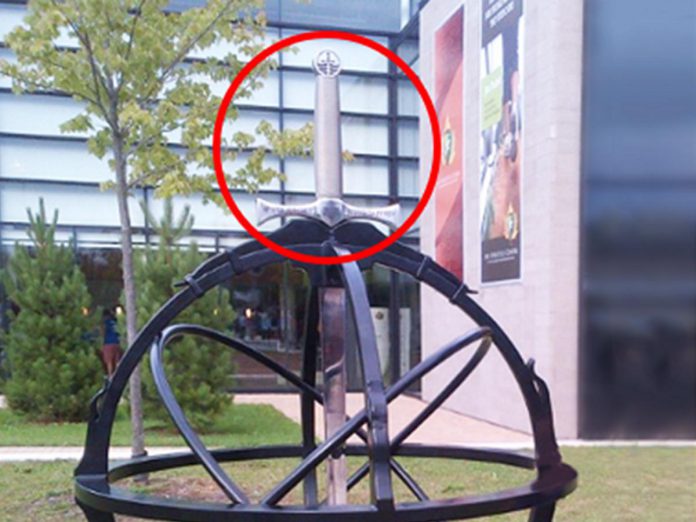
Peterborough police are investigating the theft of the sword hilt from the Trent Excalibur Legacy Sculpture, located between the Trent Athletics Centre and the Justin Chiu Stadium on The Trent University campus. (Police-supplied photo)
Peterborough police are investigating the March theft of part of a sculpture on the Trent University campus.
On Wednesday (April 27), officers were made aware the hilt of the sword has been removed from the Trent Excalibur Legacy Sculpture sometime between March 21 and 22.
The sword hilt is valued at more than $5,000.
Advertisement - content continues below
Police say a photo was circulated on social media shortly after the theft, in the hopes the sword hilt would be returned, but that has not happened.
Installed in 2013 between the Trent Athletics Centre and the Justin Chiu Stadium, the Trent Excalibur Legacy Sculpture was conceived by Trent Varsity athlete Sara Rettie and created by local artist Todd Riddolls of California Iron.
Anyone with information is asked to contact Peterborough Police at 705-876-1122 x555. If you prefer to remain anonymous, you can contact Crime Stoppers at 1-800-222-8477 or online at www.stopcrimehere.ca.
International Compost Awareness Week 2022 runs from May 1 to 7. Composting is one way we can help to reverse climate change by taking action in our own backyard. (Photo: Karen Halley)
Each week, GreenUP provides a story related to the environment. This week’s story is by Hayley Goodchild, Coordinator of Neighbourhood and Residential Programs at GreenUP.
May 1 to 7 is International Compost Awareness Week. This is an ideal time to learn how composting can help reverse climate change.
What is composting? It’s a human activity that leverages natural processes of decay to turn organic materials into soil enriching humus. In other words, it’s managing how things rot.
Organic matter includes anything that was once living, such as vegetable scraps, hair, animal bones, or that greasy pizza box from last night’s dinner. To us, these things are waste.
Advertisement - content continues below
To microbes, these things are food. Bacteria, fungi, and other microorganisms break down the material into humus, water, and other by-products, such as heat and carbon dioxide (CO2). These organisms require oxygen to do their job effectively.
When we send organic waste to landfills, it decomposes without the benefit of oxygen, creating methane. Methane is a potent greenhouse gas that does much more damage to our atmosphere than the CO2 produced in aerobic (oxygen-rich) compost systems.
Diverting organics from landfill to compost can achieve significant greenhouse gas reductions through methane reductions alone, which is why the municipal composting facility slated for 2023 is so important.
A compost pile with an internal temperature between 44 and 65 degrees Celsius tells you aerobic microorganisms are hard at work. When we send organic waste to landfills instead of composting it, the waste decomposes without the benefit of oxygen and produces the potent greenhouse gas methane. (Photo: Hayley Goodchild)
“The composting facility is anticipated to be a significant driver of corporate greenhouse gas emissions reductions, supporting the target to reduce emissions by 45 per cent below the 2011 baseline by 2030,” says James Byrne, climate change coordinator for the City of Peterborough.
When you factor in the ability of plants and trees to sequester carbon throughout their lives, the CO2 produced by composting plants and trees should be nullified.
Byrne also encourages residents to think about the types of waste we generate in the first place, especially since the municipal system won’t be operational until 2023.
Advertisement - content continues below
“Soiled cardboard and paper products, like that greasy pizza box, can actually generate more methane emissions than food scraps because of their high carbon content,” Byrne explains. “Consider making pizza at home, or eating out at a restaurant when that feels comfortable for you.”
The composting facility is great news for city residents but, with less than a decade left to avert catastrophic climate change, there is no time to waste.
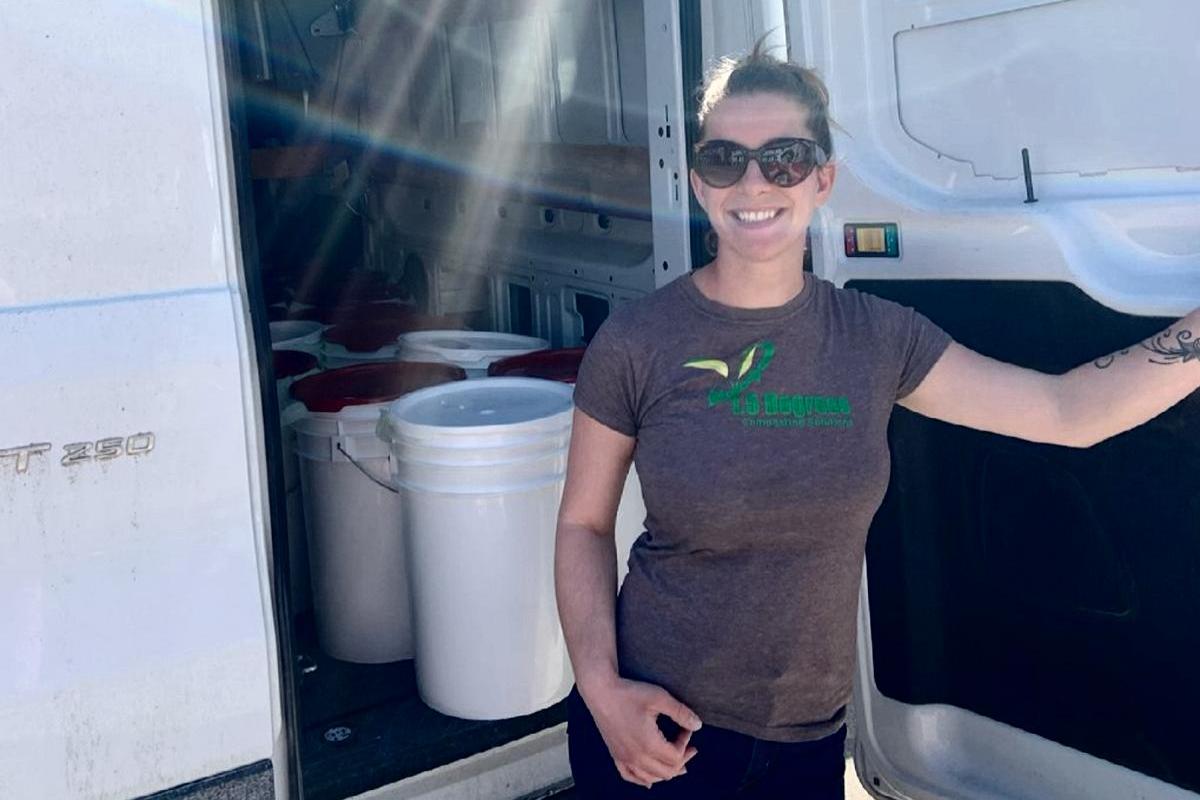
The urgency of the climate crisis inspired Desiree Bandi to begin 1.5 Degrees Composting Solutions in 2020. The company collects customers’ organic waste each week, delivers it to a regional composting facility, and returns finished compost to participants in the spring. For those who can’t make use of their compost, Bandi donates their portions to local community gardens.
Desiree Bandi of 1.5 Degrees Composting Solutions, which offers an organic waste pick-up service for residents and commercial clients in the Peterborough area. (Photo: 1.5 Degrees Composting Solutions)
Closing the compost loop is a crucial piece of the puzzle.
“Returning organic matter and microbial life to the ground makes healthy plants, and that sequesters carbon from the atmosphere,” explains Bandi. “There are also many other benefits to compost, such as healthier food, reducing the need for fertilizers, and better water retention in the soil.”
To take advantage of these benefits, add compost to your garden and vegetable beds on a regular basis, usually once per year. There’s no need to work it into the soil. Simply add a layer one or two inches thick in the spring or fall. Take care to work around any existing plants. Don’t bury their leaves or stems.
Advertisement - content continues below
The Ecology Park Native Plant and Tree Nursery, which opens on May 21, will be selling bulk compost this season. Please visit the GreenUP website at greenup.on.ca/ecology-park/nursery/ at for details.
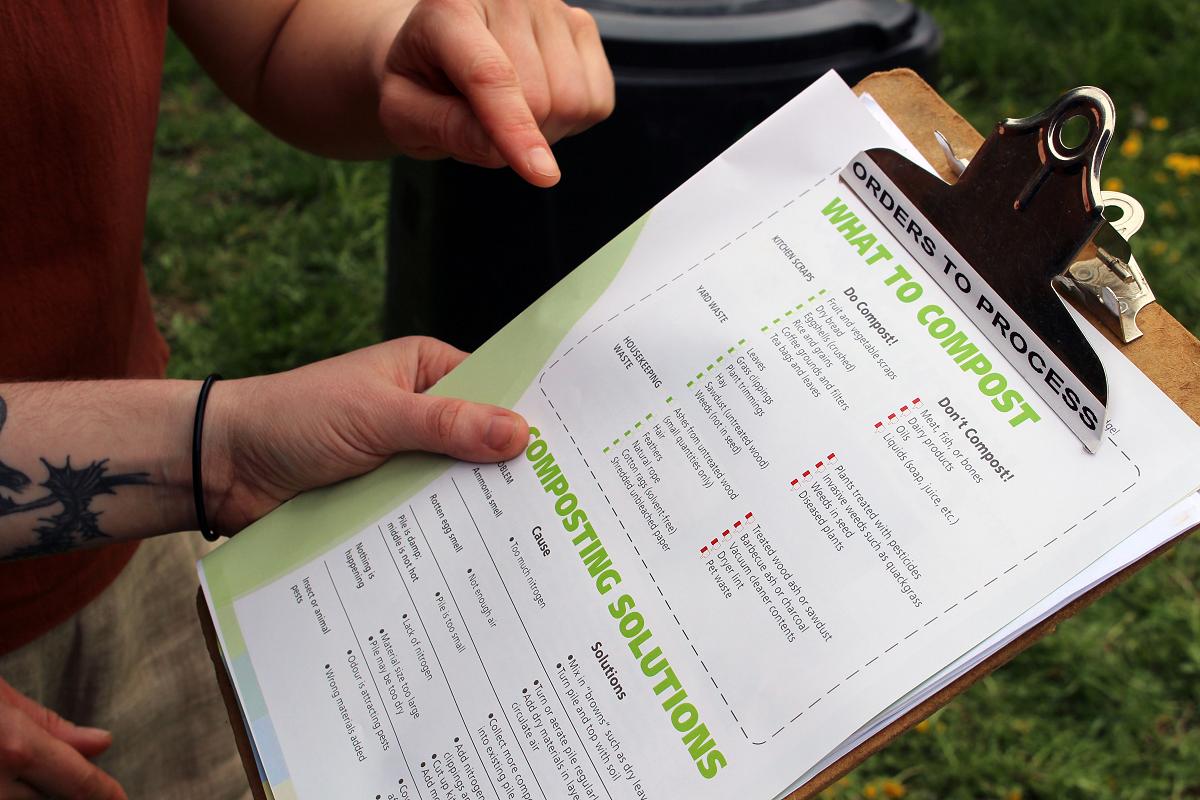
Spring is great time to begin composting at home. It is simple to do as long as you balance nitrogen-rich “greens” and carbon-rich “browns” in your pile. You should also avoid materials like meat or dairy products that can attract pests.
You can find more information in GreenUP’s composting fact sheet. Backyard composter, kitchen compost bins, and compost accessories, including a hand-powered compost aerator, are available for purchase at GreenUP’s online store at shop.greenup.on.ca.
GreenUP provides a helpful composting fact sheet with tips on how to install a backyard composter and take care of your compost for optimal results. (Photo: Karen Halley)
No backyard? No problem. Vermicomposting is a worm-based composting method that can be practised indoors or on a balcony. Services such as 1.5 Degrees are also available for those who cannot compost in a backyard. Visit (peterboroughcompost.ca for more information.
Businesses interested in composting as a means of reducing their carbon footprint can learn more through Green Economy Peterborough, a new local network that supports businesses to act on climate. Visit greenup.on.ca/green-economy-peterborough/ for more information.
The Peterborough, Victoria, Northumberland and Clarington Catholic District School Board created this graphic to announce its decision to fly the Pride flag at school board facilities during June 2022.
In a reversal of a decision last year, the Peterborough, Victoria, Northumberland and Clarington Catholic District School Board has voted to fly the Pride flag at school board facilities during the month of June.
At the board meeting on Tuesday night (April 26), trustee Kevin MacKenzie brought forth a motion to fly the flag “to further the promotion of an environment of inclusion, diversity and equity in our community.”
“I want to set the same example to my children that Jesus did, and that’s to love all people,” MacKenzie said as he presented the motion.
Advertisement - content continues below
Share on Bluesky
“I want (students) to feel proud of their school board and their school,” MacKenzie said. “I want them to feel proud of themselves. I want them to be filled with pride because I can tell you that I am proud of every student in our board. Let them be proud and let’s raise the Pride flag.”
The motion passed with a majority vote of 3 to 2.
MacKenzie and trustee Loretta Durst supported the motion, and trustees David Bernier and Linda Ainsworth voted against it. With trustee Helen McCarthy absent from the meeting and with a trustee position vacant, board chair Braden Leal cast the tie-breaking vote in support of the motion.
Advertisement - content continues below
Share on Bluesky
“Time and time again, Pope Francis’ message is explicit — we must always consider the person,” Leal said. “The doors of our Catholic schools must be clearly open to all people. We have an opportunity to physically and symbolically demonstrate full inclusion, to welcome each and every member of the 2SLGBTQ+ community by flying the Pride flag during Pride Month.”
In a similar voting situation last June, an equal number of trustees voted for and against a motion to display secondary flagpoles to display flags during months of awareness.
The tie vote led to the former board chair casting a deciding vote, but this time against the motion.
In the aftermath of that decision, made during Pride Month, a parent launched an online petition protesting the decision, with the petition eventually garnering more than 23,000 signatures.
This story has been updated to correct errors and to provide details on the vote.
kawarthaNOW.com offers two enews options to help readers stay in the know. Our VIP enews is delivered weekly every Wednesday morning and includes exclusive giveaways, and our news digest is delivered daily every morning. You can subscribe to one or both.
Submit your event for FREE!
Use our event submission form to post your event on our website — for free.
To submit editorial content or ideas, please contact us.