The Ontario government has announced it will end funding for Peterborough’s Consumption and Treatment Services (CTS) site, which has been in operation for almost four years.
The Peterborough CTS site is one of seven CTS sites the Ontario government is closing in communities that now have a Homelessness and Addiction Recovery Treatment (HART) Hub funded by the province.
“Our government is focused on treatment, recovery, and safer communities,” said Ontario health minister Sylvia Jones in a media release on Monday (March 16). “Through our almost $550 million investment to establish HART Hubs across the province, we are ensuring people struggling with addiction can access the care and supports they need to break the tragic cycle of addiction and rebuild their lives while protecting Ontario communities.”
Advertisement - content continues below
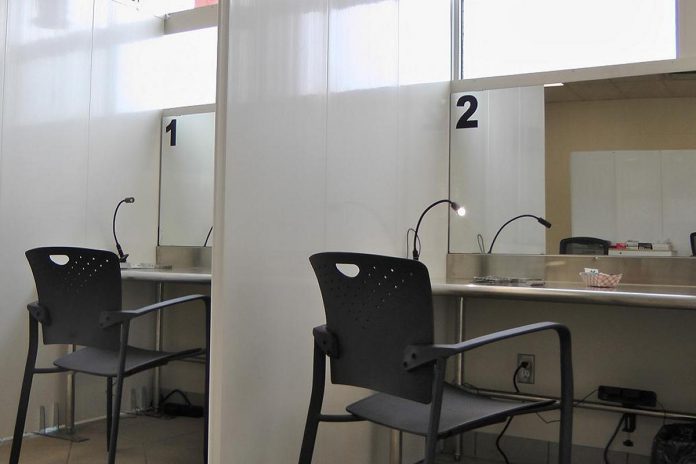
Located in the former bus terminal at 220 Simcoe Street in downtown Peterborough, the CTS opened in June 2022 to provide a safe and medically supported space for people to consume pre-obtained drugs under the supervision of health professionals. People using the CTS are provided with sterile injection supplies, education on safer consumption practices, drug checking, basic medical services, and referrals to addiction treatment services, housing, and other social services.
The CTS is operated by Four Counties Addictions Services (Fourcast), which is also leading Peterborough’s HART Hub, one of 28 approved across Ontario.
The creation of HART Hubs resulted from the province’s August 2024 “safer communities” announcement that banned supervised drug consumption sites within 200 metres of schools and child care centres. It resulted in the closure of nine existing provincially funded supervised drug consumption sites, including four in Toronto as well as sites in Guelph, Hamilton, Thunder Bay, Ottawa, and Kitchener-Waterloo. CTS sites that were not located within 200 metres of schools and child care centres continued to receive funding.
Advertisement - content continues below
Along with Peterborough, the other six sites that will no longer receive provincial funding as a result of Monday’s announcement include two sites in Toronto, two sites in Ottawa, one site in Niagara, and one site in London.
“This latest step responds directly to local concerns over public safety associated with these sites and furthers the government’s plan to fund treatment and lasting recovery from addiction, rather than continued public funding of drug injection sites,” reads the province’s media release.
The Ontario government states it will initiate a 90-day wind-down period “to give clients time to transition to the support provided by their local HART Hub.”
“During this period the government will work directly with the municipalities and community partners to ensure a safe, coordinated wind-down of provincial funding for the drug injection sites and successful transition into the new model of recovery,” the media release states.
Advertisement - content continues below
In January 2025, the Ontario government announced $6.2 million for Peterborough’s HART Hub for local service delivery partners to provide a continuum of services for people with complex service needs on their recovery journey from addictions and homelessness.
It delivers primary and psychiatric care, mental health and addictions services (including case management, Rapid Access Addiction Medicine (RAAM), withdrawal management, bed-based addictions treatment, and aftercare), peer recovery coaches, mental health and addictions supportive housing (both transitional and permanent) and dual diagnosis supportive housing with 24/7 community wrap-around services, occupational therapy, and vocational services.
Like all of the HART Hubs funded by the province, the Peterborough hub will not offer safer supply, supervised drug consumption, or needle exchange programs — leaving a gap in services for people living with addiction who are not in treatment.
Harm reduction advocates and healthcare professionals have objected to the provincial government’s decision to shut down CTS sites, stating they decrease public drug use and save lives and reduce pressure on the healthcare system by preventing overdoses.
According to Lakelands Public Health (the health unit formed by the merger of Peterborough Public Health and the Haliburton, Kawartha, Pine Ridge District Health Unit), the Peterborough CTS site recorded over 15,000 visits between January 2023 and August 24 and successfully managed 104 drug poisonings without a single fatality.
In December 2025 alone, 896 individuals (including repeat visitors) used the site, with 28 per cent of these visits for services other than the consumption of drugs, such as substance use support and treatment, housing, health services, and mental health resources.
Advertisement - content continues below
Statement from the Canadian Civil Liberties Association
The Canadian Civil Liberties Association (CCLA) has issued a statement that “strongly condemns” the province’s move.
“Safe consumption sites are proven harm-reduction measures that support people who use drugs and people living with addiction. This decision will make it harder to access essential, life-saving health services.”
“Communities across Ontario and throughout Canada are facing an unprecedented toxic drug crisis, alongside escalating homelessness and mental health challenges. This is a moment that demands expanded, evidence-based supports — not reduced access to critical, lifesaving health care services.”
“This misguided decision will put vulnerable and marginalized people at greater risk and will cost lives. The loss of funding for these services will disproportionately harm already marginalized communities, including Indigenous and racialized people, as well as those experiencing poverty and homelessness, who face systemic barriers to accessing health care and other supports.”
Statement from HIV Legal Network and the HIV & AIDS Legal Clinic Ontario
The HIV Legal Network and the HIV & AIDS Legal Clinic Ontario (HALCO) has also issued a statement to “unequivocally denounce” the province’s decision, calling consumption and treatment services sites “hubs of community care and support that reduce the risk of overdose and HIV infection, backed by decades of empirical evidence proving their effectiveness.”
“Despite this, the Government of Ontario has tried to systematically dismantle these services since it came into power,” the statement reads. “In 2018, it arbitrarily limited the number of sites that Ontario would fund. In the years that followed, Ontario continued to defund sites or refused to fund new ones.”
According to the HIV Legal Network and HALCO, overdose rates in Toronto alone increased by 50 per cent in January 2026 compared to January 2025 when the province closed the majority of CTS sites in Toronto, “despite warnings from the government’s own experts that overdoses would increase.”
“What we know right now is that more people will die without access to the lifesaving care they receive at supervised consumption sites. These sites exist within our communities and make them better and safer for everyone. We will continue to support the fight to keep them open and keep our community members alive and well.”
Statement from Lakelands Public Health
A statement from Lakelands Public Health “acknowledges and thanks Fourcast for the important work they have done, and continue to do, to support individuals who use substances by providing access to services, treatment connections, and compassionate care” and notes that, without alternate funding, the Peterborough CTS will close.
“Programs that provide harm reduction services and pathways to treatment are an important part of a comprehensive public health approach to addressing substance use and the ongoing drug poisoning crisis,” the statement reads.
“Continuity of services that support people who use substances is an important component of protecting community health, particularly at a time when many communities continue to experience the impacts of the toxic drug supply.”
Lakelands Public Health adds that it “will continue to collaborate with local drug strategies to understand the impacts of this change and to support individuals who may be affected.”
Statement from Peterborough 360 Degree Nurse Practitioner-Led Clinic
A statement from the Peterborough 360 Degree Nurse Practitioner-Led Clinic, which provides primary care and health system navigation for marginalized and vulnerable population, notes that the closure of the Peterborough CTS “will have significant and far-reaching effects — not only for individuals who relied on this service, but for the broader community and the many partners who support it.”
“The closure of the CTS represents not only the loss of a critical harm reduction service, but also the loss of an important entry point into primary care for individuals who often face substantial barriers to accessing traditional healthcare,” the statement reads.
“This comes at a time when our clinic has already experienced reductions in harm reduction capacity, including the loss of funding for the Safer Supply Program (SSP) last year. Programs like SSP and CTS are not standalone services — they are interconnected components of a broader continuum of care that support engagement, stability, and safety. Evidence shows that supervised consumption services and related harm reduction programs reduce overdose deaths, improve access to treatment, and act as critical gateways into healthcare and social supports.”
“The closure of the CTS is expected to increase pressure on the Emergency Department, as more individuals will require acute care for overdoses and related complications that were previously managed in a supervised setting. In addition, the loss of on-site nursing care — including preventative wound care — means more untreated infections and complications, further driving avoidable hospital visits. This added demand will contribute to longer wait times and increased strain on an already overburdened system.”
“The impacts of this closure will extend well beyond the healthcare sector. Without a comparable service in place, we can expect increased pressures on paramedic services and police, who will see a rise in overdose responses and crisis calls. Public spaces — including the library, transit hubs, and other shared community environments — will experience increased challenges as individuals who previously accessed supervised care are displaced. Public works teams will also face increased demands related to community safety and public space maintenance.”
The statement adds that, while organizations such as Fourcast, PARN (Peterborough AIDS Resource Network), and Peterborough Regional Health Centre’s Rapid Access Addiction Medicine (RAAM) Clinic will continue to support people who use substances through treatment, recovery, and harm reduction services, “gaps in care will inevitably emerge” with the closure of the CTS.
“The CTS has been a vital point of connection for many individuals, and its closure will leave a noticeable void.”
The original version of this story has been updated with statements from the HIV Legal Network and the HIV & AIDS Legal Clinic Ontario (HALCO), Lakelands Public Health, and the Peterborough 360 Degree Nurse Practitioner-Led Clinic.