















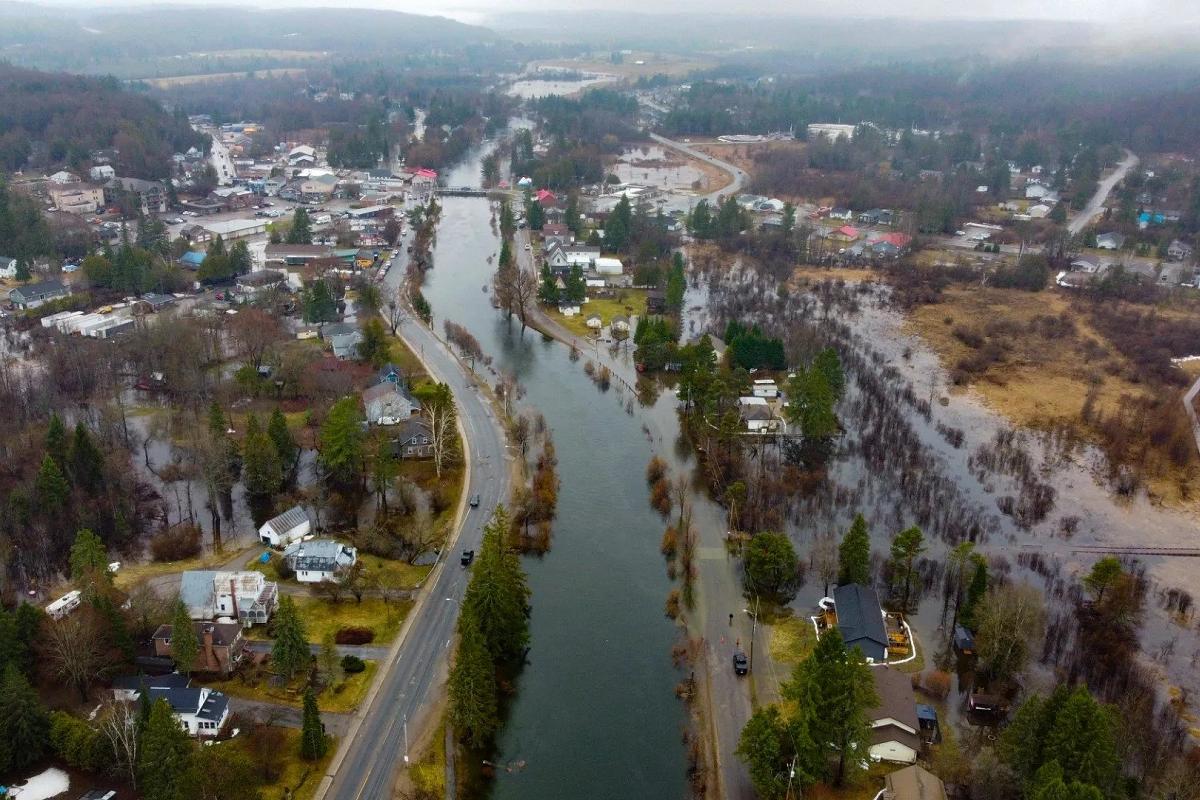
Following the severe impacts of spring flooding on communities such as Minden Hills in Haliburton County, a local ecologist is suggesting actions individual property owners can take that could collectively help mitigate flood risk in the future.
While the primary cause of this year’s flooding was increased snowmelt due to above-seasonal temperatures and significant rain, Kate Dickson told kawarthaNOW that “A lot of power is with the individual in their immediate area.”
Dickson is a project ecologist with The Land Between, a charitable organization established in 2007 that partakes in conservation research and activities in the region across central Ontario from the Ottawa Valley in the east to Georgian Bay and southern Parry Sound in the west.
Flooding exacerbated by climate change and human impact
Dickson sees the recent flooding, including in Haliburton County, as a symptom of global climate change combined with human-caused impacts on the ecosystem.
“There’s been a number of factors over a number of years that have created the conditions for this to happen,” she said.
As one of The Land Between’s six program areas, Indigenous knowledge and traditional practices also inform Dickson’s perspective on the future of flood risk prevention.
“We’re learning this for the first time, they’re not,” said Dickson of the land stewardship that Indigenous peoples across this region have practised for thousands of years.
In particular, Dickson identified shoreline denaturalization, wetland infilling, and displacement and removal of native wildlife as three main factors contributing to increased flood risk.
Why natural shorelines matter
Shoreline denaturalization refers to any alterations made to the natural shoreline along bodies of water, from adding a retaining wall to removing native plants. Dickson said that denaturalization occurs for numerous reasons, but such alterations are often made in relation to cottage property developments.
One example of shoreline denaturalization that Dickson identified was removing native plants and replacing them with ornamental plants and grass lawns to better suit residential properties.
“Those plants are not as well suited to capturing water through their root systems and bringing it into the soil,” Dickson explained, adding that the water then runs off into the lake.
She noted that most people do not choose to purchase ornamental plants with the intention of causing ecological harm, but rather that they are unaware of the implications of removing native plants. As such, The Land Between provides guides and resources to educate people about native plants and how to design a native plant garden.
Dickson said that, in a “balanced” year, snowmelt is reintegrated into the ecological system through several methods including ground absorption, runoff, and evaporation. However, when there are “snaps between hot and cold” rather than gradual warming, excess runoff occurs, leading to flooding of nearby bodies of water.
The role of wetlands and beavers in water management
Another contributor to flooding is wetland infilling, which is the practice of draining a wetland and adding soil and sediment to stabilize and raise the surface. In 2022, The Land Between joined environmental activists in the Haliburton region to speak out against wetland infilling in the Municipality of Dysart et al.
“Wetlands are a very important type of ecosystem that act as a sponge for nature,” said Dickson, adding that the Haliburton region is home to many provincially significant and unevaluated wetlands that provide habitat to a host of animals, including species at risk.
Dickson said that although the Haliburton region has “faced less development pressure” than southern Ontario, wetland infilling is still a concern for The Land Between.
“It has happened for the development of houses and cottages on a variety of scales,” said Dickson.
She noted that such alterations to the landscape also have downstream effects on the resident wildlife that live in these unique habitats.
Another issue is the displacement and removal of native wildlife by private landowners — especially beavers,
“People don’t always want to co-exist with beavers,” said Dickson.
Calling them “ecosystem engineers,” Dickson said beavers have an important role to play in controlling the flow of rivers and streams through the construction of dams.
Since beavers also build new habitats for other animals and create new wetlands with vegetation, removing them from the ecosystem reduces the overall biodiversity of the local environment, Dickson said.
In addition to the long-term effects, Dickson note that relocating beavers is “not necessarily effective” as typically a new beaver will take over the space.
Small actions by property owners can have a big collective impact
Speaking to the role of individuals in protecting shorelines and wetlands, Dickson recognized that “it can feel really daunting” when policy decision-making occurs at a high level.
However, with much of the shoreline within Haliburton County being privately owned, she said there is a lot that individuals can do to have a positive impact.
The Land Between hosts community workshops on how to design and build a native plant shoreline garden, encouraging homeowners in the area to contribute to collective efforts by re-establishing natural shorelines across the region.
“This is something that people along the shoreline can do that has a really big impact,” said Dickson.
Despite this, Dickson said that she and other ecologists in the conservation sector often experience resistance from homeowners to the idea of establishing a native plant garden.
“The biggest pushback that I hear about natural shorelines is that they are going to be an unkempt wild zone,” she said.
For her part, Dickson wants to dispel myths about natural shorelines, including by assuring homeowners that native plant gardens can be curated to any preference and purpose.
To the community at large, Dickson’s message is simple: “Doing nothing can have a really big impact.”
To that end, she said people can help preserve the long-term health of the ecosystem simply by not removing native plants and by not impeding wildlife and their natural habitats.
Dickson pointed to how activities such as growing native plants, co-existing with wildlife, and stewarding the land have many long-term benefits beyond mitigating flood risk.
“We’re talking about these things in the context of flooding, but there are a whole lot of benefits to planting native shorelines and not infilling wetlands,” she said.
For more information about The Land Between, visit www.thelandbetween.ca.