



















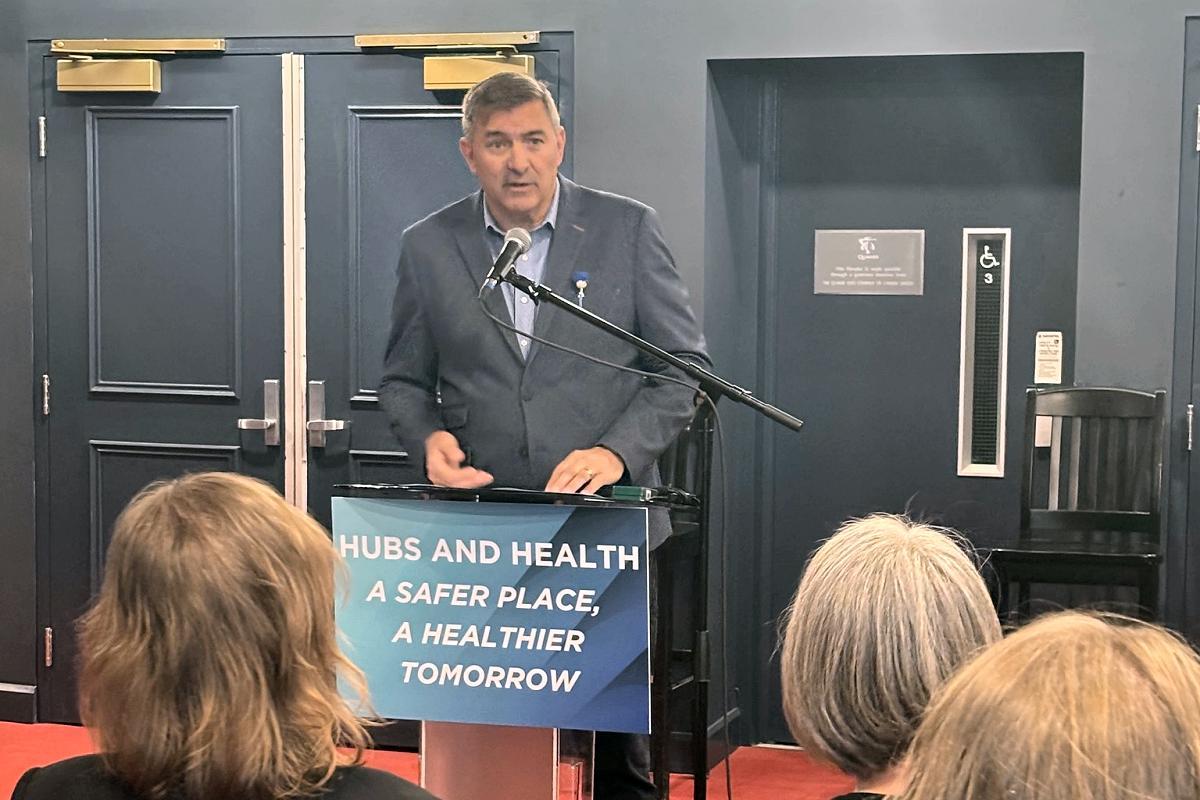
With the closure of Peterborough’s Consumption and Treatment Site (CTS) imminent, Peterborough-Kawartha MPP Dave Smith says his priority is supporting programs that focus on sobriety-based treatment, not harm reduction strategies.
“I think that the approach of getting people sober will be a much more successful long-term approach than allowing people to continue feeding their addiction,” Smith told kawarthaNOW in a recent interview.
A response to the opioid crisis, the Peterborough CTS opened in June 2022 inside the renovated former bus terminal at 220 Simcoe Street in downtown Peterborough to provide a safe and medically supported space for people to consume pre-obtained illicit substances under the supervision of health professionals.
MPP originally advocated for establishment of CTS to ‘save lives’
At that time, Smith was an advocate for the CTS and supported Four Counties Addiction Services Team (Fourcast) with securing $1.3 million in funding from the province through the Ministry of Health.
“The creation of the Opioid Response Hub, mobile mental health and addictions clinics, expanded withdrawal management and outreach services and, now, consumption and treatment services will save lives,” said Smith at a 2022 funding announcement.
Regarding his early participation in the development of Peterborough’s CTS, Smith said he was “heavily involved,” including through discussion with service providers and leading partners.
Fourcast operated safe consumption services in partnership with Peterborough AIDS Resource Network (PARN), Peterborough 360 Degree Nurse Practitioner-Led Clinic, the Mobile Support Overdose Resource Team (MSORT), Peterborough Drug Strategy, and Peterborough County-City Paramedics.
“One of the things that that group had consistently said to me was we would see a significant reduction in overdose deaths if we were to have a consumption and treatment site,” said Smith.
In December 2025, Peterborough Public Health (now merged with the Haliburton, Kawartha, Pine Ridge District Health Unit as Lakelands Public Health) reported that deaths related the the drug poisoning crisis were at 41 over 11 months, down from reported figures of 60 in 2024 and 78 in 2023.
However, according to Smith, the reduction was not significant enough to meet expectations or to justify further funding.
“I don’t think you could attribute a reduction (only) to the CTS because we also had a number of other initiatives that we took to try and combat the opioid crisis,” he added.
MPP now says treatment and recovery programs should be priority
Smith said that his focus looking ahead is to support programs and providers that offer treatment services such as detox and rehab.
“I believe that the pathway to sobriety is treatment,” he said. “I believe the pathway to sobriety and a healthy life is to stop with your addiction.”
On a local level, Smith identified his support for initiatives such as Peggy Shaughnessy’s RedPath Wellness Centre and the two mobile mental health and addiction clinics operated by the Canadian Mental Health Association – Haliburton, Kawartha, Pine Ridge (CMHA HKPR) that use purpose-fitted out-of-service buses.
Smith also cites his support of the new Homelessness and Addictions Recovery Treatment (HART) Hubs. Peterborough is one of 28 communities approved for HART Hub funding, having secured $6.3 million through a joint proposal between Fourcast and the City of Peterborough.
“This is another program that has a lot of my fingerprints on it,” said Smith.
Following the closure of the CTS, Fourcast will begin the operation of Peterborough’s provincially funded HART Hub. Eligible activities under HART Hub funding include, but are not limited to, primary care, mental health and addictions services, supportive housing, case management, and drop-in services.
Smith said the Peterborough hub will work in conjunction with the Wolfe Street modular housing community, One City Peterborough, and the Trinity Community Centre, and community organizations such as the Brock Mission, as they “bring people through that continuum of sobriety.”
Like all provincially funded HART Hubs, the Peterborough hub will not offer safer supply, supervised drug consumption, or needle exchange programs. Local organizations including Fourcast say the lack of such programs will leave a gap in the healthcare and recovery continuum.
In its March 16 announcement of the latest CTS closures, the province stated the goal of HART Hubs was to “fund treatment and lasting recovery from addiction, rather than continued public funding of drug injection sites.”
Smith said that “the Ontario government and myself, and I think most of the advocates in this area” believe in allocating limited resources towards approaches based on treatment rather than harm reduction.
“I’m firmly of the belief that harm reduction without treatment is simply palliative care,” said Smith.
Fourcast: CTS closure will result in more discarded needles in the community
In a recent interview with kawarthaNOW, Donna Rogers, executive director of Fourcast, spoke about the role of harm reduction in recovery and healthcare, non-traditional forms of harm reduction, and how language around harm reduction has developed a warped meaning in everyday society.
“The term harm reduction has been co-opted into language that feels like it is damaging and harmful,” said Rogers.
For her part, services such as overnight shelters, food programs, accessible healthcare, and drop-in programs are all forms of harm reduction in that they protect people experiencing homelessness and poverty from the risks of weather exposure, hunger and starvation, and illness.
“When people say harm reduction, they don’t mean reducing harms related to exposure or starvation — they think of discarded needles,” she explained.
The risks of improperly disposed needles, along with substances and other substance use paraphernalia, is one impact of public substance use on community safety. In November 2022, Fourcast and Peterborough Public Health reported a drop in the number of discarded needles in public spaces following the opening of the CTS.
“Public works will see an impact through more discarded needles in the community,” Rogers said of the upcoming CTS closure.
MPP says treatment-based approach will reduce public drug use
Enforcing the ban on safe consumption sites within 200 metres of schools and child-care centres was a central part of the Ford government’s 2025 re-election platform, in part citing concerns about safety in parks and public spaces.
For Smith, increased community safety will result when fewer people are using substances by accessing programs provided by the HART Hub and other treatment-first providers.
“The more people we can break the addiction cycle with, the less drug use that actually occurs, and the less opportunity there is for that drug use to be in public,” said Smith.
When asked about frontline worker concerns about the connection between increased substance use in public spaces and the closure of the CTS, Smith said that the vast majority of overdose-related deaths in 2018 occurred within an individual’s own home.
“These are not homeless individuals — these are your neighbours,” said Smith. “These are some of the people who are dying from this. And we need to change that direction.”
Responding to the backlash from frontline workers, sector leaders, and community members about the impending CTS closure and the potential impacts of a gap in services for those currently using the site, Smith reiterated his belief that harm reduction-based approaches are not successful in the long term.
“Everything has been about building to treatment,” Smith said. “If you want to take a harm reduction approach, you will kill people.”