




















The closure of Peterborough’s Consumption and Treatment Site (CTS) has led to local health and community leaders speaking out about impacts on non-consumption based services.
“If there are people that have only been accessing care through the CTS, we do worry about them,” Danielle Howson, executive director and nurse practitioner lead at the Peterborough 360 Degree Nurse Practitioner-Led Clinic, told kawarthaNOW. “Where are they going to go? How are they going to access care?”
A response to the opioid crisis, the Peterborough CTS opened in June 2022 inside the renovated former bus terminal at 220 Simcoe Street in downtown Peterborough to provide a safe and medically supported space for people to consume pre-obtained illicit substances under the supervision of health professionals.
CTS offered walk-in access to primary care services through a registered nurse
The Nurse Practitioner-Led Clinic had been providing a full-scope registered nurse (RN) to the CTS, who offered primary care services such as wound care, antibiotic prescriptions, and systems navigation support. Howson explained that RN services were offered on a walk-in basis to allow the CTS clinic to support unattached and often unhoused patients.
The loss of this on-site and accessible service is worrying for Howson, as many individuals accessing the CTS clinic do not receive care elsewhere nor have a regular primary care provider such as a family doctor.
“We know that the population of people that attend the CTS are a cohort that doesn’t necessarily have regular primary care interactions,” Howson said.
She added the scope of the RN position enabled them to provide routine primary care services as well as specialized care for the distinct needs of the unhoused and substance-using populations.
“Somebody that’s living rough is exposed to the elements, which leads to some complex wounds,” she explained. “Also anybody who uses injectable substances has a higher risk for wounds.”
There are some other organizations within Peterborough that offer services that overlap with the care the RN was providing at the CTS, including Peterborough Street Medicine, a physician-led organization that provides care to unhoused and precariously housed individuals.
Through an alternate funding model that pays physicians hourly rather than by fee-for-service, Peterborough Street Medicine offers services at locations such as Brock Mission, Cameron House, the YES Shelter, and the modular housing community on Wolfe Street, without requiring patients to enrol with a physician.
However, for Howson, the CTS provided a valuable centralized location that offered low-barrier access to healthcare that cannot be replicated by other outreach and homelessness services.
“It’s just one more barrier to people that are already facing barriers, and one more valuable resource that is being taken away from that community,” said Howson.
CTS closure may increase pressure on weekly clinic at Trinity Community Centre
Trinity Community Centre, operated by One City Peterborough, is another low-barrier space for unhoused and precariously housed people to access services such as healthcare and systems navigation support.
In a recent interview with kawarthaNOW, Donna Rogers, executive director of Four Counties Addiction Services Team (Fourcast), said the CTS closure would impact Trinity due in large part to an overlap of client population as well as the proximity of Trinity to the downtown core.
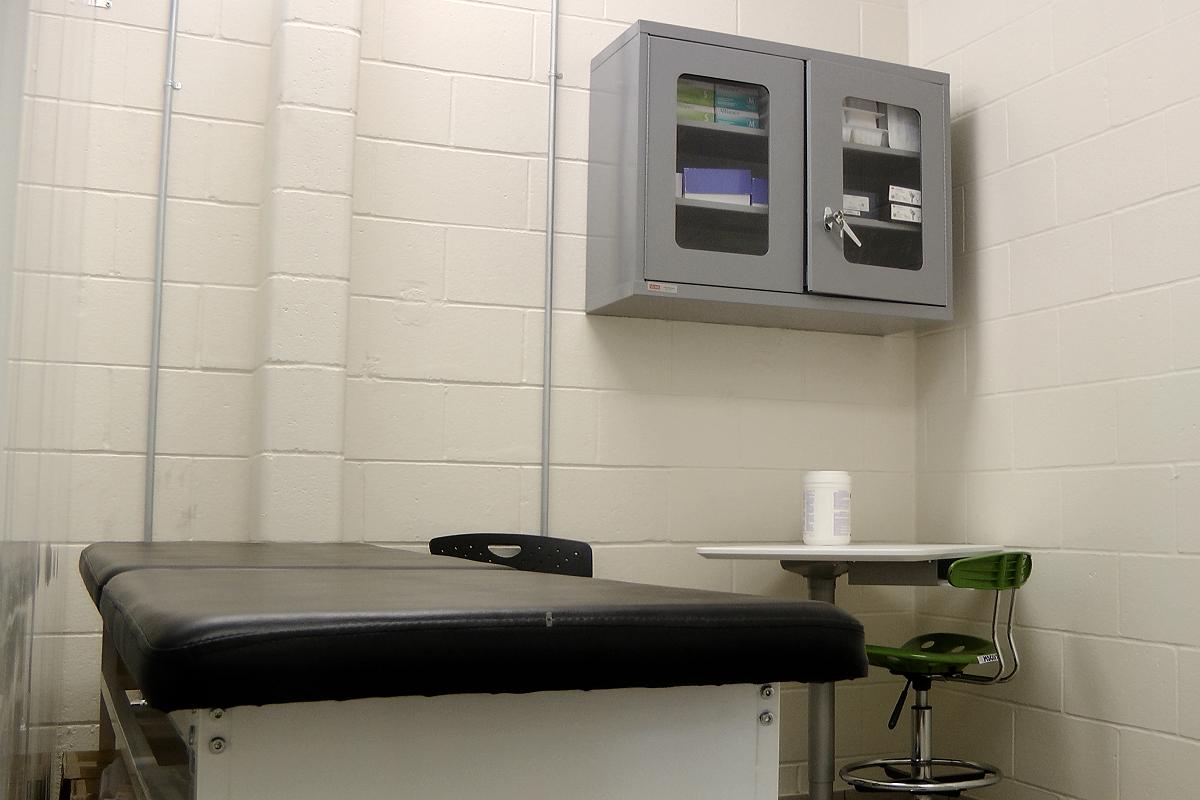
Trinity houses an on-site clinic consisting of two exam rooms operated one afternoon a week in partnership with the Peterborough Community Health Centre and Peterborough Street Medicine.
“They could be here seven days a week … there are enough health issues,” said One City outreach programs director Auden Palmer of the healthcare professionals who provide services at the clinic.
Palmer said, whle One City and Trinity are sometimes seen as an alternative to the CTS for providing primary care to unhoused and precariously housed people, this is a oversimplification and does not recognise the unique services the CTS offered.
Palmer pointed out that One City’s focus at Trinity is to offer a drop-in day program and an overnight shelter, not healthcare services.
“We’re not a health organization we have no plans to become a health organization,” Palmer said.
One City sees its role in serving the overlapping population of users of the CTS and Trinity as providing housing stabilization infrastructure while partnering with healthcare organizations.
Loss of primary care outreach at CTS may have downstream impacts on healthcare system
Healthcare professionals like Howson and public health specialists have said that the loss of primary care outreach at the CTS will have detrimental impacts on the healthcare system at large.
In particular, the CTS closure may result in increased emergency medical situations that could have been prevented by consistent care or early treatment provided by the RN at the CTS.
“There’s a really big importance placed on getting people that care when they need it and not waiting until it’s bad enough for tertiary care,” Howson said.
Ashley Safar, executive director of the Peterborough Community Health Centre, spoke about the impacts of the CTS closure in an earlier interview with kawarthaNOW, noting it was a space where some individuals were accessing both mental health and primary care services.
“I am concerned about what the impact will look like on the larger healthcare system,” Safar said.
Local collaborations will continue to provide services to unattached patients
Howson told kawarthaNOW that, despite the CTS closure, the Nurse Practitioner-Led Clinic will continue to collaborate closely with CTS partners Fourcast and Peterborough Community Paramedics to provide services to unattached patients, calling it “phenomenal collaboration.”
However, she noted that future collaborations would be dependent on funding.
Going forward, Howsen said the Nurse Practitioner-Led Clinic would retain the RN position that was at the CTS within their team but for a different function.
On a broader level, with $688,000 in new funding recently announced by the Ontario government, the Nurse Practitioner-Led Clinic will work alongside the Peterborough Family Health Team and their Connect Clinic to attach patients currently without a permanent primary care provider.
The Connect Clinic provides transitional care to currently unattached patients, using the Health Care Connect waitlist to work with family health team physicians and nurse practitioners, as well as community partners such as the Nurse Practitioner-Led Clinic and the Peterborough Community Health, Centre to find long-term attachment for patients.