


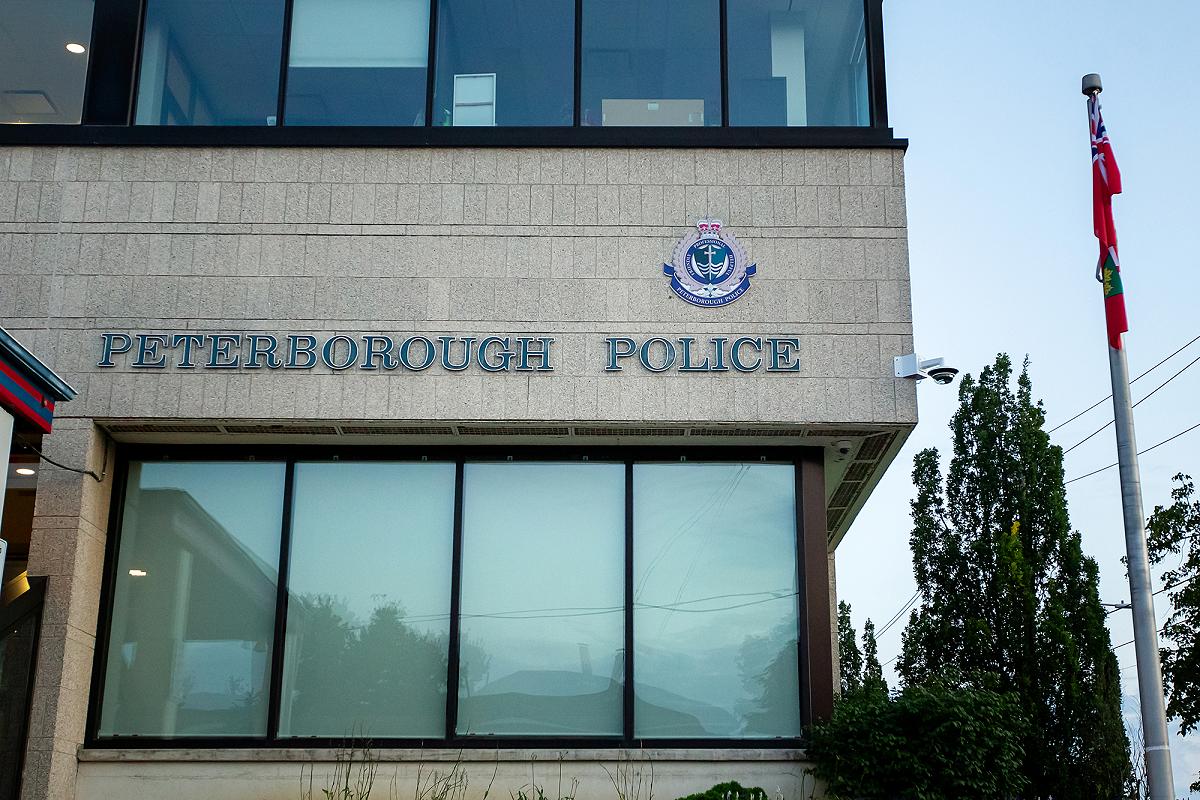















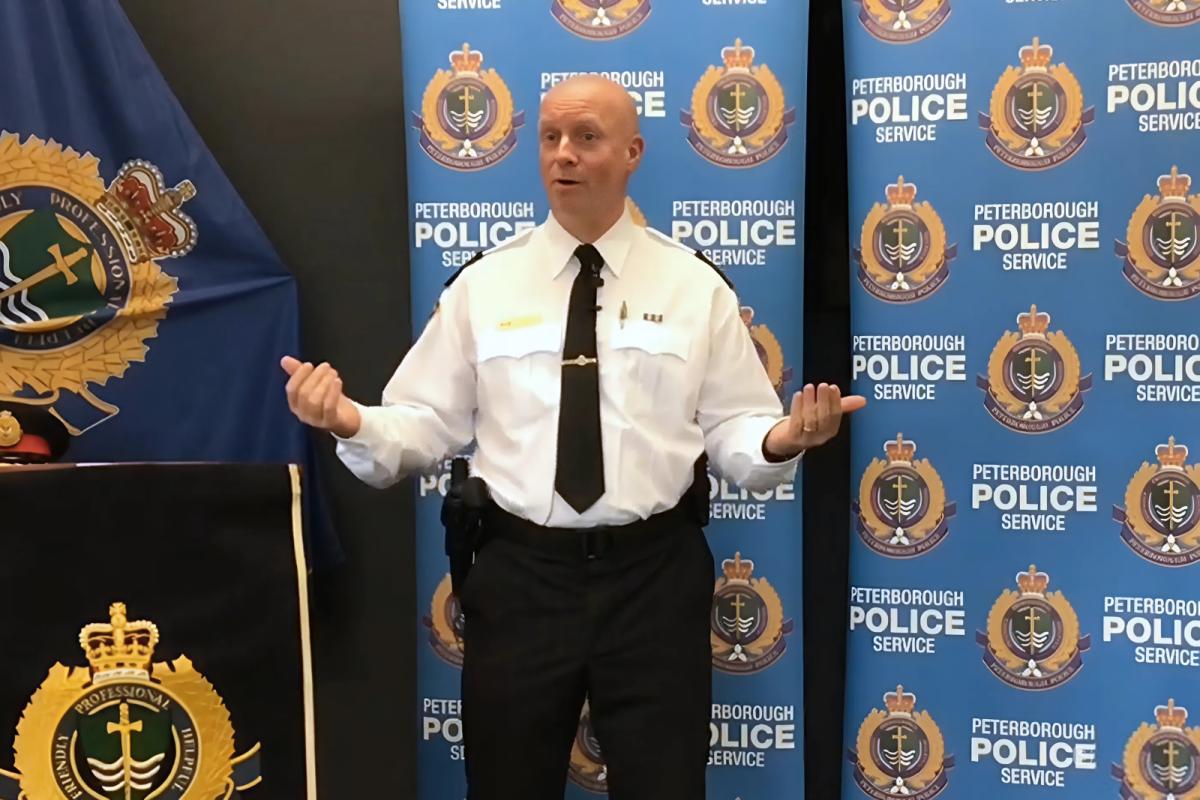
In light of the upcoming closure of Peterborough’s Consumption and Treatment Site (CTS), the Peterborough Police Service will have a zero-tolerance policy for open-air illicit drug use to ensure community safety in public spaces.
“We cannot go into the summer months allowing a small group of people to determine how others will use public spaces in this community,” said Chief Stuart Betts in a recent interview with kawarthaNOW.
Local addictions support organizations have voiced concerns that the CTS closure will lead to an increase in substance use in public spaces and drug-related medical and safety emergencies.
A response to the opioid crisis, the Peterborough CTS opened in June 2022 inside the renovated former bus terminal at 220 Simcoe Street in downtown Peterborough to provide a safe and medically supported space for people to consume pre-obtained illicit substances under the supervision of health professionals.
Concerns that policy shift to treatment over harm reduction will result in more open-air drug use
The decision to close Peterborough’s CTS comes almost two years after the Ontario government’s August 2024 “safer communities” announcement of a policy shift to restrict harm reduction sites and make addiction treatment a priority, banning supervised drug consumption sites within 200 metres of schools and child care centres.
The government later expanded that policy to close all supervised drug consumption sites, announcing a $500 million investing in 28 Homelessness and Addiction Recovery Treatment (HART) Hubs, including one in Peterborough, that are focused on treatment, recovery, and housing. The hubs do not offer supervised consumption or harm reduction services like needle exchange.
In recent comments to kawarthaNOW, Peterborough-Kawartha MPP Dave Smith spoke further to the Ford government’s position on the role of CTS closures in increasing community safety, saying “It’s about finding ways to break the cycle of the addiction. That will make our community a safer place.”
Leaders from agencies working in the addictions and harm reduction sector have indicated that the closure of Peterborough’s CTS may cause increased safety concerns as there will be a gap in services for current service users of the CTS.
“These uses will happen somewhere else,” said Donna Rogers, executive director of Four Counties Addiction Services Team (Fourcast) of the approximate 300 uses per month supervised at the Peterborough CTS.
For his part, Chief Betts said the location of the CTS impacted community safety for the area around Simcoe and Aylmer, especially for public spaces such as the Peterborough Public Library and for surrounding businesses.
“They (CTS) attract a clientele and a drug subculture into our downtown,” Betts said.
Police chief says open-air drug use will not be tolerated
From a policing and community safety perspective, Chief Betts said there will be a no-tolerance policy on open-air illicit drug use in line with the Peterborough Police Services’ safer public spaces initiative.
Under the original initiative announced in October 2023, police officers would approach a person using drugs in a public space and request they move to a different location, offering them information on where to find community services such as the CTS site. To avoid criminalizing people with an addiction, officers would only arrest a substance user and seize their illegal drugs for destruction if the person did not comply with the police request.
Last June, police announced they would begin arresting anyone found using illicit substances in public spaces, and any illicit drugs would be seized for destruction or submitted for analysis and evidence to support any charges laid. At the time, Chief Betts said the escalation was necessary “to address a persistent problem in our community,” particularly downtown, and was consistent with the provisions of Ontario’s then-new Safer Municipalities Act.
“My expectation is that there will be heavy enforcement, with absolutely no room for discretion when addressing and engaging people who are openly using illicit drugs in public,” Chief Betts said with respect to any open-air illicit drug use as a result of the closure of the CTS.
However, the police chief also said that it is important to recognize when the appropriate response is emergency medical care rather than law enforcement. As such, he encouraged community members to alert paramedic services in the case of a medical emergency.
“Sometimes people who are under the influence of drugs behave erratically, but erratic behaviour doesn’t necessarily mean criminal behaviour,” Chief Betts said.
The police also aim to engage members of the public in building community safety through programs such as the Community F.I.R.S.T. initiative to address property crime and the new online identification portal where residents can help identify criminal suspects.
To help dissuade open-air drug use, Chief Betts encourages residents to continue to use community spaces.
“Often people are less likely to engage in acts of antisocial behaviour — in this case open-air illicit drug use — if there is a passive surveillance,” he added, referring to the presence of the public in community spaces.
If they do witness open-air illicit drug use, residents should report it to police. So far in 2026, the police have responded to 159 calls for service related to open-air illicit drug use, seizing drugs in 38 instances, making 25 arrests, and laying 24 charges. Of the 159 calls, 139 came from residents and 102 came from downtown Peterborough.
Police response to substance use includes collaborating with healthcare organizations
Speaking about current and future police response and management of cases involving substance use, Chief Betts highlighted a number of collaborative initiatives run by Peterborough Police Service and healthcare organizations including Fourcast, Peterborough Regional Health Centre (PRHC), and the Canadian Mental Health Association – Haliburton, Kawartha, Pine Ridge Branch (CMHA HKPR).
On March 17, the Peterborough Police Service announced a new outreach partnership with Fourcast, which formed a new Addiction Specialist Team by placing an addictions counsellor with a police constable.
“This partnership comes at an opportune time as the CTS is transitioning from open to closed,” Chief Betts said. “It provides us with an opportunity to engage with those folks who might otherwise have been using the CTS and to try and put them into the right resources.”
Another resource he spoke about was the three Mobile Crisis Intervention Teams operated in partnership with CMHA HKPR and PRHC. Two teams are comprised of a police constable and a CMHA HKPR mental health worker, and the third with an officer and a registered practical nurse supplied by PRHC.
Chief Betts also indicated that the Peterborough Police Service has recently established a response team for victims of intimate partner violence (IPV) with support from the Victim Services department.
As part of their response to the impending CTS closure, Chief Betts noted, the police have also engaged with staff and leadership at the Peterborough Public Library.
Peterborough Public Library taking steps to deter illegal activity such as drug use
In a recent interview with kawarthaNOW, library director and CEO Melissa Redden, spoke about actions the library is taking, in part in collaboration with and on recommendations from the Peterborough Police Service.
“We take a lot of steps to mitigate behaviour that breaches our code of conduct,” Redden said.
In particular, she mentioned increased training for staff, data analysis of incident history, and restructuring of library spaces to prevent antisocial behaviour. This has included reorganizing furniture to prevent isolated spaces that have higher rates of behaviour in violation of the code of conduct.
“We’re setting up the space to be used in a way that aligns more with our code of conduct and reducing or mitigating just through natural deterrence,” Redden said.
Although there have been instances of substance use and associated medical emergencies at the library in the past, both Chief Betts and Redden were clear that they will continue to ensure adequate law enforcement to prevent illegal activity on the site.
“I want to be clear that we view the library as a community resource, not a secondary location for drug use,” said Chief Betts.
While Chief Betts said he recognizes that safe consumption sites “provide a service, and often a well-intentioned and potentially life-saving service, for a small group of people who require that type of access,” he added that his “core responsibility is overseeing public safety” and he is “not in favour of places for people to go to consume illicit drugs.”
Responding to comments published by kawarthaNOW from local healthcare leaders, including Rogers and medical officer of health Dr. Thomas Piggott, about the potential increase in emergency medical calls when the CTS is closed, Chief Betts said that he would support a “middle ground” approach, such as an alternative drop-off location for paramedic services for those experiencing substance-related medical emergencies.