

















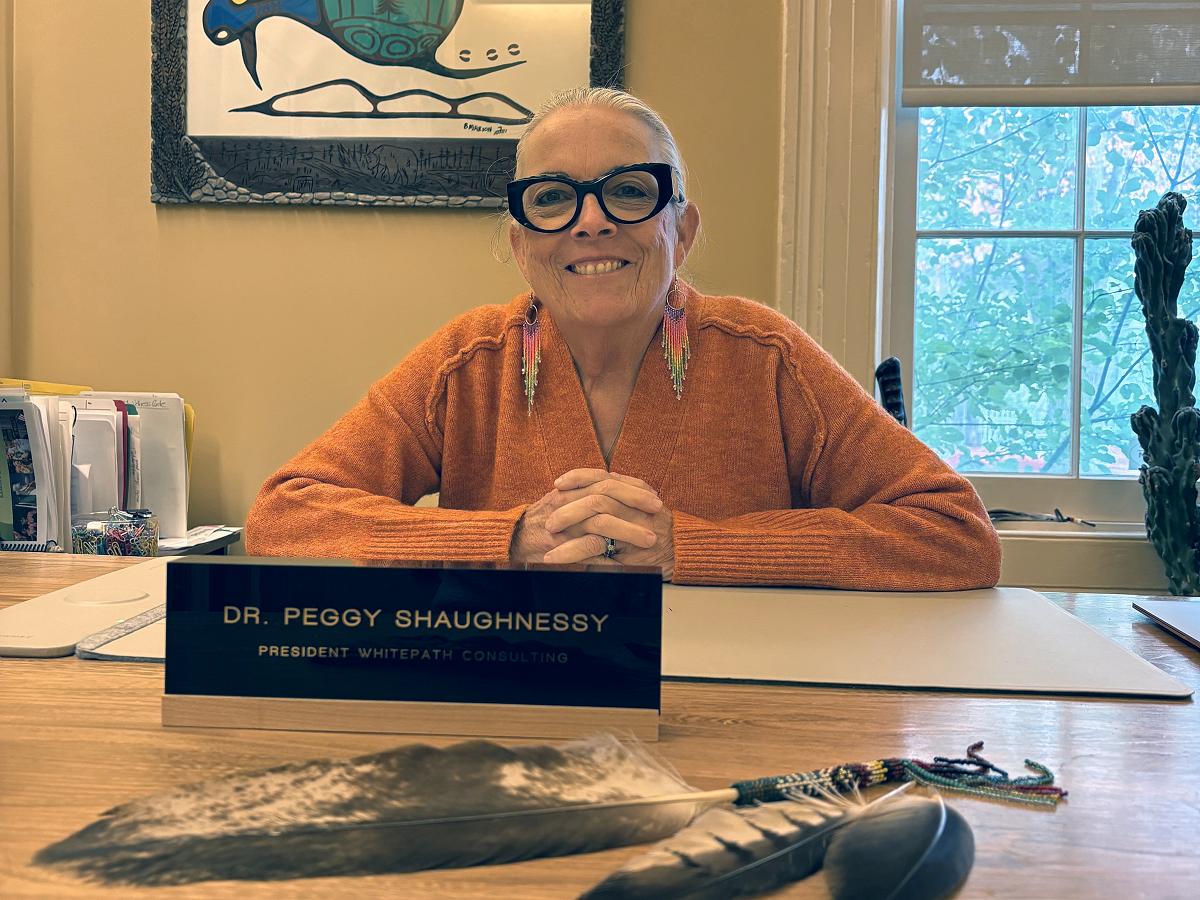
Over the past 20 years, 67-year-old Peterborough resident Dr. Peggy Shaughnessy has seen the landscape of mental health and addictions care change rapidly. Despite this, she has remained consistent in her approach and says she will continue on the path of healing one person and then the next.
“I will stay on the ground, in the ditches — I’ll help them out one at a time,” said Shaughnessy in a recent interview with kawarthaNOW.
Shaughnessy is the creator of the RedPath Approach, founder and director of care for the RedPath Wellness Centre, and president of Whitepath Consulting.
Building the RedPath approach through Indigenous-informed healing
Shaughnessy began developing what would become known as the RedPath approach while she was working in Kingston Penitentiary as a nurse. At the nearby Millhaven Maximum Institution in Bath, there had been 53 stabbings in 51 days.
“They sent me in there to interview guys that had been stabbed, or who had stabbed someone else,” said Shaughnessy. “What came out of that needs assessment was that these men really needed Indigenous-based programming.”
As she developed the RedPath approach, Shaughnessy worked with Indigenous Elders across Canada, as well as the Trent University psychology department — in particular, under the direction of Dr. James Parker through his Emotion and Health Research Laboratory.
In 2002, Shaughnessy established Whitepath Consulting to provide training and education to treatment providers, First Nation communities, and social service organizations to facilitate RedPath programs themselves.
VIDEO: History of the RedPath Program
“We’ve been walking this path with integrity since 2002,” said Liz Shaughnessy-Rowe, manager of programs at RedPath and Shaughnessy’s daughter. “Nothing has changed — our language has stayed the same since 2002.”
Having spent many years travelling to train others on the RedPath approach, Shaughnessy decided to bring treatment options to her hometown of Peterborough. In 2017, Shaughnessy and Shaughnessy-Rowe established the charitable organization, Right To Heal, in response to the opioid crisis.
“We were fortunate to have the Ontario government come forth with some funding in order to be able to do what we did across the country here in Peterborough,” said Shaughnessy.
In October 2022, the organization began providing mental health and addictions treatment using the RedPath approach from their headquarters in the former St. Andrew’s Church (now Celestial Church of Christ) at 441 Rubidge Street in Peterborough.
However, thanks to an introduction from a loyal supporter of Right to Heal, the organization was given the opportunity to relocate to 271 Brock Street, just steps away from their original location.
Creating a focused, community-centred space for recovery at 271 Brock Street
“We were given the opportunity to move into this space which really has a home feeling,” said Shaughnessy. “It also allowed us to downsize — the church was quite big and we were using it beyond our mandate.”
For Shaughnessy and her daughter, the move to 271 Brock Street has allowed them to refocus on the intention and core values of their mission rather than becoming “distracted” trying to provide all services to all people.
“What this space gifted us was a tunnel vision on our mission,” said Shaughnessy-Rowe. “We used to be distracted by the noise.”
Programs at RedPath are offered at no-cost to participants and allow people so self-refer to all services. The Peterborough-based Wellness Centre is the organization’s outpatient clinic, where individuals can partake in the addiction treatment or living without violence programs.

“It’s a safe place to change your life and the only reason you’re here is because you’re willing to do that,” Shaughnessy-Rowe explained.
Based on research and pilot programs, Shaughnessy and Shaughnessy-Rowe identified that many people struggling with mental health and addictions issues were disconnected from their community.
“One of the biggest things for those that are suffering or the vulnerable population is the lack of community and the lack of a space to come to,” said Shaughnessy.
“If the cause of addiction is disconnection, then the medicine for addiction is connection,” added Shaughnessy-Rowe.
Program participants are invited to spend time at 271 Brock Street and build community with others in treatment. The Wellness Centre offers activities such as drumming, beading, gardening and nature walks, and a wide variety of events hosted by participants, staff, and placement students.
“You’re not going to a place where people are drinking or on drugs,” one participant told kawarthaNOW. “You’re meeting another person and making a true connection. What more can you ask for?”
Transitional housing project aims to support long-term sobriety
For Shaughnessy and Shaughnessy-Rowe, their programs and the RedPath Wellness Centre provide a vital space where people can seek sobriety-based treatment and be held accountable by their community.
“We don’t do harm reduction here — there are enough places that do it,” said Shaughnessy. “People need to have a space if they don’t want those things.”
As participation in these programs is voluntary, Shaughnessy and Shaughnessy-Rowe explained that participants must be self-motivated and committed to remain involved. Both women are ready to “call out” those who are not following the promises they make to themselves upon entry into the program.
“Let’s just say, you get chats from Big Momma and you decide you better take a good lesson,” said another participant, referring to Shaughnessy’s nickname.
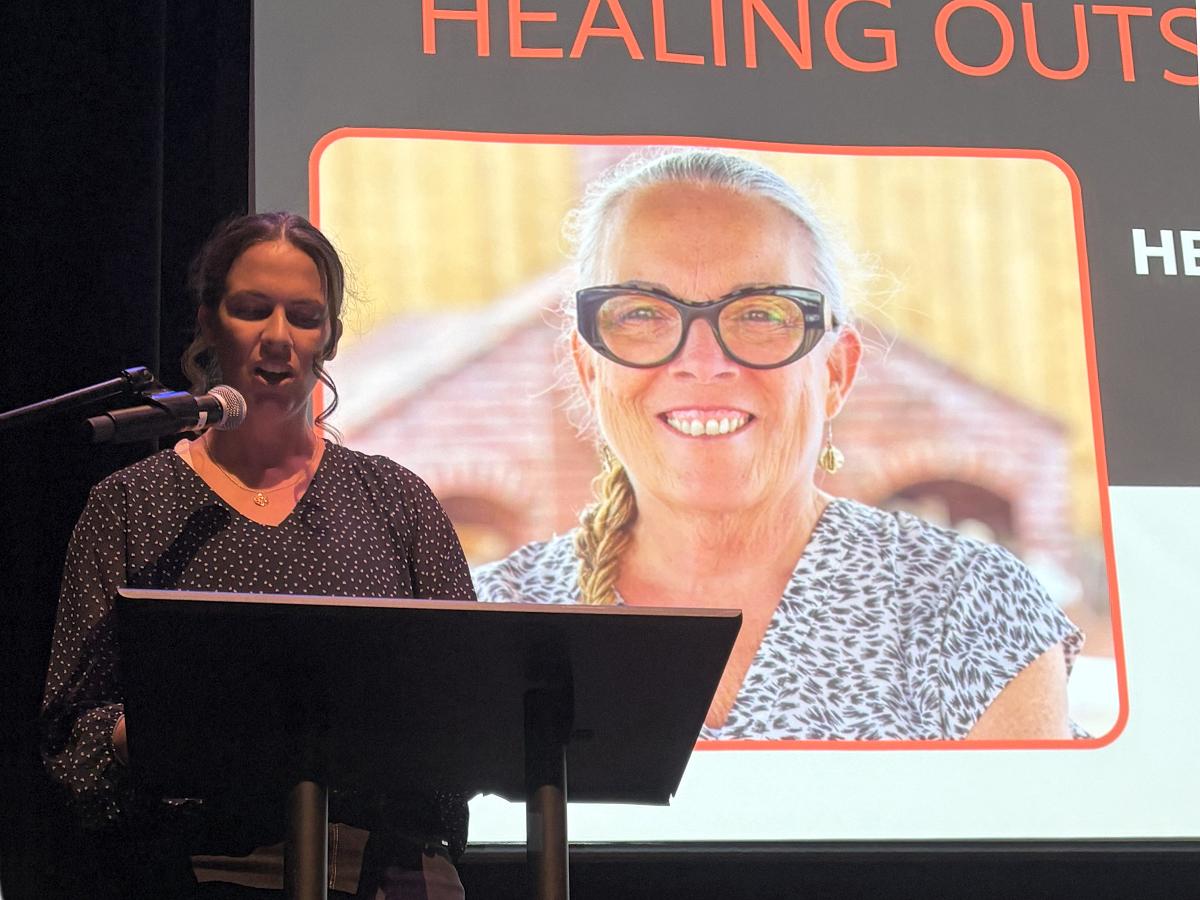
Shaughnessy-Rowe said that, while holding participants accountable is part of establishing a relationship built on honesty and trust, they recognize that making significant change takes time and repetition.
“We know he’s going to use cocaine on the first of the month — we don’t guilt him for that, he feels guilt enough,” she explained. “But we do say ‘This has happened every single month, when are you going to make a new choice?'”
One challenge that Shaughnessy and Shaughnessy-Rowe identified when working with RedPath participants is that individuals are often living in environments that are detrimental to recovery such as unsafe shared housing, living without family or friends nearby, or being unhoused.
“Nobody wants to live that way,” said Shaughnessy-Rowe. “Nobody wakes up and says ‘I’m gonna be a drug addict’ — but there’s no safe spaces for them to undo the harm.”
As such, RedPath intends to build 14 transitional housing units on the property at 271 Brock Street that would each include a bedroom, bathroom, and a small kitchenette.

In February 2026, the RedPath Wellness Centre received $150,000 in seed funding from the City of Peterborough following a motion introduced by Monaghan Ward councillor Matt Crowley to support the transitional housing project, which was approved by city council.
“We don’t want this to be a shelter,” said Shaughnessy-Rowe. “We want this to be a place where people learn how to live again — a safe place where they can close the door and learn how to exist.”
Shaughnessy said this project would cost approximately $7 million to build, including a $1 million environmental assessment to ensure that construction on the property would be safe.
The RedPath transitional housing program would operate as a sober-living residence, implementing strict rules to ensure abstinence and commitment to the RedPath program.
“It would be very strict that it has to stay a sacred space,” said Shaughnessy.
Shaughnessy-Rowe said that, from her perspective, residence in this program would be “very appealing” for those going through the courts and justice system.
Committed to the RedPath approach amid a changing mental health and addictions healthcare landscape
Despite changes both nationally and locally to the mental health and addictions healthcare landscape, such as the opening and subsequent closure of Peterborough’s Consumption and Treatment Site (CTS) and new provincial funding for Homelessness and Treatment Recovery (HART) Hubs, Shaughnessy and her daughter remain confident in the RedPath approach.
“As the systems are crumbling and we continue to be in crisis, we are still walking forward outside of that crumbling system doing what we’re here to do,” Shaughnessy-Rowe said.
For Shaughnessy, changes in government funding and priorities have a significant impact on the services being offered within the local area, often at the expense of those struggling with addiction.
“They’re being used as pawns to get more money,” she said.
It is seeing the changes in service provider values, language, and treatment options over the past 20 years while recognizing the ongoing crisis that has led to Shaughnessy’s consistent and certain methodology.
“What’s gotten crystal clear to us is that we’re not here to change the system — we’re actually here to help one person, one day at a time,” said Shaughnessy-Rowe.
For more information about RedPath Wellness Centre, visit www.redpathwellnesscentre.ca.