











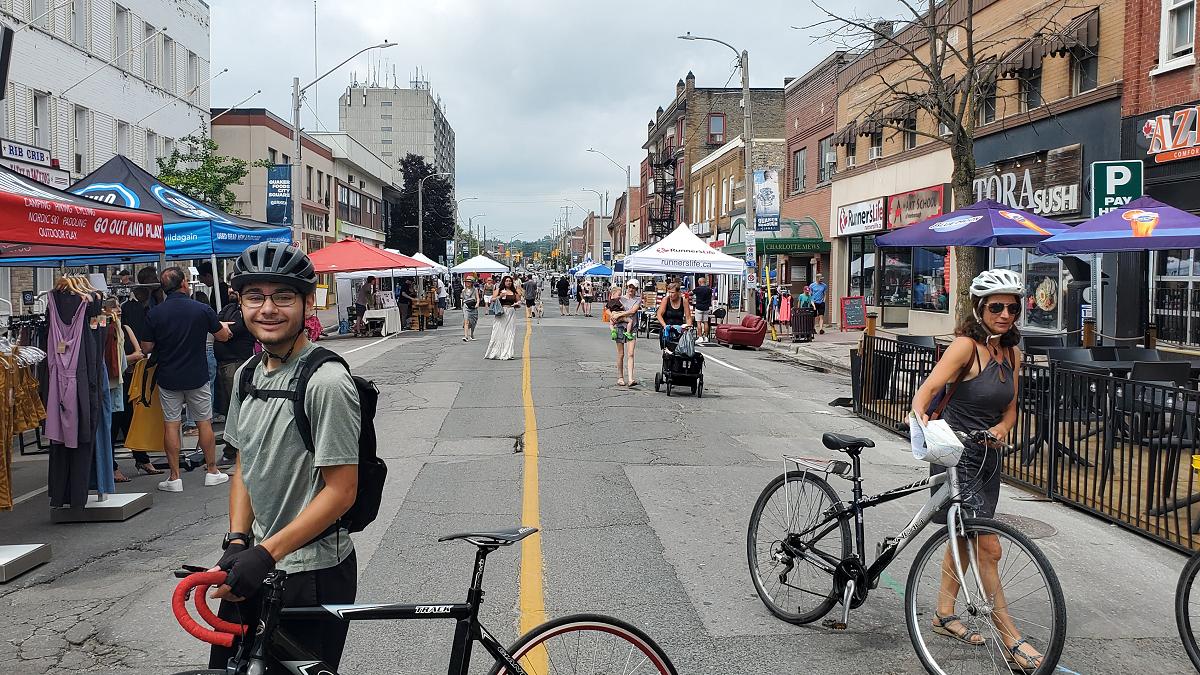
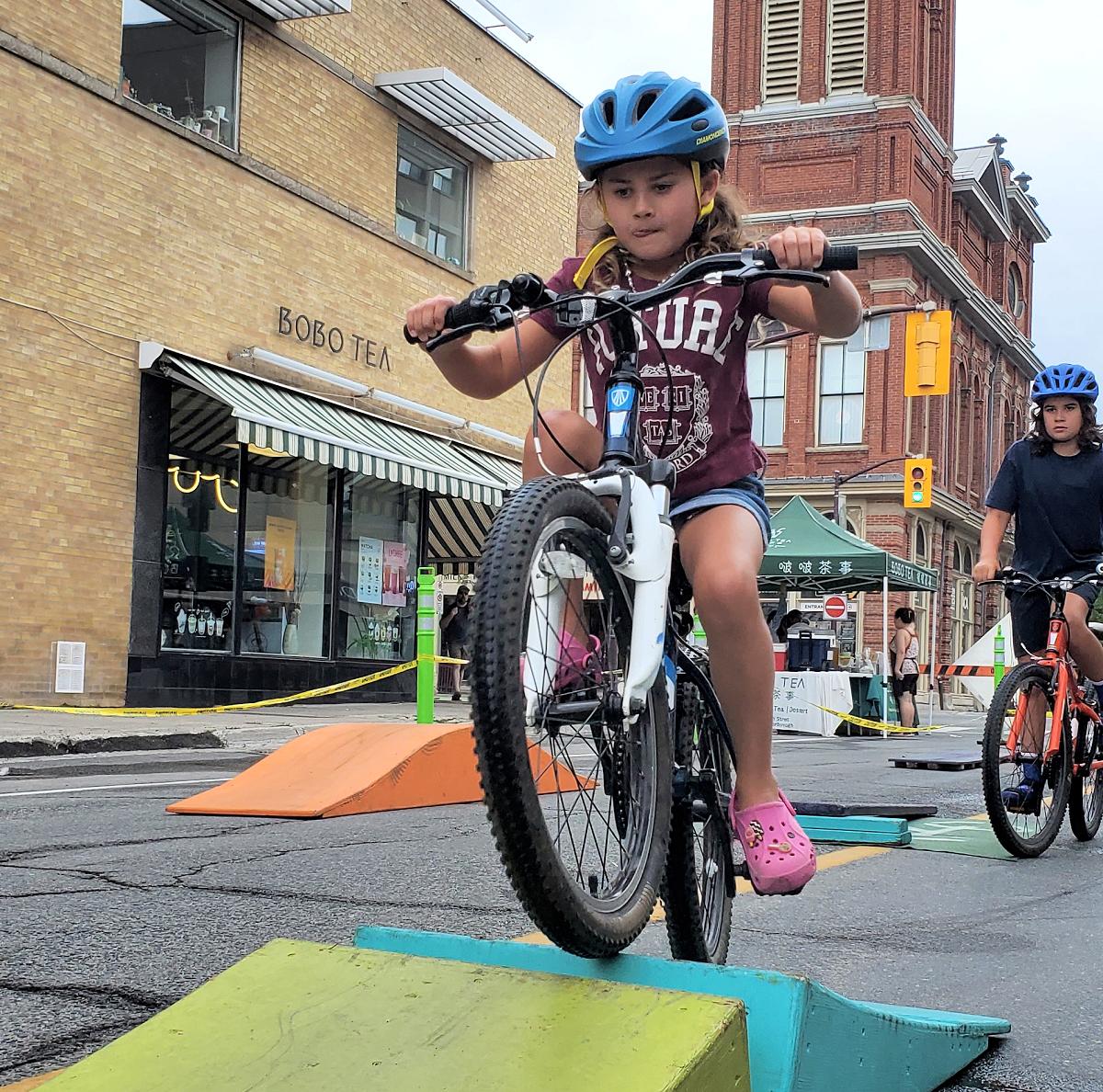
Peterborough’s Market Hall clock tower stood tall in the background as a young boy shakily navigated his bicycle down Charlotte Street.
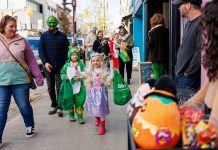
It’s an improbable place to learn to ride a bike, but there wasn’t a car to be seen on Charlotte between George and Aylmer streets, as crowds descended for the Second Saturday Sidewalk Sale on August 8.
While parents browsed sale racks, kids did loops on GreenUP’s pop-up bike playground, which had a teeter-totter, ramps, and other obstacles to practise cycling skills on. People paused in the street to eat BeaverTails, slurp bubble tea, chat with friends they’d bumped into, and watch kids zip by on bikes.
“I’m so proud of you,” shouted the grandmother of the boy taking his first pedal strokes.
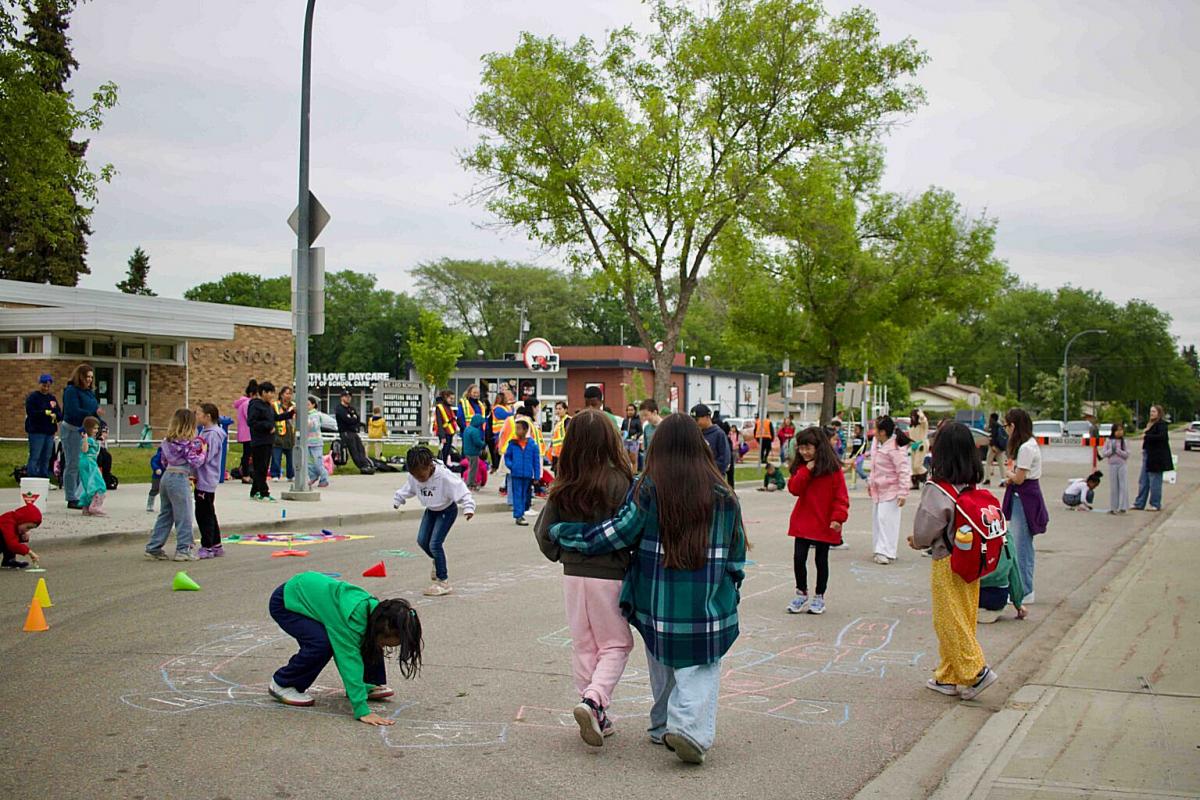
As local children return to school this fall and many little ones don their backpacks for the first time, GreenUP is working to bring something like this relaxed, playful, pedestrian-focused atmosphere to Peterborough school zones. The goal is to have one-day school street pop-ups at several local schools as a way to see what the journey to school could look like if pedestrians and cyclists were prioritized.
GreenUP has received a grant from the National Active School Streets Initiative, which is funded by the Public Health Agency of Canada, to pilot the idea locally. The initiative, more than two years in the making, represents the next phase of GreenUP’s ongoing advocacy around creating safer, less polluted, and more welcoming streets.
Car-free zones in front of schools at the start and end of the day make it safer and more enticing for kids to walk, roll, or bike to class, cut pollution and congestion in school zones, and boost kids’ physical activity and ability to get around their communities independently.
Although GreenUP has hosted pedestrian zone pop-ups in the past, both in partnership with Peterborough Pulse and as part of its NeighbourPLAN project, its work through the National Active School Streets Initiative will offer an opportunity for school communities and local decision-makers to experience how diverting vehicle traffic away from pedestrian hotspots could make the daily school commute safer for everyone.
Peterborough isn’t the only city making strides toward more pedestrian-focused streets. Montreal began closing kilometres of commercial streets to cars during the summer months at the outset of the COVID-19 pandemic, while Toronto, Hamilton, St. Catharines, and other Canadian cities have also begun flirting with car-free streets.
Locally, Peterborough has reduced Hunter Street between George and Aylmer streets to one lane of traffic each summer since 2020 to make more room for pedestrians and patios.
Behind these efforts to carve out more space for people in cities is a reimagining of what streets are for. The dominant thinking in North America for the last century or so has been that a street’s main purpose is to quickly move as much vehicle traffic as possible. It’s what led many cities, including Peterborough, to convert some downtown arteries to one-way streets in the 1950s and ’60s, for example.
When Peterborough’s George and Water streets made that switch in 1957, the idea was that traffic would flow faster because drivers would be able to pass slower moving vehicles and wouldn’t have to wait for oncoming traffic to go by before making left turns, according to Peterborough Examiner articles from the time.
A city official quoted in the Examiner summed up the vision this way: “What we are doing, actually, is making our two streets (George St. and Water St.) into a four-lane highway, with the stores between George and Water Sts. as the centre strip.”
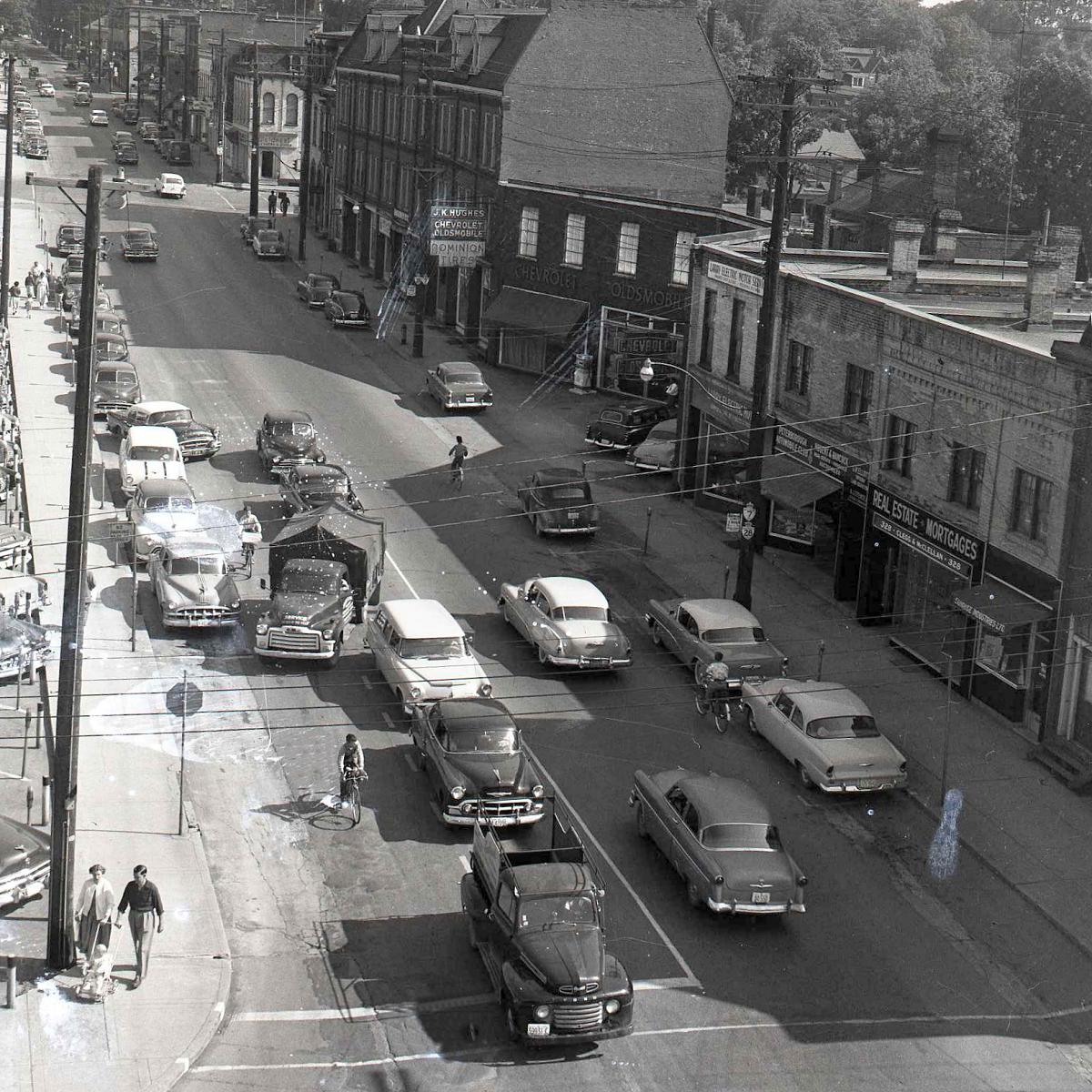
Decades on, some cities have found that one-way streets resemble highways a little too much, with high traffic speeds causing safety issues in busy pedestrian areas.
Oshawa, Hamilton, and Prince Albert in Saskatchewan are among those that are reverting some streets to two-way traffic to slow vehicles down and improve safety and comfort for people walking, cycling, and driving.
It’s all part of a paradigm shift toward designing streets that make people want to linger — not just pass through — which is key to creating vibrant, safe, and economically successful cities.
Crowded sidewalks not only mean more people spending money at local shops, but also more eyes on the street to help maintain safety, as the urbanist Jane Jacobs wrote.
The pendulum has started to swing back from where it was in the 1950s, but there’s still a lot of work to create streets centred around people, not just the movement of cars.
If you’re interested in learning more about GreenUP’s School Streets initiative or measures to support students to walk, cycle, and take the bus at school, email activeschooltravel@greenup.on.ca. To learn more about Active School Travel Peterborough, visit greenup.on.ca/active-school-travel-peterborough.