Adalsteinn Brown, co-chair of Ontario's COVID-19 science advisory table, presented a sobering assessment of the pandemic in Ontario at a technical media briefing at Queen's Park on April 1, 2021. (CPAC screenshot)
In advance of the announcement of an expected provincial lockdown on Thursday (April 1), Ontario’s top health officials delivered a sobering assessment of the status of the COVID-19 pandemic in Ontario — and recommended a month-long province-wide stay-at-home order to bring the disease under control.
“We are in the third wave of the pandemic and, as the new variants spread, you will see that COVID is killing faster and younger,” said Adalsteinn Brown, co-chair of Ontario’s COVID-19 science advisory table, who presented COVID-19 modelling projections along with chief medical officer of health Dr. David Williams.
“It’s spreading far more quickly than it was before, and we cannot vaccinate quickly enough to break this third wave,” Brown added.
Advertisement - content continues below
Brown described the situation in Ontario’s hospitals now, compared to the first and second waves of the pandemic.
“It used to be that one family member, often an older parent or grandparent, would be in an intensive care unit while other members of the family would have caught a much milder form of the disease if at all,” he said. “But with the new variants, that are both more contagious and more dangerous, we’re seeing situations where whole families end up in intensive care, all at the same time.”
Brown added that, because Ontario’s health care system is already under strain, patients have to moved between regions.
“Even as people are fighting for their lives, we have to separate families,” he said. “One family ended up spread between three hospitals … another family ended up being spread between three cities, in three different hospitals, and all of them died.”
Brown pointed out that the variants of concern are resulting in younger people ending up in hospital, using the example of one physician’s observations.
“This doctor worked through the brunt of the first and second wave,” Brown said. “He told us very clearly that even at the worst of these times, he hadn’t seen this many young otherwise healthy people fighting for their lives against COVID-19.”
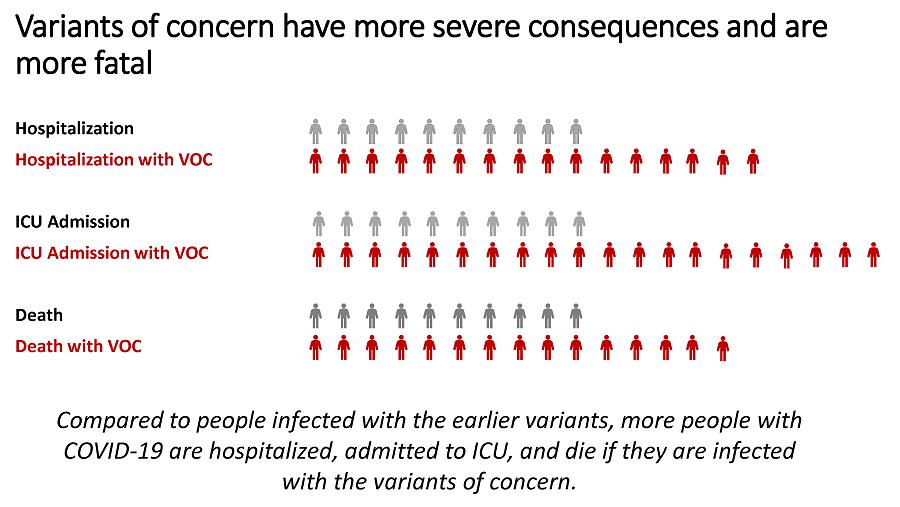
A slide from the update on COVID-19 projections presented by Ontario’s Science Advisory and Modelling Consensus Tables on April 1, 2021.
While vaccination is the key to long-term control, Brown said, adherence to public health measures — masks, physical distancing, hand hygiene, and staying outside if you need to meet people — are key to controlling the pandemic while people are being vaccinated.
“Sometimes we talk about public health measures and the economy, or public health measures and mental health, as a trade-off,” Brown said. “This is a false debate. The faster we get the pandemic under control, the faster we return to normal. Partial measures, half-hearted adherence, and denial prolong the pandemic and make life harder for everyone.”
Brown said this was particularly true for children and youth, with school infections reflecting what is happening in the community.
“Schools should be the last place to close, and the first to open,” Brown said.
“But as international experience shows, if we don’t get the pandemic under control, we will have to take more drastic measures for longer periods of time. If we don’t get the pandemic under control, we’ll have more sick people, some of whom will never get better. We will further damage our hospital system and the people working in it. We’ll have more unnecessary death, and it will hurt students and our society.”
Advertisement - content continues below
Brown then presented an update on COVID-19 modelling projections, that included the following key findings:
The third wave is here and being driven by variants of concern.
Younger Ontarians are ending up in hospital. With the UK B.1.1.7 variant, the risk of ICU admission is two times higher and the risk of death is 1-1/2 times higher.
COVID-19 threatens the health system ability to deal with regular ICU admissions and the ability to care for all patients.
Vaccination is not reaching the highest-risk communities, delaying its impact as an effective strategy.
School disruptions have a significant and highly inequitable impact on students, parents and society. Further disruptions should be minimized.
Stay-at-home orders will control the surge, protect access to care, and increase the chance of the summer Ontarians want.
Other points raised during the presentation include:
Cases and positivity rates in most public health unit regions now exceed the criteria for them to be placed in the ‘Red-Control’ level of Ontario’s COVID-19 response framework.
The increase in cases is not the result of more testing, because testing rates have remained flat.
Most new cases are variants of concern and, compared to people infected with the earlier variants, more people with COVID-19 are hospitalized, admitted to ICU, and die if they are infected
with the variants of concern.
Short-term projections are for 6,000 cases per day by the end of April, unless there is a province-wide stay-at-home order. While either a two-week or four-week stay-at-home order will reduce daily cases to below 2,000, a two-week stay-at-home order will result in cases creeping back up to 2,000 by the end of the month.
Advertisement - content continues below
With a stay-at-home order in place, ICU occupancy will peak at 800 beds by the end of April, and then gradually decline. Without a stay-at-home order, ICU occupancy will reach 1,000 beds. In either case, hospitals may have to begin triaging patients to manage the burden on the system.
The cumulative surgical backlog related to the pandemic has now affected 245,367 patients, with urgent surgeries making up the majority of these cases.
Essential workers, particularly racialized and marginalized communities in urban centres, are bearing the brunt of the pandemic, making vaccination of essential workers and control of workplace outbreaks critical.
While vaccinations of older Ontarians are continuing, a large percentage of them have still not received a first dose, including 17 per cent of those 80 and older, 40 per cent of those 75 to 79, and 72 per cent of those 70 to 74. Fewer older Ontarians in high-risk neighbourhoods have received vaccinations compared to more older Ontarians in low-risk neighbourhoods who have received vaccinations.
School interruptions will have significant impacts on students, families, and society. Students whose learning is interrupted by the pandemic will experience a drop in lifetime earnings and face health risks from social isolation and loss of structure, with students who are already disadvantaged being affected more.
A vial of the Pfizer-BioNTech COVID-19 vaccine at Walter Reed National Military Medical Center in Bethesda, Maryland. (Photo: Lisa Ferdinando)
Three COVID-19 mass vaccination clinics are set to open after the Easter long weekend in the Haliburton, Kawartha Pine Ridge District (HKPR) Health Unit region.
In a virtual media briefing on Wednesday (March 31), acting medical officer of health Dr. Ian Gemmill said clinics will be opening on Tuesday at the Fenelon Falls Community Centre in Fenelon Falls, the Campbellford Seymour Fire Hall in Trent Hills, and S.G. Nesbitt Arena in Minden.
A second mass vaccination site in Haliburton County is also expected to open at the A.J. LaRue Community Centre in Haliburton the following week.
Advertisement - content continues below
“If you’re looking for immunization in these centres, please keep checking the provincial website,” said Dr. Gemmill. “We’ve taken the vaccine that we’ve had promised to us and put in appointments right until April 24th. As soon as those are loaded online, people can get on there and make their appointments.”
In the HKPR region, those born in 1946 or earlier are currently eligible for vaccine appointments at the soon-to-open clinics. Appointments must be made through the online provincial booking system at covid-19.ontario.ca/book-vaccine/ or by calling 1-833-943-3900.
“If you don’t see the (vaccination) site (in the provincial system), that means the appointments aren’t in yet or they’re all booked up,” Dr. Gemmill noted. “Just keep checking. If we have vaccines available, there will be appointments. Once an appointment is made, that vaccine is spoken for.”
Over the next 10 days, the health unit will have completed its target of opening six mass immunization clinics across the HKPR region. The four new mass immunization clinics will be an addition to clinics already operating at the Cobourg Community Centre in Northumberland County and the Lindsay Exhibition in the City of Kawartha Lakes.
According to provincial officials at a technical media briefing on Wednesday, as of March 29 more than 28,000 COVID-19 doses have been administered in the HKPR region and more than 2,600 people have been fully vaccinated, including all residents of area long-term care homes.
Of the region’s residents aged 80 years and older, 82 per cent have already received a single dose of a COVID-19 vaccine or have booked an appointment to receive one, along with 50 per cent of residents aged 75 to 79.
Dr. Gemmill noted that while vaccine eligibility in the region still starts at 75 years of age, he anticipates eligibility will soon open up for those 70 and older as is the case in some other regions in the province.
At the Wednesday media briefing, provincial officials stated the HKPR region will receive 35,100 Pfizer doses by May 12th and 9,600 Moderna doses by April 19th, although 27,100 of all those doses have not yet been confirmed.
Advertisement - content continues below
The province also plans to distribute 10,800 doses of the AstraZeneca vaccine to the HKPR region in early April. These doses will be administered by local pharmacies (at least three in the region) as well as by family doctors and other primary care providers to their patients. The province has not yet announced the pharmacies and primary care providers that will receive these doses.
“We’re asking people not to call the pharmacies and family doctors about this because they will not have any information yet,” Dr. Gemmill pointed out. “Please watch the media for more information.”
Dr. Gemmill also shared his concerns about the current rise in the province’s COVID-19 cases, urging HKPR residents to continue adhering to public health measures.
“We’re not going up (in cases) here in the same worrisome degree as they are in other parts of Ontario, but things can turn on a dime,” Dr. Gemmill remarked. “It just takes a couple of ill-advised events that can lead to a number of people being infected in the area, and of course, they infect others.”
“It is time to keep adhering to personal measures even if a person has been immunized,” he added. “We’re learning that one dose of vaccine is providing pretty good protection, but until we see what happens on a population basis (how the virus is restricted in its movement from person to person in the population), I continue to recommend personal measures until we have other guidance.”
This will be Dr. Gemmill’s final week as acting medical officer of health for the HKPR district health unit. Dr. Natalie Bocking will assume the position on Monday, April 5th. Dr. Bocking has spent the past four years working as a public health physician with Thunder Bay District Health Unit and Sioux Lookout First Nations Health Authority. She and her family moved to the City of Kawartha Lakes in the fall of 2019.
As of Wednesday, there were 34 active cases of COVID-19 in the health unit’s region, including 18 in Northumberland and 16 in Kawartha Lakes, with 56 presumed cases of variants of concern, including 38 in Northumberland and 18 in Kawartha Lakes.
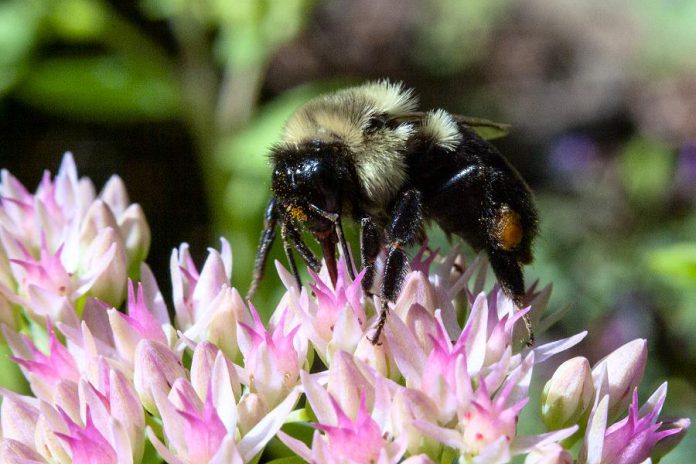
Unlike the domesticated honeybee, the bumblebee is a native pollinator. Only a bumblebee queen survives the winter by sheltering in small holes just beneath or on the ground's surface. They emerge in early spring to search for a nest site to start a new colony. If you begin cleaning up your yard too early in the spring, you can disturb the hibernating queen. (Photo: Leif Einarson)
If you are privileged enough to have a yard or garden, you are probably eager to tidy it up now that spring is here.
Each week, GreenUP provides a story related to the environment. This week’s story is by Leif Einarson, Communications Manager at GreenUP.
It may be hard to wait, but treading lightly during early spring is a win-win.
“We should hold off on garden work until late April or early May, once temperatures are regularly above 10 to 15 degrees Celsius,” states Hayley Goodchild, sustainability and landscaping project Coordinator at GreenUP.
Advertisement - content continues below
“There are two reasons for this,” she explains. “First, there are a lot of native pollinators and other beneficial wildlife sheltering under the leaf litter and other covered spaces of your garden — we want to protect them and not expose them to stress.”
“Second, soil tends to be very wet at this time of year. The structure of the soil can be very delicate. We do not want to compact the soil and make it difficult for roots and water to find their way into the soil.”
Native pollinators give us many gifts. They are essential not only to a vibrant garden but also to the health of the ecosystems we depend upon in Ontario.
A small carpenter bee on sedum flowers. These bees are named after their nesting habitat in dead wood, stems, or pith. Lightly metallic or blue in colour when viewed carefully, these small bees are excellent buzz pollinators of eggplant, tomato, and other vegetables. Buzz pollinating is a type of pollination that involves vibrations that release pollen from flowers while also fertilizing them. (Photo: Leif Einarson)
“Approximately one third of what we eat requires insect pollination,” explains Dr. Sheila Colla, who specializes in pollinator research and is an assistant professor in the Faculty of Environmental and Urban Change at York University (you can learn about her research at savethebumblebees.ca). “Pollinated foods tend to be the fruits and veggies that add vitamins and flavour to our meals.”
“People often think honeybees are the only important bee and thus think they are helping by having hives,” observes Colla. “In Canada, the most important pollinators are native bees and flies, not honeybees.”
Unlike native pollinators, domesticated honeybees were introduced to North America from Europe and Asia.
Advertisement - content continues below
“We have over 800 species of bees in Canada with about 400 of them occurring in Ontario,” says Colla. “Other insects that visit flowers and move around pollen grains (pollinators) include butterflies, moths, wasps, beetles, and ants. These native insects have co-evolved with native plants and provide important ecosystem services which support other wildlife.”
“Many important Indigenous foods and medicines have co-evolved to be pollinated by specific native pollinators,” Colla adds. “Pollinators introduced from elsewhere can bring with them diseases our native pollinators have not been exposed to. Introduced pollinators can also disrupt those co-evolved pollination relationships and instead benefit weedy or invasive plant species.”
So what can we do to support the incredible diversity of native pollinators in Ontario?
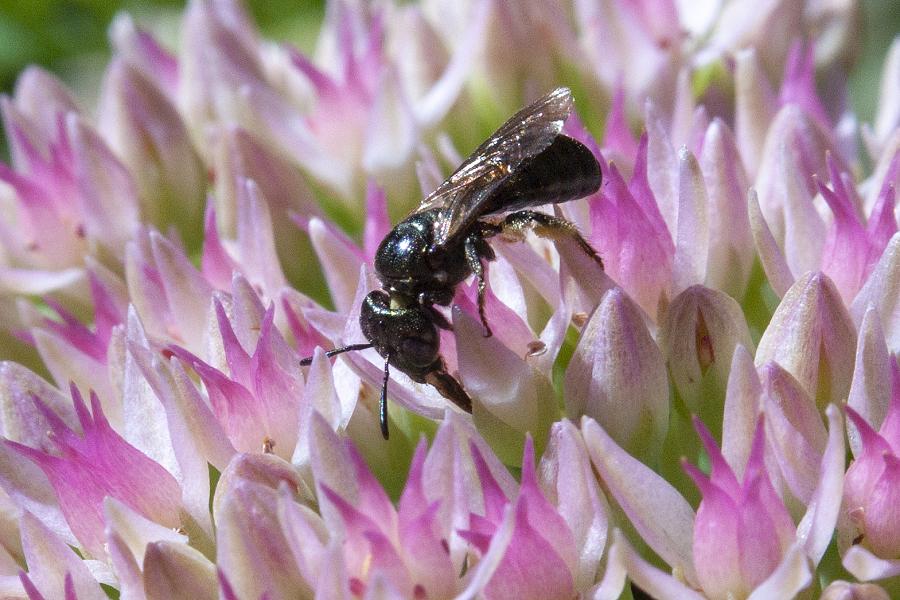
The family Halcitidae is the second-largest family of bees and can be found all over the world. Often metallic in appearance, these bees get their common name (sweat bees) because some of them are attracted to perspiration. These bees are important pollinators for many plants, including varieties of herb (basil, sage, rosemary), goldenrod, aster, daisy, sunflower, sumac, milkweed, and economically significant crops like mustards, peas, beans, and cabbages. (Photo: Leif Einarson)
“The main threats to native pollinators are introduced disease from domesticated bees and climate change,” says Colla. “People can help by contributing photos to BumbleBeeWatch.org (a free phone app) and by spreading the word that we have lots of different bee species. Both of these actions are so important. Anyone can do these things and they are free.”
Another way to help native pollinators is to plant pollinator-friendly gardens.
“Native plants support native pollinators,” Colla explains. “Especially things that bloom early in the spring, like willows, and late in the fall, like goldenrod.”
Advertisement - content continues below
You can also help by providing appropriate nesting habitat for native pollinators.
“Bees like to nest in old stems or in piles of rocks and old logs,” says Colla.
Leave stems uncut over the winter and into the spring, and ensure there are old logs and piles of rocks placed in your garden. These simple acts can help native pollinators who in turn provide essential gifts to our planet and our plates.
Buzzing bumblebee bums may be a familiar sight for observant Peterborough residents. This bumblebee has found its way inside a flowering Turtlehead (Chelone obliqua). Unlike domesticated honeybees, native bumblebees are capable of buzz pollinating, which is a type of pollination that involves vibrations that release pollen from flowers while also fertilizing them. (Photo: Leif Einarson)
As you tread lightly in your garden this spring, keep an eye out for native pollinator activity.
“In spring, a bumblebee queen will come out of overwintering and search for a nest site to start a new colony,” Colla says. “A bumblebee queen is a large bee and you will see her flying low in zigzags while stopping to explore crevices.”
“Bumblebees are good pollinators of tomatoes because unlike honeybees they can buzz-pollinate and can forage in greenhouses. Unlike honeybees, which use the sun to navigate, bumblebees use landmarks on the ground to navigate.”
“Squash bees are ground-nesting bees that specialize in the pollination of squash plants. Squash bees tend to be early morning/dawn pollinators so people often miss them.”
Advertisement - content continues below
If native pollinators are evading your gaze, Dawn Pond has some tips on how to be a pollinator detective. You may know Pond as the Downtown Vibrancy Manager with the Peterborough DBIA, and as the coordinator of several Depave Paradise projects with GreenUP. What you may not know is that Pond also has a background in pollinator and plant research.
“Look in hollow stems that have dried out over winter and are at least six inches long,” Pond says. “These stems can be suitable nesting locations for cavity-dwelling native bees. If the hollow centre of a stem is filled with bee cells (made of leaves and natural material) then it was home for new bees throughout the winter.”
“You can also look in the bare soil for evidence of wild bees,” Pond adds. “Ground-dwelling solitary bees emerge from their burrows as the weather warms up. Approximately 70 per cent of our native bee species in North America are ground dwelling.”
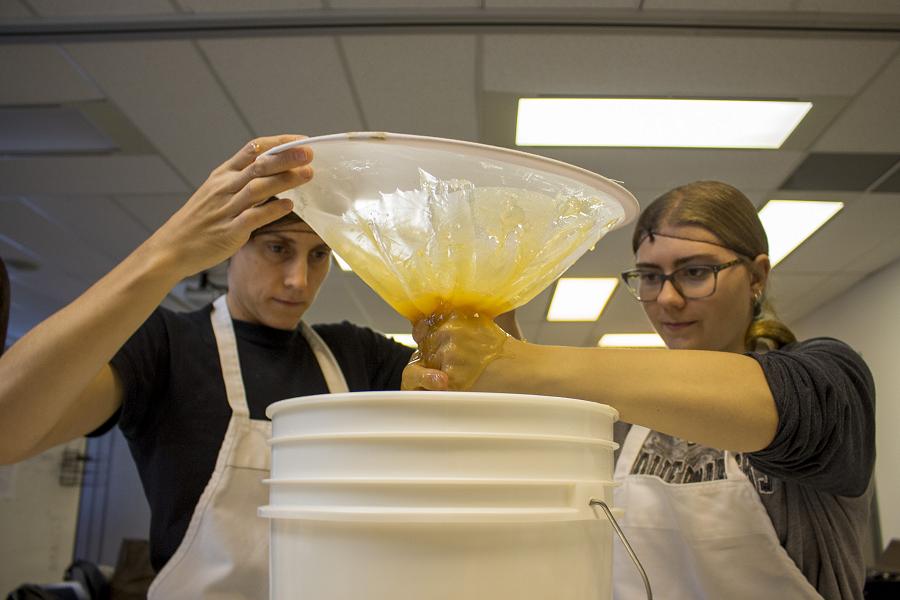
Brianna Salmon, executive director of GreenUP, helps a student filter honey in 2019 from a hive of domestic honeybees that is kept at Holy Cross Catholic Secondary School in Peterborough. Community beekeeping programs can build awareness about pollination and the responsibility of sustainably managing domesticated livestock in ways that minimize adverse impacts on native wildlife and ecosystems. (Photo: Leif Einarson)
“The polyester bee (Colletes inaequalis) is a common native bee species in North America and one of the first to emerge each spring. This bee makes its nest in sandy, bare soil. If you are lucky, you will see tiny burrows where the bees have dug themselves out of the soil to pollinate your plants throughout the spring and summer.”
This spring, support native pollinators by treading lightly in your yard and garden. Celebrate by finding evidence of native pollinators in your area and sharing it with GreenUP on social media @PtboGreenUP.
If you are looking for some outdoor volunteer work this spring and summer, contact Peterborough Pollinators at ptbopollinators@gmail.com to help care for their pollinator gardens around the city.
Tessa Plint, a former researcher with Western University in London, poses with a statue of the giant beaver at Yukon Beringia Interpretive Centre. The bear-sized rodent is thought to have gone extinct more than 10,000 years ago during the last ice age. (Photo: Western University)
Scotland has the Loch Ness monster, the Pacific Northwest has Sasquatch, and now the Kawarthas has — the Giant Beaver?
Over the past few weeks, some residents of the Kawarthas have reported seeing a bear-sized animal with huge teeth and a long tail, emerging from the water of local lakes as the winter ice breaks up.
“At first I thought it was a small black bear that fell through the ice, until I saw those huge incisors,” says Jose Broma, who lives on Jack Lake near Apsley and reported the first sighting.
Advertisement - content continues below
Broma, who says he was too busy running away to take a photo, then told his next-door neighbour about his experience. That’s when he discovered his neighbour had also had a close encounter with the same animal.
“She didn’t want to tell anybody because she was afraid they’d think she was crazy,” Broma says. “She was kind of relieved to find out I saw it too.”
The two of them then created a Facebook group, which now has more than 200 members from across the Kawarthas who all claim to have seen a similar creature. The Facebook group includes several photos of a large animal, but all of them are out of focus.
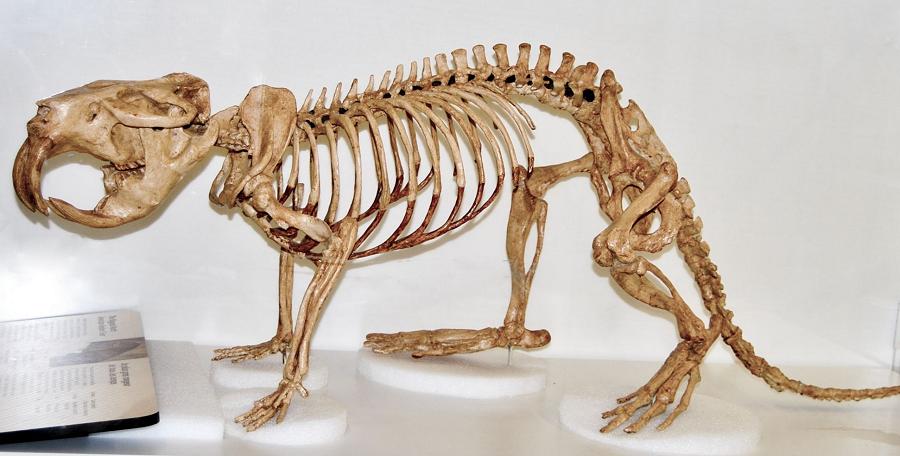
A skeleton of a giant beaver at the Canadian Museum of Nature. Paleontologists have found giant beaver bones and teeth from Ohio to southern Ontario to the Yukon Territory. (Photo: Western University)
A biologist with the Ministry of Natural Resources and Forestry before he retired, Broma firmly believes the animal is actually a descendant of the prehistoric giant beaver (Castoroides), a huge rodent that roamed North America more than 10,000 years ago during the last ice age, along with the mastodon and giant sloth.
All these large animals, known as megafauna, went extinct during the Pleistocene–Holocene transition period. Scientists continue to debate whether the animals were killed off by climate change or by the Clovis people, who colonized North America around 13,000 years ago.
Paleontologists have found giant beaver bones and teeth from Ohio to southern Ontario to the Yukon Territory. References to the giant beaver can be found in the oral history of various Indigenous peoples in North America, some of whom may even have used giant beaver teeth as wood chiselling tools.
Advertisement - content continues below
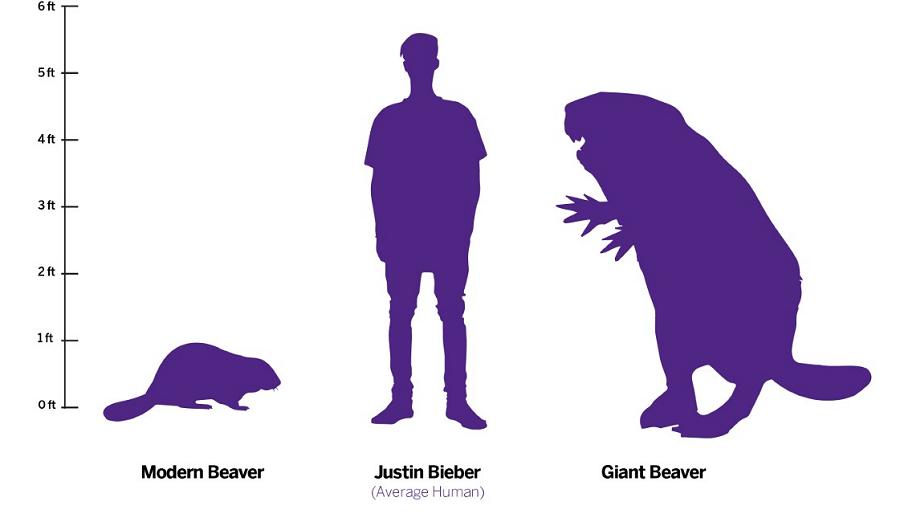
The largest rodent in North America at the time, the giant beaver was about two metres long and weighed up to 100 kilograms, with 15-centimetre-long incisors and a tail up to 64 centimetres long.
There have never been any previous reported sightings of an animal resembling the giant beaver in North America, let alone in the Kawarthas.
Broma has his own theory why the sightings have only happened in the last few weeks.
Beaver versus Bieber: a modern beaver, a human, and a giant beaver. (Illustration: Scott Woods / Western University)
“I think it’s because of COVID,” Broma explains. “I’ve read in the news that lots of wildlife around the world has been coming out of the forests and jungles. Maybe the giant beaver thinks it’s finally safe to come out of the water now because there aren’t so many people around.”
kawarthaNOW emailed scientists at several Ontario universities for comment on this story, but only received a single response.
“This has got to be an April Fool’s joke, right?” the email said.
All images from this story come from actual research on the giant beaver at Western University in London, Ontario. A May 2019 study uncovered a possible reason why the giant beaver went extinct at the end of the last ice age (spoiler: unlike the modern beaver, the giant beaver didn’t eat wood).
Here’s an update on COVID-19 cases in Ontario as well as in the greater Kawarthas region.
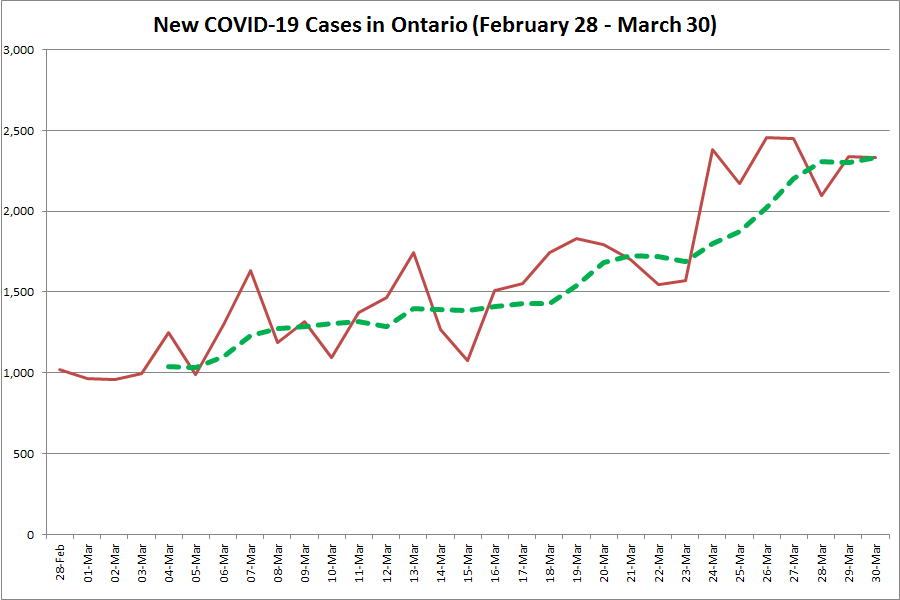
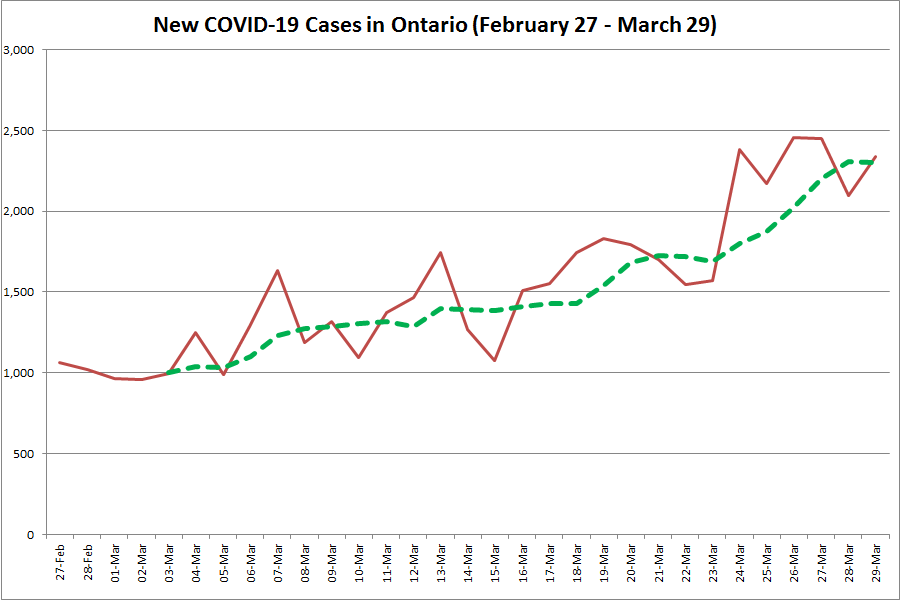
Today, Ontario is reporting 2,333 new cases — a full week of increases over 2,000 — with the seven-day average of daily cases increasing by 109 to 2,316. The province is also reporting 98 more confirmed cases of the B.1.1.7 UK variant, 1 more confirmed case of the B.1.351 South Africa variant, and 2 more confirmed cases of the P.1 Brazilian variant.
At a joint media conference with federal and Toronto municipal officials today to announce joint funding to expand Canada’s vaccine manufacturing capacity at a Sanofi Pasteur plant in North York,
Ontario Premier Doug Ford said he was “very, very concerned” about rising case numbers and ICU admissions.
“Stay tuned, you’ll hear an announcement tomorrow,” Ford said in response to a reporter’s question, urging Ontarians to avoid social gatherings on the Easter long weekend.
In the greater Kawarthas region, there are 47 new cases to report and an additional 8 cases resolved, with the number of active cases across the region increasing by 36 from yesterday to 154. Most of the new cases — 32 — are in Hastings Prince Edward (currently in the ‘Green-Prevent’ level), which overtook Peterborough today (currently in the ‘Red-Control’ level) with the highest number of active cases in the region at 71 due to outbreaks in Quinte West and Belleville. See below for detailed numbers from each regional health unit.
Advertisement - content continues below
Most of today’s new cases are in Toronto (785), Peel (433), York (222), Hamilton (153), Ottawa (124), and Durham (120).
There are double-digit increases in Middlesex-London (93), Niagara (77), Windsor-Essex (50), Halton (50), Waterloo (38), Thunder Bay (30), Sudbury (26), Simcoe Muskoka (24), Eastern Ontario (20), Southwestern (20), Wellington-Dufferin-Guelph (11), and Brant (10), with smaller increases in Hastings Prince Edward (7), Kingston, Frontenac and Lennox & Addington (7), and Leeds, Grenville & Lanark (6).
The remaining 13 health units are reporting 5 or fewer new cases, with 3 health units reporting no new cases at all.
Of today’s new cases, 56% are among people 39 and younger, with the highest number of cases (816) among people ages 20-39 followed by 685 cases among people ages 40-59.
With 1,973 more cases resolved since yesterday, the percentage of resolved cases has decreased by 0.1% to 92.1%. The average positivity rate across Ontario has dropped by 1.7% to 4.5%, meaning that 45 out of every 1,000 tests performed were positive for COVID-19 on March 30.
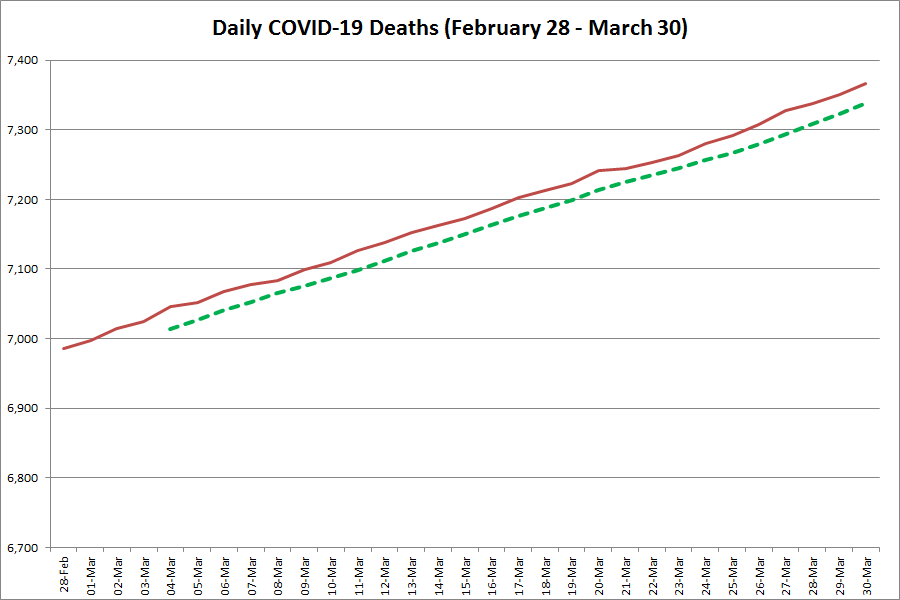
Ontario is reporting 15 new COVID-19 deaths today, with 4 new deaths in long-term care homes for the second day in a row. Ontario has averaged 15 new daily deaths over the past week, an increase of 1 from yesterday.
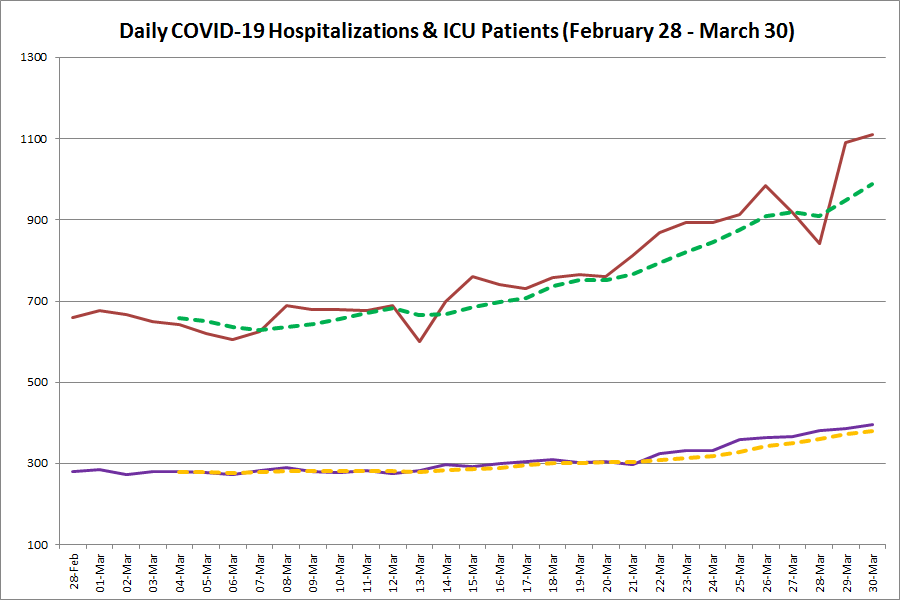
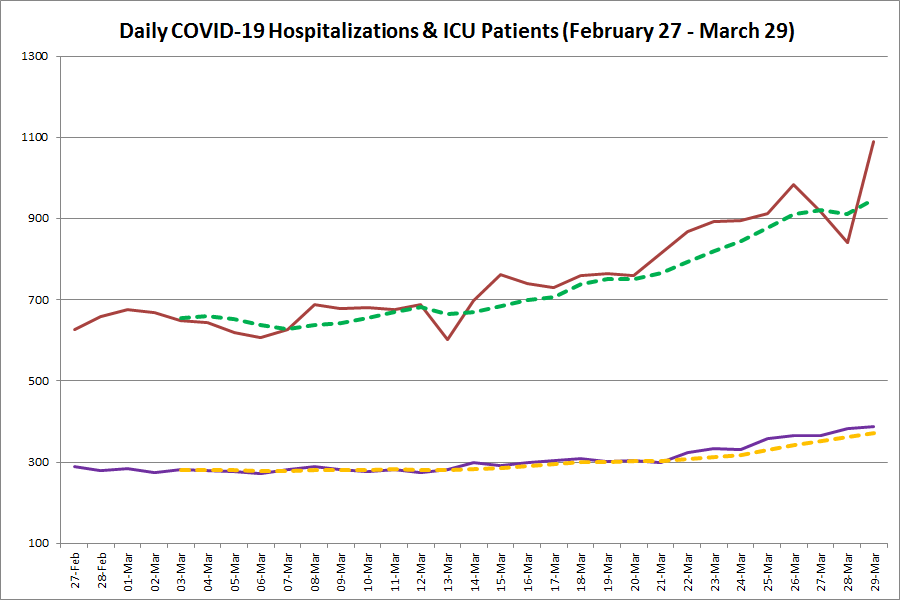
The number of hospitalizations has increased by 29 to 1,111, with the number of patients with COVID-19 in ICUs increasing by 9 to 396 and the number of patients with COVID-19 on ventilators increasing by 3 to 252.
A total of 52,532 tests were completed yesterday, with the backlog of tests under investigation increasing by 5,400 to 40,466.
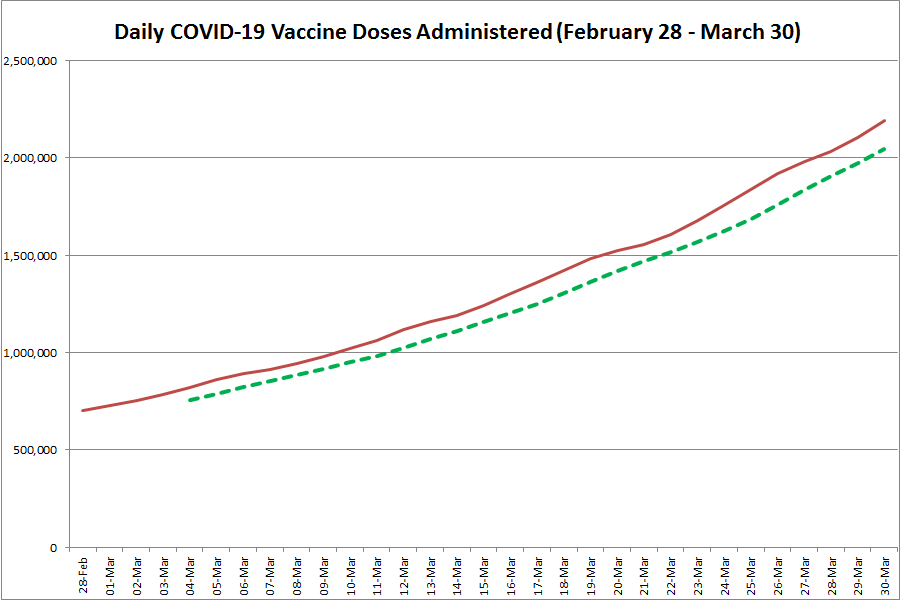
A total of 2,192,2530 doses of vaccine have now been administered — a record increase of 89,873 doses yesterday — with 315,820 people fully vaccinated with both doses of vaccine, an increase of 1,931 from yesterday.
The number of fully vaccinated people now represents 2.14% of Ontario’s population, an increase of 0.01% from yesterday, with fully and partially vaccinated people representing 14.88% of the population, an increase of 0.61% from yesterday. An estimated 70-90% of the population must be immunized to achieve herd immunity.
There are 322 new cases in Ontario schools, a decrease of 196 from yesterday, including 282 student cases and 50 staff cases. There are 83 new cases in licensed child care settings in Ontario, a decrease of 13 from yesterday, including 54 cases among children and 29 cases among staff.
Advertisement - content continues below
In the greater Kawarthas region, there are 47 new cases to report, including 32 in Hastings Prince Edward, 9 in Peterborough, 4 in Kawartha Lakes, and 2 in Northumberland. There are no new cases in Haliburton.
Two outbreaks at two unidentified workplaces in the City of Peterborough were declared on March 31.
There is 1 new hospitalization in Hastings Prince Edward.
There are 13 new regional cases of presumed variants of concern, including 6 in Peterborough, 5 in Hastings Prince Edward, and 2 in Kawartha Lakes.
An additional 8 cases have been resolved, including 7 in Peterborough and 1 in Kawartha Lakes. An outbreak at an unidentified congregate living facility in Peterborough was declared resolved on March 29.
There are currently 154 active cases in the greater Kawarthas region, an increase of 36 from yesterday, including 71 in Hastings Prince Edward (11 in Quinte West, 32 in Belleville, 6 in Tyendinaga & Deseronto, 5 in Prince Edward County, 7 in Central Hastings, and 2 in North Hastings), 52 in Peterborough, 18 in Northumberland, and 13 in Kawartha Lakes. There are no active cases in Haliburton.
Since the pandemic began in the greater Kawarthas region, there have been 875 confirmed positive cases in the Peterborough area (813 resolved with 10 deaths), 584 in the City of Kawartha Lakes (526 resolved with 55 deaths), 497 in Northumberland County (467 resolved with 12 deaths), 65 in Haliburton County (64 resolved with 1 death), and 514 in Hastings and Prince Edward counties (437 resolved with 6 deaths). The most recent death was reported in Peterborough on March 16.
The provincial data in this report is pulled from Ontario’s integrated Public Health Information System (iPHIS) at 4 p.m. the previous day, as well as from systems in Toronto, Ottawa, and Middlesex-London at 2 p.m. the previous day. Data from local health units is more current and is usually reflected in the provincial data the following day. There may be discrepancies between the Ontario data reported today (which is from yesterday) and the local health unit data reported today (which is from today).
Peterborough Public Health’s service area is the City and County of Peterborough and the Hiawatha and Curve Lake First Nations.
The health unit provides daily reports, including on weekends, excluding statutory holidays.
Confirmed positive: 875 (increase of 9) Total variants of concern cases: 199 (increase of 6) Active cases: 52 (increase of 2) Close contacts: 198 (decrease of 59) Deaths: 10 Resolved: 813 (increase of 7) Hospitalizations (total to date): 30 (no change)* Total tests completed: Over 46,350 (increase of 100) Outbreaks: Gzowski College student residence at Trent University, Empress Gardens retirement home in Peterborough, Workplace #1 in City of Peterborough, Workplace #2 in City of Peterborough (net increase of 1) Vaccine doses administered: 24,309 (last updated March 25)
*As of March 31, Peterborough Regional Health Centre is reporting fewer than 10 patients hospitalized with COVID-19 (no change) and 24 patients transferred from other areas as a result of a provincial directive (increase of 1).
**An outbreak at an unidentified congregate living facility in Peterborough was declared resolved on March 29. Two outbreaks at two unidentified workplaces in the City of Peterborough were declared on March 31.
Haliburton, Kawartha, Pine Ridge District Health Unit
The Haliburton, Kawartha, Pine Ridge District Health Unit’s service area is the City of Kawartha Lakes, Northumberland County, and Haliburton County.
The health unit provides reports from Monday to Saturday, excluding Sundays and statutory holidays.
Confirmed positive: 1,146 including 584 in Kawartha Lakes, 497 in Northumberland, and 65 in Haliburton (increase of 6, including 4 in Kawartha Lakes and 2 in Northumberland)* Cases with N501Y mutation: 56, including 18 in Kawartha Lakes and 38 in Northumberland (increase of 2 in Kawartha Lakes)** Active cases: 34, including 16 in Kawartha Lakes and 18 in Northumberland (increase of 5, including 3 in Kawartha Lakes and 2 in Northumberland) Probable cases: 0 (no change) High-risk contacts: 130, including 42 in Kawartha Lakes, 67 in Northumberland, and 5 in Haliburton (net increase of 9)*** Hospitalizations (total to date): 50, including 30 in Kawartha Lakes, 17 in Northumberland, and 3 in Haliburton (no change)**** Deaths (including among probable cases): 68, including 55 in Kawartha Lakes, 12 in Northumberland, and 1 in Haliburton (no change) Resolved: 1,057, including 526 in Kawartha Lakes, 467 in Northumberland, 64 in Haliburton (increase of 1 in Kawartha Lakes) Tests completed: 162,785 (increase of 716) Vaccine doses administered: 23,198 (increase of 7,410, last updated on March 29) Number of people fully vaccinated: 2,618 (increase of 335, last updated on March 29) Outbreaks: None (no change)
*The health unit states that total counts and counts for individual counties may fluctuate from previously reported counts as cases are transferred to or from the health unit based on case investigation details and routine data cleaning.
**The N501Y mutation has been identified in variants of concern including the B.1.1.7 UK variant, the B.1.351 South Africa variant, and the P.1 Brazilian variant.
***This total includes an additional 7 high-risk contacts directly followed up through the Public Health Ontario contact tracing process that are missing the contacts’ county.
****As of March 31, Ross Memorial Hospital in Lindsay reports 1 patients hospitalized with COVID-19 (decrease of 1).
Hastings Prince Edward Public Health
Hastings Prince Edward Public Health’s service area is Hastings County (including Bancroft) and Prince Edward County.
The health unit provides daily reports, including on weekends, excluding statutory holidays.
Confirmed positive: 514 (increase of 32) Confirmed variants of concern cases: 20 (increase of 5) Active cases: 71 (increase of 32) Deaths: 6 (no change) Currently hospitalized: 1 (increase of 1) Currently hospitalized and in ICU: 0 (no change) Currently hospitalized and in ICU on ventilator (total to date): 0 (no change) Resolved: 437 (no change) Tests completed: 82,931 (increase of 8) Vaccine doses administered: 28,473 (increase of 1,678) Number of people fully vaccinated: 1,946 (increase of 26) Outbreaks: Unidentified workplace in Trenton (no change)
Advertisement - content continues below
Province of Ontario
Confirmed positive: 349,903 (increase of 2,333) COVID-19 variants of concern (VOC) confirmed cases: 1,898 of B.1.1.7 UK variant (increase of 98); 69 of B.1.351 South Africa variant (increase of 1); 92 of P.1 Brazilian variant (increase of 2) VOC R(t): 1.35 (no change, last updated March 26)* 7-day average of daily new cases: 2,316 (increase of 109) Resolved: 322,382 (increase of 1,973), 92.1% of all cases (decrease of 0.1%) Positivity rate: 4.5% (decrease of 1.7%) Hospitalizations: 1,111 (increase of 21) Hospitalizations in ICU: 396 (increase of 9) Hospitalizations in ICU on ventilator: 252 (increase of 3) Deaths: 7,366 (increase of 15) 7-day average of daily new deaths: 15 (increase of 1) Deaths of residents in long-term care homes: 3,901 (increase of 4) Total tests completed: 12,551,173 (increase of 52,532) Tests under investigation: 40,466 (increase of 5,400) Vaccination doses administered: 2,192,2530 (increase of 89,873), 14.88% of Ontario’s population (increase of 0.61%)** People fully vaccinated (two doses): 315,820 (increase of 1,931), 2.14% of Ontario’s population (increase of 0.01%)**
*R(t) is a virus’s effective reproduction number, which is the average number of new infections caused by a single infected individual at a specific time (t) in a partially immunized population. To successfully eliminate a disease from a population, R(t) needs to be less than 1.
**An estimated 70-90% of the population must be immunized to achieve herd immunity.
COVID-19 cases in Ontario from February 28 – March 30, 2021. The red line is the number of new cases reported daily, and the dotted green line is a five-day moving average of new cases. (Graphic: kawarthaNOW.com)COVID-19 tests completed in Ontario from February 28 – March 30, 2021. The red line is the daily number of tests completed, and the dotted green line is a five-day moving average of tests completed. (Graphic: kawarthaNOW.com)COVID-19 hospitalizations and ICU admissions in Ontario from February 28 – March 30, 2021. The red line is the daily number of COVID-19 hospitalizations, the dotted green line is a five-day moving average of hospitalizations, the purple line is the daily number of patients with COVID-19 in ICUs, and the dotted orange line is a five-day moving average of patients with COVID-19 in ICUs. (Graphic: kawarthaNOW.com)COVID-19 deaths in Ontario from February 28 – March 30, 2021. The red line is the cumulative number of daily deaths, and the dotted green line is a five-day moving average of daily deaths. (Graphic: kawarthaNOW.com)COVID-19 vaccine doses administered in Ontario from February 28 – March 30, 2021. The red line is the cumulative number of daily doses administered, and the dotted green line is a five-day moving average of daily doses. (Graphic: kawarthaNOW.com)
4th Line Theatre in Millbrook is Canada's premier outdoor theatre company. (Photo: 4th Line Theatre / Facebook)
4th Line Theatre in Millbrook is postponing its first play of the 2021 summer season, originally scheduled for July, due to the pandemic.
“I am sorry to have to announce that we have made the difficult decision to postpone the world premiere of Alex Poch-Goldin’s The Great Shadow until the summer of 2022,” writes managing artistic director Kim Blackwell in an email on Wednesday (March 31). “This decision is based on many factors. Most critical to our decision is the public health directive presently in place for our region.”
With the Peterborough region currently in the ‘Red-Control’ level of the province’s COVID-19 response framework, the outdoor theatre is limited to a maximum of 25 people at any performance. Blackwell says this makes it financially infeasible to stage a production, since that represents only 1/16th of the available seating at Winslow Farm.
Advertisement - content continues below
“We also have to make the health and safety of our company members and audiences the number one priority,” Blackwell adds. “While the vaccine roll-out is moving forward, the number of active cases in the province is concerningly high. I wish I had better news for you, and I know that this decision may cause you disappointment and frustration.”
As for the second play of the 2021 summer season, Maja Ardal’s Wishful Seeing, Blackwell says 4th Line Theatre will make a decision on May 1st on whether that production will proceed or also be postponed.
“On the positive side, I know there will be theatre at the farm later this summer,” Blackwell writes. “And I expect us to produce theatre into the fall and winter of 2021.”
Both plays were originally set to premiere at the Winslow Farm in summer 2020, but were postponed until 2021 because of the pandemic.
Ontario Premier Doug Ford responds to a reporter's question during a media conference about Ontario's COVID-19 vaccination plan in North York on March 30, 2021. (CPAC screenshot)
Here’s an update on COVID-19 cases in Ontario as well as in the greater Kawarthas region.
As the Easter long weekend approaches, Ontario is reporting 2,336 new cases — the sixth straight day of increases over 2,000 — with the seven-day average of daily cases increasing by 113 to 2,207. The province is also reporting 51 more confirmed cases of the B.1.1.7 UK variant, 6 more confirmed cases of the B.1.351 South Africa variant, and 8 more confirmed cases of the P.1 Brazilian variant.
“I’m extremely concerned about the situation that we’re seeing,” Premier Doug Ford said at a media conference in North York today, implying that more restrictions may be coming in the next couple of days. “Everything’s on the table right now. So folks, be prepared, don’t make plans for Easter. I won’t hesitate to lock things down if we have to. I did it before, I’ll do it again.”
Ford’s comments come the day after the Ontario COVID-19 Science Advisory Table published an alarming report confirming variants of concern are driving the third wave of the pandemic, now accounting for more than two-thirds of all new COVID-19 infections in Ontario.
The B.1.1.7 UK variant alone accounts for more than 90 per cent of these infections, with emerging evidence that it is both more transmissible and virulent. Variants of concern are associated with a 63 per cent increased risk of hospitalization, a 103 per cent increased risk of ICU admission, and a 56 per cent increased risk of death due to COVID-19.
The variants of concern “will result in a considerably higher burden to Ontario’s health care system”, warns the report. The number of people hospitalized with COVID-19 is now 21 per cent higher than at the start of the province-wide lockdown in late December, while ICU occupancy is 28 per cent higher.
COVID-19 hospitalizations and ICU admissions in Ontario from February 27 – March 29, 2021. The red line is the daily number of COVID-19 hospitalizations, the dotted green line is a five-day moving average of hospitalizations, the purple line is the daily number of patients with COVID-19 in ICUs, and the dotted orange line is a five-day moving average of patients with COVID-19 in ICUs. (Graphic: kawarthaNOW.com)
The third wave is also affecting younger people more than the previous two waves, with the percentage of COVID-19 patients now in ICUs who are younger than 60 years around 50 per cent higher than it was in late December. The report states the full burden on the province’s health care system is yet to come, since the increased risk of COVID-19 hospitalization, ICU admission, and death from variants of concern is most pronounced 14 to 28 days after diagnosis.
In the greater Kawarthas region, there are 15 new cases to report and an additional 15 cases resolved, with the number of active cases across the region increasing by 1 from yesterday to 118. See below for detailed numbers from each regional health unit.
Advertisement - content continues below
Most of today’s new cases are in Toronto (727), Peel (434), York (229), Durham (194), Ottawa (144), and Hamilton (123).
There are double-digit increases in Halton (91), Niagara (63), Simcoe Muskoka (39), Middlesex-London (38), Waterloo (31), Windsor-Essex (28), Brant (25), Eastern Ontario (23), Wellington-Dufferin-Guelph (23), Lambton (20), Sudbury (19), Thunder Bay (16), Chatham-Kent (12), Southwestern (11), and Haldimand-Norfolk (10), with smaller increases in Hastings Prince Edward (8) and Haliburton, Kawartha, Pine Ridge (7).
The remaining 11 health units are reporting 5 or fewer new cases, with 3 health units reporting no new cases at all.
Of today’s new cases, 55% are among people 39 and younger, with the highest number of cases (789) among people ages 20-39 followed by 664 cases among people ages 40-59.
With 1,477 more cases resolved since yesterday, the percentage of resolved cases has decreased by 0.2% to 92.2%. The average positivity rate across Ontario has increased by 0.1% at 6.2%, meaning that 61 out of every 1,000 tests performed were positive for COVID-19 on March 29.
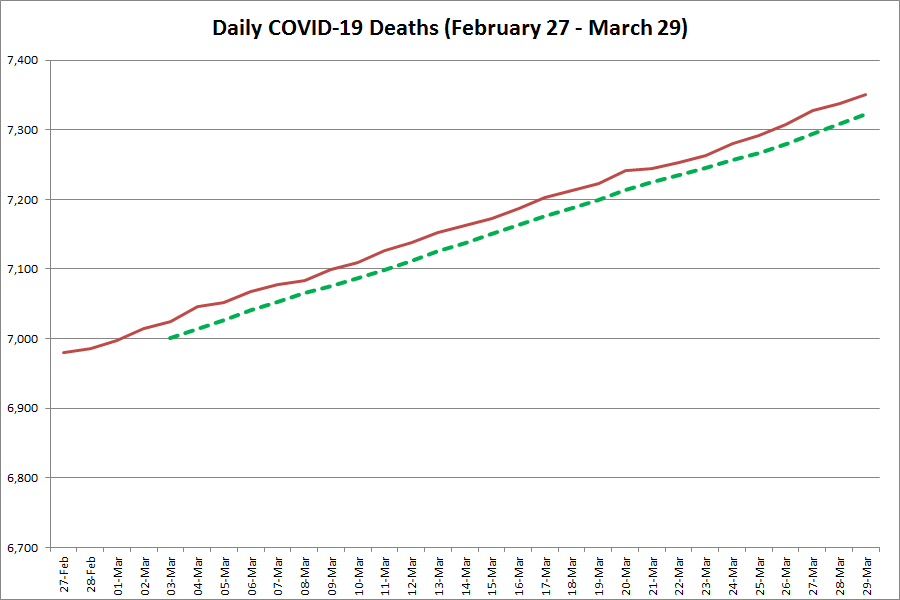
Ontario is reporting 14 new COVID-19 deaths today, with 4 new deaths in long-term care homes. Ontario has averaged 14 new daily deaths over the past week, an increase of 1 from yesterday.
Echoing the warning in yesterday’s Ontario COVID-19 Science Advisory Table report, the number of hospitalizations has spiked by 249 to 1,090, with the number of patients with COVID-19 in ICUs increasing by 5 to 387 and the number of patients with COVID-19 on ventilators increasing by 13 to 249.
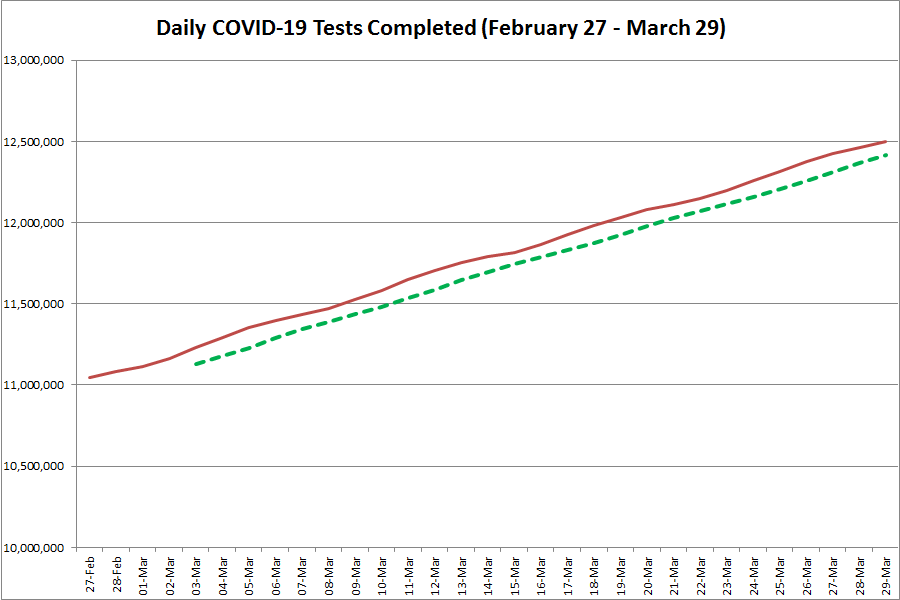
A total of 36,071 tests were completed yesterday, with the backlog of tests under investigation increasing by 17,350 to 35,066.
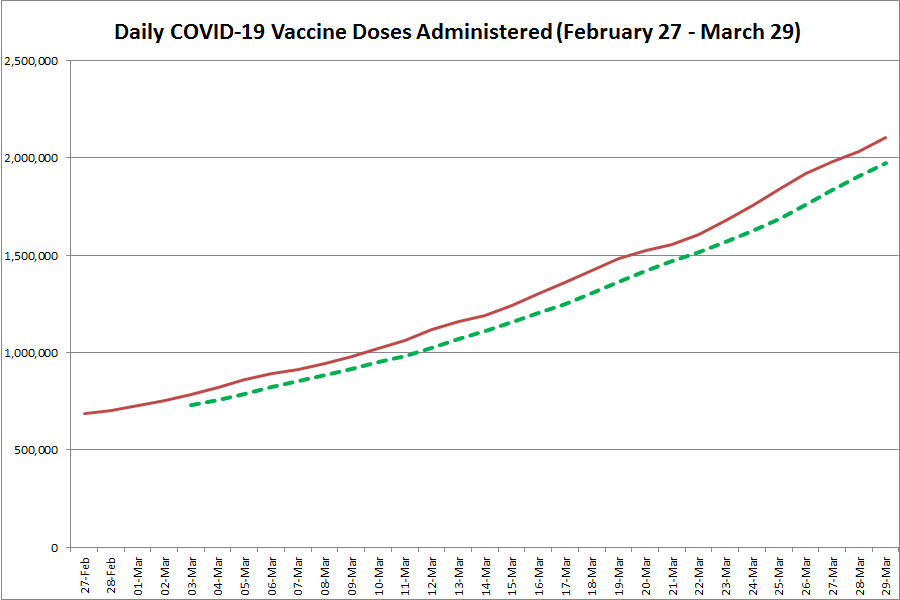
A total of 2,102,380 doses of vaccine have now been administered, an increase of 70,645 from yesterday, with 313,889 people fully vaccinated with both doses of vaccine, an increase of 2,641 from yesterday.
The number of fully vaccinated people represents 2.13% of Ontario’s population, with fully and partially vaccinated people representing 14.27% of the population. An estimated 70-90% of the population must be immunized to achieve herd immunity and, at the current rate of vaccination, it will take almost four months to immunize 70% of Ontarians with one dose of vaccine.
There are 518 new cases in Ontario schools, an increase of 303 from yesterday, including 440 student cases, 77 staff cases, and 1 case among an unidentified person. There are 96 new cases in licensed child care settings in Ontario, an increase of 60 from yesterday, including 59 cases among children and 37 cases among staff. Note: cases reported on Tuesdays include the total number of cases reported from Friday afternoon to Monday afternoon.
Advertisement - content continues below
In the greater Kawarthas region, there are 15 new cases to report, including 11 in Peterborough, 3 in Hastings Prince Edward, and 1 in Northumberland. There are no new cases in Kawartha Lakes or Haliburton.
There is a new outbreak at an unidentified workplace in Trenton.
There are 16 new regional cases of presumed variants of concern, including 8 in Peterborough, 5 in Hastings Prince Edward, 2 in Kawartha Lakes, and 1 in Northumberland.
An additional 15 cases have been resolved, including 13 in Peterborough, 1 in Northumberland, and 1 in Hastings Prince Edward.
There are currently 118 active cases in the greater Kawarthas region, an increase of 1 from yesterday, including 50 in Peterborough, 39 in Hastings Prince Edward (8 in Quinte West, 16 in Belleville, 6 in Tyendinaga & Deseronto, 3 in Prince Edward County, and 6 in Central Hastings), 16 in Northumberland, and 13 in Kawartha Lakes. There are no active cases in Haliburton.
Since the pandemic began in the greater Kawarthas region, there have been 866 confirmed positive cases in the Peterborough area (806 resolved with 10 deaths), 580 in the City of Kawartha Lakes (525 resolved with 55 deaths), 495 in Northumberland County (467 resolved with 12 deaths), 65 in Haliburton County (64 resolved with 1 death), and 482 in Hastings and Prince Edward counties (437 resolved with 6 deaths). The most recent death was reported in Peterborough on March 16.
The provincial data in this report is pulled from Ontario’s integrated Public Health Information System (iPHIS) at 4 p.m. the previous day, as well as from systems in Toronto, Ottawa, and Middlesex-London at 2 p.m. the previous day. Data from local health units is more current and is usually reflected in the provincial data the following day. There may be discrepancies between the Ontario data reported today (which is from yesterday) and the local health unit data reported today (which is from today).
Peterborough Public Health’s service area is the City and County of Peterborough and the Hiawatha and Curve Lake First Nations.
The health unit provides daily reports, including on weekends, excluding statutory holidays. Note: Due to updates and maintenance, the health unit’s online data tool will not be updated on March 29 or 30; information on the number of close contacts, deaths, hospitalizations, completed tests, and outbreaks will not be available.
Confirmed positive: 866 (increase of 11) Confirmed variants of concern cases: 1 (no change) Presumed variants of concern cases: 193 (increase of 8) Active cases: 50 (decrease of 2) Close contacts: 257 Deaths: 10 Resolved: 806 (increase of 13) Hospitalizations (total to date): 30* Total tests completed: Over 46,250 Outbreaks: Unidentified congregate living facility in Peterborough, Gzowski College student residence at Trent University, Empress Gardens retirement home in Peterborough (no change) Vaccine doses administered: 24,309 (last updated March 25)
*As of March 30, Peterborough Regional Health Centre is reporting fewer than 10 patients hospitalized with COVID-19 (no change) and 23 patients transferred from other areas as a result of a provincial directive (increase of 1).
Haliburton, Kawartha, Pine Ridge District Health Unit
The Haliburton, Kawartha, Pine Ridge District Health Unit’s service area is the City of Kawartha Lakes, Northumberland County, and Haliburton County.
The health unit provides reports from Monday to Saturday, excluding Sundays and statutory holidays.
Confirmed positive: 1,140, including 580 in Kawartha Lakes, 495 in Northumberland, and 65 in Haliburton (increase of 1 in Northumberland)* Cases with N501Y mutation: 54, including 16 in Kawartha Lakes and 38 in Northumberland (increase of 3, including 2 in Kawartha Lakes and 1 in Northumberland)** Active cases: 29, including 13 in Kawartha Lakes, 16 in Northumberland (increase of 1 in Kawartha Lakes) Probable cases: 0 (no change) High-risk contacts: 121, including 41 in Kawartha Lakes, 53 in Northumberland, and 6 in Haliburton (net decrease of 3)*** Hospitalizations (total to date): 50, including 30 in Kawartha Lakes, 17 in Northumberland, and 3 in Haliburton (no change)**** Deaths (including among probable cases): 68, including 55 in Kawartha Lakes, 12 in Northumberland, and 1 in Haliburton (no change) Resolved: 1,056, including 525 in Kawartha Lakes, 467 in Northumberland, 64 in Haliburton (increase of 1 in Northumberland) Tests completed: 162,069 (increase of 724) Vaccine doses administered: 23,198 (increase of 7,410, last updated on March 29) Number of people fully vaccinated: 2,618 (increase of 335, last updated on March 29) Outbreaks: None (no change)
*The health unit states that total counts and counts for individual counties may fluctuate from previously reported counts as cases are transferred to or from the health unit based on case investigation details and routine data cleaning.
**The N501Y mutation has been identified in variants of concern including the B.1.1.7 UK variant, the B.1.351 South Africa variant, and the P.1 Brazilian variant.
***This total includes an additional 11 high-risk contacts directly followed up through the Public Health Ontario contact tracing process that are missing the contacts’ county.
****As of March 29, Ross Memorial Hospital in Lindsay reports 2 patients hospitalized with COVID-19 (increase of 1).
Hastings Prince Edward Public Health
Hastings Prince Edward Public Health’s service area is Hastings County (including Bancroft) and Prince Edward County.
The health unit provides daily reports, including on weekends, excluding statutory holidays.
Confirmed positive: 482 (increase of 3) Confirmed variants of concern cases: 15 (increase of 5) Active cases: 39 (increase of 2) Deaths: 6 (no change) Currently hospitalized: 0 (no change) Currently hospitalized and in ICU: 0 (no change) Currently hospitalized and in ICU on ventilator (total to date): 0 (no change) Resolved: 437 (increase of 1) Tests completed: 82,923 (increase of 21) Vaccine doses administered: 26,795 (increase of 1,582) Number of people fully vaccinated: 1,920 (increase of 5) Outbreaks: Unidentified workplace in Trenton (increase of 1)
Advertisement - content continues below
Province of Ontario
Confirmed positive: 347,570 (increase of 2,336) COVID-19 variants of concern (VOC) confirmed cases: 1,800 of B.1.1.7 UK variant (increase of 51); 69 of B.1.351 South Africa variant (increase of 6); 90 of P.1 Brazilian variant (increase of 8) VOC R(t): 1.35 (decrease of 0.01, last updated March 26)* 7-day average of daily new cases: 2,207 (increase of 113) Resolved: 320,409 (increase of 1,477), 92.2% of all cases (decrease of 0.2%) Positivity rate: 6.2% (increase of 0.1%) Hospitalizations: 1,090 (increase of 249) Hospitalizations in ICU: 387 (increase of 5) Hospitalizations in ICU on ventilator: 249 (increase of 13) Deaths: 7,351 (increase of 14) 7-day average of daily new deaths: 14 (increase of 1) Deaths of residents in long-term care homes: 3,897 (increase of 4) Total tests completed: 12,498,641 (increase of 36,071) Tests under investigation: 35,066 (increase of 17,350) Vaccination doses administered: 2,102,380 (increase of 70,645), 14.27% of Ontario’s population (increase of 0.48%)** People fully vaccinated (two doses): 313,889 (increase of 2,641), 2.13% of Ontario’s population (increase of 0.02%)**
*R(t) is a virus’s effective reproduction number, which is the average number of new infections caused by a single infected individual at a specific time (t) in a partially immunized population. To successfully eliminate a disease from a population, R(t) needs to be less than 1.
**An estimated 70-90% of the population must be immunized to achieve herd immunity.
COVID-19 cases in Ontario from February 27 – March 29, 2021. The red line is the number of new cases reported daily, and the dotted green line is a five-day moving average of new cases. (Graphic: kawarthaNOW.com)COVID-19 tests completed in Ontario from February 27 – March 29, 2021. The red line is the daily number of tests completed, and the dotted green line is a five-day moving average of tests completed. (Graphic: kawarthaNOW.com)COVID-19 hospitalizations and ICU admissions in Ontario from February 27 – March 29, 2021. The red line is the daily number of COVID-19 hospitalizations, the dotted green line is a five-day moving average of hospitalizations, the purple line is the daily number of patients with COVID-19 in ICUs, and the dotted orange line is a five-day moving average of patients with COVID-19 in ICUs. (Graphic: kawarthaNOW.com)COVID-19 deaths in Ontario from February 27 – March 29, 2021. The red line is the cumulative number of daily deaths, and the dotted green line is a five-day moving average of daily deaths. (Graphic: kawarthaNOW.com)COVID-19 vaccine doses administered in Ontario from February 27 – March 29, 2021. The red line is the cumulative number of daily doses administered, and the dotted green line is a five-day moving average of daily doses. (Graphic: kawarthaNOW.com)
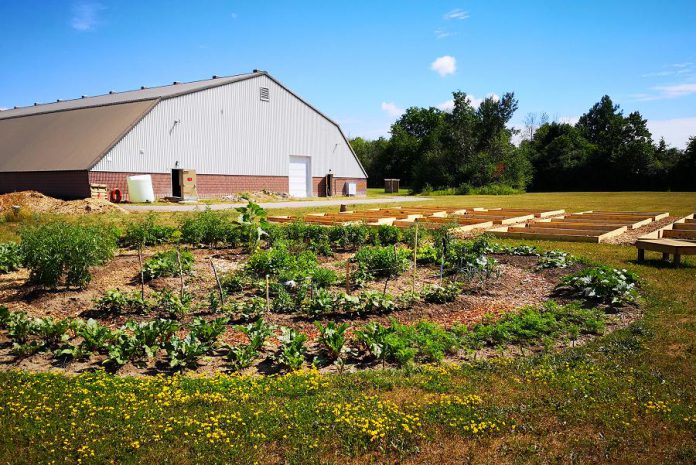
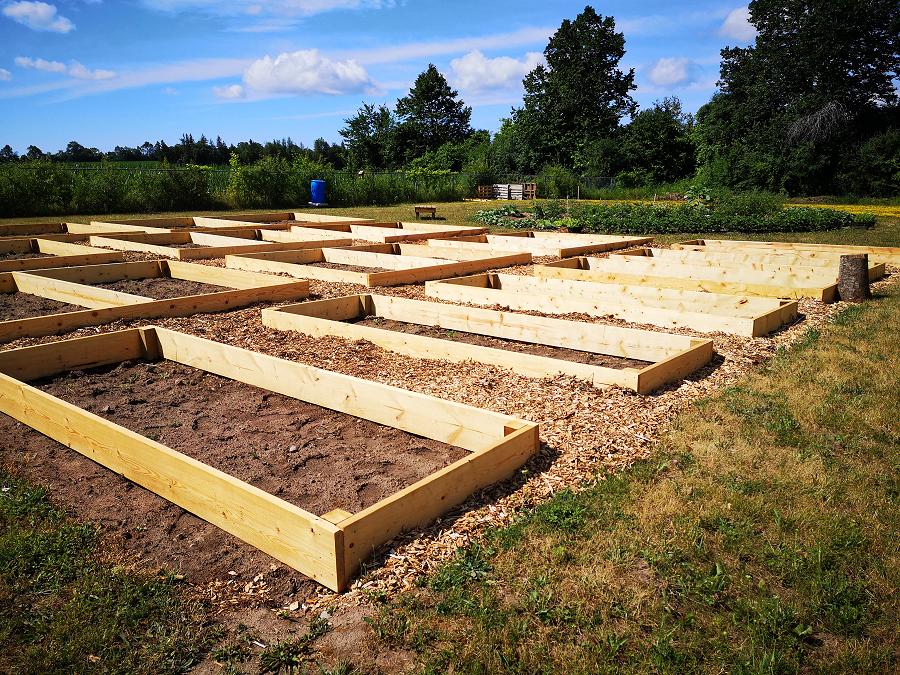
Sheet Seven Community Garden, located behind the Peterborough Curling Club at 2195 Lansdowne Street West, in July 2020 with raised garden beds under construction. Allotment plots of various sizes are now available with annual fees from $35 to $125 depending on the size. (Photo courtesy of Pauline Orpwood / Peterborough Curling Club)
Peterborough’s newest community garden, the Sheet Seven Community Garden located behind the Peterborough Curling Club at 2195 Lansdowne Street West, will be hosting its first community gardeners beginning in May.
The garden was conceived in spring 2020 by Emilie Metcalfe, an assistant ice technician at the Peterborough Curling Club, after the pandemic forced the club to close its doors for the season.
Seeing the potential in the large expanse of unused lawn behind the club’s building, Metcalfe proposed an idea to the club’s board of directors: use the lawn to create a space for members to gather in the curling off-season to foster community as well as to teach about sustainability and growing your own food.
Advertisement - content continues below
With the board’s approval and support, within weeks Metcalfe — now the coordinator of Sheet Seven — and many volunteers transformed part of the lawn into a circular garden, designed to look like a curling house.
During the 2020 growing season, that first test garden produced flowers, russet potatoes, pickling cucumbers, slicing cucumbers, butternut squash, pie pumpkins, carrots, beets, zucchini, delicata squash, slicing tomatoes, paste tomatoes, cherry tomatoes, radishes, bush beans, Lincoln peas, sugar snap peas, kale, kohlrabi, onions, spinach, and lettuces.
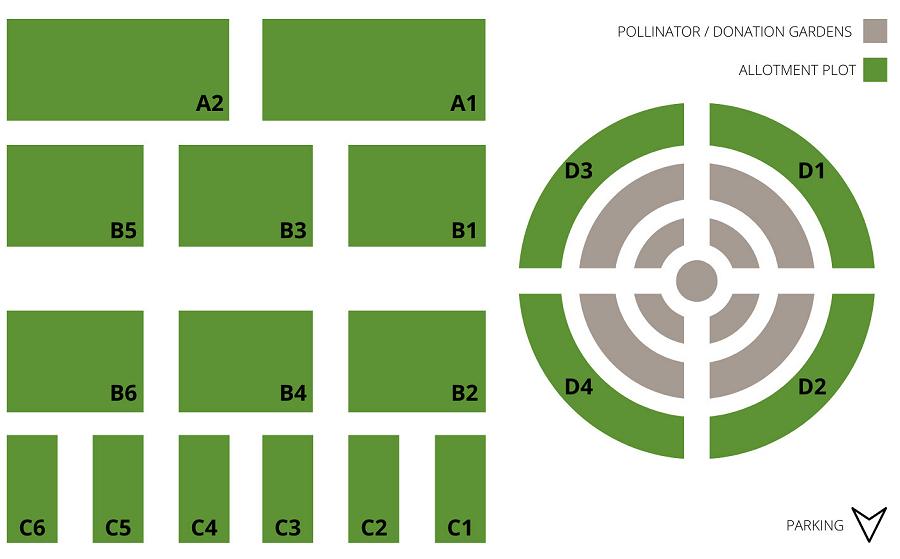
In July 2020, volunteers expanded the community garden to include raised garden beds. Now, 18 plots of varying sizes — from small at 4′ x 12′ to large at 12′ x 20′ — are available for lease. This includes four quarter plots in the original “curling house” garden (the remainder will be used for pollinator and donation gardens).
Allotment plots available for lease at the Sheet Seven Community Garden, located behind the Peterborough Curling Club at 2195 Lansdowne Street West. (Graphic: Sheet Seven Community Garden)
To raise funds for the ongoing maintenance of the community garden, Sheet Seven has also launched a rain barrel sale. The rain barrels are reclaimed food grade barrels once used to transport fruits and vegetables that have been repurposed and refitted as rain barrels.
Rain barrel orders can be placed before Saturday, April 17th at rainbarrel.ca/sevencommunitygarden/. The barrels can be picked up from 10 a.m. to 1 p.m. on Saturday, April 24th at the Peterborough Curling Club. Optional home delivery to Peterborough residents is also available after April 24th.
Raised gardens under construction in July 2020 at Sheet Seven Community Garden, located behind the Peterborough Curling Club at 2195 Lansdowne Street West. Sheet Seven is now accepting applications for leasing allotment plots at the community garden for the 2021 growing season. (Photo courtesy of Pauline Orpwood / Peterborough Curling Club)
Peterborough residents who want to know when they become eligible for a COVID-19 vaccine can now sign up with Peterborough Public Health to be notified by e-mail.
You can visit www.peterboroughpublichealth.ca/notifyme to submit your email address and select one of more groups you wish to be notified about once vaccination clinics are open to them. You can select by age group, as well as by a specific chronic health condition.
“Details are still being finalized on how to best vaccinate residents with the chronic health conditions identified by the Ontario Government in its Phase 2 vaccination plan,” says Brittany Cadence, communications manager with Peterborough Public Health. “By signing up with ‘Notify Me’, we will be able to provide tailored information in our notifications to those who fall into the various health categories once it becomes available.”
Advertisement - content continues below
Essential caregivers, those who live or work in congregate settings, and essential frontline workers who cannot work for home can also choose to be notified. You can sign up for notifications for more than one group.
When local clinics and healthcare providers are ready to serve a selected group, Peterborough Public Health will send an email notification to those on the mailing list for that group explaining how to book a vaccination appointment.
“With a rapidly changing vaccine distribution plan and other Ontario regions opening up eligibility for different groups at different times, it can be confusing to know when it’s your turn to book an appointment,” Cadence adds. “By simply providing us with your email address, we hope to provide peace of mind to residents by leaving it with us to contact them directly once the groups they’ve selected become eligible to book a COVID-19 vaccine appointment.”
According to the health unit, all email addresses gathered through the ‘Notify Me’ form will be stored securely until use and then deleted after the final notification is issued once Phase 3 vaccinations begin.
The ‘Notify Me’ system is only available through email, and the health unit is encouraging residents without an email address to ask a loved one with an email address to sign up on their behalf.
Some of the 13,560 pounds of food collected for Kawartha Food Share in October 2020 during the "Spare a Square #2" food drive. The shelves at Kawartha Food Share need to be retocked, and the organizers behind "Spare a Square" are back for 2021 with a business-to-business challenge to collect at least 20,000 pounds of food on Friday, April 9th, followed by a Peterborough-wide porch food drive on Saturday, April 10th. (Photo: Kawartha Food Share / Facebook)
On Saturday, April 10th, volunteers with Kawartha Food Share are turning the phrase “porch pirate” into a good thing with a Peterborough-wide spring porch food drive.
Starting at 9 a.m. on April 10th, city residents are asked to leave a bag of non-perishable food items on their front porch to be picked up by ‘Porch Pirates for Good’ volunteers.
“The shelves at Kawartha Food Share are low again and they need the help of the community to restock,” reads a media release from Megan Murphy, who helped organize two ‘Spare a Square’ porch food drives in 2020 that collected 41,267 pounds of food and more than $5,000 in monetary donations for Kawartha Food Share.
Advertisement - content continues below
COVID-masked volunteers will drive around the city in their own vehicles to collect the items and deliver them to the Kawartha Food Share warehouse. There will be no face-to-face contact between those donating and those picking up and, if you are ill, you are asked to refrain from donating.
Those who are ill or who can’t donate food items can also help by making a monetary donation at kawarthafoodshare.com/donations.html. For every $1 donated, Kawartha Food Share can purchase up to $6 worth of food.
In addition to the community porch food drive on Saturday, organizers are also asking Peterborough businesses to challenge each other to see if they can collectively raise a “bounty” for Kawartha Food Share by donating more than 20,000 pounds of food on Friday, April 9th alone.
Kawartha Food Share volunteers Susan Dunkley and Anne Arnold picking up a food donation from kawarthaNOW in October 2020. Peterborough businesses that want to participate in the April 9th business-to-business food drive challenge can register with Susan by email or using an online form. (Photo: Jeannine Taylor / kawarthaNOW)
Businesses interested in participating can register by emailing Susan Dunkley at susan@suzihomemaker.ca or by completing a Google Docs form. Business pick-ups will take place from 10:30 a.m. to 3 p.m. on Friday, April 9th.
“Porch Pirates for Good” will be collecting donated non-perishable food items for Kawartha Food Share from porches across the City of Peterborough on Saturday, April 10th. (Poster: Porch Pirates for Good)
For both food drives, the items most needed for the shelves at Kawartha Food Share are canned tuna, pasta and pasta sauce, easy-to-make food that kids like (including Alphagetti, Kraft Dinner, and Chef Boyardee, breakfast cereal, peanut butter, non-perishable fruit and vegetable items, rice, canned soup or stew, feminine hygiene products, and baby formula.
On average, 8,700 people are using food banks every month in the city and county of Peterborough. At times throughout the pandemic, there has been a 20 per cent increase of food bank use — including by precarious workers who have lost hours and are relying on food banks for support more frequently.
kawarthaNOW.com offers two enews options to help readers stay in the know. Our VIP enews is delivered weekly every Wednesday morning and includes exclusive giveaways, and our news digest is delivered daily every morning. You can subscribe to one or both.
Submit your event for FREE!
Use our event submission form to post your event on our website — for free.
To submit editorial content or ideas, please contact us.