
















Home Blog Page 636

Ontario reports 1,076 new COVID-19 cases, including 6 in greater Kawarthas region

Here’s an update on COVID-19 cases in Ontario as well as in the greater Kawarthas region.

Today, Ontario is reporting 1,076 new cases. However, this total includes only 361 new cases for Toronto, due to a data error from Toronto Public Health’s migration to Ontario’s Contact and Case Management system. Toronto Public Health’s actual case count for February 11 as reported on its website is 546, meaning the actual provincial case count today would be 1,261.

Today’s new cases include 39 more cases of the more contagious B.1.1.7 UK variant. The seven-day average of new cases has decreased by 84 to 1,189, although this average is based on the under-reported case count in Toronto.

In the greater Kawarthas region, there are 6 new cases to report and 13 additional cases resolved, with the number of active cases across the region increasing by 9 to 98. There has been 1 new COVID-related death in Kawartha Lakes.

Advertisement - content continues below


Most of today’s new cases are in Toronto (361), Peel (210), and York (122) — although the actual case count reported by Toronto Public Health today is 546.

There are double-digit increases in Waterloo (59), Ottawa (52), Durham (31), Halton (31), Hamilton (30), Simcoe Muskoka (24), Thunder Bay (22), Windsor-Essex (18), Niagara (17), Wellington-Dufferin-Guelph (17), Brant (13), Lambton (11), and Southwestern (11), with smaller increases in Haliburton, Kawartha, Pine Ridge (9), Middlesex-London (7), Sudbury (6), and Eastern Ontario (6).

The remaining 14 health units are reporting 5 or fewer new cases, with 6 health units reporting no new cases at all.

Of today’s new cases, 52% are among people 40 and older, with the highest number of cases (369) among people ages 40-59, followed by 346 cases among people ages 20-39. This is the first day during the second wave that cases in the 40-59 age group have exceeded those in the 20-39 age group.

With 1,415 more cases resolved since yesterday, the percentage of resolved cases has increased by 0.2% to 93.3%. The average positivity rate across Ontario has decreased by 0.1% to 2.2%, meaning that 22 out of every 1,000 tests performed were positive for COVID-19 on February 11.

Ontario is reporting 18 new COVID-19 deaths today, including 8 in long-term care homes. Ontario has averaged 28 new daily deaths over the past week.

Hospitalizations have decreased by 120 from yesterday to 763, with the number of patients with COVID-19 in ICUs decreasing by 4 to 295 and the number of patients with COVID-19 on ventilators decreasing by 7 to 204.

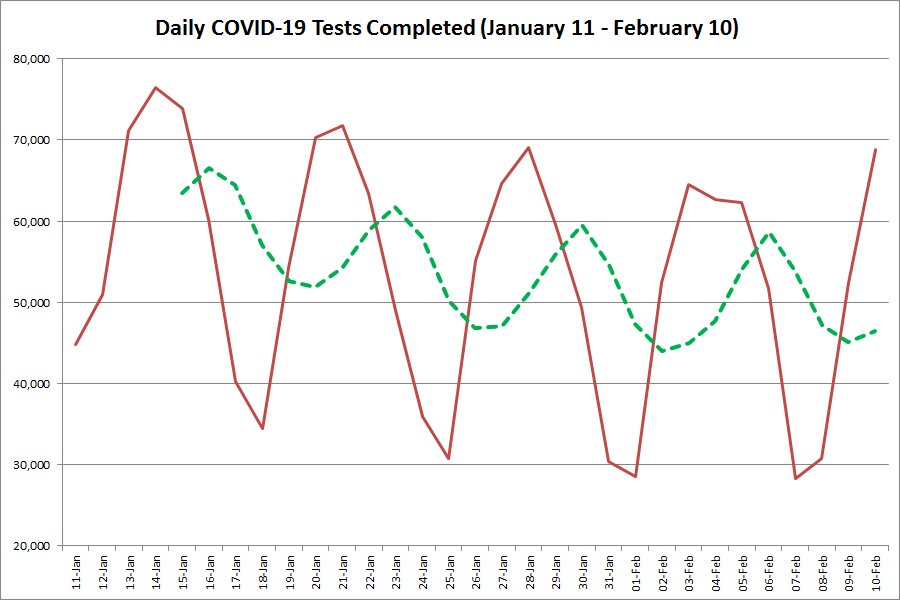
A total of 62,012 tests were completed yesterday, with the backlog of tests under investigation decreasing by 5,038 to 38,345.

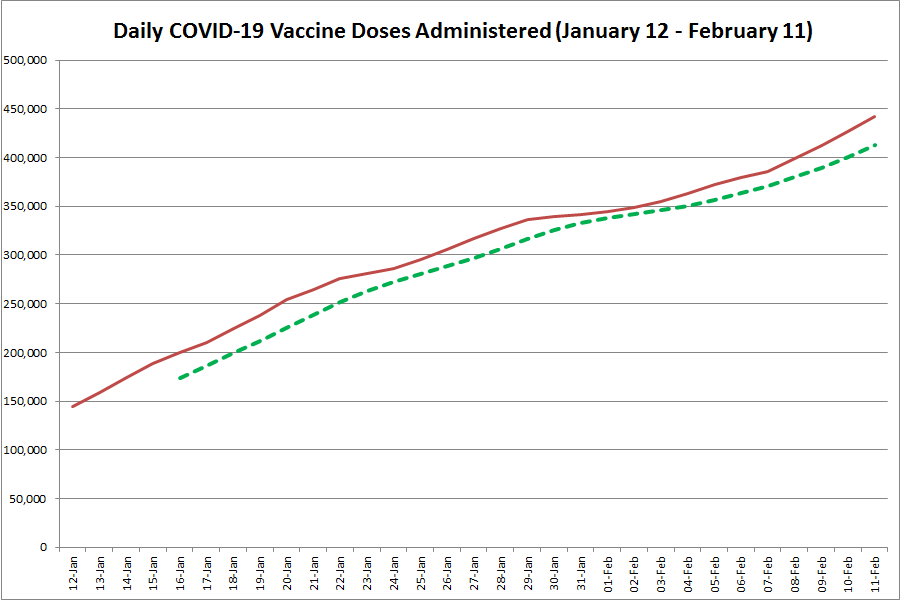
A total of 442,441 doses of vaccine have now been administered, an increase of 15,605 from yesterday, with 151,282 people fully vaccinated with both doses of vaccine, an increase of 14,294 from yesterday.

There are 31 new cases in Ontario schools, an increase of 2 from yesterday, including 24 student cases and 7 staff cases. There are 16 new cases in licensed child care settings in Ontario, no change from yesterday, with 12 cases among children and 4 cases among staff.

Advertisement - content continues below


In the greater Kawarthas region, there are 6 new cases to report, including 3 in Hastings Prince Edward, 2 in Northumberland, and 1 in Kawartha Lakes. There are no new cases in Peterborough or Haliburton.

There has been 1 new COVID-related death in Kawartha Lakes.

An additional 13 cases have been resolved, including 7 in Kawartha Lakes, 3 in Northumberland, 2 in Peterborough, and 1 in Hastings Prince Edward.

There are currently 98 active cases in the greater Kawarthas region, a decrease of 9 from yesterday, including 43 in Kawartha Lakes, 24 in Northumberland, 15 in Hastings Prince Edward (3 in Quinte West, 8 in Belleville, 1 in Tyendinaga & Deseronto, and 3 in Tyendinga Mohawk Territory), 14 in Peterborough, and 2 in Haliburton.

Since the pandemic began in the greater Kawarthas region, there have been 565 confirmed positive cases in the Peterborough area (542 resolved with 9 deaths), 503 in the City of Kawartha Lakes (422 resolved with 51 deaths), 402 in Northumberland County (369 resolved with 9 deaths), 52 in Haliburton County (50 resolved with no deaths), and 384 in Hastings and Prince Edward counties (364 resolved with 5 deaths). The most recent death was reported in Kawartha Lakes on February 12.

The provincial data in this report is pulled from Ontario’s integrated Public Health Information System (iPHIS) at 12 p.m. the previous day. Data from local health units is more current and is usually reflected in the provincial data the following day. There may be discrepancies between the Ontario data reported today (which is from yesterday) and the local health unit data reported today (which is from today).

Advertisement - content continues below


Peterborough Public Health

Peterborough Public Health’s service area is the City and County of Peterborough and the Hiawatha and Curve Lake First Nations.

The health unit provides daily reports, including on weekends, excluding statutory holidays.

Confirmed positive: 565 (no change)
Active cases: 14 (decrease of 2)
Close contacts: 54 (decrease of 10)
Deaths: 9 (no change)
Resolved: 542 (increase of 2)
Hospitalizations (total to date): 24 (no change)*
Total tests completed: Over 42,300 (increase of 100)
Outbreaks: Peterborough Regional Health Centre, Peterborough Retirement Residence (no change)
Vaccine doses administered: 976 (as of February 12)

*As of February 12, Peterborough Regional Health Centre is reporting 3 patients hospitalized with COVID-19 (no change from yesterday) and 17 patients transferred from other areas as a result of a provincial directive (no change from yesterday).


Haliburton, Kawartha, Pine Ridge District Health Unit

The Haliburton, Kawartha, Pine Ridge District Health Unit’s service area is the City of Kawartha Lakes, Northumberland County, and Haliburton County.

The health unit provides reports from Monday to Saturday, excluding Sundays and statutory holidays.

Confirmed positive: 957, including 503 in Kawartha Lakes, 402 in Northumberland, and 52 in Haliburton (increase of 3, including 1 in Kawartha Lakes and 2 in Northumberland)*
Active cases: 69, including 43 in Kawartha Lakes, 24 in Northumberland, and 2 in Haliburton (decrease of 9, including 7 in Kawartha Lakes and 2 in Northumberland)
Probable cases: 3, including 2 in Northumberland and 1 in Kawartha Lakes (no change)
High-risk contacts: 236, including 119 in Kawartha Lakes, 86 in Northumberland, and 4 in Haliburton (net increase of 23)**
Hospitalizations (total to date): 38, including 26 in Kawartha Lakes, 10 in Northumberland, and 2 in Haliburton (no change)***
Deaths (including among probable cases): 60, including 51 in Kawartha Lakes and 9 in Northumberland (increase of 1 in Kawartha Lakes)
Resolved: 841, including 422 in Kawartha Lakes, 369 in Northumberland, 50 in Haliburton (increase of 10, including 7 in Kawartha Lakes and 3 in Northumberland)
Tests completed: 132,895 (increase of 726)
Institutional outbreaks: Caressant Care McLaughlin Road long-term care home in Lindsay, Central East Correctional Centre in Lindsay (two outbreaks), Regency long-term care home in Port Hope, Hyland Crest long-term care home in Minden, Extendicare Cobourg long-term care home, Extendicare Cobourg Landmark retirement home, Pinecrest Nursing Home in Bobcaygeon, Cobourg Police (no change)

*The health unit states that total counts and counts for individual counties may fluctuate from previously reported counts as cases are transferred to or from the health unit based on case investigation details and routine data cleaning.

**This total includes an additional 27 high-risk contacts directly followed up through the Public Health Ontario contact tracing process that are missing the contacts’ county.

***As of February 12, Ross Memorial Hospital in Lindsay reports 1 patient is hospitalized with COVID-19 (no change since yesterday).


Hastings Prince Edward Public Health

Hastings Prince Edward Public Health’s service area is Hastings County (including Bancroft) and Prince Edward County.

The health unit provides daily reports, including on weekends, excluding statutory holidays.

Confirmed positive: 384 (increase of 3)
Active cases: 15 (increase of 2)
Deaths: 5 (no change)
Currently hospitalized: 0 (no change)
Currently hospitalized and in ICU: 0 (no change)
Currently hospitalized and in ICU on ventilator (total to date): 0 (no change)
Resolved: 364 (increase of 1)
Tests completed: 50,958 (increase of 19)
Vaccines administered: 1,301 (increase of 205)
Institutional outbreaks: None (no change)

Advertisement - content continues below


Province of Ontario

Confirmed positive: 283,587 (increase of 1,076)*
7-day average of new cases: 1,180 (decrease of 84)*
Resolved: 264,459 (increase of 1,415, 93.3% of all cases)
Positivity rate: 2.2% (decrease of 0.1%)
Hospitalizations: 763 (decrease of 120)
Hospitalizations in ICU: 295 (decrease of 4)
Hospitalizations in ICU on ventilator: 204 (decrease of 7)
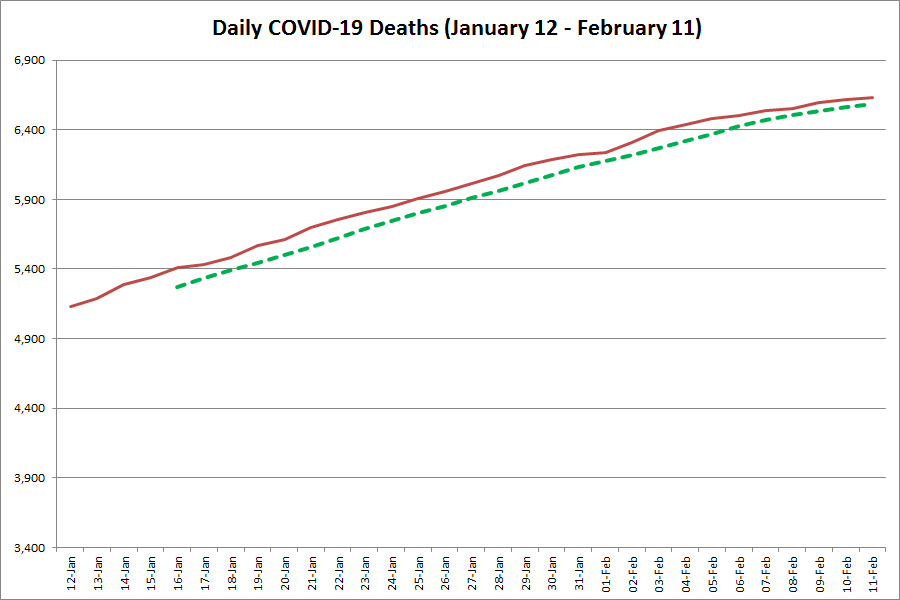
Deaths: 6,632 (increase of 18)
Deaths of residents in long-term care homes: 3,777 (increase of 8)
Total tests completed: 10,268,451 (increase of 62,012)
Tests under investigation: 38,345 (decrease of 5,038)
Vaccination doses administered: 442,441 (increase of 15,605)
People fully vaccinated (two doses): 151,282 (increase of 14,294)
Total COVID-19 variant cases: 275 of B.1.1.7 UK variant (increase of 39); 3 of B.1.351 South Africa variant (no change); 1 of P.1 Brazilian variant (no change)**

*Due to Toronto Public Health’s migration to Ontario’s Contact and Case Management system, 361 new cases for Toronto are included in this report. Toronto Public Health’s actual case count for February 11 as reported on its website is 546, meaning the actual provincial case count today would be 1,261.

**Toronto Public Health reported a confirmed case of the P.1 Brazilian variant on February 8. This case is not yet included in the provincial data.

COVID-19 cases in Ontario from January 12 - February 11, 2021. The red line is the number of new cases reported daily, and the dotted green line is a five-day moving average of new cases. (Graphic: kawarthaNOW.com)
COVID-19 cases in Ontario from January 12 – February 11, 2021. The red line is the number of new cases reported daily, and the dotted green line is a five-day moving average of new cases. (Graphic: kawarthaNOW.com)
COVID-19 tests completed in Ontario from January 12 - February 11, 2021. The red line is the number of tests completed daily, and the dotted green line is a five-day moving average of tests completed. (Graphic: kawarthaNOW.com)
COVID-19 tests completed in Ontario from January 12 – February 11, 2021. The red line is the number of tests completed daily, and the dotted green line is a five-day moving average of tests completed. (Graphic: kawarthaNOW.com)
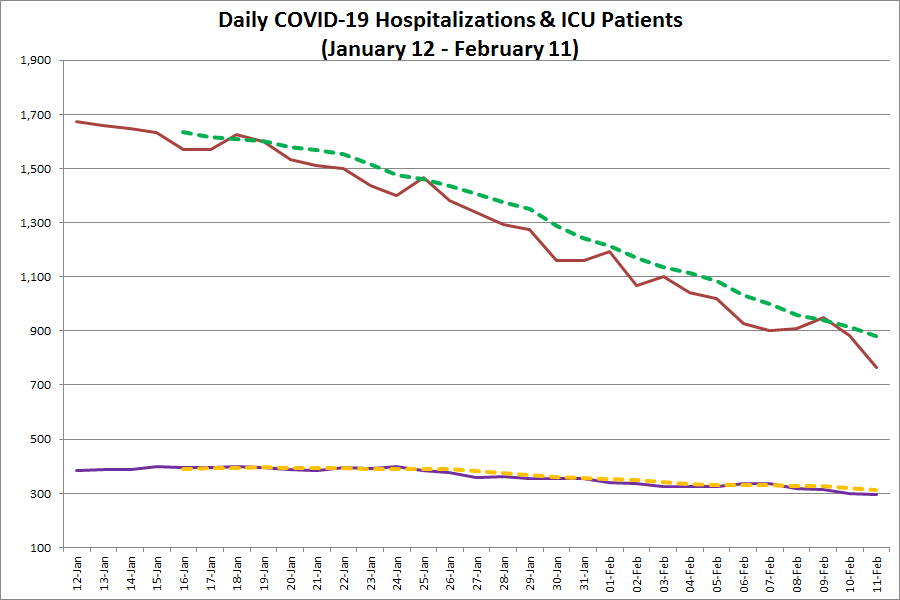
COVID-19 hospitalizations and ICU admissions in Ontario from January 12 - February 11, 2021. The red line is the daily number of COVID-19 hospitalizations, the dotted green line is a five-day moving average of hospitalizations, the purple line is the daily number of patients with COVID-19 in ICUs, and the dotted orange line is a five-day moving average of is a five-day moving average of patients with COVID-19 in ICUs. (Graphic: kawarthaNOW.com)
COVID-19 hospitalizations and ICU admissions in Ontario from January 12 – February 11, 2021. The red line is the daily number of COVID-19 hospitalizations, the dotted green line is a five-day moving average of hospitalizations, the purple line is the daily number of patients with COVID-19 in ICUs, and the dotted orange line is a five-day moving average of is a five-day moving average of patients with COVID-19 in ICUs. (Graphic: kawarthaNOW.com)
COVID-19 deaths in Ontario from January 12 - February 11, 2021. The red line is the cumulative number of daily deaths, and the dotted green line is a five-day moving average of daily deaths. (Graphic: kawarthaNOW.com)
COVID-19 deaths in Ontario from January 12 – February 11, 2021. The red line is the cumulative number of daily deaths, and the dotted green line is a five-day moving average of daily deaths. (Graphic: kawarthaNOW.com)
COVID-19 vaccine doses administered in Ontario from January 12 - February 11, 2021. The red line is the cumulative number of daily doses administered, and the dotted green line is a five-day moving average of daily doses. (Graphic: kawarthaNOW.com)
COVID-19 vaccine doses administered in Ontario from January 12 – February 11, 2021. The red line is the cumulative number of daily doses administered, and the dotted green line is a five-day moving average of daily doses. (Graphic: kawarthaNOW.com)


For more information about COVID-19 in Ontario, visit covid-19.ontario.ca.

Ontario announces colour-coded levels for 27 public health unit regions

As well as in-person shopping and personal care services, in-person dining will once again be allowed in Peterborough, Kawartha Lakes, Northumberland, and Haliburton as of February 16, 2021. Restrictions will be tighter in Kawartha Lakes, Northumberland, and Haliburton than in Peterborough as Haliburton, Kawartha, Pine Ridge District Health Unit will be in the more restrictive "Orange-Restrict" level, while Peterborough Public Health moves into "Yellow-Protect". (Stock photo)

The Ontario government has announced the 27 public health unit regions that are returning to the colour-coded COVID-19 response framework effective at 12:01 a.m. on Tuesday (February 16).

In the greater Kawarthas region, Haliburton, Kawartha, Pine Ridge District Health Unit will move into the “Orange-Restrict” level and Peterborough Public Health will move into the “Yellow-Protect”.

The Hastings Prince Edward Health Unit was one of three health units — along with Kingston, Frontenac and Lennox & Addington Public Health, and Renfrew County and District Health Unit — already moved into the least-restrictive “Green-Prevent” level effective on Wednesday (February 10), following an announcement at the beginning of the week.

Advertisement - content continues below


Only one of the 27 health unit regions, Niagara, is moving into the most restrictive “Grey-Lockdown” level.

Four health unit regions — Toronto Public Health, Peel Public Health, York Region Public Health, and North Bay Parry Sound District — will remain in the provincial shutdown announced on Boxing Day, with the stay-at-home order still in effect, until at least Monday, February 22nd.

“While we are cautiously and gradually transitioning some regions out of shutdown, with the risk of new variants this is not a reopening or a return to normal,” said health minister Christine Elliott. “Until vaccines are widely available, it remains critical that all individuals and families continue to adhere to public health measures and stay home as much as possible to protect themselves, their loved ones, and their communities.”

After returning to the COVID-19 response framework, each public health unit region will stay in its colour-coded level for at least two weeks, at which time the government will assess the impact of public health and workplace safety measures to determine if the region should stay where it is or be moved to a less restrictive or more restrictive level.

Here’s the full list of the 27 public health regions and their colour-coded level effective February 16:

Grey-Lockdown:

  • Niagara Region Public Health

Red-Control:

  • Chatham-Kent Public Health
  • City of Hamilton Public Health Services
  • Durham Region Health Department
  • Halton Region Public Health
  • Middlesex-London Health Unit
  • Region of Waterloo Public Health and Emergency Services
  • Simcoe-Muskoka District Health Unit
  • Southwestern Public Health
  • Thunder Bay District Health Unit
  • Wellington-Dufferin Guelph Public Health
  • Windsor-Essex County Health Unit

Orange-Restrict:

  • Brant County Health Unit
  • Eastern Ontario Health Unit
  • Haldimand-Norfolk Health Unit
  • Haliburton, Kawartha, Pine Ridge District Health Unit
  • Huron Perth Public Health
  • Lambton Public Health
  • Ottawa Public Health
  • Porcupine Health Unit
  • Public Health Sudbury and Districts

Yellow-Protect:

  • Algoma Public Health
  • Grey Bruce Health Unit
  • Northwestern Health Unit
  • Peterborough Public Health

Green-Prevent:

  • Leeds, Grenville and Lanark District Health Unit
  • Timiskaming Health Unit
Advertisement - content continues below


As noted, Haliburton, Kawartha, Pine Ridge District Health Unit will move into the “Orange-Restrict” level and Peterborough Public Health will move into the “Yellow-Protect”.

In both these levels, in-person shopping at retail stores and malls and in-person dining at restaurants is once again allowed, with public health restrictions in place including capacity limits. Personal care services, cinemas, performing arts facilities, and sports and recreational facilities can also reopen, also with public health restrictions in place.

There are some differences between the two levels. For example, six people can be seated together in restaurants in “Yellow-Protect” but only four people can be seated together in “Orange-Restrict”, and bars and restaurants are not allowed to stay open as long in “Orange-Restrict”. In “Orange-Restrict”, personal care services that require the removal of face coverings are prohibited.

For a complete listing of what’s allowed in each colour-coded level, visit ontario.ca/page/covid-19-response-framework-keeping-ontario-safe-and-open/.

Black Lives Matter Nogojiwanong seeking submissions from Black and Indigenous artists

Black Lives Matter Nogojiwanong is seeking works from local Black and Indigenous artists to be showcased at the virtual Black History Blowout event on February 27, 2021, at which the recipient of the annual Charlie Earle Micro Grant will also be announced. The grant is named in honour of the late Charlene "Charlie" Earle (pictured in April 2014), a local Black musician and artist who passed away suddenly in July 2019. (Photo: Esther Vincent / evmustang.ca)

Even during a global pandemic when gathering and organizing has been next to impossible, the Peterborough chapter of the Black Lives Matter organization — Black Lives Matter Nogojiwanong (BLM Nogo) — has been busy organizing, community building and, most recently, providing opportunities for both Black and Indigenous artists.

BLM Nogo has launched an open call for proposals, seeking both visual and performance submissions from Black and Indigenous artists in celebration of Black History Month. Proposals will be accepted until Monday, February 15th.

The organization will award honorariums for accepted proposals to compensate participating artists for their time. The total amount awarded to each artist will be determined based on the number of applications the organization receives.

Advertisement - content continues below


While the artistic submissions will be showcased as a part of Black History Blowout, an online celebration of Black History Month taking place at the end of February, the board of directors of BLM Nogo made the decision to open the call for proposals to Indigenous artists as well as Black artists.

“There’s a longstanding history of Black and Indigenous folk being mistreated in very similar ways,” explains Said Jiddawy, local artist, activist, and BLM Nogo board member.

“Even though our struggles aren’t exactly the same, they’re very similar. We know that we live in the same world of oppression. That’s why we wanted to include both minority groups.”

In recognition of the oppression experience by Indigenous people, Black Lives Matter Nogojiwanong is accepting submissions from both Black and Indigenous artists and performers for the virtual Black History Blowout event. The deadline for submissions is February 15, 2021.  (Graphic: Black Lives Matter Nogojiwanong)
In recognition of the oppression experience by Indigenous people, Black Lives Matter Nogojiwanong is accepting submissions from both Black and Indigenous artists and performers for the virtual Black History Blowout event. The deadline for submissions is February 15, 2021. (Graphic: Black Lives Matter Nogojiwanong)

Prerecorded performance submissions — ranging from 30 seconds to 10 minutes — by Black and Indigenous singers, dancers, musicians, performers of any discipline (theatre, drag, circus, and more), poets, storytellers, and filmmakers will be accepted.

The submissions will be featured on Saturday, February 27th at the live online event Black History Blowout, presented by BLM Nogo with funding from the Trent Centre for Women and Trans People.

Visual submissions of multi-disciplinary works from artisans, painters, photographers, sculptures, writers. and more will be included in “BHM ArtZine 2021”, a digital magazine that will be available for purchase by donation, with printed versions gifted to each contributing artist.

Advertisement - content continues below


“I wanted to put together a little magazine to showcase Black artists,” Jiddawy says. “To have something to say ‘Hey, we’re here. We exist. This is the kind of art that we do.’ It’s so exciting.”

The open call for proposals provides a wonderful opportunity for Black and Indigenous artists to connect with their audiences and to have their work showcased. This opportunity is particularly valuable for emerging artists looking to build their CVs (an abbreviation for Curriculum Vitae, an artist’s resume).

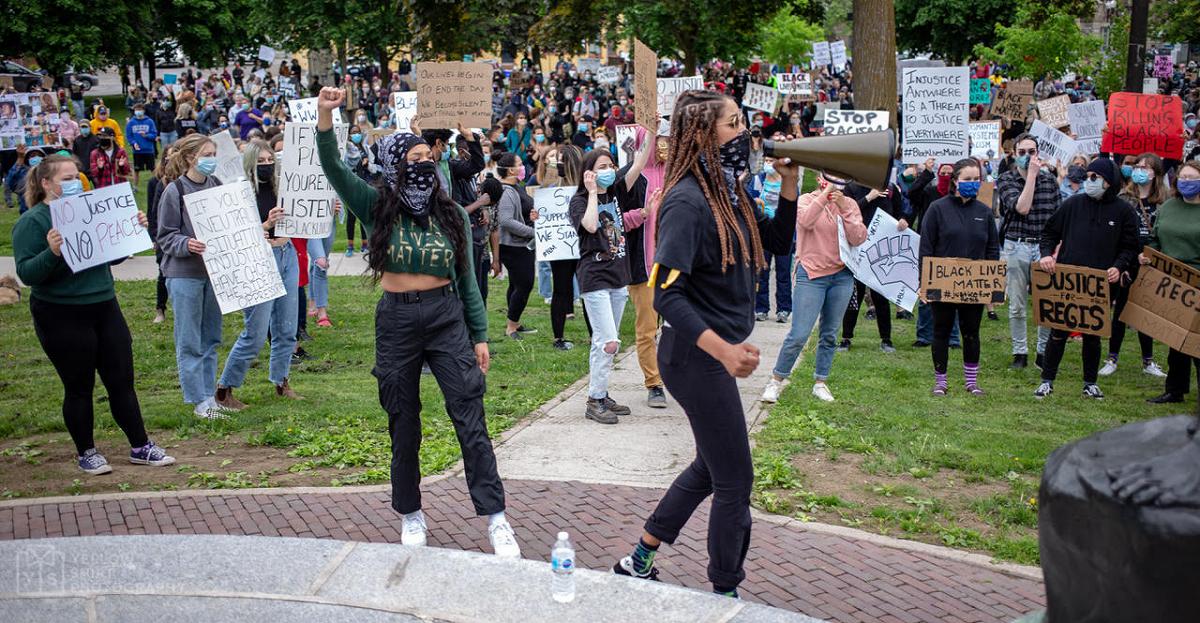
The open call and the digital event also provide a safe, online opportunity for gathering and community building to occur, which BLM Nogo’s board has been working hard to facilitate since the immensely successful, COVID-safe march in June 2020 the organization led in Peterborough/Nogojiwanong in response to the police brutality that led to the deaths of George Floyd and Regis Korchinski-Paquet last year.

Said Jiddawy, pictured at the Black Lives Matter march in Peterborough in June 2020, is a local artist, activist, and member of the Black Lives Matter Nogojiwanong board. (Photo courtesy of Black Lives Matter Nogojiwanong)

“It’s hard because there’s so many things that we wanted to do and it makes it more difficult as we can’t meet in person,” says Shaela Abbott-McLeod, activist, Trent Arthur journalist, podcaster, and BLM Nogo board member.

“It’s really difficult to do things with COVID, but we’re doing the best that we can,” she adds. “We’ve hosted direct digital action events, where we educated the community on important topics and helped them to email and call their elected officials. We’ve hosted movie screenings with Q&As with the directors afterwards. We’ve also hosted talks and interviews with prominent black figures.”

“The pandemic is really limiting what we can do, but it also works well because we are able to do a bunch of these online events and reach people who are farther away and wouldn’t otherwise be able to join. We’re also just trying to find these fun ways we can get people engaged and involved.”

Advertisement - content continues below


“Black voices and black people have typically been understood through their suffering,” says Shaela’s sister Alicia Abbott-McLeod, also an activist, podcaster, and BLM Nogo board member. “It is so essential for us to also be uplifting Black voices without the suffering. The fact that this event is happening without the tragedy is, I think, something really important to touch on.”

In addition to their activism with BLM Nogojiwanong and full-time studies at Trent and York Universities, respectively, Shaela and Alicia Abbott-McLeod host a podcast in collaboration with BLM Nogo and Arthur, Trent University’s student-run newspaper.

The podcast, “Black Girls Chatter”, discusses topics ranging from personal stories to Black history and education. It’s available most major podcast platforms and can be streamed online at anchor.fm/black-girls-chatter.

Shaela Abbott-McLeod (front left) and Alicia Abbott-McLeod (front right) pictured at the Black Lives Matter march in Peterborough in June 2020. The sisters are both activists, members of the Black Lives Matter Nogojiwanong board, and hosts of the "Black Girls Chatter" podcast produced in collaboration with Black Lives Matter Nogojiwanong and Arthur, Trent University's student-run newspaper. (Photo courtesy of Black Lives Matter Nogojiwanong)
Shaela Abbott-McLeod (front left) and Alicia Abbott-McLeod (front right) pictured at the Black Lives Matter march in Peterborough in June 2020. The sisters are both activists, members of the Black Lives Matter Nogojiwanong board, and hosts of the “Black Girls Chatter” podcast produced in collaboration with Black Lives Matter Nogojiwanong and Arthur, Trent University’s student-run newspaper. (Photo courtesy of Black Lives Matter Nogojiwanong)

“We approach our conversations it in a way that’s more informal so it’s easier for everybody to grasp,” Alicia says. “We take what we’re learning in school or what we’re teaching ourselves and, using our own personal experiences, bring that forward to our listeners to help better educate the community.”

If you are or know of a Black or Indigenous artist whose artistic work would be perfect for Black Lives Matter Nogojiwanong’s open call for proposals, visit blmnogo.com/post/bhm-artist-callout to learn more about how to submit.

The virtual Black History Blowout event takes place on Zoom from 7:30 to 11:30 p.m. on Saturday, February 27th. Tickets are $10 for allies and a discounted $5 for the guests of honour and Black and Indigenous folks, but no one will be turned away due to lack of funds.

Advertisement - content continues below


Tickets are available now at www.eventbrite.ca/e/137999388887.

During the event, BLM Nogo will also be announcing the recipient of the second annual Charlie Earle Micro Grant, awarded to a Black woman or Non-Binary artist. The grant is named in honour of Charlene “Charlie” Earle, a local Black musician and artist who passed away suddenly in July 2019 when she was only 33 years old.

To support the important work BLM Nogo does for our community, you can send a donation via e-transfer to blmnogojiwanong@gmail.com.

Ontario reports 945 new COVID-19 cases, including 17 in greater Kawarthas region

Here’s an update on COVID-19 cases in Ontario as well as in the greater Kawarthas region.

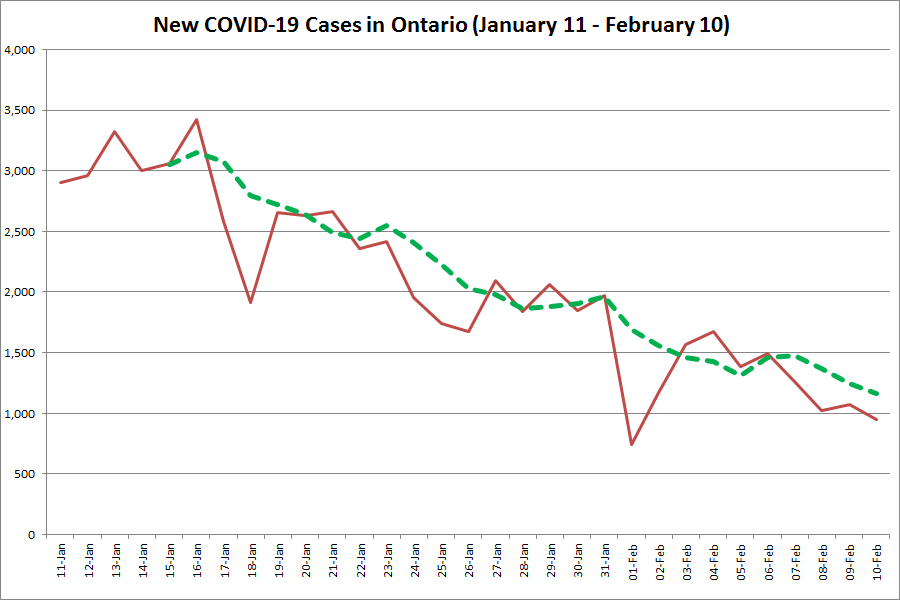
Today, Ontario is reporting 945 new cases. However, this total includes only 112 cases for Toronto, due to a data error from Toronto Public Health’s migration to Ontario’s Contact and Case Management system. Toronto Public Health’s actual case count for February 10 as reported on its website is 411, meaning the actual provincial case count today is 1,244.

Today’s new cases include 8 more cases of the B.1.1.7 UK variant. The seven-day average of new cases has decreased by 109 to 1,264, although this average is based on the under-reported case count in Toronto.

In the greater Kawarthas region, there are 17 new cases to report and 7 additional cases resolved, with the number of active cases across the region increasing by 11 to 107. There have been 2 new COVID-related deaths in Kawartha Lakes.

Advertisement - content continues below


Most of today’s new cases are in Peel (258), York (116), and Toronto (112) — although the actual case count reported by Toronto Public Health today is 411.

There are double-digit increases in Ottawa (63), Hamilton (46), Waterloo (41), Simcoe Muskoka (34), Durham (33), Halton (31), Wellington-Dufferin-Guelph (29), Windsor-Essex (25), Niagara (25), Middlesex-London (20), Eastern Ontario (15), Thunder Bay (12), Sudbury (11), and Southwestern (11), with smaller increases in Lambton (9), Haliburton, Kawartha, Pine Ridge (8), Huron Perth (8), and Chatham-Kent (7).

The remaining 13 health units are reporting 5 or fewer new cases, with 4 health units reporting no new cases at all.

Of today’s new cases, 56% are among people 39 and younger, with the highest number of cases (390) among people ages 20-39, followed by 238 cases among people ages 40-59.

With 1,344 more cases resolved since yesterday, the percentage of resolved cases has increased by 0.2% to 93.1%. The average positivity rate across Ontario has decreased by 0.2% to 2.3%, meaning that 23 out of every 1,000 tests performed were positive for COVID-19 on February 10.

Ontario is reporting 18 new COVID-19 deaths today, including 9 in long-term care homes. Ontario has averaged 32 new daily deaths over the past week.

Hospitalizations have decreased by 65 from yesterday to 883, with the number of patients with COVID-19 in ICUs decreasing by 14 to 299 and the number of patients with COVID-19 on ventilators decreasing by 15 to 211.

A total of 68,812 tests were completed yesterday, with the backlog of tests under investigation increasing by 1,658 to 43,383.

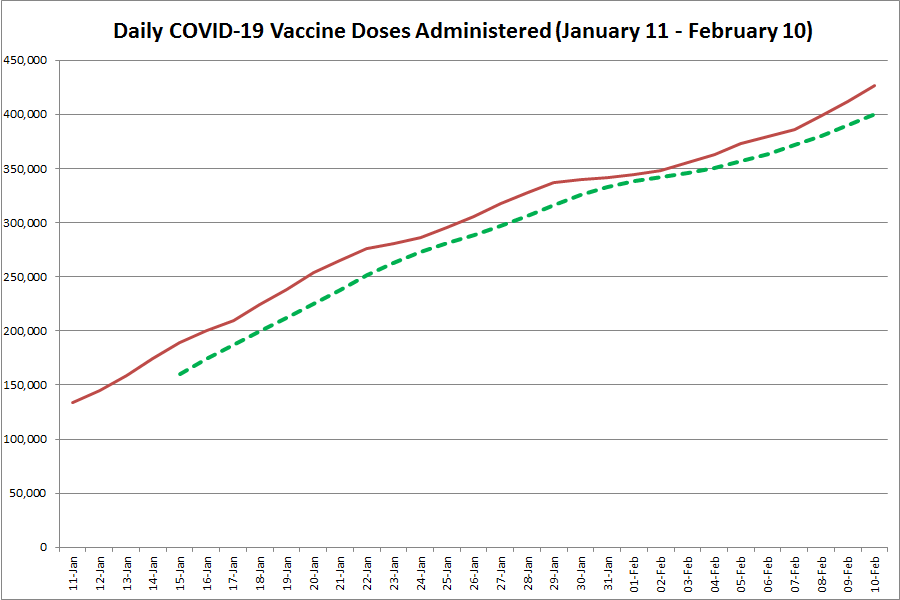
A total of 426,836 doses of vaccine have now been administered, an increase of 14,717 from yesterday, with 136,988 people fully vaccinated with both doses of vaccine, an increase of 11,263 from yesterday.

There are 29 new cases in Ontario schools, a decrease of 2 from yesterday, including 22 student cases and 7 staff cases. There are 16 new cases in licensed child care settings in Ontario, a decrease of 9 from yesterday, with 9 cases among children and 7 cases among staff.

Advertisement - content continues below


In the greater Kawarthas region, there are 17 new cases to report, including 7 in Kawartha Lakes, 4 in Hastings Prince Edward, 3 in Northumberland, 2 in Peterborough, and 1 in Haliburton.

There are 2 new COVID-related deaths in Kawartha Lakes, including another death of a resident at Caressant Care McLaughlin Road in Lindsay, raising the total number of resident deaths to 14 since the current outbreak at the long-term care home was declared on January 9.

There is 1 new hospitalization in Northumberland.

An additional 7 cases have been resolved, including 4 in Northumberland and 3 in Kawartha Lakes.

There are currently 107 active cases in the greater Kawarthas region, an increase of 11 from yesterday, including 50 in Kawartha Lakes, 26 in Northumberland, 16 in Peterborough, 13 in Hastings Prince Edward (3 in Quinte West, 7 in Belleville, and 3 in Tyendinga Mohawk Territory), and 2 in Haliburton.

Since the pandemic began in the greater Kawarthas region, there have been 565 confirmed positive cases in the Peterborough area (540 resolved with 9 deaths), 502 in the City of Kawartha Lakes (415 resolved with 50 deaths), 401 in Northumberland County (366 resolved with 9 deaths), 52 in Haliburton County (50 resolved with no deaths), and 381 in Hastings and Prince Edward counties (363 resolved with 5 deaths). The two most recent deaths were reported in Kawartha Lakes on February 11.

The provincial data in this report is pulled from Ontario’s integrated Public Health Information System (iPHIS) at 12 p.m. the previous day. Data from local health units is more current and is usually reflected in the provincial data the following day. There may be discrepancies between the Ontario data reported today (which is from yesterday) and the local health unit data reported today (which is from today).

Advertisement - content continues below


Peterborough Public Health

Peterborough Public Health’s service area is the City and County of Peterborough and the Hiawatha and Curve Lake First Nations.

The health unit provides daily reports, including on weekends, excluding statutory holidays.

Confirmed positive: 565 (increase of 2)
Active cases: 16 (increase of 2)
Close contacts: 64 (increase of 5)
Deaths: 9 (no change)
Resolved: 540 (no change)
Hospitalizations (total to date): 24 (no change)*
Total tests completed: Over 42,200 (increase of 50)
Outbreaks: Peterborough Regional Health Centre, Peterborough Retirement Residence (no change)
Vaccine doses administered: 976 (as of February 10)

*As of February 11, Peterborough Regional Health Centre is reporting 3 patients hospitalized with COVID-19 (a decrease of 1 from yesterday) and 17 patients transferred from other areas as a result of a provincial directive (an increase of 3 from yesterday).


Haliburton, Kawartha, Pine Ridge District Health Unit

The Haliburton, Kawartha, Pine Ridge District Health Unit’s service area is the City of Kawartha Lakes, Northumberland County, and Haliburton County.

The health unit provides reports from Monday to Saturday, excluding Sundays and statutory holidays.

Confirmed positive: 955, including 502 in Kawartha Lakes, 401 in Northumberland, and 52 in Haliburton (increase of 11, including 7 in Kawartha Lakes, 3 in Northumberland, and 1 in Haliburton)*
Active cases: 78, including 50 in Kawartha Lakes, 26 in Northumberland, and 2 in Haliburton (net increase of 6)
Probable cases: 3, including 2 in Northumberland and 1 in Kawartha Lakes (no change)
High-risk contacts: 213, including 102 in Kawartha Lakes, 89 in Northumberland, and 4 in Haliburton (net increase of 34)**
Hospitalizations (total to date): 38, including 26 in Kawartha Lakes, 10 in Northumberland, and 2 in Haliburton (increase of 1 in Kawartha Lakes)***
Deaths (including among probable cases): 59, including 50 in Kawartha Lakes and 9 in Northumberland (increase of 2 in Kawartha Lakes)
Resolved: 831, including 415 in Kawartha Lakes, 366 in Northumberland, 50 in Haliburton (increase of 7, including 3 in Kawartha Lakes and 4 in Northumberland)
Tests completed: 132,169 (increase of 843)
Institutional outbreaks: Caressant Care McLaughlin Road long-term care home in Lindsay, Central East Correctional Centre in Lindsay (two outbreaks), Regency long-term care home in Port Hope, Hyland Crest long-term care home in Minden, Extendicare Cobourg long-term care home, Extendicare Cobourg Landmark retirement home, Pinecrest Nursing Home in Bobcaygeon, Cobourg Police (no change)

*The health unit states that total counts and counts for individual counties may fluctuate from previously reported counts as cases are transferred to or from the health unit based on case investigation details and routine data cleaning.

**This total includes an additional 16 high-risk contacts directly followed up through the Public Health Ontario contact tracing process that are missing the contacts’ county.

***As of February 11, Ross Memorial Hospital in Lindsay reports 1 patient is hospitalized with COVID-19 (no change since yesterday).


Hastings Prince Edward Public Health

Hastings Prince Edward Public Health’s service area is Hastings County (including Bancroft) and Prince Edward County.

The health unit provides daily reports, including on weekends, excluding statutory holidays.

Confirmed positive: 381 (increase of 4)
Active cases: 13 (increase of 4)
Deaths: 5 (no change)
Currently hospitalized: 0 (no change)
Currently hospitalized and in ICU: 0 (no change)
Currently hospitalized and in ICU on ventilator (total to date): 0 (no change)
Resolved: 363 (no change)
Tests completed: 50,958 (increase of 19)
Vaccines administered: 1,301 (increase of 205)
Institutional outbreaks: None (no change)

Advertisement - content continues below


Province of Ontario

Confirmed positive: 282,511 (increase of 945)*
7-day average of new cases: 1,264 (decrease of 109)*
Resolved: 263,044 (increase of 1,344, 93.1% of all cases)
Positivity rate: 2.3% (decrease of 0.2%)
Hospitalizations: 883 (decrease of 65)
Hospitalizations in ICU: 299 (decrease of 14)
Hospitalizations in ICU on ventilator: 211 (decrease of 15)
Deaths: 6,614 (increase of 18)
Deaths of residents in long-term care homes: 3,769 (increase of 9)
Total tests completed: 10,206,439 (increase of 68,812)
Tests under investigation: 43,383 (increase of 1,658)
Vaccination doses administered: 426,836 (increase of 14,717)
People fully vaccinated (two doses): 136,988 (increase of 11,263)
Total COVID-19 variant cases: 236 of B.1.1.7 UK variant (increase of 8); 3 of B.1.351 South Africa variant (no change); 1 of P.1 Brazilian variant (no change)**

*Due to Toronto Public Health’s migration to Ontario’s Contact and Case Management system, only 112 new cases are included in this report (this data error also affects the 7-day average of new cases). Toronto Public Health’s actual case count for February 10 as reported on its website is 411, meaning the actual provincial case count today is 1,244.

**Toronto Public Health reported a confirmed case of the P.1 Brazilian variant on February 8. This case is not yet included in the provincial data.
COVID-19 cases in Ontario from January 11 - February 10, 2021. The red line is the number of new cases reported daily, and the dotted green line is a five-day moving average of new cases. (Graphic: kawarthaNOW.com)
COVID-19 cases in Ontario from January 11 – February 10, 2021. The red line is the number of new cases reported daily, and the dotted green line is a five-day moving average of new cases. (Graphic: kawarthaNOW.com)
COVID-19 tests completed in Ontario from January 11 - February 10, 2021. The red line is the number of tests completed daily, and the dotted green line is a five-day moving average of tests completed. (Graphic: kawarthaNOW.com)
COVID-19 tests completed in Ontario from January 11 – February 10, 2021. The red line is the number of tests completed daily, and the dotted green line is a five-day moving average of tests completed. (Graphic: kawarthaNOW.com)
COVID-19 hospitalizations and ICU admissions in Ontario from January 11 - February 10, 2021. The red line is the daily number of COVID-19 hospitalizations, the dotted green line is a five-day moving average of hospitalizations, the purple line is the daily number of patients with COVID-19 in ICUs, and the dotted orange line is a five-day moving average of is a five-day moving average of patients with COVID-19 in ICUs. (Graphic: kawarthaNOW.com)
COVID-19 hospitalizations and ICU admissions in Ontario from January 11 – February 10, 2021. The red line is the daily number of COVID-19 hospitalizations, the dotted green line is a five-day moving average of hospitalizations, the purple line is the daily number of patients with COVID-19 in ICUs, and the dotted orange line is a five-day moving average of is a five-day moving average of patients with COVID-19 in ICUs. (Graphic: kawarthaNOW.com)
COVID-19 deaths in Ontario from January 11 - February 10, 2021. The red line is the cumulative number of daily deaths, and the dotted green line is a five-day moving average of daily deaths. (Graphic: kawarthaNOW.com)
COVID-19 deaths in Ontario from January 11 – February 10, 2021. The red line is the cumulative number of daily deaths, and the dotted green line is a five-day moving average of daily deaths. (Graphic: kawarthaNOW.com)
COVID-19 vaccine doses administered in Ontario from January 11 - February 10, 2021. The red line is the cumulative number of daily doses administered, and the dotted green line is a five-day moving average of daily doses. (Graphic: kawarthaNOW.com)
COVID-19 vaccine doses administered in Ontario from January 11 – February 10, 2021. The red line is the cumulative number of daily doses administered, and the dotted green line is a five-day moving average of daily doses. (Graphic: kawarthaNOW.com)


For more information about COVID-19 in Ontario, visit covid-19.ontario.ca.

Ontario government postpones March break until April

The Ontario government has postponed March break from the week of March 15th to the week of April 12th.

“This decision was made with the best advice of Ontario’s Chief Medical Officer of Health and public health officials, including consultations with many local Medical Officers of Health,” reads a statement from education minister Stephen Lecce issued on Thursday afternoon (February 11).

Lecce says the decision to postpone March break was made to “avoid a repeat of the concerning spike in youth-related cases over the winter break” and based upon advice from health experts to help protect against more contagious variants of the COVID-19 virus.

Advertisement - content continues below


“We appreciate the hard work of students and staff in the education sector and I want to be clear: March break is being postponed, not cancelled,” Lecce says.

Leece adds the government is recommending against travel.

“Ontarians should refrain from travelling, particularly given the increase in new variants that pose a direct risk to our country,” he says.

“Please stay at home as much as possible and continue following the direction of public health officials so that we can keep schools open and protect our seniors, frontline health workers, and all families.”

Infant in deadly Kawartha Lakes incident died as a result of being shot by police, SIU confirms

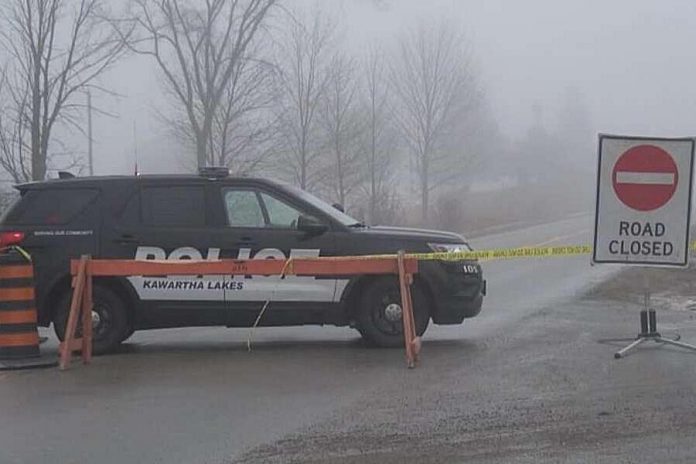
A Kawartha Lakes police vehicle blocks access to Pigeon Lake Road east of Lindsay after a police shooting on November 26, 2020 that resulting in a 33-year-old suspect and an OPP officer being seriously injured. The suspect's one-year-old son was found fatally shot in the man's pickup truck. (Photo: CBC)

Ontario’s police watchdog has confirmed the death of a one-year-old boy during the November 26th confrontation in Kawartha Lakes between police and a 33-year-old man was a result of being shot by police.

The Special Investigations Unit (SIU) issued the confirmation in a news release on Thursday (February 11).

“Upon receipt and review of additional forensic evidence in this case, including the results of the postmortem examination performed on a child, and reports prepared by the Centre of Forensic Sciences of analyses conducted with respect to bloodstains in the pickup truck, the trajectory of shots that struck the truck, and firearms, cartridge cases and projectiles, the SIU can today confirm that the child’s death on November 26, 2020 in Kawartha Lakes was the result of being shot by police,” reads the statement from the SIU.

Advertisement - content continues below


The confirmation comes 11 weeks after the incident in which the boy’s father was also shot by police, later succumbing to his injuries in hospital.

Police had been responding to a report that the man had abducted his son. When they attempted to stop the man’s pick-up truck, it collided with another vehicle and seriously injured an OPP officer.

Police confronted the driver and three officers fired shots at the pick-up truck, injuring the man. The body of the infant was later found in the pick-up truck, along with a handgun. No information has been released on whether the driver brandished or fired the handgun during the incident.

In its previous statement on the incident, issued on January 15, the SIU indicated the three police officers who were directly involved in the incident were yet to be interviewed.

“Subject officers are under no legal obligation to speak with the SIU but may if they choose to do so,” the SIU said at the time.

Today’s statement from the SIU provides no further information on witness interviews or any other details, other than to say the investigation is ongoing.

CBC reports that SIU spokesperson Monica Hudon wrote in an email on Thursday that the three officers have “not as yet availed themselves of an opportunity to be interviewed.”


This story has been updated with more information about the status of the investigation.

Almost $1.4 million in government funding for new community hub in Bancroft

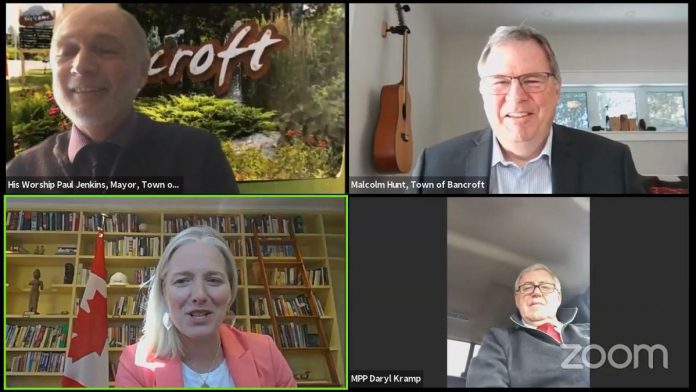
Bancroft mayor Paul Jenkins, the town's strategic planner Malcolm Hunt, federal minister of infrastructure and communities Catherine McKenna, and Hastings-Lennox and Addington MPP Daryl Kramp participate in a virtual announcement of almost $1.4 million in federal and provincial funding for the new North Hastings Community Hub. (Screenshot)

The federal and provincial governments are providing almost $1.4 million in funding for a new community hub in downtown Bancroft, to be constructed on municipally owned property on Cleak Avenue.

The 4,000-square-foot North Hastings Community Hub will be an accessible, three-storey mixed-use building, with space on the ground floor for the North Hastings Public Library. The building will also include 20 affordable housing units on the second and third floors, as well as 30 to 40 public parking spaces.

The funding announcement was made virtually on Thursday (February 11) by Catherine McKenna, the federal minister of infrastructure and communities, Hastings-Lennox and Addington MPP Daryl Kramp on behalf of Ontario infrastructure minister Laurie Scott, and Bancroft mayor Paul Jenkins along with the town’s strategic planner Malcolm Hunt.

Advertisement - content continues below


“We need better public spaces, community spaces that are accessible to everyone, including better libraries,” Minister McKenna said. “They’re at the heart of inclusive, sustainable and welcoming communities where people want to live, work and raise a family.”

The Canadian government is providing $749,960 for the project and the Ontario government is providing $624,904.

“I know the community needs this very, very much,” added MPP Kramp. “Bancroft truly is the hub of the entire region. This will provide a new space for the North Hastings Public Library, right in downtown Bancroft. It’s going to provide space not just for the library, but inclusive space for the residents and the significant influx of visitors who enjoy the area every year. It’s going to be a real anchor in the community.”

The Town of Bancroft is also contributing $500,036 to the project.

“This very unique public-private partnership — that marries all the benefits of the community hub, the library, and affordable housing development — will serve the North Hastings region and beyond very well,” said Mayor Jenkins.

Jenkins said the region has between 15,000 and 50,000 permanent and seasonal residents, depending on the time of the year, with more people relocating to the area permanently during the pandemic.

Jenkins pointed out that the affordable housing component of the project, which will be provided by Springdale Developments, is privately funded.

Advertisement - content continues below


“This combination of two separate projects and entities in one facility provides a very, very efficient use of land and financial resources that otherwise would have made either project tough to do,” Jenkins said.

Jenkins added the new community hub will also provide an opportunity for residents, especially seniors and lower-income people, to make use of current and emerging technologies.

The North Hastings Public Library, which was founded in 1901, is currently located in an old Bell Telephone building and is “very cramped and totally inaccessible,” according to Jenkins.

“The new location will open many opportunities, and create a facility that is both accessible and inclusive,” he said, adding that the project will aid in the revitalization of Bancroft’s downtown core.

Bancroft’s strategic planner Malcolm Hunt said construction is expected to begin in early fall 2021 and take 16 months to complete.

Peterborough medical officer of health Dr. Rosana Salvaterra retiring later this year

Dr. Rosana Salvaterra has served as medical officer of health for Peterborough Public Health since 2008. (Photo: Peterborough Public Health)

After 13 years as Peterborough’s medical officer of health, Dr. Rosana Salvaterra has announced she will be retiring later this year.

“We are deeply grateful for Dr. Salvaterra’s tireless service and passionate leadership that have contributed significantly to the public health of our local community over these past 13 years,” states Andy Mitchell, Mayor of Selwyn Township and chair of the Peterborough County-City Board of Health, in a media release issued on Thursday morning (February 11).

“Thousands of local lives are better off thanks to her care,” Mitchell adds. “The board’s focus now is to recruit her replacement as soon as possible so these successes can continue.”

Advertisement - content continues below


Mitchell says that operations at Peterborough Public Health will not be affected, that the board of health has already struck a search committee to recruit a new medical officer of health, and that Dr. Salvaterra is committed to ensuring a smooth transition.

“I will be eligible to retire as early as July, but I have assured the board and my staff that I will be here until the board has recruited a successor,” Dr. Salvaterra says. “That means I don’t have a fixed departure date in mind at the moment. I am prepared to stay until the end of the year if needed.”

Dr. Salvaterra has served as medical officer of health for Peterborough Public Health since 2008.

“Her scientific acumen and ability to mobilize the talents around her have advanced the quality of public health across the region, earning her a deep level trust and respect throughout the community,” states a media release.

“Dr. Salvaterra has proven herself a passionate community leader through her tireless advocacy with policy makers, regular presentations at council meetings and local events, and frequent media appearances. She has continued to practice clinical medicine in PPH’s Sexual Health Clinic, and stayed active in the community as guest lecturer at Trent University, and chair of the Peterborough Food Action Network.”

Advertisement - content continues below


In November 2013, the Ontario College of Family Physicians bestowed an Award of Excellence to Dr. Salvaterra in recognition of her outstanding service.

“Retirement will be bittersweet,” Dr. Salvaterra says. “Being a medical officer of health has been more than a full-time job, especially for the past year. I welcome the time and space to pursue other interests and projects. But there are so many people that I will miss deeply. I am hoping these relationships that I have forged over the years will endure and thrive.”

Empowering youth, especially young women, to be climate action leaders

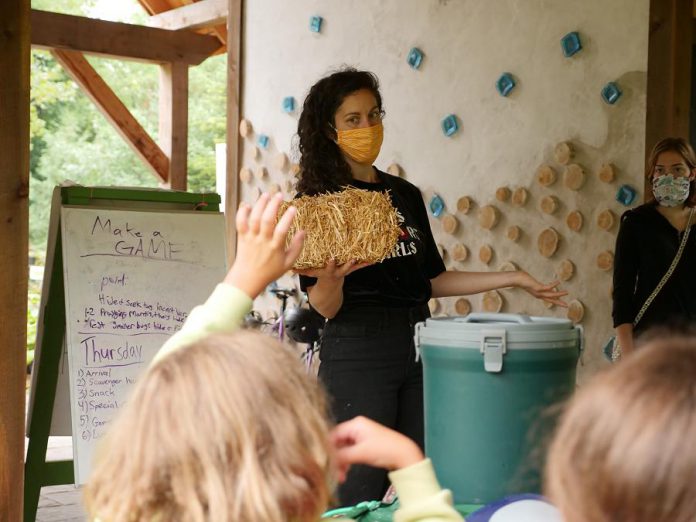
Jen Feigin, executive director of the Endeavour Centre, speaks about sustainable building approaches during the 2020 pilot of GreenUP's Girls Climate Leadership Camp at Peterborough's Ecology Park. The camp gave a small cohort of girls the opportunity to learn about the impacts of climate change, to develop strategies to support action in their households, and to meet inspiring women-identified climate leaders who are creating positive change in our community. (Photo: Ben Hargreaves)

The realities of climate change are a heavy weight to be passing on to our children.

I recently read an article about climate change by Dr. Britt Wray in The Walrus. In “Therapy for the End of the World,” Dr. Wray cites a study that mapped the opinions of more than 9,000 Canadians. 64 percent responded that they think climate change will start to harm people living in Canada within the next ten years.

The realities and choices that young people will be navigating as they get older will look very different than the choices my parents made, or than I am making today.

Advertisement - content continues below


I think a lot about how it feels to hold the weight of climate change; about how it impacts the work that I do, the way that I feel, and the things that I hope for. I also I think a lot about how it might feel to hold this weight as a child.

When I was eight, I did not think that a global disaster such as climate change was going to shape my future. I was already a teenager in the late ’90s when countries from across the world agreed to reduce their greenhouse gas emissions as part of the Kyoto Protocol. Confronting the realities of climate change — as a youth, a young adult, and even as a person edging toward my forties — has felt like a struggle.

For children, even as we engage with the issues in ways that are age-appropriate, the reality is not a gentle one. A parent interviewed in a recent article in the Washington Post recalls her eight-year-old telling her “my life would be better without climate change.” As a parent, she tries to validate those feelings, but admits that, “it’s sad, it’s hard.”

Malaika Collette is a local youth activist and high school student, and an alumnus of Kawartha Pine Ridge District School Board's Youth Leadership in Sustainability Program. (Photo: Heather Doughty Photography)
Malaika Collette is a local youth activist and high school student, and an alumnus of Kawartha Pine Ridge District School Board’s Youth Leadership in Sustainability Program. (Photo: Heather Doughty Photography)

In Dr. Wray’s article in The Walrus, youth climate activist Clover Hogan (who founded the youth organization Force of Nature), says “what [she] finds hardest is accepting that all the action in the world may not be enough to save humanity and so many other species.” But for Hogan, recognizing her grief helps her to “feel more authentic in [her] hope for the future,” to reveal what matters most, and to find the power to act.

For Malaika Collette, a local youth activist and high school student, the relationship between knowledge and action is a critical one.

Collette participated in the Kawartha Pine Ridge District School Board’s Youth Leadership in Sustainability Program, which deepened her understanding of climate science and politics, but also introduced her to climate solutions and local changemakers.

Advertisement - content continues below


Particularly when it comes to educating younger students, Collette emphasized “We can’t just talk about the science or the challenges. We need to talk about the solutions and opportunities for local action, so that children can have hope for the future.”

Indeed, despite the immense weight of this reality, we see that the global climate movement is being powered by child and youth activists, many of them girls.

Plan International recognizes that climate change “has a disproportionate impact on children, particularly girls”, because it “magnifies the inequalities they already suffer and their unequal access to health, sexual reproductive health and rights, education, participation, and protection.”

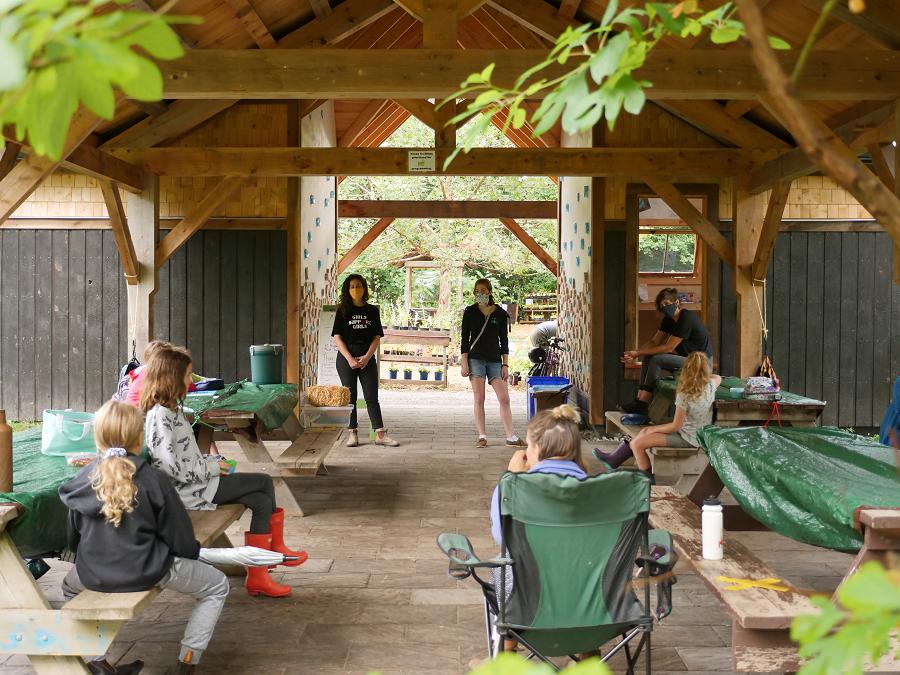
Participants in GreenUP's first-ever Girls Climate Leadership Camp at Ecology Park in Peterborough meet with special guests Jen Feigin (executive director of the Endeavour Centre), Dana Jordan (local youth climate activist, alumnus of the Youth Leadership in Sustainability Program, and youth representative on The City of Peterborough Environmental Advisory Committee), and Brianna Salmon (executive director of GreenUP). (Photo: Ben Hargreaves
Participants in GreenUP’s first-ever Girls Climate Leadership Camp at Ecology Park in Peterborough meet with special guests Jen Feigin (executive director of the Endeavour Centre), Dana Jordan (local youth climate activist, alumnus of the Youth Leadership in Sustainability Program, and youth representative on The City of Peterborough Environmental Advisory Committee), and Brianna Salmon (executive director of GreenUP). (Photo: Ben Hargreaves

According to Plan, increasing “access to quality education and age and gender responsive climate information is essential in enabling girls to become leaders in climate action and to participate in climate change decision-making.”

At GreenUP, our children’s environmental and climate programs focus on education and curriculum but they also focus on action. For everyone, but especially for young people, we know that participating in climate solutions is a strategy for survival, for inclusion, and for wellness.

In 2020, GreenUP piloted a Girls Leadership Camp that gave a small cohort of girls the opportunity to learn about the impacts of climate change, to develop strategies to support action in their households, and to meet inspiring women-identified climate leaders who are creating positive change in our community.

Advertisement - content continues below


In 2021, we will be expanding our Girls Climate Leadership Program and creating new opportunities for action. Working with the Nourish Project, the Endeavour Sustainable Building School, and other local partners, we will offer hands-on opportunities for girls to learn about food security, low-carbon building, water protection, active transportation, and ecosystem restoration.

Our gender-responsive climate action program will create a safe (and fun!) space for girls to overcome gendered barriers to participation, and will equip them with the tools, connections, and capacity for action. While the climate crisis remains heavy, we know that girls can be a strong and powerful force for change.

This important programming is possible because of funding through the Community Foundation of Greater Peterborough, supported by a collaboration between Community Foundations of Canada and the Equality Fund, with support from the Government of Canada. This program is also supported by Watson & Lou, an awesome woman-led local business in downtown Peterborough.

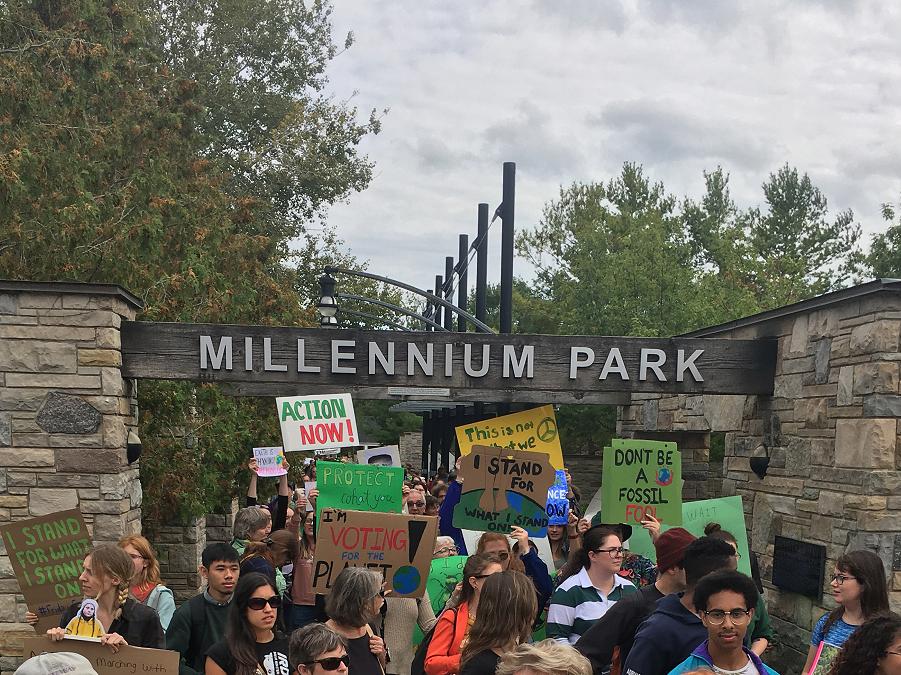
On September 27, 2019, youth in Peterborough led a protest march to local federal political candidates' campaign offices as part of The Global Climate Strike protest. This youth-led global protest movement took place in 4,500 locations in 150 countries and is one of the largest movements of its kind in history. (Photo: Leif Einarson)
On September 27, 2019, youth in Peterborough led a protest march to local federal political candidates’ campaign offices as part of The Global Climate Strike protest. This youth-led global protest movement took place in 4,500 locations in 150 countries and is one of the largest movements of its kind in history. (Photo: Leif Einarson)

To learn more about GreenUP’s climate action programming, visit greenup.on.ca/climate-action-resource/.

In the coming months, GreenUP will be announcing more about our Girls Climate Leadership Program. Follow our social media accounts @PtboGreenUP or sign up for GreenUP’s e-newsletter for regular updates.

First COVID-19 variant case in greater Kawarthas region reported in Northumberland County resident

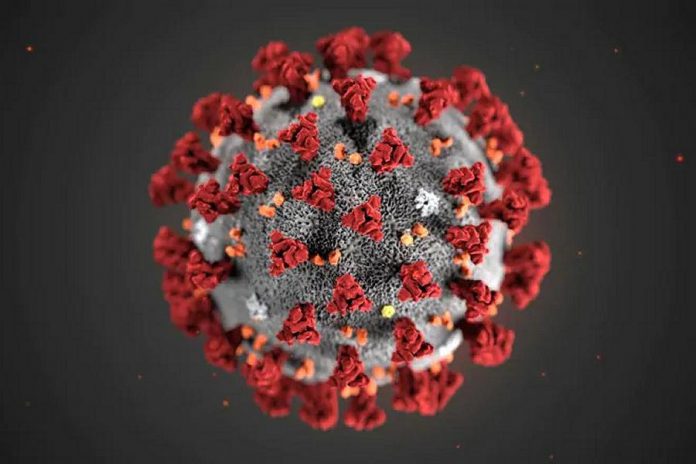
The first case of a variant of the COVID-19 virus in the greater Kawarthas region has been reported in a resident of Northumberland County, according to the Haliburton, Kawartha, Pine Ridge District Health Unit.

The health unit states it received the test results on Tuesday night (February 9) but does not yet know which of the COVID-19 variants the person is infected with. While all confirmed COVID-19 cases are being further tested for variants, the health unit states, it takes a few extra days for the results to be determined.

There are three known variants of the COVID-19 virus in Canada: a variant first identified in the United Kingdom in November 2020 (the B.1.1.7 variant), the South African variant identified in December 2020 (the B.1.351 variant), and a variant first detected in travellers from Brazil who arrived in Japan in January 2021 (the P.1 variant).

Advertisement - content continues below


The three variants of the COVID-19 virus have been identified as being a greater risk to people due to high rates of transmission.

“While it is unfortunate that we are seeing a case with the variant of concern, it is not unexpected,” says Dr. Ian Gemmill, the health unit’s acting medical officer of health, in a media release. “The three variants have been identified across Canada, and their high level of transmissibility has just meant it was a matter of time before we saw something locally.”

The health unit has notified the Northumberland County resident who has been infected with the variant. The person, who had previously been identified as a confirmed case, was already in isolation. All of the person’s high-risk contacts had also been previously contacted and are in isolation as well.

Dr. Gemmill says the identification of the variant in the community means that it is more important than ever that residents continue to be vigilant and follow the public health measures to help stop the spread.

Advertisement - content continues below


“Even though the provincial stay-at-home order is going to be lifted next week, I am pleading with people to continue to stay home to stop the spread,” he says. “Just because the order has been lifted, it does not change the virus, it does not change the epidemiology of the virus and it does not change the risk of spreading it to others.”

Dr. Gemmill is urging residents to continue to follow the public health advice of not having social gathering with others and not leaving home for non-essential reasons.

“Staying home is still the most prudent thing to do even with the order lifted,” he says.

Become a #kawarthaNOW fan

34,262FollowersLike
25,931FollowersFollow
17,466FollowersFollow
4,858FollowersFollow
4,052FollowersFollow
3,210FollowersFollow

Sign up for kawarthNOW's Enews

Sign up for our VIP Enews

kawarthaNOW.com offers two enews options to help readers stay in the know. Our VIP enews is delivered weekly every Wednesday morning and includes exclusive giveaways, and our news digest is delivered daily every morning. You can subscribe to one or both.


Submit your event for FREE!

Use our event submission form to post your event on our website — for free. To submit editorial content or ideas, please contact us.