



















Peterborough city council has voted to defer consideration of a winter shelter response plan until August, while unanimously voting in favour of a new initiative to keep Peterborough streets clean, traffic changes to Armour Road, and a pilot program to help seniors clean snow from the end of their driveways.
At its general committee meeting on Monday night (May 25), councillors considered a report from community services commissioner Sheldon Laidman recommending options for a planned seasonal winter shelter model for people experiencing homelessness in winter 2026-27, instead of the temporary temperature-based shelter response used this past winter.
The report presents two options for a planned overnight shelter model, both of which would provide at least 30 additional beds nightly using the former fire station on Carnegie Avenue, where the city operated an emergency temperature-based shelter response for up to 40 people per night over 10 days during the winter of 2025-26.
The first option would operate for three months from January through March and would cost about $303,000 annually, plus $20,000 in startup costs, while the second option would run for six months from November through April at an annual operating cost of about $576,600, plus $20,000 in startup costs.
Mayor suggests deferring the report until 2027 budget deliberations
Mayor Jeff Leal said he would be moving a deferral of the report, but first asked legislative services commissioner David Potts to comment on a recent decision by Ontario Superior Court Justice Michael R. Gibson preventing the Region of Waterloo from removing residents living at an encampment in downtown Kitchener and the impact it will have.
In his response, Potts spoke about how some legal decisions do not favour municipal jurisdictions when councils are attempting to balance competing interests, “including protecting open spaces, parks, and other spaces for public use.” He referred to past council decisions to proceed with enforcement through the removal of encampments when the municipality was able to meet the minimum standard for the number of available shelter beds.
The mayor then said the report should be deferred until 2027 budget deliberations as the city is still waiting for its allocation of almost $2 million from the provincial government’s Homelessness Prevention Program, which supports the 50 modular homes and support services on Wolfe Street.
“It is pretty difficult to deliberate on two options that would add another just shy under a million dollars to the budget in 2027,” Leal said, apparently adding the costs of the two mutually exclusive options together.
“Hopefully by the time the next council comes into place (and) they start their deliberation, we’d have clear direction from the province on our allocation for the Homeless (sic) Prevention Program.”
Councillor Dave Haacke spoke in support of the deferral, stating that his research shows that Peterborough provides 40 per cent more shelter per capita than Durham Region.
“I think that’s unfair,” Haacke said, referring to a lack of provincial funding. “I believe we are paying way too much towards that service for the number — sorry, not paying too much, the numbers are out of whack … We could pump 10 more million dollars into this program and be in the same boat.”
Councillors clash over urgency of making a decision
Councillor Keith Riel spoke against the deferral, referring to it as “groundhog day.”
“Last year, staff brought a report on a winter response. This is no different than the report that’s here in front of us, trying to get ahead of the curve. So what happened last year? This council voted not for a winter response. We lost two individuals to inclement weather last year. And here we were, when all of a sudden the weather dips to 30 and 40 below, we’re scrambling, trying to get a shelter up and running with social services staff.”
“You talk about $1 million to save some lives. This council, just a month ago, had no problem earmarking for the next council $57 million (for a multi-sport and event centre) — no problem at all. But for a million dollars to try and save some individuals around in the inclement weather, here we are tonight, saying oh, maybe we’ve spent too much money?”
In her remarks, councillor Joy Lachica thanked Laidman and city staff for the detail in the report, and spoke in support of the second option as it would accommodate unpredictable weather and would appeal to service providers for staffing purposes.
“A deferral is shocking to me,” she said. “Why would we put ourselves in a position where we are scrambling, as the previous speaker has said? I don’t think it’s responsible. I don’t think that we’re considering the human factor. I think we need to be prepared, and we don’t want to waste any more time.”
Councillor Matt Crowley said he would not support the deferral, noting “a little bit of conflation” between the staff report and earlier comments by Mayor Leal and Potts. He said he was unclear how provincial funding under the Homelessness Prevention Program or enforcement of the city’s parks by-law relates directly to the report.
“This report is specifically discussing a winter shelter emergency response plan, and I think it is incumbent that we make a decision on it,” he said, asking Laidman what some of the difficulties would be if the report was deferred to the next council. “Would we even be able to enact an emergency shelter response at the blink of an eye, if this weren’t to come back until November?”
Calling it a “key question,” Laidman said the rationale for bringing the report to council now was to provide “enough lead time to provide such a service in time for the winter.” He also added that, because the 2027 budget will be the first budget for a new term of council, budget deliberations will likely not take place until January or February.
“I think realistically the new council would be looking at the 2027(-2028) winter season for such a shelter to be put into place if that was their desire,” he said.
Concerns raised about cost and Carnegie Avenue location
After commenting that there is “some misinformation that’s getting out there that we aren’t doing anything and (are) voted against things,” councillor Lesley Parnell said council last year tried to find another operator instead of One City Peterborough “but we still ended up funding them at $2 million more,” stating “that was supposed to be our winter response.”
She also listed a number of other examples of city funding during the current council term for transitional and supportive housing.
“Our budget for homeless … has gone from $458,000 a year in 2022 — municipal money — to $4.256 million a year, and that’s municipal taxpayer dollars, so we have significantly increased the budget on this and yet we just seem to have as many people homeless even though we have housed that many more people … it’s absolutely not fair to say we haven’t done anything.”
For his part, councillor Gary Baldwin said he was “torn on this one.”
“You can recall last year we, council, asked staff to go out and do an RFP for another operator,” Baldwin said.
He was referring to a June 2025 council decision against providing additional homelessness funding for One City Peterborough to expand its daytime and overnight drop-in programs at Trinity Centre in 2026, and to issue a request for proposals to see if another organization could operate a program in another location. Less than five months later, council voted to award a $1.12 million contract to One City so the non-profit organization could operate a low-barrier shelter.
“I said at the time there won’t be any other operators, and it’s going to cost us twice as much money. That’s exactly what happened. It went from a little less than $1 million to over $2 million dollars. My colleague is correct. We’re talking about human lives here. We’re looking at a plan to prepare for the inevitable. We’re going to have some inclement weather. So, you know, my head is saying it’s money but my heart is saying we have to look after all of the people we represent.”
After confirming with Laidman that the former fire station on Carnegie Avenue is where the winter shelter would be located, Baldwin raised concerns that the location was a long distance away from downtown, where unsheltered people receive services, and results in transportation costs.
He asked Laidman whether there were any other sites in the downtown where the shelter could be located, such as the library. Laidman said using the former fire station does not disrupt other city services or programming, and there are few buildings that the city owns that would be suitable for a shelter.
Councillor Riel commented that, if there was another potential service provider or shelter location, they would have responded to the city’s earlier RFP. He noted that the number of homeless people is increasing and that, if the city is going to be removing people from encampments, shelter beds need to be available for them.
Councillor Baldwin reiterated that the city should look at alternative options in the downtown area instead of the fire hall location.
In his remarks, councillor Kevin Duguay noted there were people in the gallery from the Carnegie Avenue area who are objecting to using the former fire station for an emergency shelter.
“I’m wondering, to the note of the deferral, if we were to establish a little tighter timeline where staff could report back to us and maybe there are alternatives in the central area that would eliminate the need for transportation services and other matters,” Duguay said, adding that he is “very concerned about the escalating costs.”
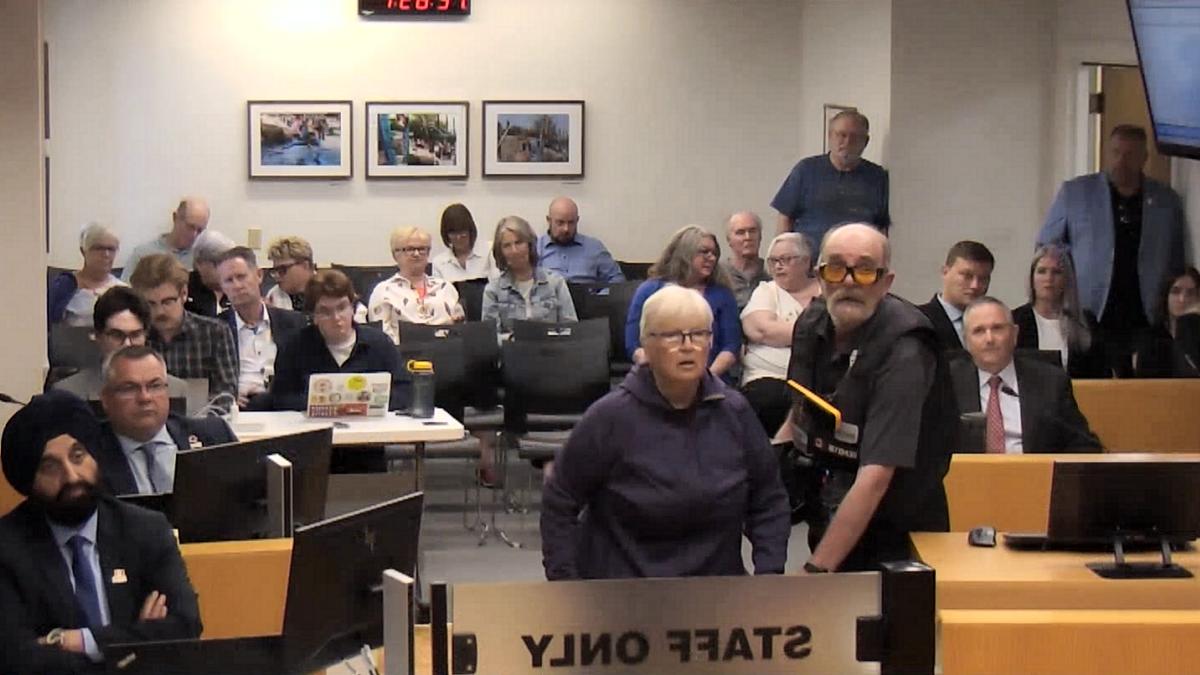
Duguay’s remarks were interrupted for a couple of minutes by Peterborough resident Margie Sumadh, who approached the council horseshoe while shouting at councillors as a security guard tried to convince her to sit back down.
Councillor Andrew Beamer, who is chair of general committee, repeatedly asked her to sit down and encouraged her to come to city council the following Monday to make a public delegation. The security guard eventually escorted her back to the gallery. Sumadh later told kawarthaNOW that she was irate with the way unhoused people are being treated.
“It’s very clear that this is a subject that’s important to a lot of people,” Duguay said, continuing his remarks about the costs to the city of providing homelessness programs before asking if city staff could come back to council with alternative locations.
Commissioner says it will be ‘extremely difficult’ to find another location by August
Councillor Beamer asked Laidman whether city staff could come back to council in August with recommendations for alternative locations.
“Realistically, I think that’s going to be a real challenge,” Laidman said. “I’ve been here for seven years. This is going to be probably the fourth or fifth time I’ve been asked to do this exercise by council of finding another location. It is extremely difficult.”
“We will certainly undertake it and go through that exercise but you just want to be pragmatic about it. One of the reasons to put Carnegie in front of council was it exists, it’s under the city’s control, we know that costs are, and we know how to service the site. Trying to evaluate other sites in the downtown — we will certainly do it; I just don’t want to over-commit to council that it would be successful.”
“I think honestly there would need to be some type of consultation process too, about if we’re going to put more services in the downtown,” Laidman added. “Councillors get calls every day about issues with services we have in the downtown, and I would question whether that’s something council wants to continue to advocate for.”
After councillor Beamer confirmed with Mayor Leal that he would be agreeable to having staff report back to council at a later date, the mayor suggested September.
Mayor Leal then spoke about what he called the “most concerning aspect” of the staff report, which is the increasing number of seniors with chronic illnesses who are experiencing homelessness, referring to the possibility of housing these seniors in long-term care beds that are in development.
Councillor Riel raised an issue with having staff report back to council in September, noting that August 21 is the end of the nomination period for the fall election, at which point it may be determined that council is in a “lame duck” period where it is restricted by the Municipal Act from making expenditure decisions over $50,000. Councillor Beamer then adjusted the timeline to August for staff to report back to council.
Councillor Lachica spoke again to the deferral, urging council to accept the advice of Laidman and city staff and make a decision now.
As the final speaker on the deferral, councillor Beamer — in whose ward the Carnegie fire station is located — said he could not support any recommendation to have the emergency shelter at that site, noting neighbourhood resident in the gallery who are strongly opposed to it. He said that both he and his fellow ward councillor Haacke have heard from hundreds of neighbourhood residents objecting to the location, and he has only heard from one resident in support.
Beamer said that residents are concerned that a temporary shelter will become permanent, noting that is what has happened with the Wolfe Street modular housing community and the Trinity Community Centre, both of which were supposed to be temporary. He said residents are also concerned about crime, garbage, and property values, and supported a deferral so another location could be found.
Council then voted on the deferral motion, which passed 6-4, with Mayor Leal and councillors Haacke, Beamer, Parnell, Duguay, and Baldwin voting in favour and councillors Don Vassiliadis, Lachica, Crowley, and Riel voting against. Councillor Alex Bierk was absent from the meeting.
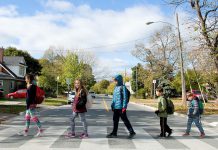
In other matters before council, councillors voted unanimously 10-0 in favour of the “Clean Streets Peterborough” initative, a traffic operations review of Armour Road between Hunter Street and Parkhill Road, and a windrow removal subsidy pilot program.
Items endorsed by general committee will be considered by council for final approval next Monday (June 1), when registered delegations will be heard.
Council meetings are streamed live at www.peterborough.ca.