















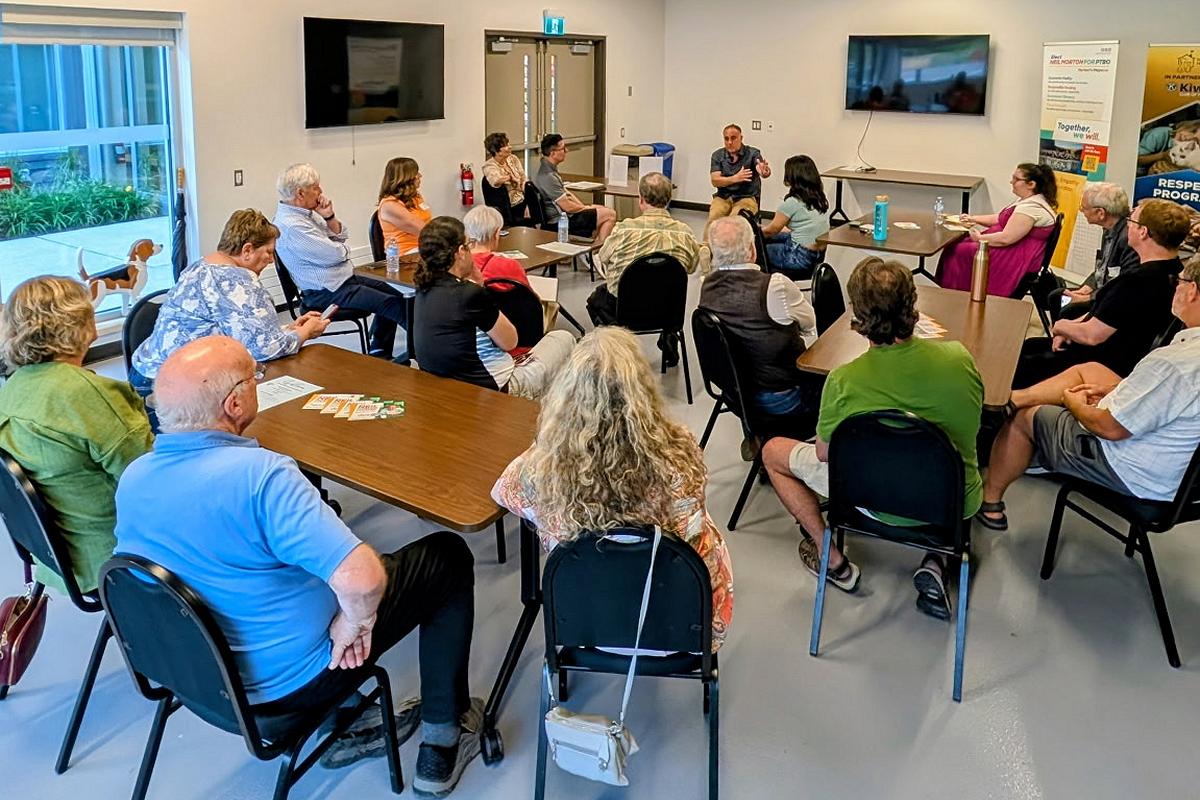
On Tuesday night (June 9), Peterborough mayoral candidate Neil Morton hosted the first of five “working sessions” asking for feedback from residents on his key policy areas and goals for office.
Morton is one of five people who have filed nomination papers to run for the office of mayor in the October municipal election in Peterborough, with the others being Michael Eamon, Jacob Méthot, incumbent Ashburnham Ward councillor Keith Riel, and Rebecca Schillemat. Incumbent mayor Jeff Leal is expected to announce this month whether he will be seeking re-election.
Entitled “Together, We Will Modernize Civic Engagement,” Tuesday’s event took place at the Peterborough Animal Care Centre at 1999 Technology Drive, which is in Ashburnham Ward.
Session focused on issues related to integrity, transparency, and accountability
Morton’s campaign has planned other policy-related sessions in the city’s remaining four wards over the coming weeks, with additional topics including economic development, taxes and affordability, downtown revitalization, and social issues including addiction, mental health, and homelessness.
“We’re at a pivotal moment in the history of this city,” said Morton at Tuesday night’s event, noting a commitment to transparency and communication throughout his campaign, including via these listening sessions.
Over six months ago, when Morton began his self-described “100 Coffees” engagement initiative, he highlighted the importance of hearing from a wide cross-section of residents and local stakeholders, and noted his willingness to hear “hard truths” about Peterborough.
Describing himself as someone who “tells it like it is”, Morton said his values of transparency and communication are representative of how he intends to operate if elected mayor.
“This is what we’ll do when I win,” Morton told kawarthaNOW.
Concerns raised about limits on public delegations and timing
At Tuesday night’s session, a small but eager group of local residents and Morton loyalists began by discussing the issue of citizen delegations at city council meetings, which are currently limited to four registered speakers per agenda item with each delegate speaking for no more than five minutes.
Gord Halsey, who has previously appeared as a delegate before council, said that council’s February decision to limit the number of delegations interferes with the democratic process and reduces opportunities for the public to be involved in decision making.
“I think it needs to go back to where it was truly democratic,” said Halsey.
One of the reasons council decided to limit the number of public delegations per agenda item was because of the impact on the length of council meetings, especially during meetings with heavy agendas. In February, council considered a change to its procedure by-law that would have limited the total number of delegations to 10 for each council meeting, instead of the previous limit of 10 delegations for each topic or report on a council agenda.
After hearing from several public delegations objecting to the proposed limit, notably former mayor Diane Therrien-Hale, councillors backed off the 10-delegations-per-meeting limit and voted to allow four delegations per agenda item.
For Halsey and other attendees at Tuesday night’s event, the reduction in public delegations reflects a trend by the incumbent council of treating community input as secondary to decision making. Halsey spoke of his experience giving delegations at council and being met with blank faces and little to no response from council members or the mayor.
Further to this, attendees proposed that public delegations should take place be given further ahead of the council meeting when voting occurs.
Morton agreed with attendees that council hearing delegations close to the vote does not represent transparent decision making and argued that it encourages councillors to make decisions in large part without hearing constituent feedback.
“It does look like they’re going through the motions when you watch it on TV,” Morton noted.
Another participant, who noted that he lives in Peterborough’s East City, also said public feedback should be happening earlier in the decision-making process. In particular, he identified the proposed 17-storey apartment building beside Mark Street United Church in East City and the pickleball courts at Bonnerworth Park as examples of what he considers a lack of timely public engagement.
“You go to those meetings and you realize people are so far down the decision-making cycle, they pretty much have their minds made up,” he said.
He further said that early involvement would allow neighbourhoods to be involved in determining suitability and need while preserving the quality of life for existing residents.
Increasing civic engagement through better communication at City Hall
Morton, who has a background in journalism and communications, spoke throughout the event about the topic of communications as a key aspect of both his campaign and potential mayoralty.
He explained that intentional communications are vital to ensuring that residents know what is going on in their community and have an understanding of how they can be involved in decision-making processes or how to have their voices heard.
“Early in the process you have to make constituents feel like they’re active stakeholders in decision-making, and the way to do that is to be super transparent early on,” Morton said.
Another participant, Betsy Healey, said she believed every City of Peterborough department should have a dedicated communications staff member whose responsibility is to keep the general public informed and engaged.
“That transparency, that involvement, makes people feel that they are valued and respected and that their input is meaningful,” she added.
Morton also shared some of his ideas for increased communications at City Hall, including podcasts and YouTube series with human-centric content.
“I’ve seen other municipalities do that — where you take people behind the scenes and you interview the staff and you interview the people on the frontline that are doing stuff that you’re paying your taxes for,” Morton explained.
Morton said he considers open communication to be at the forefront of what he would bring to City Hall as mayor and that his “transparent, authentic, and accountable” mindset will build positive relationships between city staff, councillors, and residents.
Jessica Correa, a candidate for city councillor in Otonabee Ward who joined the session as a participant, spoke about her value of “meeting people where they are at,” in spaces they already occupy and in communities with which they are familiar.
“I think we need to show up where people are,” Correa said. “If you want to know how the parks are, go to the park and ask people at the park.”
To this end, Morton workshopped his idea of hosting mayoral office hours, where residents could speak directly with the mayor on a regular basis. The Morton campaign identified the ability to discuss ideas in such a way as central to why they are hosting the working sessions.
Building a culture of trust between citizens and City Hall
For some of the participants at Tuesday night’s event, including Jan Fialkowski and Blair Armitage, civic engagement can be bolstered by the presence of neighbourhood associations that collaborate with the city and form strong relationships with staff and councillors.
“One of our chairs of the resident association was able, almost single-handedly, to save a pool that council was going to demolish,” said Fialkowski of her experience living with formalized neighbourhood associations, known as resident councils, in the City of New Westminster in B.C.
Armitage spoke about the importance of residents having a relationship with city staff and councillors, saying it is vital to building trust within the community.
“Back in the day, I knew every mayor,” Armitage said. “You saw them at Smitty’s. Today, I don’t know who they are.”
Event attendees also spoke at length about the importance creating a culture of respect at City Hall both between councillors and with the treatment of residents.
Morton said that his standards and expectations for respect would be based on accountability and collaboration.
“I 100 per cent believe that we’re going to liberate City Hall,” Morton said. “We’re going to get out of people’s way. And I 100 per cent think I can create a great culture there.”
The Morton campaign is sharing the results of each policy session on its website at www.mortonformayor.ca/community_input, including the 26 ideas related to integrity, transparency, and accountability that were generated at Tuesday night’s event.
kawarthaNOW’s coverage of municipal election candidates is provided for informational purposes only and does not constitute an endorsement of any candidate, campaign, or platform.