


















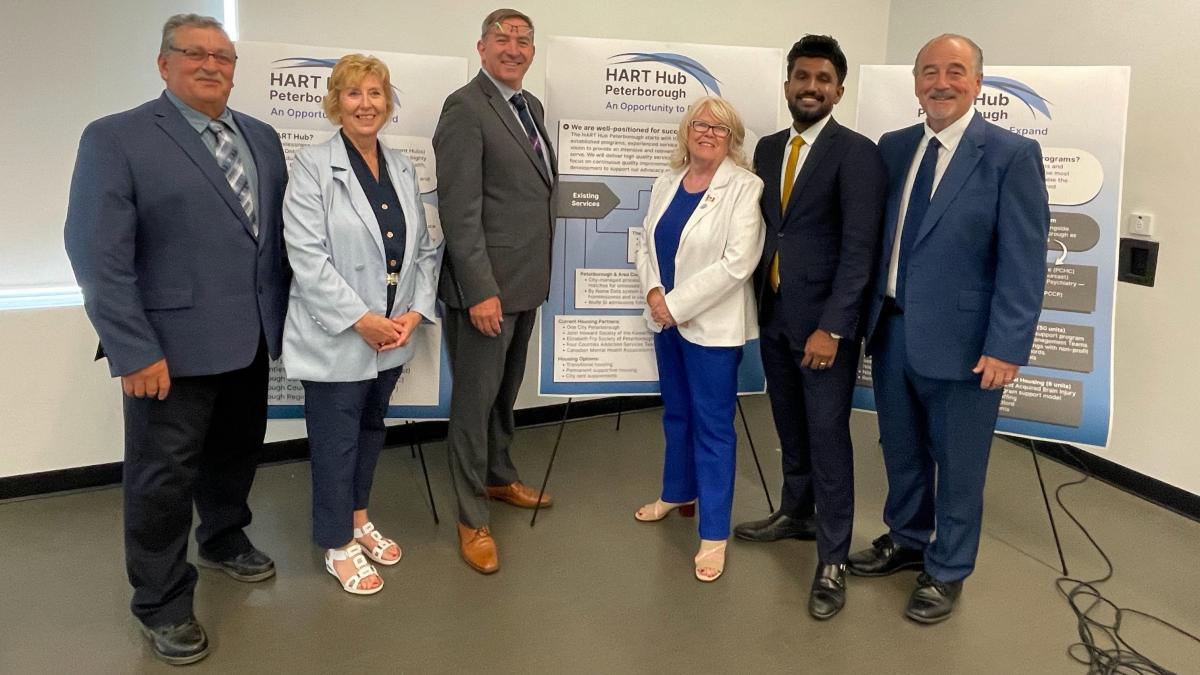
Community leaders and representatives of municipal and provincial governments gathered at the Miskin Law Community Complex on Friday morning (June 26) to mark the launch of the Homelessness and Addictions Recovery Treatment (HART) Hub in Peterborough.
The Ontario government is providing $6.3 million in annual funding to support Peterborough’s HART Hub, which will provide transitional and supportive housing and addiction services as well as healthcare services at 210 Wolfe Street — the site of the City of Peterborough’s modular housing community for people experiencing homelessness.
Peterborough is one of 29 HART Hubs funded by the province representing a total investment of more than $560 million.
Recovery and treatment model focused on residents of Wolfe Street modular housing community
“This historic investment will change the lives of many people in our community,” said Donna Rogers, executive director of the Four Counties Addictions Services Team (Fourcast), the lead organization for the HART Hub.
Those attending Friday’s event included municipal politicians Peterborough-Kawartha MPP Dave Smith, Haliburton-Kawartha Lakes-Brock MPP Laurie Scott, and Scarborough-Rouge Park MPP and associate minister of mental health and addictions Vijay Thanigasalam, along with local politicians including Peterborough mayor Jeff Leal, Peterborough County warden Bonnie Clark, Trent Lakes mayor Terry Lambshead, and Selwyn Township deputy mayor Ron Black, who is also board chair of Fourcast.
“I want to applaud the provincial government for their generous investment in our local HART Hub model,” Black said. “Your investment vision allowed local innovation and design, leveraging the expertise and experience of our local partners.”
MPP Smith, who has been an ardent supporter of the HART Hub, described its continuum of services as a “buffet” with a number of entry points.
“We’re giving them the opportunity to be reintegrated back into society, to be part of the community again and it’s something that we haven’t seen in a very long time,” Smith said of HART Hub clients.
For his part, MPP Thanigasalam shared stories from other HART Hubs and spoke of the Ford government’s focus on “breaking the cycle” of addiction by focussing on recovery and treatment.
“This is a comprehensive recovery treatment hub,” Thanigasalam said. “You can go through, get the treatment you need, and go through the journey all the way to employment training as well.”
Long-term housing stability for unhoused people with addiction and mental health issues is the goal
Rogers said that the Peterborough HART Hub will provide specialized services to individuals living at the Wolfe Street modular housing community to enable them to secure supportive and long-term housing.
“Our unique model puts a laser focus on long-term housing stability for those with few housing options,” Rogers said. “We believe that housing is the solution for those in our community facing the intersecting crisis of addiction, mental health, and homelessness.”
The Peterborough HART Hub will operate four new services: an on-site healthcare team at Wolfe Street integrated with existing frontline staff from the Elizabeth Fry Society of Peterborough (EFry), 50 units of transitional housing for residents moving out of modular housing, six spaces of supportive housing hosted by the Canadian Mental Health Association – Haliburton, Kawartha, Pine Ridge (CMHA HKPR) for individuals with acquired brain injuries or a dual diagnosis including developmental disorders, and a six-month “sober living” program for people who are unhoused when entering addictions treatment.
Healthcare organizations involved in the HART Hub include the Peterborough Community Health Centre, Peterborough County-City Paramedics, and the Peterborough Regional Health Centre.
In an interview with kawarthaNOW in May, Rogers spoke about the design and values of the HART Hub and described how they intend to operate their services.
“Our goal is long-term stable housing, with the appropriate supports for the people who are the most complex in our community,” said Rogers.
Specialized supports for modular housing community residents with complex needs
Fourcast and partners identified the residents of the Wolfe Street modular housing community as being highly complex due to the intersection of challenges with mental health, disability, addictions, and homelessness.
In particular, Rogers said that this is a population that does not have reliable access to primary care or specialized healthcare, which leads to health issues becoming more severe and complex. The on-site health team established by the HART Hub funding will address this disconnection and provide essential care to residents.
“This is a responsive and accessible model of healthcare,” said Rogers.
The 50 units of transitional housing will be provided in partnership with private and non-profit landlords, including One City Peterborough through their additional rental unit (ARU) developments.
Rogers said that securing and maintaining housing is difficult for individuals experiencing chronic homelessness, especially residents of the Wolfe Street modular housing community who require low-barrier entry to services and shelter.
“Finding housing units is not easy — housing is not available for the people that we are trying to serve,” Rogers said.
Correen Day, director of services for EFry, spoke to kawarthaNOW about the challenges that Wolfe Street residents face when working towards transitioning out of chronic homelessness.
“We’re seeing intersections with our criminal justice system and with our healthcare system based upon the way they’ve had to survive over the time that they were homeless,” Day explained.
Day said that having on-site supportive services at all stages of the HART Hub system creates an accessible route for transition out of Wolfe Street for individuals who require additional support.
The HART Hub will provide specialized support for individuals with acquired brain injury or dual diagnosis including developmental disorders through the six spaces hosted by CMHA HKPR.
Kerri Kightley, director of programs and services at CMHA HKPR, said that securing housing for people with many co-occurring conditions and health issues as the care required is much more specialized, and therefore, more limited.
“I think we’re just looking at how we build small steps so that people have more opportunities to then live more independently and in housing that they choose,” Kightley said.
The six-month sober-living program that will serve unhoused people entering addictions treatment is the only HART Hub program that will require abstinence for participation, Rogers told kawarthaNOW.
A philosophical shift away from supervised consumption sites
Although the Ford government has positioned the HART Hubs as a replacement for now-defunct Consumption and Treatment Sites (CTS), Rogers described the transition from the CTS model to the HART Hub model as a “philosophical shift,” further saying, “it’s doing diametrically different things.”
A response to the opioid crisis, Peterborough CTS’s opened in June 2022 in the former bus terminal at 220 Simcoe Street in downtown Peterborough to provide a safe and medically supported space for people to consume pre-obtained drugs under the supervision of health professionals.
On March 16, the Ontario government announced it would end funding for seven CTS sites in communities that now have a provincially funded HART Hub, including Peterborough, with a “90-day wind-down period … to give clients time to transition to the support provided by their local HART Hub.”
Like all HART Hubs, the Peterborough hub will not offer safer supply, supervised drug consumption, or needle exchange programs.
When asked about the transition from a consumption-based model to an abstinence-based model, Thanigasalam said the Ford government is responding to calls for funding for recovery services.
“Our government doesn’t believe in providing tools for the most vulnerable communities to use drugs. Instead, we believe in providing recovery and treatment by breaking the cycle of addiction,” said Thanigasalam.
He further said that the investment in the HART Hub program is four times larger than what had been provided to operate CTS sites.
For his part, MPP Smith reiterated his position that “Harm reduction without treatment is palliative care.”