

















Home Blog Page 23

Northumberland County council elects veteran politicians Bob Crate and Mandy Martin as warden and deputy warden

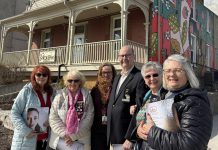
Municipality of Trent Hills mayor Bob Crate (front, second from right) and Cramahe Township mayor Mandy Martin (front, second from left) have been elected as warden and deputy warden of Northumberland county by their fellow councillors for the final year of this council's 2023-26 term. (Photo: Northumberland County)

A seasoned politician will be once again donning the chains of office as he takes on the role as warden for Northumberland County.

Bob Crate, mayor of the Municipality of Trent Hills, was elected to the position at county council’s regular monthly meeting on Wednesday (December 17). Veteran Colborne politician Mandy Martin, Mayor of Cramahe Township, will serve as deputy warden.

Northumberland County council is comprised of the mayors of each of the seven towns, townships, or local municipalities within its boundaries. The head of county council is called the warden and is elected annually from amongst its membership, as is the deputy warden.

Advertisement - content continues below


Crate and Martin, who are assuming the roles from Brighton mayor Brian Ostrander and Municipality of Port Hope mayor Olena Hankivsky, will serve as warden and deputy warden for the final year of this council’s 2023-26 term, with the next municipal election set for October 26, 2026.

“This final year of our four-year strategic plan is about finishing strong and staying focused on what comes next,” Crate said in a statement.

“We’re operating in a time of constant change, with new expectations and shifting policies coming at municipalities faster than ever. That means working together as one team — listening to residents, supporting staff, and advocating for the tools and funding our community needs to succeed.”

Crate previously served as warden in 2022 and 2021, was deputy warden in 2000, and is a long-time county councillor. Martin has also sat in various seats on county council, having previously served as warden in 2023.

Advertisement - content continues below


In a media release from Northumberland County, Martin emphasized the importance of council working as a unified team to support staff and residents while advancing major county initiatives in 2026.

“Our success depends on how well we work together — listening to residents, respecting one another’s perspectives, and supporting staff,” Martin said. “If we remain aligned, we can continue to deliver meaningful progress for Northumberland.”

As the calendar year winds down, Northumberland County and council reflected during the meeting on Ostrander’s leadership that took them through a year marked by significant pressures on municipal governments while continuing to advance essential services and major strategic priorities that support residents across the county.

Ostrander acknowledged both the challenges faced and the progress achieved.

“2025 asked a great deal of our organization,” Ostrander said in a statement.

“I am incredibly proud of what council and staff accomplished. In one of the most complex years local government has faced, staff continued to deliver high-quality services and advance major priorities for residents. I have every confidence the organization is well positioned to finish this term strong.”

Advertisement - content continues below


Throughout 2025, the county advanced work across a broad range of priorities, including infrastructure renewal, broadband expansion, emergency services modernization, housing and homelessness supports, physician recruitment efforts, climate adaptation planning, and made progress toward full operations at the new Golden Plough Lodge and Northumberland County Archives & Museum (GPL & NCAM) site in Cobourg.

“Looking ahead, council will focus on completing remaining strategic plan commitments while advancing major projects, including the opening of the GPL & NCAM, continued broadband expansion, and moving the shovel-ready Trent River Crossing toward construction,” the release stated.

Council will also be charged with supporting the transition to new administrative leadership with the appointment of a new chief administrative officer in 2026 for Northumberland County.

Advertisement - content continues below


Crate was nominated for the position of warden by John Logel, Mayor of the Township of Alnwick/Haldimand, for “his proven leadership experience as warden, his integrity, sound judgment, and his consistent focus on decisions that serve the best interests of residents across Northumberland County.”

Meanwhile, Martin was elected following a nomination by Crate, who noted their previous work together and expressed confidence in her leadership and contributions.

The roles of warden and deputy warden are one-year terms, each filled by one of the seven members of Northumberland County council.

ReFrame Film Festival unveils 2026 lineup of more than 40 social and environmental documentaries, including local films

Six of the more than 40 social and environmental documentary films to be screened during the 2026 ReFrame Film Festival, which runs in person in downtown Peterborough from January 30 to February 1 and online across Canada from February 3 to 8. Pictured (left to right, top and bottom) are the feature films "Holloway," "Future Council," and "At All Kosts," along with local films "Home," "Echoes in the Steel," "Mr. Possibility,", "Shropshire Sheep Scandal," and "No More Silent Battles." (kawarthaNOW collage)

The organizers of the 2026 ReFrame Film Festival have unveiled the full lineup of the more than 40 new international documentary films that will be screened when festival is held in downtown Peterborough from January 30 to February 1 and online across Canada from February 3 to February 8.

Each year, the lineup is carefully curated over months of thoughtful review and decision-making by the festival’s creative director Eryn Lidster and the volunteer programming advisory committee. To help audiences plan their experiences, the films are divided into thematic collections that draw attention to the stylistic choices or subject matter.

This year’s collections consist of “Art Beat” (exploring growth and resistance powered by art), “A Thousand Words” (exploring the ways in which text and images connect us, divide us, and shape how we see the world), “Flora & Fauna” (exploring relationships with other beings), “Sharp Angles” (spotlighting how documentary craft invites a new perspective), “Women Everywhere” (examining women speaking out and sharing stories), and “Windows In” (stories that invite us into intimate community and family spaces).

Advertisement - content continues below


Featuring both feature-length and short films, the in-person screenings will take place in downtown Peterborough at Showplace Performance Centre (290 George St. N.) and Market Hall Performing Arts Centre (140 Charlotte St.), and just over half the films will also be available in the virtual programming.

The in-person programming will kick off on Friday, January 30 at 4:45 p.m. with a screening of Ocean Seen from the Heart and Echoes in the Steel at Showplace and The Nest at Market Hall.

The following films will only be screening in person at Showplace or Market Hall:

  • Endless Cookie – 97 min. – Friday, January 30 at 7:30 p.m. at Market Hall
  • We’ll Go Down in History – 25 min. – Saturday, January 31 at 10 a.m. at Market Hall
  • The Librarians – 92 min. – Saturday, January 31 at 10 a.m. at Market Hall
  • Leveret Road – 15 min. – Saturday, January 31 at 12:30 p.m. at Showplace
  • Future Council – 87 min. – Saturday, January 31 at 12:30 p.m. at Showplace
  • Zanana – 6 min. – Saturday, January 31 at 4:45 p.m. at Showplace
  • Put Your Soul on Your Hand and Walk – 112 min). – Saturday, January 31 at 4:45 p.m. at Showplace
  • Each to their Own World – 16 min. – Saturday, January 31 at 7:30 p.m. at Showplace
  • Life After – 99 min. – Saturday, January 31 at 7:30 p.m. at Showplace
  • The Survival of the Wooden Canoe – 20 min. – Sunday, February 1 at 10 a.m. at Showplace
  • Agatha’s Almanac – 96 min. – Sunday, February 1 at 10 a.m. at Showplace
  • Heightened Scrutiny – 89 min. – Sunday, February 1 at 12:30 p.m. at Market Hall
  • Sister Love Mother Child – 12 min. – Sunday, February 1 at 2:45 p.m. at Showplace
  • Requiem for a Tribe – 52 min. – Sunday, February 1 at 2:45 at Showplace
  • Inga – 28 min. – Sunday, February 1 at 4:45 p.m. at Market Hall
  • Zurawski V Texas – 99 min. – Sunday, February 1 at 4:45 at Showplace
  • Shropshire Sheep Scandal – 22 min. – Sunday, February 1 at 7:30 p.m. at Market Hall
  • Mr. Possibility – 24 min. – Sunday, February 1 at 7:30 p.m. at Showplace
  • Silver Screamers – 94 min. – Sunday, February 1 at 7:30 p.m. at Showplace

VIDEO: “Holloway” (2024) trailer

One of the most notable feature films on the lineup comes from local filmmaker Dr. Jenny Ingram, a trailblazer in geriatric medicine and seniors’ care. Based in Peterborough, Ingram founded the Kawartha Centre as a site for international Alzheimer research trials.

Her 2025 film No More Silent Battles explores the experiences of four families navigating the complexities of dementia care, revealing their resilience and resourcefulness, and analyzing the critical role of community support. It explores the impacts of trained home care providers and the urgent need to develop policies and funding that support dementia care at home.

No More Silent Battles is featured in the “Windows In” collection and will be screened virtually and at Market Hall on Saturday, January 31 at 4:45 p.m.

Advertisement - content continues below


Another highlight on the lineup is Holloway, which is featured in the “Women Everywhere” collection and is directed by Dairy-May Hudson and Sophie Compton. The deeply personal film follows six women as they return to the now-abandoned infamous Holloway Prison in London, England, sharing some of their most intimate experiences, unravelling what led them to incarceration, and presenting an eye-opening portrait of failing systems and trauma.

The film is being screened both virtually and in person on Saturday, January 31 at 12:30 p.m. at Market Hall.

In his 2024 film Future Council, director Damon Gameau takes viewers on an inspiring and humorous journey described as “School of Rock meets An Inconvenient Truth.” The film follows eight children who are invited on an adventure across Europe in a school bus powered by biofuel, with the mission of better understanding the planet’s predicament and exploring solutions. The children then form a “Future Council,” and take the conversations about protecting the planet and the future from the streets to the boardroom to advise and influence the world’s largest polluters and most influential companies.

The film is only being screened in person at Showplace on Saturday, January 31 at 12:30 p.m.

VIDEO: “Future Council” (2024) trailer

Another not-to-be-missed feature is At All Kosts by Joseph Hillel, which explores how artists use the performing arts as a mode of resistance in Haiti in the time of cholera and street gangs. The 2024 film follows young people born after the Duvalier dictatorship who have lived through 19 presidents, 36 prime ministers, eight coups d’etat, three foreign military interventions, and two major earthquakes.

Following the assassination of President Jovenel Moïse in 2021, the country has been abandoned to the criminality of gangs who terrorize the population, yet still these artists gravitate to a unique creative space where theatre comes to life for ten days every year.

The film is featured in the “Art Beat” collection and will be screened virtually and in person on Saturday, January 31 at 2:45 p.m. at Market Hall.

Advertisement - content continues below


In ReFrame’s lineup of locally made films, audiences will not only be familiar with some of the filmmakers but will recognize some of the subjects and places the films explore.

This includes Echoes in the Steel by award-winning Peterborough filmmaker Rob Viscardis. The 2025 film follows Douro-based metal artist Garrett Gilbart after his long-favoured vintage car scrapyard closed for environmental remediation. Garrett must let go of a defining source of inspiration and material for one body of his work and accept his own continued transformation as an artist.

The short film will be screened at Showplace on Friday, January 30 at 4:45 and online throughout the virtual festival.

VIDEO: “At All Kosts” (2024) trailer

Directed by award-winning filmmaker Maya Bastian, Shropshire Sheep Scandal is a short documentary that follows a farmer named Montana Jones in Hastings in the Municipality of Trent Hills who, starting in 2010, fought to protect her flock of rare Shropshire sheep from the Canadian Food Inspection Agency that alleged the animals were diseased. The night before their scheduled slaughter, however, the sheep vanished, and left in their place was a note from a mysterious organization called the “Farmers Peace Corps.” It was the beginning of a years-long legal and emotional odyssey for Jones, who refused to back down in the fight for her flock.

The film, categorized in the “Flora & Fauna” Collection, will be only available for in-person screening on Sunday, February 1 at 7:30 p.m. at Market Hall.

Another local film was produced by Degrassi creator Linda Schuyler and directed by Will Bowes. Home explores the community-wide reckoning that happens when Cobourg’s unhoused community find an unlikely sanctuary on a vacant heritage estate owned by the provincial government. The film unveils the powerful stories of those living in the encampment, while delving into the history of the land, chronicling the grassroots efforts offering aid, capturing the unease of nearby residents, and exposing the escalating political stakes as the province prepares to sell the property.

The 2025 film is part of the virtual programming and will also be screened at Showplace on Saturday, January 31 at 2:45 p.m.

Advertisement - content continues below


Other local short films include Mr. Possible by Matt Snell, The Survival of the Wooden Canoe produced by Joan Barrett and co-directed by Snell, Joan Barrett, and Rodney Fuentes, and the short film They Called it the Butcher Shop: The Fleck Strike in Images by Lauren Stoyles.

There are four festival pass options currently on sale, including a $145 hybrid pass that allows access to all in-person and online film screenings, a $120 all-access in-person pass, a $75 watch-with-a-friend virtual pass, and a $60 single virtual pass.

For festival passes and to see the full lineup for the 2026 ReFrame Film Festival, visit reframefilmfestival.ca.


kawarthaNOW is proud to be a media sponsor of the 2026 ReFrame Film Festival.

Neighbourhood association agrees to pay $22,500 settlement to the City of Peterborough and Brock Mission

Sarah McNeilly reacts as councillor Lesley Parnell, who was chairing a public meeting under the Planning Act on February 24, 2025, tells her she is not allowed to speak to Mayor Jeff Leal's use of his strong mayor powers to expedite Brock Mission's proposed transitional housing project. The meeting, where the mayor's motion to expedite the project was approved by a one-third council vote, led to McNeilly forming the Northcrest Neighbours for Fair Process (NNFP) neighbourhood association, which launched an ultimately unsuccessful legal challenge of the mayor's decision that led to a settlement agreement where NNFP has agreed to pay $22,500 to the City of Peterborough and Brock Mission. (kawarthaNOW screenshot of City of Peterborough video)

A Peterborough neighbourhood association has accepted a settlement requiring that it pay $22,500 to the City of Peterborough and Brock Mission within 60 days, concluding a lengthy legal process that dates back to the spring.

The decision by Northcrest Neighbours for Fair Process (NNFP) to accept the settlement follows its announcement last Wednesday (December 10) that it dropped its legal challenge against the City of Peterborough’s use of strong mayor powers to expedite Brock Mission’s six-storey, 52-unit transitional housing complex planned for a site at 738 Chemong Road adjacent to Cameron House, a women’s shelter also operated by Brock Mission.

The road to this point began back on February 3 when Peterborough Mayor Jeff Leal issued a statement confirming he would, in deference to a request from Brock Mission, use his strong mayor powers to amend the City’s zoning by-law to allow the project to proceed as well as exempt the project from existing site plan requirements — a process that ensures development projects comply with municipal policies and minimize negative impacts on the environment and surrounding community.

Advertisement - content continues below


Mayor Leal stayed true to that vow on February 24 at a city council meeting, when he brought forward a motion to use his strong mayor powers to expedite the project. While seven of 11 council members voted against the motion, councillors Gary Baldwin, Kevin Duguay, and Lesley Parnell, along with the mayor, voted in favour. While a majority of council voted against the motion, just one third of council (including the mayor) must be in support for a strong mayor powers motion to pass.

All who spoke at that meeting, including 15 public delegations, were forbidden from addressing the use of strong mayor powers and could speak only to the proposed zoning by-law amendment. In addition, the rules of procedure that govern council meetings were suspended in accordance with legislation as it pertains to strong mayor powers.

In the aftermath of that meeting, NNFP was formed to represent some 100 residents of the Teacher’s College and Brookdale neighbourhoods in Northcrest Ward. NNFP later announced its intention to legally challenge Mayor Leal’s use of strong mayor powers, claiming in a statement that the proposed Brock Mission project was being “rushed through without proper oversight, transparency or consultation.”

Since day one, NNFP has been clear that it supports transitional housing. However, it argued that the Brock Mission project doesn’t qualify as “housing” under provincial rules governing the use of strong mayor powers.

NNFP also expressed serious concerns with the proposed project’s close proximity to Cameron House, maintaining that the placement of a large co-ed transitional facility beside a women’s shelter poses a safety issue and trauma-informed-care concerns for the women at Cameron House.

In order to file a court application and retain legal counsel, NNFP created a separate incorporated entity. As NNFP chair, Sarah McNeilly agreed to be the sole director and member of Northcrest Neighbours for Fair Process Ltd. named in the subsequent proceedings.

In response to NNFP’s legal challenge, the City of Peterborough filed a notice of motion in late May requesting security of court-related costs in the amount of $10,000. The motion argued that NNFP is a shell corporation without operations and no assets to pay the costs of the respondent (the City).

City solicitor Scott Seabrooke further argued that NNFP was incorporated solely for the purpose of insulating McNeilly from being exposed personally to a cost award, further maintaining his belief that “the applicant will try to avoid paying any order for costs.”

Following a summer that saw Brock Mission added as a respondent to the legal challenge and NNFP raise more than $13,000 for its legal costs via GoFundMe campaign, the City filed a second motion seeking $30,000 from NNFP Inc. for security of costs — triple what was originally requested.

Fast forward to November 20 when Ontario Superior Court Justice Susan Woodley, having earlier heard arguments from NNFP, the City of Peterborough and Brock Mission, issued a ruling that supported the City’s motion for $30,000 in security costs. Justice Woodley added NNFP, lacking the ability to pay potential legal costs, would be required to demonstrate a strong likelihood of success of its case based on the merits — a threshold she concluded NNFP could not meet.

Justice Woodley further noted that the Municipal Act contains an immunity cause for decisions made using strong mayor powers if a decision was made legally and in good faith, and observed that Mayor Leal exercised his legal authority and acted in good faith when invoking strong mayor powers.

In the end, all this considered, Justice Woodley ruled the interests of justice would be served by requiring NNFP to post $30,000 in security within 30 days of the order, and also allowed the respondents to seek additional security costs from NNFP as the case proceeds and costs increase.

Advertisement - content continues below


On December 10, NNFP announced it was dropping its challenge, noting the outcome to date “reflects a broader democratic failure: a tax-funded municipal corporation using its legal might to overwhelm citizens with limited means.”

In simpler terms, David met Goliath, and this time Goliath prevailed.

In a media release issued on Wednesday (December 17), NNFP confirmed the $22,500 settlement figure was arrived at following 10 weeks of discussions between NNFP, the City of Peterborough and its chief building official, and Brock Mission.

NNFP said those discussions began immediately after the October 1 hearing, where Brock Mission’s lawyer Philip Cranell informed the court that the organization had, that very morning, received a conditional offer of $20 million in funding from the Canadian Mortgage and Housing Corporation (CMHC) to build the Chemong Road project.

According to NNFP, that public disclosure “marked a turning point” in the group’s legal challenge as the project suddenly had potential funding attached to it.

“We were shocked,” said NNFP chair Sarah McNeilly in the release, adding that it had been unclear before then whether the project was financially viable at all.

“Once we learned that Brock Mission had access to $20 million, we immediately stepped aside. While my neighbours and I have serious concerns with the planning process, proposed location, and program model for McNabb House, we would never want to jeopardize a charity’s ability to access that level of support.”

A rendering of Brock Mission's proposed 52-unit, six-storey co-ed transitional housing apartment building to be constructed at 738 Chemong Road in Peterborough, adjacent to the existing Cameron House women's shelter. (kawarthaNOW screenshot of City of Peterborough video)
A rendering of Brock Mission’s proposed 52-unit, six-storey co-ed transitional housing apartment building to be constructed at 738 Chemong Road in Peterborough, adjacent to the existing Cameron House women’s shelter. (kawarthaNOW screenshot of City of Peterborough video)

According to NNFP, two days after the October 1 hearing it offered to withdraw its legal challenge entirely, with no costs to any party, but that offer “went unanswered” and the matter remained “open and unresolved” for the next seven weeks — despite the fact that Brock Mission had a “shovel-ready” deadline of December 31 in connection with $250,000 in funding the City had provided to Brock Mission in February to cover project costs associated with site planning and building permit processes.

“This lack of resolution and closure should never have gone this far,” said Deborah Berrill, a member of NNFP’s executive committee. “Her Honour made it clear at the hearing that she would be ruling in the City’s favour and encouraged all parties to settle. We tried to do exactly that. I don’t understand why the City and Brock Mission chose to prolong the matter, especially when they could have spent the last 10 weeks getting shovel-ready.”

When Justice Woodley issued her November 20 ruling and ordered NNFP to post $30,000 security for costs, NNFP was financially unable to continue its legal challenge. Security for costs is a court-required deposit and it must be paid for a case to proceed.

However, even if NNFP decided to end its challenge immediately, the judge’s ruling stated that the City and Brock Mission were entitled not only to the costs of their motion, but the $30,000 security for costs, subject to any offer to settle.

After the ruling, the City and Brock Mission responded jointly with a settlement demand requiring $30,000 in costs, to be split between the two parties, payable by both NNFP’s incorporated entity and personally by its sole director, Sarah McNeilly, within 60 days.

Counsel for both the City and Brock Mission indicated that if a settlement with NNFP wasn’t reached by December 10, they would ask the court “to pierce the corporate veil” — a rare legal move that would make McNeilly personally liable for NNFP Inc.’s debts — and pursue close to $100,000 in costs, with $40,000 to $60,000 of that to the City and $20,000 plus HST to Brock Mission.

According to NNFP, it subsequently offered $17,000 to end the matter outright, noting it could immediately pay $8,000 (representing the remainder of NNFP’s pooled funds). The City and Brock Mission counter-offered with a $25,000 settlement demand. After NNFP again offered $17,000, the City responded that it would only accept that amount to resolve the $30,000 security for costs motion, not the entire costs of their motion, which would leave NNFP on the hook for substantially higher legal costs.

With the December 10 settlement deadline approaching, NNFP came back with an offer of $20,000 to conclude the matter, to which the City countered with a demand for $22,500. NNFP says it accepted that offer to protect its members and volunteers from further financial risk.

Advertisement - content continues below


“The City and Brock Mission had already won,” said McNeilly in her statement. “Justice Woodley made that clear at the hearing, well in advance of her written decision. Yet instead of ending the matter, they pursued personal costs against me and our neighbourhood group — even after Brock Mission announced a $20 million funding offer and while facing their own year-end deadline. The facts speak for themselves.”

“This sends a very clear and chilling message to citizens: if you challenge your local government, they will make you pay,” she added. “What happened to us is punitive. It is meant to discourage ordinary people from ever questioning how decisions are made. That is profoundly undemocratic.”

In an exclusive interview with kawarthaNOW, McNeilly maintains the group’s legal challenge was launched solely in response to Mayor Leal’s use of strong mayor powers, not in protest of the development of transitional housing.

“The good fight we’ve been fighting has always been about democracy — about regular people, citizens, having a voice and using that voice,” she says. “To say that we (NNFP) are anti-housing is demonstrably untrue. This has always been about us saying ‘Whoa, shouldn’t we have a conversation here?’ This (the use of strong mayor power) is a decree.”

As for the settlement itself, McNeilly says it’s “the lesser of many evils. It could have been way worse.”

That, however, doesn’t lessen the pain of having to come up with the money, and relatively quickly to boot.

“I’m hoping my neighbours will help me with that but, at the end of the day, I’m on the hook,” she says. “We’re very much just regular people. The main demographic of our neighbourhood group is pensioners, mostly single women; folks who work in the caring professions, which is not that lucrative.”

McNeilly notes that NNFP met on Tuesday night (December 16) to discuss the settlement and the need for an emergency fundraising campaign to meet the 60-day deadline to pay $22,500 to the City and Brock Mission.

The proposed location of Brock Mission's six-storey building at 738 Chemong Road in Peterborough. (Map: Google Maps)
The proposed location of Brock Mission’s six-storey building at 738 Chemong Road in Peterborough. (Map: Google Maps)

As for people who have expressed concern that NNFP’s legal challenge has required municipal tax dollars, McNeilly argues “those resources never needed to be used in the first place.”

“From the get-go, all we wanted was for Mayor Leal to rescind his strong mayor powers (for the Brock Mission project) and bring the by-laws back to council for a proper vote where majority rules. It still could have passed, but at least it would have been fair.”

“This could have been over quickly. The City extended the process, making it far more expensive for us (NNFP) and for taxpayers. They used all of these tactics — filing motions and such. We never asked them to do that. Frankly, it’s the City that has drained resources — I suspect to bleed us out.”

“We never thought we would challenge in court, but it was literally our only option. Traditionally, planning decisions would be appealed before the Ontario Land Tribunal, but that’s no longer an option for regular citizens. Now only hospitals and airports and major institutions can do that. This (going to court) was our option to try and have a say.”

McNeilly says her “fatal mistake” was identifying herself to the City as the person leading the legal challenge prior to NNFP being incorporated, which she says resulted in the City’s claim that she had set up a shell corporation to protect herself from legal liability and its initial demand for a $10,000 security deposit.

“The entire crux of the City’s argument was that one person, Sarah McNeilly, is running the show. It’s all her. There aren’t a hundred neighbours working with her in a neighbourhood association.”

Advertisement - content continues below


While the settlement brings an end to NNFP’s legal challenge, McNeilly notes “there are other ways to fight City Hall.”

“We have a crucial election coming up,” she points out, referring to the municipal election in October 2026. “I hope that people will use their voice.”

McNeilly, who is a two-time breast cancer survivor, admits NNFP’s legal challenge “has certainly taken its toll on me.”

“Finally reaching a settlement is very much bad news for us, but there’s a strange relief that comes from it. I compare it to being diagnosed with cancer. It’s an anguished relief. Anyone who has live through the hell of waiting for pathology results will know exactly what I’m talking about.”

“These last 10 weeks have felt like that purgatory,” she says of the settlement negotiation process. “The uncertainty, the waiting, the inertia, the stagnation — it’s maddening. So, even though this is not the result we wanted, there’s a strange relief because, at the very least, now we can make a plan. Now we can find some way to survive it.”

kawarthaNOW has reached out to the City of Peterborough for a comment on the settlement agreement, but did not receive a response by deadline. This story will be updated if or when the City responds.

Peterborough police honour seven residents for actions that protected community safety

On December 16, 2025, Peterborough police honoured seven area residents with citizen recognition awards for their "extraordinary actions" in connection with several incidents in the community. (Photo: Peterborough Police Service)

The Peterborough Police Service has recognized seven area residents — including four young teenagers — with citizen recognition awards for their “extraordinary actions” in connection with several incidents in the community.

The awards were presented on Tuesday (December 16) during the Peterborough Police Service board meeting, with each resident receiving a certificate presented by police chief Stuart Betts.

“We thank them for being engaged and willing to help fellow citizens or bring awareness to a crime in progress,” Chief Betts said. “While we don’t want anyone to put themselves in harm’s way, we also recognize that we sometimes find ourselves in compelling situations where we can help. In each of these cases, the actions of these residents made a difference in our community.”

Advertisement - content continues below


Narissa C., Malory S., Matthew H., and Noah S. – March 2025

While investigating an unrelated incident at Peterborough Square, the officers were approached by four 14-year-old youth who told them they had seen a man with his pants down, gesturing and trying to get one of the girls to join him in a washroom inside the mall.

The four teens went out of their way to make sure this was brought to police attention, and it resulted in the arrest of man who was charged with sexual touching under 16 years of age and failing to comply with a probation order. The teens remained on scene and provided police with statements. The man was later convicted and sentenced to time in jail.

“We thank these four young people for their courage to speak up and leadership,” read a media release from the police.

Advertisement - content continues below


James T. – August 6, 2024

James was with his wife in a bank on Chemong Road when a man rushed in, ran to a teller, and attempted to rob the bank. Realizing what was happening, James grabbed the would-be robber and wrestled him to the ground, where he was able to detain him until police arrived.

As it turned out, the suspect was wanted in two other robberies that happened in April and July of 2024. In all three robberies, police say, the man splashed lighter fluid on employees although no fires were set.

“We thank James for his quick thinking, and selfless response. His actions assisted officers in solving three robberies and led to the arrest of someone who clearly presented a danger to community safety.”

Advertisement - content continues below


Ruba V. – April 22, 2025

When an 80-year-old man entered the Esso Gas Station store on Parkhill Road East and attempted to use the Bitcoin ATM machine, Ruba — aware that the man could potentially be a victim of a scam — called police.

He kept the elderly man distracted until the arrival of officers, who prevented him from using the bitcoin machine and becoming a victim of a financial crime. It was further learned that the potential victim suffered from dementia.

“We thank Ruba for being aware of the warning signs of possible frauds and scams, and his willingness to intervene. He truly made a difference in this resident’s life.”

Advertisement - content continues below


Zachary S. – June 16, 2025

When Zachary saw a 27-year-old man who was on the wrong side of the fence at the top of the Peterborough Lift Lock, he rushed over to the man and was able to grab and hold onto him until police arrived.

Upon their arrival, officers could see the man’s feet dangling from the locks while he was being held by Zachary. Police quickly ran up to the top of the Lift Lock and were able to lift the man back to a spot of safety, where he was apprehended under the Mental Health Act.

“We truly believe the 27-year-old man would not be alive today without this intervention and it goes without saying that the act by this civilian saved a life. We thank Zachary for his actions.”

‘Hope means you’ve got a future’: How Five Counties Children’s Centre changed one family’s life

Suzette and Glen White credit Five Counties Children's Centre for helping their son Adam succeed in life. Diagnosed with cerebral palsy in 1978 at 10 months of age, Adam received treatment at Five Counties over the next 19 years. "Cerebral palsy is not a gift," Suzette notes, "but we accepted the bumps and difficulties along the way with Five Counties, which was, and still is, a fabulous and generous godsend today for so many!" (Photo courtesy of Five Counties Children's Centre)

The morning of Wednesday, March 22, 1978, stands out vividly for Suzette White.

After days of excruciating pain and countless tests at the then Peterborough Civic Hospital, she found herself in labour — three weeks ahead of her due date. Suzette was quickly transferred to Toronto General Hospital, where she gave birth to her son Adam later that evening.

Despite the difficulties of their first pregnancy, Adam’s arrival was a moment of joy and laughter for Suzette and her husband Glen. It also marked the start of an extraordinary journey for the family that took them through the doors of Five Counties Children’s Centre in Peterborough.

Advertisement - content continues below


It wasn’t always easy. In his first few months, Adam’s physical development seemed to lag behind his peers — something that didn’t escape the notice of his parents. Sitting upright was a struggle for Adam, crawling seemed impossible, and milestones came slowly to him.

Concerned, the Whites sought answers from their family doctor, who referred them to pediatrician Dr. Mary Thain. It was Dr. Thain who first uttered the words “cerebral palsy,” explaining that Adam’s difficulties likely stemmed from a lack of oxygen at birth — a diagnosis that, while bewildering and daunting for the Whites, also had an upside.

“Getting the diagnosis, it was for me at least a bit of a relief,” Glen says. “Now there’s an issue, now there’s an approach on how we can deal with it. Not knowing is, in my mind, the worst.”

Adam White never forgot the support he received at Five Counties, returning as a volunteer to assist with various youth and teen programs. As an adult, he also served many years on the Five Counties Board of Directors as a member and eventual chairperson. (Photo courtesy of Five Counties Children's Centre)
Adam White never forgot the support he received at Five Counties, returning as a volunteer to assist with various youth and teen programs. As an adult, he also served many years on the Five Counties Board of Directors as a member and eventual chairperson. (Photo courtesy of Five Counties Children’s Centre)

The Whites’ introduction to Five Counties came in December 1978, courtesy of Dr. Thain’s referral. Five Counties physiotherapist Karen Bowen was the first to guide 10-month-old Adam through his initial therapy sessions. The Centre soon became a lifeline for the Whites, offering not just medical expertise but compassion, patience, and hope.

For Glen, that last point was everything: “Hope, to me, hope … if you’ve got that, you’ve got a future.”

Suzette recalls the gentle care Adam received, and how Five Counties staff — Karen, Barb Purdie, Sharon White, Sue Russell, and Darlene Callan — opened doors to a brighter future for her son.

Advertisement - content continues below


Over the next 19 years, Adam’s life would be shaped by the Centre’s unwavering support. When he was six, a major surgery at Toronto Sick Children’s Hospital, arranged through Five Counties, helped improve his mobility. The ordeal of metal plates and screws in his legs was tough, but the results were transformative. Adam’s resilience grew, and so did his independence.

Sports and recreation became an avenue for Adam’s growth. Through Five Counties’ programs, he tried swimming, skiing, tae kwon do, and track and field. A highlight was his participation in the Metropolitan Toronto Police Games at Variety Village, a source of pride for both Adam and his parents.

Later, Adam discovered a passion for sledge hockey, joining the Five Counties Blazers and eventually coaching the team. The camaraderie and sense of achievement he found on the ice were invaluable, and when the team transitioned to the Kawartha Blazers Sledge Hockey Association, Adam continued to inspire others as a coach.

VIDEO: The White’s Story: How Five Counties Changed One Family’s Life

Adam’s involvement didn’t stop there. He volunteered for summer programs, joined the Teen Committee, and even created the teen newsletter, sharing his experiences and encouraging younger children. He would go on to a career in education, where he continues to nurture and support young minds.

For Suzette, the Centre also became a place of purpose. She volunteered for fundraising campaigns, worked in the Foundation office, and served on the Board of Directors (something Adam would also do).

Reflecting on nearly five decades, Suzette describes Five Counties as a “godsend, miracle … it was like a second home” and a place that educated, sustained, and uplifted her family. The friendships forged with other parents facing similar challenges brought joy and relief, reminding them they were not alone.

Advertisement - content continues below


“Cerebral palsy is not a gift,” Suzette notes, “but we accepted the bumps and difficulties along the way with Five Counties, which was, and still is, a fabulous and generous godsend today for so many!”

As Five Counties marks its 50th anniversary, the White family’s story stands as a power testament to what can be done together. For Adam, Glen, and Suzette, the journey continues — marked by gratitude for the dedication, love, and support that helped them overcome every obstacle.

Five Counties is grateful to have been part of the ride!

ReFrame Film Festival chair says power of documentary storytelling remains at the heart of the 22nd annual festival

For more than two decades, the ReFrame Film Festival has been bringing thought-provoking social and environmental justice documentaries from around the world to audiences in Nogojiwanong/Peterborough, expanding the festival in recent years to include a virtual program available to audiences across Canada. The 2026 festival will present more than 40 films, with in-person screenings as well as Q&As, panels, and performances in downtown Peterborough from January 30 to February 1 followed by a virtual program from February 3 to 8. (Photo courtesy of ReFrame Film Festival)

For more than two decades now, the ReFrame Film Festival has offered documentary film lovers “a bright light at the end of January.”

According to festival board chair Melanie Buddle, that’s one of the many reasons for the continued success of the annual festival, which returns for its 22nd year from January 30 to February 8, 2026.

But beyond warming the hearts and minds of winter-weary audiences, Buddle says it’s the power of documentary storytelling that really inspires people to experience the festival year after year.

Advertisement - content continues below


“Once you’ve seen some great documentaries, you can see the possibilities,” says Buddle. “Sometimes people think a documentary is just a learning tool and it’s going to be very earnest, but that’s not true. Documentaries run the gamut — they’re everything. They’re creative. They’re whimsical. The subject matter is wildly different.”

When ReFrame returns with in-person programming from January 30 to February 1 in downtown Peterborough and Canada-wide virtual programming from February 3 to 8, it will mark Buddle’s second year as the chair of the non-profit organization’s board.

Buddle, who is principal of Peter Gzowski College at Trent University, has been a board member of ReFrame for five years and says her involvement came from her desire to “do something community minded.”

“Peterborough has a really vibrant and incredible arts scene, and it’s only so because everyone supports each other,” she says.

ReFrame Film Festival board chair Melanie Buddle speaks to audiences during the 2025 festival in downtown Nogojiwanong/Peterborough. She says the festival brings "a bright light at the end of January" to winter-weary audiences, and is encouraging longtime festival-goers to bring a young person with them this year. (Photo courtesy of ReFrame Film Festival)
ReFrame Film Festival board chair Melanie Buddle speaks to audiences during the 2025 festival in downtown Nogojiwanong/Peterborough. She says the festival brings “a bright light at the end of January” to winter-weary audiences, and is encouraging longtime festival-goers to bring a young person with them this year. (Photo courtesy of ReFrame Film Festival)

Originally called the “Travelling World Community Festival” until it was renamed in 2009, ReFrame was co-founded in 2005 by Carole Roy and Krista English who, with the help of volunteers from the community and Trent University, had the vision of bringing world-class, global documentaries to Peterborough.

“The stories we offer through films from around the world are stories of people who are inventing and reinventing their social environments, their realities, and their futures,” reads the program from the inaugural festival. “These are people who challenge the limits they face and find a myriad of ways to imagine a better world.”

That original vision continues to be the mandate and focus as ReFrame prepares for the 2026 festival with a lineup of more than 40 documentary films from around the world.

“We’ve had documentaries about Sesame Street and Mr. Dressup, alongside ‘plastic is bad for the world’ documentaries, alongside really hardcore documentaries about race and racism,” says Buddle. “It’s everything, and I think that’s what makes it timeless. People know they’re going to see a wide variety of films.”

Advertisement - content continues below


Every year, the films are curated with the help of a volunteer program advisory committee and divided into categories that cover a broad range of subject matter and themes to help audiences find the stories they are most interested in.

“Loyal viewers will know that you can’t leave a ReFrame festival feeling only despair — that’s not a fun place to be — but also you don’t want to leave a festival feeling like it was pretty lightweight and there’s not much to learn,” Buddle says.

“It is a balancing act, and many films will be all of that in one. You’re moved, you’re crying, you’re laughing, and you leave with this nice mix of a little sadness and then a little bit of hope. That’s what great art does. It leaves you partly wanting more, but it also puts you through all the emotions. You’re left emotionally breathless and hyper aware and inspired about what we can do.”

Following the screening of "Any Other Way: The Jackie Shane Story" at the 2025 ReFrame Film Festival, Karleen Pendleton Jiménez (left) led a Q&A with editor Mike Munn and director Michael Mabbott. The in-person panel discussions, Q&As, performances, and other events during the festival not only aim to continue the conversations being explored in the films, but also give audiences an inside look into documentary filmmaking. (Photo courtesy of ReFrame Film Festival)
Following the screening of “Any Other Way: The Jackie Shane Story” at the 2025 ReFrame Film Festival, Karleen Pendleton Jiménez (left) led a Q&A with editor Mike Munn and director Michael Mabbott. The in-person panel discussions, Q&As, performances, and other events during the festival not only aim to continue the conversations being explored in the films, but also give audiences an inside look into documentary filmmaking. (Photo courtesy of ReFrame Film Festival)

Alongside the lineup of documentaries to be screened in-person and virtually, the festival will also feature a series of additional Q&As, workshops, panel discussions, and related performances. These events not only guide the audience’s understanding of the themes and subject matter of the films, but give them behind-the-scenes insight into the production process.

“When you’ve watched a very thought-provoking deep documentary, you often finish with a lot of questions about how they filmed it, where they went, how they know to ask those questions,” Buddle says. “That really enhances that community feel and allows you to immerse yourself in the experience.”

Over more than two decades, ReFrame has remained committed to fostering an experience that is accessible to all audiences. Reasonably priced festival passes, the Community Access Program, and no-questions-asked pay-what-you-can ticket pricing ensures financial barriers do not prevent people from enjoying the festival.

“We continue to maintain that as part of our ethos, and that’s part of giving back to a community and social justice,” Buddle explains. “It shouldn’t be only for people who can afford it. If you want to attend a film, just show up and you can watch.”

Accessibility also means accommodating the needs of all audience members, which means there are “tone notes” for all films, content warnings as appropriate, and sensory supports during screenings including quiet rooms, assisted listening devices, captions, and more.

Advertisement - content continues below


With its hybrid model since the pandemic of an in-person program and a virtual program, ReFrame essentially delivers two festivals in one with support from two full-time staff members alongside seasonal and contract team members, as well as volunteers — who have been at the heart of the festival since it began. Along with those who donate their time to assist during screenings, volunteers also include the festival’s board and the programming advisory committee.

Buddle says ReFrame has been adamant about maintaining the “ethos of a community-minded approach” with the programming advisory committee.

“That was important because ReFrame had operated as a collective and so, when we went to a more formalized structure, we wanted to keep the creative piece of the collective,” she says. “ReFrame did incredibly well with small budgets for a long time, but you do really hit some burnout. To have a structure where we have volunteers such as the board, and staff members as well, has allowed us to keep its high standard.”

Some members of the ReFrame Film Festival team at Showplace Performance Centre in downtown Peterborough during the 2025 festival, including (front) board chair Melanie Buddle, creative director Eryn Lidster, and executive director Kait Dueck and (back) intern Hannah McCammon, communications officer Michael Morritt, financial controller Michael Goede, and technical lead Philip Fox Jones. (Photo courtesy of ReFrame Film Festival)

Ahead of the 2026 festival, Buddle is encouraging loyal festival-goers to bring along those who are new to the festival — including young people.

“My challenge to all those that love ReFrame is bring a young person, bring a nephew, bring a kid, bring a grandkid,” she says. “It will help the festival, and the arts community in general in Peterborough, continue to be vibrant if the next generation coming up is attending.”

Buddle adds that community support for the festival — whether by attending, volunteering, donating, or through partnerships and sponsorships — is increasingly important.

Advertisement - content continues below


“To keep festivals like ReFrame going, and to keep the arts community going, constantly requires funding. Government funding has gotten harder (to secure) and we continue to rely on the generosity of our audiences and our community partners,” Buddle says.

“Thank you to the generosity of Peterborough. This doesn’t happen in every town, so I would like to thank Peterborough/Nogojiwanong at large and our audience for continuing to offer such warm support for this festival because you can’t do it without the people.”

Purchase in-person, virtual, and hybrid passes for the 2026 ReFrame Film Festival at reframefilmfestival.ca, where you’ll also find information about volunteering and donating.


kawarthaNOW is proud to be a media sponsor of the 2026 ReFrame Film Festival.

Patricia and David Morton increase their annual donation to YWCA Peterborough Haliburton to $60,000

Through the Morton Family Foundation, Peterborough residents David and Patricia Morton have made a $60,000 donation to YWCA Peterborough Haliburton to help women and children experiencing gender-based violence in Haliburton County. Since 2020, the Morton Family Foundation has donated $310,000 to the charitable organization. (Photo supplied by YWCA Peterborough Haliburton)

Having donated $50,000 each year to YWCA Peterborough Haliburton over the past five years, well-known Peterborough philanthropists David and Patricia Morton have stepped up once again to support women and children escaping domestic abuse in the Haliburton region — this year by donating $60,000.

The couple have been donors to YWCA Peterborough Haliburton for 13 years, and began their annual $50,000 donation at the height of the pandemic in 2020, when violence against women increased, especially during lockdowns. With this year’s $60,000 gift through the Morton Family Foundation, the couple’s six-year total donation to the YWCA has reached $310,000.

The Mortons say they increased their annual donation by $10,000 this year after seeing a need for even more support, as instances of gender-based violence and intimate partner violence (IPV) are continuing to increase both nationally and locally.

Advertisement - content continues below


“Police reports and other recent statistical data show that domestic abuse and IPV have actually increased since 2024,” Patricia says in a media release.

According to Statistics Canada, police services across the country in 2024 reported 349 victims of family violence per 100,000 individuals and 356 victims of IPV per 100,000 individuals aged 12 and older.

As a professor emerita who taught history and women’s studies for 26 years at Trent University, Patricia says she strongly believes that helping women is vital in creating a more safe and equitable society where families can live and thrive — something her husband David also believes.

Advertisement - content continues below


“It is becoming almost a tradition for David and I to help support the wonderful work of YWCA Peterborough Haliburton,” Patricia says.

“This year, we are increasing the amount of our annual donation because, sadly, recent studies show that children who experience or witness domestic abuse and violence in their own homes have twice the rate of psychiatric disorders as children in non-violent homes.”

She adds that, so far, YWCA Peterborough Haliburton has been able to accommodate all vulnerable rural women and children who are fleeing from domestic abuse and violence through its services in Haliburton County, which include the YWCA Women’s Centre and Haliburton Emergency Rural SafeSpace (HERS).

Advertisement - content continues below


For his part, David says he and Patricia “are very pleased to be able to continue our support of YWCA Peterborough Haliburton.”

“The work that YWCA Peterborough Haliburton does to keep women who are at risk safe is obviously critical,” David says. “As a man, I am always shocked and appalled at how many men continue to abuse their partners. I have never been able to understand why this happens so frequently, but it is something that must somehow be addressed more seriously by social and government agencies.”

“And now, to learn that there have been a few human trafficking cases in Haliburton in recent years makes YWCA’s role even more crucial. We are so pleased to be able to continue to support YWCA Peterborough Haliburton’s efforts as its activities in support of abused women are, unfortunately, more needed than ever.”

Advertisement - content continues below


Both Patricia and David say they “deeply hope” their donation encourages other residents who can afford to do so to donate to YWCA Peterborough Haliburton .

“Let us all always remember that ‘There but for good fortune go you and I,'” the couple says.

YWCA Peterborough Haliburton is aiming to raise $200,000 this year for women and children in need through its annual holiday appearl campaign. To donate, visit wl.donorperfect.net/weblink/weblink.aspx?name=E920251QE&id=1.

Peterborough police searching for three suspects in December homicide of 33-year-old man

Warrants have been issued for the arrest of 28-year-old Peter Pople, 44-year-old Michael Waterman, and 29-year-old Kaya Coughlin, all of Peterborough, in connection with the homicide of a 33-year-old man in downtown Peterborough on December 6, 2025. (Police-supplied photos)

Peterborough police are searching for three suspects wanted in a connection with the homicide of a 33-year-old man in downtown Peterborough earlier in December.

At around 6 a.m. on Saturday, December 6, officers were called to an apartment building near Brock and Aylmer streets where they found a severely injured man in an apartment. Despite life-saving efforts, the victim was pronounced dead at the scene.

Through investigation, police have identified three suspects — all Peterborough residents — and obtained warrants for their arrest.

Advertisement - content continues below


Two of the suspects, 28-year-old Peter Pople and 44-year-old Michael Waterman, are wanted for second-degree murder. The third suspect, 29-year-old Kaya Coughlin, is wanted for manslaughter.

Police have already arrested a fourth person, 32-year-old Dominick Rivers of Peterborough, in connection with the homicide and charged him with accessory after the fact to murder, failure to comply with probation, and six counts of operation while prohibited under the Criminal Code. The accused man appeared in court on December 10 and was remanded into custody.

Anyone with information is asked to call Peterborough police at 705-876-1122 ext 555, or anonymously through Crime Stoppers at 1-800-222-8477 or at stopcrimehere.ca.

Northumberland County’s temporary warming centre in Cobourg averaging 15 visitors a night as county outlines usage limits

A temporary overnight warming centre was established at Northumberland County headquarters on Courthouse Road in Cobourg on November 27, 2025 after county council decided to close the low-barrier warming room at the 310 Division Street shelter (pictured) earlier in the year. (Photo: Northumberland County)

Northumberland County’s new warming centre in Cobourg has been open for two weeks now and has welcomed an average of 15 people nightly looking for a place to escape winter’s chill.

With the new space intended to serve as a warm place to rest, Northumberland County and the Town of Cobourg say they are working together to ensure people who drop into the room in the Northumberland County headquarters building at 555 Courthouse Road know the purpose of the centre.

Because the warming room is located in a government building not designed to include sleeping accommodations, provincial and local regulations — such as building code, fire code, and zoning — affect how the room can be used, the county noted in a media release on Friday (December 12).

Advertisement - content continues below


“For this reason, the room is not set up for sleeping, but instead for rest, with tables and chairs available,” the county stated. “While visitors are no longer required to remain awake, staff do conduct regular wellness checks that can be disruptive to continuous sleep.”

The county and town are encouraging those seeking “meaningful rest” with designated sleeping facilities to inquire about accessing shelter services at Northumberland County’s homeless shelter, Transition House, which is located at 310 Division Street in Cobourg.

“Our priority in hosting the warming room is to offer a safe space where people can seek respite from the cold, ensuring the health, safety, and dignity of residents facing the harsh realities of homelessness,” said Brian Ostrander, warden of Northumberland County, in the release.

“While the warming room is necessarily set up as a drop-in warming space, we know how essential uninterrupted sleep is for physical and mental well-being. Staff encourage visitors seeking this type of service to check availability at (Transition House).”

Advertisement - content continues below


According to the county, 50 people have accessed the warming room since it opened on November 27.

kawarthaNOW reached out to the county for comments about expectations related to occupancy and other details, but a spokesperson was not available prior to deadline.

In the release, Northumberland County and the Town of Cobourg say they will continue to work closely to ensure the safety and well-being of visitors who rely on the space.

“Our approach has always been ensuring that the warming room operates safely, responsibly, and in the best interests of the people who depend on it, as well as the surrounding community,” said Town of Cobourg Mayor Lucas Cleveland.

Advertisement - content continues below


Located in committee room A at the Northumberland County headquarters building, the space operates nightly from 8 p.m. to 8 a.m. daily until March 31. In addition to providing a warm indoor location for people experiencing homelessness, the centre provides access to washrooms, seating, and light refreshments.

The reason for the temporary warming room goes back to earlier this year, when county council directed staff to close the low-barrier warming room on the lower level of the 310 Division Street shelter and explore other locations outside of Cobourg to establish a new space.

The decision to close the shelter’s warming room followed seven months of complaints from neighbouring residents and businesses after the shelter, which is owned by Northumberland County and operated by Transition House, opened in December 2024.

Advertisement - content continues below


Over the summer, county staff toured and considered eight possible warming room locations, six of which were outside of Cobourg (including three churches and three municipal sites) and two of which were within Cobourg (including two municipal sites owned by Northumberland County).

In early October, council directed staff to explore the potential of a warming room at four of those locations: county headquarters at 555 Courthouse Road, the county building at 600 William Street, the Ontario Agri-Food Venture Centre at 216 Purdy Road in Colborne, and Fenella Hall at 8071 County Road 45 in Roseneath.

Later in the month, at its October 28 meeting, county council reviewed a staff report describing the operational considerations, outcomes and impacts, and financial implications of each location, with council ultimately deciding on the Courthouse Road location.

Cheeky Duck Vineyard brings back winter ‘snow domes’ for alfresco dining in Lakefield

You can enjoy a cozy alfresco dining experience in December thanks to the snow domes at Cheeky Duck Vineyard in Lakefield. Warmed by electric heaters, the two plastic domes seat up to 12 to 14 diners each, and are already drawing diners from across and beyond The Kawarthas. The snow domes are available until January 2, when Cheeky Duck closes until the spring. (Photo courtesy of Cheeky Duck Vineyard)

If you’ve ever wanted to dine alfresco in the winter in The Kawarthas, Cheeky Duck Vineyard is making it easy to do so. The Lakefield farm-to-table restaurant has brought back their snow domes, which keep heat trapped inside and snow trapped outside so you can enjoy the wine and bites regardless of the weather.

“It’s a really cool experience that we offer,” says founder and head chef Josh Keepfer. “We have lots of clients that are even booking Airbnbs in the area and coming up from the city just to have a dome experience, which is super fun.”

Providing an experience is exactly what Keepfer and his team have always set out to do. Cheeky Duck’s origins go back to 2018 as the catering company Kitchen Farmacy, which does about 40 off-site weddings each year.

Advertisement - content continues below


During the pandemic, Keepfer began planting five acres of grapevine and, in June of 2024, opened the restaurant to serve share plates and pizzas made on wood stoves and live fires. As a biodynamic vineyard, Cheeky Duck prioritizes a regenerative cycle, including runner ducks assisting with pest control in place of pesticides and all food scraps going right back to the animals.

“We just want to have something a bit close to us to be able to serve the beautiful food that we offer, but also a kind of agritourism experience,” says Keepfer. “When people park and they see the farm animals, then come and sit down and have the dining experience, it’s the whole picture. It’s something that we’ve been working so hard in creating so that experience in not just the food and wine, but the land itself.”

Hailing from Wales, Keepfer trained under Michelin chefs across Europe and says that eating outside and dining on share plates is something that’s very common overseas but also something he describes as being the “Canadian cottage way.”

“It’s special when we go out to the lakes here and see family at the cottage,” he says. “You have a dining table and people bring food and share food, and it’s just the romance of it and the experience from it that we really wanted to harness here.”

The snow domes at The Cheeky Duck Vineyard make for an intimate and cozy gathering for dining as well as for special occasions including corporate dinners, bachelorette parties, birthdays, and more. For head chef and founder Josh Keepfer, dining outdoors is reminiscent of the "Canadian cottage way" as people share food over the dinner table. (Photo courtesy of Cheeky Duck Vineyard)
The snow domes at The Cheeky Duck Vineyard make for an intimate and cozy gathering for dining as well as for special occasions including corporate dinners, bachelorette parties, birthdays, and more. For head chef and founder Josh Keepfer, dining outdoors is reminiscent of the “Canadian cottage way” as people share food over the dinner table. (Photo courtesy of Cheeky Duck Vineyard)

Keepfer says Cheeky Duck Vineyard focuses on “comfort familiarities that people love and can relate to,” which is why they want to make outdoor dining available, even in the winter.

“We wanted to carry on that experience of guests sitting outside and dining and really enjoying the food aspects, the wine aspects, and the views of the vineyard, so we thought about how we can keep that experience in place,” Keepfer says.

The vineyard is now equipped with two large plastic domes — upgraded in size from last year’s — that can seat up to 12 to 14 diners at a time across three tables. Larger groups can also secure an entire dome, which has been done for corporate dinners, bachelorette parties, birthday parties, and other events.

Advertisement - content continues below


While they are kept warm with electric garage heaters, the domes aren’t insulated so Keepfer recommends diners wear layers just in case they get chilly.

“I’ve walked in and there’s been people just in their T-shirts and there have been people with just a small jumper on, so it’s really dependent on your comfort level,” Keepfer says. “We pre-heat the domes so when guests arrive, they’re already warm.”

Open “snow or shine,” the domes are already proving to be a popular destination, with lots of reservations already booked right through Christmas and until January 2 when Cheeky Duck closes until the spring. Of course, if a snow dome table isn’t available, you can still dine inside the restaurant.

Founded by Chef Josh Keepfers, Cheeky Duck Vineyard is a biodynamic and zero-waste vineyard. Runner ducks are used for pest control in place of pesticides and all food waste goes back to the animals. Because the land plays such a major role in the farm-to-table restaurant's operations, dining alfresco has become an important experience offered on site. (Photo courtesy of Cheeky Duck Vineyard)
Founded by Chef Josh Keepfers, Cheeky Duck Vineyard is a biodynamic and zero-waste vineyard. Runner ducks are used for pest control in place of pesticides and all food waste goes back to the animals. Because the land plays such a major role in the farm-to-table restaurant’s operations, dining alfresco has become an important experience offered on site. (Photo courtesy of Cheeky Duck Vineyard)

“People just want to do something different in the Kawarthas right now,” Keepfer says. “It’s been a very welcomed experience.”

Located at 1786 Youngs Point Road in Lakefield, Cheeky Duck Vineyard is open from 4 to 9 p.m. Wednesday to Saturday and from 10 to 3 p.m. on Sundays for brunch. Note that the restaurant is closed on Christmas Eve and Christmas Day, but will reopen on Boxing Day.

For more information and to book a table, visit www.cheekyduckvineyard.com.

Become a #kawarthaNOW fan

33,901FollowersLike
25,878FollowersFollow
17,501FollowersFollow
4,819FollowersFollow
3,950FollowersFollow
3,207FollowersFollow

Sign up for kawarthNOW's Enews

Sign up for our VIP Enews

kawarthaNOW.com offers two enews options to help readers stay in the know. Our VIP enews is delivered weekly every Wednesday morning and includes exclusive giveaways, and our news digest is delivered daily every morning. You can subscribe to one or both.


Submit your event for FREE!

Use our event submission form to post your event on our website — for free. To submit editorial content or ideas, please contact us.