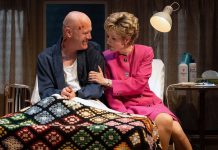
Michal Grzejszczak, James Barrett, and Mallory Brumm star in Globus Theatre's production of the romantic comedy "Buying the Farm" by Canadian playwrights Shelley Hoffman and Stephen Sparks, with 11 performances from September 25 to October 5, 2024 at the Lakeview Arts Barn in Bobcaygeon. The production coincides with the annual International Plowing Match & Rural Expo, which takes place this year at the Lindsay Exhibition Fairgrounds from October 1 to 5. (Photo: Rebecca Anne Bloom)
For the first production of its fall season, Globus Theatre in Bobcaygeon is presenting the romantic comedy Buying the Farm by Canadian playwrights Shelley Hoffman and Stephen Sparks for 11 performances from September 25 to October 5.
It’s no coincidence that Globus Theatre’s artistic producer James Barrett and artistic director Sarah Quick chose to open the fall season with a made-in-Ontario play about a family farm.
The production overlaps with the annual International Plowing Match & Rural Expo (IPM), which takes place this year at the Lindsay Exhibition Fairgrounds from October 1 to 5. The largest agricultural and rural expo in all of North America, the event is a celebration of agriculture and rural living.
“When we started planning the International Plowing Match for 2024 in Lindsay, I knew that I wanted it to be something that created special events across the Kawartha Lakes,” says Bob Armstrong, chair of the IPM 2024 local organizing committee.
“So I spoke to James and Sarah about putting on a play at the same time as the International Plowing Match and I’m delighted they have selected to produce Buying the Farm. I think this show is perfect because it is a great connection to agriculture and the rural landscape we love in the Kawarthas.”
Advertisement - content continues below
In Buying the Farm, Brad Deacon (played by Globus newcomer Michal Grzejszczak) is a young real estate agent from the city trying to prove himself to his father. Wearing a plaid button-down shirt, $200 jeans, and lizard skin cowboy boots, he arrives at the Bjornson family farm convinced he can persuade old bachelor farmer Magnus (James Barrett) to finally sell the farm, succeeding where other agents have failed.
With Magnus facing mounting debt and with his farm surrounded by suburban developments, it appears that Brad may indeed succeed — until he meets Magnus’ high-spirited and secretive great niece Esme (played by Globus newcomer Mallory Brumm) who is unwavering in her resolve that the farm is not for sale.
Buying the Farm was written by Toronto-based wife-and-husband Shelley Hoffman and Stephen Sparks. Hoffman, who describes herself as a “recovering actor,” is a Gemini-award winning scriptwriter and showrunner of children’s television, while Sparks has been a professional actor for more than 35 years.
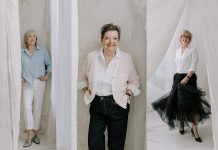
“Buying the Farm” playwrights Shelley Hoffman and Stephen Sparks. The Toronto-based couple were inspired to write the play based on Sparks’ youth growing up on a farm. (kawarthaNOW collage of photos courtesy of the playwrights)
In 2016, Sparks pitched his wife on an idea for a play that drew upon his youth growing up on a farm.
“One morning, I said something about a story that has to do with a kid on the farm and how the sale of their farm went,” Sparks said in a 2020 interview with Constance Scrafield of the Orangeville Citizen. “I often work in regional theatres and I’m often aware of farm land. Shelley is the driving force — she said, ‘I want to write this.'”
Three years after that pitch, Buying the Farm premiered at the Port Stanley Festival Theatre, and went on to hit productions at the Royal Manitoba Theatre Centre and other venues across Manitoba, as well as at Thunder Bay’s Magnus Theatre, Kincardine’s Blue Water Summer Playhouse, and more.
“Stephen and I are thrilled to have Buying the Farm brought to audiences in Bobcaygeon,” says Hoffman.
Advertisement - content continues below
While on the surface Buying the Farm is a light-hearted comedy, it reflects a serious issue increasingly affecting agriculture in Ontario. According to the 2021 census, Ontario is losing 319 acres of usable farmland every day to development, up from 175 acres daily in 2016. The play also touches on the struggles of maintaining family farms and the divisions between urban and rural life.
“This play was inspired by Stephen’s history of family farming and our road trips where we’ve seen acre after acre of farmland developed for housing,” Hoffman explains.
Buying the Farm runs for 11 performances from September 25 to October 5, with 8 p.m. shows from Wednesday, September 25th to Saturday, September 28th, and again from Tuesday, October 1st to Saturday, October 5th. There will also be two 2 p.m. matinee performances on Saturday, September 28th and Thursday, October 3rd. An optional dinner is available at 6 p.m. before the evening performances.
Tickets are $50 for the show only or $100 for dinner and the show, and are available by calling the box office at 705-738-2037 (toll free at 1-800-304-7897) or online at globustheatre.com.
A 17-year-old from Cavan-Monaghan Township is dead after he was struck by a vehicle in the west end of Peterborough early Saturday morning (September 14).
At around 3 a.m. on Saturday, police officers responded to a 9-1-1 call about a pedestrian who was struck by a vehicle in the North Monaghan Parkway and Dobbin Road area.
The driver of the vehicle remained on the scene and provided first aid to the teenager until first responders arrived.
Advertisement - content continues below
The teen was transported to Peterborough Regional Health Centre where he succumbed to his injuries.
The roadway was closed for about eight hours while the police investigated and documented the scene.
Police have not released the name of the victim or whether the driver is facing any charges.
The opinion piece is by Peterborough medical officer of health Dr. Thomas Piggott and Camp Kawartha executive director Jacob Rodenburg.
With kids back to school, fall colours will soon change and birds will begin their migratory journeys. This year, a daily migration of cell phones will not be happening. In Ontario and across the country, provinces are creating or reinforcing cell phone bans in the classroom.
There is a clear educational benefit and need to decrease screen time for concentration. But we want to spend a little bit of time in this column talking about another aspect: the importance of decreased screen time for health.
Kids in 2024 are more plugged in and preoccupied by screens than any previous generation. The average North American child spends 2,738 hours in front of a screen time per year. To put in perspective, that is almost 1.5 times a ‘9 to 5’ job.
Advertisement - content continues below
What kids have gained in connectedness to the global internet and network of people and information, they have lost in connectedness to the nature around them. These days our kids are inside, sitting passively in front of a world sealed behind glowing, two-dimensional screens.
What did you do with these 2,738 hours when you were a kid?
We remember playing outside. Unstructured play, flourishing, imagining time in the woods or fields, playing with other kids, and connected to the environment around us. When we played, we cooperated, we used initiative, we solved problems and entertained ourselves. Outside all of our senses were activated — we experienced the colours, smells, and sounds of the season, which made us feel more a part of the world around us.
The loss of this connectedness is sometimes called “nature deficit disorder.” While this might not be an official medical diagnosis, the consequences of screen time and the loss of time outside from a health standpoint are quite apparent.
Children under two years of age that have screen time is particularly concerning. The Canadian Pediatric Society recommends no screen time at all before that age and very limited from two to five years old. The health risks associated with screen time this early in life include obesity, sleep, deprivation, impairment to reading skills, language, development, and social skills, difficulties with attention, and vision problems.
Advertisement - content continues below
For older children and adolescents, increased screen time is associated with a decreased attention span, decreased emotional stability, and mental illness. In one study, adolescents that had high screen time versus low screen time were twice as likely to have a diagnosis of depression or anxiety.
We live in a digital world. It is likely unreasonable to limit screen time altogether in older kids, especially as they are used for homework or other important activities. Cell phone bans are clearly important for education and health, but banning screens at school is not enough. Video games or other screen time at home can quickly add up.
From a public health perspective, we know that focusing on improving health — not just preventing diseases — is important.
Similarly, rather than just banning screen time, we should be thinking about how to make screen time more irrelevant, less of a draw.
This is where the treatment for nature deficit disorder comes in: nature. Richard Louv, the author of the Last Child in the Woods – Saving our Children from Nature Deficit Disorder calls time spent in nature “Vitamin N”.
Advertisement - content continues below
Exposure to the outdoors at a young age brings not only decreased screen time, but tremendous health benefits. Nature improves mood, decreases the risk of chronic disease, and improves psychological well-being. Research has also shown that simply seeing the colour green increases our serotonin levels (the feel-good hormone). Breathing in forest air has been associated with a boost to immune systems.
Perhaps most importantly, kids who spend time outside report feeling happier.
This is not only a benefit for our health, but for our environment as well. Children that spend more time in nature grow up to care deeply about it. They become environmentalists and are interested in restoring and protecting the nature around us for generations to come. They understand the connection that our health has with the health of the environment around us.
And so as we are back to school and cell phones are banned, let us think not just about decreasing screen time, but about inspiring a love of nature in children and in the child in all of us. With some luck, nature can help to re-occupy the space that screen time has stolen.
Advertisement - content continues below
We are blessed with a beautiful natural environment around the Peterborough/Nogojiwanong region — get out and explore!
As families, we can take our children outside on a regular basis so that they can come to know and love a natural place. As teachers, we can explore and learn from our schoolyard or a nearby park. We can visit local outdoor centres. As adults, we too can reconnect with the living systems that nourish us by taking walks, biking, or just relaxing in nature.
Let’s also remember that each one of us occupies a space and we have a choice. We can either make this space worse, the same, or better. We can collectively bring nature back to our school grounds, backyards, and places where we work by rewilding, planting native species, and creating natural corridors. When we teach children this ethic, we leave a legacy of stewardship that will endure for years to come.
If you’re interested in learning more about nature, activities for your children, grandchildren, or friends, see the Pathways to Stewardship & Kinship materials freely available at pathwayproject.ca.
Dr. Thomas Piggott is medical officer of health and CEO of Peterborough Public Health. Jacob Rodenburg is executive director of the local not-for-profit educational organization Camp Kawartha and author of a number of books on nature and stewardship.
Northumberland County council has hired a consultant to complete a review of police services in Northumberland, which encompasses looking at one police service for the entire county instead of the current three: the Port Hope Police Service, the Cobourg Police Service, and the Ontario Provincial Police's Northumberland detachment with locations in Cobourg, Brighton, and Campbellford. (kawarthaNOW collage of police service photos)
Northumberland County council will take a look at the findings of a study exploring police services in Northumberland, including the concept of having one county-wide force, during its next regular meeting of county council.
The results of the Northumberland County Police Services Review study will be before council on Wednesday (September 18). The county council meeting begins at 9:30 a.m. at county headquarters in Cobourg on Courthouse Road and is also accessible on the county’s YouTube channel and can be joined through Zoom.
StrategyCorp, the consultant hired by the county to undertake the review, completed the study following a four-month process that kicked off in April. Council requested the study be completed to assess current policing practices across Northumberland County and explore potential future service delivery models.
Advertisement - content continues below
Municipality of Brighton Mayor Brian Ostrander, who currently serves as the warden of Northumberland County council, earlier told kawarthaNOW that having one county-wide police force for Northumberland instead of three separate services was worth a second look.
Ostrander said he proposed to council the motion of updating the 2007 study on the same issue for a few reasons.
“It showed there could be some fairly significant savings if there was an amalgamated service or one contract across the county,” Ostrander told kawarthaNOW. “I wondered if it was of interest to have that study updated, and it was.”
Advertisement - content continues below
As local municipalities prepare for anticipated regional population growth of 35 per cent over the next 25 years, findings from this study are intended to “support informed decision-making around future policing services,” Northumberland County noted in a media release.
Currently in Northumberland County, the Cobourg Police Service serves the Town of Cobourg, the Port Hope Police Service primarily serves the urban area of the Municipality of Port Hope, and the OPP’s Northumberland detachment (with locations in Cobourg, Brighton, and Campbellford) serves the rural area of the Municipality of Port Hope, along with Hamilton Township, Alnwick-Haldimand Township, Cramahe Township, the Municipality of Brighton, and the Municipality of Trent Hills.
At the meeting, council will review the study that looks at existing service models — considering service levels, operational costs, and evolving community needs — and identifies options for future service delivery.
The review was expected to encompass stakeholder interviews and a thorough evaluation of current policing service levels, operational costs, and existing revenue streams. The goal was to provide recommendations for future service delivery based on options ranging from maintaining existing service structures to consideration of a combined model, the county noted.
Advertisement - content continues below
Following discussion, county council will decide whether to move forward with the second phase of the project, which would involve a full costing of alternative service delivery models identified in the study.
“Ultimately, any changes to local policing models would be at the discretion of each lower-tier municipality, with whom jurisdiction for police services resides,” the county noted.
To learn more about the police services review study, and to access the report being presented at the meeting, visit joinin.northumberland.ca. For the agenda of the September 18 meeting and instructions on how to watch the meeting or join via Zoom, visit northumberland.ca/council.
Having a Pride event of its very own is critical for the village of Lakefield, according to the Lakefield Pride Committee. The Lakefield Pride Picnic, an annual family event founded in 2021, takes place on September 22, 2024 in Isabel Morris Park and includes a march from the park through the village. (Photo: Lakefield Pride / Facebook)
Rebecca Rose, a member of the Lakefield Pride Committee, vividly remembers her encounter with a local senior during the first Pride picnic in the village of Lakefield.
The woman, who Rose had previously met, introduced her non-binary adult child to Rose at the event.
“(The mother) doesn’t drive, and lives at the local senior citizens’ apartments,” Rose told kawarthaNOW. “Her entire community is Lakefield. When her child expressed their identity to her, she didn’t understand, she was afraid, and worried for her child. She didn’t share with any of her peers as she felt shame.”
Advertisement - content continues below
Share on Bluesky
“She believed something was wrong with her child, and wondered how she had gone wrong,” Rose added. “A few hours at our picnic and she left armed with information, reassurance, pamphlets, and the knowledge that her adult child was okay. She was full of pride and happiness, and most of all, relief.”
The encounter, according to Rose, remains one reason why having a Pride picnic in Lakefield each year is critical for the village.
While the Lakefield Pride Committee participates in the Peterborough-Nogojiwanong Pride’s Pride Week from September 20 to 29, Rose says it’s also important for the village to have its own event.
Committee members are getting ready for the fourth annual Lakefield Pride picnic, which is slated for Sunday, September 22. The event runs from 11 a.m. to 3 p.m. at Isabel Morris Park, which is located at 20 Concession St. in Lakefield.
“Even though Lakefield is only a short car ride from Peterborough, it is its own community and often those who live there are isolated to it,” Rose said. “If we can reach one person every year who learns something, or feels safer, or more included, then this project is worth everything we put into it.”
There are kids in Lakefield who face bullying from other young people and the adults around them, Rose noted.
Advertisement - content continues below
“Our event arose out of criticism a mother received while her young son was innocently playing dress-up in his sister’s princess dresses in the front yard one day, and news articles about a Pride flag being burned at a school in a neighbouring town,” Rose explained.
According to Rose, the Lakefield Pride picnic was primarily an initiative of young people who grew up and live in the village and want to make a difference.
“By supporting them to create this event, they are empowered to be the change they want to see in the world,” Rose said.
Advertisement - content continues below
As for the woman with a non-binary child, attending the Lakefield Pride picnic was an important local support for her in understanding and learning to accept her child’s identity.
“This mother would never have had the ability or occasion to attend any of the other Peterborough Pride events, as she is exclusively a pedestrian, and had not told anyone she knew about her concerns,” Rose pointed out.
This year the Lakefield Pride Committee is hoping for, as always, great weather and a large community turn out.
“We really just want to create a great experience for our community to share love and kindness for all,” Rose said.
The Peterborough Theatre Guild presents Ben Muir's "How to Survive a Zombie Apocalypse" and Marni Walsh's history-based drama "Ghost Story" for 10 performances from September 20 to October 5, 2024. (Graphic: Peterborough Theatre Guild)
For the first production of its 2024-25 season, the Peterborough Theatre Guild is presenting a double-header of two one-act plays: the world premiere of the history-based drama Ghost Story by Marni Walsh and the interactive farcical spoof How to Survive a Zombie Apocalypse by Ben Muir. The two plays run for 10 performances from September 20 to October 5
Ghost Story focuses on two famous historical Marys, who happen to be mother and daughter. Mary Wollstonecraft was an 18th-century British writer, philosopher, and advocate of women’s rights who wrote one of the earliest works of feminist philosophy, 1792’s A Vindication of the Rights of Woman. Her daughter, Mary Shelley (nee Gowan), is best known as the author of the 1818 Gothic novel Frankenstein; or, The Modern Prometheus, considered an early example of science fiction.
The two women never actually knew one another, as Mary Wollstonecraft died at the age of 38 only 11 days after giving birth to her daughter, Mary Wollstonecraft Gowan. Mary was raised by her father, political philosopher William Godwin, who provided her with a rich albeit informal education.
Advertisement - content continues below
When Mary was a teenager, she met the Romantic poet and philosopher Percy Bysshe Shelley and, in 1816, the couple and Mary’s stepsister Claire Clairmont famously spent a summer with poet Lord Byron and his physician John William Polidori near Geneva in Switzerland. During the miserable weather, which was cold and rainy due to volcanic ash from an eruption in the Dutch East Indies the previous year, the group amused themselves with German ghost stories, which prompted Byron to propose that they each write their own ghost story.
Unable to come up with a ghost story, 18-year-old Mary was anxious for days until — after the group discussed the scientific phenomenon where muscles of dead creatures could be made to move when jolted with an electric current — she had a terrifying “waking dream” about a manufactured creature that is brought to life, leading her to write her famous novel.
In Ghost Story, Mary Shelley seeks advice at the grave site of her mother where, “the words of their works shine a light on their lives and the themes that still resonate today,” according to a description of the play.
British writer, philosopher, and advocate of women’s rights Mary Wollstonecraft and her daughter Mary Wollstonecraft Shelley (nee Gowan), author of “Frankenstein; or, The Modern Prometheus.” (Public domain photos)
“They’re both incredible women and their lives are just ripe with theatre,” says playwright Marni Walsh in a video for the Peterborough Theatre Guild. “Both Mary Shelley and her mother Mary Wollstonecraft were feminists. Both were very interested in the rights of all people, not just woman, but equality for all.”
“Mary Shelley had a very specific interest in science and the concern that science would go too far and too fast and that the world would suffer for it. These women warned us and their warnings are very pertinent right now. I think that we could learn from history and we should be listening to these voices once again.”
A resident of Melancthon in Dufferin County, Walsh has been an actor, director, and playwright for over 40 years. In 2020, she and Debra Hale founded Act 3 Theatre, a professional collective of women theatre artists over 55 which has performed original shows at Aki Theatre, Alumnae Theatre, Crest Theatre Green Room, the Toronto Fringe Festival, Theatre Collingwood, Orillia Opera House, and Theatre Orangeville.
Produced by Jen Eve, Ghost Story stars Carling Dulder, Lisa Guthro, Aimee Hindle, Millie Martin Thorne, and Julie Mereweather and is directed by Lee Bolton who, as well as being a director, playright, and teacher, has been an arts administrator including for the Peterborough Symphony Orchestra and the Nogojiwanong Indigenous Fringe Festival. She previously directed Walsh’s The Trial of Rosie McDougall at Toronto’s Red Sandcastle Theatre.
Advertisement - content continues below
As Britain’s famous sketch comedy Monty Python would say, the second one-act play of the Peterborough Theatre Guild’s season-opening production is something completely different.
First staged in 2019, How to Survive a Zombie Apocalypse by British writer Ben Muir was a fringe festival hit and has since spawned a best-selling book, a top-ranking podcast series, a monthly magazine column, two sequels, and more.
In the play, leading zombie expert Dr. Dale Seslick of the School of Survival and his three inept assistants take audience members through an interactive seminar that not only teaches them how to survive the undead, but tests them to determine which person in the audience will be the ultimate survivor.
The cast of the original fringe production of Ben Muir’s “How to Survive a Zombie Apocalypse.” (Photo: Attic Door Productions)
Produced by Marion Griffin and directed by Margaret Monis, the Peterborough Theatre Guild production features John Austin as Dr. Dale, the cool and collected seminar leader who is fluent in zombie survival lore and is never stumped for an answer, Andrea Lane as Judy O’Dea, Dr. Dale’s second in command who attempts to keep the rest of the team under control, James Burrell as Donald Straite, an older survivalist who has followed every conspiracy theory in the book and has attempted and succeeded many difficult training exercises, and Peter Symington as Tristen Granger, Dr. Dale’s nephew who has absolutely no idea what is going on during the seminar.
In the tradition of British farce, expect a lot of fast-paced wacky humour and, because the play is an interactive seminar, lots of audience participation.
Ghost Story and How to Survive a Zombie Apocalypse run at the Guild Hall at 364 Rogers Street in Peterborough’s East City from September 20 to October 3, with performances at 7:30 p.m. on September 20 and 21, 26 to 28, and October 3 to 5, with 2 p.m. Sunday matinee performances on September 22 and 29.
Advertisement - content continues below
Assigned seating tickets are $30 for adults, $27 for seniors, and $20 for students and are available by calling 705-745-4211 or online at www.peterboroughtheatreguild.com.
For the September 21 and October 3 performances, the Peterborough Theatre Guild is offering a “bring a friend” discount where you can get a complimentary ticket with the purchase of one regular ticket by using the promo code FRIEND when ordering online.
kawarthaNOW is proud to be a media sponsor of the Peterborough Theatre Guild’s 2024-25 season.
A think tank of Peterborough family doctors is hoping to help solve some of the issues related to recruiting and retaining physicians. The group was formed by Dr. Madura Sundareswaran, a family physician who opened her practice in Peterborough in 2019 and founded the Peterborough Newcomer Health Clinic in 2023. She lives in Peterborough with her husband, Dr. Mathew Moore, who is also a family doctor. In March 2024, Dr. Sundareswaran received an award from the College of Physicians and Surgeons of Ontario that honours outstanding Ontario doctors. (Photo courtesy of Peterborough Newcomer Health Clinic)
A group of doctors in Peterborough has created a physician think tank with the hopes of healing what ails the primary care sector, which is currently in the state of an “escalating crisis,” one physician says.
Dr. Madura Sundareswaran, the Peterborough family doctor who formed the think tank, said the group is necessary to uncover new solutions to meet the growing shortage of family doctors in the city and elsewhere. The think tank meets regularly to identify challenges and brainstorm strategies with the hopes of finding a remedy for the fragile primary care component of the health care system.
“This group aims to strengthen the sense of community among physicians and advocate for changes in the community to maintain access to primary care,” Dr. Sundareswaran said in a media release.
Advertisement - content continues below
Share on Bluesky
Earlier this summer, the think tank generated a report proposing a collaborative, multi-systems level strategy that could be used to guide future recruitment and retention efforts.
“The think tank hopes to work alongside the City of Peterborough to support its recent commitment to physician recruitment and retention,” Dr. Sundareswaran added.
Dr. Sundareswaran, who earlier this year received an award from the College of Physicians and Surgeons of Ontario that honours outstanding Ontario doctors, shared with kawarthaNOW her motivation for the initiative.
“Our local family doctors have all been impacted by the numerous family physician retirements and practice closures in our community over the last few years — the ever-increasing administrative burden, burnout and operational expenses continue to threaten the future of our profession,” Dr. Sundareswaran said.
“Despite this, Peterborough is made up of a strong group of family physicians who continue to enjoy their work, are passionate about what they do, and dedicate time and resources to train the next generation of family physicians.”
The think tank aims to identify and address community-level challenges of administrative and systemic barriers “that threaten the future of the profession and compromise direct patient care,” Dr. Sundareswaran said.
“The solution to successful family physician recruitment and retention cannot lie on the shoulders of a single entity, but requires collaboration between various stakeholders including but not limited to the City of Peterborough, the provincial government, and family physicians themselves.”
She hopes to foster a sense of community among family physicians and support local recruitment and retention efforts. Being involved in the think tank is a unique endeavor for many of its participants and encourages both physician leadership and advocacy, the doctor added.
Advertisement - content continues below
Share on Bluesky
The think tank’s report shares perspectives on recruitment efforts to date and highlights potential solutions to help strengthen the recruitment and retention efforts within the community. Dr. Sundareswaran is hopeful the report can serve as a guideline for organizations, such as local government, which have identified physician recruitment as a priority.
The report shares feedback on recruitment efforts to date and “provides tangible solutions for a community-focused physician recruitment strategy.” Physicians share perspectives on incentive programs and stress the need for programs that support both new and existing family physicians.
“Family physicians are hoping for a more transparent, collaborative, and reliable recruitment strategy in the future, and hope to work with the City of Peterborough in the upcoming months to achieve this,” Dr. Sundareswaran said.
Advertisement - content continues below
“By creating specific, community-focused goals, the think tank aims to … support physician-led initiatives to improve the local landscape of primary care,” Dr. Sundareswaran added. “In doing so, the think tank lends itself to become an innovative and productive recruitment and retention tool for family physicians.”
Each think tank session draws between 15 and 25 participants.
Since launching this initiative, the group has created resources for family physicians, including letter templates to standardize communication with community partners and a database of local referral destinations. The think tank has also advocated for changes in how referrals and letters are received between primary care and partner institutions.
Advertisement - content continues below
Share on Bluesky
“By being independent, the think tank aims to provide an objective forum and unify the voices of our local family physicians in a way that does not yet exist,” Dr. Sundareswaran said.
In response to the growing family physician shortage, the think tank is motivated to find solutions to mend “the escalating crisis,” she added.
The think tank is also working on strategies to retain physicians, which is another big challenge. Read more in an upcoming article in kawarthaNOW.
Barb Callander's photo of a pair of curious river otters in a wetland feeding Balsam Lake was the judges' favourite winner in the namesake category of the 2024 Lake Biodiversity Photo Challenge. (Photo: Barb Callander)
A photo by a Kawartha Lakes woman is one of eight winners of this year’s national Lake Biodiversity Photo Challenge.
Barb Callander’s photo of a pair of curious river otters in a wetland feeding Balsam Lake was selected as a judges’ favourite in the namesake category of the fourth annual challenge organized by hosted by Living Lakes Canada, an award-winning water science and stewardship non-profit organization.
“The lake system is under pressure from increased nutrient loading and invasive species,” Callander wrote as part of the caption for her photo.
Advertisement - content continues below
Nearly 450 photos were submitted for the 2024 challenge, which celebrates lakes across Canada and raises awareness around what’s threatening their biodiversity.
Judges’ favourites and public favourites were selected in each of four categories — lake landscapes, lake biodiversity, and lake impacts, along with a youth category — for a total of eight winning shots from across Canada, plus a special mention.
The judges’ favourites were selected by a panel of Living Lakes Canada team members and photo challenge partners and prize sponsors, and the public favourites were selected based on 1,228 votes.
This photo by Adam Benn of a cedar waxwing enjoying the Vaseux Lake Migratory Bird Santuary in Okanagan, B.C. was voted the public favourite winner in the namesake category of the 2024 Lake Biodiversity Photo Challenge. (Photo: Adam Benn)
The full list of winners is below.
Judges’ Favourites
Lake Landscapes Category: Mario Mailloux, Lanaudière region, QC
Lake Biodiversity Category: Barb Callander, Kawartha Lakes, ON
Lake Impacts Category: Haolun Tian, Eastern Ontario
Kids Category: Zoe Bystrov, Simcoe County, ON
Advertisement - content continues below
Public Favourites
Lake Landscapes Category: Andy Li, Banff National Park, AB
Lake Biodiversity Category: Adam Benn, Okanagan, BC
Lake Impacts Category: Tracey, Halladay, East Kootenays, BC
Kids Category: Neora Varghese, Southern Alberta, AB
Advertisement - content continues below
Special Mention
Sophie Sanfacon, Vancouver Island, BC
Each winner will receive the grand prize of an online photography workshop with professional photographer Viktoria Haak, Nikon Canada Ambassador and Kase Filter Global Ambassador, as well as prize packages with items from Kicking Horse Coffee, Lush, and Laykhaus.
Kawartha World Issues Centre's 35th anniversary fundraising celebration on October 29, 2024 at Market Hall Performing Arts Centre in downtown Peterborough will feature a keynote speech by award-winning anti-racism and Indigenous researcher and entrepreneur Larissa Crawford and a performance by Indigenous roots singer-songwriter Mimi O'Bonsawin. (Photos: Feather Photo and Jen Squires)
Peterborough’s Kawartha World Issues Centre (KWIC) is asking residents to “think global and act local” when it comes to making a meaningful difference in the community in Peterborough and beyond.
The charitable organization is hosting a milestone anniversary celebration and fundraiser on Tuesday, October 29 called “Think Global, Act Local: 35 Years of KWIC.” The event begins at 6 p.m. at Market Hall Performing Arts Centre in downtown Peterborough and will explore and celebrate KWIC’s history and provide a glimpse into the future for the organization.
Dr. Stephanie Rutherford, chair of the 35th anniversary committee and vice-chair of the board, told kawarthaNOW that KWIC has a few aspirations for the upcoming 35th anniversary affair.
Advertisement - content continues below
“Our hope is that this event will be a celebration of the three-and-a-half decades of KWIC advocacy to make our community a better place,” said Rutherford, who is also associate professor of environment and resource studies at Trent University.
“We want this be a joyful event, where people come together to recognize our successes and recommit ourselves to making positive change in Peterborough and beyond. We also hope this event will be an opportunity for those less familiar with KWIC to learn about our work and build our community.”
The event features a keynote speech by award-winning anti-racism and Indigenous researcher and entrepreneur Larissa Crawford, addressing the importance of youth voices in the fight for social and environmental justice.
“Crawford proudly passes on Métis and Jamaican ancestry to her daughter, Zyra, and is a published Indigenous, anti-racism, and climate justice researcher, policy advisor, and restorative circle keeper with over 15 years of experience,” a media release noted. She is also the founder of Future Ancestors Services, a social impact and sustainability consulting firm that aims to advance systemic barrier removal through anti-racism and ancestral accountability.
Advertisement - content continues below
The event will also feature a performance by Mimi O’Bonsawin, a contemporary roots singer-songwriter born in northeastern Ontario with mixed French Canadian and Abénaki heritage, and a member of Odanak First Nation.
“Through her rhythm and story-driven songs, Mimi’s music embraces the beauty of Land,” the release said.
KWIC has been invested in creating change in Nogojiwanong/Peterborough and in the surrounding areas since 1989, and has engaged with causes such as the UN’s sustainable development goals, food justice, gender equality, and climate justice.
Advertisement - content continues below
The centre’s work currently focuses on empowering youth to become changemakers through skill development and education opportunities such as mentorship programs, in-school workshops and placements. KWIC invites all community members to join the organization in the quest to Think Global, Act Local and share in conversation about the future of advocacy and the role of young people in creating change.
Residents can attend the event and also support KWIC’s ongoing fundraising efforts by participating in the silent auction, which features a variety of donated prizes including personal training sessions, a Yankee Candle gift hamper, and some exclusive vintage KWIC swag.
Looking ahead, Rutherford provided a preview of KWIC’s future goals.
“The primary focus of KWIC will continue to be to mentoring local youth changemakers to take action on global issues, creating a more just and sustainable world,” she said. “In line with our new strategic plan, we will empower youth and community members to take action through mentorship and community education that connects global issues to local initiatives.”
“Over the next 35 years, KWIC’s focus will be expanding its network of youth changemakers while continuing to empower a new generation of young people to lead the way toward a more just, equitable, and sustainable world.”
For more information about Kawartha World Issues Centre, visit kwic.info.
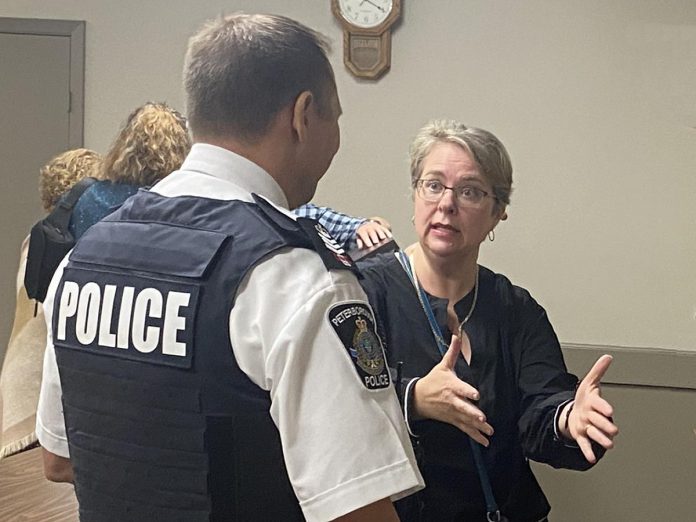
Peterborough Police Service Staff Sergeant Mark Reesor listens to an Ashburnham Ward resident following a public meeting on community safety at the Peterborough Lions Community Centre in East City on September 11, 2024. (Photo: Paul Rellinger / kawarthaNOW)
If anything was abundantly clear Wednesday night (September 11) at the Peterborough Lions Community Centre in East City, it’s that the city that earlier generations called home is long gone and there’s no chance of a comeback.
Manufacturing giants are long departed, infrastructure is straining under increased traffic, and barely a week passes without word that a long-established business is either closing or relocating. Then there’s crime.
But as the audience of some 120 people gathered at the Burnham Street meeting place were well aware, it’s the types of crime that is causing the most concern. Residential and vehicle break-ins are all too common, making all, regardless of where they live, more susceptible to being a victim.
Advertisement - content continues below
Share on Bluesky
On this night, crime and police enforcement in Area 4 — a police-designated sector that encompasses Ashburnham Ward as well as south Peterborough west to past Monaghan Road — was the focus during a community meeting called for by resident Kelly King and subsequently organized by Ashburnham Ward councillors Keith Riel and Gary Baldwin.
Peterborough Police Service Staff Sergeant Mark Reesor was the keynote speaker, but Chief Stuart Betts made a surprise appearance.
After providing a lengthy review of the organizational structure of the city police service, which is comprised of 148 deployable officers and 80 civilian staff, Staff Sgt. Reesor revealed that occurrences of violent crime in the city, as measured by the national Crime Severity Index, have dropped by one per cent since 2022.
Further, also since 2022, there has been a reduction of more than seven per cent in non-violent crimes. Combined, Peterborough has seen drop of just more five per cent, ranking 21st out of 45 Ontario municipalities, with one being the worst ranking.
Not surprisingly, that revelation came as a surprise to most on hand.
“We would love to see those numbers drop more,” said Staff Sgt. Reesor. “But the fact they’re going down, and trending down, doesn’t mean that the work is done — but it’s certainly trending in the right direction.”
Around 120 people gathered at the Peterborough Lions Community Centre in East City on September 11, 2024 for a public meeting on community safety where Peterborough Police Service Staff Sergeant Mark Reesor made a detailed presentation on the police service and crime statistics in the city. (Photo: Ashley Bonner / East City Peterborough Facebook group)
Despite that overall decrease, city police are responding to significantly more calls.
From January 1 to the end of August, officers responded to 26,699 occurrences, which is a sizable jump of 10 per cent over the same period in 2023. However, just 16.5 per cent of those occurrences — 4,415 — were “criminal in nature.”
During the same period, 3,079 criminal charges were laid, a 33 per cent increase over the same time frame in 2023. Broken down further, charges laid for theft under $5,000 are up 61 per cent this year, followed by failure to comply with probation (up 53 per cent), and possession of property obtained by crime (up 39 per cent).
According to Staff Sgt. Reesor, most of the calls that police are responding to aren’t related to crime at all.
“What are they? They are a whole bunch of different things. It could be a neighbour dispute, which isn’t criminal. It could be an unwanted person. It could be a motor vehicle accident. It could be somebody asking for information or advice. There’s a ton of different types of calls that we respond to.”
“When somebody calls and says ‘I need help,’ we go because often there’s nobody else to go. It may not be our primary job or role, but when somebody calls and asks for help they expect somebody to show up. That’s us because no one else is often responding.”
Advertisement - content continues below
Share on Bluesky
Meanwhile, referring specifically to Area 4, Staff Sgt. Reesor noted officers have responded to 6,045 occurrences this year, again to the end of August — a 12 per cent jump over the same period last year. Close to 20 per cent of those occurrences — 1,197 — resulted in criminal charges being laid.
“There’s a real mix in this area of town,” said Staff Sgt. Reesor. “We’ve got schools. We’ve got businesses. We’ve got residential, and we’ve got industrial. It just creates a lot of different dynamics. That’s not unique to this area, but it certainly plays into how we respond to calls and what takes up a lot of our time.”
The good news, noted Staff Sgt. Reesor, can be found in the early success of the police service’s Community F.I.R.S.T. (Community-Focused Investigation Response Support Team) unit. Launched in January as a year-long pilot program and comprised of four frontline officers, its sole responsibility is to investigate property crimes involving both residences and businesses.
This year has seen Community F.I.R.S.T. respond to 1,149 calls and recover $31,414.80 in stolen property as well as 112 shopping carts, more than 20 bicycles, and a handful of green organic waste bins.
“Community F.I.R.S.T. is dealing with what would be triaged as low priority (crime), meaning there not an immediate safety risk,” Staff Sgt. Reesor noted. “Thefts are typically in this category.”
“If somebody breaks into your car overnight and steals a bunch of stuff, it’s important to us, but we may not have an officer available at that time to send right away because of our call volumes. This unit follows up on those types of calls.”
Peterborough police chief Stuart Betts addresses the crowd during an Ashburnham Ward community meeting on September 11, 2024 at the Peterborough Lions Community Centre in East City. (Photo: Ashley Bonner / East City Peterborough Facebook group)
Staff Sgt. Reesor also spoke at length on the service’s Safer Public Spaces initiative. When it was launched in October 2023, it made Peterborough one of just two Canadian police jurisdictions that has adopted a zero-tolerance approach to the use of illicit drugs in public.
Staff Sgt. Reesor drew the meeting’s loudest reaction when he noted Chief Betts has directed “our primary function as a police service is public safety.”
That said, officers encountering someone using an illicit substance in public is first asked to go the Consumption and Treatment Site at 220 Simcoe Street in downtown Peterborough, where he or she can do so legally while begin medically supervised. As a result, of the 395 calls responded to under the program, only 13 arrests have been made, and those for non-drug related reasons.
Share on Bluesky
“When the public doesn’t feel safe, that’s a problem,” acknowledged Staff Sgt. Reesor. “You should have the right to be safe and feel safe. That’s specifically what this program is geared towards. When we get a call about somebody using drugs in an open public space, we will respond and we will deal with that person.”
“That doesn’t mean we’re going to show up and arrest the person, but we’re going to speak with that person and let them know that that behaviour is not appropriate — that we’re not going to tolerate it. Then we’re going to direct them to services that are available in the community. The idea of just pushing them down the road isn’t effective.”
Staff Sgt. Reesor said 78 of the 395 calls for open air drug use were in Area 4. And of the total, 361 calls were resident-initiated.
“That’s good,” he pointed out. “We don’t have the resources to be everywhere. There’s a lot of people in this room, and in Peterborough, that see things. We want to know what’s going on so we can deal with it.”
Advertisement - content continues below
Share on Bluesky
Finally, Staff Sgt Reesor addressed what is perhaps the most contentious issue for many city residents: tenting.
“If it happens on city property, city bylaw enforcement is the primary responding agency, not the police,” he clarified. “If they require our assistance, they’ll call us and we’ll go and assist them. But our primary purpose, our mandate, isn’t to be dragging people in tents off of public property. Same with bus shelters.”
Somewhat surprisingly, when questions were opened up to the audience, there was little concrete criticism — contrary to what you might see on social media — of city police’s performance. However, there were requests for clarifications about police procedures and initiatives outlined earlier by Staff Sgt. Reesor.
After the meeting, he told kawarthaNOW that the meeting turnout alone provided encouragement for a police service that is tasked to do more with less due to budget restraints.
“When people don’t show up, it means they’ve stopped caring,” Staff Sgt. Reesor explained. “So to see this many people is great. It shows us that people still care. People want to see our community get better.”
Advertisement - content continues below
Share on Bluesky
He added that the changing make-up of communities across the province, Peterborough included, is a fact of life that is a factor in the occurrences of certain types of crime and how police services adapt to meet the challenges presented.
“I grew up in Peterborough — I remember when it was different than it is now,” Staff Sgt. Reesor said. “Maybe (we) were a little bit more ignorant to the things that were going on back then, but we have seen a shift in this community. It is disappointing and sad to see that shift. I think that certainly spurred a lot of the people to come tonight.”
Although he did not specifically address it when speaking from the podium, Staff Sgt. Reesor implied that crime prevention begins with the exercising of common sense.
“We can only be so many places at a time,” he said of the police. “A couple of the programs I talked about tonight are geared toward providing people with information about how they can reduce the risk of crime at their residence or business.”
“Absolutely people need to take steps in order to reduce the risk of crime. There’s a place for police — our presence and other things play into efforts to reduce overall crime — but we can’t be everywhere, so it is partly on individuals and businesses as well.”
kawarthaNOW.com offers two enews options to help readers stay in the know. Our VIP enews is delivered weekly every Wednesday morning and includes exclusive giveaways, and our news digest is delivered daily every morning. You can subscribe to one or both.
Submit your event for FREE!
Use our event submission form to post your event on our website — for free.
To submit editorial content or ideas, please contact us.