















Home Blog Page 609

Three filmmakers talk about their films screening at the 2021 ReFrame Film Festival

In summer of 2017, filmmaker Suzanne Crocker (bottom right) and her family started their year-long quest to feed themselves from food gathered, grown, and hunted close to their home in the Yukon. In "First We Eat", which screens at the 2021 ReFrame Film Festival, Crocker explores their journey and the complexity of improving local food security in the far north. (Photo: Alex Hakonson)

The first-ever virtual 2021 ReFrame Film Festival takes place from January 22 to 29 and features almost 50 documentaries of various lengths.

The aim of the festival is to inform and engage our community in social and environmental topics through film.

Below are selections from interviews with three of the filmmakers whose films are screening during the festival. Full transcripts of each interview are available at greenup.on.ca/reframe-2021-interviews/.

Advertisement - content continues below


Olivia Mater on “Starborn”

Olivia Mater is the filmmaker behnd the short film "Starborn", a haunting and poetic reflection of our current struggles as interpreted 50 years in the future by a grandmother speaking to her grandchildren. The film screens at the virtual ReFrame Film Festival, which starts Friday, January 22 and runs to Friday, January 29. (Photo courtesy of Olivia Mater)
Olivia Mater is the filmmaker behnd the short film “Starborn”, a haunting and poetic reflection of our current struggles as interpreted 50 years in the future by a grandmother speaking to her grandchildren. The film screens at the virtual ReFrame Film Festival, which starts Friday, January 22 and runs to Friday, January 29. (Photo courtesy of Olivia Mater)

Olivia Mater is an emerging filmmaker and a recent graduate from the Indigenous Studies program at Trent University.

Tell me about the setting of your film: where and when does it take place?

The film takes place 50 years in the future. The setting of the film is my parents’ backyard, on the homelands of the Saugeen Anishinaabeg. A grandmother is weaving a story for her grandchildren. [They are] gathered around a fire to hear the stories of [today], now, 50 years in their past.

We usually think of memory as something that only looks backwards, but your film asks us to imagine memories of the future. Why is that important to you?

As a settler here, that way of looking at time and looking at the world has been taught to me by the Indigenous teachers I have had in my life, and specifically Joanne Argue [at Trent University].

She was constantly beckoning us to think about time in a non-linear way, and think about what it means to live and exist while looking forwards and backwards at once. Every action we do now affects the ones who are not here yet.

We are also part of a lineage of ancestors who dreamed worlds into being so we could be. Our responsibility is to do the same.

Advertisement - content continues below


Suzanne Crocker on “First We Eat”

Suzanne Crocker is an award-winning filmmaker and retired family doctor. In "First We Eat", she documents her family's year-long commitment to feeding themselves from food found, hunted, and grown in and around her Yukon community. The film screens at the virtual ReFrame Film Festival, which starts Friday, January 22 and runs to Friday, January 29.  (Photo: Alex Hakonson)
Suzanne Crocker is an award-winning filmmaker and retired family doctor. In “First We Eat”, she documents her family’s year-long commitment to feeding themselves from food found, hunted, and grown in and around her Yukon community. The film screens at the virtual ReFrame Film Festival, which starts Friday, January 22 and runs to Friday, January 29. (Photo: Alex Hakonson)

Suzanne Crocker is an award-winning filmmaker living with her family of five in Dawson City, Yukon.

Why did you decide to eat 100 per cent local food for an entire year? Why not an incremental commitment to eat more local, or a commitment over a shorter period of time?

We are on the traditional territory of the Tr’ondëk Hwëch’in. I was inspired that Indigenous folks ate 100 per cent locally for thousands and thousands of years prior to colonization. Even a hundred or so years ago, when settlers first came to this area, Dawson was apparently able to produce 97 per cent of our food. Now 97 per cent of our food is trucked in from thousands and thousands of kilometres away.

My goal was to put food sovereignty to the test here in the north. I really wanted to know if we could still do this in this era. Rather than just research this academically or bring in a bunch of experts to talk about food sovereignty in the north, I thought one of the best ways would be to try it.

A lot of people are accustomed to a culture of rushing and convenience. How did those habits or tendencies change during that year?

There is this irony in life that the more modern conveniences we have in our life that are meant to save us time, the less time we seem to have.

There are some silver linings to slowing down in the kitchen, to actually making food and cooking. It can be a very meditative time.

VIDEO: “First We Eat” trailer

Can you share your reflections on the labour that was involved in getting your food for that year, and the implications of that labour and the financial costs of food more broadly in your community and around the world?

Speaking to financial costs, taking the labour costs out of the picture for a moment, I did track what it cost to purchase our food that year from local farmers [and found] it was more costly to eat 100 per cent local, by about 25 per cent.

What I also came to recognize that year was the cost to produce food. When we were buying things in the store that were less expensive — somewhere along that food chain from seed to plate — that cost was coming out at someone else’s expense. It is important to recognize that, if we are able, we should support and pay for the true cost of food.

Of course, not everyone is able to do that. It is important that those of us who are able, that we do. It is important that those people in positions of bigger procurement and buying power, also start promoting and sourcing their food locally.

Advertisement - content continues below


Karen O’Krafka on “Headwaters to Hearts: Education in Action”

GreenUP's Wonders of Water program is centre stage in the ReFrame Film Festival short "Headwaters to Hearts: Education in Action". In this photo, students at Ste. Anne's Catholic Elementary School in Peterborough can be seen transforming a section of their school yard to support the local watershed. (Photo: Anne Corkery)
GreenUP’s Wonders of Water program is centre stage in the ReFrame Film Festival short “Headwaters to Hearts: Education in Action”. In this photo, students at Ste. Anne’s Catholic Elementary School in Peterborough can be seen transforming a section of their school yard to support the local watershed. (Photo: Anne Corkery)

Karen O’Krafka coordinates GreenUP’s Wonders of Water program. She shares her thoughts on the GreenUP film “Headwaters to Hearts: Education in Action” and the project it features: a student-led project to transform the flood-prone area of a Peterborough school into a rain garden.

What is one lasting impact, for you, of the project and the film that came out of it?

This [Wonders of Water] project was especially poignant. I remember doing a sub-watershed tour with those leadership students on March 12, 2020; the day before the provincial lock-down came into effect. That was powerful.

They talk a lot [in the film] about that day, about the tour, about getting that really good sense of where the headwaters of Jackson Creek begin. They talk about ending the day where Jackson Creek flows into the Otonabee with a Sacred Water Ceremony with Curve Lake Elder Dorothy Taylor.

If ever we had to plan how to send kids into a turbulent and vulnerable time — not that we ever want to do that — but if we did, this is a beautiful way to do it.


For details about the ReFrame Film Festival, and to purchase all-access passes or festival 5-packs (where you can choose five films to watch), visit my.reframefilmfestival.ca.

kawarthaNOW is proud to be a sponsor of the 2021 ReFrame Film Festival.

Kawartha health unit ‘ready to go’ when region receives COVID-19 vaccine

The Haliburton, Kawartha Pine Ridge District (HKPR) Health Unit has completed a COVID-19 vaccine program and plans to submit it to Ontario’s health ministry later this week.

“We are ready to go as soon as we’ve got a vaccine available, with a focus on the residents, staff, and essential caregivers in long-term care,” the acting medical officer of health, Dr. Ian Gemmill, said during a virtual media briefing on Wednesday (January 20).

According to Dr. Gemmill, the program is based on the health unit’s past immunization plan. However, they have spent the last few weeks reviewing and revising it to be more specific to COVID-19.

Advertisement - content continues below


“It’s based on our previous experience of mass immunization, and the experience of others who have been running mass immunization in high-instance areas, who have already worked with coronavirus,” he said.

The program includes a plan for vaccine distribution to long-term care homes and high-risk retirement homes — the health unit’s priority when they receive the vaccine supply expected in early February. Healthcare workers will also be offered the vaccine as it becomes available.

“The next in line after long-term care homes, healthcare workers, and home-care patients will be other essential workers,” explained Dr. Gemmill. “People who have to work to keep our society going during this pandemic.”

The health unit will then distribute the vaccine to at-risk older adults, followed by all older adults, followed by the general population.

While Dr. Gemmill said he hopes to begin the HKPR area’s first phase of vaccine distribution in early February, this is subject to change as supplies change.

Retired general Rick Hillier, chair of Ontario’s vaccine distribution task force, announced yesterday there is a shortage of the Pfizer-BioNTech vaccine due to a production issue in Belgium, and there will be no shipments to Canada next week.

Currently, two vaccines have been approved for use in Canada: the Pfizer vaccine and the Moderna vaccine. Dr. Gemmill said the Moderna vaccine is “probable for this area given the shortage of the Pfizer.”

Advertisement - content continues below


“It’s too bad that we’re having these supply issues,” said Dr. Gemmill, “but what I’m asking people is to be patient because the commitment, I know, from all of our government, is that the vaccine will be in arms as quickly as we can get the vaccine in place. We are going to make sure that happens in this area.”

“We’ve been told that by March, we won’t have to be worrying about the supply,” he added.

In the meantime, Dr. Gemmill assured the HKPR Health Unit is prepared to distribute the vaccine as soon as supply becomes available.

“We have a plan in place, and once the vaccine is ready to go, we are ready to go.”

Dr. Gemmill said the key principles in their completed immunization plan are efficiency, “once we get the vaccine to get it into arms as fast as possible,” and accessibility, “which means people don’t have to drive for hours to get their dose of vaccine.”

“Then we are also, of course, being guided by, and must adhere to, the priority list given by local direction,” he added. “But within that, we will be looking at local risk. If we don’t have enough vaccine for all the long-term care homes, we will be looking at the ones at the highest risk first.”

Advertisement - content continues below


There are many aspects involved in preparing to distribute a vaccine, according to Dr. Gemmill.

“We’re talking to healthcare providers, many who have offered to help us to immunize,” he said. “We’ve talked to municipalities about what venues we can use. For security, we’ve talked to our colleagues in the police force. We’ve been talking to our indigenous community at Alderville about how to design it for that community as well.”

As for vaccine distribution venues, Dr. Gemmill says the health unit is looking into large buildings such as arenas.

“We want to ensure we do this in a way that secures safety. So, for instance, people are not exposed to coronavirus as they’re waiting to get their vaccine.”

Dr. Gemmill said the health unit’s shift to vaccine planning is “a bright light.”

“One month ago, we had no vaccine. That meant that we couldn’t do anything. Restrictions in place can hold back the spread, but they can’t be in place forever and, therefore, we need the vaccine to protect the population so we can get back to normal.”

As of January 20th, there are 63 active cases of COVID-19 in the region served by the health unit, including 20 in the City of Kawartha Lakes, 39 in Northumberland County, and four in Haliburton County. There have been eight COVID-related deaths in the region so far this year, including four in Kawartha Lakes and four in Northumberland.

Students in greater Kawarthas region resume in-person learning January 25

All elementary and secondary school students in the greater Kawarthas region will be returning to in-person learning on Monday, January 25th.

Ontario education minister Stephen Lecce issued a statement about school re-openings late Wednesday afternoon (January 20).

“On the advice from the Chief Medical Officer of Health, the government is allowing seven public health units and over 100,000 students to return to class on Monday, January 25,” Lecce states. “Getting students back into class is our top priority.”

Advertisement - content continues below


For students returning to in-person learning, masks will now be mandatory inside schools for all students, including those in Grades 1 to 3 (masks are recommended but not mandatory for Kindergarten students). Masks will now also be required outdoors where physical distancing of at least two metres cannot be maintained.

The government will also be introducing additional safety measures, including province-wide targeted asymptomatic testing and enhanced screening.

Schools in the following public health units will be permitted to resume in-person learning on Monday:

  • Grey Bruce Health Unit
  • Haliburton, Kawartha, Pine Ridge District Health Unit
  • Hastings and Prince Edward Counties Health Unit
  • Kingston, Frontenac and Lennox & Addington Health Unit
  • Leeds, Grenville and Lanark District Health Unit
  • Peterborough Public Health
  • Renfrew County and District Health Unit

All school boards in the greater Kawarthas region are affected by this announcement but, as some of the school boards span multiple public health units, not all schools within every school board will be resuming in-person learning. However, all schools within the greater Kawarthas region will be resuming in-person learning on January 25th.

Below are the details for each school board in in the greater Kawarthas region.

Hastings and Prince Edward District School Board

All elementary and secondary schools will resume in-person learning on Monday, January 25th. Transportation to schools will resume as usual on Monday.

Trillium Lakelands District School Board

All elementary and secondary schools within the City of Kawartha Lakes and Haliburton County will resume in-person learning on Monday, January 25th, with bus service also resuming. Elementary and secondary schools within the District of Muskoka will continue with remote learning.

Kawartha Pine Ridge District School Board

All elementary and secondary schools within the city and county of Peterborough and Northumberland County will resume in-person learning on Monday, January 25th, with bus service also resuming. Elementary and secondary schools within the Municipality of Clarington will continue with remote learning.

Peterborough Victoria Northumberland and Clarington Catholic District School Board

All elementary and secondary schools within the city and county of Peterborough, the City of Kawartha Lakes, and Northumberland County will resume in-person learning on Monday, January 25th, with bus service also resuming. Elementary and secondary schools within the Municipality of Clarington will continue with remote learning.

Conseil scolaire de district catholique du Centre-Est de l’Ontario

All elementary and secondary schools outside of Ottawa will resume in-person learning on Monday, January 25th. Elementary and secondary schools in Ottawa will continue with remote learning.

Winter weather travel advisory for Thursday afternoon in northern Kawarthas

Environment Canada has issued a winter weather travel advisory for Thursday afternoon (January 21) for the northern Kawarthas.

The advisory is in effect for northern Peterborough County including Apsley, northern Kawartha Lakes including Fenelon Falls, and all of Haliburton County.

Locally heavy snow squalls are forecast to develop Thursday afternoon.

Advertisement - content continues below


While these snow squalls are not expected to linger over any one area very long, heavy snow and reduced visibility caused by blowing snow will make travel difficult at times.

Up to 10 cm of new snowfall can be expected by the time the snow squalls move south of the area Thursday evening.

Travellers should consider changing their travel plans accordingly.

Ontario reports 2,655 new COVID-19 cases, including 14 in greater Kawarthas region

Public health nurse Simone Jackson wearing personal protective equipment as she prepares to open a swab to test a patient for COVID-19 in Peterborough Public Health's clinic. (Photo courtesy of Peterborough Public Health)

Here’s an update on COVID-19 cases in Ontario as well as in the greater Kawarthas region.

Ontario is reporting 2,655 new cases today, with the seven-day average of daily cases across the province decreasing by 43 to 2,850.

In the greater Kawarthas region, there are 14 new cases to report and 27 additional cases resolved, with the number of active cases across the region decreasing by 13 to 136.

Most of today’s new cases are in Toronto (925), Peel (473), York (226), Windsor-Essex (179), Niagara (129), and Waterloo (101).

There are double-digit increases in Ottawa (86), Hamilton (75), Simcoe Muskoka (71), Durham (70), Middlesex-London (65), Wellington-Dufferin-Guelph (56), Halton (51), Southwestern (20), Thunder Bay (17), Eastern Ontario (16), Haldimand-Norfolk (16), Porcupine (14), Chatham-Kent (13), Lambton (12), and Huron Perth (11), with smaller increases in Peterborough (9) and Haliburton, Kawartha, Pine Ridge (7).

The remaining 11 health units are reporting 5 or fewer new cases, with 5 health units reporting no new cases at all.

Advertisement - content continues below


Of today’s new cases, 50% are among people 39 and younger, with the highest number of cases (1,003) among people ages 20-39, followed by 800 cases among people ages 40-59. With 3,714 more cases resolved since yesterday, the percentage of resolved cases has increased by 0.6% to 86.9%. The average positivity rate across Ontario has decreased since yesterday by 1.8% to 4.9%, meaning that 49 out of every 1,000 tests performed were positive for COVID-19 on January 19.

Ontario is reporting 89 new COVID-19 deaths today, including 42 in long-term care homes. Hospitalizations have decreased by 28 from yesterday to 1,598, with the number of patients with COVID-19 in ICUs decreasing by 5 to 395, and the number of patients with COVID-19 on ventilators increasing by 4 to 296.

A total of 54,307 tests were completed yesterday, with the backlog of tests under investigation increasing by 12,213 to 48,963. A total of 237,918 doses of vaccine have now been administered, with 13,784 daily doses administered and 32,361 total vaccinations completed (i.e., both doses administered).

Due to the winter break and the remote learning period during the state of emergency, there will be no data to report for schools in southern Ontario until at least January 26. There are 26 new cases in licensed child care settings in Ontario, a decrease of 24 from yesterday, with 12 cases among children and 14 cases among staff.

Advertisement - content continues below


In the greater Kawarthas region, there are 14 new cases to report, including 7 in Peterborough, 3 in Hastings Prince Edward, 2 in Kawartha Lakes, and 2 in Northumberland. There are no new cases to report in Haliburton.

None of the new cases reported today in licensed child care settings are in the greater Kawarthas region.

An additional 27 cases have been resolved, including 10 in Peterborough, 10 in Northumberland, 6 in Kawartha Lakes, and 1 in Hastings Prince Edward.

There are currently 136 active cases in the greater Kawarthas region, a decrease of 13 from yesterday, including 47 in Peterborough, 39 in Northumberland, 26 in Hastings Prince Edward (10 in Quinte West, 14 in Belleville, and 1 in Prince Edward County), 20 in Kawartha Lakes, and 4 in Haliburton.

Since the pandemic began in the greater Kawarthas region, there have been 495 confirmed positive cases in the Peterborough area (442 resolved with 6 deaths), 342 in the City of Kawartha Lakes (299 resolved with 36 deaths), 350 in Northumberland County (305 resolved with 6 deaths), 43 in Haliburton County (39 resolved with no deaths), and 363 in Hastings and Prince Edward counties (332 resolved with 5 deaths). The most recent death was reported in Northumberland on January 17.

The provincial data in this report is pulled from Ontario’s integrated Public Health Information System (iPHIS) at 12 p.m. the previous day. Data from local health units is more current and is usually reflected in the provincial data the following day. There may be discrepancies between the Ontario data reported today (which is from yesterday) and the local health unit data reported today (which is from today).

Advertisement - content continues below


Peterborough Public Health

Peterborough Public Health’s service area is the City and County of Peterborough and the Hiawatha and Curve Lake First Nations.

The health unit provides daily reports, including on weekends, excluding statutory holidays.

Confirmed positive: 495 (increase of 7)
Active cases: 47 (decrease of 3)
Close contacts: 77 (decrease of 14)
Deaths: 6 (no change)
Resolved: 442 (increase of 10)
Hospitalizations (total to date): 20 (no change)*
Total tests completed: Over 40,700 (increase of 50)
Outbreaks: Fairhaven long-term care home in Peterborough, The Regency retirement home in Lakefield, Centennial Place long-term care home in Millbrook (no change)

*As of January 20, Peterborough Regional Health Centre is reporting fewer than 10 patients hospitalized with COVID-19, with fewer than 10 patients transferred from other areas as a result of a provincial directive. The hospital is not providing exact numbers of patients.


Haliburton, Kawartha, Pine Ridge District Health Unit

The Haliburton, Kawartha, Pine Ridge District Health Unit’s service area is the City of Kawartha Lakes, Northumberland County, and Haliburton County.

The health unit provides reports from Monday to Saturday, excluding statutory holidays.

Confirmed positive: 735, including 342 in Kawartha Lakes, 350 in Northumberland, and 43 in Haliburton (increase of 4, including 2 in Kawartha Lakes and 2 in Northumberland)*
Active cases: 63, including 20 in Kawartha Lakes, 39 in Northumberland, and 4 in Haliburton (decrease of 11)
Probable cases: 2 in Kawartha Lakes (decrease of 1 in Kawartha Lakes)
High-risk contacts: 165, including 78 in Kawartha Lakes, 57 in Northumberland, and 14 in Haliburton (no change)**
Hospitalizations (total to date): 29, including 19 in Kawartha Lakes, 9 in Northumberland, and 1 in Haliburton (no change)***
Deaths (including among probable cases): 42, including 36 in Kawartha Lakes and 6 in Northumberland (no change)
Resolved: 643, including 299 in Kawartha Lakes, 305 in Northumberland, 39 in Haliburton (increase of 16, including 6 in Kawartha Lakes and 10 in Northumberland)
Institutional outbreaks: Hope St. Terrace long-term care home in Port Hope, Fenelon Court in Fenelon Falls, Island Park Retirement Residence in Campbellford, Maplewood long-term care home in Brighton, Caressant Care McLaughlin Road in Lindsay, Tower of Port Hope, Canadian Centre for Addictions in Port Hope, Golden Plough Lodge in Cobourg, Warkworth Place long-term care home in Warkworth (no change)

*The health unit states that total counts and counts for individual counties may fluctuate from previously reported counts as cases are transferred to or from the health unit based on case investigation details and routine data cleaning.

**This total includes an additional 18 high-risk contacts directly followed up through the Public Health Ontario contact tracing process that are missing the contacts’ county.

***As of January 19, Ross Memorial Hospital in Lindsay reports 4 patients are hospitalized with COVID-19.


Hastings Prince Edward Public Health

Hastings Prince Edward Public Health’s service area is Hastings County (including Bancroft) and Prince Edward County.

The health unit provides daily reports, excluding statutory holidays.

Confirmed positive: 363 (increase of 3)
Active cases: 26 (increase of 1)
Deaths: 5 (no change)
Currently hospitalized: 1 (no change)
Currently hospitalized and in ICU: 0 (no change)
Currently hospitalized and in ICU on ventilator (total to date): 0 (no change)
Resolved: 332 (increase of 1)
Tests completed: 38,410
Institutional outbreaks: Hastings Manor Beech Villa in Belleville, Crown Ridge long-term care home in Quinte West (no change)

Advertisement - content continues below


Province of Ontario

Confirmed positive: 244,932 (increase of 2,655)
Resolved: 212,897 (increase of 3,714, 86.9% of all cases)
Positivity rate: 4.9% (decrease of 1.9%)
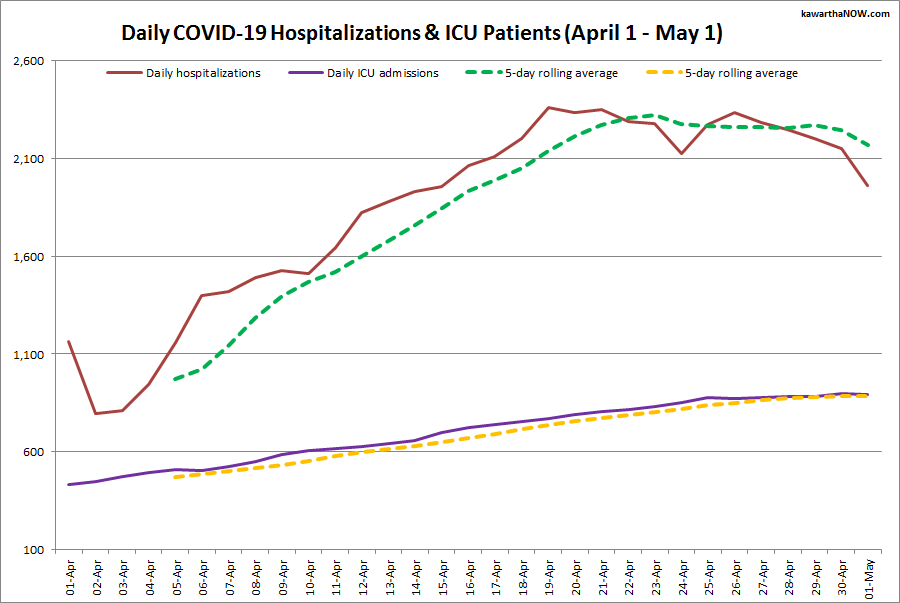
Hospitalized: 1,598 (decrease of 28)
Hospitalized and in ICU: 395 (decrease of 5)
Hospitalized and in ICU on ventilator: 296 (increase of 4)
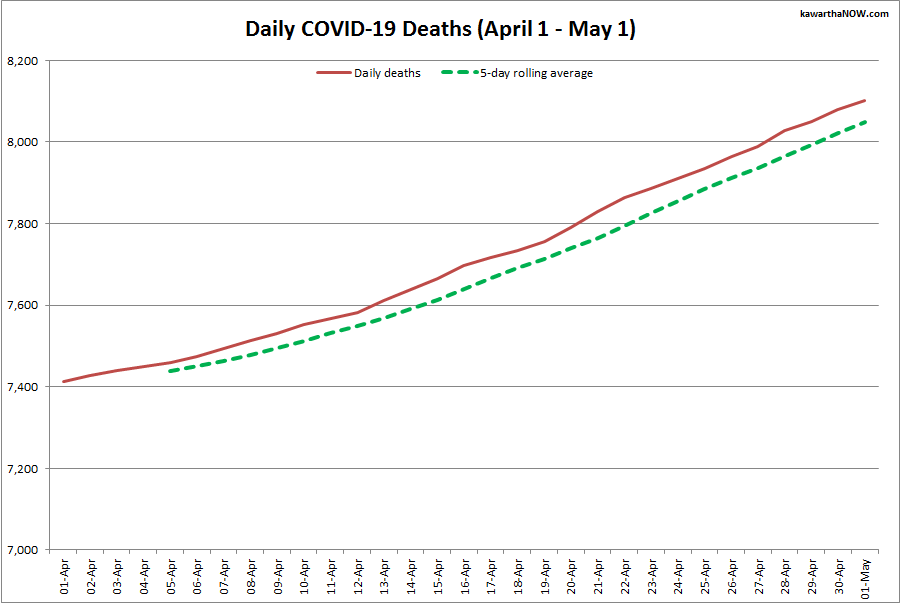
Deaths: 5,568 (increase of 89)
Deaths of residents in long-term care homes: 3,274 (increase of 42)
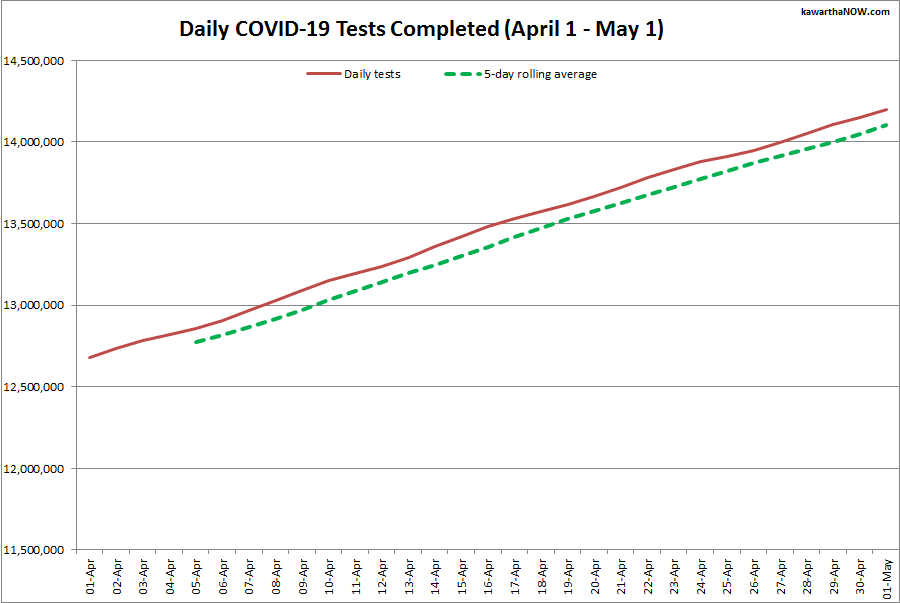
Total tests completed: 9,054,585 (increase of 54,307)
Tests under investigation: 48,963 (increase of 12,213)
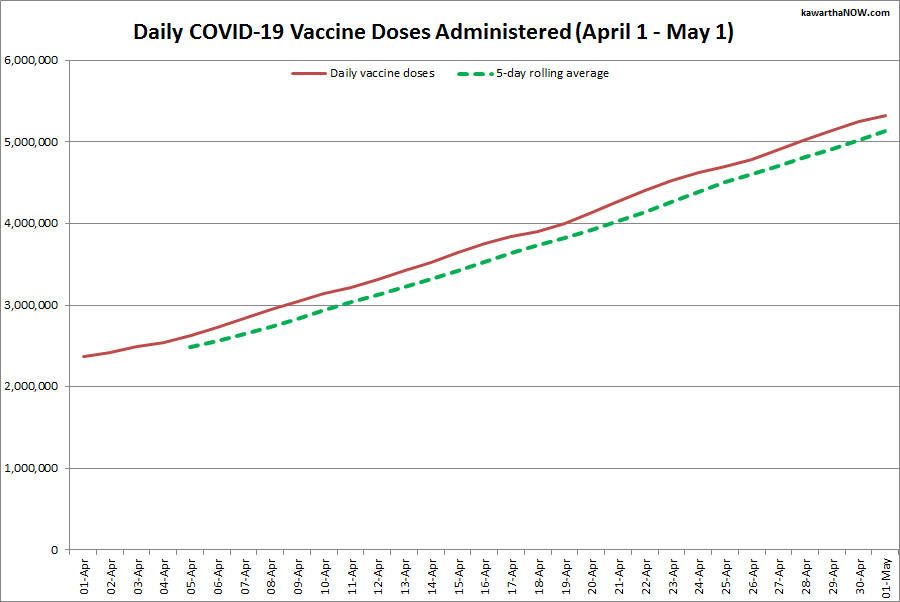
Vaccinations: 13,784 daily doses administered, 237,918 total doses administered, 32,361 total vaccinations completed (both doses)

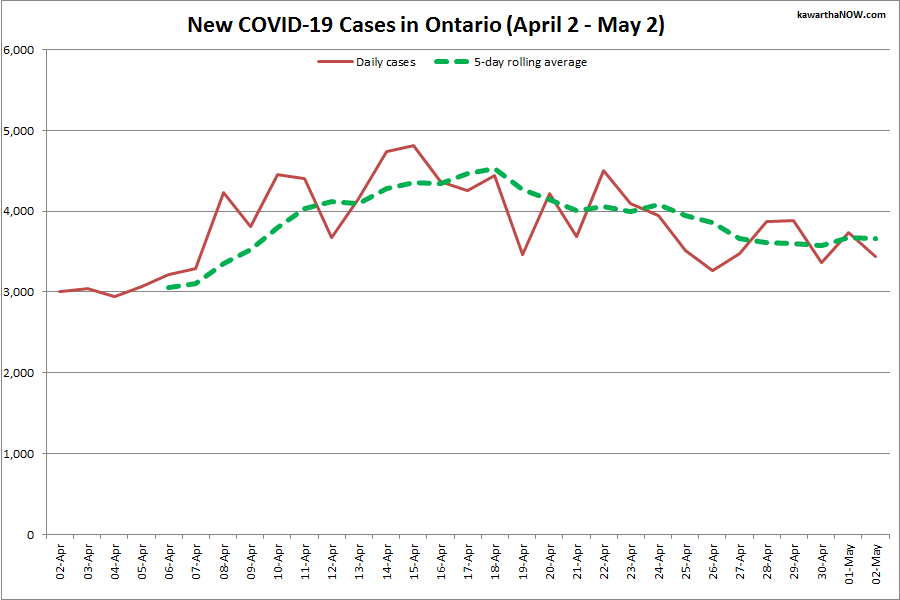
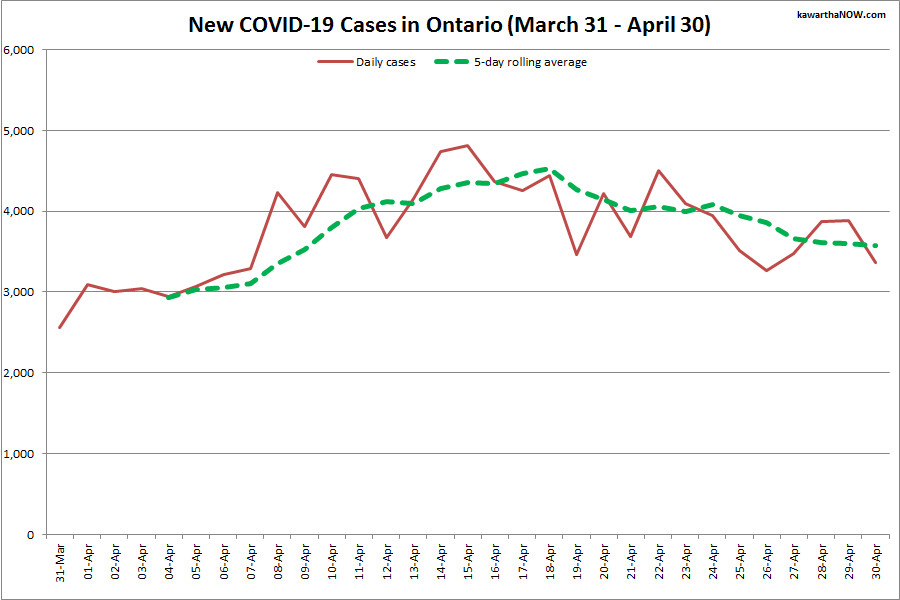
COVID-19 cases in Ontario from December 20, 2020 - January 19, 2021. The red line is the number of new cases reported daily, and the dotted green line is a five-day moving average of new cases. (Graphic: kawarthaNOW.com)
COVID-19 cases in Ontario from December 20, 2020 – January 19, 2021. The red line is the number of new cases reported daily, and the dotted green line is a five-day moving average of new cases. (Graphic: kawarthaNOW.com)
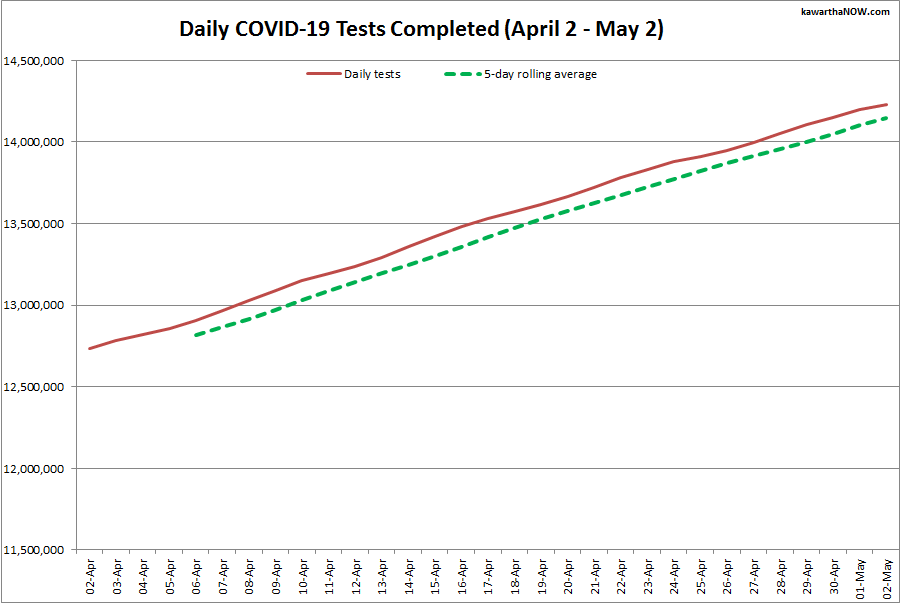
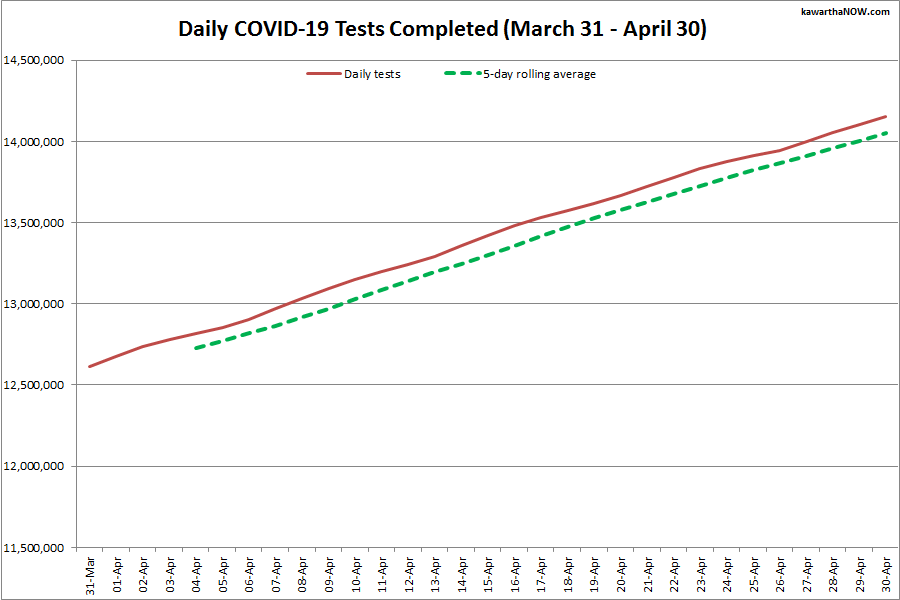
COVID-19 tests completed in Ontario from December 20, 2020 - January 19, 2021. The red line is the number of tests completed daily, and the dotted green line is a five-day moving average of tests completed. (Graphic: kawarthaNOW.com)
COVID-19 tests completed in Ontario from December 20, 2020 – January 19, 2021. The red line is the number of tests completed daily, and the dotted green line is a five-day moving average of tests completed. (Graphic: kawarthaNOW.com)
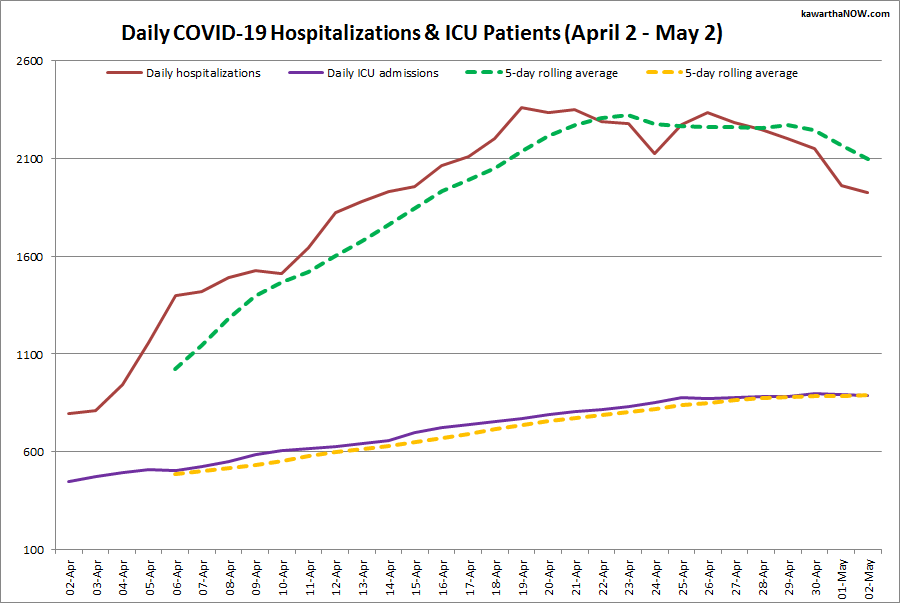
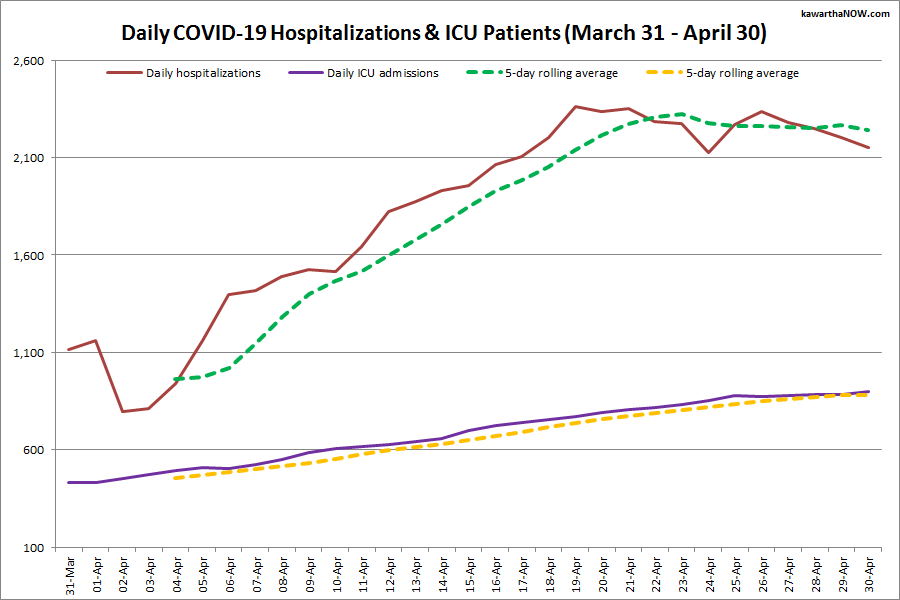
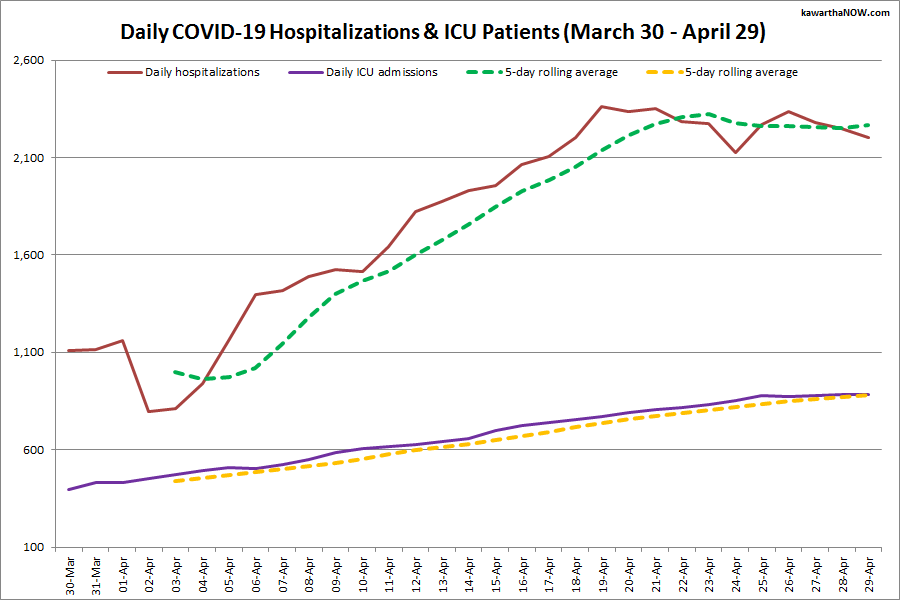
COVID-19 hospitalizations and ICU admissions in Ontario from December 20, 2020 - January 19, 2021. The red line is the daily number of COVID-19 hospitalizations, the dotted green line is a five-day moving average of hospitalizations, the purple line is the daily number of patients with COVID-19 in ICUs, and the dotted orange line is a five-day moving average of is a five-day moving average of patients with COVID-19 in ICUs. (Graphic: kawarthaNOW.com)
COVID-19 hospitalizations and ICU admissions in Ontario from December 20, 2020 – January 19, 2021. The red line is the daily number of COVID-19 hospitalizations, the dotted green line is a five-day moving average of hospitalizations, the purple line is the daily number of patients with COVID-19 in ICUs, and the dotted orange line is a five-day moving average of is a five-day moving average of patients with COVID-19 in ICUs. (Graphic: kawarthaNOW.com)
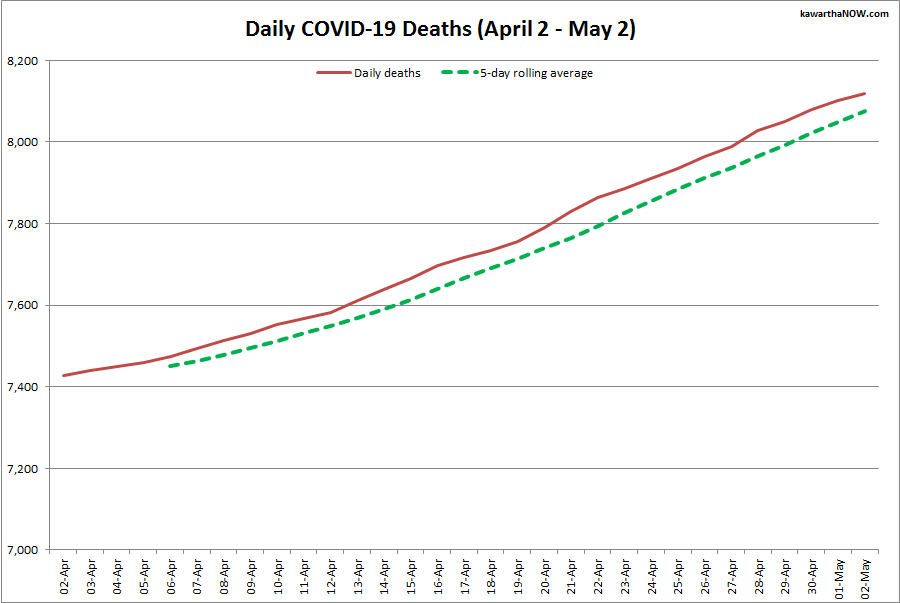
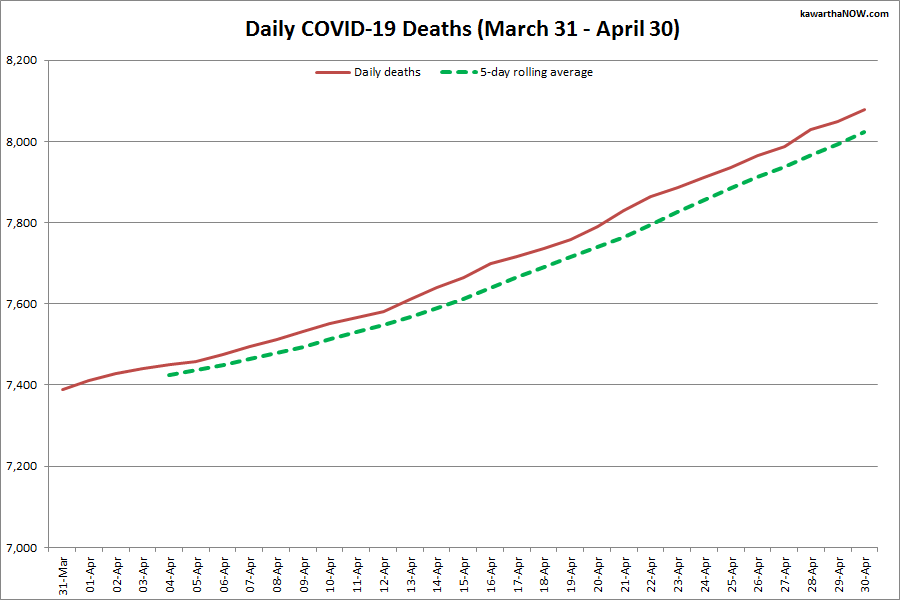
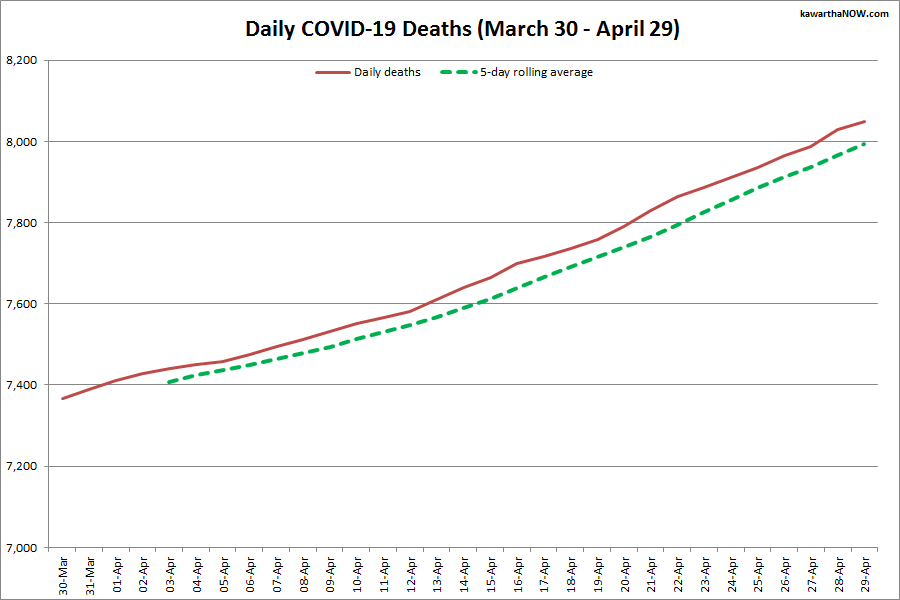
COVID-19 deaths in Ontario from December 20, 2020 - January 19, 2021. The red line is the cumulative number of daily deaths, and the dotted green line is a five-day moving average of daily deaths. (Graphic: kawarthaNOW.com)
COVID-19 deaths in Ontario from December 20, 2020 – January 19, 2021. The red line is the cumulative number of daily deaths, and the dotted green line is a five-day moving average of daily deaths. (Graphic: kawarthaNOW.com)


For more information about COVID-19 in Ontario, visit covid-19.ontario.ca.

Kawartha Lakes Arts Council is helping local artists move online

At the new online marketplace set up by the Kawartha Lakes Arts Council, you can purchase works by local artists who are members of the arts council, such as 'Ginko Leaf Branch', a metallic wall sculpture by Paul and Beverly Williams. (Photo courtesy of Kawartha Lakes Arts Council and the artists)

Since March, the pandemic has devastated income opportunities for visual artists and artisans who depend on shows, festivals, fairs, and studio tours to connect with their audiences and to sell their work.

We tend to think of visual artists and artisans as isolated, solitary practitioners but so much of their work — and indeed their livelihoods — depend on our ability to gather in groups.

“It’s been tremendous,” says Margaret Cunningham, media liaison for the Kawartha Lakes Arts Council, of the impacts COVID-19 has had on local artists.

Advertisement - content continues below


“Our artists have missed the public events where they can meet their customers face to face, where they can share their talents — their goods that they sell and show. It’s that interpersonal connection with the consumers that they’ve missed tremendously.”

Many artists have had to change the ways they grow and connect with their audiences by turning towards online outreach and sales.

However, for many artists, the transition to a digital presence has been difficult, taking their time and energy away from what they were born to do: create art.

Lindsay artisan woodworker James Lukow, a member of the Kawartha Lakes Arts Council, at work in his studio. (Photo courtesy of Kawartha Lakes Arts Council and the artist)

That’s why the Kawartha Lakes Arts Council is supporting visual artists and artisans with its new strategic digital plan.

“The purpose of this digital strategy is to give the artists that opportunity to showcase their art in yet another location and another venue among a very targeted, focused group of members, associates, partners, and affiliates,” Cunningham explains.

The Kawartha Lakes Arts Council’s strategic digital plan includes a logo and brand refresh, and the creation of a new website with a digital sales and marketing platform for members at www.kawarthalakesartscouncil.com, which offers a year-round marketplace of arts and cultural products and services.

The initiative is a vital lifeline for local artists who have lost opportunities to connect with their audiences and sell their work due to the pandemic.

Advertisement - content continues below


Kawartha Lakes Arts Council members will now have a platform to increase their digital presence and, ultimately, their sales.

“Everyone has been missing out on all that outreach that they’re normally used to,” adds Cunningham.

The initiative will also offer crucial online support and online sales training for artists with arts council memberships, which will help to break down barriers for many artists who haven’t yet been able to sell their work securely online.

“The online web supplier will be walking the artists through the process,” says Cunningham of the digital training opportunities. “For those that aren’t used to it [digital marketing and sales], it can be fairly onerous and complicated, so we’re trying to mitigate that divide.”

“We’re making it easy for those that don’t know how to move online and we’re also giving the tools to those who do know how so they can just get on with it,” she adds.

'A River Runs Through', an elemental art piece by Daniel Marlatt available for purchase through the Kawartha Lakes Arts Council's online marketplace. (Photo courtesy of Kawartha Lakes Arts Council and the artist)
‘A River Runs Through’, an elemental art piece by Daniel Marlatt available for purchase through the Kawartha Lakes Arts Council’s online marketplace. (Photo courtesy of Kawartha Lakes Arts Council and the artist)

The arts council’s digital initiative was born from a crisis. Though it is a direct response to an emergency that seeks to serve the needs of the community, it also has the potential to benefit members year-round long after the pandemic has ended (it will end!).

“It will become the new normal, another way for artists to present who they are and what they do,” says Cunningham of online sales. “It’s an evolution and it’s here to stay, so we’ve just got to get on the bandwagon; some artists need to adjust to that.”

Fortunately, the Kawartha Lakes Arts Council is here to help local artists make that adjustment.

Advertisement - content continues below


“The intent of this is just to open everybody’s eyes and show that we can do this — and to keep it as simple as possible,” says Cunningham.

'Beauty of the Beets', an ink-on-paper work by Lesley Drummond available for purchase  through the Kawartha Lakes Arts Council's online marketplace. (Photo courtesy of Kawartha Lakes Arts Council and the artist)
‘Beauty of the Beets’, an ink-on-paper work by Lesley Drummond available for purchase through the Kawartha Lakes Arts Council’s online marketplace. (Photo courtesy of Kawartha Lakes Arts Council and the artist)

If you’re an artist looking to expand your digital presence and sales, you can access these vital supports by becoming a member of the Kawartha Lakes Arts Council.

If you’re a community member wondering how you can support local artists, you can go online and buy art made by local artists today.

To learn how to buy a membership or how to buy some fantastic local art, visit www.kawarthalakesartscouncil.com.

The initiative, which has received funding from both the private and public sectors, was made possible with the support of community partners including LLF Lawyers LLP, DLF Pickseed, Economic Development of City of Kawartha Lakes and Barton Creative Co., and the Federal Economic Development Agency for Southern Ontario.

North Kawartha Food Bank thanks community for support after loss of Sayers grocery store in Apsley

Residents, local businesses, and community-minded corporations stepped up to support North Kawartha Food Bank after fire destroyed Sayers in Apsley, the only grocery store in the township. For example, Campbell's donated five skids of food to the food bank. (Photo courtesy of North Kawartha Food Bank)

North Kawartha Food Bank in Apsley has issued a public thank you to all those who stepped up to help after the town lost its only grocery store — including year-round and seasonal residents, local and corporate businesses, and community organizations.

In the early morning of Saturday, December 5th, Sayers Independent Food Town in Apsley was devastated by a fire. The family-owned grocery store was the only one in North Kawartha Township, which has around 2,300 year-round residents and around 12,000 seasonal residents.

“The word spread as quickly as the flames and by the next evening a group of concerned citizens met via Zoom to discuss the implications and methods to help the community, the Sayers family and their employees,” says Diane Rothnie, treasurer of the North Kawartha Food Bank, in an email to kawarthaNOW.

On December 5, 2021, a fire raged through Sayers Independent Food Town in Apsley, destroying the town's only grocery store that also served the residents of North Kawartha Township. The Sayers family intends to rebuild and reopen. (Photo courtesy of North Kawartha Food Bank)
On December 5, 2021, a fire raged through Sayers Independent Food Town in Apsley, destroying the town’s only grocery store that also served the residents of North Kawartha Township. The Sayers family intends to rebuild and reopen. (Photo courtesy of North Kawartha Food Bank)

Rothnie says the committee still meets weekly, and will continue to do so until the Sayers family rebuilds and reopens the grocery store.

“Community residents, both full and part-time, community organizations, and community-minded corporations were at the ready to help financially, with food donations, with deliveries, and with fundraising,” Rothnie says.

Here are some examples of the donations to the food bank:

Advertisement - content continues below


  • Loblaw’s Real Canadian Superstore in Peterborough donated $5,000 worth of food products.
  • Campbell’s donated five skids of food.
  • Kawartha Dairy and Gay Lea donated butter.
  • Apsley Veterinary Services donated many bags and cans of pet food.
  • Peterborough musician Drew Phillips held a virtual Christmas concert, raising more than $2,000.

“Our team of volunteers and clients would like to thank all the individuals, lake associations, and the many companies for your generosity and thoughtfulness,” Rothnie says.

“We are so blessed to be living in such a caring and generous community of concerned citizens.”

A delivery of donated food arrives from Loblaw's Real Canadian Superstore in Peterborough. (Photo courtesy of North Kawartha Food Bank)
A delivery of donated food arrives from Loblaw’s Real Canadian Superstore in Peterborough. (Photo courtesy of North Kawartha Food Bank)
Advertisement - content continues below


Bobcaygeon-based Kawartha Dairy, along with Gay Lea, donated butter to the North Kawartha Food Bank. (Photo courtesy of North Kawartha Food Bank)
Peterborough musician Drew Phillips held a virtual Christmas concert and raised $2,004.23 for the North Kawartha Food Bank. (Photo: Drew Phillips / Facebook)

Highway 28 is closed between North School Road and 15th Line due to collision

A road closure sign on Highway 28 near Woodview following a head-on collision in February 2019. (Photo courtesy of Geri-Lynn Cajindos)

Highway 28 is closed between North School Road and the 15th Line of Selwyn Township following a two-vehicle collision early on Wednesday morning (January 20).

At around 5:30 a.m., a car was travelling northbound on Highway 28 near Clear Lake Road north of Young’s Point when it crossed into the southbound lane for an unknown reason and collided with a southbound logging truck.

The car’s driver was taken to hospital with non-life threatening injuries.

Advertisement - content continues below


The cause of the collision remains under investigation.

Highway 28 remains closed between North School Road and the 15th Line in Selwyn Township while the roadway is cleaned up.

While the highway is closed, traffic is being detoured via North School Road and 15th Line.

Missing 11-year-old Carter Ryan Pollock has returned home

Carter Ryan Pollock. (Police-supplied photo via Christine Pollock)

Missing 11-year-old Carter Ryan Pollock has been found, Peterborough police announced on Monday (January 25).

Police say Carter returned home at 11 p.m. on Sunday night and “is in good spirits”.


Original story:

Peterborough police are continuing their search for missing 11-year-old Carter Ryan Pollock.

Carter was last seen on Tuesday (January 19) at 10 a.m., walking out of the Peterborough Regional Health Centre.

Police say he approached a dark grey pick-up truck, but then walked away.

Carter is described as white and 4’10” with a thin build, wearing green-framed eyeglasses, a black hat (worn backwards), a white hoodie with black markings on the arm, grey sweat plants, and black sneakers.

Police say they have concerns for Carter’s safety.

“If anyone is harbouring the child or misleading police during the investigation, please come forward immediately to help us locate the child safe and sound,” a police media release states. “Police want to remind the public that it is a criminal offence to obstruct police during an investigation.”

Advertisement - content continues below


Police say they have received several tips and information on Carter’s whereabouts and are continuing to follow up those leads.

Anyone with information is asked to call the Peterborough Police at 705-876-1122 or Crime Stoppers at 1-800-222-tips (8477), or visit the Crime Stoppers website at stopcrimehere.ca.

Carter Ryan Pollock, pictured in the clothes he was wearing when he went missing on January 19, 2021. (Police-supplied photo)

Ontario reports 1,913 new COVID-19 cases, including 16 in greater Kawarthas region

Here’s an update on COVID-19 cases in Ontario as well as in the greater Kawarthas region.

Ontario is reporting 1,913 new cases today — although the province says Toronto Public Health could not report all of its cases due to a technical issue. Yesterday, Toronto reported 815 new cases and today it is reporting 550 cases.

With today’s reported cases, the seven-day average of daily cases across the province has decreased by 142 to 2,893.

In the greater Kawarthas region, there are 16 new cases to report and 14 additional cases resolved, with the number of active cases across the region increasing by 3 to 149.

Most of today’s new cases are in Toronto (550, with this number under-reported due to a technical issue), Peel (346), and York (235).

There are double-digit increases in Durham (82), Windsor-Essex (81), Waterloo (79), Middlesex-London (73), Halton (71), Hamilton (63), Niagara (52), Simcoe Muskoka (48), Ottawa (41), Huron Perth (37), Wellington-Dufferin-Guelph (31), Lambton (28), Southwestern (22), Eastern Ontario (14), and Chatham-Kent (13), with smaller increases in Porcupine (6) and Haldimand-Norfolk (6).

The remaining 15 health units are reporting 5 or fewer new cases, with 3 health units reporting no new cases at all.

Advertisement - content continues below


Of today’s new cases, 51% are among people 39 and younger, with the highest number of cases (701) among people ages 20-39, followed by 561 cases among people ages 40-59. With 2,873 more cases resolved since yesterday, the percentage of resolved cases has increased by 0.5% to 86.3%. The average positivity rate across Ontario has increased since yesterday by 0.2% to 6.8%, meaning that 68 out of every 1,000 tests performed were positive for COVID-19 on January 18.

Ontario is reporting 46 new COVID-19 deaths today, including 20 in long-term care homes. Hospitalizations have increased by 55 from yesterday to 1,626, with the number of patients with COVID-19 in ICUs increasing by 6 to 400, and the number of patients with COVID-19 on ventilators decreasing by 11 to 293.

A total of 34,531 tests were completed yesterday, pushing the total number of tests completed since the pandemic began to over 9 million. Since yesterday, the backlog of tests under investigation has increased by 18,269 to 36,750. A total of 224,134 doses of vaccine have now been administered, with 14,346 daily doses administered and 25,609 total vaccinations completed (i.e., both doses administered).

Due to the winter break and the remote learning period during the state of emergency, there will be no data to report for schools in southern Ontario until at least January 26. There are 50 new cases in licensed child care settings in Ontario, an increase of 21 from yesterday, with 26 cases among children and 24 cases among staff.

Advertisement - content continues below


In the greater Kawarthas region, there are 16 new cases to report, including 7 in Peterborough, 3 in Northumberland, 3 in Kawartha Lakes, and 3 in Hastings Prince Edward. There are no new cases to report in Haliburton.

None of the new cases reported today in licensed child care settings are in the greater Kawarthas region.

An additional 14 cases have been resolved, including 6 in Peterborough, 6 in Hastings Prince Edward, 1 in Kawartha Lakes, and 1 in Northumberland.

There are currently 149 active cases in the greater Kawarthas region, an increase of 3 from yesterday, including 50 in Peterborough, 47 in Northumberland, 25 in Hastings Prince Edward (9 in Quinte West, 13 in Belleville, 1 in Prince Edward County, and 1 in Central Hastings), 23 in Kawartha Lakes, and 4 in Haliburton.

Since the pandemic began in the greater Kawarthas region, there have been 488 confirmed positive cases in the Peterborough area (432 resolved with 6 deaths), 339 in the City of Kawartha Lakes (293 resolved with 36 deaths), 348 in Northumberland County (295 resolved with 6 deaths), 43 in Haliburton County (39 resolved with no deaths), and 361 in Hastings and Prince Edward counties (331 resolved with 5 deaths). The most recent death was reported in Northumberland on January 17.

The provincial data in this report is pulled from Ontario’s integrated Public Health Information System (iPHIS) at 12 p.m. the previous day. Data from local health units is more current and is usually reflected in the provincial data the following day. There may be discrepancies between the Ontario data reported today (which is from yesterday) and the local health unit data reported today (which is from today).

Advertisement - content continues below


Peterborough Public Health

Peterborough Public Health’s service area is the City and County of Peterborough and the Hiawatha and Curve Lake First Nations.

The health unit provides daily reports, including on weekends, excluding statutory holidays.

Confirmed positive: 488 (increase of 7)
Active cases: 50 (increase of 1)
Close contacts: 91 (decrease of 14)
Deaths: 6 (no change)
Resolved: 432 (increase of 6)
Hospitalizations (total to date): 20 (no change)*
Total tests completed: Over 40,650 (increase of 50)
Outbreaks: Fairhaven long-term care home in Peterborough, The Regency retirement home in Lakefield, Centennial Place long-term care home in Millbrook (no change)

*As of January 19, Peterborough Regional Health Centre is reporting fewer than 10 patients hospitalized with COVID-19, with fewer than 10 patients transferred from other areas as a result of a provincial directive. The hospital is not providing exact numbers of patients.


Haliburton, Kawartha, Pine Ridge District Health Unit

The Haliburton, Kawartha, Pine Ridge District Health Unit’s service area is the City of Kawartha Lakes, Northumberland County, and Haliburton County.

The health unit provides reports from Monday to Saturday, excluding statutory holidays.

Confirmed positive: 730, including 338 in Kawartha Lakes, 348 in Northumberland, and 43 in Haliburton (increase of 6, including 3 in Kawartha Lakes and 3 in Northumberland)*
Active cases: 74, including 23 in Kawartha Lakes, 47 in Northumberland, and 4 in Haliburton (net increase of 4)
Probable cases: 1 in Kawartha Lakes (decrease of 1 in Kawartha Lakes)
High-risk contacts: 165, including 71 in Kawartha Lakes, 62 in Northumberland, and 14 in Haliburton (net increase of 2)**
Hospitalizations (total to date): 29, including 19 in Kawartha Lakes, 9 in Northumberland, and 1 in Haliburton (no change)***
Deaths (including among probable cases): 42, including 36 in Kawartha Lakes and 6 in Northumberland (no change)
Resolved: 627, including 293 in Kawartha Lakes, 295 in Northumberland, 39 in Haliburton (increase of 2, including 1 in Kawartha Lakes and 1 in Haliburton)
Institutional outbreaks: Hope St. Terrace long-term care home in Port Hope, Fenelon Court in Fenelon Falls, Island Park Retirement Residence in Campbellford, Maplewood long-term care home in Brighton, Caressant Care McLaughlin Road in Lindsay, Tower of Port Hope, Canadian Centre for Addictions in Port Hope, Golden Plough Lodge in Cobourg, Warkworth Place long-term care home in Warkworth (no change)

*The health unit states that total counts and counts for individual counties may fluctuate from previously reported counts as cases are transferred to or from the health unit based on case investigation details and routine data cleaning.

**This total includes an additional 18 high-risk contacts directly followed up through the Public Health Ontario contact tracing process that are missing the contacts’ county.

***As of January 19, Ross Memorial Hospital in Lindsay reports 4 patients are hospitalized with COVID-19, a decrease of 1 since yesterday


Hastings Prince Edward Public Health

Hastings Prince Edward Public Health’s service area is Hastings County (including Bancroft) and Prince Edward County.

The health unit provides daily reports, excluding statutory holidays.

Confirmed positive: 361 (increase of 3)
Active cases: 25 (decrease of 3)
Deaths: 5 (no change)
Currently hospitalized: 1 (no change)
Currently hospitalized and in ICU: 0 (no change)
Currently hospitalized and in ICU on ventilator (total to date): 0 (no change)
Resolved: 331 (increase of 6)
Tests completed: 38,391
Institutional outbreaks: Hastings Manor Beech Villa in Belleville, Crown Ridge long-term care home in Quinte West (no change)

Advertisement - content continues below


Province of Ontario

Confirmed positive: 242,277 (increase of 1,913)*
Resolved: 209,183 (increase of 2,873, 86.3% of all cases)
Positivity rate: 6.8% (increase of 0.2%)
Hospitalized: 1,626 (increase of 55)
Hospitalized and in ICU: 400 (increase of 6)
Hospitalized and in ICU on ventilator: 292 (decrease of 11)
Deaths: 5,479 (increase of 46)
Deaths of residents in long-term care homes: 3,232 (increase of 20)
Total tests completed: 9,000,278 (increase of 34,531)
Tests under investigation: 36,750 (increase of 18,269)
Vaccinations: 14,346 daily doses administered, 224,134 total doses administered, 25,609 total vaccinations completed (both doses)

*Due to a technical issue at Toronto Public Health, there is likely an under-reporting of cases today.

COVID-19 cases in Ontario from December 19, 2020 - January 18, 2021. The red line is the number of new cases reported daily, and the dotted green line is a five-day moving average of new cases. (Graphic: kawarthaNOW.com)
COVID-19 cases in Ontario from December 19, 2020 – January 18, 2021. The red line is the number of new cases reported daily, and the dotted green line is a five-day moving average of new cases. (Graphic: kawarthaNOW.com)
COVID-19 tests completed in Ontario from December 19, 2020 - January 18, 2021. The red line is the number of tests completed daily, and the dotted green line is a five-day moving average of tests completed. (Graphic: kawarthaNOW.com)
COVID-19 tests completed in Ontario from December 19, 2020 – January 18, 2021. The red line is the number of tests completed daily, and the dotted green line is a five-day moving average of tests completed. (Graphic: kawarthaNOW.com)
COVID-19 hospitalizations and ICU admissions in Ontario from December 19, 2020 - January 18, 2021. The red line is the daily number of COVID-19 hospitalizations, the dotted green line is a five-day moving average of hospitalizations, the purple line is the daily number of patients with COVID-19 in ICUs, and the dotted orange line is a five-day moving average of is a five-day moving average of patients with COVID-19 in ICUs. (Graphic: kawarthaNOW.com)
COVID-19 hospitalizations and ICU admissions in Ontario from December 19, 2020 – January 18, 2021. The red line is the daily number of COVID-19 hospitalizations, the dotted green line is a five-day moving average of hospitalizations, the purple line is the daily number of patients with COVID-19 in ICUs, and the dotted orange line is a five-day moving average of is a five-day moving average of patients with COVID-19 in ICUs. (Graphic: kawarthaNOW.com)
COVID-19 deaths in Ontario from December 19, 2020 - January 18, 2021. The red line is the cumulative number of daily deaths, and the dotted green line is a five-day moving average of daily deaths. (Graphic: kawarthaNOW.com)
COVID-19 deaths in Ontario from December 19, 2020 – January 18, 2021. The red line is the cumulative number of daily deaths, and the dotted green line is a five-day moving average of daily deaths. (Graphic: kawarthaNOW.com)


For more information about COVID-19 in Ontario, visit covid-19.ontario.ca.

Become a #kawarthaNOW fan

32,173FollowersLike
25,776FollowersFollow
17,563FollowersFollow
4,736FollowersFollow
3,809FollowersFollow
3,134FollowersFollow

Sign up for kawarthNOW's Enews

Sign up for our VIP Enews

kawarthaNOW.com offers two enews options to help readers stay in the know. Our VIP enews is delivered weekly every Wednesday morning and includes exclusive giveaways, and our news digest is delivered daily every morning. You can subscribe to one or both.


Submit your event for FREE!

Use our event submission form to post your event on our website — for free. To submit editorial content or ideas, please contact us.