




















Thousands of community, health, and social services workers represented by OPSEU/SEFPO are entering the fourth week of their province-wide strike, as the union continues to demand retroactive funding from the Ontario government for community and social service agencies.
“We’ve been trying to do everything we can to stay off strike, but the government wasn’t taking us seriously,” said Jessica Bushey, president of OPSEU/SEFPO Local 358, which represents more than 300 full-time and part-time developmental service workers employed by Community Living Trent Highlands (CLTH) in Peterborough, Kawartha Lakes, and Haliburton County.
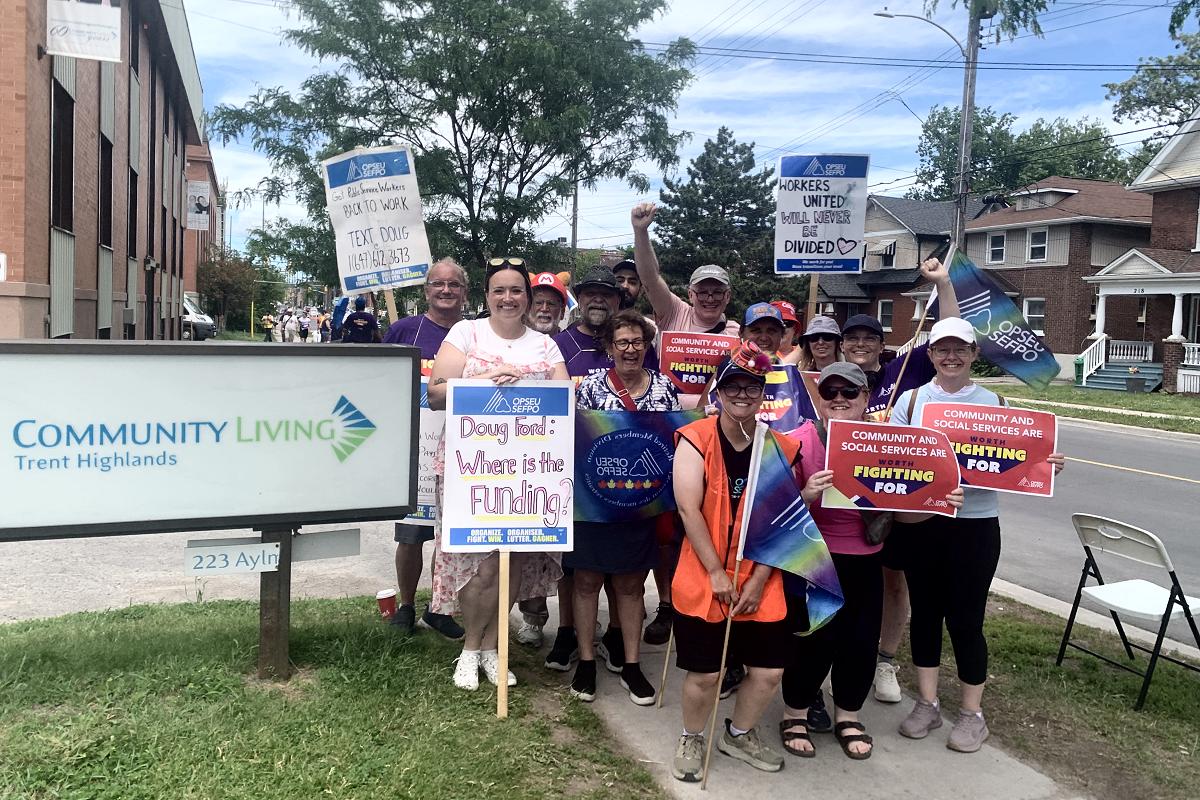
On Friday (June 12), Bushey spoke to kawarthaNOW from the picket line outside the CTLH’s Peterborough office at 223 Aylmer Street North, surrounded by a large crowd of loud supporters and clear support from passing cars.
Local developmental services workers are part of province-wide strike
CLTH provides services to people with intellectual disability as a primary diagnosis, including child and youth services, housing support, and day programs. The Trent Highlands agency is one of 125 Community Living organizations in Ontario, with each primarily funded by the Ministry of Children, Community and Social Services.
In November 2019, the Ford government passed Bill 123, which imposed a one per cent limit on pay increases for public sector workers between 2020 and 2023. Public sector workers, labour activists, and community members from all walks of life have spoken out against this bill since its inception.
“These guys work so hard — they care for people that need their assistance all the time — and it’s just unfair the way this government and the employer has been treating them,” said Betty Cree, president of OPSEU Provincial Retired Members Division, as she joined CLTH staff on the picket line.
In November 2022, Bill 124 was repealed following a ruling from the Ontario Superior Court of Justice that it was unconstitutional. This ruling was upheld by the Court of Appeal for Ontario in February 2024.
Following union-led bargaining across public service sectors, the Ontario government provided some retroactive funding was to offset the impact of Bill 124. However, to date, the government has provided no retroactive funding to organizations and professionals in the community and social service sectors.
Bushey said the current strike is a direct response to the lack of funding received by these sectors.
“This is how we’ve had to apply pressure so that they negotiate with us and give us back what was stolen,” said Bushey.
Union campaign seeks retroactive wage increases and stable future funding
Local 358 is part of OPSEU’s provincial-wide “Worth Fighting For” campaign, joining 26 other OPSEU local units on strike representing over 4,000 public service workers.
In addition to developmental service workers, the campaign also represents those working in public service sectors including child and youth services, shelters, and mental health and addictions.
“We’re part of a huge historic labour movement. We couldn’t do this on our own,” Bushey said of the importance of joining other OPSEU local units in strike action.
On it Worth Fighting For campaign website, OPSEU states that its has two primary goals in this initiative, the first being “justice for stolen wages” in reference to the reduced compensation increases due to the one per cent cap. In particular, OPSEU is seeking alignment with compensation provided to other public service sectors.
Bushey told kawarthaNOW about impacts experienced by developmental services workers due to Bill 124 legislation, saying that many union members — including those at the top of the pay scale — are forced to work multiple jobs, including non-professional roles outside of the sector.
“We have (union) members who are working multiple jobs, having to go to the food bank, or having to move back home with their parents because our wages haven’t kept up,” said Bushey.
Further to this, Bushey said it is significant that the employee demographic in sectors and organizations that did not receive retroactive pay increases is overwhelming made up of women and immigrants.
“I don’t think it should be overlooked that the workers are new Canadians and women,” Bushey said. “I think that it’s purposeful.”
Bushey added that gender inequity is clear in the funding distribution following Bill 124, noting that sectors such as probation and parole and the liquor control board (LCBO) were provided with retroactive funding.
“I don’t think that’s a mistake by the Ontario government,” Bushey said. “They paid their own workers (first).”
The second goal OPSEU outlines on its website is “funding for the future of our services,” identifying the need for an increase in core funding to prevent cuts to jobs and services as well as to protect the continuity of care for service users.
Bushey said that inadequate funding for community and social services programs has direct impacts on clients and outcomes. New research from the Canadian Centre for Policy Alternatives showed that funding for the Ministry of Children, Community and Social Services has dropped 2.4 per cent over the past year.
“The people we support might have a budget of $14 a day for food. That’s preposterous,” said Bushey.
Union is concerned about privatization of developmental services
Another concern Bushey expressed was about the increased privatization of public services in Ontario, saying it could leading to potential worse outcomes for clients through lack of oversight and standardisation.
For Bushey, people with disabilities and their caregivers are currently being forced to choose between affordability and quality of care. She said further that for many people they have spent many years with little to no support and this leads them to choosing low-cost private options.
“But if I’m that desperate, why wouldn’t I go private?” Bushey asks.
In 2021, the Ontario government released Journey to Belonging: Choice and Inclusion, its long-term reform plan for developmental services in the province. Critics have argued that the plan’s shift from a direct non-profit model to an individualized funding model, where individuals and families manage their own funding, favours the for-profit sector.
Although private care options are often less costly, Bushey said, there may be fewer regulations for the provider and the care given. She noted that staff members at CLTH and similar organizations are trained or registered professionals typically with extensive education.
“Journey To Belonging sounds like this lovely person-centred thing, but it’s privatization of our public services at the end of the day,” said Bushey.
Community Living Trent Highlands asks union local to resume contract negotiations
With respect to OPSEU’s job action, CLTH released a statement on Thursday (June 11) that its management team was inviting Local 358 to the bargaining table.
“While we certainly are aware of the union’s province-wide efforts to seek a retroactive increase from the provincial government, we’re committed to supporting and further strengthening our relationship with Local 358 and their members in Peterborough, Kawartha Lakes and Haliburton,” said CLTH executive director Teresa Jordan.
“Yesterday I reached out to the union’s local leadership and asked them back to the table to finish negotiating a mutually agreeable contract at the local level … I asked the union to meet us because we believe this is the best way to settle this strike and get people back to work.”
But for Bushey, the strike is about more than the contract signed at CLTH. Without an agreement from the province to provide retroactive and stable future funding, she said, CLTH does not have the capacity to meet the needs or demands of union members.
“We are willing to talk to the employer. However, they haven’t received funding for Bill 124. They don’t have what we need,” she said.
Bushey added that CLTH has chosen not to make a statement in support of OPSEU’s demands of the province. She considers this a barrier to Local 358 reaching an agreement, as the union’s demands are reliant upon retroactive Bill 124 funding.
“They’re not willing to help us get the funding,” said Bushey. “We’re not really sure why they’re perpetuating this, as if we’re ignoring them, when they know what our fight is about.”