





















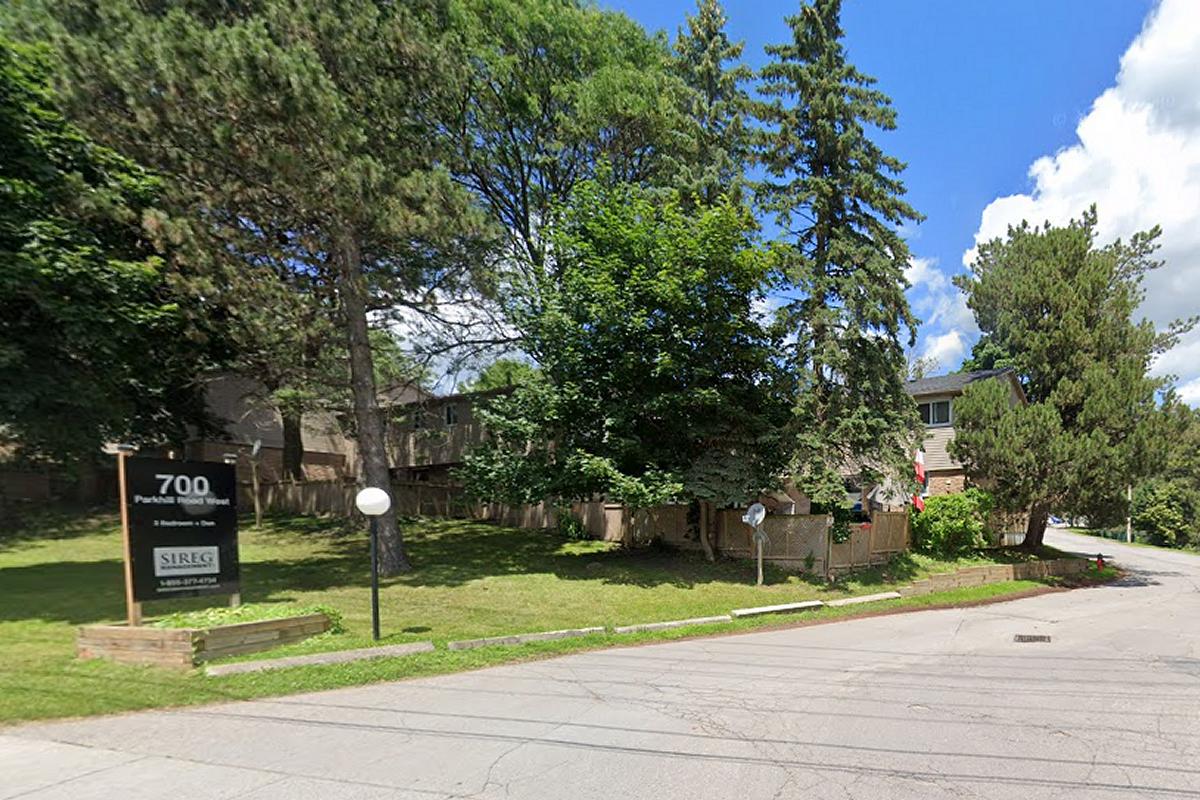
A real estate management company’s appeal to the Ontario Land Tribunal (OLT) of Peterborough city council’s decision denying its application to convert rental units into condominiums has moved forward a step, but a hearing date has not yet been set as the two parties haven’t agreed on the key issues of the case.
Lawyers for Burlington-based Simple Investor Real Estate Group (SIREG) and the City of Peterborough attended an OLT case management conference, held virtually, on Thursday (May 7).
Led by OLT vice-chair Shannon Braun, the conference included city solicitor Scott Seabrooke, the city’s director of planning, development and urban design Brad Appleby, city planner Ian Walker, and city councillor Matt Crowley, in whose ward the townhouse complex is located, as well as lawyer Matthew A. Di Vona representing SIREG. Only Braun, Seabrooke, and Di Vona spoke during the conference.
City cited rental stock and affordable housing concerns in denying application
In June 2025, SIREG submitted a completed draft plan of condominium to the city to convert rental units at 700 Parkhill Road West into condominiums. Four years ago, the company purchased the property known as Parkhill Place, which consists of 10 two-storey residential townhomes comprising 128 three-bedroom units.
In its application to the city, SIREG noted it would continue to maintain the property but sell the three-bedroom units to private investors, with existing tenants continuing to rent the units from the new owners.
On December 1, city council meeting as general committee held a public meeting under the Planning Act where they considered a staff report that recommended council reject SIREG’s application.
City planner Ian Walker advised council that approving the conversion would result in the potential long-term loss of 17 per cent of the city’s stock of three-bedroom rental units and doesn’t guarantee continued affordable rent rates or affordable purchase prices for the units.
At that meeting, council voted to support the staff recommendation, subsequently ratifying that decision at a city council meeting on December 8. Both votes carried by a unanimous vote of 11-0. SIREG lawyer Jasdeep Dhillon spoke to council at the December 8 meeting and said there was “a good possibility” SIREG would appeal to OLT if council ratified its earlier decision.
SIREG filed its appeal the following month.
Purpose of case management conference is to address procedural issues
On Thursday, Braun explained that the purpose of a case management conference “is simply to address procedural issues and organize for a hearing on the merits that will come later.”
Procedural issues include the possibility of settlement and mediation discussions, identification of issues, a draft procedural order, the possible start date and duration of the hearing, and directions for filing of witness lists, expert witness statements, and written evidence ahead of a hearing.
“We are not here today to debate the merits of the application, but to accomplish goals such as determining the length of any hearing that might be required or subsequent hearing events, agreeing on issues for a future hearing on the merits, and dealing with status requests,” Braun said.
She noted that OLT had received a participant request from Jen Lacey, a tenant at 700 Parkhill who is opposed to SIREG’s application.
She described some of Lacey’s concerns with the application, including that existing tenants will not be able to stay in their units, that 40 per cent of the units are deemed affordable housing, that any new tenants following conversion would not have protection from eviction, that the application is not providing any new housing in the city, and that the 128 units proposed to be converted represent 17 per cent of three-bedroom units in the city and, if converted, would have a negative impact on the rental housing market.
Confirming with Di Vona and Seabrooke they had no objection to Lacey’s request, Braun granted her participant status, “as the tribunal is satisfied that she has a genuine interest in the proceedings and that her statement can help the tribunal to adjudicate on the issues for a future merit hearing.”
Braun asked if the two parties had discussed either settling some of the issues in dispute or scoping them out, and if they were aware of the opportunity for tribunal-led mediation.
After Di Vona and Seabrooke advised they had had meetings but had not reached a settlement and did not require mediation, Braun moved on to whether the parties had agreed upon the identification of issues, which she called the “issues list.”
Disagreements over issues list and hearing transcript stall hearing date
Di Vona told Braun that the two parties had not reached consensus on the issues list, noting the city’s list broadly identified that SIREG’s condo conversion application did not conform with the city’s official plan, but did not provide details as to why.
While acknowledging she hadn’t seen the most recent version of the issues list from Seabrooke, Braun said she preferred the list from Di Vona because it was more specific and encouraged the two parties to continue to work together to come to agreement on the issues list, which has to be approved by the tribunal.
She said it is insufficient for the city to claim SIREG’s application doesn’t conform with the city’s official plan without providing specifics.
“To say ‘Does this conform with the official plan?’ … doesn’t help the tribunal in terms of understanding what it’s going to hear and who it’s going to hear from,” said Braun, with the latter referring to expert witneesses on specific issues.
After Di Vona asked if a hearing date could be scheduled, Braun said she was “not inclined to set a hearing date” until there was consent between both parties on the issues list.
Di Vona asked that it be “put on the record” that the delay in setting a hearing date was “caused by the city’s inadequate issues list,” noting that his client had held several meetings with city staff as well as with experts to develop its list.
Seabrooke said he took “umbrage” with Di Vona’s comment, noting that Di Vona only provided his client’s issues list a week or two before the case management conference,
Braun said it was not unusual at this stage of the appeal process for parties to be in disagreement over an issues list and they should allow some time to reach consensus. She added that a second case management conference could be avoided and a hearing date could be set if the parties can reach conensus.
“I’m not opposed to having both counsel provide your availability for a hearing should you be able to arrive at an issues list and submit on consent,” she said.
Seabrooke asked how many days of availability would be required for a hearing, with Braun responding that determing that without having a confirmed issues list was like “trying to shoot in the dark.”
“When I look at the draft procedural order that I have in front of me, I’ve got an estimate of 20 days. Had I had an issues list on consent here today, I would have been asking some questions about those 20 days, the number of witnesses to be called, and the disciplines of those witnesses. We’re flying blind.”
Seabrooke raised another point of contention between the parties in the draft procedural order, which is the city’s intention to hire a court reporter at its own expense to transcribe the hearing verbatim.
Braun noted that the OLT usually does not allow recording of hearings, and that the city would need to make a request to the tribunal to do so. She asked if SIREG was agreeable to the request.
Di Von said he would consent to the recording of the hearing proceedings only if the city agreed to provide a copy of the transcript. Seabrooke objected to that condition, saying the city would not necessarily be ordering a copy of the transcript from the recording.
Second case management conference set for June if parties don’t reach an agreement
As the conference wrapped up, Braun summarized that there was no agreement between the two parties on either the issues list or a transcript of the hearing and encouraged them to continue to work through the disagreements, noting that both parties could consult via email with the tribunal for guidance.
Braun asked the two parties to provide their availability for a date for a second case management conference should it be necessary, with Thursday, June 11 set as that date.
She also asked the parties whether they could provide an issues list on consent by May 19, which they agreed to attempt to do. She said the June 11 case management conference would likely proceed if the issues list was not provided by May 19, although she noted it was not a hard deadline and the parties could continue to work to reach consensus after that date.
Braun said that if the parties can reach consensus before the June 11 case management conference, it will not be required and they can ask for hearing dates to be set. She noted that the parties should request hearing dates “well enough into the future” to accommodate potential motions before the hearing, so that any motions do not consume time at the hearing.