











Four upcoming events in the Kawarthas will mark the 100th anniversary of the Balsam Lake canoe tragedy that claimed 11 lives, almost all of them teenage boys from Toronto.
The Balsam Lake Association is hosting a talk by a local historian with in-depth knowledge of the tragedy at the Coboconk Legion on July 11, a memorial day takes place on July 18 with a lake flotilla and on-water service followed by a screening in Kirkfield of a dramatic film based on the tragedy with cast members participating in a Q&A, and The Canadian Canoe Museum is hosting a screening of the same film and a discussion with the filmmaker and cast members on July 20.
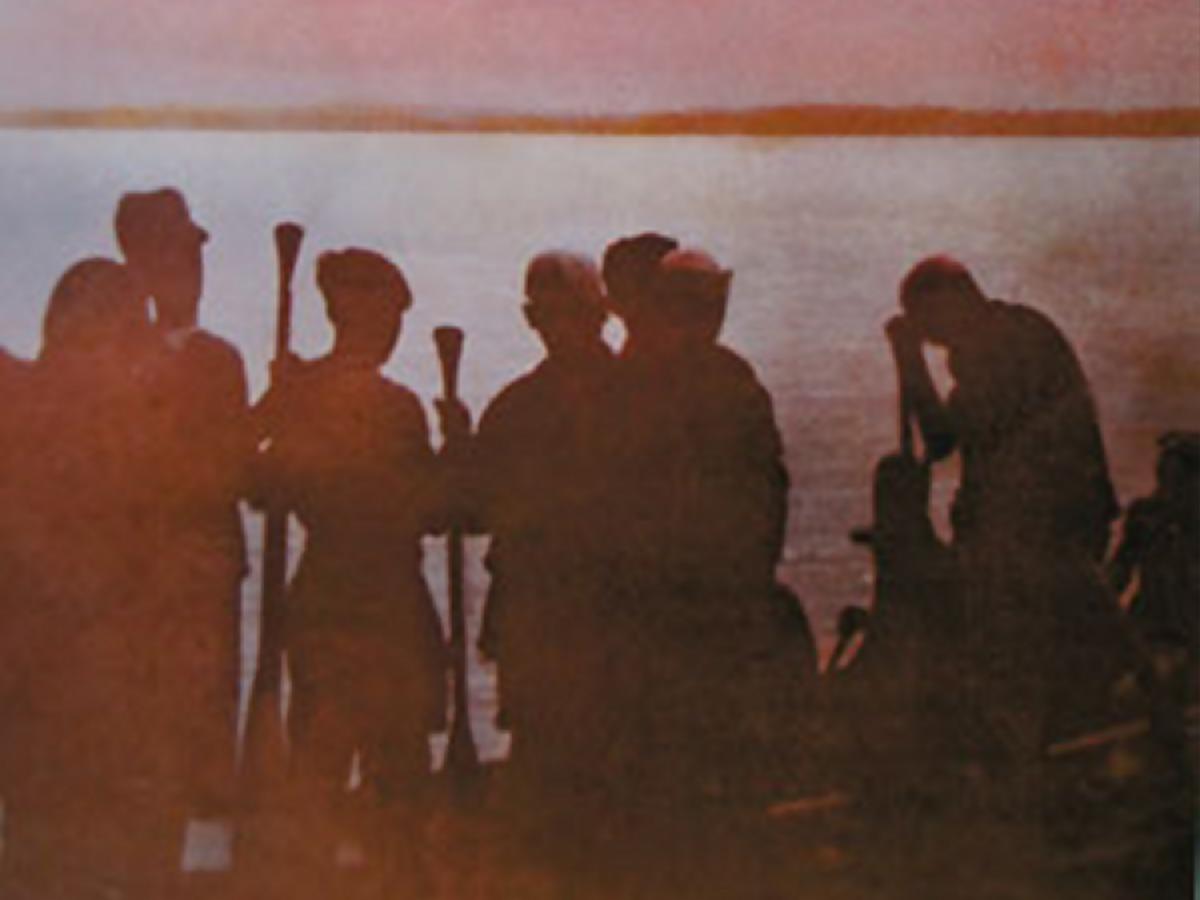
The tragedy happened on July 20, 1926 after a group of around 25 boys arrived at an annual Anglican Church leadership camp on Long Point on Balsam Lake conducted by the Brotherhood of St. Andrew of St. James Cathedral in Toronto.
The two adult directors of the camp, Robert Shea-Butcher from Toronto and Arthur Lambden from Galt (now Cambridge), asked for 13 volunteers from among the boys to help them paddle a 30-foot “war canoe” to Coboconk, located around 12 kilometres northeast across the lake from Long Point. The plan was to pick up two more canoes and supplies including food, spend the night in town, and then paddle back to Long Point in the morning.
With Shea-Butcher — a 26-year-old First World War veteran who didn’t know how to swim — leading the group, the 15 paddlers set off for Coboconk after eating dinner.
Lambden, who survived the paddling trip along with three of the boys, recounted to The Toronto Star as he was recovering in Fenelon Falls on July 23, 1926 that everything had been going well until around 8 p.m., when the canoe approached the narrows where Gull River flows into the lake.
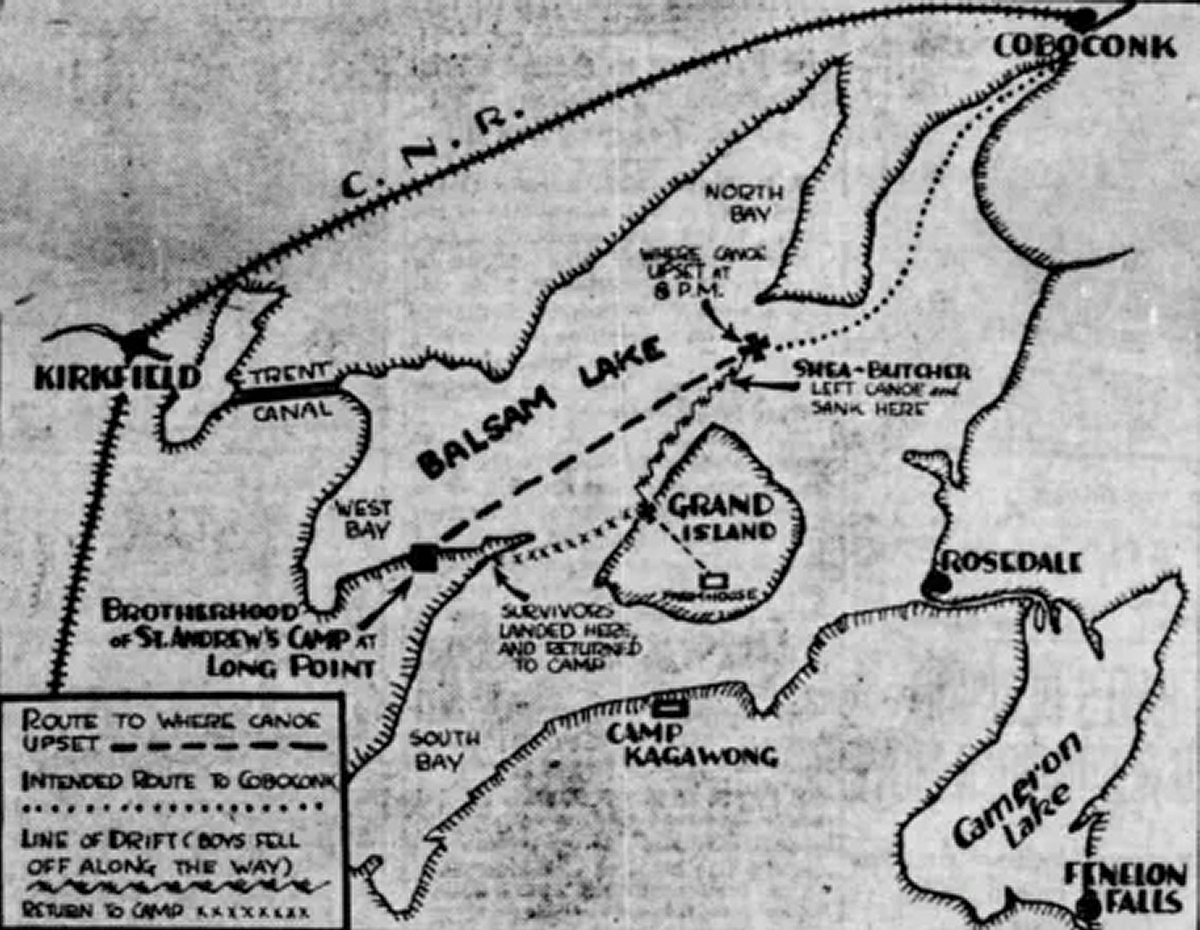
“Here our craft, which was in the hands of fifteen disciplined young men, with leaders well versed in camp craft, was suddenly struck by a wind and heavy wash,” Lambden said. “Without warning the canoe capsized. It rolled right over, finishing gunwale up but waterlogged to the water’s edge.”
Lambden said that Shea-Butcher, who had injured his knee when the canoe capsized and was holding on to the stern, directed the group to cling to the gunwales, seven on each side, and paddle for land, which was about three-quarters of a mile away.
According to Lambden, 18-year-old Oliver Mardall — who had been cheering on the other boys — was the first to lose his grip and succumb. Then Shea-Butcher let go of the stern and vanished under the water, reportedly calling out that he was sacrificing himself for the others. Lambden said Shea-Butcher’s final instructions had been for everyone to remove their shoes and any unneeded clothing.
“The boys dropped off one by one as their strength failed them,” Lambden said. “They went to their death without a whimper and to the last unselfishly trying to help the other fellow. Ray Allen of Peterboro lost his life when he volunteered to swim to land for help. About fifty yards from the canoe he passed from sight.”
By the time the canoe drifted to the shores of Grand Island in the middle of the lake five hours later, only four survivors remained: Lambden along with George Waller, William Wigginton, and Leonard O’Hara, all from Toronto.
According to an account published at the time, the four exhausted survivors spent a cold, wet night on Grand Island, before managing to paddle the canoe back to Long Point the next day, using a single remaining paddle and some planks found on shore.
Once the survivors landed at Long Point, they then made a two-mile trek through the woods back to their camp, arriving in mid-afternoon.
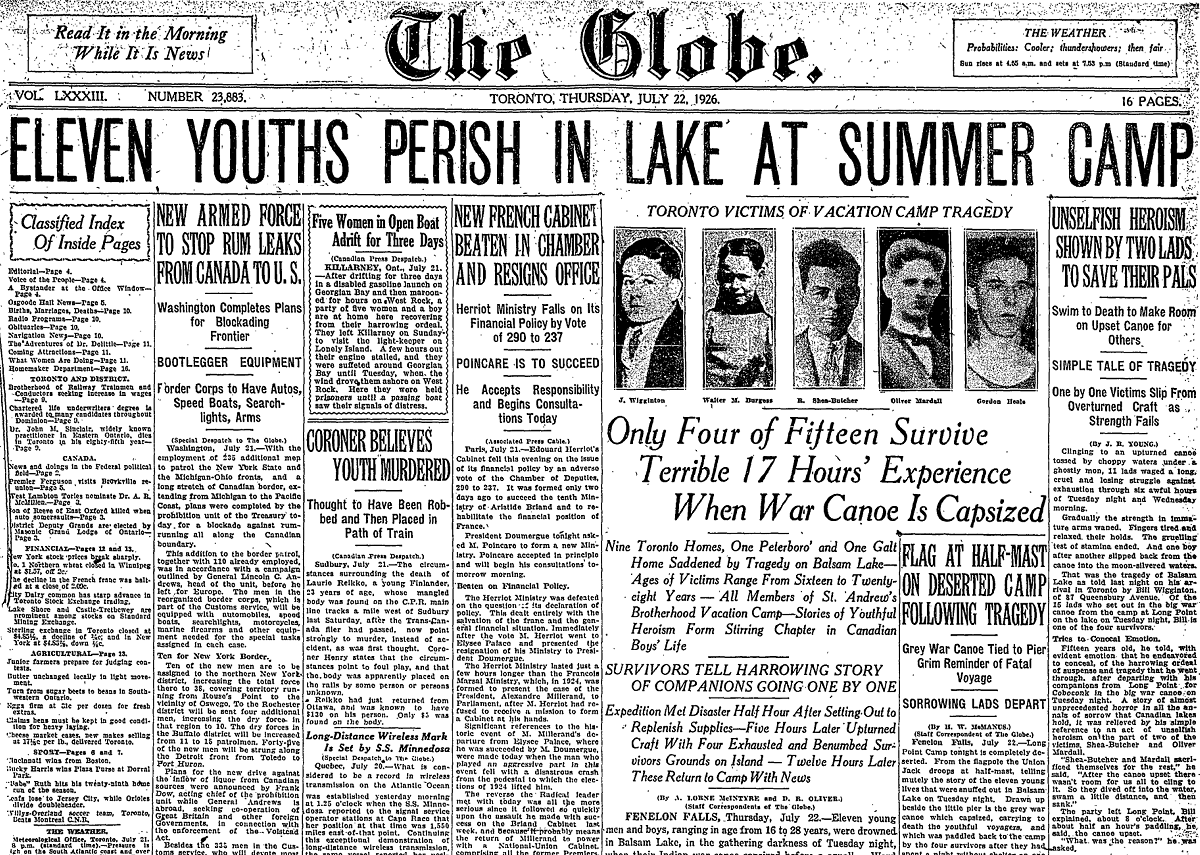
Along with Shea-Butcher, Mardall, and Allen, the other victims of the tragedy were 16-year-old Jack Wigginson (William’s brother), 14-year-old Frank Burkitt, 16-year-old Walter Burgess, 19-year-old Gordon Heale, 16-year-old Vernon Clarke, 16-year-old Joe Edwards, and 16-year-old Harold Bakewell — all of Toronto — along with Harry Mills of Galt.
The tragedy made headlines around the world, and seven of the Toronto victims were interred beneath a massive four-metre-high cross at St. James Cemetery, near Bloor and Parliament streets, with a small stone perimeter around the graves etched with the names of all 11 victims.
A public inquiry into the tragedy, held in Lindsay in August 1926, ruled that no one was to blame and the deaths were a tragic accident — despite that fact there were no lifejackets on board the canoe, the camp leaders made no effort to determine the swimming and paddling experience of the volunteers, and concerns were raised that the canoe was not safe for recreational use.
In 2019, Richard Bell’s drama Brotherhood was released. The film, which tells the story of the tragic canoe journey, was screened privately for residents of the Balsam Lake community that July, with Ontario’s lieutenant governor Elizabeth Dowdeswell in attendance.
The film was released theatrically that December in Toronto, before being screened at over 60 theatres across Canada. In 2020, the film won the Canadian Screen Award for Best Visual Effects, with a nomination for Best Original Song. Brotherhood has since been released on streaming platforms, and currently can be seen on CBC Gem.
VIDEO: “Brotherhood” (2019) trailer
On Saturday (July 11), the Balsam Lake Association is presenting “100 Years On – Remembering the Brotherhood of St. Andrew Canoe Tragedy” from 10 a.m. to noon at the Coboconk Legion (2916 County Road 48, Coboconk).
The free event features a presentation by local historian Doug Paterson. The Balsam Lake resident lobbied St. James Cemetery in Toronto to restore its memorial to the victims, including by landscaping the overgrown graves and replacing the stone cross that vandals had damaged and toppled years before. The restored monument was revealed at a graveside re-dedication ceremony in June 2024.
A memorial day for the tragedy takes place on Saturday, July 18, when a flotilla consisting of canoes and other boats will depart from Long Point near Ant Island at 2 p.m. and follow the original route for 30 minutes, finishing with an on-water memorial service for the victims near Grand Island. The flotilla will include an Anglican priest accompanied by a bagpiper, and participants are encouraged to bring flowers to place in the water during the service.
The flotilla will be followed at 7:30 p.m. by a screening of Brotherhood at The Olde Kirk – Kirkfield and District Historical Society Museum (992 Portage Road, Kirkfield), with a post-screening question-and-answer session featuring members of the cast. The event is free to attend, although donations to The Olde Kirke are appreciated.
Then, on Monday, July 20 — 100 years to the day of the tragedy — The Canadian Canoe Museum at 2077 Ashburnham Drive in Peterborough will present a screening of Brotherhood at 7 p.m.
The screening will be followed by a question-and-answer session with Bell and actors Sam Ashe Arnold, Haig McGarry, and Perry Mucci, who will speak about the tragedy that inspired the film and the process of bringing it to the screen. Tickets are $15 and are available at www.canoemuseumstore.ca/products/speaker-series-brotherhood-screening-mon-july-20-2026.
The original version of this story has been updated with the memorial day events on July 18.