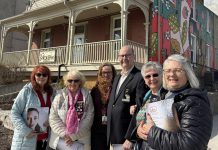
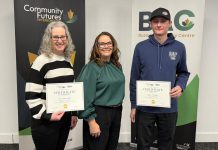
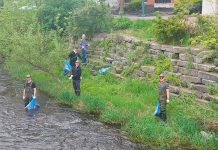
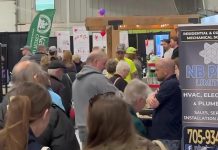
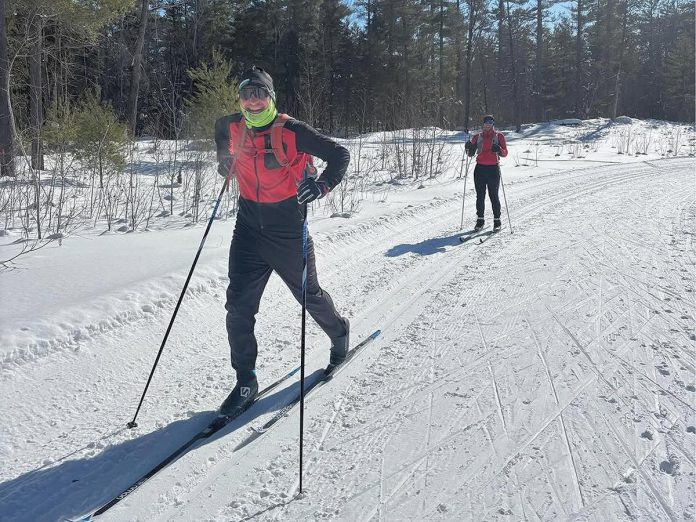
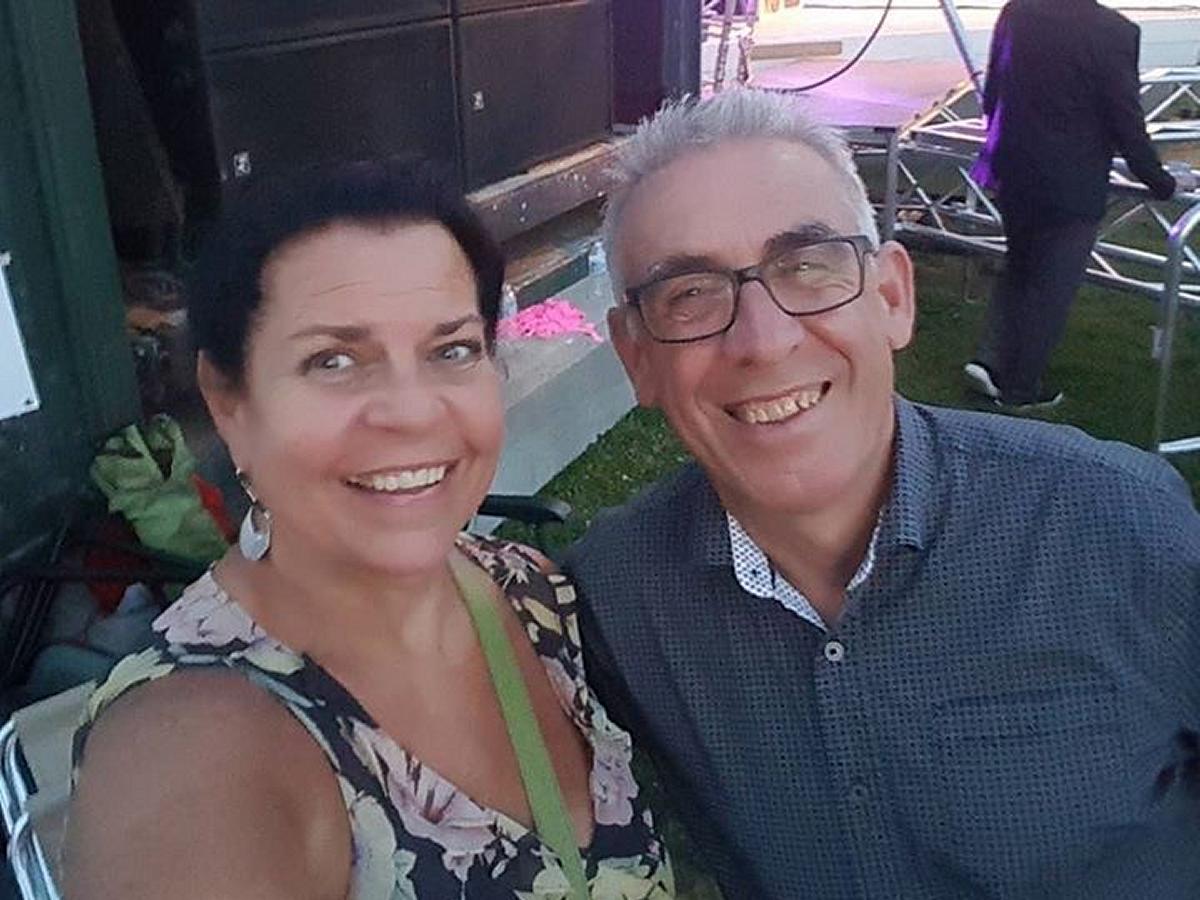
Two of the many cross-country skiers who participated in the Kawartha Nordic ComPassion Relay at Kawartha Nordic Ski Club in North Kawartha Township on January 31, 2026, raising just over $18,000 for the ComPassion Project supporting six local organizations. (Photo: Kawartha Nordic / Instagram)
Peterborough-area cross-country skiers have raised just over $18,000 for six local organizations that protect natural spaces and support marginalized communities.
The Kawartha Nordic ComPassion Relay was held last Saturday (January 31) at the Kawartha Nordic Ski Club, located off Highway 28 just north of Haultain in North Kawartha Township. The non-competitive ski relay saw solo participants and teams of friends, families, and co-workers choose from 3 km, 7 km, or 12 km and ski for as long as six hours.
Since it was first organized in 2022 by John Hauser, an employee of Peterborough outdoor gear retailer Wild Rock Outfitters and a board member of Kawartha Nordic Ski Club, the annual ski relay has raised more than $80,000 for local charities in the Peterborough area.
Advertisement - content continues below
The inaugural event was a 24-hour ski marathon for mental health. In 2023, it became an eight-hour ski relay and raised funds for a supportive housing project of the Canadian Mental Health Association Haliburton, Kawartha, Pine Ridge, with the 2024 event raising funds for YES Shelter for Youth and Families.
In 2025, the event began raising funds for the ComPassion Project, created by Wild Rock co-founder Kieran Andrews with the aim of helping organizations focused on environmental stewardship and social change.
“The ComPassion Relay is all about community,” says Hauser in a media release from the Community Foundation of Greater Peterborough. “We’re supporting local organizations doing much-needed work in the Peterborough area. It’s inspiring to see how much folks of all ages care for our community — it’s a reminder that good things are happening.”
John Hauser, a staff member at Wild Rock Outfitters and a board member of Kawartha Nordic Ski Club, organized the inaugural Kawartha Nordic ski relay in 2022 after losing a cousin to suicide during the pandemic and feeling the toll of the pandemic on his own mental health. (Photo: Wild Rock Outfitters / Instagram)
An endowment fund administered by the foundation in partnership with Wild Rock, the ComPassion Project supports YES Shelter for Youth & Families, Peterborough Trailbuilders Association, Peterborough Bicycle Advisory Committee, Kawartha Land Trust, Fourcast Addiction Services, and One City Peterborough
Andrews says the Kawartha Nordic ComPassion Relay is “exactly what we had in mind when we first envisioned the ComPassion Project.”
“This grassroots event is one of our favourite fundraisers,” Andrews says. “It brings together people of all ages who push themselves, have fun, and support the community.”
Advertisement - content continues below
One of the goals of the ComPassion Project is to strengthen community recreation and access to the outdoors. Last year, project funding helped the Peterborough Trailbuilders purchase a Snowdog machine to help groom winter trails for fat biking, improving trail quality and accessibility after heavy snowfalls.
“We couldn’t be more honoured to be chosen as one of the organizations the ComPassion Project supports,” says Peterborough Trailbuilders president Paul Wilkinson.
The support of the ComPassion Project is also important for social services like One City Peterborough, according to the organization’s executive director Tammy Kuehne, particularly during this year’s “brutally cold winter.”
“For our folks who are unhoused, it is almost unbearable,” Kuehne says. “With our overnight shelter being full each night, this grant allowed us to increase our evening emergency outreach, bringing hot drinks, clothing, and survival gear to individuals living rough. It can be the difference between hypothermia and managing. We are truly, truly thankful to the ComPassion project.”
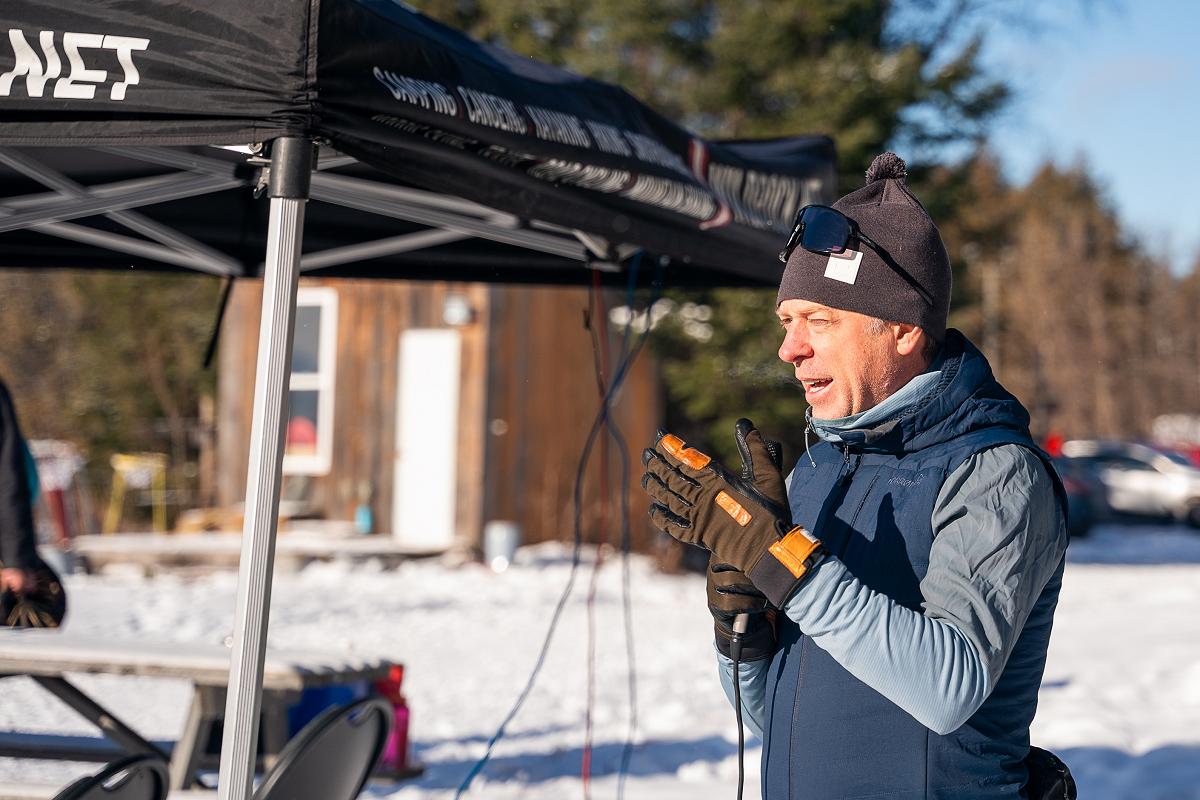
Kieran Andrews, founder of the ComPassion Project and co-founder of Wild Rock Outfitters, addresses participants at the 2025 Kawartha Nordic ComPassion Relay hosted by the Kawartha Nordic Ski Club in North Kawartha Township. The annual event raises funds for the ComPassion Project, which is delivered in partnership with the Community Foundation of Greater Peterborough to support six local organizations that protect natural spaces and support marginalized communities. (Photo: Jeff Faulds Photography)
The $18,000 raised by the Kawartha Nordic ComPassion Relay is on top of more than $39,000 donated to the ComPassion Project by community members through a number of initiatives held throughout late fall.
That included $36,000 raised last November when Andrews matched donations up to $20,000 made to the ComPassion Project in honour of his late father Chris. With more than 70 individual donations and his matching donations, a total of $36,000 was raised.
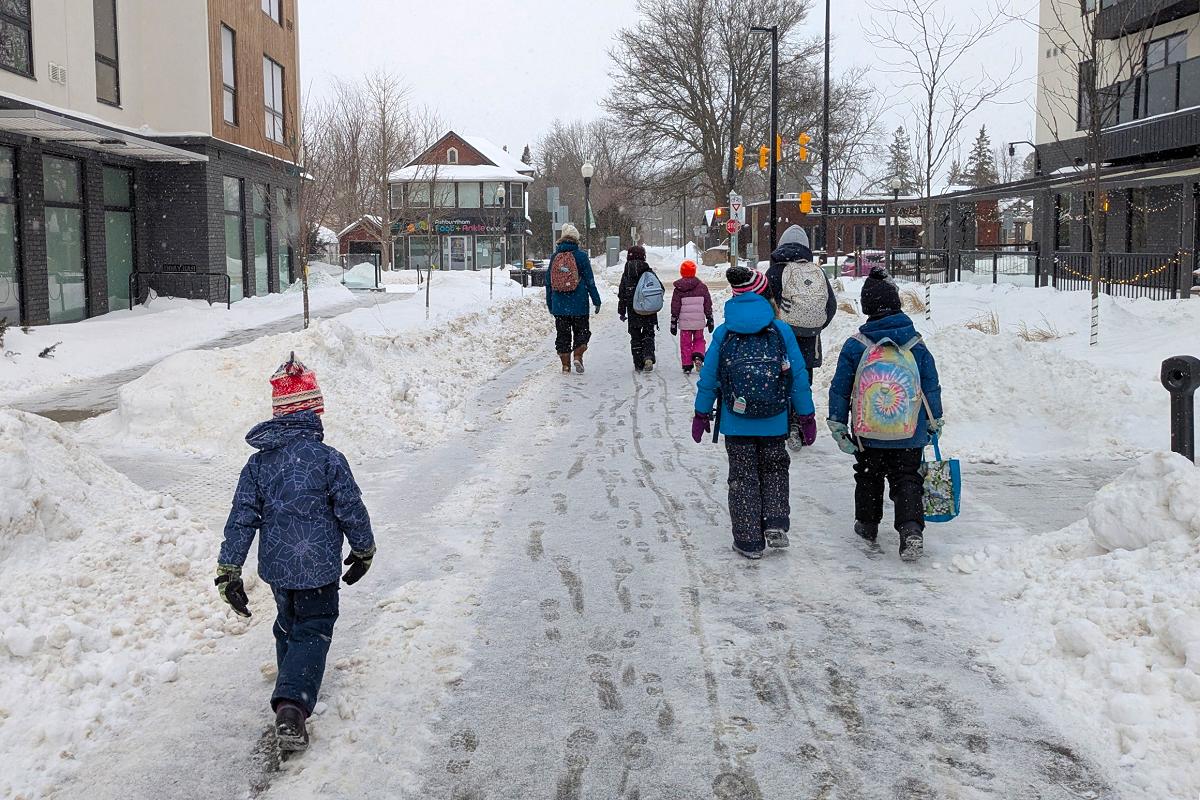
Allowing children to engage in play is an important way kids make sense of the world and understand their own boundaries. Climbing a snow pile (in a safe location) during a winter walk to school is a great example of letting kids take reasonable risks and gain confidence through play. (Photo: Clara Blakelock / GreenUP)
Winter is certainly making itself known this year. Between the growing snowbanks, surprise snow days, and the cold that seems to linger, it can be tempting to see the outdoors as something to endure rather than enjoy.
Active School Travel Peterborough celebrated Winter Walk Day on Wednesday (February 4) and will continue to celebrate it all month long, as a reminder that winter can be a season of movement, play, and connection, especially for kids.
Each week, GreenUP provides a story related to the environment. This week’s story is by Ashley Burnie Seeds, Education & Active Transportation Program Manager, GreenUP, and chair of Active School Travel Peterborough.
With fewer than 40 per cent of children reaching their recommended daily physical activity levels and more time being spent on screens, the simple act of walking to school can make a world of difference. It offers daily exercise, sparks creativity, and creates space for kids to slow down, explore, and feel more grounded, even in the cold.
Advertisement - content continues below
The walk to school matters more than one might think. Children thrive on routine and structure, but when every moment of their day is scheduled, something important can be lost.
That’s where play comes in. When life is very busy and playtime is often relegated to weekends or right before bed, taking time to play during the walk to and from school is a practical and enriching choice.
Play is child-led and often has no goal for the child aside from curiosity and fun. Kids can choose how they play, for how long, and with what.
Making snow angels is a perfect activity during a winter walk to school. Encouraging kids to take a quiet moment to engage their senses helps them regulate emotions and build relationships with nature. (Photo: Clara Blakelock / GreenUP)
Consider how many of the most magical moments of play naturally happen on the walk to and from school: climbing snowbanks, crunching icy puddles, spotting animal tracks, breaking icicles, balancing along curbs, or turning sticks into swords, wands, or hiking poles. These small moments add up to key moments in a child’s wellbeing and development.
Three powerful ways play shows up on the school walk include social connection and imagination, learning what bodies can do, and building a relationship with nature.
Social connection and imagination happens while walking together, which gives kids space to talk, laugh, make up songs, invent stories, and process their day. This kind of playful world-building strengthens friendships, communication skills, and emotional wellbeing.
Advertisement - content continues below
Learning what their bodies can do — through everyday challenges like jumping over slush, sliding down snowy ridges, or climbing piles of plowed snow — help a child test their limits, build confidence, and understand the capabilities of their bodies in a joyful way.
Winter is a season that invites noticing the natural world, it’s the beginning of how someone builds curiosity and understanding — a relationship. The quiet of snowfall. The crunch under boots. Bare branches against the sky. Walking creates time to slow down and observe, even if just during the walk to school.
This kind of mindful engagement helps kids feel connected to the natural world, which research shows leads to greater resilience, calm, and care for the environment.
Kids walking to school along the Rotary trail in Peterborough’s East City. Winter doesn’t have to mean staying inside. Build curious, resilient, playful kids by incorporating a walk to or from school into the daily routine. (Photo: Bryn Magee / GreenUP)
Using the winter as a time to refocus on noticing and building curiosity, awareness, and a sense of belonging in nature is aligned with the best practises of outdoor education.
Local outdoor education resource, Pathway to Stewardship and Kinship, encourages a plethora of seasonal experiences, which can be as simple as visiting the same outdoor spot throughout the year and asking questions.
What’s different? What’s the same? What can be seen, heard, or felt today? The resource outlines landmark outdoor experiences for every age group, in every season.
Advertisement - content continues below
Winter doesn’t have to be something to get through. It is a wonderful season for creating mindful, active, and happy kids. The twice daily walk to and from school invites families to feel the air, engage in play, watch the changing world, and move their bodies, without having to schedule extra time.
So, this February, instead of bundling up only to dash to the car, consider walking to school — even once or twice a week. Turn the journey into an adventure. Let kids lead and play. Pause to notice the season together.
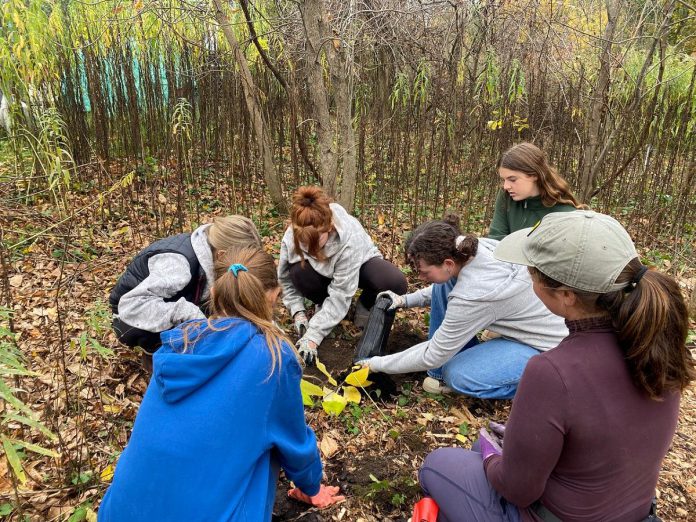
Students in the 2025 cohort of the Kawartha Pine Ridge District School Board's Youth Leadership in Sustainability (YLS) program plant native pawpaw trees in Peterborough's Ecology Park with the help of GreenUP. Applications are now open for the fall 2026 class of the one-semester four-credit program which helps high school students learn about being a leader for sustainability through experiential learning opportunities and field trips led by local community organizations. (Photo courtesy of YLS)
Since 2018, Youth Leadership in Sustainability (YLS) has been transforming farms, forests, and parks into classrooms to empower young people to protect the planet against the most critical climate crises it faces today.
A one-semester and four-credit program offered by the Kawartha Pine Ridge District School Board, YLS invites grade 11 and 12 students to learn about sustainability by getting out of the traditional classroom and connecting with expert community leaders. Through experiential learning, the program prepares youth for leadership roles while giving them practical solutions they can put into action.
“Climate change isn’t a problem of tomorrow,” says YLS program coordinator and teacher Emma Jane Woods. “It’s something that we’re facing right now, and oftentimes the onus of climate change is put on the younger generations, which is incredibly stressful. It’s anxiety inducing.”
Advertisement - content continues below
Share on Bluesky
“It’s super important to have them empowered and feeling like they can make a difference, and they can use their voice to accomplish big things, both within our community and within the global community as well.” Woods adds.
Woods took over the helm of the program when award-winning teacher and founder Cameron Douglas left in the summer of 2025 to become a program director at British Columbia’s Pearson College UWC.
Though he founded YLS because he saw students yearning to “roll up their sleeves, dive in, and make things happen” when it came to tackling climate issues, Douglas also found students had a new “zest for learning” when they completed the program.
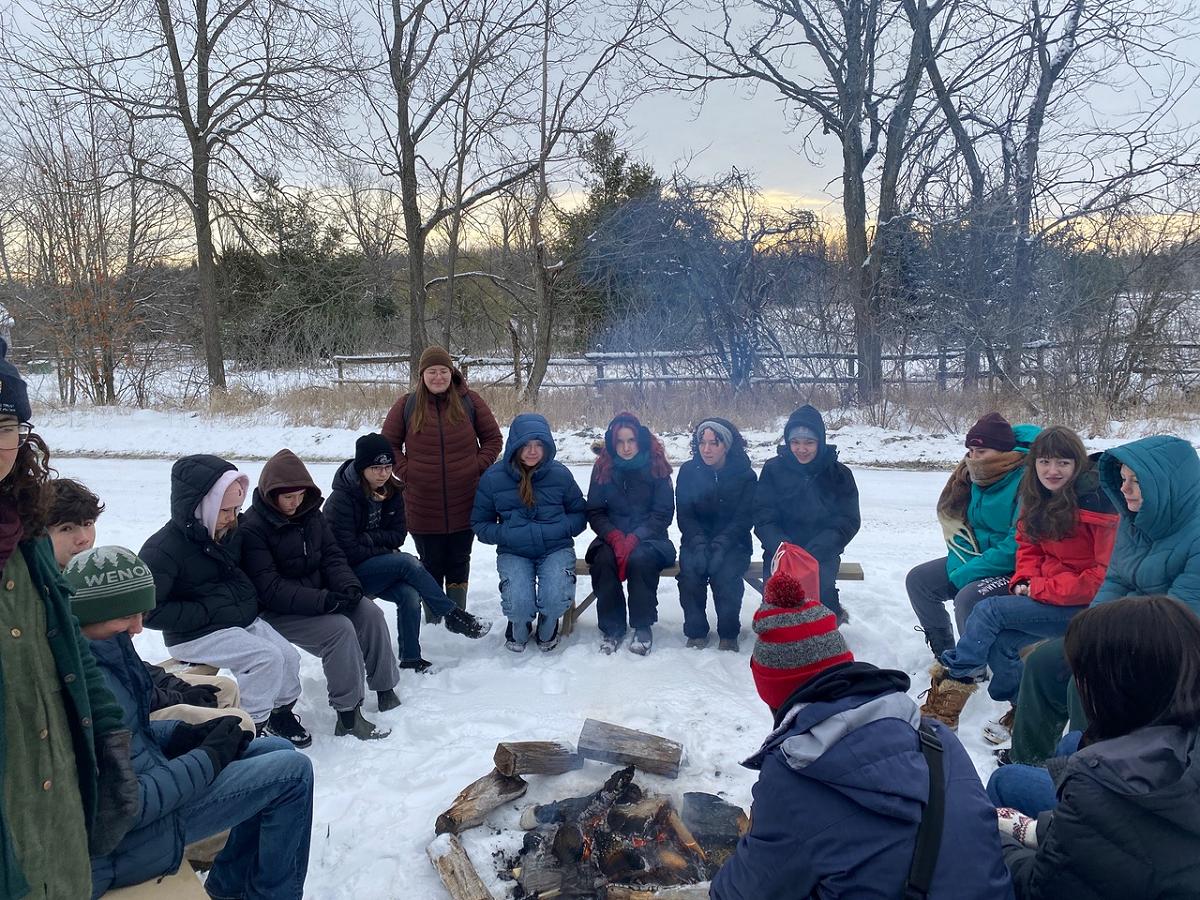
Students enrolled in the Youth Leadership in Sustainability (YLS) program visit the Dance Nature Sanctuary in Selwyn Township with staff from Kawartha Land Trust to learn about native seed dispersal and ecosystem restoration. The YLS program was founded by Cameron Douglas in 2018 to help youth develop the skills to become leaders in sustainability. (Photo courtesy of YLS)
“They explored a different learning model and, in a number of cases, students who were pretty disengaged at school came to life and really responded well to that wireless format that’s much less structured,” Douglas says. “Very significantly, what they responded to was a strong sense of community because we spent the day together and we spent a lot of time building a secure, reinforcing classroom. They came out of their shell and were able to engage.”
For her part, Woods adds it’s difficult to sum up just how beneficial experiential learning can be for students, especially when it comes to getting them to care about the planet.
“At the end of the day, they probably aren’t going to remember the specific lesson or the specific term that I taught them when standing up at the front (of the classroom), but they are going to remember planting 300 trees and the pride that they felt,” she says. “They are going to remember walking through the woods and watching a barred owl fly right past them. They are going to remember these connections that they form with the land and the love that they feel with the land as a result.”
Advertisement - content continues below
Share on Bluesky
Woods explains that strengthening the students’ connection to the land and building that love is essential for inspiring conservation efforts of the future.
“If somebody loves something, they’re much more willing to protect it and much more likely to take action to protect it, so getting our youth outside and connected to the land is absolutely crucial, as well as getting them connected to the community.”
Between traditional classroom settings at Trent University and Peterborough Alternative Continuing Education (PACE) at PCVS, students enrolled in the fall 2025 class went on 19 separate field trips that had them learning from local organizations.
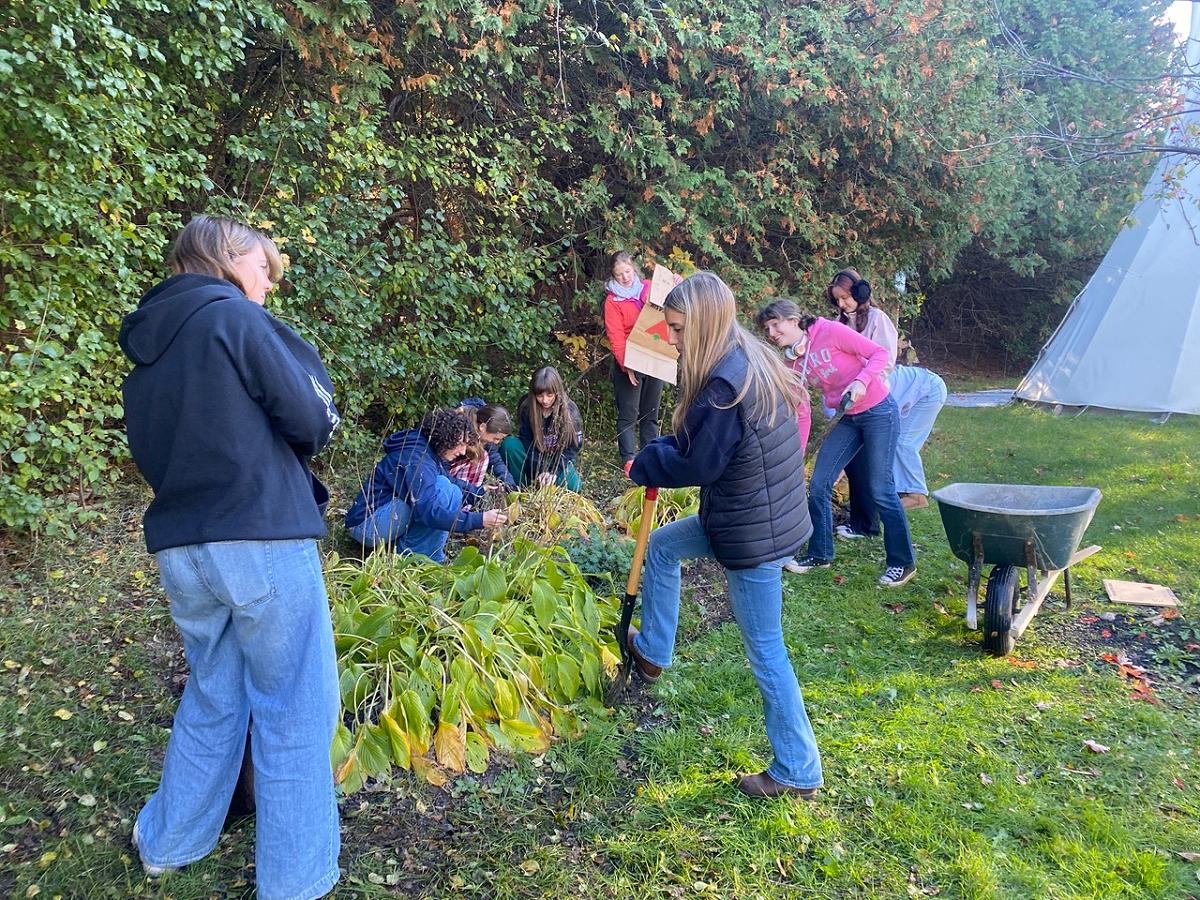
Students of the Youth Leadership in Sustainability (YLS) program collaborate with the Trent University School of Education to replace non-native garden plants with native plants. Graduates of the integrated curriculum program are often inspired to pursue post-secondary studies and careers in related fields. (Photo courtesy of YLS)
Among several others, these included trips to Ecology Park to learn from GreenUP, tree planting with Otonabee Region Conservation Authority, learning traditional practices at the Alderville Black Oak Savanna, visiting property protected by Kawartha Land Trust, volunteering with the Haliburton Children’s Water Festival, and going on overnight camping trips in provincial parks.
Organizations like One City Peterborough and Kawartha Food Share even spoke to the students to provide understanding on how supporting vulnerable populations can ultimately connect to broader sustainability efforts.
“We’ve been really fortunate that the community has opened their arms to us very readily,” says Woods. “I can tell you it’s the experiences that make a difference for them (the students). It’s the learning that comes from that and hearing from someone that they aren’t hearing from constantly that they really appreciate. That helps to connect the dots for them between what sustainability mean and how they can be a leader for sustainability in their life.”
Advertisement - content continues below
Share on Bluesky
“When communities and organizations host us and engage with us, we as teachers and students are the beneficiaries,” Douglas adds. “Often in their mandate is engagement of youth, so it’s a two-way street. They were quite happy to have this captive YLS audience to share some of their priorities to. That’s an absolute cornerstone of the program that brings it to life — the rich range of community partnerships.”
The YLS program also largely focuses on integrating Indigenous perspectives on the land into sustainability understanding.
“One of the best ways to fully engage with reconciliation efforts is through land-based reconciliation, which we do a lot of throughout the semester,” says Woods. “My co-teacher is absolutely fantastic, and she makes a lot of time and space to hear from Indigenous people, spotlight those Indigenous voices, and have some of those tough conversations in a really supportive environment.”
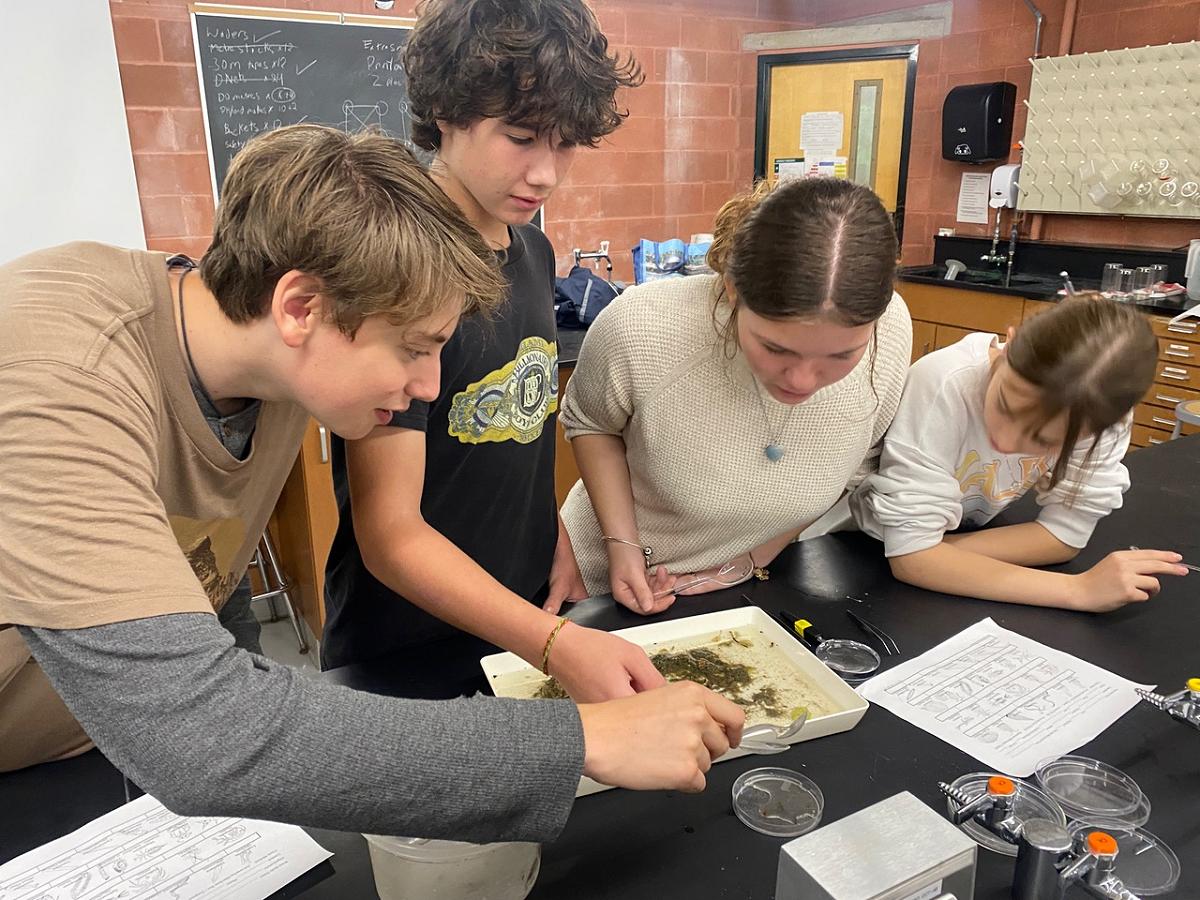
Youth Leadership in Sustainability (YLS) students identify benthic macroinvertebrates in a Trent University lab to assess the health of local ecosystems. The one-semester, four-credit program includes a combination of traditional classroom learning and experiential learning opportunities guided by representatives from local organizations. (Photo courtesy of YLS)
Graduates of YLS have gone on to post-secondary studies in related fields, have worked in climate education, and have been involved on advisory teams for the Canadian Net-Zero Emissions Accountability Act and Climate Action Network Canada’s campaign for a national Youth Climate Corps program, which would employ tens of thousands of young Canadians in climate-related work.
Students are additionally invited to attend Trent University lectures and complete complementary coursework as part of the YLS program. Students who achieve a certain grade in the courses are then eligible to receive a non-transferable Trent University credit.
“Even if they don’t go to Trent, the biggest benefit is seeing what university is like, but still with the dedicated support of high school teachers there to help them navigate it,” says Woods. “What I’ve heard from a lot of my students is that they appreciate being able to immerse themselves in the post-secondary setting and that it has taken a lot of anxiety or nervousness away from them when they think about going into their own post-secondary pathway afterwards.”
Advertisement - content continues below
Share on Bluesky
With limited spots available, registration is now open for the 2026 YLS cohort. Though there is a fee to cover the cost of the field trips, financial assistance is available on a limited basis. Those interested in donating to ensure students do not face financial barriers, as well as organizations interested in hosting fields trips, are encouraged to reach out to YLS.
“That network of support from partners is really what makes a difference for these folks when they’re getting that experiential education and creating those connections within the community,” says Woods.
Based on student testimonials, not only have the youth challenged themselves, connected with “like-minded” friends, and consider YLS to be a “highlight” of their lives, they also felt empowered to use their voices to make change.
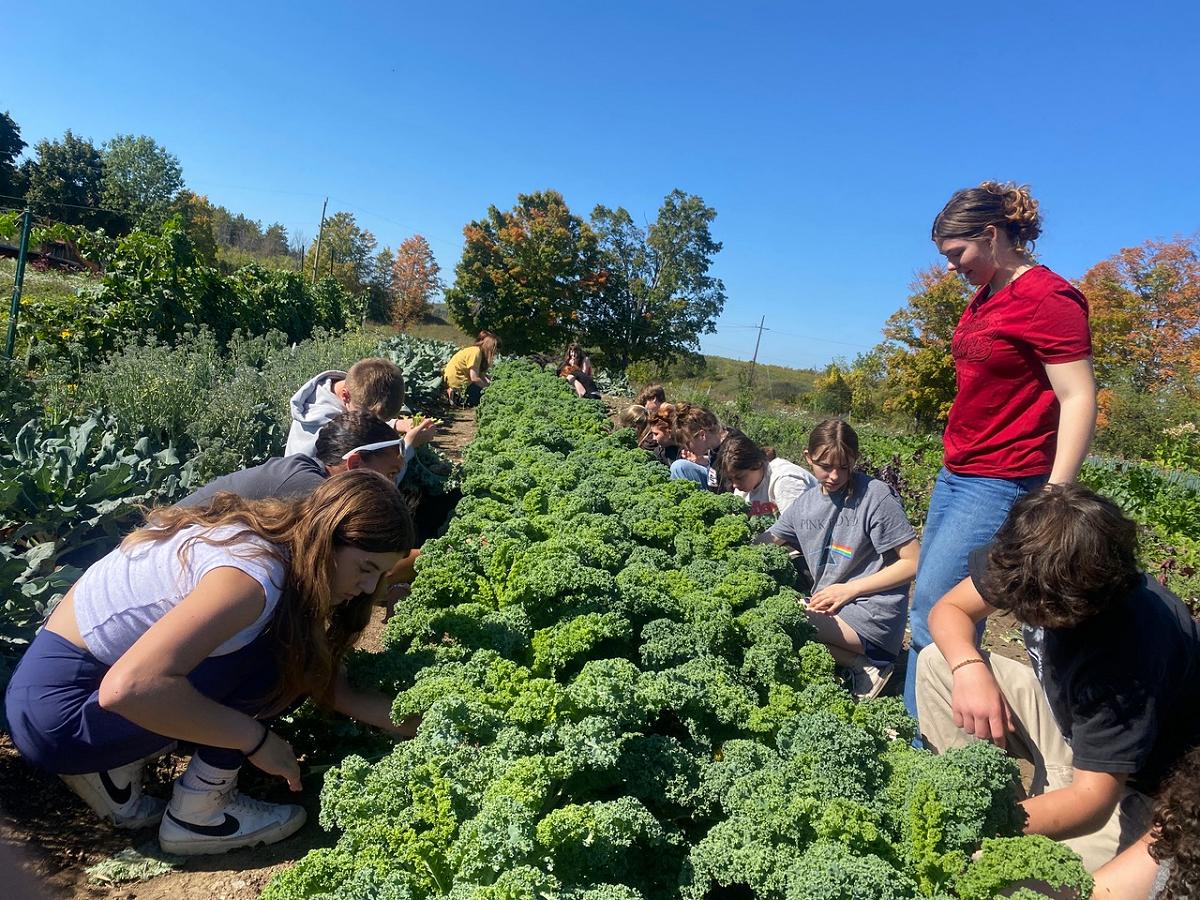
Youth Leadership in Sustainability (YLS) students prepare kale to be ready to harvest on the Trent Research Farm. Project coordinator and teacher Emma Jane Woods says the integrated curriculum program aims to get youth loving the outdoors so they are incentivized to become leaders in protecting the planet. (Photo courtesy of YLS)
“YLS helped me to grow as a leader and step out of my comfort zone,” says Elizabeth, a graduate of the 2025 program. “I now know how to be an informed environmental activist within my community and create effective change.”
That, Woods says, is key to the program’s success.
“Ensuring the students are empowered, feel a sense of agency in the discussions, and feel like they do have a voice at the table — because they should, because it’s going to be their problems, and they’re going to be facing the consequences of these things — will ultimately help them manage the stress of navigating the changing climate,” she says. “It will help them recognize that they do have the power to make a difference.”
To learn more about YLS and to apply, visit yls.green.
VIDEO: “ReWilding The Classroom” documentary by Rodney Fuentes
The original version of this story has been updated to clarify that Climate Action Network Canada supports a campaign for a national Youth Climate Corps program but does not operate such a program. The only Youth Climate Corps programs currently operating in Canada are located in British Columbia and run by the non-profit organization Wildsight and its partner Youth Climate Corps British Columbia.
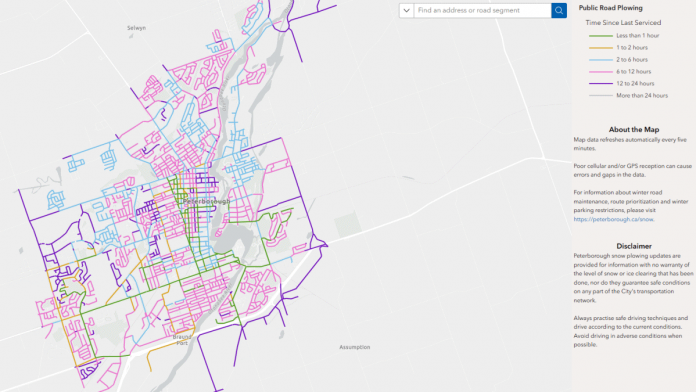
The City of Peterborough's new interactive snowplowing update map shows the location of snowplows every five minutes, with colour-coding of streets representing when a road was last serviced. (kawarthaNOW screenshot)
Peterborough residents who are wondering which streets have been plowed after it snows have a new tool at their disposal, courtesy of the City of Peterborough.
The city has launched a new online snowplow tracker map with close-to-real-time information about the location of plows and their progress during winter maintenance operations, including the clearing and treating of roads after snow events.
Developed by the city’s geomatics and mapping division in collaboration with the public works division, the map uses GPS and automatic vehicle location technology to display the location and progress of snowplows every five minutes. The map will be active for the winter season.
Advertisement - content continues below
“This new interactive map enhances the visibility of our operations and helps the community better understand how and when roads are being cleared,” says Cassandra Babcock, the city’s public works operations director, in a media release.
In addition to showing the location of snowplows, the map also uses colour-coding to display the last time a road has been serviced, with a road coloured green meaning less than an hour, orange meaning one to two hours, blue two to six hours, pink six to 12 hours, purple 12 to 24 hours, and grey for more than 24 hours.
According to the city, the map is for informational purposes only and does not guarantee current road conditions or safety. The city advises residents to always practise safe driving techniques, drive according to the current conditions, and avoid driving in adverse conditions when possible.
Advertisement - content continues below
The map also provides no information about when a street may be plowed. The city says it designs snowplow routes to clear and treat arterial and collector roads first, as required by legislated standards.
These are the roads that see the highest volume of daily traffic, are on transit routes, or pass by Peterborough Regional Health Centre.
Once arterial and collector roads have been plowed and treated, snowplows will then proceed to clear and treat streets in residential neighbourhoods.
Advertisement - content continues below
A statement from city councillors Keith Riel and Don Vassiliadis, who are co-chairs of the city’s municipal operations portfolio, calls the map “a valuable resource for our community.”
“It allows residents to track snowplows and understand route priorities. It also helps the community see the scale and complexity of winter operations and shows how the city is actively managing winter road operations throughout the winter season.”
More information about snow removal in the City of Peterborough, including a link to the interactive map, is available at peterborough.ca/snow.
Eddy Sweeney as Wesley and Carling Dulder as Anna during a rehearsal of the Peterborough Theatre Guild's production of "Midnight Madness" by award-winning Peterborough-born playwright Dave Carley. Directed by Jane Werger, the fast-paced comedy runs for 10 performances from February 27 to March 14. (Photo: Jordan Lyall Photography)
For the fifth and penultimate production of its 2025-26 season, the Peterborough Theatre Guild will be staging Midnight Madness, a comedy by Peterborough native Dave Carley, for 10 performances from February 27 to March 14.
Described as a fast-paced and entertaining exploration of the unexpected turns that can change a life, the play begins as Bloom’s Furniture manager Wesley is about to close the doors for the final time on the store and on his career during a going-out-of-business sale, when former high school classmate Anna walks in.
She doesn’t recognize him at first, but Wesley remembers her as he has been keeping tabs on all his former classmates. Anna has returned to her home town to start a career as a lawyer and, as the pair recall the humiliating events that drove them both of them from high school before graduation, they reconcile with their past and find a spark of romance.
Advertisement - content continues below
Directed by Jane Werger, the Peterborough Theatre Guild production stars Eddy Sweeney as Wesley, Carling Dulder as Anna, and Jack Burke as Mister Bloom.
Born and raised in Peterborough, award-winning playwright Dave Carley is no stranger to the Peterborough Theatre Guild, having written the musical spoof Susanna!, based on the life of 19th-century English-born Canadian author Susanna Moodie, for the Guild in 1979 while he was a student at the University of Toronto. His 1985 play Hedges, also staged by the Guild, represented Canada at an international theatre festival in Japan.
To date, Carley’s many full-length and short plays have seen over 500 productions across Canada, the United States, and in many countries around the world. One of his latest full-length plays, an adaptation of Canadian writer and environmentalist Farley Mowat’s 1979 war memoir And No Birds Sang, will have its world premiere at the Capitol Theatre in Port Hope in August.
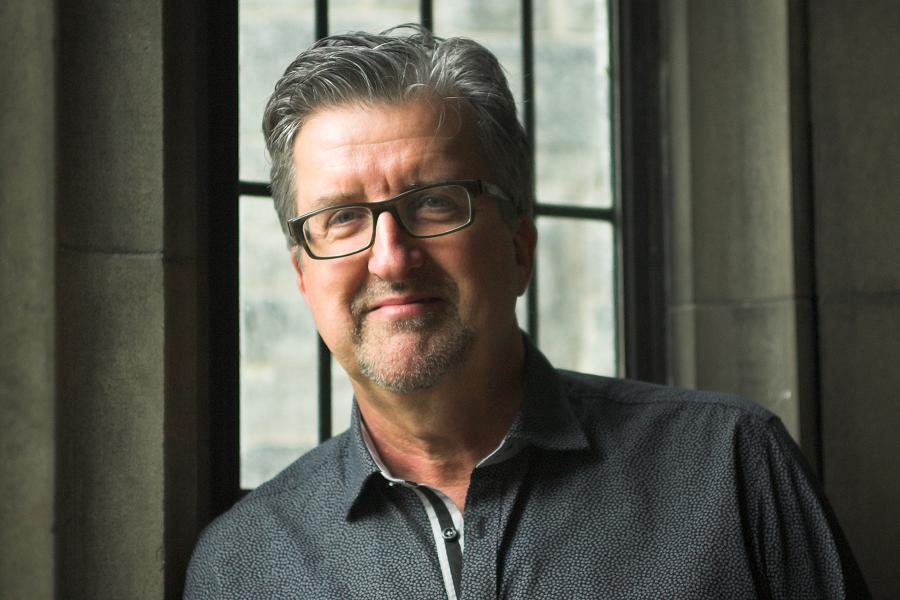
Born and raised in Peterborough, Dave Carley’s many plays have seen over 500 productions across Canada, the United States, and in many countries around the world. He wrote the musical spoof “Susanna!” for the Peterborough Theatre Guild in 1979 while he was a student at the University of Toronto. (Photo: Stephanie Hanna)
Although he now lives and works in Toronto, Carley describes himself as “a proud Peterburian” and, in 2022, was inducted into the Peterborough Pathway of Fame.
Midnight Madness will be staged at the Guild Hall at 364 Rogers Street in Peterborough’s East City with evening performances at 7:30 p.m. on February 27 and 28, March 5 to 7, and March 12 to 14, with 1:30 p.m. matinee performances on March 1 and 8.
A paramedic suffered life-threatening injuries in a collision on Monday afternoon (February 2) just north of Madoc.
Shortly after 3 p.m. on Monday, Central Hastings Ontario Provincial Police (OPP) and emergency services responded to reports of a collision involving an ambulance and a transport truck at the intersection of Highway 7 and Highway 62.
Two paramedics were transported to hospital, with the driver of the ambulance later airlifted to a trauma centre with life-threatening injuries. Police did not disclose information on the extent of the injuries suffered by the second paramedic.
Advertisement - content continues below
The two occupants of the transport truck were taken to hospital as a precaution.
The intersection of Highway 7 and Highway 62 will be closed until repairs to the traffic lights are completed.
Police are continuing to investigate the collision. Anyone with any information or with dashcam footage is asked to contact Central Hastings OPP at 1-888-310-1122. To remain anonymous, call Crime Stoppers at 1-800-222-TIPS (8477) or visit www.ontariocrimestoppers.ca.
Lakelands Public Health says it is responding to a cybersecurity incident that affected some of its internal systems, but has not confirmed whether the incident involved ransomware or the theft of personal information.
The public health unit announced Tuesday (February 3) that, after becoming aware of the incident last Thursday, it moved immediately to secure its systems and activate its incident-response protocols. A third-party cybersecurity firm has since been engaged to investigate and contain the breach and support recovery efforts.
While the investigation is ongoing, Lakelands Public Health says systems used to manage infectious disease data and clinical appointments — including immunization and sexual health services — appear not to have been affected.
Advertisement - content continues below
“Our priority response to this event is protecting the information entrusted to us and maintaining continuity of critical public health services,” said Dr. Thomas Piggott, medical officer of health and CEO of Lakelands Public Health.
According to the health unit, if its investigation determines personal or personal health information was compromised, affected individuals will be notified directly.
Lakelands Public Health has not disclosed the nature of the cybersecurity incident, but attacks on healthcare organizations in Canada frequently involve ransomware — a form of malware that encrypts systems and demands payment to restore access.
Advertisement - content continues below
According to national cybersecurity reporting, healthcare organizations are among the most frequently targeted public-sector institutions in Canada due to the critical nature of their services and the sensitivity of the data they hold.
Hospitals, public health units, and regional health authorities have increasingly faced operational disruptions rather than immediate data breaches, with attackers seeking payments of large sums (usually in untraceable cryptocurrency) to restore access to systems and data.
In recent years, several Canadian hospitals and health agencies have reported ransomware incidents that forced staff to revert to paper records, delay non-urgent procedures, or temporarily suspend digital services. Cybersecurity experts have noted that public agencies often choose not to publicly confirm ransomware involvement during early investigations, particularly when containment efforts are still underway.
Advertisement - content continues below
Lakelands Public Health says some programs and services may experience temporary disruptions as systems are restored, though most services remain available across all office locations.
Residents with urgent public health concerns are being encouraged to call 1-866-888-4577 and follow the prompts. After-hours urgent calls can be directed to 705-760-8127 for Peterborough City and County, or 1-888-255-7839 for Haliburton County, the City of Kawartha Lakes, and Northumberland County.
The health unit says it will continue to provide updates as more information becomes available.
Former mayor Diane Therrien-Hale addresses Peterborough city council on February 2, 2026 during a delegation on the new procedure by-law. Council adopted her suggestion that the by-law allow a small number of public delegations for each item on a council agenda, rather than a total of 10 delegations per agenda as proposed in the by-law. (kawarthaNOW screenshot of City of Peterborough video)
Peterborough city council has approved a new procedure by-law that bans councillors from taking their phones into council chambers, but reversed course on a proposed restriction on the number of public delegations that could appear before council at each meeting.
Ironically, council’s delegation decision at its meeting on Monday night (February 2) was influenced by a public delegation by former Peterborough mayor Diane Therrien-Hale.
A requirement of the Municipal Act, a procedure by-law governs the rules for calling, holding, and regulating municipal council and committee meetings. In Peterborough, it’s been the practice of council to consider amendments to the procedure by-law at least once during a council’s four-year term.
Advertisement - content continues below
Share on Bluesky
The new procedure by-law was developed by a working group that included Mayor Jeff Leal, councillor Andrew Beamer as chair of general committee, and councillor Lesley Parnell as chair of planning committee, along with city staff including city CAO Jasbir Raina, Potts, Kennedy, and deputy city clerk Natalie Garnett.
Along with prohibiting electronic devices in chambers, the new procedure by-law allows the aural recording of closed sessions, expands the chair’s authority (including by limiting the ability of councillors to raise points of order), reduces councillor speaking time on motions during council meetings, limits the total number of public delegations at a council meeting to 10, limits both the number of questions councillors can ask public delegates and the speaking time delegates have when responding to questions, and removes the ability of council to reconsider a motion it has approved during the same meeting.
In her delegation, Therrien-Hale said that she understands council’s mandate to update the by-law and supports some of the proposed changes, but added that other changes reflect criticism that council can be “somewhat archaic” and “lacking in transparency and forward-thinking decision making.”
She said that, while she supports the decision to aurally record the proceedings of closed sessions, she disagrees with the proposed ban on electronic devices other than in closed sessions.
“In open session, such a ban is an outright overreach of authority and something that literally no other municipality in the province has enacted,” Therrien-Hale said. “Passing the by-law with this ban will only serve to further the city and this council’s reputation as being stuck in the 20th century, unable and or unwilling to adapt to the current technological reality of how the world works in 2026.”
“I take particular umbrage with some members of council who spoke in support of this change by making unfounded accusations towards other members and contravening their own stated desire to ‘Elect Respect’,” she added, in an apparent reference to councillor Parnell who previously accused councillor Alex Bierk of receiving outside information on his cell phone during a council meeting.
“Such cognitive dissonance continues to be disappointing, but not surprising. Moreover, implementing such a ban three months before the May 1st nomination period opens for the October municipal election seems, as the kids would say, highly sus.”
Therrien-Hale noted that imposing a phone ban will “further alienate young people from the political process.”
“If you personally don’t want to use or learn to use a cell phone, that’s fine, but do not police the rest of council and the incoming council with such unnecessary and regressive measures.”
Advertisement - content continues below
Share on Bluesky
With respect to limiting the number of public delegations to 10 for each council meeting, instead of the current limit of 10 delegations for each topic or report on a council agenda, Therrien-Hale said the proposed by-law raises issues of “fairness and equitable access of residents to be able to speak before council.”
“Limiting delegations to a maximum of 10, regardless of the number of agenda items, is deeply problematic,” she said. “There are often cycles of council where there are multiple highly contentious issues on the agenda, and restricting the public’s ability to delegate on those issues is not helpful in building trust and confidence between the public and our elected officials, which at all levels of government seems to be at an all-time low.”
“Allowing only 10 delegations means that the ability of people to register depends entirely on their quick access to reliable technology and internet, their ability to navigate the (city’s) website, or their ability to physically attend the (city) clerk’s office to fill out the delegation forms. I would argue that this is unfair and borders on discriminatory to people without reliable technology and to folks who rely on transit or other forms of transportation to physically get to City Hall to register in time to be one of the first and only 10.”
As a “compromise,” the former mayor suggested that public delegations continue to be permitted per topic or report on the agenda, but that the number of delegations per item be reduced from 10 in the current by-law to between three and five.
“(This is) something that other municipalities have done and is quite in line with how other municipalities in eastern Ontario have handled this issue.”
In response to a question from councillor Keith Riel about changes to the procedure by-law during her time as mayor, Therrien-Hale noted that, when she was the chair of the Eastern Ontario Mayors’ Caucus, the City of Peterborough allowed an unlimited number of public delegations allowed council meetings, which was an issue.
“Other municipalities in eastern Ontario thought that the City of Peterborough having no limits was just wild and unheard of,” she said. The city’s procedure by-law was subsequently changed to a limit of 10 delegations per topic or report.
“Going from what we have now, 10 per item, to 10 overall, regardless of what the agenda looks like, to me is just going to be problematic down the road because, as you know, some agendas are quite light (but for) some cycles the agenda is super heavy, and you have a ton of different issues that people want to speak to.”
In his comments, councillor Gary Baldwin recalled a city council meeting “when there were probably 40 or 50 delegates talking about (BWXT Nuclear Energy Canada Inc.) and we didn’t finish the delegations until almost 11:30 at night. Council business completed at 3 a.m.”
“There were a number of us, I think including yourself at the time, who said at the time that council couldn’t make great decisions after midnight,” he said.
In response to a question from councillor Bierk about the proposed phone ban, Therrien-Hale said she can understand the concern about the public thinking city business is being done on personal electronic devices, but noted some members of the general public think business is already being done “behind closed doors anyways.” She wondered how the city would enforce a ban that is more restrictive than the rules in high school.
“It’s trying to solve a problem that hasn’t really been pointed to as actually being a problem,” she said, reiterating that a phone ban may dissuade younger people from getting involved in municipal politics.
Advertisement - content continues below
Share on Bluesky
Additional public delegations on the topic included Danielle Turpin, Rob Hailman, and Roy Brady, who all also raised concerns about the changes in the by-law that restrict public engagement and discussion, particularly the limit on delegations.
During council debate on the proposed procedure by-law, councillor Dave Haacke proposed an amendment to allow four delegations per agenda item rather than 10 delegations per agenda. During the general committee meeting last Monday, Haacke had also proposed an amendment to the proposed by-law to increase the number of questions a councillor can ask a public delegation from one to two. That motion was carried by a unanimous vote of 11-0 and added to the main motion.
Councillors Bierk, Beamer, Joy Lachica, Matt Crowley, Kevin Duguay, and Gary Baldwin all spoke in favour of Haacke’s latest amendment, while councillor Riel reiterated his concerns from last week’s general committee meeting about the lack of consultation with individual councillors about the proposed procedure by-law.
After the debate, council voted 11-0 in support of Haacke’s amendment.
Councillor Bierk then proposed a second amendment to change the wording of the proposed procedure by-law from “not be in possession of any electronic device that could facilitate a communication that does not comply” with direction by the chair to “not communicate through any electronic device that could facilitate a communication that does not comply,” noting the purpose of the procedure by-law is to govern how meetings are run, not to govern the conduct of councillors.
“It just limits the very awkward thing of the chair having to police what I’m going to do with my phone, and that will be an awkward situation,” Bierk said. “This negates all that. It is just it is putting the onus on us to follow the rules, and it doesn’t take these drastic steps that are being proposed that no other municipality, including the municipalities that were consulted in the report, are taking. This wording aligns much more closely with how other municipalities govern communications at a meeting.”
He pointed to the city computer in front of him (each councillor has access to a computer during council meetings).
“This falls under the definition as the by-law is written as an electronic device,” he said, adding that the microphone each councillor uses while speaking does as well.
Advertisement - content continues below
Share on Bluesky
Councillor Lachica proposed an amendment to Bierk’s amendment that would include an exception for emergency use related to family status and accessibility reasons, with Lachica noting that minors may not know how to contact the city clerk during a family emergency and councillor Riel noting that he uses his cellphone to control the volume of his hearing aids.
Councillors debated the concerns about accommodating accessibility needs and how councillors would be contacted during emergencies, consulting with city staff on several points, before voting 7-4 in favour of Lachica’s amendment to Bierk’s amendment, with the mayor and councillors Haacke, Beamer, and Parnell voting against.
Councillors then voted on Bierk’s amended amendment, which lost 5-6, with the mayor and councillors Don Vassiliadis, Haacke, Beamer, Parnell, and Baldwin voting against.
Council then returned to a debate on the main motion, with councillor Lachica noting that it was “oxymoronic” that her amendment to Bierk’s amendment passed but the original amendment did not, and councillor Baldwin asking city staff if there could be an educational session at the beginning of every term where councillors learn about the procedural by-law.
“It is my personal belief that a by-law … should not need an education session — it should be clear to everyone involved,” Bierk said in reference to Baldwin’s question.
“Maybe it’s just the fact that I’m the youngest on council,” said Bierk, who turned 44 last Monday, before placing his hand on the city computer in front of him. “I understand how I can use this thing in the exact same way as I can use my phone. It’s absurd to me that this (city computer) is allowed when the by-law explicitly says any electronic device (is prohibited).”
Council then voted on the main motion to pass the new procedure by-law, including the two amendments proposed by councillor Haacke, which carried 8-3, with councillors Bierk, Lachica, and Riel voting against it.
After the meeting, councillor Lachica provided a brief statement to kawarthaNOW about the debate on the procedural by-law.
“Universal, inclusive design is so essential in removing systemic barriers to participation for all. It is my utmost hope that in our governance we are always reflecting on whether we are, indeed, removing systemic barriers or creating them.”
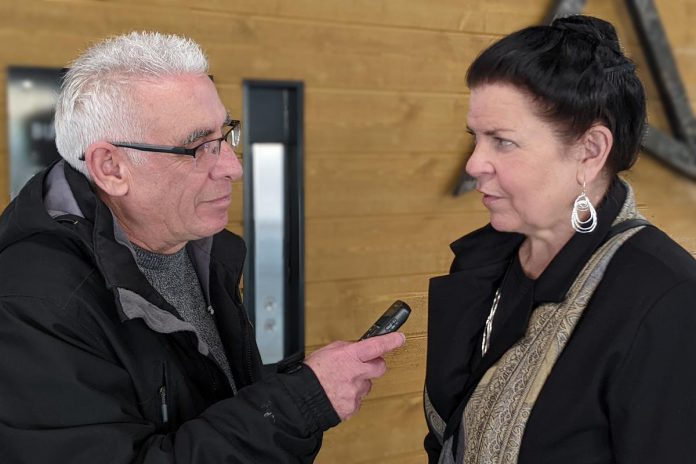
Paul Rellinger interviews kawarthaNOW founder, CEO, and publisher Jeannine Taylor at VentureNorth in downtown Peterborough on January 17, 2024 after she was announced as one of the 14 inductees of JA-NEO's 2024 Business Hall of Fame. (Photo: Bruce Head / kawarthaNOW)
I have the good fortune to live with a very wise woman. That was never clearer to me than it was late in the afternoon of a cold January day back in 2016.
Arriving home, just a half hour removed from being un-hired by Peterborough This Week, I was a mess. Being let go from the only job you’ve known for 33 years has that effect. Despair, confusion and anger overwhelmed me as I broke the news to my partner in marital crime.
There was a short pause before Mary spoke.
“Now you can do what you want to do.”
Advertisement - content continues below
What I wanted to do was what I had been doing since August 1980 when I was hired as a reporter for CKAR/CKQT in Oshawa before being hire three years later by Oshawa This Week — share people’s stories.
But how? The platform for doing just that had been abruptly taken away from me. And I was still angry. Angry to be deemed no longer useful because I made too much money (I didn’t), had too much vacation time (I earned it), and that my publisher at the time hid in his office, sending an underling to enact his decree. I felt I deserved some respect.
Having found comfort in the fact that I left 884 Ford Street with the balls he didn’t have, I spent a few days mulling over options. I was 57 years old. There was still plenty of ink in my pen. Then I picked up the phone.
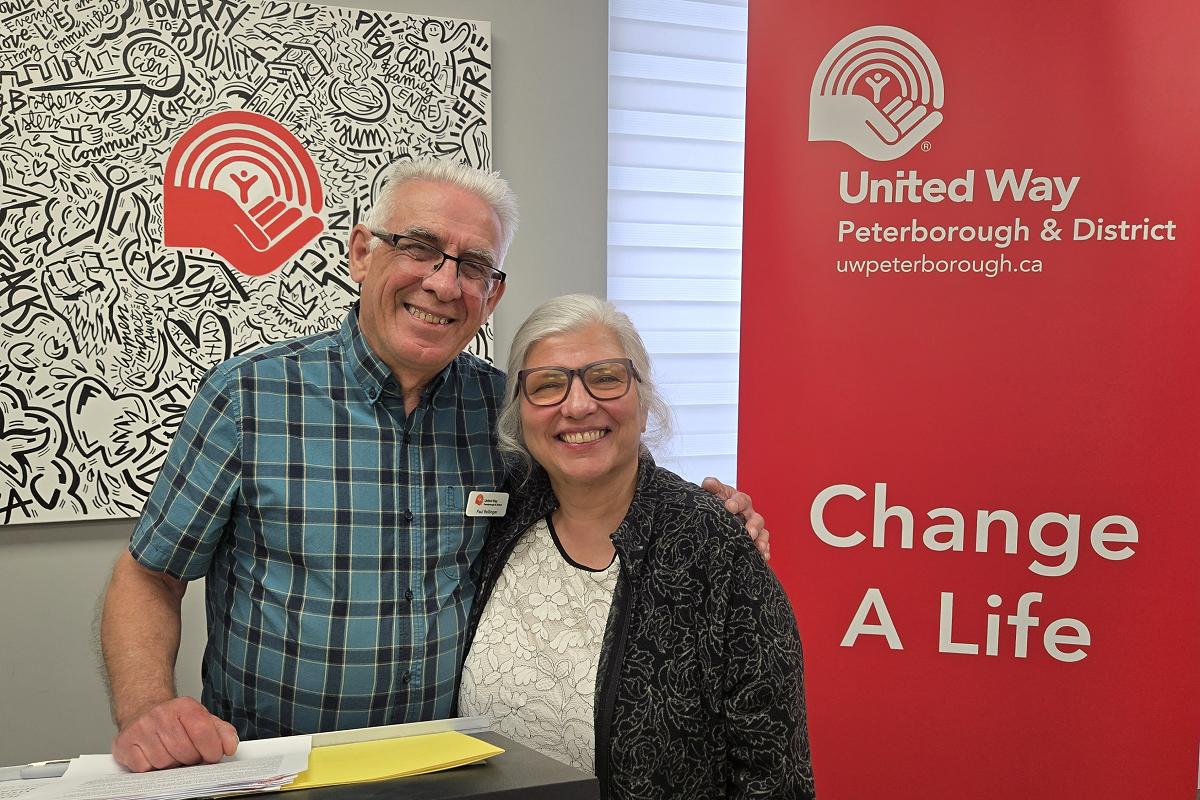
Paul Rellinger with Mary, his wife of 44 years, during the United Way Peterborough & District’s announcement on May 21, 2025 of Rellinger’s appointment as chair of the United Way’s 2025 community campaign. (Photo: Jeannine Taylor / kawarthaNOW)
Let me take you back to about a year earlier. Mary and I were at the Black Horse Pub when we bumped into Jeannine Taylor and her partner Bruce Head enjoying, as I’ve since learned, some rare time away from their many responsibilities as, respectively, publisher and managing editor of kawarthaNOW, a digital media platform they founded and launched as quidnovis.com in April 1996.
We made small talk, mostly around the state of the local media landscape, current city issues and such. Before calling it a night, Jeannine spoke the words that brought me to your reading mine.
“If anything happens to you at Peterborough This Week, give me a call.”
Remembering well her direction of a year earlier, I phoned Jeannine and said “Something has happened.”
Advertisement - content continues below
Shortly after, on February 3, 2016, my first kawarthaNOW article was published — a preview of an upcoming Heart Healthy Seniors Fair headlined “Getting to the heart of matters at Activity Haven.” It wasn’t anything close to award worthy but it was, and remains, among the most satisfying pieces I’ve written. I was again doing what I always what I always wanted to do. The wise woman’s direction had been followed.
Since then, my byline has appeared atop 876 kawarthaNOW articles, including this one. I’ve interviewed, and shared the thoughts and views of politicians, professors, musicians, entrepreneurs, actors and activists, and pretty much everyone in between. Countless keyboard pecks have been accompanied by smiles. By tears, too.
I can’t honestly say that anyone I’ve sat down with has been a favourite over another. Each interaction has been satisfying for different reasons.
What I can say is that it has never been lost on me what a tremendous leap of faith it is for one to share their story and thoughts with another — a complete stranger, in most cases — and hope he or she gets it right. I am as humbled by that trust as I am by the responsibility.
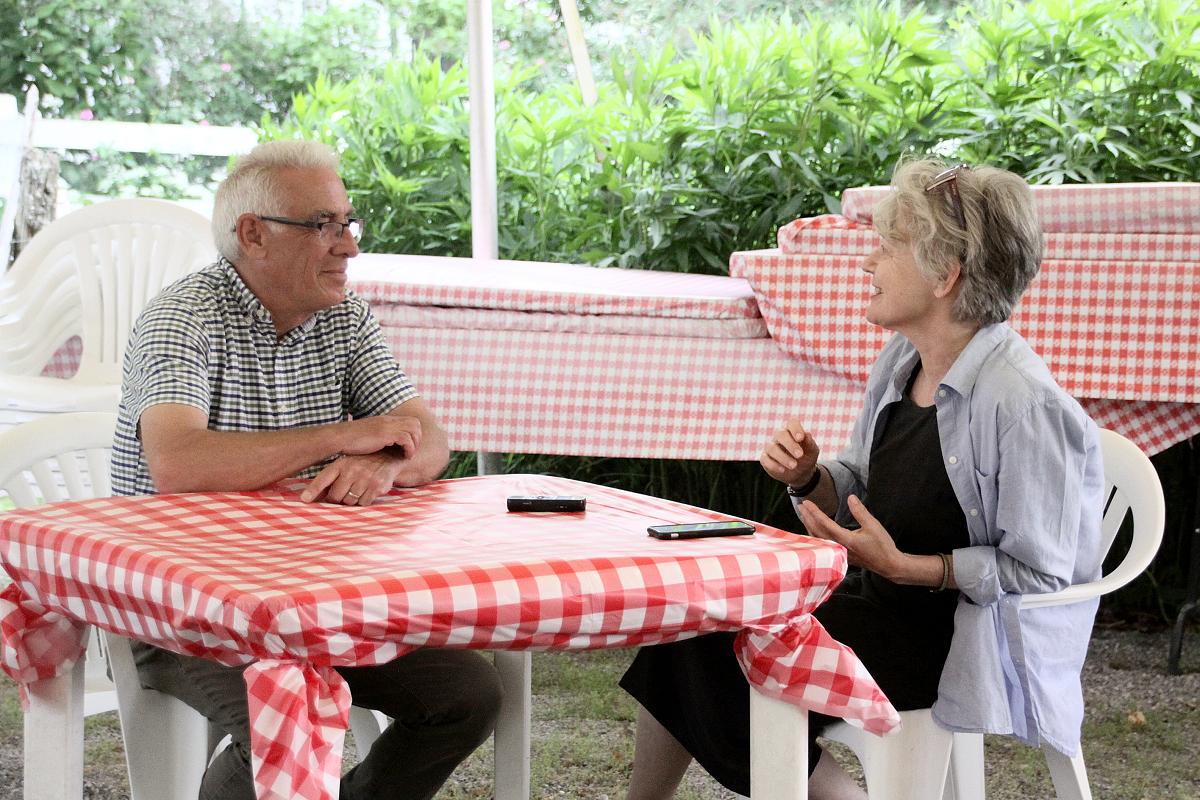
kawarthaNOW writer Paul Rellinger speaks with “Onion Skins & Peach Fuzz: The Farmerettes” playwright Alison Lawrence during 4th Line Theatre’s media day event on June 18, 2024 at the Winslow Farm in Millbrook. (Photo: Jeannine Taylor / kawarthaNOW)
Reflecting now on what has transpired since that dark time in January 2016, I take great satisfaction in the fact that being self-employed has allowed me the flexibility needed to pursue interests and causes that have been, and remain, near and dear to my heart.
In 2018, I ran for a city council seat. I came up short, but better for the experience.
I’ve been able to continue my affiliation with Peterborough Family Literacy Day as its longtime honorary chair and emcee, and from 2016 to 2024, was a member of the Peterborough Musicfest board, serving two years as its chair.
In 2020, I co-founded Peterborough Performs: Musicians United To End Homelessness, which I still organize. That local music showcase has raised close to $150,000 for United Way-supported agencies on the front lines of homelessness. And, in a few months’ time, my term as chair of the United Way campaign will end, hopefully with the news we have achieved the $1.6 million goal.
Advertisement - content continues below
Now, on the surface, it would seem I’m pumping my own tires by relating all this this. I get that, but bear with me — there’s a method to my self-promotion madness.
None of what I listed would have been possible without the patience and understanding of Jeannine and Bruce. They have a business to run and count on those in their employ to be ready as needed. I owe them both a huge debt of gratitude for being accommodating.
They say time heals all wounds, and on reflection, despite how things came to an abrupt end, Peterborough This Week provided some good times, the memories of which remain fresh. Back in 1989 into the following few years, the original newsroom crew was an absolute joy to work with.
The many industry awards claimed thereafter were a thrill to receive, but I revelled more in the accomplishments of those I worked with, knowing I had, as managing editor, a hand in their success.
kawarthaNOW publisher Jeannine Taylor with writer Paul Rellinger at Peterborough Musicfest in July 2018, two years after he started writing for kawarthaNOW. (Photo courtesy of Paul Rellinger)
To this day, I miss working alongside certain people. Others I don’t miss one bit, along with the never-ending office politics that wore me down bit by bit.
Through the good graces of Jeannine and Bruce, I’ve since been able to still do what I want to do. I’ve been blessed to have a transferable skill that they saw as a good fit with kawarthaNOW’s day-one mandate of providing current events and community information to residents, visitors and cottagers in Peterborough and the Kawarthas, and surrounding communities.
Jeannine has said to me many times that her strength is recruiting good people. No argument there. Just gratitude to be among those she has brought on, then and since.
Advertisement - content continues below
On April 23rd, I’ll attempt to blow out 68 candles on my birthday cake. Before or after that exertion, on that same day, I’ll text Jeannine and wish her a happy birthday, one reliable and practical and, ya, stubborn Taurus to another.
Are there another 876 kawarthaNOW articles to write? Perhaps, but one never knows what’s ahead. That was the case 10 years ago and is certainly the case now.
I’m not remotely qualified to give advice, but I will leave you with one thought: if you’re not doing what you want to do, what are you doing?
The wise woman was onto something. Still is, in fact.
Bruce and Elizabeth Thompson alone donated $14,000 of the $40,000 raised for Campbellford Memorial Hospital during the 34th annual Polar Plunge at Campbellford Lions Community Park on January 31, 2026. (Photo: Campbellford Memorial Hospital Auxiliary)
Participants braved frigid temperatures to plunge into the icy waters of the Trent River in Campbellford this past weekend in support of Campbellford Memorial Hospital.
Held at Campbellford Lions Community Park at noon on Saturday (January 31), the 34th annual Polar Plunge raised a total of $40,000 — exceeding its fundraising goal by $15,000.
Organized by the auxiliary to the Campbellford Memorial Hospital, the event was postponed from the previous weekend due to extreme cold temperatures. While temperatures were slightly warmer on Saturday, participants still faced a wind chill of -19°C.
Advertisement - content continues below
“We cannot thank our community enough,” said auxiliary representatives.
“From the volunteers who worked tirelessly behind the scenes, to the plungers who boldly took the leap, to the pledgers and spectators who showed their unwavering support, this event truly demonstrates what we can accomplish together for our hospital.”
The auxiliary singled out Bruce and Elizabeth Thompson for their generosity, who not only matched pledges up to $10,000, but issued a challenge to participants to take a second plunge into the Trent River for an additional $1,000 donation per plunge.
Advertisement - content continues below
Dorset Mitchell, the Trent Hills Thunder Hockey Club, Trent Hills Fire Chief Shawn Jamieson, and Fleming College paramedic students accepted the challenge, bringing the Thompsons’ total donation to $14,000.
The auxiliary also thanked Earl McLean, the Trent Hills Fire Department, the Trent Hills roads crew, and the Campbellford Lions Club for their support of the event.
All proceeds raised during the 34th Annual Polar Plunge will be directed toward supporting patient care at Campbellford Memorial Hospital.
kawarthaNOW.com offers two enews options to help readers stay in the know. Our VIP enews is delivered weekly every Wednesday morning and includes exclusive giveaways, and our news digest is delivered daily every morning. You can subscribe to one or both.
Submit your event for FREE!
Use our event submission form to post your event on our website — for free.
To submit editorial content or ideas, please contact us.