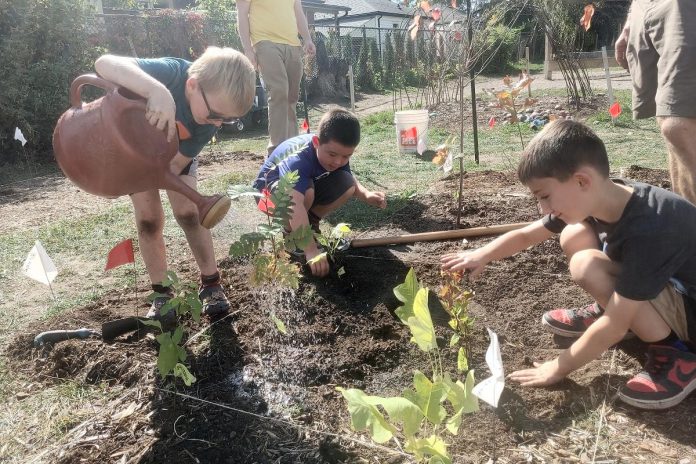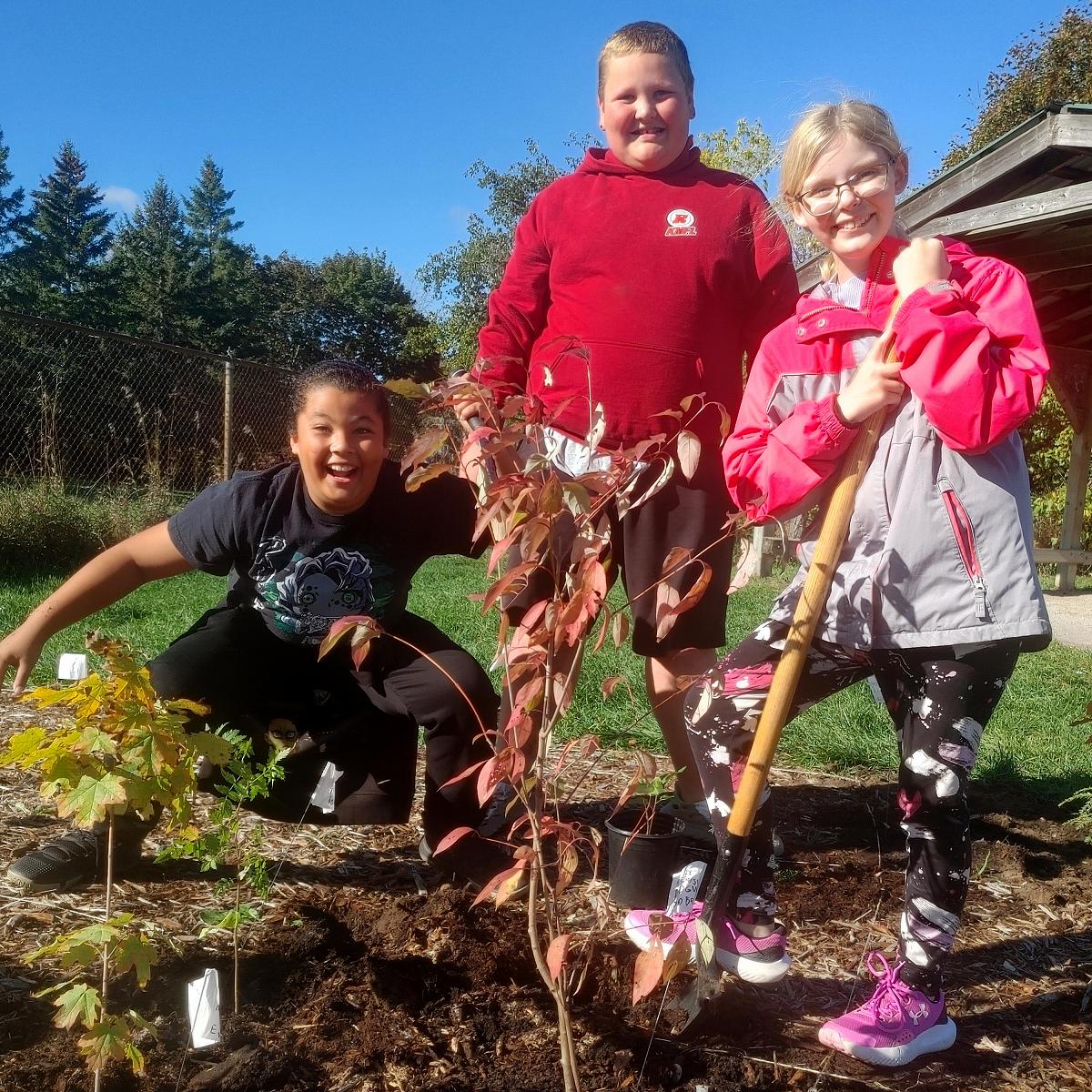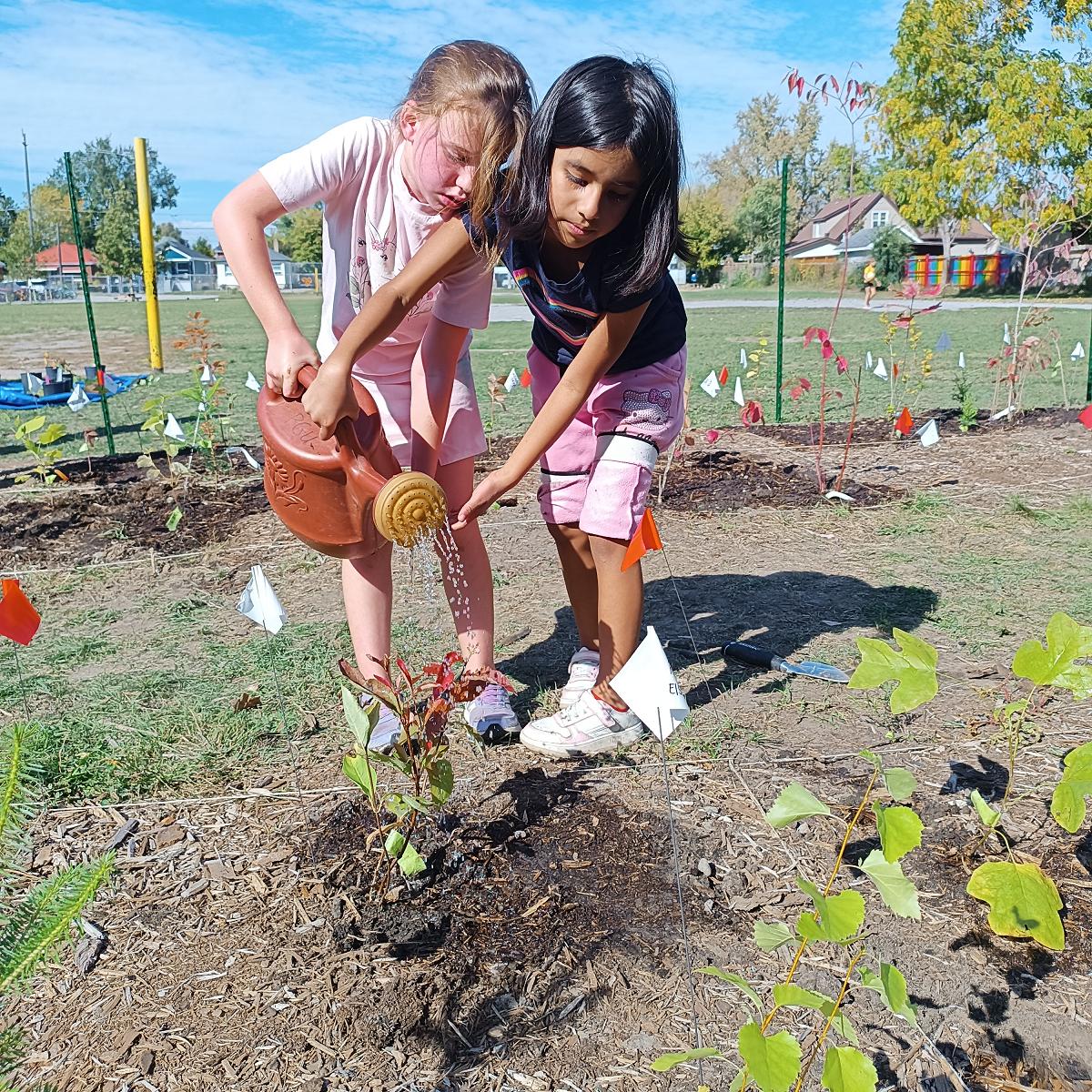










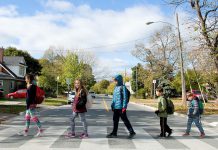



Summer camp staff at Camp Kawartha, whose outdoor and environmental education programs and camps immerse children in nature, promoting a oneness with the Earth. (Photo courtesy of Camp Kawartha)
GreenUP is pleased to invite Jacob Rodenburg, renowned author, local environmental champion, and executive director of Camp Kawartha, to share his reflections on the important role language plays in the perceived value of nature. GreenUP and Camp Kawartha have worked closely in many capacities over the years, including in the development of the Pathways to Stewardship and Kinship and most recently to collaborate on Reconciling with the Land, a pilot project which supports naturalizing local schoolyards.
Each week, GreenUP provides a story related to the environment. This week’s story is by guest author Jacob Rodenburg, Executive Director, Camp Kawartha.
Words are powerful. They are the building blocks of our thoughts. We use them to make sense of our experiences, connect with each other, and imagine new ways of being in the world. But sometimes, our language limits us. It narrows our vision and defines what we value, especially when it comes to the natural world.
If we stop and think about it, our language is replete with anthropocentric or human-centered terms. Nature is a “resource,” valued only for its usefulness to us. Trees are seen as “lumber.” Insects are reduced to “pests.” Swamps are dismissed as “wastelands.” Soil is “dirt,” something to wash off. Mountains are “rich” in ore, just waiting to be mined.
This use of language impairs our connection to the natural world, diminishes our sense of belonging, and diminishes our ability to see nature’s inherent worth.
Advertisement - content continues below
Consider the term “vacant land.” It evokes emptiness — something waiting to be filled, usually with concrete. But what if we said “green space” instead? Suddenly, the land becomes more alive. Valuable. Whole. We name it, and we give it meaning.
Imagine a vocabulary rooted in ecocentrism, where the Earth is not a supply warehouse, but a community of living beings.
A forest is not a timber stand, but a vibrant society of trees, fungi, birds, and mammals. Pollinators aren’t pests; they’re essential allies. Wetlands aren’t wastelands; they are nurseries full of life, purifying and storing water. Soil isn’t dirt, but the living skin of the planet, teeming with more organisms in one handful than there are people on Earth.
A giant puffball mushroom is discovered at the Camp Kawartha Environment Centre. (Photo courtesy of Camp Kawartha)
Even the term “development” needs to be reimagined. Today, development often means leveling the land, clearing vegetation, and building over it. Progress is measured in poured concrete and rising towers.
But what if we embraced the idea of developing nature as well? What if development also meant restoring habitats, planting native species, bringing biodiversity into our cities, and designing with nature rather than against it? What if the true sign of progress was a neighborhood alive with birdsong, shaded by trees, and connected by green corridors?
Let’s rethink the bottom line, too. Right now, it’s about profit. But what if our bottom line was the health of people and the planet? What if success meant human and natural communities thriving together?
Advertisement - content continues below
Let us reimagine prosperity itself, not as accumulation, but as reciprocity. True wealth could be measured in clean air and water, healthy soil, thriving ecosystems and citizens who come to care for and tend natural spaces.
Instead of extracting value from the Earth, what if we grew value with it — investing in living systems that repay us a thousandfold in beauty, resilience, and health?
We need bold, new words that carry hope and possibility. Let’s create “nature-rich” cities so we are not nature-poor. Let’s redefine “inclusion” to include wild species and native habitats in the design of our buildings and streets. Let “community” expand to include the soil beneath our feet, the trees above, the rivers that wind through, and the birdsong at dawn.
Summer campers planting trees at Camp Kawartha. True wealth could be measured in clean air and water, healthy soil, thriving ecosystemsm and citizens who come to care for and tend natural spaces. (Photo courtesy of Camp Kawartha)
We are not separate from nature. We are nature. The Anishinaabe have a beautiful word to describe their connection to nature. They say “Nda-nwendaaganag,” or all my relations, meaning the soil, water, rocks, trees, insects, birds, plants, mammals are all part of their kin.
Embedded in this word is a way of knowing that honours relationship, respect, responsibility, and reciprocity (from Anishinaabe scholar and educator Nicole Bell). Indigenous knowledge systems teach us how to have a positive relationship with the land seeing it not as property, but as our relative — not as a resource, but as teacher and provider.
These teachings offer essential wisdom for our time, reminding us that to live well, we must live with the Earth, not above it.
Advertisement - content continues below
In our modern cities and suburbs, we often practice a quiet kind of “nature apartheid” places only for people including vast zones of concrete and glass, while we relegate nature to slivers of green confined to parks and preserved areas.
But we can change that.
We can rewild our backyards, our schoolyards, even our rooftops. We can design buildings that host birds, pollinators, and plants. We can create green corridors, where life flows again.
Day campers planting in Abby’s Garden at Camp Kawartha. Practicing stewardship at a young age informs tomorrow’s leaders about sustainable practices. (Photo courtesy of Camp Kawartha)
Let us speak a new language, one of kinship, not conquest. Let us name the world as if we belong to it, not as its masters, but as its kin. The words we choose shape the world we create. So let us speak with wonder, let us animate the land so it becomes vital and alive. Let us listen, again, to the Earth, and answer with language that heals.
What new words will you choose? How will you help rewild our vocabulary — so the Earth is not only seen, but also heard, felt, and cherished once more?
Camp Kawartha is an award-winning environmental non-profit offering curriculum-linked outdoor and environmental education programs dedicated to fostering stewardship in children of all ages. Learn more about Camp Kawartha at campkawartha.ca.
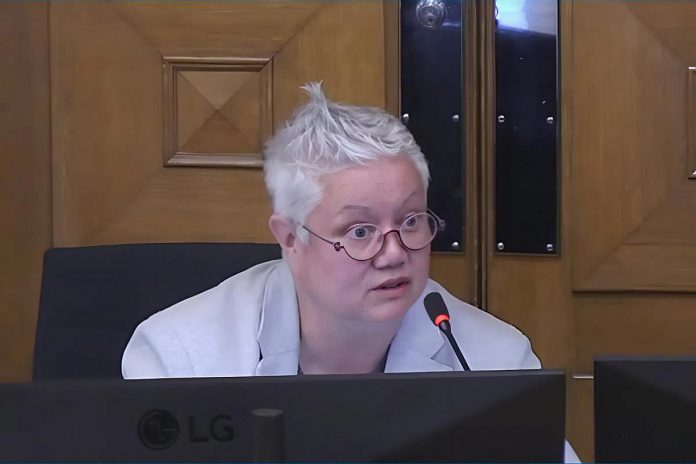
Peterborough city councillor and deputy mayor Joy Lachica, Peterborough County warden Bonnie Clark, and North Kawartha mayor Carolyn Amyotte are elected officials in the Kawarthas region who have pledged to "Elect Respect" by signing a new motion that calls to stand up to abuse and harassment faced by politicians, especially those who are women or ethnic minorities. (kawarthaNOW collage)
Elected officials in Peterborough County and beyond are banding together to “Elect Respect” by signing their names to a province-wide movement speaking out against toxicity and restoring civility in political culture.
Why? Because the local politicians agree with the initiative’s tagline: democracy depends on it.
“We as leaders of diverse backgrounds are not alone in the struggle to create a better culture — a professional culture, a healthy culture — in our governance workplaces,” says City of Peterborough councillor Joy Lachica.
“It enables us to work in a productive and a positive work environment where we can make the decisions. Ultimately, it’s for the people that we need to make sure that a governance work environment is healthy, is well, is positive, and is respectful.”
Advertisement - content continues below
Share on Bluesky
At the time of this writing, among the Elect Respect signatories — the majority of whom are women — are Lachica, North Kawartha mayor Carolyn Amyotte and Apsley councillor Ruth Anne McIlmoyl, Peterborough County warden Bonnie Clark, Port Hope councillor Claire Holloway Wadhwani, and Peterborough trustee Steve Russell.
Founded by Burlington mayor Marianne Meed Ward, Elect Respect began as a conversation between a small group of women called the Halton Elected Representatives (HER) who first came together to share experiences of abuse and harassment as women in politics.
In recognition that elected officials from across levels of government and of diverse backgrounds can face attacks — despite that it is more common among women and ethnic minorities — the group rebranded to Elect Respect.
The initiative invites elected officials and civilians to sign an online pledge to join together “in standing up for civility and respect in our political spaces.” The coalition hopes to see, in the coming months, elected officials endorse and table resolutions and support for the campaign.
Warden Clark brought such a motion forward for Peterborough County council’s consideration at its meeting on Wednesday (June 25), which was approved by council as a consent item. Clark has learned about Elect Respect while taking part at the Rural Healthy Democracy Forum hosted in Almonte on June 12.
“We spoke about how democracy is healthy when everyone is able to participate fully and safely and contribute to our communities,” Clark says. “I support this motion wholeheartedly, and we must support the systems and dialogue that elect respect. We want women and marginalized groups to feel safe.”
Clark suggests one of the issues is that it’s almost expected that those in public roles should face harassment.
“A couple of things we say is ‘you have to have a thick skin to be in politics,’ and I’ve also heard many people say it’s a ‘blood sport’,” she says. “Let’s change that. Let’s change it to the fact that we want to treat everyone with respect and pledge to that and reject harassment, personal attacks, and focus on ideas, policies, and debates. We are a democracy, so you support the decision that is made because it’s collective.”
She adds that, since the pandemic, she has seen a change in how elected officials are treated in the public sphere, and she fears this abuse and mistreatment can cause community members to be fearful of running for public office.
“If we’re going to promote democracy, we need to have elections and have choices. If this (abuse and harassment) is one of the deterrents for people not running … I hope to stand in support so that we can maybe turn that around,” she says.
“But once elected, we want people to stay in their seats because they’ve worked hard to acquire those seats. It’s knowing that there are like-minded people around and that support is there. That’s what I want to come out of County Council in this motion: to show that respect and support.”
Advertisement - content continues below
Share on Bluesky
For her part, North Kawartha mayor Carolyn Amyotte notes she saw “both men and women” colleagues leaving office during the 2022 municipal election.
“It wasn’t because they had accomplished their goals and were finished with public service, but because they were tired of the harassment and abuse and just couldn’t take it anymore,” she says. “We lost some amazing, dedicated and experienced community leaders.”
“Who wants to run for office if they are going to be subjected to the kind of hatred and vitriol that is directed at politicians on a regular basis? Communities lose out on having diverse and broad representation when people are afraid to run for office, and our democracy is undermined when we don’t respect and protect those we elect to lead our communities.”
As an elected representative for over 20 years, Amyotte says she has “seen the decline in civility and decorum across all level of government.” That’s why, she says, she’s also bringing an Elect Respect motion to the next North Kawartha Township council meeting.
“We need to push back against the rise in toxicity and abuse that is directed at both politicians and all those who work in public service,” she says.
Amyotte adds that it’s not just a commitment to put a stop to abuse and mistreatment from members of the public, but also from other elected colleagues. She explains that, in 2023, North Kawartha council passed a resolution calling for legislative amendments to improve municipal codes of conducts and enforcement, and to hold councillors accountable for workplace harassment.
The initiative was led by The Women of Ontario Say NO in support of Bill 5: The Stopping Harassment and Abuse by Local Leaders Act. The motion called for harsher penalties, considering that the most severe penalty that can be imposed on a municipal councillor in Ontario is suspension of pay for for 90 days.
Advertisement - content continues below
Share on Bluesky
This is a timely issue for Lachica, after the City of Peterborough’s integrity commissioner Guy Giorno concluded she had been bullied by Peterborough mayor Jeff Leal following an April 2 general committee meeting on the controversial Bonnerworth Park redevelopment. The integrity commissioner also found that Mayor Leal has breached city council’s code of conduct by intimidating city councillor Alex Bierk.
However, on June 2, city council voted 7-3 in favour of a motion not to impose any kind of penalty on the mayor — either in the form of a reprimand or by suspending his pay — for the two breaches. The councillors who voted in favour of the motion believed the integrity commissioner’s report itself was sufficient punishment.
“Each and every Ontarian is entitled to a healthy and safe work environment, even as elected officials,” Lachica says. “Yes, it’s a different environment and we’re not typical employees, but within our professional world and in our environment where we work we’re held to, in fact, an even higher bar because we’re elected and we’re role models for the community.”
“That’s why we have integrity commissioners, and we have to work hard as individuals to make sure that we keep that in check. So to me, this is just business. This is not an emotional decision. It’s about doing business in a positive environment for the sake of our community, for the sake of our public, so that we can get the work done that we need to.”
Describing Peterborough as “a strong, positive, and democratic-minded community,” Lachica says many members of the public have shared that it’s important to them to fight for a safe work environment.
“The bottom line is that no person deserves to be treated with intimidation or bullying in any work environment,” she says. “There is a great deal of important business that needs to be done in our landscape and if we don’t have the healthiest, most respectful environment to do that then the public isn’t being served to the degree it should.”
Advertisement - content continues below
Lachica, Clark, and Amyotte all agree that it’s crucial to endorse “Elect Respect” as they think ahead to the 2026 municipal election, and to encourage community members not to be too intimidated to get involved in local politics.
“It’s a time for us to not take our democracy for granted,” says Lachica, noting it’s “eroding” in the U.S.
“I think there’s not a better time (to run in an election) and if people have the wherewithal, the courage, and the analysis to get involved, it’s just a moment that can’t be missed,” Lachica says.
“So (I send) much courage to people that would run in next year’s municipal election. I think that we’re just beginning to see changes that are monumental in the city of Peterborough and we’re going to be seeing more as we come together and accomplish them.”
More information on Elect Respect can be found at electrespect.ca.
Northumberland County resident Stewart Richardson (middle), pictured with Northumberland County Archives and Museum (NCAM) archivist Abigail Miller (left) and NCAM curator Katie Kennedy, had donated $85,000 to support the creation of the inaugural exhibit at the new museum facility, currently under construction in Cobourg. (Photo: NCAM)
History is in the making at the Northumberland County Archives and Museum (NCAM) in Cobourg as it has received a significant financial contribution from its first private donor.
NCAM is celebrating a donation of $85,000 from local entrepreneur, history enthusiast, and philanthropist Stewart Richardson.
The inaugural private donation reflects a commitment to preserving and sharing the stories of Northumberland County, NCAM archivist Abigail Miller said.
Advertisement - content continues below
“This generous gift from Mr. Richardson reinforces the value of NCAM’s work and the trust the community places in us,” Miller told kawarthaNOW.
“NCAM is honoured to celebrate the generosity of a community member who believes that preserving our shared history matters and is worth supporting. As the first major private donation of its kind, it sets a strong foundation for future giving. We hope that it will encourage others to be part of something meaningful and lasting,” Miller added.
NCAM’s main exhibition gallery will be named after Richardson in recognition of his contribution.
Advertisement - content continues below
“History has always fascinated me,” Richardson shared in a statement. “Having worked closely with the NCAM staff, I have found their hard work and dedication an inspiration and it is for these reasons I have made this donation.”
The money will be used to support the creation of the inaugural exhibit at NCAM, which is opening with the new building in the fall.
Gidinawendimin, meaning “All Our Relations,” will celebrate Anishinaabemowin in the Michi Saagiig dialect, the first predominant language spoken on this territory. The Indigenous-led exhibition will feature local Indigenous voices, contemporary digital art, and interactive media.
Advertisement - content continues below
This announcement of Richardson’s donation comes at a pivotal time as the museum prepares for the exhibit’s debut, NCAM noted.
“We are thrilled and deeply grateful to Mr. Richardson for this transformative gift,” said Northumberland County Warden Brian Ostrander.
“This sponsorship is not only a significant cultural investment — it reflects the vital importance of preserving and sharing the stories that shape our identity as a community and the rich and enduring histories of Indigenous peoples on this land. We hope this act of generosity inspires others to contribute to the protection and celebration of our shared heritage.”
Richardson has lived in Northumberland County for most of his life. Local history has always been of great interest to him, and he has frequently used the extensive resources offered at NCAM.
“From the early days of this project, Mr. Richardson has been a big supporter who has helped us build momentum,” Miller said. “It is incredibly meaningful to name the exhibition gallery after someone who is so passionate about local history and a true friend to this community.”
Advertisement - content continues below
NCAM is a cultural institution committed to preserving and promoting the stories of the people, places, and development of Northumberland County.
The new facility, which will be shared with the county’s long-term care facility the Golden Plough Lodge, is on Courthouse Road.
The inaugural exhibit and NCAM has also been made possible in part by the Government of Canada, along with significant support from Cameco, the world’s largest publicly traded uranium company based in Saskatoon and with a uranium conversion facility in Port Hope. As part of Cameco’s contribution, a public research and programming space within the new NCAM facility will be named the Cameco Reading Room.
Those interested in joining Richardson and Cameco in sponsoring NCAM and the Gidinawendimin exhibit can visit northumberland.ca/sponsorship for more information. Naming rights are still available for several portions of the new museum, including the collections hall.
Siemens Canada's 183,000 square-foot manufacturing facility is located at 1954 Technology Drive in Peterborough. (Photo: Google Maps)
Siemens Canada will “wind down manufacturing” at its Peterborough facility over the next two years, beginning immediately, affecting around 160 jobs.
In an announcement on Wednesday (June 25), the technology company stated it will be consolidating its Peterborough operations at its other Ontario plant, located in Concord.
Located at 1954 Technology Drive in Peterborough, Siemens Milltronics Process Instruments Inc. develops ultrasonic measurement instruments for process industries such as water and wastewater, oil and gas, chemical, food and beverage, pharmaceutical, and mining.
Advertisement - content continues below
Siemens Canada acquired Milltronics Ltd. in 2000 for $335 million. At the time, Milltronics had annual sales of $119 million and operated in 12 countries.
“The manufacturing of measurement intelligence technologies currently located in Peterborough will move into an existing Siemens facility in Concord that manufactures the company’s RuggedCom portfolio of industrial grade communications equipment,” a media release states.
Around 70 new manufacturing jobs will be created in Concord as a result of the consolidation of operations, according to the company.
Advertisement - content continues below
“These actions are necessary for Siemens’ industrial automation business to become more competitive in a challenging market environment with increased competitive pressures,” the company states.
“Siemens understands the impact this action has on employees and the local Peterborough community, and the company is dedicated to managing this process with transparency and respect.”
“Siemens is committed to supporting employees who are affected and will implement a comprehensive support program to assist employees during this period of change.”
Advertisement - content continues below
In a statement, Peterborough Mayor Jeff Leal says “This morning’s announcement from Siemens Canada was very difficult to hear for our community.”
“I’ve been told that the people in the affected positions will be offered jobs at other Siemens facility locations or other supports if they choose not to accept relocation,” he states.
“The loss of these jobs in Peterborough is deeply concerning to the affected individuals, their families, and our entire community. I appreciate Siemens’ commitment to do all they can to help affected employees.”
Advertisement - content continues below
According to the mayor, Siemens will still operate in Peterborough with 40 employees, but will be seeking to lease its 183,000 square-foot facility on Technology Drive to another manufacturer.
“The city’s economic development division has already connected with Siemens and will work diligently alongside them to find a new tenant for that facility as soon as possible,” Leal states.
“I want to thank Siemens for their long history of good corporate citizenship in Peterborough. The company and its employees have consistently donated their time and money to charitable causes in our community, including the Salvation Army and the Peterborough Humane Society. While the company is reducing its presence in Peterborough, it remains committed to our community as part of its global corporate restructuring.”
Kids, parents, families, supporters, and local dignitaries joined the celebrations at Five Counties Children's Centre in Cobourg on June 19, 2025 to mark the official opening of the new accessible backyard space. Completed at a cost of $376,000, the backyard project includes accessible amenities like a rubberized track for wheelchairs/bikes/mobility devices, sensory play equipment, a slide, and wheelchair swing, along with other play features, raised garden beds, stage area, gazebo, Indigenous cultural awareness space, sunshade cover, storage sheds, and safety fencing. (Photo courtesy of Five Counties Children's Centre)
“If you build it, they will come.”
Every month, Five Counties Children’s Centre provides a story about the work of the charitable organization. This month’s story is by Scott Pepin, CEO, Five Counties Children’s Centre.
This iconic line from the 1989 movie Field of Dreams still resonates in 2025, especially at Five Counties Children’s Centre.
In the movie, Iowa corn farmer Ray Kinsella (played by actor Kevin Costner) hears a voice telling him that if he builds it (a baseball diamond) in his cornfield, they will come — ghosts of great players from the past who will return to play baseball.
Advertisement - content continues below
Sure enough, it works in the movie, just as it did for real at the Five Counties site in Cobourg.
Over the past three years, a vacant parcel of land behind the site — what we call our field of dreams — has been transformed into a safe, fully accessible outdoor space for treatment, recreation, cultural awareness, and outdoor education programs.
Dubbed the Northumberland Backyard Project, we built it — and children, parents, families, supporters, dignitaries, and others came out last Thursday (June 19) for the official opening to see and experience the space.
VIDEO: From Field of Dreams to Amazing, Accessible Reality
Completed at a cost of $376,000, the backyard project includes accessible amenities like a rubberized track for wheelchairs/bikes/mobility devices, sensory play equipment, a slide, and wheelchair swing.
There are also other play features, raised garden beds, stage area, gazebo, Indigenous cultural awareness space, sunshade cover, storage sheds, and safety fencing.
With a few final refinements and enhancements in the works, the backyard space is already proving a hit with children, parents, families, and service providers.
Advertisement - content continues below
Dr. Beverlie Dietze, an early childhood educator/researcher and outdoor play specialist, is an expert on the power of outdoor play to benefit children.
She joined us for the official opening on June 19, and beautifully summed up what the accessible outdoor space means for the Northumberland community.
“Today is more than a ribbon cutting,” she noted. “It’s a celebration of what your community values: children, inclusion, and knowing the essential role that outdoor play experiences have on children’s development.”
A three-year effort to transform a vacant parcel of land behind Five Counties Children’s Centre in Cobourg into an accessible backyard space has been completed. The result is a space that allows for treatment, recreation, cultural awareness, and outdoor education for kids of all ages and abilities. The backyard space is already proving a hit with children, parents, families, and service providers. (Photo courtesy of Five Counties Children’s Centre)
This accessible backyard space is a true example of the power of partnerships.
Five Counties joined with the County of Northumberland, Northumberland EarlyON Child and Family Centres, YMCA Northumberland, and Nogojiwanong Friendship Centre to lead and champion the project.
With a significant boost from capital grants provided by the provincial government and the Ontario Trillium Foundation, the project took off. Local companies, service clubs and organizations, and individual donors also pitched in with financial support. The net result is a backyard for which we can all be proud.
Advertisement - content continues below
Each of the partner agencies sees value in the backyard space as an enhancement of the programs and services they can provide to children and youth of all abilities.
Krista, one of our Five Counties clinicians, is among them.
“Having that rubberized track and the backyard just opens up a new world of accessibility and wonder for the kids and myself,” she notes. “You can just look out there and see the possibilities of the different things that we can do together.”
It’s all smiles as local families and Five Counties staff embrace the transition of a field of dreams behind the Five Counties Children’s Centre site in Cobourg into a safe, fully accessible backyard space. The $376,000 project was a true example of how partner agencies, the Ontario government, and the Northumberland community came together to turn a “field of dreams” into a reality for children with disabilities or exceptionalities, their families, and service providers. (Photo courtesy of Five Counties Children’s Centre)
Another of our Five Counties clinicians, Colleen, has described accessible playgrounds, play areas, or ones with accessible features this way.
“Play is how kids learn, and unstructured play opportunities in these kinds of accessible settings benefit all children — those with disabilities or exceptionalities, and those without,” she says. “These spaces become a place for children to interact, have fun together and build understanding and empathy, while forging new friendships between kids of different ages and abilities.”
That’s been the vision of our field of dreams. We’ve built it, and we’re so grateful children and families in Northumberland are coming to play and embrace it!
A sixth-generation family farm first settled in 1902, Woodleigh Farms in the Township of Cavan Monaghan is focused on improving soil health through sustainable and regenerative agricultural practices including no-till farming (pictured), rotational grazing, and composting. Most recently, the farm has launched an innovative and award-winning pilot project that will turn forest waste wood into biochar, a form of pure carbon used as a carbon-sequestering soil amendment. (Photo courtesy of Woodleigh Farms)
Woodleigh Farms is not just growing crops for today, but growing a sustainable future through innovative farming practices – including one that sequesters carbon while improving soil quality and reducing the need for fertilizer for generations to come.
Located in the Township of Cavan Monaghan, one of Peterborough County’s eight townships, Woodleigh Farms is a sixth-generation family farm first settled in 1902. Now under the direction of Norm Lamothe and his family, Woodleigh Farms grows soy, wheat, oat, and corn, produces maple syrup, sells firewood and hay, raises livestock, and operates a market garden and year-round passive solar greenhouse.
Making regenerative and sustainable practices a priority, such as no-till farming, rotational grazing, and composting, everything on the farm is centred around managing and improving the soil. For Lamothe, soil quality is critical for sustainable agriculture, as traditional farming practices have depleted soil organic matter – with some estimates suggesting a reduction of 50 per cent over the last century in North America.
“If we want to feed a bigger world with less acreage, then we have to really pay attention to how we manage the soil – it’s the building block of life,” says Lamothe. “Introducing more carbon to the soil is going to help us do that.”
That’s why Lamothe is embarking on the “biggest project” in his entrepreneurial career, and one that he labels his “legacy.”
Woodleigh Farms’ Catching Carbon pilot project, the first of its kind in Canada, is producing and trialling biochar, a carbon-sequestering organic amendment that supports crop and soil health. Biochar is a stable form of carbon produced through pyrolysis — the heating of an organic material, such as biomass, in the absence of oxygen.
The Catching Carbon project will see unmarketable and unusable forest biomass turned into wood chips and fed into a new purpose-built pyrolysis plant that will produce a pure carbon by-product. Biochar, which is a form of charcoal, can then be used as a soil amendment that can sequester up to four tonnes of carbon dioxide (CO2) per tonne of biochar. In addition to sequestering carbon, biochar can reduce the need for fertilizer and improve crop yields.
Originally founded in 1902, Woodleigh Farms is now managed by Norm and Emily Lamothe and their family. The regenerative farm currently grows soy, wheat, oat, and corn, and produces maple syrup, sells firewood and hay, raises livestock, and operates a market garden and year-round passive solar greenhouse. (Photo courtesy of Woodleigh Farms)
Its innovative project has already earned Woodleigh Farms the Green Economy Award from Green Economy Canada, along with a financial award from the Rotary Club of Peterborough’s Rotary Environmental Innovators Fund (REIF).
Being involved in such innovation would not be possible without the support from local organizations and businesses, including Peterborough GreenUP. Woodleigh Farms is a member of the environmental organization’s Green Economy Peterborough and is working towards the target of becoming a net-zero operation.
As a provincial leader in soil health initiatives, Woodleigh Farms supports research and trial projects led by the Ontario Soil Network, Ontario and Crop Improvement Association, Ecological Farmers Association of Ontario, and numerous universities, including the University of Waterloo, Trent University, and the University of Guelph.
Throughout the summer, Woodleigh Farms also hosts field days, inviting local farmers to share their experiences while demonstrating some of their innovative and regenerative practices.
Supporting its agricultural innovation, Woodleigh Farms sources products from local businesses including machinery from Cavan’s All Tracker Parts, fertilizer from Cavan Agri, various products from Sunderland Co-operative, and fuel from Upper Canada Fuels.
The farm also works with Graze & Gather to distribute maple syrup and other products, and has developed unique and customizable syrup bottles for local businesses like Millbrook’s Pastry Peddler, Peterborough’s Monaghan Lumber, and Peterborough’s Moving Media.
Woodleigh Farms is open by appointment only at 528 Sharpe Line in Cavan. For more information, visit cavanfresh.ca.
The Local Advantage in Peterborough County is a branded editorial feature series about locally owned independent businesses in Peterborough County, created in partnership with Peterborough County’s Economic Development & Tourism Division.
As part of its response to the impact of U.S. tariffs, Peterborough County is showcasing the many unique businesses located in the county, both by sharing their stories of success and how they support both residents and other businesses in their communities.
Whether by shopping at local businesses, dining at local restaurants, staying at local accommodation, or enjoying local experiences, residents and visitors can enhance the economic resilience of Peterborough County during these challenging times and help establish a sustainable foundation for the future.
For more information about economic development and tourism in Peterborough County, visit www.ptbocounty.ca/ecdev and The Kawarthas Tourism at thekawarthas.ca.
On June 24, 2025, Peterborough's YES Shelter for Youth and Families (YES) officially celebrated the completion of major repairs to its emergency shelter building at 196 Brock Street in downtown Peterborough. The project was made possible through community support, including significant funding from the Community Foundation of Greater Peterborough. (Photo courtesy of YES)
From installing a new generator and institutional-grade plumbing to giving the exterior of the building an aesthetic refresh, YES Shelter for Youth and Families has unveiled extensive upgrades to the space that provides refuge for young people and families in Peterborough.
On Tuesday (June 24), YES officially announced the successful completion of major repairs to its emergency shelter building at 196 Brock Street, just west of George Street in downtown Peterborough. The project was made possible as a result of the community’s support, including a substantial donation from the Community Foundation of Greater Peterborough.
This “critical work” ensures the long-term safety, function, and dignity of the shelter, which serves youth and families experiencing homelessness across Peterborough city and county, a media release noted.
“My biggest hope is that YES can continue to support youth and families, during the hardest times of their lives, with dignity,” YES executive director Aimeé Le Lagadec told kawarthaNOW about her wish for the lasting impact of the construction work.
Back in 2021, YES asked the community to help raise $200,000 to cover the cost of necessary repairs to the emergency shelter building.
“Thanks to the Community Foundation of Greater Peterborough and many generous donors, we have raised just over $265,000 allowing us to cover the most necessary work and some new repair needs as they came up,” Le Lagadec said. “As a community, we safeguarded this essential space for the future,”
Advertisement - content continues below
The building now features reinforced structural elements, institutional-grade plumbing and fixtures, exterior aesthetic renewal, and the installation of a new generator, while maintaining a welcoming and safe space for young people and parents with children needing shelter.
“This isn’t just about repairing a building,” Justin Sutton, communications coordinator at the Community Foundation of Greater Peterborough, told kawarthaNOW.
“It’s about safeguarding a vital lifeline — the only emergency shelter for youth and families in Peterborough. When we come together to support this space, we’re not just helping those in crisis, we’re strengthening the entire community.”
Advertisement - content continues below
The media was invited to an event on Tuesday that featured an exterior tour of the shelter to see the repairs first-hand and hear about the improvement for youth and families in Peterborough.
The conclusion of the repairs was an important moment to celebrate, Le Lagadec said.
“Not only was it important for YES to celebrate the immense support of the community and the Community Foundation of Greater Peterborough, but it was also an opportunity to highlight the hard work and support that the agency has been doing in the community for 25 years,” she told kawarthaNOW.
Advertisement - content continues below
“The needs of our homeless population are as prevalent as they have ever been,” Le Lagadec added.
YES has been providing emergency shelter and transitional supports to youth and families in Peterborough city and county since 2000.
Services include the Brock Street emergency shelter, homelessness prevention programming, the RISE Youth Housing Program, the Carriage House Alternative Classroom, a food and clothing cupboard, and housing supports.
Staff at One City Peterborough's Trinity Community Centre preparing to open its overnight drop-in program. (Photo: One City Peterborough 2024-25 annual report)
Peterborough city council has voted against continuing to provide funding to expand the daytime and overnight drop-in programs at Trinity Centre in 2026 for people experiencing homelessness.
Following a late-night discussion at its general committee meeting on Monday (June 23), with councillor Dave Haacke absent from the meeting, council were split on two motions to allocate $269,280 to One City Peterborough to enhance the overnight drop-in program at Trinity Centre and $244,800 to expand the operating hours of the daytime program at Trinity Centre.
Under council’s rules of order, a tie vote means a motion has failed as there’s no majority in the affirmative. However, councillors voted unanimously in favour of a $250,000 increase to the city’s Housing Stability Fund and $285,600 to expand Brock Mission’s capacity.
The four items were part of a staff report on homelessness winter shelter options from community services commissioner Sheldon Laidman, in response to a council request from February for such a report.
Advertisement - content continues below
Laidman’s report recommended that council commit $1.05 million of the city’s 2026 operating budget to maintain existing homelessness services that were funded through $1.2 million from social services reserves in 2025.
The 2025 funding included $264,000 to allow the Trinity overnight drop-in program to operate through summer 2025 and $240,000 to expand the operating hours of the Trinity daytime program in 2025.
The funding in 2025 also included a $360,000 increase to the Housing Stability Fund to expand access to prevention and diversion supports for residents at risk of homelessness and to provide financial supports for people moving from homelessness into housing, as well as $280,000 to expand Brock Mission’s 24/7 capacity from 32 to 40 beds, helping to reduce pressure on the emergency shelter system.
The report recommended that council approve the continuation of similar levels of funding in 2026, but through the city’s 2026 operating budget rather than through social services reserves, which would result in an increase of 0.46 per cent to the 2026 property tax rate.
“Failure to invest the $1,050,000 million for 2026 will significantly compromise the City’s ability to respond to homelessness,” the report states, noting that an additional 53 people will be unsheltered as they would be without access to overnight indoor space throughout the year and that 300 homeless or low-income people who rely on the city’s only daytime drop-in program will lose access to a consistent and accessible indoor location.
“Without these supports, pressures on emergency services, hospital emergency departments, and encampment management will likely increase, straining other parts of the municipal system and reducing the overall effectiveness of the homelessness response,” the report states.
Share on Bluesky
In introducing a motion to accept the report, councillor Keith Riel — who, along with councillor Alex Bierk, is co-chair of the city’s homelessness portfolio — noted that the city is unable to enforce the removal of tent encampments in city parks if there are insufficient shelter spaces.
“This has been a theme for well over a year,” Riel said. “If you don’t have a place to put people, then you’re going to have what I can say is a situation that I don’t think any councillor wants to face.”
Councillor Bierk told council that, if it does not support the report’s recommendations, the people using the services will not longer have a place to sleep or a place to go during the day.
“It provides overnight support for 50 to 60 individuals every night, and it provides support for 300-plus individuals during the daytime to access that,” he said. “These are the most vulnerable individuals in our community.”
Advertisement - content continues below
Share on Bluesky
Bierk acknowledged the concerns of some community members and some councillors with Trinity Centre, but said that One City Peterborough is offering “essential supports” to people who need them, including serving 74,752 meals in the past year, a 57 per cent increase from the year before.
“If you think the situation is bad now, with the calls that we’re getting and with the situation of homelessness, it’s going to get a lot worse if we don’t support this,” Bierk said.
In response to a question from councillor Matt Crowley about the relationship between the city’s enforcement strategy for the parks and facilities by-law and homelessness, legislative services commissioner David Potts said that the city’s ability to clear tent encampments depends on the availability of shelter spaces, and that is the “only factor” preventing enforcement.
In response to a question from councillor Don Vassiliadis about whether the city conducts performance reviews with One City Peterborough for its operations of Trinity Centre, city project manager Jessica Penner said the city completes annual audits and meets with One City on a bi-weekly basis to monitor the operations and address any emerging concerns.
In response to a question from councillor Kevin Duguay about when the contract expires with One City Peterborough, community services commissioner Sheldon Laidman provided clarification on how the programs at Trinity Centre are currently operating and how the additional funding would be used.
He explained that the Trinity Centre overnight drop-in program as originally approved by council will continue until March 31, 2026, and council is being asked to approve funding to extend the program’s 45 beds through summer 2026. The daytime program, which normally operates for only four hours a day, will run until September 2026, and council is being asked to approve funding to continue the expanded operating hours of the daytime program from 9 a.m. to 7 p.m. beyond December 2025.
Advertisement - content continues below
Share on Bluesky
“I have some serious reservations about extending funding to One City as an organization,” councillor Duguay said. “The difficulty that I have throughout all of this is where some of this funding is going. I don’t believe in funding a bad operator — a bad apple.”
He suggested, after the contract with One City Peterborough ends, the city could issue an RFP (request for proposals) to see if another organization could operate a program in another location.
Duguay said that One City Peterborough has not delivered programs “that were keeping with their original presentations to council.”
In his comments, Mayor Jeff Leal said he was supportive of funding for the Housing Stability Fund and Brock Mission, but is “really challenged” by expanding funding to One City Peterborough, referring to the organization’s 2024-25 annual report.
The mayor criticized One City’s staffing costs of just under $1 million, representing 83 per cent of their budget, and expressed concerns about the number of Indigenous people who are clients of Trinity Centre, suggesting that the federal government should be providing funding. He also criticized the lack of information in the annual report about the success rate of One City’s programs.
Peterborough mayor Jeff Leal gestures with the 2024-25 annual report of One City Peterborough during a general committee meeting on June 23, 2025, indicating he didn’t support providing additional funding to the non-profit organization that operates services for homeless people at Trinity Centre. (kawarthaNOW screenshot of City of Peterborough video)
Share on Bluesky
“This is an organization, I think, (that) needs an audit — it needs an in-depth audit,” Leal said. “We need to sit down with them and get some understanding about the contents that are in this public report that they put out. Until we can get that information, I’m not going to support the two budget allocations for Trinity.”
After pointing out that One City Peterborough has adhered to its contract with the city, councillor Bierk noted that if council does not support an extra six months of core funding for Trinity Centre over the summer, “then we don’t have a winter plan.”
“Our winter plan that’s presented in this report is contingent on using that site at Trinity,” he said. “And we did put out an RFP when we were establishing our winter response that One City is operating, and I believe that One City was the only (organization) to apply for that RFP, much in the same way that One City was the only (organization) to apply to look into our additional winter response in this report.”
In response to the mayor’s observation about One City’s staffing costs, Bierk said that “every expert on homelessness that I’ve talked to has said that the most crucial element in having a successful shelter, and we use this model at Wolfe Street, is a high (staff-to-client) ratio.”
After noting that adding more shelter spaces has not decreased the number of people who are homeless, councillor Lesley Parnell said “we just cannot keep growing and growing and growing this expense on our local municipal taxpayer. That’s the bottom line.”
“Everybody around this chamber has a great deal of compassion — we all have compassion,” Mayor Leal said, following Parnell’s comments, later stating, “I’m not comfortable … shovelling money over to One City with no accountability.”
“Our money is being invested there with no accountability. It’s not wrong to ask for some accountability. That’s not an issue of compassion, it’s just an issue of accountability.”
Advertisement - content continues below
Share on Bluesky
In her comments, councillor Joy Lachica said that “Some of what I’m hearing feels like we’re throwing up our hands.”
“It’s because we’re frustrated,” she said. “We’re frustrated that it’s not going away, that it’s still with us, and the numbers don’t seem to be decreasing. They also don’t seem to be increasing, which is something we should hold on to.”
She added that if there are issues with Trinity Centre such as people milling about, “then let’s deal with that,” suggesting a high fence could be installed similar to the Wolfe Street community.
“Let’s not give up on those people — let’s not give up on the relationship that we’ve built (with One City),” Lachica said. “We need not to abandon our city on this issue, and that’s what we’d be doing if we don’t continue to address this on some level. We cannot pull the plug.”
In his final comments, councillor Bierk said “We’ve already been around in the circle of this debate,” noting that council previously approved funding the services out of reserves.
“We identified the need,” Bierk said. “We were coming into the summer months and we knew what would happen if we were not providing those supports in the summer months: the homelessness situation in our community would blow up, because we do not have a place for people to go. So now, all of a sudden, when we’re being asked to put this into our budget and maintain this, people are backing off.”
Share on Bluesky
“How are the issues that you all are raising going to get better if we cut this service? They’re not going to get better.”
He said that, without the services offered by One City Peterborough, the 522 unique individuals served at Trinity Centre overnight last year “would be looking around our parks, our backyards, our vestibules at our businesses and where we park, for shelter because that’s the reality for them.”
As well as the four motions before council, the report also included a number of other options for council’s consideration, including a winter overnight warming space option for six months (November 2025 to April 2026), a winter-only 24/7 shelter option for six months (November 2025 to April 2026), and additional modular units at the Wolfe Street bridge modular housing program.
Councillor Crowley put forth an additional motion to support the winter-only 24/7 shelter option at Trinity Centre from November 1, 2025 to April 30, 2026, to be funded with $150,000 from social services reserves for 2025 and $300,000 from the city’s 2026 operating budget, which was the first motion that council voted on.
That motion failed 5-5 (a tie vote means the motion is withdrawn), with councillors Lachica, Bierk, Crowley, and Riel and Mayor Leal voting in favour, and councillors Andrew Beamer, Vassiliadis, Parnell, Duguay, and Baldwin voting against.
The motion for $269,280 to enhance the Trinity Centre overnight drop-in program also failed 5-5, with councillors Lachica, Bierk, Crowley, Baldwin, and Riel voting in favour, and Mayor Leal and councillors Vassiliadis, Beamer, Parnell, and Duguay voting against.
The motions for a $250,000 increase to the Housing Stability Fund and for $285,600 to expand Brock Mission’s 24/7 capacity both passed unanimously with a vote of 10-0 in favour.
The motion for $244,800 to expand the operating hours of the daytime program at Trinity Centre failed 5-5, with councillors Lachica, Bierk, Crowley, Baldwin, and Riel voting in favour, and Mayor Leal and councillors Vassiliadis, Beamer, Parnell, and Duguay voting against.
Items endorsed by general committee will be considered by council for final approval at 6 p.m. next Monday (June 30), when registered public delegations will have the opportunity to address council.
Update: The June 30 city council meeting was rescheduled to 5 p.m. on Wednesday, July 2 due to power outages at city hall.
The New Canadians Centre's fifth annual "Lessons from the Land" event on July 1, 2025 features a range of Indigenous-led programs and activities at the Jiimaan Kinomaagewin / Canadian Canoe Museum in Nogojiwanong-Peterborough. With a focus on learning from the water, the day will include a Voyageur canoe tour of Little Lake led by the museum. All events are free and family friendly, though advanced registration is required for the canoe tour. (Photo: The Canadian Canoe Museum)
If you’re searching for a meaningful, educational, and reflective way to celebrate Canada Day, the New Canadians Centre is inviting you to spend the day learning from the land.
The non-profit organization is hosting “Lessons from the Land” for the fifth year, bringing free activities led by local Indigenous leaders to Jiimaan Kinomaagewin (Canadian Canoe Museum) at 2077 Ashburnham Drive in Nogojiwanong-Peterborough.
Taking place on Tuesday, July 1 from 9:30 a.m. to 1:05 p.m., the day will include activities, programs, and opportunities to learn about and celebrate Indigenous heritage, culture, and knowledge.
The New Canadians Centre is hosting the 2025 “Lessons from the Land” event on Canada Day at the Jiimaan Kinomaagewin / Canadian Canoe Museum on the shores of Little Lake in Nogojiwanong-Peterborough. When the event ends just after 1 p.m., participants can explore the museum’s exhibits free of charge, courtesy of the New Canadians Centre. (Photo: Justen Soule)
Share on Bluesky
For many years, NCC used the day to host the Multicultural Canada Day Festival, which was one of their most celebratory events of the year with lots of food, dance, markets, and diverse cultures.
However, with the commitment to walk alongside Indigenous Peoples, especially after the May 2021 discovery of 215 unmarked graves at a former residential school in Kamloops, B.C., NCC decided to take a different approach to Canada Day and make it a day to pause and reflect on the path forward to Truth and Reconciliation.
“We decided to move away from celebrating multiculturalism in Canada on that day and instead holding some space for our newcomers, immigrants, and refugees to learn more about the real history of Canada as a nation,” says NCC Community Engagement Manager Mauricio Interiano.
“We’re really excited to be partnering with amazing Indigenous local leaders and to be running a lot of workshops and activities, so that our clients can have a different understanding and relationship with the land in this country that they decided to move to.”
Curve Lake First Nation leader and advocate Janet McCue (pictured) and her sister Linda McCue will open the New Canadians Centre’s fifth annual “Lessons from the Land” event on July 1, 2025 at the Jiimaan Kinomaagewin / Canadian Canoe Museum in Nogojiwanong-Peterborough. Janet will also give a talk on wild rice during the free event. (Photo: New Canadians Centre)
Share on Bluesky
Interiano explains that many of NCC’s clients frequently ask about the significance of the Indigenous land acknowledgements that frequently preface civic and community occasions, and this event allows the organization to provide context and education.
“Many folks who have come from other countries don’t have a real sense of history that happened on this land,” he says. “Indigenous folks have been taking care of our land, and we wanted to connect with this in a more meaningful way, and Lessons from the Land brings us that opportunity.”
The event will kick off with an opening ceremony led by Curve Lake First Nation leader and advocate Janet McCue who will be joined by her sister Linda McCue. Anishnaabe Kwe (Ojibwe/Cree) spoken word artist Sarah Lewis, who was the City of Peterborough’s inaugural poet laureate, will also recite her original poetry and set a reflective and inspirational tone for the events of the day.
While in past years, Lessons from the Land has featured activities around medicine wheels, cedar teachings, and walks at local parks, this year’s event at the Canadian Canoe Museum, on the shore of Little Lake, will focus on learning from the water.
During the New Canadians Centre’s “Lessons from the Land” event on July 1, 2025 at the Jiimaan Kinomaagewin / Canadian Canoe Museum, TRACKS Youth Program will lead a fast-paced interactive River Race game that will explore the journey and challenges faced by salmon, eels, and sturgeon during spawning season in the Lake Ontario tributaries, while examining the role of traditional ecological knowledge in understanding local ecosystems. (Photo: New Canadians Centre)
Share on Bluesky
“The Canadian Canoe Museum being open now presented this opportunity to get onto the water and to learn more about canoes and this way of transportation that Indigenous Peoples have used in the past,” Interiano says. “Many of our clients haven’t been to the museum and this gives them the chance to do that while learning and getting on the water on a nice summer day.”
Following this theme, at 10 a.m., Janet McCue will lead a talk about mnoomin (the Anishinaabemowin word for wild rice, pronounced mah-noh-min) and its importance in Anishnaabe culture, and will also provide some recipes for how it can be used.
From 10:30 a.m. to 12:00 p.m., guests can board a Voyageur canoe for a tour of Little Lake. Guided by the Canadian Canoe Museum, the participatory, educational event is open to people of all ages and skill levels, but is limited to 35 people and must be booked in advance. Participants should come dressed for the water.
Other family-friendly events will run simultaneously beginning at 10:30 a.m., including a fast-paced River Race game led by TRACKS Youth Program, an educational program hosted by Trent University that combines Indigenous science and western science within an environmental context.
The interactive activity will explore the journey of salmon, eel, and sturgeon during spawning season in the Lake Ontario tributaries by studying the obstacles they face, the importance of the waterways, and the role of traditional ecological knowledge in understanding local ecosystems.
Robyn Ivory from Curve Lake First Nation’s Indigenously Infused will lead a hands-on workshop called “Rooted Teachings: Medicines of the Land” during the New Canadians Centre’s “Lessons from the Land” event on July 1, 2025 at the Jiimaan Kinomaagewin / Canadian Canoe Museum. (Photo: Indigenously Infused)
Share on Bluesky
Alternatively, guests can explore the sacred relationship between Indigenous communities and medicinal plants during “Rooted Teachings: Medicines of the Land,” a hands-on workshop led by Robyn Ivory from Indigenously Infused, a Curve Lake First Nation company that grows, harvests, and infuses traditional plants into candles, mists, and melts.
Participants will be guided through the uses, teachings, and stories of traditional medicines, as Ivory highlights the four Sacred Medicines and seven Grandfather Teachings. Anishinaabemowin language and cultural teachings will be woven throughout the session as participants deepen their understanding of how plants are grown, harvested, and prepared with respect, and how these medicines can support our well-being today.
“Robyn will be bringing some medicinal plants to teach folks the different ways that they can use this important gift from our motherland,” Interiano says.
The final event to run simultaneously will be a strawberry pin beading circle. Jaida Ponce, a Kichi Siibi Niizi Mnidoo Anishinaabe youth from Ardoch Algonquin First Nation, will lead the meaningful beading workshop centred on ode’imin (the Anishinaabemowin word for strawberry, pronounced o-day-min, which literally translates to “heart berry”), symbolic of love and truth in many Indigenous cultures.
Ponce will share teachings, stories, and reflections rooted in Anishinaabe traditions and values as participants bead their strawberries and learn the cultural significance of beading. All materials will be provided. The workshop is limited to 35 participants, though no advanced registration is required.
During the New Canadians Centre’s “Lessons from the Land” event on July 1, 2025 at the Jiimaan Kinomaagewin / Canadian Canoe Museum, Jaida Ponce from Ardoch Algonquin First Nation will lead strawberry pin beading circle. (Photo: New Canadians Centre)
Share on Bluesky
Those unable to attend the beading circle are invited to pick up a free beading kit at the NCC office at 221 Romaine Street after July 1 and follow an online video tutorial by Dominique O’Bonsawin, an Abenaki and French-Canadian artist who owns the Cedarlilie Bead Shop.
At noon, Thomas Olszewski’s Grandfather’s Kitchen will be catering a lunch of soup and bread, before Janet and Linda lead a drumming circle to close the event at 12:45 p.m. After that, attendees will be able to explore the Canadian Canoe Museum free of charge, courtesy of NCC.
To expand the conversations and educational opportunities beyond July 1 and to help community members to continue to reflect on the path forward, NCC has a virtual hub of educational resources that are always accessible. Participants will find videos and information on Turtle Island, Nogojiwanong, the residential school system, the Truth and Reconciliation Commission of Canada and the 94 Calls to Action, and much more.
“On their own time and at their own pace, people can learn more about Indigenous Peoples and, in general, how to be friends of the environment and the land that we’re on,” Interiano says.
Given that Lessons of the Land will be taking place outdoors, NCC is encouraging participants to bring a refillable water bottle (a water fountain is on site), a dish pack for lunch (bowl, plate, spoon, and fork), sunscreen, and chairs or blankets to sit on. There are plans to move inside the museum should there be rain.
The New Canadians Centre’s “Lessons from the Land” event on July 1, 2025 at the Jiimaan Kinomaagewin / Canadian Canoe Museum will conclude with a lunch of soup and bread catered by Thomas Olszewski’s Grandfather’s Kitchen. (Photo: New Canadians Centre)
Share on Bluesky
But, above all, Interiano encourage people to come to the event willing to learn and reflect.
“We want people leaving this space feeling more appreciative of the land that we’re on and learning more about what the land has to offer outside the context of Canada,” he says. “I hope folks learn a new recipe, learn new ways of engaging in nature, and learn the knowledge that a lot of Indigenous folks have been using for many years — but also to learn other ways of celebrating Canada Day and the land that you’re on.”
This branded editorial was created in partnership with the New Canadians Centre. If your organization or business is interested in a branded editorial, contact us.
Seven-time Juno award-winning musician Serena Ryder performs a free-admission concert in Del Crary Park on June 28, 2025 when she opens Peterborough Musicfest's 38th season. Ryder was born and raised in Millbrook and later moved to Peterborough to attend high school before embarking on a successful musical career. (Photo: Kayla Rocca)
When confronted with a list of notable graduates of the former Peterborough Collegiate and Vocational School (PCVS), more than a few names jump off the page.
Before closing its doors in June 2012, the historic public high school graduated the likes of Canada’s 14th prime minister Lester B. Pearson, renowned ballerina Evelyn Hart, comedian Sean Cullen, and former Peterborough MP Maryam Monsef, to name but a few on a long list.
Then there’s Serena Ryder.
Advertisement - content continues below
When Millbrook-raised Ryder departed the McDonnel Street high school for the last time, she couldn’t have known that platinum-selling albums, several hit singles, and seven Juno Awards would one day highlight her resumé.
Peterborough Musicfest presents Serena Ryder
When: Saturday, June 28, 2025 at 8 p.m. Where: Del Crary Park (100 George St. N., Peterborough) How much: Free admission
Bring your own lawn chairs or blankets (lawn chairs are available to rent). VIP seating available for sponsors. No smoking, alcohol, or pets permitted. There’s no public parking at Del Crary Park, but there’s neighbourhood street parking nearby and ample parking in downtown Peterborough.
But what she did know, and knew from an early age, was she loved to sing, that she had a penchant for writing songs, and that she came by her musical gifts naturally — her biological father being a musician in his native Trinidad before coming to Canada in the early 1960s.
Ryder started singing in legion halls and motels at the age of eight, learned to play the guitar at 13 and began writing songs, and was performing in legion halls and coffeehouses at the age of 15. But it was in Peterborough where her musical career was really launched in early 1998, when record producer Damon de Szegheo, the owner of Peterborough-based independent record label Mime Radio, approached her to record.
Serena Ryder during her high school days at the former Peterborough Collegiate and Vocational School just before she embarked on a musical career. (kawarthaNOW file photo)
Calvin Bakelaar (stage name VanCamp) will be performing the inaugural Future Sound Series concert at 6:15 p.m. prior to Serena Ryder’s performance.
In 2024, Bakelaar received the Peterborough Folk Festival’s Emerging Artist Award — the same award whose inaugural recipient was Ryder back in 2001.
Three years later, following the release of her debut album Falling Out — produced by Szegheo — Ryder performed at the Peterborough Folk Festival as the inaugural recipient of the festival’s Emerging Artist Award.
As good as Peterborough was to Ryder during those baby step years, Ryder has consistently been faithful to Peterborough, and in particular to Peterborough Musicfest. So it is that on Saturday (June 28), making her fifth appearance at Del Crary Park, Ryder will open the 38th season of free-admission summer concerts.
Ryder’s follow-up to Falling Out came in 2005 when, backed by Hawksley Workman — yet another Peterborough connection — she recorded Unlikely Emergency. While not a big commercial success, the album did garner her an invitation to perform at a media event in advance of the 2005 Canadian Songwriters Hall of Fame induction.
VIDEO: “Weak in the Knees” – Serena Ryder
Advertisement - content continues below
The following year, If Your Memory Serves You Well was released — a collection of covers of notable Canadian songs like Leonard Cohen’s “Sisters of Mercy” and Galt MacDermot’s “Good Morning Starshine” from the musical Hair, along with the Ryder-penned singles “Weak in the Knees” and the re-recorded “Just Another Day.” Achieving gold status, the album served to whet the appetite of a wider audience anxious for what was next.
In 2008, Is It O.K. quenched that hunger, also attaining gold status, helped by the single “Little Bit of Red.”
In almost every music artist’s background, there’s a year that jumps out as being pivotal in terms of creative output and resulting wider attention. For Ryder, that year was 2012 when Harmony was released.
VIDEO: “Little Bit Of Red” – Serena Ryder
Featuring the platinum-selling singles “Stompa” and “What I Wouldn’t Do,” Ryder’s fifth studio album directed its creator, as if she didn’t already know, to click her shoes because she’s not in Peterborough anymore.
To say Harmony was a game changer for Ryder is an understatement, as nothing but good things — very good things — followed. For example, “Stompa” found its way onto an episode of the American medical drama TV series Grey’s Anatomy as it wiggled its way to number 14 on the U.S. charts.
Days after the album’s release, it achieved the top spot on CBC’s Radio 2 Top 20 chart — the first time a Canadian artist attained that position. And Ryder’s late night show debut saw her perform “Stompa” on The Tonight Show with Jay Leno.
Advertisement - content continues below
Harmony was a tough act follow, for sure, but in 2017, Ryder did her level best with Utopia. It too enjoyed platinum sales in Canada, with the singles “Got Your Number” and “Electric Love” enjoying chart success.
Ryder arrives in Peterborough with her latest studio album being 2021’s The Art of Falling Apart, a deeply personal musical documentation of her struggles with alcohol, depression, anxiety, and general mental health that produced the aptly named single “Better Now” — which she also re-recorded as a duet with American roots-rock musician Steve Earle.
“When I was 19, my first solo overseas tour was opening for Steve Earle in Australia,” Ryder recounts in a statement about the duet. “It was such a joy to share the road with Steve and he really took me under his wing. I was drinking a lot at the time, and I remember him telling me ‘Hey, you gotta slow down hon’. His voice still rings in my ears almost 20 years later. Better Now is a song about my decision to get sober, and it feels like kismet to have Steve join me on the remix, celebrating peace, sobriety, and health.”
VIDEO: “What I Wouldn’t Do” – Serena Ryder
In a March 2021 interview with Robert Frezza of Ladygunn, Ryder recounts that while wasn’t planning to make The Art of Falling Apart, it resulted from a “breather from touring” combined with her writing a speech on mental wellness that she delivered.
“The Art of Falling Apart means that you can find so much healing and have mental wellness when you allow yourself to experience uncomfortable feelings without trying to change them,” she explained.
“If you are able to sit with yourself in those comfortable moments, and if you’re able to sit down with them long enough, a lot of transformation and healing can happen. It’s an album about the journey of transformation from one side of the woods to the other. It’s about going through the pain and coming through transformed on the other side.”
Advertisement - content continues below
Asked how she’s grown, both personally and as a songwriter, Ryder said she’s “a lot more vulnerable and transparent.”
“I feel like I don’t pretend to know as much as I used to. I used to think I knew a lot. Every day is a mystery and there’s beauty in the mystery of life. I’m enjoying not knowing because it makes life have constant nourishment and lessons every day.”
“As a songwriter, I’m writing more about my actual experiences instead of concepts of ideas. What’s happening is what you are hearing.”
VIDEO: “Stompa” – Serena Ryder
Still, Ryder hasn’t forgotten what got her to this point: unique melodies, poignant lyrics and a stage presence that’s as genuine as it is entertaining.
“I love that I’m at a place in my career that I have a really big catalogue (of music) so I can keep it interesting for myself and my audience,” she said. “I love playing ‘What I Wouldn’t Do and ‘Stompa.’ The messages are still pure. When you write from that place, those messages are timeless.”
Noting she hopes “my music feels like home for those who listen to it,” the fact that it will actually be performed at home again by Serena Ryder on June 28 is seemingly perfect for a host of reasons.
VIDEO: “Better Now” – Serena Ryder
Peterborough Musicfest is presenting 16 free-admission concerts during its 38th season, each staged on Wednesday and Saturday nights until Saturday, August 16th.
Overseen by executive director Tracey Randall and staff, a board of directors, and numerous volunteers, Peterborough Musicfest’s stated mission remains “to provide diverse, affordable live music to enrich cultural and economic prosperity in our community.”
For more information on this concert or the 2025 season, visit www.ptbomusicfest.ca or phone the Peterborough Musicfest office at 705-755-1111.
kawarthaNOW is proud to be a headline sponsor of Peterborough Musicfest’s 2025 season.
kawarthaNOW.com offers two enews options to help readers stay in the know. Our VIP enews is delivered weekly every Wednesday morning and includes exclusive giveaways, and our news digest is delivered daily every morning. You can subscribe to one or both.
Submit your event for FREE!
Use our event submission form to post your event on our website — for free.
To submit editorial content or ideas, please contact us.