



















Here’s an update on COVID-19 cases in Ontario as well as in the greater Kawarthas region.
Holiday reporting
Provincial reports will not be available on Good Friday or Easter Sunday. Friday numbers will be reported in Saturday’s update, and Sunday numbers will be reported in Monday’s update.
Today’s update is briefer than usual, as provincial data is unavailable on Good Friday. Friday’s data will be provided in Saturday’s report.
Two regional health units are supplying reports on Good Friday: Peterborough Public Health and Hastings Prince Edward Public Health. Information from Haliburton, Kawartha, Pine Ridge District Health Unit will be provided on Saturday.
Advertisement - content continues below
In the greater Kawarthas region, there are 27 new cases to report, including 14 in Hastings Prince Edward and 13 in Peterborough.
An outbreak at an unidentified child care facility in Belleville was declared on April 1.
There are 11 new regional cases of presumed variants of concern in Hastings Prince Edward.
There is 1 new hospitalization in Peterborough and 1 new hospitalization and ICU admission in Hastings Prince Edward.
An additional 11 cases have been resolved, including 6 in Hastings Prince Edward and 5 in Peterborough.
There are currently 198 active cases in the greater Kawarthas region, an increase of 8 from yesterday, including 84 in Hastings Prince Edward (24 in Quinte West, 37 in Belleville, 7 in Tyendinaga & Deseronto, 5 in Prince Edward County, 10 in Central Hastings, and 1 in North Hastings), 63 in Peterborough, 26 in Kawartha Lakes, 24 in Northumberland, and 1 in Haliburton.
Since the pandemic began in the greater Kawarthas region, there have been 892 confirmed positive cases in the Peterborough area (819 resolved with 10 deaths), 594 in the City of Kawartha Lakes (526 resolved with 55 deaths), 503 in Northumberland County (467 resolved with 12 deaths), 66 in Haliburton County (64 resolved with 1 death), and 543 in Hastings and Prince Edward counties (445 resolved with 6 deaths). The most recent death was reported in Peterborough on March 16.
Peterborough Public Health’s service area is the City and County of Peterborough and the Hiawatha and Curve Lake First Nations.
The health unit provides daily reports, including on weekends, excluding statutory holidays.
Confirmed positive: 892 (increase of 13) Total variants of concern cases: 206 (no change) Active cases: 63 (increase of 8) Close contacts: 238 (increase of 18) Deaths: 10 (no change) Resolved: 819 (increase of 5) Hospitalizations (total to date): 31 (increase of 1)* Total tests completed: Over 46,800 (increase of 150) Outbreaks: Gzowski College student residence at Trent University, Empress Gardens retirement home in Peterborough, Workplace #1 in City of Peterborough, Workplace #2 in City of Peterborough (no change) Vaccine doses administered: 30,433 (last updated April 1)
*As of April 1, Peterborough Regional Health Centre is reporting fewer than 10 patients hospitalized with COVID-19 (no change) and 25 patients transferred from other areas as a result of a provincial directive (increase of 1).
Hastings Prince Edward Public Health
Hastings Prince Edward Public Health’s service area is Hastings County (including Bancroft) and Prince Edward County.
The health unit provides daily reports, including on weekends, excluding statutory holidays.
Confirmed positive: 543 (increase of 14) Confirmed variants of concern cases: 41 (increase of 11) Active cases: 89 (increase of 5) Deaths: 6 (no change) Currently hospitalized: 2 (increase of 1) Currently hospitalized and in ICU: 2 (increase of 1) Currently hospitalized and in ICU on ventilator (total to date): 0 (no change) Resolved: 445 (increase of 6) Tests completed: 109,915 Vaccine doses administered: 32,761 (increase of 1,522) Number of people fully vaccinated: 1,935 (decrease of 2) Outbreaks: Unidentified workplace in Trenton, Unidentified setting in Belleville, Unidentified child care facility in Belleville (increase of 1)*
*An outbreak at an unidentified child care facility in Belleville was declared on April 1.
BWXT Nuclear Energy Canada Inc. in Peterborough and Toronto manufactures nuclear fuel bundles for use in CANDU nuclear reactors, supplying both the Pickering and Darlington nuclear power plants. The carcinogenic heavy metal beryllium is used during the fuel bundle manufacturing process. The Canadian Nuclear Safety Commission has approved a 10-year operating licence for BWXT that also authorizes the company to move its fuel pellet manufacturing operation from Toronto to Peterborough. (Photo: BWXT Nuclear Energy Canada Inc.)
As a follow-up to its recent issuance of a new operating licence to Peterborough-based BWXT Nuclear Energy Canada Inc., the Canadian Nuclear Safety Commission (CNSC) hosted a webinar Wednesday (March 31) that summarized its findings as they pertain to beryllium levels in soil and air samples.
In July 2020, CNSC staff conducted soil sampling for beryllium in the vicinity of BWXT in Building 21 of the former Hitachi GE nuclear facility where uranium fuel pellets may one day be manufactured.
In mid December, based on the results of the sampling that concluded “there is no risk to the environment and human health” for properties in the facility’s vicinity, CNSC granted BWXT a 10-year licence effective January 1st, 2021.
While pellet manufacturing isn’t being done now at the Peterborough facility, BWXT sought a licence in the event the production of pellets is moved to the city from Toronto within the next 10 years.
Advertisement - content continues below
As reviewed during the webinar by Kiza Sauvé, the director of CNSC’s Health Sciences and Environmental Compliance Division, beryllium — a carcinogenic heavy metal — is naturally present in soil but activities that add to its level include the burning of coal, fuel oil, and petroleum-based substances.
“The most restrictive criteria for beryllium concentration in soil is 4 milligrams per kilogram,” noted Sauvé, adding “the natural background range for soil not contaminated by industrial sources is up to 2.5 milligrams per kilogram.”
“All of the concentrations of beryllium in soil measured in the CNSC’s independent environmental monitoring program sampling campaigns during 2014 to 2020 are within the (natural) background range.”
BWXT manufactures nuclear fuel bundles for use in CANDU nuclear reactors — one of three licenced suppliers of fuel bundles in Canada, supplying both the Pickering and Darlington nuclear power plants.
BWXT’s Toronto plant produces natural and depleted uranium dioxide pellets. The company’s Peterborough plant uses the pellets and in-house manufactured zirconium alloy tubes to assemble fuel bundles (pictured) for nuclear power reactors. The Canadian Nuclear Safety Commission has approved a 10-year operating licence for BWXT that also authorizes the company to move its fuel pellet manufacturing operation to Peterborough. (Photo: BWXT Nuclear Energy Canada Inc.)
Sauvé explained that brazing — a metal joining process used to connect nuclear fuel bundle components — employs beryllium as a fusing agent. That results in the creation of airborne beryllium particles that present an occupational hazard for workers.
To mitigate the risk, the space is maintained under negative pressure so all airborne particles are collected and removed via a filtration system before the air is emitted to the atmosphere.
“Beryllium emissions from BWXT’s Peterborough operation are at a level that could not result in a change in beryllium soil concentrations,” concludes the CNSC report.
Despite that assurance, and what appears to be strong evidence that backs it up, a Peterborough-based organization is moving ahead with its legal challenge of the CSNC decision to issue BWXT its 10-year licence.
Citizens Against Radioactive Neighbourhoods (CARN), represented by the Canadian Environmental Law Association (CELA), has filed an application for a judicial review of the decision. Along with beryllium contamination, the group objects to the potential production of uranium dioxide pellets at BWXT’s Peterborough plant.
According to CARN spokesperson Bill Templeton, at issue is the facility’s manufacturing process being simply too close to Prince of Wales Public School on Mongahan Road at Sherbrooke Street, as well being adjacent to residential neighbourhoods both north and south of the site.
Advertisement - content continues below
“If this were happening in an industrial park on the outskirts of the city or, better yet, on vacant land quite far from Peterborough, it wouldn’t be an issue,” said Templeton.
“The reason our shorts are in a knot is we can’t find anywhere else in the world where this situation exists: that they make nuclear fuel pellets next to an elementary school.”
“When you and I drive along the 401, we see Darlington, we see Pickering in the distance. We notice there are huge empty fields around them. That’s on purpose. Where are those empty fields here?”
Of note, added Templeton, is the fact that one of the CNSC five panel members — Dr. Sandor Demeter — voted against the BWXT licence application.
“He has concerns … he says there are some risks here,” said Templeton.
“As long as there’s doubt, as long as there are risks, why not err on the side of caution? His voice was overruled. He’s one of five but he was the only one (of the panel members) with a medical/health background who’s qualified to judge about the impact on human health.”
Citizens Against Radioactive Neighbourhoods (CARN) is challenging the Canadian Nuclear Safety Commission’s approval of BWXT Nuclear Energy Canada Inc.’s 10-year operating licence, due to the proximity of the company’s Peterborough plant (pictured) to Prince of Wales Public School and adjacent residential neighbourhoods. Along with concerns about beryllium contamination, CARN objects to the possible production of uranium dioxide pellets at the Peterborough plant. (Photo: BWXT Nuclear Energy Canada Inc.)
Templeman said the CNSC is “a captured regulator”, adding “they want to see the nuclear industry go forward. Of course, it’s their stock and trade. They did not get independent testing done of the beryllium issue. They (CNSC staff) are qualified but they’re evaluating their own work.”
According to a release from CARN, it’s seeking an order declaring that “the CNSC’s issuance of a licence permitting pelleting in Peterborough unlawful, and the licence conditions allowing for this change to be deemed invalid and of no effect.”
Asked by kawarthaNOW during the webinar if CARN’s challenge will in any way impact the issuing of the licence, CNSC’s Nuclear Processing Facilities Division Director Andrew McCallister, said, in a word, “No.”
“The judicial review has not imposed a stay on the licence activities or the associated work by CNSC staff,” he clarified, adding “We’re continuing to ensure that that BWXT’s Peterborough operations continue to operate in a safe manner.”
For the complete CNSC decision as it pertains to the BWXT licence application, visit .
As of Friday (April 2), all residents of the greater Kawarthas region aged 70 and over in 2021 can make COVID-19 vaccination appointments through the provincial booking system.
On Thursday afternoon, the Ontario government announced expanded booking eligibility in 10 public health unit regions, including all three in the greater Kawarthas region: Peterborough Public Health, Hastings Prince Edward Public Health, and the Haliburton, Kawartha, Pine Ridge District Health Unit.
Appointments at local mass immunization clinics can be made online at ontario.ca/bookvaccine.
Advertisement - content continues below
The government also announced the AstraZeneca vaccine will be available at 350 more pharmacies across the province, including selected pharmacies in the greater Kawarthas region. The AstraZeneca vaccine is available by appointment to those 55 or older in 2021.
Residents of the greater Kawarthas region can contact the pharmacies below to make an appointment. You will have to join a waitlist if the selected pharmacy has not yet received its vaccine doses.
As of April 2, 2021, there are no pharmacies in Haliburton County offering the AstraZeneca vaccine. For the most up-to-date list of pharmacies offering vaccination appointments, visit covid-19.ontario.ca/vaccine-locations.
Severn Court Student Residence at 555 Wilfred Drive in Peterborough provides off-campus student housing primarily to Fleming College students, as well as students of Seneca College Aviation and Trent University. (Photo: Severn Court Management Company / Facebook)
Peterborough police have concluded their investigation into the February 20th gatherings at Severn Court Student Residence that led to a major COVID-19 outbreak without laying any charges or issuing any fines.
“We, unfortunately, do not have enough evidence to reasonably lay charges for the events that allegedly transpired on or around February 20,” said medical officer of health Dr. Rosana Salvaterra during a Peterborough Public Health media briefing on Thursday (April 1).
“It’s unclear, from what we know, where those gatherings were, who hosted the gatherings, and if everyone who attended has disclosed that they were there,” she added. “And we have no proof that the indoor capacity limits, which at the time were 10 people, were exceeded at any of those parties. We just don’t have enough good evidence to be able to take any further action at this time.”
Advertisement - content continues below
Following Dr. Salvaterra’s comments in the briefing, Peterborough police issued an email confirming the investigation has ended.
“A lot of the information was related to health information and it was not clear as to what happened and what rules were breached given the restrictions at the time,” the email reads. “Peterborough police attempted to access that information through a search warrant. That request was declined. Peterborough police will not be proceeding any further with the investigation.”
The outbreak at Severn Court Student Residence, a privately owned student housing complex near Fleming College, resulted in almost 60 cases and the death of a 31-year-old student. That student, who refused to participate in the gatherings because he was afraid of being infected, was subsequently hospitalized after becoming seriously ill.
Meanwhile, with the Ontario government’s announcement on Thursday of a four-week province-wide shutdown to contain the spread of variants of concern, Dr. Salvaterra noted the variants now account for 67 per cent of all Ontario COVID-19 cases, and are associated with a 63 per cent increased risk for hospitalization, a 103 per cent increased risk of ICU admission, and a 56 per cent increased risk of death.
The grim news of yet another lockdown is in stark contrast to what has been good progress made on the local vaccination front.
According to Dr. Salvaterra, 30,433 local residents have received at least their first dose of vaccine — 6,124 more than one week ago. She said 84 per cent of residents age 80 and up have received their first dose,n vaccinated, 40 per cent of those aged 70 to 79, and 30 per cent of those aged 60 to 69.
In addition to those encouraging numbers, Dr. Salvaterra noted a new shipment of AstraZeneca is expected to arrive as early as this weekend.
“This will be made available to people aged 55 and up,” she said, noting three pharmacies in the region will receive a supply of AstraZeneca soon with more to come on board at a later date.
The three pharmacies, all located in the City of Peterborough, are Costco Pharmacy (485 The Parkway), High Street Guardian Pharmacy (815 High Street, Unit 9), and Wal-Mart Pharmacy (1002 Chemong Road). Vaccinations at each location are by appointment only.
Advertisement - content continues below
Turning to the local status of cases, there are currently 55 active cases in the region. March, with 225 new cases detected, represented the largest one-month case count locally since the pandemic began. Of even greater concern are the 206 variants of concern cases — a jump of 41 since last week.
Meanwhile, the outbreak picture has improved somewhat, with an outbreak at the Brock Mission declared resolved, and two ongoing outbreaks — at Trent University’s Gzowksi College and Empress Gardens Retirement Residence in downtown Peterborough — described by Dr. Salvaterra as “stable”.
However, two workplace outbreaks which have resulted in eight total cases were declared Wednesday (March 31), with one of the two being a business where there was customer interaction.
Also commenting during Thursday’s media briefing were Peterborough-Kawartha MP Maryam Monsef, Peterborough Mayor Diane Therrien, Peterborough County Warden J. Murray Jones, and Peterborough board of health chair and Selwyn mayor Andy Mitchell.
Mayor Therrien spoke specifically to the just-announced shutdown, making it clear she feels it doesn’t go nearly far enough to make a difference one month from now.
“This is not a full lockdown,” she said. “Big box stores are allowed to continue to operate with impunity. Small businesses and self-employed people are going to be the ones to suffer. Front-line essential workers still don’t adequate access to paid sick days, and schools will remain open. This isn’t going to get us to COVID zero.”
“If you’re going to do a lockdown, to prevent the spread in a meaningful way, it needs to be tough across the board and enforced,” Mayor Therrien added. “Without that happening, I’m worried that we’re setting ourselves up for another wave and shutdown and an unsustainable pattern going forward.”
Here’s an update on COVID-19 cases in Ontario as well as in the greater Kawarthas region.
Easter weekend reporting
Provincial reports will not be available on Good Friday or Easter Sunday. Friday numbers will be reported in Saturday’s update, and Sunday numbers will be reported in Monday’s update. Depending on the availability of reports from local health unit reports, kawarthaNOW may or may not be issuing a COVID-19 update on Good Friday or Easter Sunday.
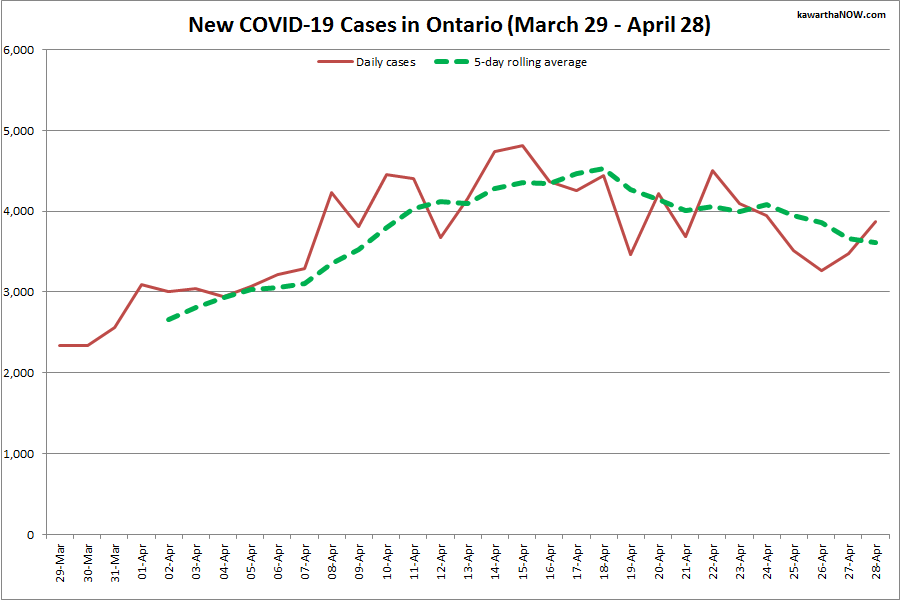
Today, Ontario is reporting 2,557 new cases, with the seven-day average of daily cases increasing by 35 to 2,341. There are 55 more confirmed cases of the B.1.1.7 UK variant and 4 more confirmed cases of the P.1 Brazilian variant.
In the greater Kawarthas region, there are 39 new cases to report and an additional 3 cases resolved, with the number of active cases across the region increasing by 36 from yesterday to 190. See below for detailed numbers from each regional health unit.
Advertisement - content continues below
Most of today’s new cases are in Toronto (743), Peel (484), York (311), Ottawa (131), Hamilton (119), and Durham (107).
There are double-digit increases in Halton (82) Simcoe Muskoka (73), Middlesex-London (71), Waterloo (46), Wellington-Dufferin-Guelph (43), Eastern Ontario (37), Windsor-Essex (37), Niagara (34), Hastings Prince Edward (30), Lambton (30), Thunder Bay (27), Brant (27), Haldimand-Norfolk (16), Haliburton, Kawartha, Pine Ridge (15), Chatham-Kent (14), Grey Bruce (14), Sudbury (13), and Southwestern (13), with smaller increases in Peterborough (9) and Leeds, Grenville & Lanark (7).
The remaining 8 health units are reporting 5 or fewer new cases, with all health units reporting at least 1 case.
Of today’s new cases, 57% are among people 39 and younger, with the highest number of cases (941) among people ages 20-39 followed by 738 cases among people ages 40-59.
With 1,814 more cases resolved since yesterday, the percentage of resolved cases has decreased by 0.1% to 92.0%. The average positivity rate across Ontario has increased by 0.3% to 4.8%, meaning that 48 out of every 1,000 tests performed were positive for COVID-19 on March 31.
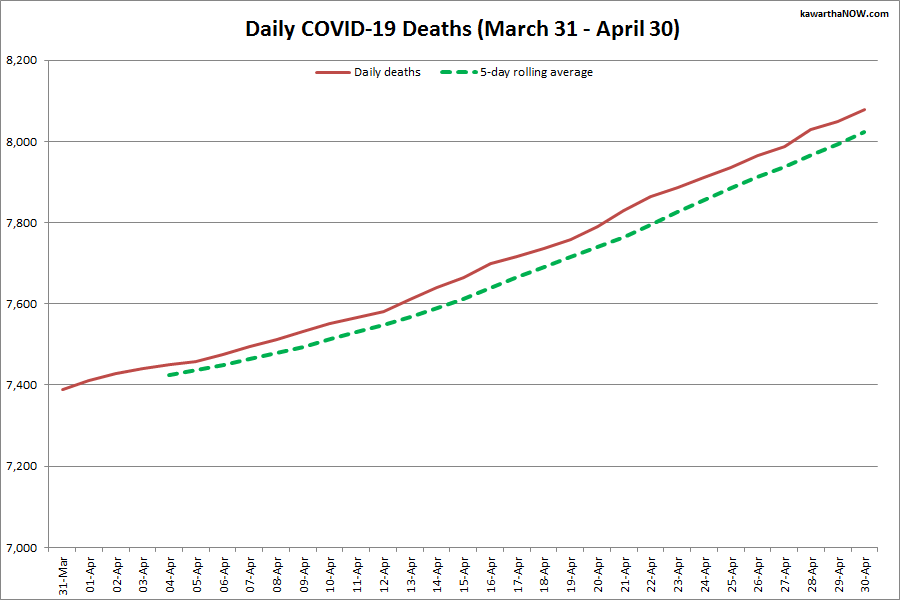
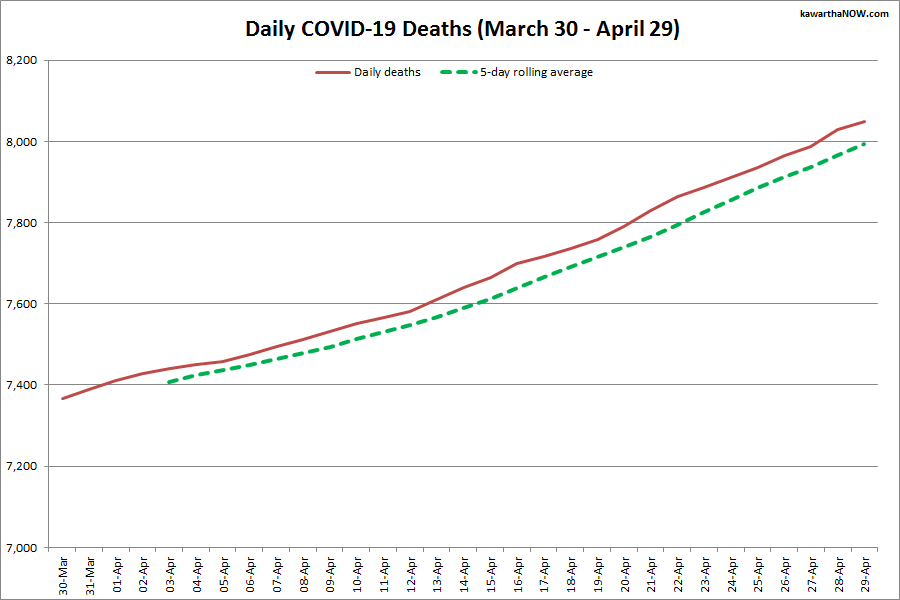
Ontario is reporting 23 new COVID-19 deaths today, with no new deaths in long-term care homes. Ontario has averaged 16 new daily deaths over the past week, an increase of 1 from yesterday.
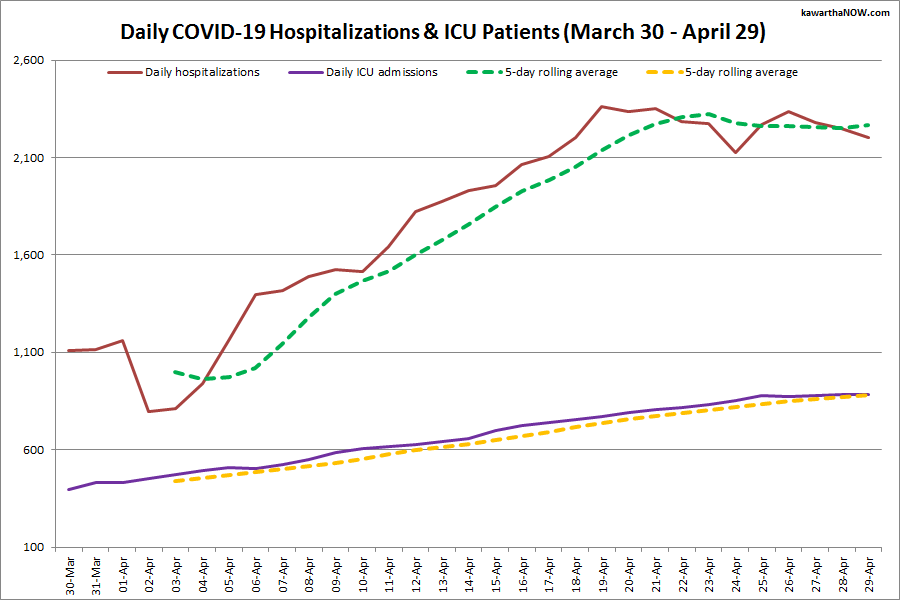
The number of hospitalizations has increased by 5 to 1,116, with the number of patients with COVID-19 in ICUs increasing by 37 to 433 and the number of patients with COVID-19 on ventilators increasing by 7 to 259.
A total of 62,290 tests were completed yesterday, with the backlog of tests under investigation increasing by 1,591 to 42,057.
A total of 2,276,313 doses of vaccine have now been administered, an increase of 84,060 from yesterday, with 317,715 people fully vaccinated with both doses of vaccine, an increase of 1,895 from yesterday.
The number of fully vaccinated people now represents 2.16% of Ontario’s population, an increase of 0.02% from yesterday, with fully and partially vaccinated people representing 15.45% of the population, an increase of 0.57% from yesterday. An estimated 70-90% of the population must be immunized to achieve herd immunity.
There are 249 new cases in Ontario schools, a decrease of 73 from yesterday, including 211 student cases, 36 staff cases, and 2 case among unidentified people. There are 59 new cases in licensed child care settings in Ontario, a decrease of 22 from yesterday, including 38 cases among children and 21 cases among staff.
Advertisement - content continues below
In the greater Kawarthas region, there are 39 new cases to report, including 16 in Hastings Prince Edward, 8 in Peterborough, 8 in Kawartha Lakes, 6 in Northumberland, and 1 in Haliburton.
Outbreaks at Golden Plough Lodge in Cobourg and an unidentified setting in Belleville were declared on March 31.
There are 21 new regional cases of presumed variants of concern, including 10 in Hastings Prince Edward, 7 in Peterborough, 3 in Kawartha Lakes, and 1 in Northumberland.
An additional 3 cases have been resolved, including 2 in Hastings Prince Edward and 1 in Peterborough.
There are currently 190 active cases in the greater Kawarthas region, an increase of 36 from yesterday, including 84 in Hastings Prince Edward (24 in Quinte West, 37 in Belleville, 7 in Tyendinaga & Deseronto, 5 in Prince Edward County, 10 in Central Hastings, and 1 in North Hastings), 55 in Peterborough, 26 in Kawartha Lakes, 24 in Northumberland, and 1 in Haliburton.
Since the pandemic began in the greater Kawarthas region, there have been 879 confirmed positive cases in the Peterborough area (814 resolved with 10 deaths), 594 in the City of Kawartha Lakes (526 resolved with 55 deaths), 503 in Northumberland County (467 resolved with 12 deaths), 66 in Haliburton County (64 resolved with 1 death), and 530 in Hastings and Prince Edward counties (439 resolved with 6 deaths). The most recent death was reported in Peterborough on March 16.
The provincial data in this report is pulled from Ontario’s integrated Public Health Information System (iPHIS) at 4 p.m. the previous day, as well as from systems in Toronto, Ottawa, and Middlesex-London at 2 p.m. the previous day. Data from local health units is more current and is usually reflected in the provincial data the following day. There may be discrepancies between the Ontario data reported today (which is from yesterday) and the local health unit data reported today (which is from today).
Peterborough Public Health’s service area is the City and County of Peterborough and the Hiawatha and Curve Lake First Nations.
The health unit provides daily reports, including on weekends, excluding statutory holidays.
Confirmed positive: 879 (increase of 4)* Total variants of concern cases: 206 (increase of 7) Active cases: 55 (increase of 3) Close contacts: 220 (increase of 22) Deaths: 10 Resolved: 814 (increase of 1) Hospitalizations (total to date): 30 (no change)** Total tests completed: Over 46,650 (increase of 300) Outbreaks: Gzowski College student residence at Trent University, Empress Gardens retirement home in Peterborough, Workplace #1 in City of Peterborough, Workplace #2 in City of Peterborough (no change) Vaccine doses administered: 30,433 (increase of 6,124 since March 25)
*The health unit is reporting 8 new cases in the last 24 hours. As 4 cases have been removed from previous days, the total case count has only increased by 4.
**As of April 1, Peterborough Regional Health Centre is reporting fewer than 10 patients hospitalized with COVID-19 (no change) and 25 patients transferred from other areas as a result of a provincial directive (increase of 1).
Haliburton, Kawartha, Pine Ridge District Health Unit
The Haliburton, Kawartha, Pine Ridge District Health Unit’s service area is the City of Kawartha Lakes, Northumberland County, and Haliburton County.
The health unit provides reports from Monday to Saturday, excluding Sundays and statutory holidays.
Confirmed positive: 1,163 including 594 in Kawartha Lakes, 503 in Northumberland, and 66 in Haliburton (increase of 15, including 8 in Kawartha Lakes, 6 in Northumberland, and 1 in Haliburton)* Cases with N501Y mutation: 50, including 21 in Kawartha Lakes and 29 in Northumberland (increase of 4, including 3 in Kawartha Lakes and 1 in Northumberland)** Active cases: 51, including 26 in Kawartha Lakes, 24 in Northumberland, and 1 in Haliburton (increase of 17, including 20 in Kawartha Lakes, 6 in in Northumberland, and 1 in Haliburton) Probable cases: 1 (increase of 1 in Kawartha Lakes) High-risk contacts: 145, including 46 in Kawartha Lakes, 75 in Northumberland, and 4 in Haliburton (net increase of 15)*** Hospitalizations (total to date): 50, including 30 in Kawartha Lakes, 17 in Northumberland, and 3 in Haliburton (no change)**** Deaths (including among probable cases): 68, including 55 in Kawartha Lakes, 12 in Northumberland, and 1 in Haliburton (no change) Resolved: 1,057, including 526 in Kawartha Lakes, 467 in Northumberland, 64 in Haliburton (no change) Tests completed: 163,439 (increase of 654) Vaccine doses administered: 23,198 (last updated on March 29) Number of people fully vaccinated: 2,618 (last updated on March 29) Outbreaks: Golden Plough Lodge in Cobourg (increase of 1)*****
*The health unit states that total counts and counts for individual counties may fluctuate from previously reported counts as cases are transferred to or from the health unit based on case investigation details and routine data cleaning.
**The N501Y mutation has been identified in variants of concern including the B.1.1.7 UK variant, the B.1.351 South Africa variant, and the P.1 Brazilian variant.
***This total includes an additional 20 high-risk contacts directly followed up through the Public Health Ontario contact tracing process that are missing the contacts’ county.
****As of April 1, Ross Memorial Hospital in Lindsay reports 1 patients hospitalized with COVID-19 (decrease of 1).
*****An outbreak was declared at Golden Plough Lodge in Cobourg on March 31.
Hastings Prince Edward Public Health
Hastings Prince Edward Public Health’s service area is Hastings County (including Bancroft) and Prince Edward County.
The health unit provides daily reports, including on weekends, excluding statutory holidays.
Confirmed positive: 530 (increase of 16) Confirmed variants of concern cases: 30 (increase of 10) Active cases: 84 (increase of 13) Deaths: 6 (no change) Currently hospitalized: 1 (no change) Currently hospitalized and in ICU: 1 (increase of 1) Currently hospitalized and in ICU on ventilator (total to date): 0 (no change) Resolved: 439 (increase of 2) Tests completed: 82,939 (increase of 8) Vaccine doses administered: 31,239 (increase of 2,766) Number of people fully vaccinated: 1,933 (decrease of 13) Outbreaks: Unidentified workplace in Trenton, Unidentified setting in Belleville (increase of 1)*
*An outbreak at an unidentified setting in Belleville was declared on March 31.
Advertisement - content continues below
Province of Ontario
Confirmed positive: 352,460 (increase of 2,557) COVID-19 variants of concern (VOC) confirmed cases: 1,953 of B.1.1.7 UK variant (increase of 55); 67 of B.1.351 South Africa variant (decrease of 2); 96 of P.1 Brazilian variant (increase of 4) VOC R(t): 1.33 (decrease of .02, last updated March 27)* 7-day average of daily new cases: 2,341 (increase of 35) Resolved: 324,196 (increase of 1,814), 92.0% of all cases (decrease of 0.1%) Positivity rate: 4.8% (increase of 0.3%) Hospitalizations: 1,116 (increase of 5) Hospitalizations in ICU: 433 (increase of 37) Hospitalizations in ICU on ventilator: 259 (increase of 7) Deaths: 7,389 (increase of 23) 7-day average of daily new deaths: 16 (increase of 1) Deaths of residents in long-term care homes: 3,901 (no change) Total tests completed: 12,613,463 (increase of 62,290) Tests under investigation: 42,057 (increase of 1,591) Vaccination doses administered: 2,276,313 (increase of 84,060), 15.45% of Ontario’s population (increase of 0.57%)** People fully vaccinated (two doses): 317,715 (increase of 1,895), 2.16% of Ontario’s population (increase of 0.02%)**
*R(t) is a virus’s effective reproduction number, which is the average number of new infections caused by a single infected individual at a specific time (t) in a partially immunized population. To successfully eliminate a disease from a population, R(t) needs to be less than 1.
**An estimated 70-90% of the population must be immunized to achieve herd immunity.
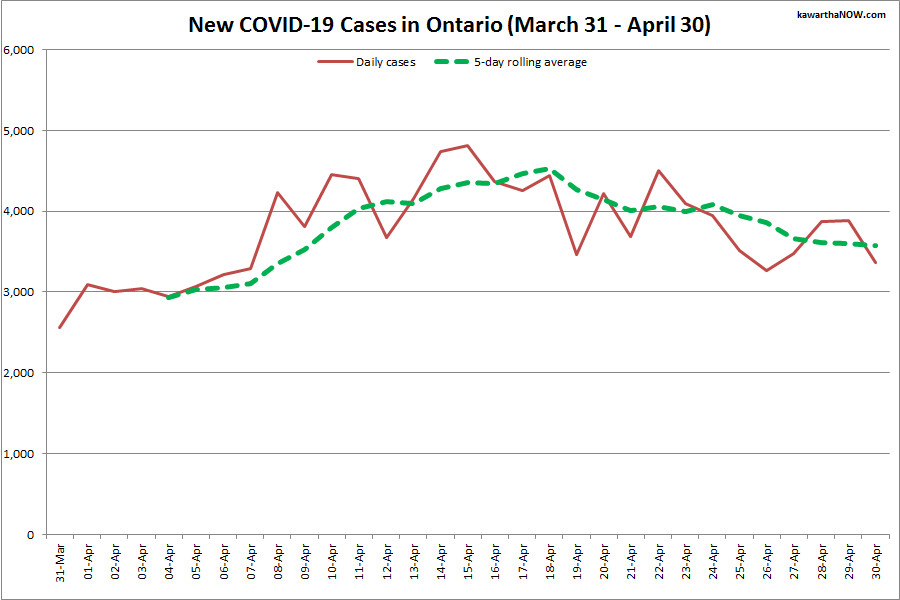
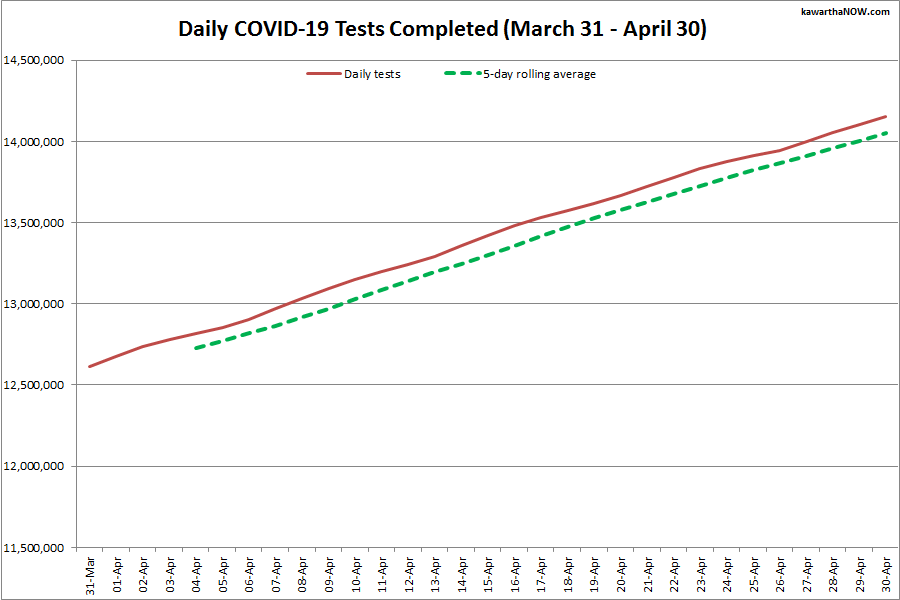
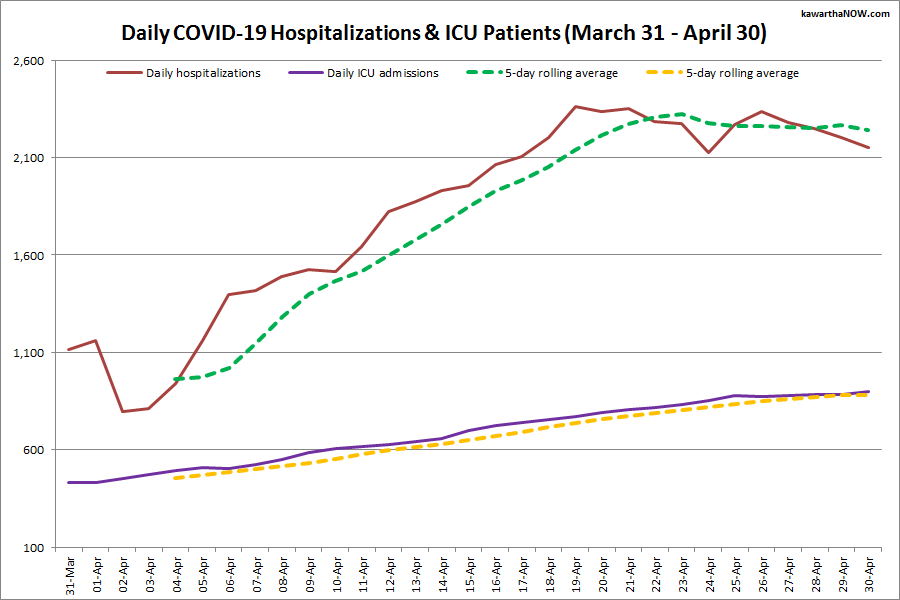
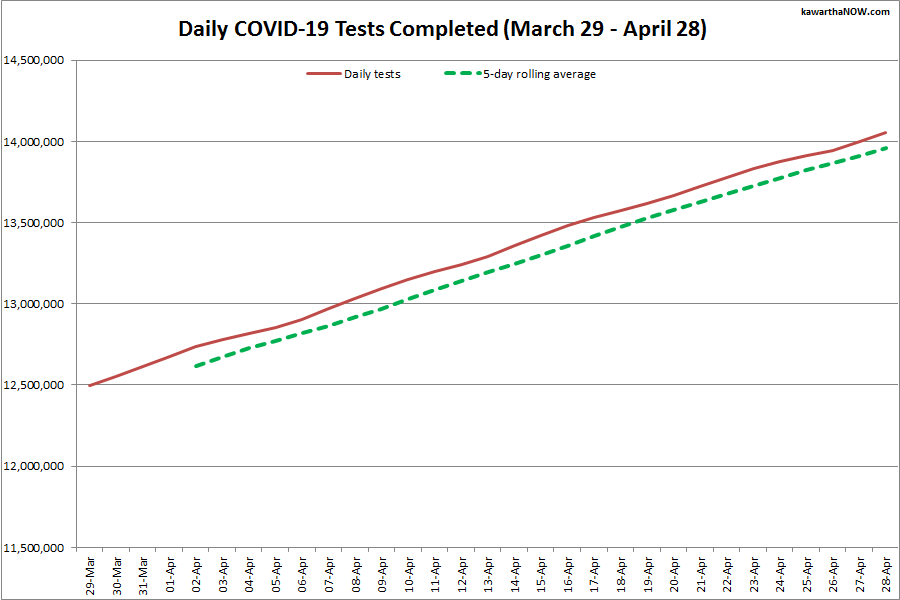
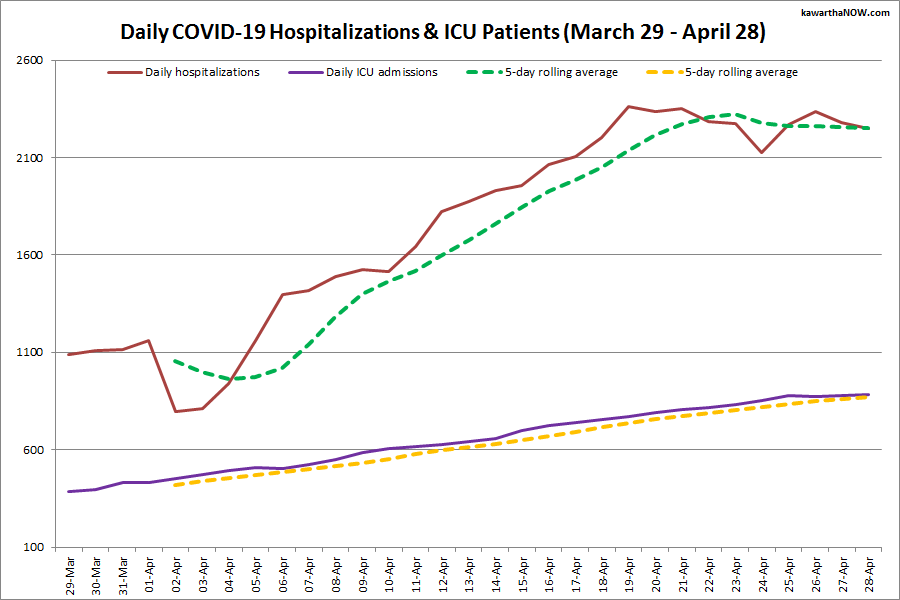
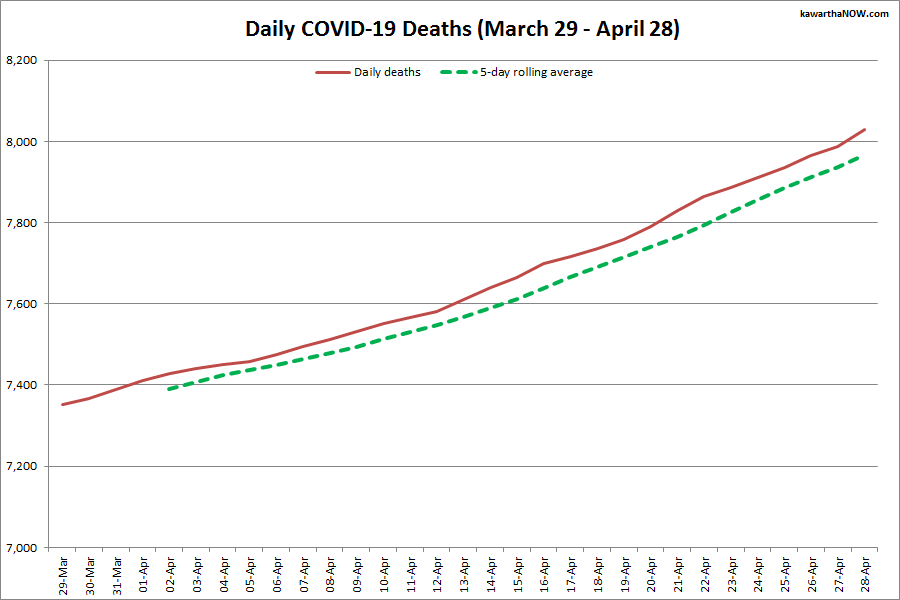
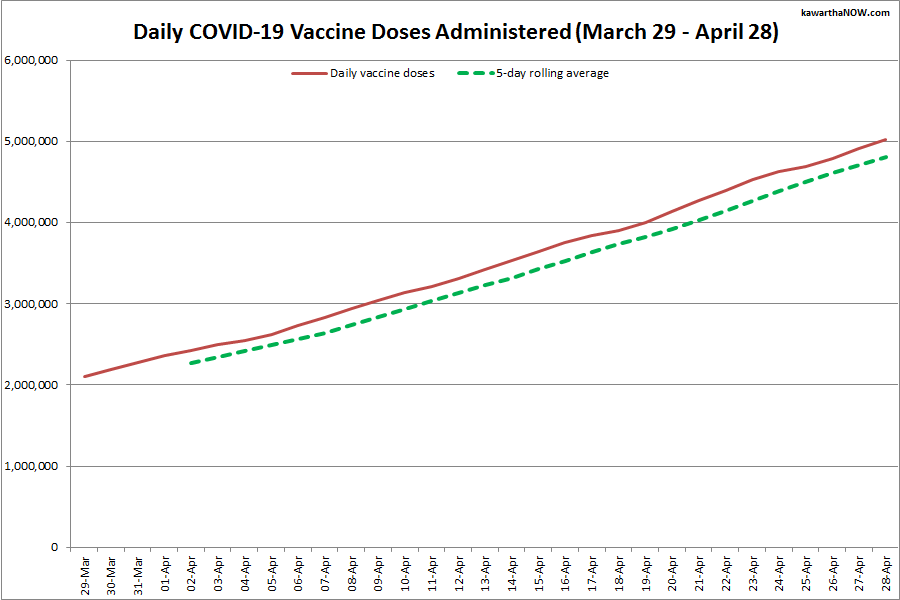
COVID-19 cases in Ontario from March 1 – March 31, 2021. The red line is the number of new cases reported daily, and the dotted green line is a five-day moving average of new cases. (Graphic: kawarthaNOW.com)COVID-19 tests completed in Ontario from March 1 – March 31, 2021. The red line is the daily number of tests completed, and the dotted green line is a five-day moving average of tests completed. (Graphic: kawarthaNOW.com)COVID-19 hospitalizations and ICU admissions in Ontario from March 1 – March 31, 2021. The red line is the daily number of COVID-19 hospitalizations, the dotted green line is a five-day moving average of hospitalizations, the purple line is the daily number of patients with COVID-19 in ICUs, and the dotted orange line is a five-day moving average of patients with COVID-19 in ICUs. (Graphic: kawarthaNOW.com)COVID-19 deaths in Ontario from March 1 – March 31, 2021. The red line is the cumulative number of daily deaths, and the dotted green line is a five-day moving average of daily deaths. (Graphic: kawarthaNOW.com)COVID-19 vaccine doses administered in Ontario from March 1 – March 31, 2021. The red line is the cumulative number of daily doses administered, and the dotted green line is a five-day moving average of daily doses. (Graphic: kawarthaNOW.com)
Ontario Premier Doug Ford announced a province-wide COVID-19 shutdown on April 1, 2021. The four-week shutdown takes effect on April 3. (CPAC screenshot)
Premier Doug Ford announced on Thursday (April 1) that Ontario is applying a “province-wide emergency brake” as a result of an alarming surge in COVID-19 cases and hospitalizations across the province.
“We’re facing a very, very serious situation,” Ford said during a media conference in Toronto. “As I’ve said many times, we will do whatever it takes to protect the people of Ontario. As Premier, it falls on me. I’m the one who has to make the tough decisions. Today, I need to make on of those tough decisions.”
The shutdown — which will last at least four weeks — takes effect at 12:01 a.m. on Saturday, April 3rd.
Advertisement - content continues below
“This is a new pandemic,” Ford said. “We are now fighting a new enemy. The new variants are far more dangerous than before. They spread faster, and they do more harm than the virus we were fighting last year.”
“We need to close the gap between where we are today and where we will be with the millions of vaccines we’re expecting by June. We need more time for our vaccine program to take hold. But we are in a desperate race right now against an extremely aggressive and fast-moving virus. We need more runway to allow our vaccine roll-out to get where we need it.”
Schools will remain open for in-person learning during the shutdown, as will child care settings, both with strict safety measures in place. Spring break will also continue as planned for the week of April 12th.
The announcement came hours after a technical media briefing by Ontario’s top health experts that shared a sobering assessment of the third wave of the pandemic in the province.
That assessment warned that COVID-19 is spreading far more quickly than it was before and “killing faster and younger”, with a higher propotion of younger people being admitted to hospital intensive care units, and recommended a four-week stay-at-home order to reduce the spread of infections.
However, the province-wide emergency brake announced on Thursday — which the province is not calling a “lockdown” — does not include a stay-at-home order.
Advertisement - content continues below
The shutdown does include the following measures;
Prohibiting indoor organized public events and social gatherings and limiting the capacity for outdoor organized public events or social gatherings to a five-person maximum, except for gatherings with members of the same household (the people you live with) or gatherings of members of one household and one other person from another household who lives alone.
Restricting in-person shopping in all retail settings, including a 50 per cent capacity limit for supermarkets, grocery stores, convenience stores, indoor farmers’ markets, other stores that primarily sell food and pharmacies, and 25 per cent for all other retail including big box stores, along with other public health and workplace safety measures.
Prohibiting personal care services.
Prohibiting indoor and outdoor dining. Restaurants, bars and other food or drink establishments will be permitted to operate by take-out, drive-through, and delivery only.
Prohibiting the use of facilities for indoor or outdoor sports and recreational fitness (e.g., gyms) with very limited exceptions.
Requiring day camps to close.
Limiting capacity at weddings, funerals, and religious services, rites or ceremonies to 15 per cent occupancy per room indoors, and to the number of individuals that can maintain two metres of physical distance outdoors. This does not include social gatherings associated with these services such as receptions, which are not permitted indoors and are limited to five people outdoors.
The government says it will evaluate the impacts of the measures throughout the next four weeks to determine if it is safe to lift any restrictions or if they need to be extended.
While a stay-at-home order is not in effect during the shutdown, the province is asking all Ontarians to limit trips outside the home to necessities such as food, medication, medical appointments, supporting vulnerable community members, or exercising outdoors with members of their household.
The government is also asking employers in all industries to allow employees to work from home whenever possible.
The province’s colour-coded COVID-19 response framework will be paused for all of Ontario’s 34 public health units when the shutdown comes into effect.
Adalsteinn Brown, co-chair of Ontario's COVID-19 science advisory table, presented a sobering assessment of the pandemic in Ontario at a technical media briefing at Queen's Park on April 1, 2021. (CPAC screenshot)
In advance of the announcement of an expected provincial lockdown on Thursday (April 1), Ontario’s top health officials delivered a sobering assessment of the status of the COVID-19 pandemic in Ontario — and recommended a month-long province-wide stay-at-home order to bring the disease under control.
“We are in the third wave of the pandemic and, as the new variants spread, you will see that COVID is killing faster and younger,” said Adalsteinn Brown, co-chair of Ontario’s COVID-19 science advisory table, who presented COVID-19 modelling projections along with chief medical officer of health Dr. David Williams.
“It’s spreading far more quickly than it was before, and we cannot vaccinate quickly enough to break this third wave,” Brown added.
Advertisement - content continues below
Brown described the situation in Ontario’s hospitals now, compared to the first and second waves of the pandemic.
“It used to be that one family member, often an older parent or grandparent, would be in an intensive care unit while other members of the family would have caught a much milder form of the disease if at all,” he said. “But with the new variants, that are both more contagious and more dangerous, we’re seeing situations where whole families end up in intensive care, all at the same time.”
Brown added that, because Ontario’s health care system is already under strain, patients have to moved between regions.
“Even as people are fighting for their lives, we have to separate families,” he said. “One family ended up spread between three hospitals … another family ended up being spread between three cities, in three different hospitals, and all of them died.”
Brown pointed out that the variants of concern are resulting in younger people ending up in hospital, using the example of one physician’s observations.
“This doctor worked through the brunt of the first and second wave,” Brown said. “He told us very clearly that even at the worst of these times, he hadn’t seen this many young otherwise healthy people fighting for their lives against COVID-19.”
A slide from the update on COVID-19 projections presented by Ontario’s Science Advisory and Modelling Consensus Tables on April 1, 2021.
While vaccination is the key to long-term control, Brown said, adherence to public health measures — masks, physical distancing, hand hygiene, and staying outside if you need to meet people — are key to controlling the pandemic while people are being vaccinated.
“Sometimes we talk about public health measures and the economy, or public health measures and mental health, as a trade-off,” Brown said. “This is a false debate. The faster we get the pandemic under control, the faster we return to normal. Partial measures, half-hearted adherence, and denial prolong the pandemic and make life harder for everyone.”
Brown said this was particularly true for children and youth, with school infections reflecting what is happening in the community.
“Schools should be the last place to close, and the first to open,” Brown said.
“But as international experience shows, if we don’t get the pandemic under control, we will have to take more drastic measures for longer periods of time. If we don’t get the pandemic under control, we’ll have more sick people, some of whom will never get better. We will further damage our hospital system and the people working in it. We’ll have more unnecessary death, and it will hurt students and our society.”
Advertisement - content continues below
Brown then presented an update on COVID-19 modelling projections, that included the following key findings:
The third wave is here and being driven by variants of concern.
Younger Ontarians are ending up in hospital. With the UK B.1.1.7 variant, the risk of ICU admission is two times higher and the risk of death is 1-1/2 times higher.
COVID-19 threatens the health system ability to deal with regular ICU admissions and the ability to care for all patients.
Vaccination is not reaching the highest-risk communities, delaying its impact as an effective strategy.
School disruptions have a significant and highly inequitable impact on students, parents and society. Further disruptions should be minimized.
Stay-at-home orders will control the surge, protect access to care, and increase the chance of the summer Ontarians want.
Other points raised during the presentation include:
Cases and positivity rates in most public health unit regions now exceed the criteria for them to be placed in the ‘Red-Control’ level of Ontario’s COVID-19 response framework.
The increase in cases is not the result of more testing, because testing rates have remained flat.
Most new cases are variants of concern and, compared to people infected with the earlier variants, more people with COVID-19 are hospitalized, admitted to ICU, and die if they are infected
with the variants of concern.
Short-term projections are for 6,000 cases per day by the end of April, unless there is a province-wide stay-at-home order. While either a two-week or four-week stay-at-home order will reduce daily cases to below 2,000, a two-week stay-at-home order will result in cases creeping back up to 2,000 by the end of the month.
Advertisement - content continues below
With a stay-at-home order in place, ICU occupancy will peak at 800 beds by the end of April, and then gradually decline. Without a stay-at-home order, ICU occupancy will reach 1,000 beds. In either case, hospitals may have to begin triaging patients to manage the burden on the system.
The cumulative surgical backlog related to the pandemic has now affected 245,367 patients, with urgent surgeries making up the majority of these cases.
Essential workers, particularly racialized and marginalized communities in urban centres, are bearing the brunt of the pandemic, making vaccination of essential workers and control of workplace outbreaks critical.
While vaccinations of older Ontarians are continuing, a large percentage of them have still not received a first dose, including 17 per cent of those 80 and older, 40 per cent of those 75 to 79, and 72 per cent of those 70 to 74. Fewer older Ontarians in high-risk neighbourhoods have received vaccinations compared to more older Ontarians in low-risk neighbourhoods who have received vaccinations.
School interruptions will have significant impacts on students, families, and society. Students whose learning is interrupted by the pandemic will experience a drop in lifetime earnings and face health risks from social isolation and loss of structure, with students who are already disadvantaged being affected more.
A vial of the Pfizer-BioNTech COVID-19 vaccine at Walter Reed National Military Medical Center in Bethesda, Maryland. (Photo: Lisa Ferdinando)
Three COVID-19 mass vaccination clinics are set to open after the Easter long weekend in the Haliburton, Kawartha Pine Ridge District (HKPR) Health Unit region.
In a virtual media briefing on Wednesday (March 31), acting medical officer of health Dr. Ian Gemmill said clinics will be opening on Tuesday at the Fenelon Falls Community Centre in Fenelon Falls, the Campbellford Seymour Fire Hall in Trent Hills, and S.G. Nesbitt Arena in Minden.
A second mass vaccination site in Haliburton County is also expected to open at the A.J. LaRue Community Centre in Haliburton the following week.
Advertisement - content continues below
“If you’re looking for immunization in these centres, please keep checking the provincial website,” said Dr. Gemmill. “We’ve taken the vaccine that we’ve had promised to us and put in appointments right until April 24th. As soon as those are loaded online, people can get on there and make their appointments.”
In the HKPR region, those born in 1946 or earlier are currently eligible for vaccine appointments at the soon-to-open clinics. Appointments must be made through the online provincial booking system at covid-19.ontario.ca/book-vaccine/ or by calling 1-833-943-3900.
“If you don’t see the (vaccination) site (in the provincial system), that means the appointments aren’t in yet or they’re all booked up,” Dr. Gemmill noted. “Just keep checking. If we have vaccines available, there will be appointments. Once an appointment is made, that vaccine is spoken for.”
Over the next 10 days, the health unit will have completed its target of opening six mass immunization clinics across the HKPR region. The four new mass immunization clinics will be an addition to clinics already operating at the Cobourg Community Centre in Northumberland County and the Lindsay Exhibition in the City of Kawartha Lakes.
According to provincial officials at a technical media briefing on Wednesday, as of March 29 more than 28,000 COVID-19 doses have been administered in the HKPR region and more than 2,600 people have been fully vaccinated, including all residents of area long-term care homes.
Of the region’s residents aged 80 years and older, 82 per cent have already received a single dose of a COVID-19 vaccine or have booked an appointment to receive one, along with 50 per cent of residents aged 75 to 79.
Dr. Gemmill noted that while vaccine eligibility in the region still starts at 75 years of age, he anticipates eligibility will soon open up for those 70 and older as is the case in some other regions in the province.
At the Wednesday media briefing, provincial officials stated the HKPR region will receive 35,100 Pfizer doses by May 12th and 9,600 Moderna doses by April 19th, although 27,100 of all those doses have not yet been confirmed.
Advertisement - content continues below
The province also plans to distribute 10,800 doses of the AstraZeneca vaccine to the HKPR region in early April. These doses will be administered by local pharmacies (at least three in the region) as well as by family doctors and other primary care providers to their patients. The province has not yet announced the pharmacies and primary care providers that will receive these doses.
“We’re asking people not to call the pharmacies and family doctors about this because they will not have any information yet,” Dr. Gemmill pointed out. “Please watch the media for more information.”
Dr. Gemmill also shared his concerns about the current rise in the province’s COVID-19 cases, urging HKPR residents to continue adhering to public health measures.
“We’re not going up (in cases) here in the same worrisome degree as they are in other parts of Ontario, but things can turn on a dime,” Dr. Gemmill remarked. “It just takes a couple of ill-advised events that can lead to a number of people being infected in the area, and of course, they infect others.”
“It is time to keep adhering to personal measures even if a person has been immunized,” he added. “We’re learning that one dose of vaccine is providing pretty good protection, but until we see what happens on a population basis (how the virus is restricted in its movement from person to person in the population), I continue to recommend personal measures until we have other guidance.”
This will be Dr. Gemmill’s final week as acting medical officer of health for the HKPR district health unit. Dr. Natalie Bocking will assume the position on Monday, April 5th. Dr. Bocking has spent the past four years working as a public health physician with Thunder Bay District Health Unit and Sioux Lookout First Nations Health Authority. She and her family moved to the City of Kawartha Lakes in the fall of 2019.
As of Wednesday, there were 34 active cases of COVID-19 in the health unit’s region, including 18 in Northumberland and 16 in Kawartha Lakes, with 56 presumed cases of variants of concern, including 38 in Northumberland and 18 in Kawartha Lakes.
Unlike the domesticated honeybee, the bumblebee is a native pollinator. Only a bumblebee queen survives the winter by sheltering in small holes just beneath or on the ground's surface. They emerge in early spring to search for a nest site to start a new colony. If you begin cleaning up your yard too early in the spring, you can disturb the hibernating queen. (Photo: Leif Einarson)
If you are privileged enough to have a yard or garden, you are probably eager to tidy it up now that spring is here.
Each week, GreenUP provides a story related to the environment. This week’s story is by Leif Einarson, Communications Manager at GreenUP.
It may be hard to wait, but treading lightly during early spring is a win-win.
“We should hold off on garden work until late April or early May, once temperatures are regularly above 10 to 15 degrees Celsius,” states Hayley Goodchild, sustainability and landscaping project Coordinator at GreenUP.
Advertisement - content continues below
“There are two reasons for this,” she explains. “First, there are a lot of native pollinators and other beneficial wildlife sheltering under the leaf litter and other covered spaces of your garden — we want to protect them and not expose them to stress.”
“Second, soil tends to be very wet at this time of year. The structure of the soil can be very delicate. We do not want to compact the soil and make it difficult for roots and water to find their way into the soil.”
Native pollinators give us many gifts. They are essential not only to a vibrant garden but also to the health of the ecosystems we depend upon in Ontario.
A small carpenter bee on sedum flowers. These bees are named after their nesting habitat in dead wood, stems, or pith. Lightly metallic or blue in colour when viewed carefully, these small bees are excellent buzz pollinators of eggplant, tomato, and other vegetables. Buzz pollinating is a type of pollination that involves vibrations that release pollen from flowers while also fertilizing them. (Photo: Leif Einarson)
“Approximately one third of what we eat requires insect pollination,” explains Dr. Sheila Colla, who specializes in pollinator research and is an assistant professor in the Faculty of Environmental and Urban Change at York University (you can learn about her research at savethebumblebees.ca). “Pollinated foods tend to be the fruits and veggies that add vitamins and flavour to our meals.”
“People often think honeybees are the only important bee and thus think they are helping by having hives,” observes Colla. “In Canada, the most important pollinators are native bees and flies, not honeybees.”
Unlike native pollinators, domesticated honeybees were introduced to North America from Europe and Asia.
Advertisement - content continues below
“We have over 800 species of bees in Canada with about 400 of them occurring in Ontario,” says Colla. “Other insects that visit flowers and move around pollen grains (pollinators) include butterflies, moths, wasps, beetles, and ants. These native insects have co-evolved with native plants and provide important ecosystem services which support other wildlife.”
“Many important Indigenous foods and medicines have co-evolved to be pollinated by specific native pollinators,” Colla adds. “Pollinators introduced from elsewhere can bring with them diseases our native pollinators have not been exposed to. Introduced pollinators can also disrupt those co-evolved pollination relationships and instead benefit weedy or invasive plant species.”
So what can we do to support the incredible diversity of native pollinators in Ontario?
The family Halcitidae is the second-largest family of bees and can be found all over the world. Often metallic in appearance, these bees get their common name (sweat bees) because some of them are attracted to perspiration. These bees are important pollinators for many plants, including varieties of herb (basil, sage, rosemary), goldenrod, aster, daisy, sunflower, sumac, milkweed, and economically significant crops like mustards, peas, beans, and cabbages. (Photo: Leif Einarson)
“The main threats to native pollinators are introduced disease from domesticated bees and climate change,” says Colla. “People can help by contributing photos to BumbleBeeWatch.org (a free phone app) and by spreading the word that we have lots of different bee species. Both of these actions are so important. Anyone can do these things and they are free.”
Another way to help native pollinators is to plant pollinator-friendly gardens.
“Native plants support native pollinators,” Colla explains. “Especially things that bloom early in the spring, like willows, and late in the fall, like goldenrod.”
Advertisement - content continues below
You can also help by providing appropriate nesting habitat for native pollinators.
“Bees like to nest in old stems or in piles of rocks and old logs,” says Colla.
Leave stems uncut over the winter and into the spring, and ensure there are old logs and piles of rocks placed in your garden. These simple acts can help native pollinators who in turn provide essential gifts to our planet and our plates.
Buzzing bumblebee bums may be a familiar sight for observant Peterborough residents. This bumblebee has found its way inside a flowering Turtlehead (Chelone obliqua). Unlike domesticated honeybees, native bumblebees are capable of buzz pollinating, which is a type of pollination that involves vibrations that release pollen from flowers while also fertilizing them. (Photo: Leif Einarson)
As you tread lightly in your garden this spring, keep an eye out for native pollinator activity.
“In spring, a bumblebee queen will come out of overwintering and search for a nest site to start a new colony,” Colla says. “A bumblebee queen is a large bee and you will see her flying low in zigzags while stopping to explore crevices.”
“Bumblebees are good pollinators of tomatoes because unlike honeybees they can buzz-pollinate and can forage in greenhouses. Unlike honeybees, which use the sun to navigate, bumblebees use landmarks on the ground to navigate.”
“Squash bees are ground-nesting bees that specialize in the pollination of squash plants. Squash bees tend to be early morning/dawn pollinators so people often miss them.”
Advertisement - content continues below
If native pollinators are evading your gaze, Dawn Pond has some tips on how to be a pollinator detective. You may know Pond as the Downtown Vibrancy Manager with the Peterborough DBIA, and as the coordinator of several Depave Paradise projects with GreenUP. What you may not know is that Pond also has a background in pollinator and plant research.
“Look in hollow stems that have dried out over winter and are at least six inches long,” Pond says. “These stems can be suitable nesting locations for cavity-dwelling native bees. If the hollow centre of a stem is filled with bee cells (made of leaves and natural material) then it was home for new bees throughout the winter.”
“You can also look in the bare soil for evidence of wild bees,” Pond adds. “Ground-dwelling solitary bees emerge from their burrows as the weather warms up. Approximately 70 per cent of our native bee species in North America are ground dwelling.”
Brianna Salmon, executive director of GreenUP, helps a student filter honey in 2019 from a hive of domestic honeybees that is kept at Holy Cross Catholic Secondary School in Peterborough. Community beekeeping programs can build awareness about pollination and the responsibility of sustainably managing domesticated livestock in ways that minimize adverse impacts on native wildlife and ecosystems. (Photo: Leif Einarson)
“The polyester bee (Colletes inaequalis) is a common native bee species in North America and one of the first to emerge each spring. This bee makes its nest in sandy, bare soil. If you are lucky, you will see tiny burrows where the bees have dug themselves out of the soil to pollinate your plants throughout the spring and summer.”
This spring, support native pollinators by treading lightly in your yard and garden. Celebrate by finding evidence of native pollinators in your area and sharing it with GreenUP on social media @PtboGreenUP.
If you are looking for some outdoor volunteer work this spring and summer, contact Peterborough Pollinators at ptbopollinators@gmail.com to help care for their pollinator gardens around the city.
Tessa Plint, a former researcher with Western University in London, poses with a statue of the giant beaver at Yukon Beringia Interpretive Centre. The bear-sized rodent is thought to have gone extinct more than 10,000 years ago during the last ice age. (Photo: Western University)
Scotland has the Loch Ness monster, the Pacific Northwest has Sasquatch, and now the Kawarthas has — the Giant Beaver?
Over the past few weeks, some residents of the Kawarthas have reported seeing a bear-sized animal with huge teeth and a long tail, emerging from the water of local lakes as the winter ice breaks up.
“At first I thought it was a small black bear that fell through the ice, until I saw those huge incisors,” says Jose Broma, who lives on Jack Lake near Apsley and reported the first sighting.
Advertisement - content continues below
Broma, who says he was too busy running away to take a photo, then told his next-door neighbour about his experience. That’s when he discovered his neighbour had also had a close encounter with the same animal.
“She didn’t want to tell anybody because she was afraid they’d think she was crazy,” Broma says. “She was kind of relieved to find out I saw it too.”
The two of them then created a Facebook group, which now has more than 200 members from across the Kawarthas who all claim to have seen a similar creature. The Facebook group includes several photos of a large animal, but all of them are out of focus.
A skeleton of a giant beaver at the Canadian Museum of Nature. Paleontologists have found giant beaver bones and teeth from Ohio to southern Ontario to the Yukon Territory. (Photo: Western University)
A biologist with the Ministry of Natural Resources and Forestry before he retired, Broma firmly believes the animal is actually a descendant of the prehistoric giant beaver (Castoroides), a huge rodent that roamed North America more than 10,000 years ago during the last ice age, along with the mastodon and giant sloth.
All these large animals, known as megafauna, went extinct during the Pleistocene–Holocene transition period. Scientists continue to debate whether the animals were killed off by climate change or by the Clovis people, who colonized North America around 13,000 years ago.
Paleontologists have found giant beaver bones and teeth from Ohio to southern Ontario to the Yukon Territory. References to the giant beaver can be found in the oral history of various Indigenous peoples in North America, some of whom may even have used giant beaver teeth as wood chiselling tools.
Advertisement - content continues below
The largest rodent in North America at the time, the giant beaver was about two metres long and weighed up to 100 kilograms, with 15-centimetre-long incisors and a tail up to 64 centimetres long.
There have never been any previous reported sightings of an animal resembling the giant beaver in North America, let alone in the Kawarthas.
Broma has his own theory why the sightings have only happened in the last few weeks.
Beaver versus Bieber: a modern beaver, a human, and a giant beaver. (Illustration: Scott Woods / Western University)
“I think it’s because of COVID,” Broma explains. “I’ve read in the news that lots of wildlife around the world has been coming out of the forests and jungles. Maybe the giant beaver thinks it’s finally safe to come out of the water now because there aren’t so many people around.”
kawarthaNOW emailed scientists at several Ontario universities for comment on this story, but only received a single response.
“This has got to be an April Fool’s joke, right?” the email said.
All images from this story come from actual research on the giant beaver at Western University in London, Ontario. A May 2019 study uncovered a possible reason why the giant beaver went extinct at the end of the last ice age (spoiler: unlike the modern beaver, the giant beaver didn’t eat wood).
kawarthaNOW.com offers two enews options to help readers stay in the know. Our VIP enews is delivered weekly every Wednesday morning and includes exclusive giveaways, and our news digest is delivered daily every morning. You can subscribe to one or both.
Submit your event for FREE!
Use our event submission form to post your event on our website — for free.
To submit editorial content or ideas, please contact us.