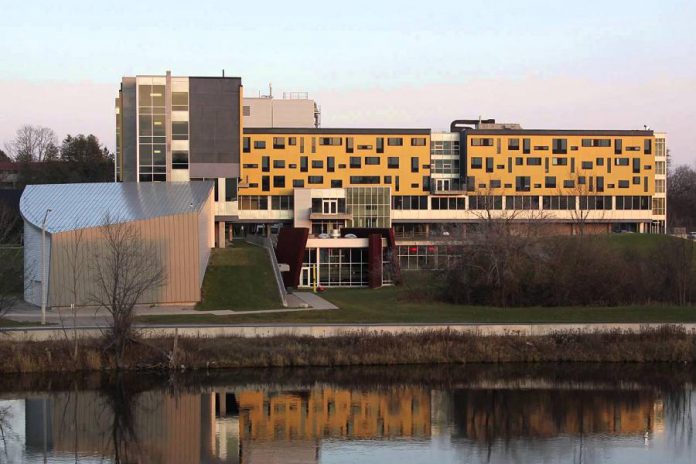
Peterborough Fire Services provides emergency and support services 24 hours a day, 7 days a week, 365 days a year. (Photo: City of Peterborough)
Peterborough Fire Services rescued a dog on Sunday afternoon (March 21) during a house fire in Peterborough.
At around 4:15 p.m. on Sunday, fire crews responded to a reported fire at a multi-residential home at the corner of Dublin and Water streets.
Upon arrival, firefighters observed heavy smoke and fire coming from the home’s main entrance and extending to the second floor.
Advertisement - content continues below
Fire crews were unable to account for the home’s occupants, and conducted a search of the home while quickly bringing the fire under control. It was determined the three occupants were not at home during the fire.
However, firefighters located a dog inside the home, which they rescued and resuscitated.
Fire and heat damage was limited to the first floor entrance and the second floor. The remainder of the property sustained minor smoke and water damage.
The fire had also extended to an adjacent property, whose occupants were evacuated as a precaution. One occupant of a rear unit was removed by fire crews. The adjacent property sustained some heat damage to one side of the dwelling.
Total damage is estimated at $110,000. All three occupants of the home have been temporarily displaced. The cause of the fire has yet to be determined.
This was the second house fire in Peterborough on Sunday. At around 8:05 a.m., Peterborough Fire Services responded to a kitchen fire at a multi-unit residential building on Sherbrooke Street. One occupant was transported to hospital with minor thermal injuries and subsequently released.
Total damage from that fire is estimated at $7,500. The cause of the fire is believed to be accidental in nature.
Here’s an update on COVID-19 cases in Ontario as well as in the greater Kawarthas region.
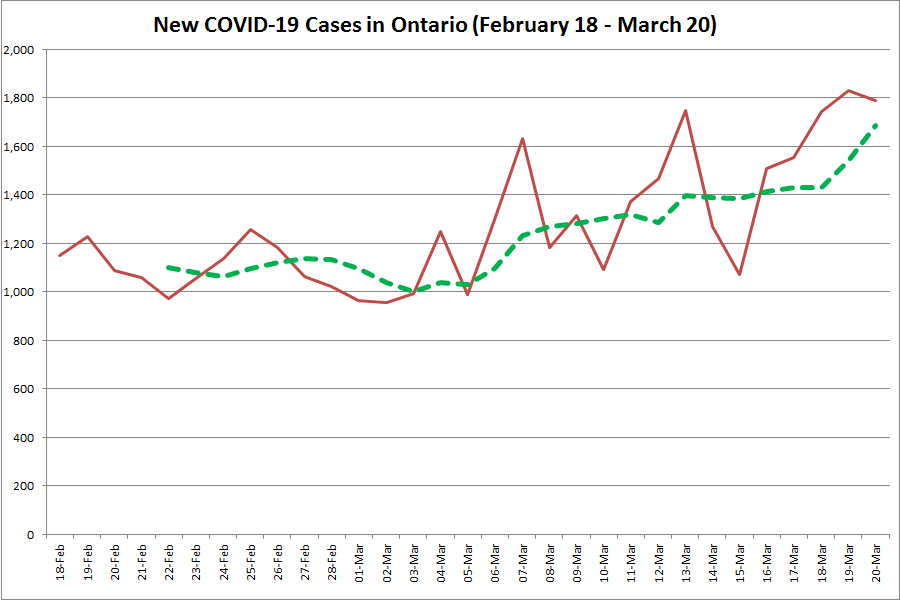
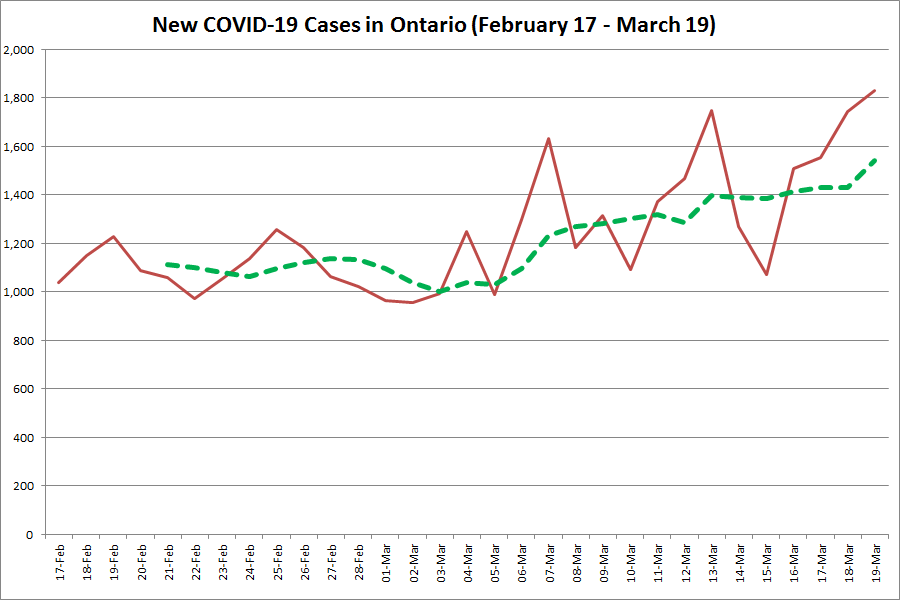
Ontario is reporting 1,791 new cases today, with the seven-day average of daily cases increasing by 6 to 1,538. The province is also reporting 57 more confirmed cases of the B.1.1.7 UK variant and 1 new case of the P.1 Brazilian variant.
In the greater Kawarthas region, there are 3 new cases to report and an additional 10 cases resolved, with the number of active cases across the region decreasing by 7 to 93. These numbers do not include Kawartha Lakes, Northumberland, and Haliburton as that health unit does not issue updates on Sundays.
Advertisement - content continues below
Most of today’s new cases are in Toronto (495), Peel (350), York (177), and Durham (106).
There are double-digit increases in Ottawa (90), Hamilton (89), Halton (52), Niagara (42), Simcoe Muskoka (40), Middlesex-London (37), Windsor-Essex (36), Sudbury (31), Leeds, Grenville & Lanark (31), Lambton (30), Thunder Bay (27), Waterloo (25), Wellington-Dufferin-Guelph (21), Eastern Ontario (18), Chatham-Kent (14), Southwestern (14), Brant (14), and Kingston, Frontenac and Lennox & Addington (12), with smaller increases in Peterborough (9), North Bay Parry Sound (8), and Northwestern (7).
The remaining 8 health units are reporting 5 or fewer new cases, with 3 health units reporting no new cases at all.
Of today’s new cases, 56% are among people 39 and younger, with the highest number of cases (617) among people ages 20-39 followed by 511 cases among people ages 40-59.
With 1,353 more cases resolved since yesterday, the percentage of resolved cases has decreased by 0.1% to 93.5%. The average positivity rate across Ontario has increased by 0.1% from yesterday to 3.7%, meaning that 37 out of every 1,000 tests performed were positive for COVID-19 on March 20.
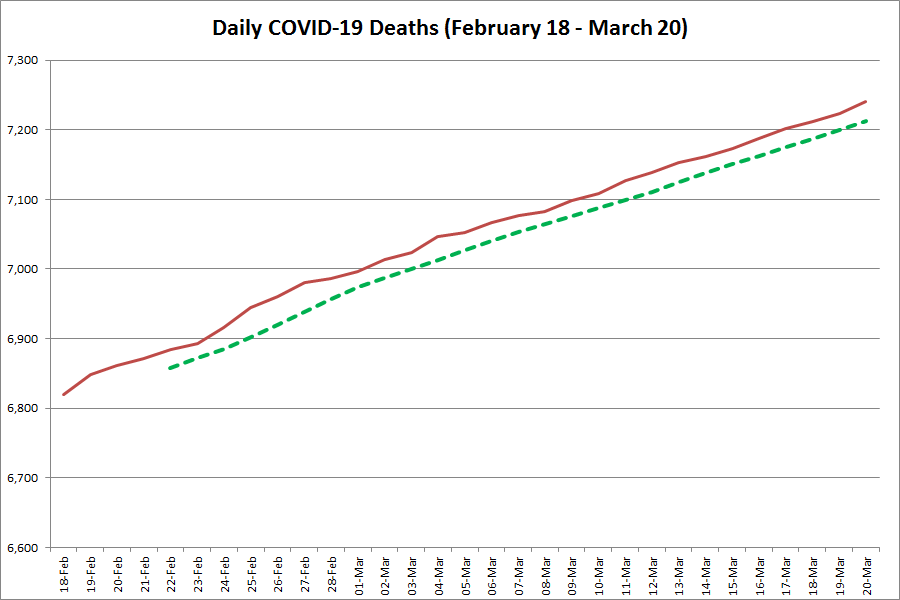
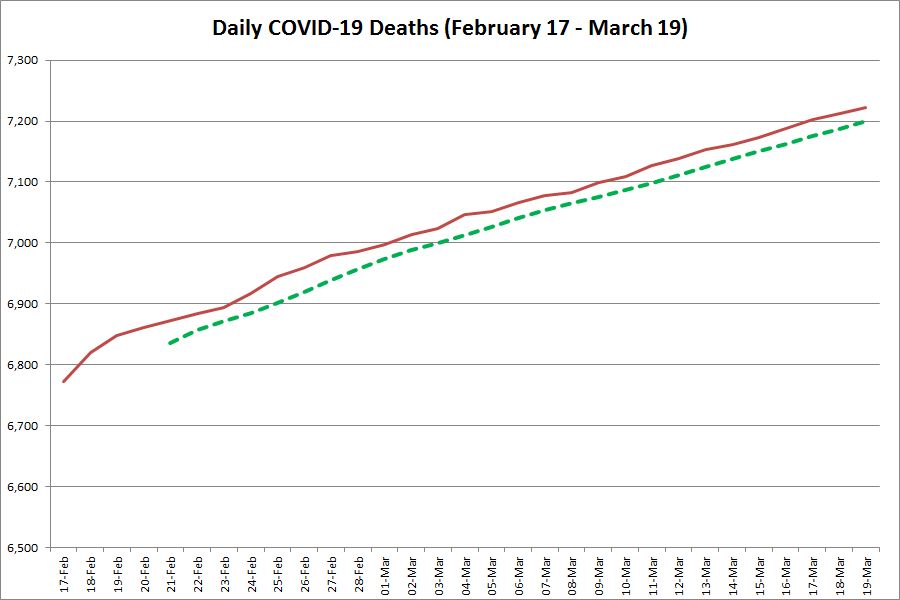
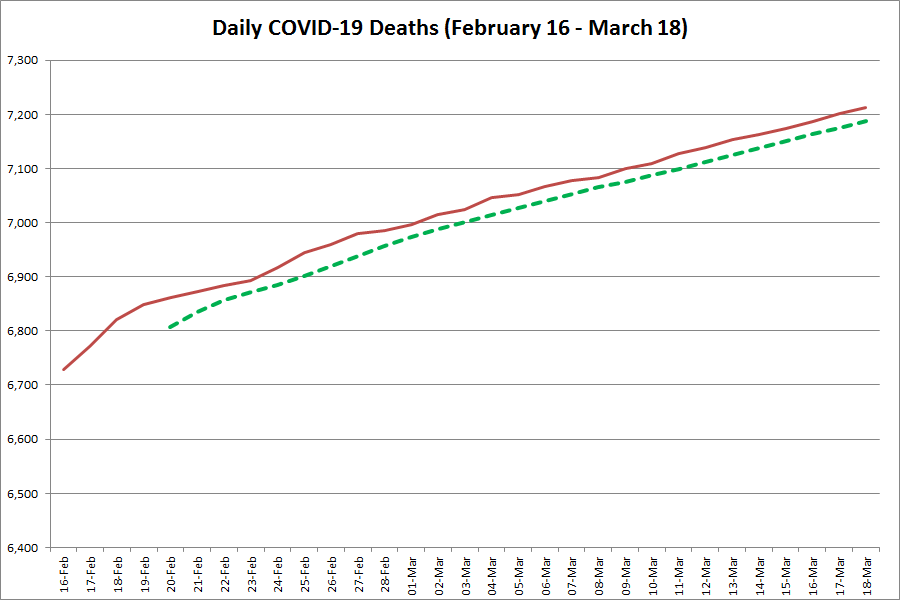
Ontario is reporting 18 new COVID-19 deaths today, with 2 new deaths in long-term care homes. Ontario has averaged 13 new daily deaths over the past week, an increase of 1 from yesterday.
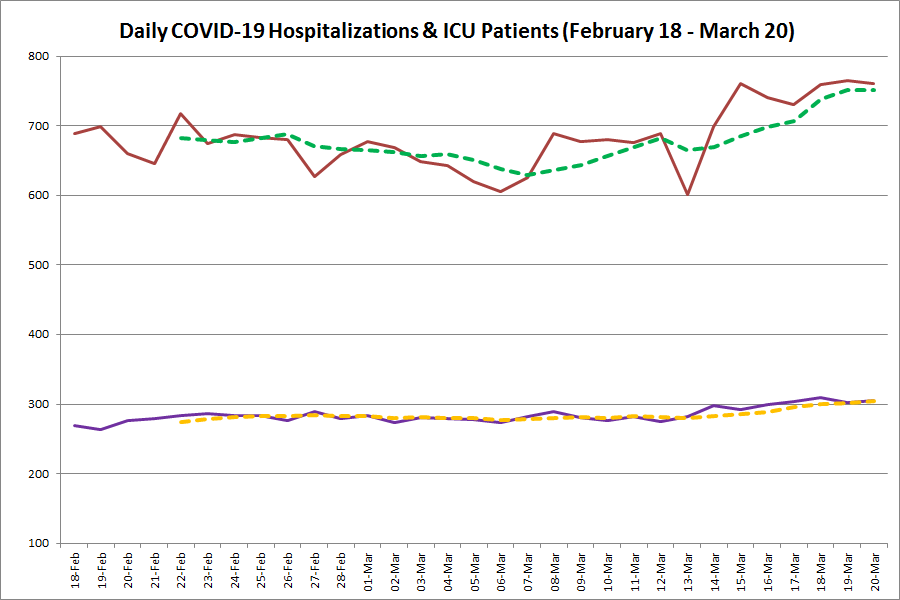
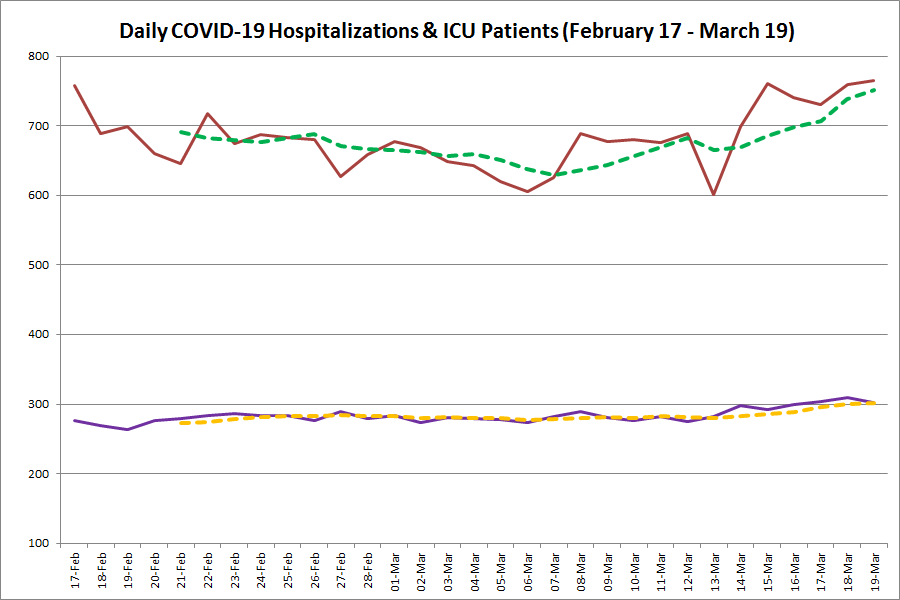
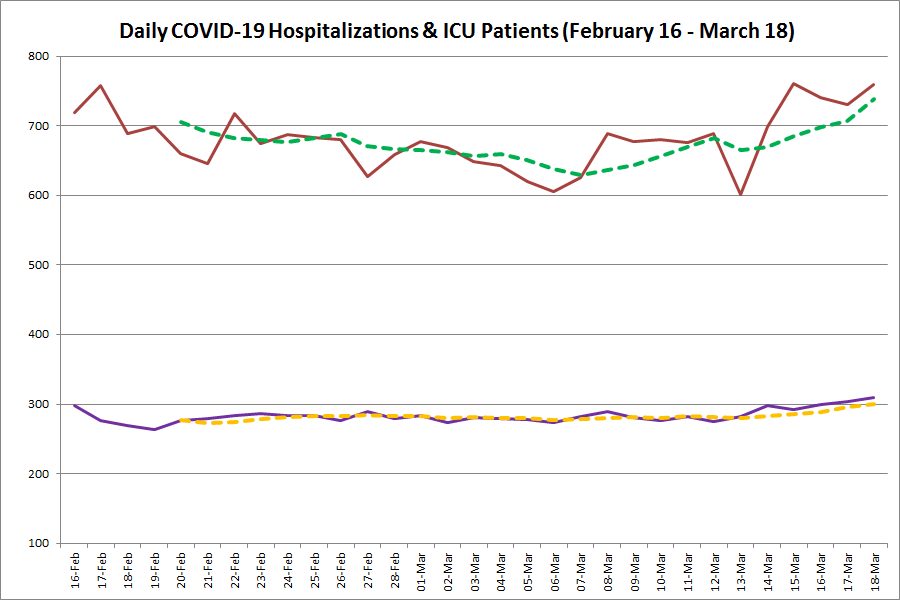
Hospitalizations have decreased by 5 from yesterday to 760, but more than 10% of hospitals did not submit data for today’s report, so the actual number of hospitalization may be higher. The number of patients with COVID-19 in ICUs increased by 3 to 305, and the number of patients with COVID-19 on ventilators has decreased by 3 to 186.
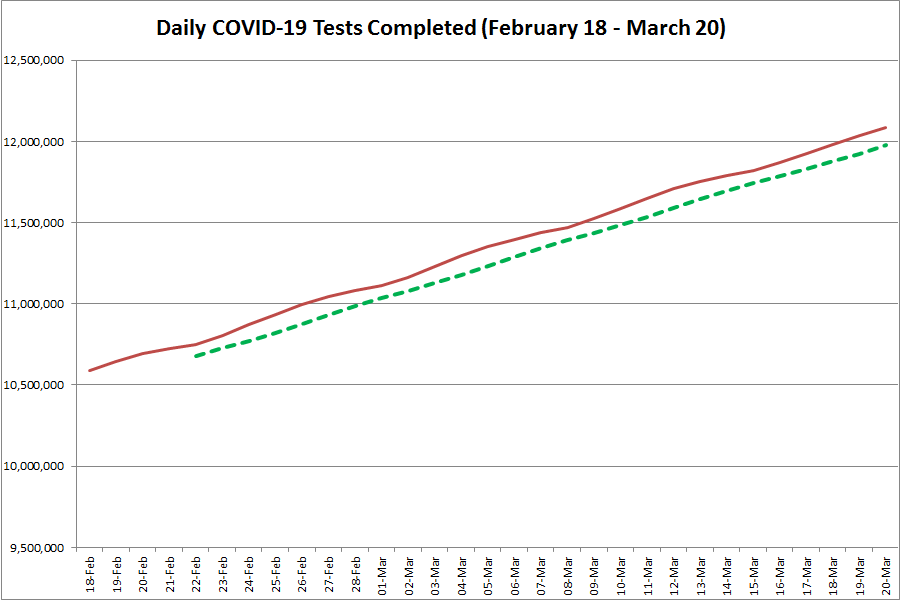
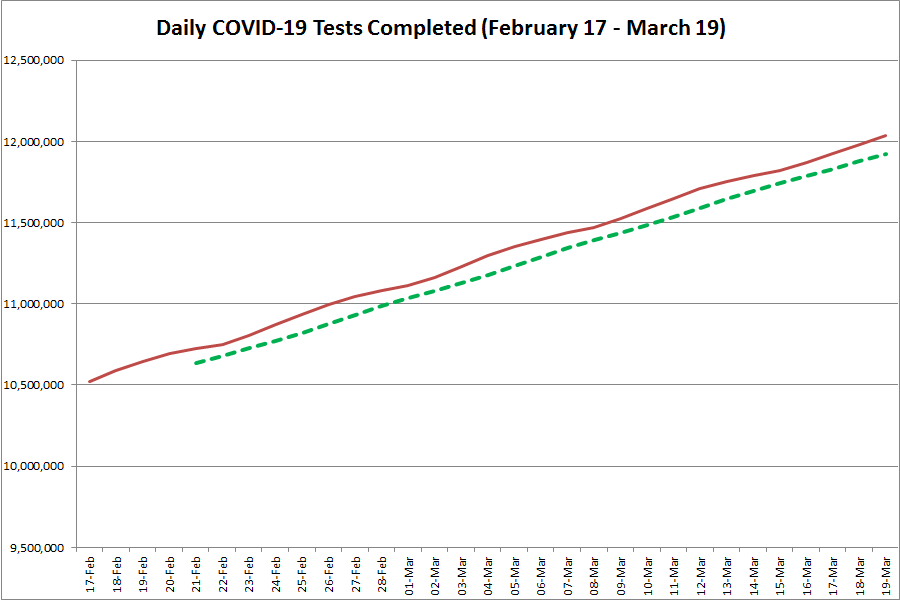
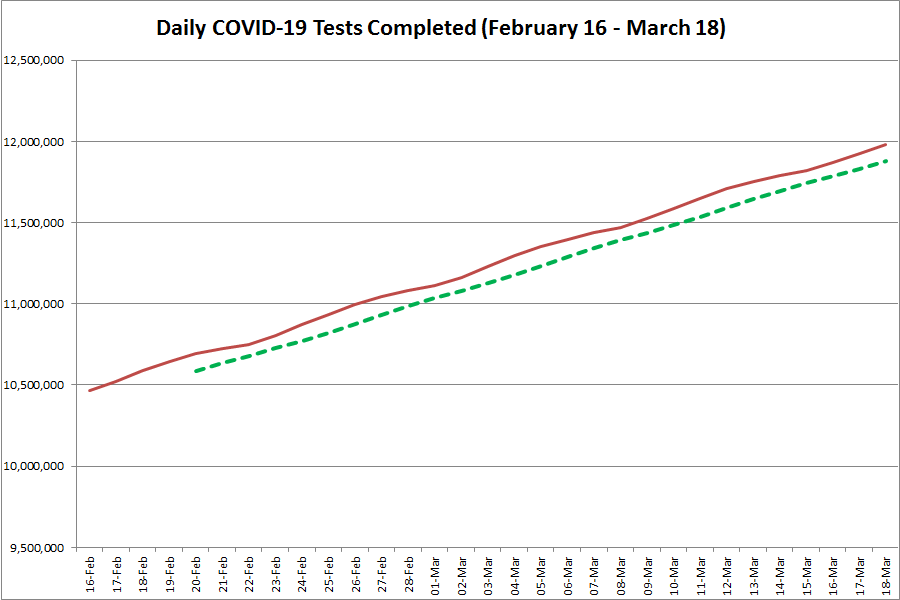
A total of 49,233 tests were completed yesterday, with the backlog of tests under investigation decreasing by 8,534 to 19,486.
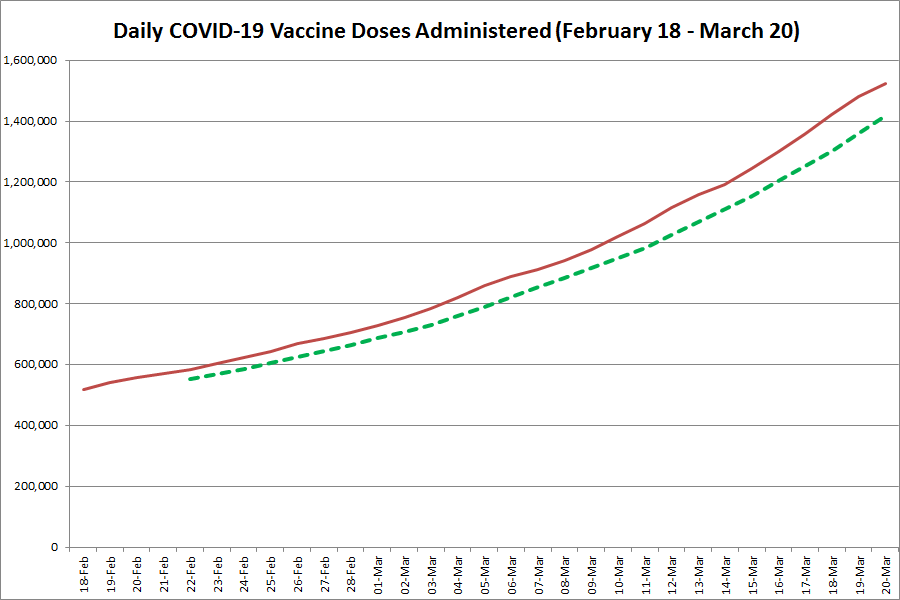
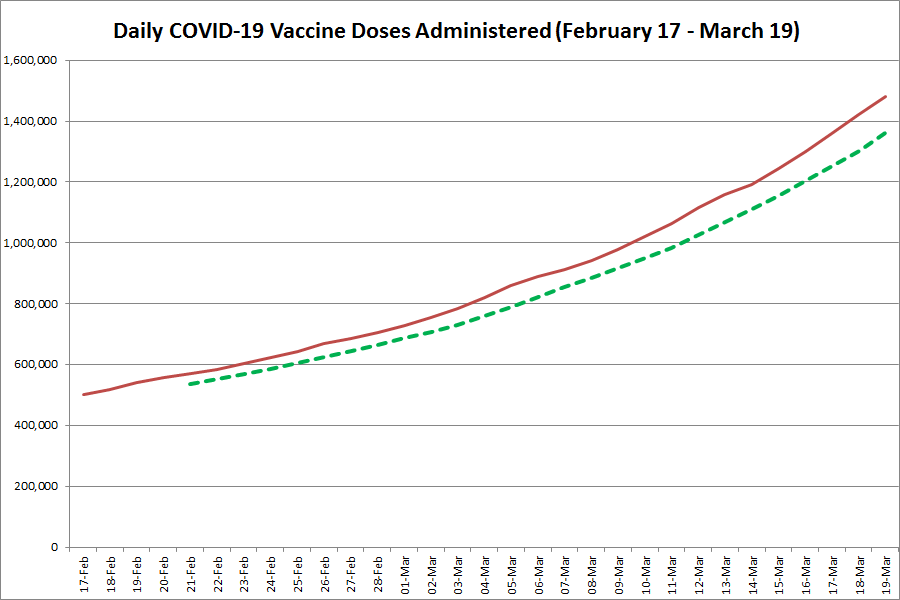
A total of 1,521,705 doses of vaccine have now been administered, an increase of 40,823 from yesterday, with 298,549 people fully vaccinated with both doses of vaccine, an increase of 1,415 from yesterday, representing 2.03% of Ontario’s population.
Advertisement - content continues below
In the greater Kawarthas region, there are 3 new cases to report in Peterborough. There are no new cases in Hastings Prince Edward. Updated numbers for Kawartha Lakes, Northumberland, and Haliburton are not available as that health unit does not issue reports on Sundays.
There are 12 new cases of presumed variants of concern and 1 new hospitalization in Peterborough.
An additional 10 cases have been resolved, including 8 in Peterborough and 2 in Hastings Prince Edward.
There are currently 93 active cases in the greater Kawarthas region, a decrease of 7 from yesterday, including 56 in Peterborough, 12 in Kawartha Lakes, 10 in Northumberland, 9 in Haliburton, and 6 in Hastings Prince Edward (1 in Quinte West, 2 in Belleville, 1 in Prince Edward County, 1 in Central Hastings, and 1 in North Hastings).
Since the pandemic began in the greater Kawarthas region, there have been 813 confirmed positive cases in the Peterborough area (747 resolved with 10 deaths), 567 in the City of Kawartha Lakes (513 resolved with 55 deaths), 475 in Northumberland County (453 resolved with 12 deaths), 62 in Haliburton County (52 resolved with 1 death), and 443 in Hastings and Prince Edward counties (431 resolved with 6 deaths). The most recent death was reported in Peterborough on March 16.
The provincial data in this report is pulled from Ontario’s integrated Public Health Information System (iPHIS) at 12 p.m. the previous day. Data from local health units is more current and is usually reflected in the provincial data the following day. There may be discrepancies between the Ontario data reported today (which is from yesterday) and the local health unit data reported today (which is from today).
Peterborough Public Health’s service area is the City and County of Peterborough and the Hiawatha and Curve Lake First Nations.
The health unit provides daily reports, including on weekends, excluding statutory holidays.
Confirmed positive: 813 (increase of 3) Confirmed variants of concern cases: 1 (no change) Presumed variants of concern cases: 156 (increase of 12) Active cases: 56 (decrease of 5) Close contacts: 211 (decrease of 7) Deaths: 10 (no change) Resolved: 747 (increase of 8) Hospitalizations (total to date): 28 (increase of 1)* Total tests completed: Over 45,600 (increase of 100) Outbreaks: Severn Court Student Residence, Trent Champlain College residence, unidentified congregate living facility in Peterborough, Gzowski College student residence at Trent University (no change) Vaccine doses administered: 13,911 (last updated on March 18)
*As of March 19, Peterborough Regional Health Centre is reporting fewer than 5 patients hospitalized with COVID-19 (no change) and 20 patients transferred from other areas as a result of a provincial directive (increase of 1).
Haliburton, Kawartha, Pine Ridge District Health Unit
The Haliburton, Kawartha, Pine Ridge District Health Unit’s service area is the City of Kawartha Lakes, Northumberland County, and Haliburton County.
The health unit provides reports from Monday to Saturday, excluding Sundays and statutory holidays. These numbers are from March 20.
Confirmed positive: 1,104, including 567 in Kawartha Lakes, 475 in Northumberland, and 62 in Haliburton (increase of 1 in Northumberland)* Cases with N501Y mutation: 38, including 7 in Kawartha Lakes, 30 in Northumberland, and 1 in Haliburton (increase of 4, including 2 in Kawartha Lakes, 1 in Northumberland, and 1 in Haliburton)** Active cases: 31, including 12 in Kawartha Lakes, 10 in Northumberland, and 9 in Haliburton (decrease of 9, including 1 in Kawartha Lakes, 7 in Northumberland, and 1 in Haliburton) Probable cases: 0 (no change) High-risk contacts: 283, including 67 in Kawartha Lakes, 144 in Northumberland, and 67 in Haliburton (net decrease of 72)*** Hospitalizations (total to date): 49, including 29 in Kawartha Lakes, 17 in Northumberland, and 3 in Haliburton (no change)**** Deaths (including among probable cases): 68, including 55 in Kawartha Lakes, 12 in Northumberland, and 1 in Haliburton (no change) Resolved: 1,018, including 513 in Kawartha Lakes, 453 in Northumberland, 52 in Haliburton (increase of 11, including 2 in Kawartha Lakes, 8 in Northumberland, and 1 in Haliburton) Tests completed: 157,017 (increase of 626) Vaccine doses administered: 10,989 (no change) Number of people fully vaccinated: 2,258 (no change) Outbreaks: Hyland Crest long-term care home in Minden, St. Michael Catholic Elementary School in Cobourg (no change)
*The health unit states that total counts and counts for individual counties may fluctuate from previously reported counts as cases are transferred to or from the health unit based on case investigation details and routine data cleaning.
**The N501Y mutation has been identified in variants of concern including the B.1.1.7 UK variant, the B.1.351 South Africa variant, and the P.1 Brazilian variant.
***This total includes an additional 33 high-risk contacts directly followed up through the Public Health Ontario contact tracing process that are missing the contacts’ county.
****As of March 19, Ross Memorial Hospital in Lindsay reports 1 patient hospitalized with COVID-19 (no change).
Hastings Prince Edward Public Health
Hastings Prince Edward Public Health’s service area is Hastings County (including Bancroft) and Prince Edward County.
The health unit provides daily reports, including on weekends, excluding statutory holidays.
Confirmed positive: 443 (no change) Confirmed variants of concern cases: 8 (no change) Active cases: 6 (decrease of 2) Deaths: 6 (no change) Currently hospitalized: 0 (no change) Currently hospitalized and in ICU: 0 (no change) Currently hospitalized and in ICU on ventilator (total to date): 0 (no change) Resolved: 431 (increase of 2) Tests completed: 78,866 (increase of 3,140) Vaccine doses administered: 19,958 (increase of 146) Number of people fully vaccinated: 1,893 (no change) Outbreaks: None (no change)
Advertisement - content continues below
Province of Ontario
Confirmed positive: 328,874 (increase of 1,791) COVID-19 variants of concern (VOC) confirmed cases: 1,287 of B.1.1.7 UK variant (increase of 57); 47 of B.1.351 South Africa variant (no change); 36 of P.1 Brazilian variant (increase of 1) VOC R(t): 1.33 (last updated March 16)* 7-day average of daily new cases: 1,538 (increase of 6) Resolved: 307,403 (increase of 1,353), 93.5% of all cases (decrease of 0.1%) Positivity rate: 3.7% (increase of 0.1%) Hospitalizations: 760 (decrease of 5)** Hospitalizations in ICU: 305 (increase of 3) Hospitalizations in ICU on ventilator: 186 (decrease of 3) Deaths: 7,241 (increase of 18) 7-day average of daily new deaths: 13 (increase of 1) Deaths of residents in long-term care homes: 3,891 (increase of 2) Total tests completed: 12,082,748 (increase of 49,233) Tests under investigation: 19,486 (decrease of 8,534) Vaccination doses administered: 1,521,705 (increase of 40,823) People fully vaccinated (two doses): 298,549 (increase of 1,415), 2.03% of Ontario’s population (est. 70-90% required for herd immunity)
*R(t) is a virus’s effective reproduction number, which is the average number of new infections caused by a single infected individual at a specific time (t) in a partially immunized population. To successfully eliminate a disease from a population, R(t) needs to be less than 1.
**More than 10% of hospitals did not submit data for this report, so the actual number of hospitalization may be higher.
COVID-19 cases in Ontario from February 18 – March 20, 2021. The red line is the number of new cases reported daily, and the dotted green line is a five-day moving average of new cases. (Graphic: kawarthaNOW.com)COVID-19 tests completed in Ontario from February 18 – March 20, 2021. The red line is the daily number of tests completed, and the dotted green line is a five-day moving average of tests completed. (Graphic: kawarthaNOW.com)COVID-19 hospitalizations and ICU admissions in Ontario from February 18 – March 20, 2021. The red line is the daily number of COVID-19 hospitalizations, the dotted green line is a five-day moving average of hospitalizations, the purple line is the daily number of patients with COVID-19 in ICUs, and the dotted orange line is a five-day moving average of is a five-day moving average of patients with COVID-19 in ICUs. (Graphic: kawarthaNOW.com)COVID-19 deaths in Ontario from February 18 – March 20, 2021. The red line is the cumulative number of daily deaths, and the dotted green line is a five-day moving average of daily deaths. (Graphic: kawarthaNOW.com)COVID-19 vaccine doses administered in Ontario from February 18 – March 20, 2021. The red line is the cumulative number of daily doses administered, and the dotted green line is a five-day moving average of daily doses. (Graphic: kawarthaNOW.com)
Highway 7 was closed on Sunday morning (March 21) between County Road 38 and County Road 45 west of Norwood as the result of a serious collision.
At around 4:30 a.m. on Sunday, Peterborough County OPP and emergency crews responded to a single-vehicle collision on Highway 7 between the 5th and 6th lines of Asphodel.
Two occupants of the vehicle suffered minor injuries and one occupant suffered serious injuries. All were transported to a local hospital for treatment.
Advertisement - content continues below
As of 8 a.m. on Sunday morning, Highway 7 remains closed between County Road 38 (east of the Indian River Reptile and Dinosaur Park) and County Road 45 (west of Norwood) as Peterborough County OPP document the scene.
The cause of the collision remains under investigation.
The Highway 7 closure will remain in place for several hours while police investigate, with detours in place. For updates on road closures, visit @OPP_CR on Twitter.
Here’s an update on COVID-19 cases in Ontario as well as in the greater Kawarthas region.
Ontario is reporting 1,829 new cases today, with the seven-day average of daily cases increasing by 52 to 1,532. The province is also reporting 55 more confirmed cases of the B.1.1.7 UK variant.
In the greater Kawarthas region, there are 5 new cases to report and an additional 15 cases resolved, with the number of active cases across the region decreasing by 10 to 100.
Advertisement - content continues below
Most of today’s new cases are in Toronto (593), Peel (287), York (157), Hamilton (124), and Ottawa (101).
There are double-digit increases in Durham (77), Simcoe Muskoka (50), Sudbury (43), Niagara (42), Lambton (41), Halton (40), Thunder Bay (32), Leeds, Grenville & Lanark (32), Windsor-Essex (29), Eastern Ontario (27), Middlesex-London (24), Chatham-Kent (23), Waterloo (18), Wellington-Dufferin-Guelph (12), Northwestern (11), Kingston, Frontenac and Lennox & Addington (11), and Peterborough (10), with smaller increases in Southwestern (9), Brant (9), and Haldimand-Norfolk (8).
The remaining 9 health units are reporting 5 or fewer new cases, with only 1 health unit reporting no new cases at all.
Of today’s new cases, 59% are among people 39 and younger, with the highest number of cases (695) among people ages 20-39 followed by 493 cases among people ages 40-59.
With 1,261 more cases resolved since yesterday, the percentage of resolved cases has decreased by 0.1% to 93.6%. The average positivity rate across Ontario has increased by 0.3% from yesterday to 3.6%, meaning that 36 out of every 1,000 tests performed were positive for COVID-19 on March 19.
Ontario is reporting 11 new COVID-19 deaths today, with 1 new death in a long-term care home. Ontario has averaged 12 new daily deaths over the past week (no change from yesterday).
Hospitalizations have increased by 6 from yesterday to 765, with the number of patients with COVID-19 in ICUs decreasing by 7 to 302, and the number of patients with COVID-19 on ventilators increasing by 13 to 189.
With 56,134 tests completed yesterday, Ontario has now administered more than 12 million tests since the pandemic began. The backlog of tests under investigation has decreased by 1,525 to 28,020.
A total of 1,480,882 doses of vaccine have now been administered, an increase of 60,283 from yesterday, with 297,134 people fully vaccinated with both doses of vaccine, an increase of 2,385 from yesterday, representing 2.02% of Ontario’s population.
Advertisement - content continues below
In the greater Kawarthas region, there are 5 new cases to report, including 3 in Peterborough, 1 in Northumberland, and 1 in Hastings Prince Edward. There are no new cases in Kawartha Lakes or Haliburton.
There are 4 new regional cases of presumed variants of concern, including 2 in Kawartha Lakes, 1 in Northumberland, and 1 in Haliburton.
An additional 15 cases have been resolved, including 8 in Northumberland, 3 in Peterborough, 2 in Kawartha Lakes, 1 in Haliburton, and 1 in Hastings Prince Edward.
There are currently 100 active cases in the greater Kawarthas region, a decrease of 10 from yesterday, including 61 in Peterborough, 12 in Kawartha Lakes, 10 in Northumberland, 9 in Haliburton, and 8 in Hastings Prince Edward (3 in Quinte West, 2 in Belleville, 1 in Prince Edward County, 1 in Central Hastings, and 1 in North Hastings).
Since the pandemic began in the greater Kawarthas region, there have been 810 confirmed positive cases in the Peterborough area (739 resolved with 10 deaths), 567 in the City of Kawartha Lakes (513 resolved with 55 deaths), 475 in Northumberland County (453 resolved with 12 deaths), 62 in Haliburton County (52 resolved with 1 death), and 443 in Hastings and Prince Edward counties (429 resolved with 6 deaths). The most recent death was reported in Peterborough on March 16.
The provincial data in this report is pulled from Ontario’s integrated Public Health Information System (iPHIS) at 12 p.m. the previous day. Data from local health units is more current and is usually reflected in the provincial data the following day. There may be discrepancies between the Ontario data reported today (which is from yesterday) and the local health unit data reported today (which is from today).
Peterborough Public Health’s service area is the City and County of Peterborough and the Hiawatha and Curve Lake First Nations.
The health unit provides daily reports, including on weekends, excluding statutory holidays.
Confirmed positive: 810 (increase of 1)* Confirmed variants of concern cases: 1 (no change) Presumed variants of concern cases: 144 (no change) Active cases: 61 (decrease of 2) Close contacts: 218 (increase of 80) Deaths: 10 (no change) Resolved: 739 (increase of 3) Hospitalizations (total to date): 27 (no change)** Total tests completed: Over 45,500 (increase of 50) Outbreaks: Severn Court Student Residence, Trent Champlain College residence, unidentified congregate living facility in Peterborough, Gzowski College student residence at Trent University (no change) Vaccine doses administered: 13,911 (increase of 3,591 as of March 18)
*The health unit is reporting 3 new cases in the last 24 hours. However, 2 cases have been removed from previous days, resulting in a net increase of 1 to the total case count.
**As of March 19, Peterborough Regional Health Centre is reporting fewer than 5 patients hospitalized with COVID-19 (no change) and 20 patients transferred from other areas as a result of a provincial directive (increase of 1).
Haliburton, Kawartha, Pine Ridge District Health Unit
The Haliburton, Kawartha, Pine Ridge District Health Unit’s service area is the City of Kawartha Lakes, Northumberland County, and Haliburton County.
The health unit provides reports from Monday to Saturday, excluding Sundays and statutory holidays.
Confirmed positive: 1,104, including 567 in Kawartha Lakes, 475 in Northumberland, and 62 in Haliburton (increase of 1 in Northumberland)* Cases with N501Y mutation: 38, including 7 in Kawartha Lakes, 30 in Northumberland, and 1 in Haliburton (increase of 4, including 2 in Kawartha Lakes, 1 in Northumberland, and 1 in Haliburton)** Active cases: 31, including 12 in Kawartha Lakes, 10 in Northumberland, and 9 in Haliburton (decrease of 9, including 1 in Kawartha Lakes, 7 in Northumberland, and 1 in Haliburton) Probable cases: 0 (no change) High-risk contacts: 283, including 67 in Kawartha Lakes, 144 in Northumberland, and 67 in Haliburton (net decrease of 72)*** Hospitalizations (total to date): 49, including 29 in Kawartha Lakes, 17 in Northumberland, and 3 in Haliburton (no change)**** Deaths (including among probable cases): 68, including 55 in Kawartha Lakes, 12 in Northumberland, and 1 in Haliburton (no change) Resolved: 1,018, including 513 in Kawartha Lakes, 453 in Northumberland, 52 in Haliburton (increase of 11, including 2 in Kawartha Lakes, 8 in Northumberland, and 1 in Haliburton) Tests completed: 157,017 (increase of 626) Vaccine doses administered: 10,989 (no change) Number of people fully vaccinated: 2,258 (no change) Outbreaks: Hyland Crest long-term care home in Minden, St. Michael Catholic Elementary School in Cobourg (no change)
*The health unit states that total counts and counts for individual counties may fluctuate from previously reported counts as cases are transferred to or from the health unit based on case investigation details and routine data cleaning.
**The N501Y mutation has been identified in variants of concern including the B.1.1.7 UK variant, the B.1.351 South Africa variant, and the P.1 Brazilian variant.
***This total includes an additional 33 high-risk contacts directly followed up through the Public Health Ontario contact tracing process that are missing the contacts’ county.
****As of March 19, Ross Memorial Hospital in Lindsay reports 1 patient hospitalized with COVID-19 (no change).
Hastings Prince Edward Public Health
Hastings Prince Edward Public Health’s service area is Hastings County (including Bancroft) and Prince Edward County.
The health unit provides daily reports, including on weekends, excluding statutory holidays.
Confirmed positive: 443 (increase of 1) Confirmed variants of concern cases: 8 (no change) Active cases: 8 (increase of 1) Deaths: 6 (no change) Currently hospitalized: 0 (no change) Currently hospitalized and in ICU: 0 (no change) Currently hospitalized and in ICU on ventilator (total to date): 0 (no change) Resolved: 429 (no change) Tests completed: 75,726 (no change) Vaccine doses administered: 19,812 (increase of 1,957) Number of people fully vaccinated: 1,893 (increase of 23) Outbreaks: None (no change)
Advertisement - content continues below
Province of Ontario
Confirmed positive: 327,083 (increase of 1,829) COVID-19 variants of concern (VOC) confirmed cases: 1,230 of B.1.1.7 UK variant (increase of 55); 47 of B.1.351 South Africa variant (decrease of 1); 35 of P.1 Brazilian variant (no change) VOC R(t): 1.33 (decrease of 0.01 as of March 16)* 7-day average of daily new cases: 1,532 (increase of 52) Resolved: 306,050 (increase of 1,261), 93.6% of all cases (decrease of 0.1%) Positivity rate: 3.6% (increase of 0.3%) Hospitalizations: 765 (increase of 6) Hospitalizations in ICU: 302 (decrease of 7) Hospitalizations in ICU on ventilator: 189 (increase of 13) Deaths: 7,223 (increase of 11) 7-day average of daily new deaths: 12 (no change) Deaths of residents in long-term care homes: 3,889 (increase of 1) Total tests completed: 12,033,515 (increase of 52,083) Tests under investigation: 28,020 (decrease of 1,525) Vaccination doses administered: 1,480,882 (increase of 60,283) People fully vaccinated (two doses): 297,134 (increase of 2,385), 2.02% of Ontario’s population (est. 70-90% required for herd immunity)
*R(t) is a virus’s effective reproduction number, which is the average number of new infections caused by a single infected individual at a specific time (t) in a partially immunized population. To successfully eliminate a disease from a population, R(t) needs to be less than 1.
COVID-19 cases in Ontario from February 17 – March 19, 2021. The red line is the number of new cases reported daily, and the dotted green line is a five-day moving average of new cases. (Graphic: kawarthaNOW.com)COVID-19 tests completed in Ontario from February 17 – March 19, 2021. The red line is the daily number of tests completed, and the dotted green line is a five-day moving average of tests completed. (Graphic: kawarthaNOW.com)COVID-19 hospitalizations and ICU admissions in Ontario from February 17 – March 19, 2021. The red line is the daily number of COVID-19 hospitalizations, the dotted green line is a five-day moving average of hospitalizations, the purple line is the daily number of patients with COVID-19 in ICUs, and the dotted orange line is a five-day moving average of is a five-day moving average of patients with COVID-19 in ICUs. (Graphic: kawarthaNOW.com)COVID-19 deaths in Ontario from February 17 – March 19, 2021. The red line is the cumulative number of daily deaths, and the dotted green line is a five-day moving average of daily deaths. (Graphic: kawarthaNOW.com)COVID-19 vaccine doses administered in Ontario from February 17 – March 19, 2021. The red line is the cumulative number of daily doses administered, and the dotted green line is a five-day moving average of daily doses. (Graphic: kawarthaNOW.com)
With double-digit daytime temperatures forecast for the first week of spring, Otonabee Conservation has issued a flood watch for the Trent-Severn Waterway in Peterborough County and the City of Kawartha Lakes.
The flood watch applies to the municipalities of Selwyn, Douro-Dummer, Asphodel-Norwood, Otonabee-South Monaghan, Cavan Monaghan, City of Kawartha Lakes, City of Peterborough, and Trent Hills.
Otonabee Conservation is advising residents of these areas to prepare for possible flooding and stay clear of anywhere that water can be seen to be accumulating and ponding. Residents should also keep away from all waterbodies, watercourses, and water control or conveyance structures such as dams, culverts, and bridges.
Advertisement - content continues below
Seven to 10 days of higher than seasonal temperatures will result in several days of 24-hour continuous snowmelt. There is also rain in the forecast during this period, although the expected amounts are minimal.
The forecasted warmer air temperatures are expected to release a significant portion of the snowpack’s water content, which is currently an average of 100 millimetres, causing rising water levels and flows in the lakes, rivers, streams, creeks, and wetlands of the Haliburton Lakes/Reservoir Lakes region, which is hydrologically connected to the Kawartha Lakes, Otonabee River, Rice Lake, and the Trent River.
The forecasted warm air temperatures and snowmelt in the Haliburton Lakes/Reservoir Lakes region will cause water levels on the Kawartha Lakes to increase, possibly rapidly. Increasing water levels on the Kawartha Lakes will, in turn, increase the water level and flow on the Otonabee River, which will then raise water levels on Rice Lake, and beyond.
Rising water levels are often the impetus for the break-up of ice cover, leading to ice damage along shorelines and the loosening of shoreline debris. Ice and debris can accumulate around water control and water conveyance structures, possibly causing localized flooding behind the ice/debris jam.
Gzowski College is located on the East Bank of the Symons Campus at Trent University in Peterborough. (Photo: Trent University)
The COVID-19 outbreak in the Gzowski College residence at Trent University in Peterborough does not appear to be related to an earlier outbreak at the Champlain College residence, according to an email sent by the university to all students on Friday (March 19).
Peterborough Public Health (PPH) declared the outbreak on Friday, but neither the health unit nor the university have provided any details on how many students at the residence have tested positive for COVID-19. On Friday, the health unit reported 15 new cases in the Peterborough region on Friday, with an increase of seven active cases.
“The university supports the actions of public health and is working with students in Gzowski College and across campus to ensure they comply with the measures being put in place to protect health and safety,” the university’s email to students reads. “PPH has confirmed this outbreak does not appear to be linked to the outbreak at the Champlain College residence, which remains in effect but is considered to be under control.”
Advertisement - content continues below
Any students who have tested positive for COVID-19 or are symptomatic, and are currently residing on campus or have been identified as close contacts of someone with COVID-19, have been moved to the separate residence specially designated for isolation.
Trent University says students living in residence at Gzowski College who are asymptomatic and have not been identified as a direct contact of someone with a COVID-19 case will receive special support as they remain in residence and attend their classes remotely or online only. Students who are not contacted by the health unit or identified as a close contact are considered to be at low risk of infection.
The university also says the health unit will be issuing a Section 22 order prohibiting Gzowski College residents from leaving their rooms other than for the purpose of picking up food exclusively at the Otonabee College dining hall over the weekend. The dining hall will be closed to all other students and others on campus and, starting Monday, will be open seven days a week for exclusive use by Gzowski College residents.
Gzowski College students will also be prohibited from using other campus facilities such as the athletics centre, library, the student centre, and other spaces outside of their college. They will not be able to entertain guests or gather in residence or college common spaces.
Advertisement - content continues below
“No individuals who have tested positive for COVID-19 or identified as high risk close contacts will leave isolation until advised by public health that it is safe to do so,” the university’s email reads. “Proactive surveillance testing has been arranged and will be conducted with all Gzowski College residents on Sunday, March 21.”
The university also says additional cleaning and sanitizing protocols have been added, and that residence students in Gzowski College have been sent a specific email with directions and have been connected with supports.
This is the third COVID-19 outbreak at a student residence in Peterborough in the past three weeks. An outbreak at the privately owned Severn Court Student Residence near Fleming College was declared on February 27 following a party held at the residence the week before, and an outbreak at Champlain College residence at Trent University was declared on March 4.
Several Trent University students had attended the Severn Court party and the index case for the Champlain College outbreak was connected to the Severn Court outbreak, which later claimed the life of a 31-year-old student who was hospitalized after becoming seriously ill.
Here’s an update on COVID-19 cases in Ontario as well as in the greater Kawarthas region.
Today’s update brings both good and bad news. The good news is that the rate of vaccinations is increasing, with Ontario administering its most-ever doses yesterday at 61,146. Two per cent of Ontario’s population has now been fully vaccinated against COVID-19 — although we still have a long way to go before reaching herd immunity, which requires an estimated minimum of 70% of the population to be immmunized.
The bad news is that Ontario, now officially in the third wave of the pandemic, is reporting 1,745 new cases today. This is the highest daily increase since January 31 when 1,969 cases were reported, and drives the seven-day average of daily cases up by 53 to 1,480.
The province is reporting 39 more confirmed cases of the B.1.1.7 UK variant, for a total of 1,175, and 1 more case of the B.1.351 South Africa variant, for a total of 48. However, presumed variants of concern now make up around half of all new cases.
In the greater Kawarthas region, there are 20 new cases to report and an additional 15 cases resolved, with the number of active cases across the region increasing by 9 to 110. An outbreak at Gzowski College student residence at Trent University was declared on March 19. See below for details for each health unit in the region.
Advertisement - content continues below
Most of today’s new cases are in Toronto (478), Peel (344), York (174), and Hamilton (116).
There are double-digit increases in Durham (96), Ottawa (73), Halton (53), Thunder Bay (52), Waterloo (35), Simcoe Muskoka (34), Sudbury (30), Lambton (29), Windsor-Essex (27), Middlesex-London (26), Niagara (25), Wellington-Dufferin-Guelph (25), Kingston, Frontenac and Lennox & Addington (22), Leeds, Grenville & Lanark (16), Northwestern (15), Chatham-Kent (14), Southwestern (12), and Eastern Ontario (11), with smaller increases in Haldimand-Norfolk (9), Brant (7), and Peterborough (6).
The remaining 9 health units are reporting 5 or fewer new cases, with 3 health units reporting no new cases at all.
Of today’s new cases, 56% are among people 39 and younger, with the highest number of cases (625) among people ages 20-39 followed by 490 cases among people ages 40-59.
With 1,296 more cases resolved since yesterday, the percentage of resolved cases has decreased by 0.1% to 93.7%. The average positivity rate across Ontario has increased by 0.2% from yesterday to 3.3%, meaning that 33 out of every 1,000 tests performed were positive for COVID-19 on March 18.
Ontario is reporting 10 new COVID-19 deaths today, with no new deaths in long-term care homes. Ontario has averaged 12 new daily deaths over the past week, a decrease of 1 from yesterday.
Hospitalizations have increased by 29 from yesterday to 759, with the number of patients with COVID-19 in ICUs increasing by 5 to 309, and the number of patients with COVID-19 on ventilators decreasing by 10 to 176.
A total of 56,134 tests were completed yesterday, with the backlog of tests under investigation decreasing by 2,785 to 29,545.
A total of 1,420,599 doses of vaccine have now been administered, an increase of 61,146 from yesterday, with 294,749 people fully vaccinated with both doses of vaccine, an increase of 2,480 from yesterday, representing 2% of Ontario’s population.
There are 132 new cases in Ontario schools, an increase of 13 from yesterday, including 106 student cases and 26 staff cases. There are 45 new cases in licensed child care settings in Ontario, an increase of 23 from yesterday, with 23 cases among children and 22 cases among staff.
Advertisement - content continues below
In the greater Kawarthas region, there are 20 new cases to report, including 15 in Peterborough, 2 in Northumberland, 1 in Kawartha Lakes, 1 in Haliburton, and 1 in Hastings Prince Edward.
An outbreak at Gzowski College student residence at Trent University was declared on March 19. Details on the outbreak are not yet available.
There are 9 new regional cases of presumed variants of concern, including 8 in Peterborough and 1 in Hastings Prince Edward.
An additional 15 cases have been resolved, including 9 in Peterborough, 3 in Hastings Prince Edward, 2 in Kawartha Lakes, and 1 in Haliburton.
There are currently 110 active cases in the greater Kawarthas region, an increase of 9 from yesterday, including 63 in Peterborough, 17 in Northumberland, 13 in Kawartha Lakes, 10 in Haliburton, and 7 in Hastings Prince Edward (3 in Quinte West, 1 in Belleville, 1 in Prince Edward County, 1 in Central Hastings, and 1 in North Hastings).
Since the pandemic began in the greater Kawarthas region, there have been 809 confirmed positive cases in the Peterborough area (736 resolved with 10 deaths), 566 in the City of Kawartha Lakes (511 resolved with 55 deaths), 474 in Northumberland County (445 resolved with 12 deaths), 62 in Haliburton County (51 resolved with 1 death), and 442 in Hastings and Prince Edward counties (429 resolved with 6 deaths). The most recent death was reported in Peterborough on March 16.
The provincial data in this report is pulled from Ontario’s integrated Public Health Information System (iPHIS) at 12 p.m. the previous day. Data from local health units is more current and is usually reflected in the provincial data the following day. There may be discrepancies between the Ontario data reported today (which is from yesterday) and the local health unit data reported today (which is from today).
Peterborough Public Health’s service area is the City and County of Peterborough and the Hiawatha and Curve Lake First Nations.
The health unit provides daily reports, including on weekends, excluding statutory holidays.
Confirmed positive: 809 (increase of 16)* Confirmed variants of concern cases: 1 (no change) Presumed variants of concern cases: 144 (increase of 8) Active cases: 63 (increase of 7) Close contacts: 138 (decrease of 5) Deaths: 10 (no change) Resolved: 736 (increase of 9) Hospitalizations (total to date): 27 (no change)** Total tests completed: Over 45,450 (increase of 150) Outbreaks: Severn Court Student Residence, Trent Champlain College residence, unidentified congregate living facility in Peterborough, Gzowski College student residence at Trent University (increase of 1)* Vaccine doses administered: 13,911 (increase of 3,591 as of March 18)
*The health unit reports 15 new cases in the last 24 hours, with 1 case from a previous day added to the total case count.
**As of March 19, Peterborough Regional Health Centre is reporting fewer than 5 patients hospitalized with COVID-19 (no change) and 20 patients transferred from other areas as a result of a provincial directive (increase of 1).
***An outbreak at Gzowski College student residence at Trent University was declared on March 19.
Haliburton, Kawartha, Pine Ridge District Health Unit
The Haliburton, Kawartha, Pine Ridge District Health Unit’s service area is the City of Kawartha Lakes, Northumberland County, and Haliburton County.
The health unit provides reports from Monday to Saturday, excluding Sundays and statutory holidays.
Confirmed positive: 1,102, including 566 in Kawartha Lakes, 474 in Northumberland, and 62 in Haliburton (increase of 4, including 1 in Kawartha Lakes, 2 in Northumberland, and 1 in Haliburton)* Cases with N501Y mutation: 34, including 5 in Kawartha Lakes and 29 in Northumberland (no change)** Active cases: 40, including 13 in Kawartha Lakes, 17 in Northumberland, and 10 in Haliburton (increase of 4, including 1 in Kawartha Lakes, 2 in Northumberland, and 1 in Haliburton) Probable cases: 0 (no change) High-risk contacts: 355, including 64 in Kawartha Lakes, 192 in Northumberland, and 64 in Haliburton (net decrease of 12)*** Hospitalizations (total to date): 49, including 29 in Kawartha Lakes, 17 in Northumberland, and 3 in Haliburton (no change)**** Deaths (including among probable cases): 68, including 55 in Kawartha Lakes, 12 in Northumberland, and 1 in Haliburton (no change) Resolved: 1,007, including 511 in Kawartha Lakes, 445 in Northumberland, 51 in Haliburton (increase of 3, including 2 in Kawartha Lakes and 1 in Haliburton) Tests completed: 156,391 (increase of 706) Vaccine doses administered: 10,989 Number of people fully vaccinated: 2,258 Outbreaks: Hyland Crest long-term care home in Minden, St. Michael Catholic Elementary School in Cobourg (no change)
*The health unit states that total counts and counts for individual counties may fluctuate from previously reported counts as cases are transferred to or from the health unit based on case investigation details and routine data cleaning.
**The N501Y mutation has been identified in variants of concern including the B.1.1.7 UK variant, the B.1.351 South Africa variant, and the P.1 Brazilian variant.
***This total includes an additional 35 high-risk contacts directly followed up through the Public Health Ontario contact tracing process that are missing the contacts’ county.
****As of March 19, Ross Memorial Hospital in Lindsay reports 1 patient hospitalized with COVID-19 (no change).
Hastings Prince Edward Public Health
Hastings Prince Edward Public Health’s service area is Hastings County (including Bancroft) and Prince Edward County.
The health unit provides daily reports, including on weekends, excluding statutory holidays.
Confirmed positive: 442 (increase of 1) Confirmed variants of concern cases: 8 (increase of 1) Active cases: 7 (decrease of 2) Deaths: 6 (no change) Currently hospitalized: 0 (no change) Currently hospitalized and in ICU: 0 (no change) Currently hospitalized and in ICU on ventilator (total to date): 0 (no change) Resolved: 429 (increase of 3) Tests completed: 75,726 (no change) Vaccine doses administered: 17,855 (increase of 2,950) Number of people fully vaccinated: 1,870 (increase of 525) Outbreaks: None (no change)
Advertisement - content continues below
Province of Ontario
Confirmed positive: 325,254 (increase of 1,745) COVID-19 variants of concern (VOC) confirmed cases: 1,175 of B.1.1.7 UK variant (increase of 39); 48 of B.1.351 South Africa variant (increase of 1); 35 of P.1 Brazilian variant (increase of 1) VOC R(t): 1.34 (no change as of March 15)* 7-day average of daily new cases: 1,480 (increase of 53) Resolved: 304,789 (increase of 1,296), 93.7% of all cases (decrease of 0.1%) Positivity rate: 3.3% (increase of 0.2%) Hospitalizations: 759 (increase of 29) Hospitalizations in ICU: 309 (increase of 5) Hospitalizations in ICU on ventilator: 176 (decrease of 10) Deaths: 7,212 (increase of 10) 7-day average of daily new deaths: 12 (decrease of 1) Deaths of residents in long-term care homes: 3,888 (no change) Total tests completed: 11,981,432 (increase of 56,134) Tests under investigation: 29,545 (decrease of 2,785) Vaccination doses administered: 1,420,599 (increase of 61,146) People fully vaccinated (two doses): 294,749 (increase of 2,480), 2.0% of Ontario’s population (est. 70-90% required for herd immunity)
*R(t) is a virus’s effective reproduction number, which is the average number of new infections caused by a single infected individual at a specific time (t) in a partially immunized population. To successfully eliminate a disease from a population, R(t) needs to be less than 1.
COVID-19 cases in Ontario from February 16 – March 18, 2021. The red line is the number of new cases reported daily, and the dotted green line is a five-day moving average of new cases. (Graphic: kawarthaNOW.com)COVID-19 tests completed in Ontario from February 16 – March 18, 2021. The red line is the daily number of tests completed, and the dotted green line is a five-day moving average of tests completed. (Graphic: kawarthaNOW.com)COVID-19 hospitalizations and ICU admissions in Ontario from February 16 – March 18, 2021. The red line is the daily number of COVID-19 hospitalizations, the dotted green line is a five-day moving average of hospitalizations, the purple line is the daily number of patients with COVID-19 in ICUs, and the dotted orange line is a five-day moving average of is a five-day moving average of patients with COVID-19 in ICUs. (Graphic: kawarthaNOW.com)COVID-19 deaths in Ontario from February 16 – March 18, 2021. The red line is the cumulative number of daily deaths, and the dotted green line is a five-day moving average of daily deaths. (Graphic: kawarthaNOW.com)COVID-19 vaccine doses administered in Ontario from February 16 – March 18, 2021. The red line is the cumulative number of daily doses administered, and the dotted green line is a five-day moving average of daily doses. (Graphic: kawarthaNOW.com)
Spring officially arrives on Saturday (March 20) and Mother Nature is celebrating with several days of sunny weather and double-digit temperatures for Peterborough and the Kawarthas.
For the first day of spring, Environment Canada is forecasting a sunny day with a high of 13°C. Sunday and Monday will also be sunny, with daytime temperatures reaching 14°C on Sunday and 15°C on Monday.
The arrival of spring in the northern hemisphere is marked by the vernal equinox at 5:37 a.m. on Saturday, which is the moment when the earth’s axis is perpendicular to the sun, so the sun’s rays shine directly on the equator.
Advertisement - content continues below
From Saturday on, the northern hemisphere will increasingly tilt towards the sun, and we’ll begin to get more hours of daylight than night.
There’s an equinox in the spring and another in the fall, the difference being whether the sun’s rays are crossing the equator into the northern hemisphere (spring) or into the southern hemisphere (fall).
The word equinox comes from the Latin words for “equal” and “night”, but it doesn’t mean there are actually equal hours of day and night.
Spring arrives in the northern hemisphere when the equator passes the centre of the sun’s disk and the earth’s axis is perpendicular to the sun. Daylight hours begin to increase until June, as the northern hemisphere increasingly tilts towards the sun. (Photo: NASA)
At sunrise and sunset, it’s still light even though the centre of the sun’s disk is below the horizon … so there are always a few more minutes of daylight than night on vernal equinox.
Daylight hours will continue to increase until the summer solstice — the longest day of the year and the official beginning of summer — which occurs this year on Sunday, June 20th at 11:31 p.m.
Spring is celebrated with festivals around the world, including Holi (“festival of colours”) in India, the Chinese New Year, and Passover and Easter in western culture.
The next milestone of spring is Easter.
Easter began as a pagan festival in the celebrating the return of life in the northern hemisphere. After the advent of Christianity, it became associated with the resurrection of Christ. However, remnants of Easter’s pagan roots can be seen in the eggs and rabbits we associated with Easter — symbols of fertility.
This year, Easter Sunday falls on April 4th. Generally, Easter is observed on the Sunday following the first full moon after the vernal equinox.
Cobourg mayor John Henderson at a media conference with Ontario Premier Doug Ford when the COVID-19 mass immunization at Cobourg Community Centre opened on March 15, 2021. (CPAC screenshot)
The Haliburton, Kawartha, Pine Ridge District Health Unit is asking area residents who have not yet been able to book a local vaccination appointment through the provincial booking system to be patient.
Additional mass immunization clinics will be launched in the coming weeks in Haliburton County, Northumberland County, and the City of Kawartha Lakes.
“We know some of our residents went into the provincial booking system to book their appointments this week and discovered there were no clinics in their area,” said acting medical officer of health Dr. Ian Gemmill, referring to the Ontario government’s online system that went live this past Monday.
Advertisement - content continues below
“We understand that it has been frustrating, but we need to ensure that there is a dose of vaccine available for every appointment,” Dr. Gemmill added. “I would ask people to be patient and go back into the system in the coming weeks to check for additional clinics.”
Everyone who wants the vaccine will receive it, Dr. Gemmill said, adding that as more vaccine becomes available locally, more clinic appointments can open and more people can be vaccinated.
The health unit is encouraging anyone who has previously tried to book a vaccination appointment but could not find a local clinic to revisit the provincial booking system again in the coming weeks to see additional clinic locations and dates.
All vaccination appointments must be booked through the provincial booking system. Booking can be done online at www.ontario.ca/bookvaccine or by phone at 1-888-999-6488.
Currently, vaccination appointments are only available for residents 80 years of age or older. However, on Friday (March 19), the Ontario government announced it is expanding vaccine eligibility to those 75 years or older, effective Monday, March 22nd.
As of March 19, the following clinic locations are already available in the provincial booking system:
Kawartha Lakes – Lindsay Exhibition (LEX) at 354 Angeline Street South in Lindsay. Clinic appointments began on Thursday (March 18).
Haliburton – Haliburton Family Medical Centre (second floor) at 7217 Gelert Road in Haliburton. Clinic appointments will begin on Monday (March 22).
Advertisement - content continues below
The following clinic locations will be available in the provincial booking system in the coming weeks:
Kawartha Lakes – Fenelon Falls Community Centre at 27 Veterans Way in Fenelon Falls. Clinic appointments will begin the week of Monday, April 5th.
Haliburton – S.G. Nesbitt Memorial Arena at 55 Parkside Street in Minden. Clinic appointments will begin the week of Monday, April 5th.
Northumberland County – Cobourg Community Centre at 750 D’Arcy Street in Cobourg. Clinic dates and times will be added to the provincial booking system by Friday, March 26th, with clinic appointments beginning Monday, March 29th.
Northumberland County – Trent Hills Emergency Services Base at 50 Doxsee Avenue in Campbellford. Clinic dates and times will be added to the provincial booking system in coming weeks.
The Grove Theatre is a community-driven 450-seat open-air venue built into the garden grove of the Fenelon Falls Fairgrounds. It will host theatrical productions, concerts, community activities, and more. (Photo courtesy of The Grove Theatre)
The Grove Theatre, a 450-seat open-air venue built into the garden grove of the Fenelon Falls Fairgrounds, is delaying its inaugural summer production due to the pandemic — but the outdoor amphitheatre will still be available for concerts, programming, and community events.
“After careful consideration, the team at The Grove Theatre has decided to postpone the mainstage production of A Midsummer Night’s Dream, the Musical, initially scheduled for this coming July, until the summer of 2022,” states a media release, adding its top priority is “the safety of audiences, artists and the community.”
“Our aim is to ensure that the venue will be ready and available for use by the creative minds at The Grove Theatre, and by other members of our community, for events more suited to COVID-era restrictions than a major musical.”
Advertisement - content continues below
The Grove Theatre says local bands, artists, and community groups have already inquired about using the venue when it is completed.
Despite the postponement of the summer theatrical production, work on the outdoor amphitheatre is continuing. A box office, concession stand, and technical booth will be constructed in the spring. A backtage area will be completed when the snow melts, with accessible paths and parking spaces created when the soil is dry.
“With the support of the Kawartha Lakes area, the team at The Grove Theatre has made this community-led dream a reality,” the media release reads. “The team wishes to celebrate everyone’s integral contribution to the immense success of this dream thus far, as the beautiful site continues to develop into a space that will enrich the lives of the community for years to come.”
kawarthaNOW.com offers two enews options to help readers stay in the know. Our VIP enews is delivered weekly every Wednesday morning and includes exclusive giveaways, and our news digest is delivered daily every morning. You can subscribe to one or both.
Submit your event for FREE!
Use our event submission form to post your event on our website — for free.
To submit editorial content or ideas, please contact us.