













Between 1831 and 1996, more than 150,000 Indigenous children in Canada were taken from their families and communities and placed in residential schools, operated by various religious orders in collaboration with the federal government to strip the children of their heritage. (Photo: Legacy of Hope Foundation)
A number of Peterborough businesses will be donating proceeds from sales on Canada Day to Indigenous causes.
The Planet, a vegetarian and vegan restaurant at 374 Water Street in downtown Peterborough, will be donating the proceeds from all sales made on Canada Day to the Legacy of Hope Foundation.
The Legacy of Hope Foundation is a national Indigenous-led charitable organization that has been working to promote healing and reconciliation in Canada for more than 19 years, including by creating awareness and understanding of Canada’s residential school system.
Advertisement - content continues below
“The recent news of more mass graves being discovered at residential schools is so upsetting,” writes The Planet on its Facebook page. “We can’t change the past but we can work towards a better future.”
Following The Planet’s lead, the Silver Bean Cafe in Millennium Park in downtown Peterborough will also be donating 25 per cent of Canada Day sales to the Legacy of Hope Foundation.
“Canada has much to be proud of, yet much to come to terms with,” the Silver Bean writes on its Facebook page.
KitCoffee (111 Hunter St. W., Peterborough) is donating all profits on Canada Day to the Indian Residential School Survivors Society.
Based in British Columbia, the Indian Residential School Survivors Society assists survivors from First Nation communities in that province with counselling, court support, information, referrals, workshops, and more.
VIDEO: Where are the children?
Although the Night Kitchen (168 Hunter St. W., Peterborough) will be closed on Canada Day, they will be cooking pizzas beside The Little Building Company and The Little Frozen Yogurt Company at County Road 4 and Highway 28 (beside the Douro arena) beginning at 12 p.m.
The Night Kitchen will donate all the proceeds from the day to the Indian Residential School Survivors Society and to the Mnoominkewin festival, held in Curve Lake during September to help educate the public about the importance of wild rice to Indigenous people.
While St. Veronus and Le Petit Bar, both in downtown Peterborough, are closed on Canada Day, they will be donating 15 per cent of sales from this weekend to the Indian Residential School Survivors Society.
Needles in the Hay, a yarn and knitting shop in downtown Peterborough, is also closed on Canada Day but will be donating 20 per cent of in-store and online sales on Friday and Saturday to the Indian Residential School Survivors Society.
Advertisement - content continues below
Between 1831 and 1996, more than 150,000 Indigenous children in Canada were taken from their families and communities and placed in residential schools, operated by various religious orders in collaboration with the federal government to strip the children of their heritage. The children, who were prohibited from speaking their native languages and practicing their culture, faced sexual, mental, and physical abuse, as well as shame and deprivation, and many children died while at these schools.
Generations of residential school survivors and their families and communities continue to be affected by the impact of residential schools. Despite this, many survivors and their descendants have retained their language and their culture and continue to work toward healing and reconciliation.
For more information about the Legacy of Hope Foundation, visit legacyofhope.ca.
For more information about the Indian Residential School Survivors Society, visit irsss.ca.
This story has been updated to include more businesses making donations and information about the Indian Residential School Survivors Society.
School’s out and the Ontario government is kicking off the summer by allowing families to fish for free from Saturday, July 3rd to Sunday, July 11th.
Normally, anyone between 18 and 65 is required to have an outdoors card and a fishing licence — except for veterans and active Canadian Armed Forces members residing in Ontario who can always fish for free.
“Fishing is a time-honoured tradition and terrific way for families to spend time together,” says Greg Rickford, Minister of Northern Development, Mines, Natural Resources and Forestry in a media release. “I hope everyone in Ontario is able to head down to a lake or river and take part in free fishing week this year.”
Advertisement - content continues below
The provincial government is reminding anglers to respect the public health regulations of step two of its reopening plan, including outdoor gathering restrictions.
The government is also reminding anglers to follow conservation licence catch limits, to obey size limits and sanctuaries, and to follow all other fishing regulations and rules.
As Canada Day is a federal statutory holiday, all government office and services and liquor stores are closed, with a few beer stores open in selected locations. Most drug stores are open, as are many grocery stores and big box stores, except in Peterborough where all are closed. Recreational services, museums, art galleries, and tourist attractions remain closed because of the pandemic.
For your convenience, we provide this list of holiday hours for 266 selected businesses and services across the Kawarthas. This information comes from their websites and social media accounts, which may or may not be up to date, so please always call them first to confirm their hours (we’ve included phone numbers), especially when you are travelling any distance.
Where you see “call to confirm hours”, that means we don’t have a lot of confidence the hours listed on a business’s website are up to date. If your business or organization is listed and the hours are incorrect, please let us know by using our content feedback form. We do not list restaurants as there are too many to linclude.
Bewdley Community Recycling Centre 7650 County Rd. 9, Hamilton 905-342-2514
CLOSED
Brighton Community Recycling Centre 1112 County Rd. 26, Brighton 613-475-1946
CLOSED
Canada Post Mail Delivery / Offices (Note: post offices operated by the private sector will be open according to the hours of service of the host business
No pickup or delivery
City of Kawartha Lakes City Hall, Municipal Service Centres, and Administration Offices 26 Francis St., Lindsay 705-324-9411
CLOSED
City of Kawartha Lakes Parks, Recreation and Culture facilities, arenas, and pools Various locations, City of Kawartha Lakes 705-324-9411
CLOSED
City of Kawartha Lakes Public Libraries Various locations, City of Kawartha Lakes 705-324-9411 x1291
CLOSED
City of Kawartha Lakes Waste and Recycling Collection 26 Francis St., Lindsay 1-888-822-2225
Moves to Fri Jul 2
City of Peterborough Day Cares Peterborough 705-748-8830
CLOSED
City of Peterborough Garbage Pickup Peterborough 705-745-1386
Moves to Mon Jul 5
City of Peterborough Green Waste Pickup Peterborough 705-876-1600
Moves to Mon Jul 5
City of Peterborough Recycling Pickup Peterborough 705-876-1600
Moves to Mon Jul 5
City of Peterborough Social Services Peterborough 705-748-8830
Musician Saskia Tomkins and The Verandah Society co-creators Megan Murphy and Kate Suhr ham it up in a promotional photo for "The Verandah Society in Residence at 4th Line Theatre", which runs for 10 performances from August 17 to 28 at the Winslow Farm in Millbrook. Tickets for the performances go on sale on July 5, 2021. (Photo: Tristan Peirce Photography)
While 4th Line Theatre is not presenting its regular season of two plays this summer due to the pandemic, the outdoor theatre company is welcoming live performance back to the Winslow Farm in Millbrook in mid August.
Tickets go on sale Monday morning (July 5) for The Verandah Society in Residence at 4th Line Theatre featuring Megan Murphy and Kate Suhr with musical accompaniment by Saskia Tomkins.
The 10 performances, which run at 6 p.m. Tuesdays to Saturdays from August 17 to 28, are directed by 4th Line’s managing artistic director Kim Blackwell with set design by Ian Burns.
Advertisement - content continues below
Murphy and Suhr launched The Verandah Society during the pandemic last summer, combining music and local stories for an intimate production they performed for small audiences on porches, backyards, and verandahs. The pair has since created two other versions of the show, with renowned performer and director Linda Kash contributing her skills as dramaturge.
The Verandah Society is named after a story written by Murphy’s great uncle Clare Galvin in his 1993 book My Town My Memories, where he describes growing up in Peterborough in the 1930s when it was common for neighbours to spend their summer evenings on their verandahs.
“We’re so thrilled to be collaborating with the 4th Line team this summer,” Murphy and Suhr state in a media release. “To have the first show back after COVID at the (Winslow) Farm is an absolute delight. We can’t wait to have a live audience join us safely on the verandah.”
Megan Murphy and Kate Suhr first launched The Verandah Society during the first summer of the pandemic as a way to share local stories and music with small audiences. The show is named after a story written by Murphy’s great uncle Clare Galvin. (Photo: Tristan Peirce Photography)
Tickets for each performance are $40 each, including service fees and taxes, and go on sale at 9 a.m. on Monday, July 5th.
Tickets can be purchased by phone at 705-932-4445 (1-800-814-0055 toll free), online at 4thlinetheatre.on.ca, or in person at 4th Line Theatre’s Box Office at 4 Tupper Street in Millbrook.
Gift certificates are also available.
Advertisement - content continues below
By mid August, Ontario should be well into step three of its reopening plan, which will allow for larger capacity outside theatrical events. Ticket availability for each performance will depend on the gathering limits set by the provincial government in step three.
“I am filled with excitement to be hosting Kate, Meg and Saskia at the Farm this summer,” Blackwell says. “The songs and stories that Kate and Meg have created will bring art back to the Farm as we begin to recover from our time of isolation. I cannot think of three better artists to guide us forward.”
4th Line Theatre will also be following any other pandemic-related health and safety requirements mandated by the government at the time of the production.
The concession stand and picnic area at the Winslow Farm will open at 4 p.m. on performance days, with local food vendors offering cash-only treats for sale before the show.
Here’s an update on COVID-19 cases in Ontario as well as in the greater Kawarthas region.
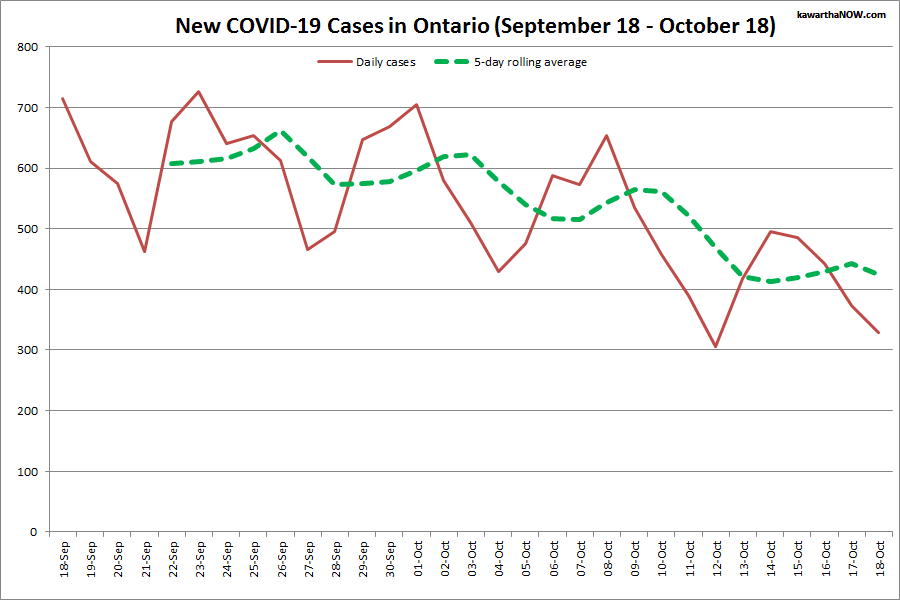
Although the province’s case count has increased by 299 today, Ontario is reporting 209 actual new cases (around 90 cases from 2020 were added to Toronto’s case count today due to a data clean-up). Based on 209 new cases, the seven-day average of daily cases has decreased by 13 to 254.
Most of today’s cases are in Waterloo (69), Toronto (40, when excluding the 90 cases from 2020), Peel (20), Grey Bruce (11), Durham (10), and Niagara (10).
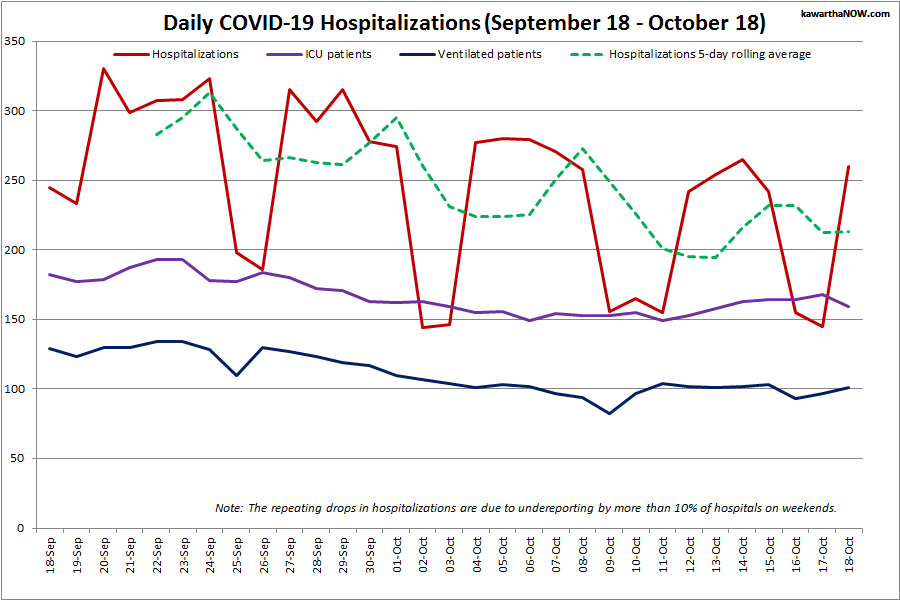
Hospitalizations have increased by 39 to 257, but some of this increase may be a result of than 10% of hospitals not submitting data for the daily bed census yesterday.
The number of patients in ICUs has fallen by 11 to 276 and the number of patients on ventilators has decreased by 6 to 185. Ontario is reporting 25 new deaths, including 3 in long-term care homes.
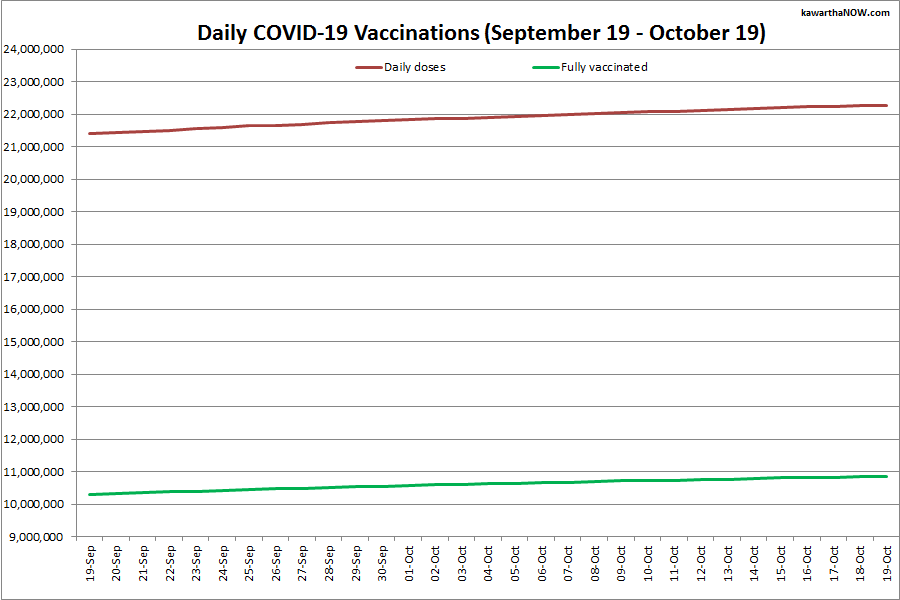
Almost 14.5 million vaccine doses have been administered, a record increase of 265,231 from yesterday, with almost 83% of Ontario’s total population now having received at least one dose. Almost 4.6 million people have been fully vaccinated, with a record 238,699 people receiving their second dose yesterday, representing almost 31% of the total population.
COVID-19 cases in Ontario from May 29 – June 28, 2021. The red line is the number of new cases reported daily, and the dotted green line is a five-day rolling average of new cases. (Graphic: kawarthaNOW.com)COVID-19 hospitalizations and ICU admissions in Ontario from May 29 – June 28, 2021. The red line is the daily number of COVID-19 hospitalizations and the purple line is the daily number of patients with COVID-19 in ICUs. (Graphic: kawarthaNOW.com)COVID-19 vaccinations in Ontario from May 29 – June 28, 2021. The red line is the cumulative number of daily doses administered and the green line is the cumulative number of people fully vaccinated with two doses of vaccine. (Graphic: kawarthaNOW.com)
Advertisement - content continues below
In the greater Kawarthas region, there are 5 new cases to report, including 4 in Peterborough and 1 in Northumberland. There are no new cases in Kawartha Lakes, Haliburton, or Hastings Prince Edward.
There are 2 new COVID-related deaths in the region, including 1 in Peterborough (the region’s 22nd COVID-related death) and 1 in Kawartha Lakes (the municipality’s 58th COVID-related death and the 76th COVID-related death in the health unit’s service area). There are 2 new COVID-related hospitalizations in Peterborough.
An additional 5 cases have been resolved in the region, including 3 in Peterborough and 2 in Northumberland.
Regional active cases have decreased by 1 in Kawartha Lakes and by 1 in Northumberland, and remain the same in Peterborough and Hastings Prince Edward.
There are currently 20 active cases in the greater Kawarthas region, a decrease of 2 since yesterday, including 11 in Peterborough, 7 in Kawartha Lakes, 1 in Northumberland, and 1 in Hastings Prince Edward (in Central Hastings). There are no active cases in Haliburton.
Since the pandemic began in the greater Kawarthas region, there have been 1,582 confirmed positive cases in the Peterborough area (1,549 resolved with 22 deaths), 1,090 in the City of Kawartha Lakes (1,038 resolved with 58 deaths), 945 in Northumberland County (927 resolved with 17 deaths), 122 in Haliburton County (121 resolved with 1 death), and 1,128 in Hastings and Prince Edward counties (1,116 resolved with 11 deaths). The most recent two deaths were reported in Peterborough and Kawartha Lakes on June 29.
One of the many painted rocks, signs, and flags containing messages for the Peterborough Victoria Northumberland and Clarington Catholic District School Board, following a June 22, 2021 decision by the board not to fly the Pride flag at Catholic schools. (Photo courtesy of Kimberly Liane)
Some members of the community want the Peterborough Victoria Northumberland and Clarington Catholic District School Board to know, “in God’s eyes, we’re all gay”.
That’s one of a series of messages painted on rocks and signs which, along with Pride flags, adorn the sidewalks at the entrance to the Catholic school board’s headquarters, located at Holy Cross Catholic Secondary School and the Catholic Education Centre at 1355 Lansdowne Street West in Peterborough.
Last Tuesday (June 22), members of the school board voted 4-3 against a proposal to install secondary flagpoles at Catholic schools for the purpose of displaying ‘special purpose’ flags — most notably the Pride flag representing the LGBTQ2S+ community.
Advertisement - content continues below
Some of the painted rocks, signs, and flags along the sidewalks at the entrance to the headquarters of the Peterborough Victoria Northumberland and Clarington Catholic District School Board at 1355 Lansdowne Street West in Peterborough. (Photo courtesy of Kimberly Liane)Apostrophe challenges aside, the messages to the Peterborough Victoria Northumberland and Clarington Catholic District School Board on these signs promote inclusion of all students regardless of their sexual orientation. (Photo courtesy of Kimberly Liane)
McDonald originally set a goal of obtaining 1,200 signatures. As of the date of this story, the petition now has more than 12,200 signatures and is likely to hit 15,000, making it one of the most-signed petitions at change.org.
As for the painted rocks, signs, and flags installed at the board’s headquarters, the theme is one of love and inclusion, with messages including “Love is love”, “Be kind”, “Queer is beautiful”, “God loves everyone”, and “God loves all the children”.
A flag placed on the sign for Holy Cross Catholic Secondary School and the Catholic Education Centre at 1355 Lansdowne Street West in Peterborough. (Photo courtesy of Kimberly Liane)A flag placed on a bench in front of Holy Cross Catholic Secondary School and the Catholic Education Centre at 1355 Lansdowne Street West in Peterborough. (Photo courtesy of Kimberly Liane)
In addition, a Pride flag hung on the Holy Cross and Catholic Education Centre sign reads “God loves gay!”, with another Pride Flag on a bench reading “Happy Pride Month!”.
kawarthaNOW was unable to find out who organized the display.
Now protected in perpetuity by Kawartha Land Trust, the Jones Wetland in Kawartha Lakes has significant natural features and habitats including mixed swamp, cattail and willow marsh, and an upland forest dominated by white ash, sugar maple, and basswood trees. (Photo courtesy of Kawartha Land Trust)
Kawartha Land Trust, the only non-government charitable organization committed to protecting land in the Kawarthas, recently announced its newest protected property: the Jones Wetland, donated by Ross Jones.
Located southwest of Fenelon Falls in the municipality of Kawartha Lakes, the 50-acre property is located directly adjacent to the Fell Wetland — a 50-acre property donated to Kawartha Land Trust by Allan Fell and his family in 2019 and protected by the organization in 2020.
Now that both properties are protected, this doubles the amount of conserved land in a provincially significant wetland that provides critical habitat for numerous species. Kawartha Land Trust will protect and care for the land in perpetuity, ensuring no future government can change the zoning on the land for another purpose.
Advertisement - content continues below
The Jones Wetland has been in the Jones family for three generations. John Jones, Ross’s grandfather, originally bought the land in 1946. Called the ‘Woodlot’ by the Jones family, the property has since been passed down to Ross Jones from his parents.
In recent years, both Ross Jones and his sister Marilyn Falls wanted to pass the property on but did not want someone to purchase it and destroy the natural elements of the land. They chose to donate the property to Kawartha Land Trust to protect it from loss or development.
While the Jones family did some cutting on the property in 1950, the property has remained untouched since. Left it to grow freely over the years, the property has significant natural features and habitats including mixed swamp, cattail and willow marsh, and an upland forest dominated by white ash, sugar maple, and basswood trees.
Donated to Kawartha Land Trust by Ross Jones, the 50-acre Jones Wetland in Kawartha Lakes is adjacent to the Fell Wetland, a 50-acre property protected by Kawartha Land Trust in 2020 after it was donated by Allen Fell and his family in 2019. (Photo courtesy of Kawartha Land Trust)
“It’s amazing how the trees have been able to take over the land and have been free to grow,” Ross Jones says, who recalls that, after some of the initial cutting by his grandfather, raspberries grew on the property every summer and their family “lived off of the raspberries.”
With the property now protected by Kawartha Land Trust, nature and wildlife — including many species at risk — will be free to thrive.
Recent research has found that just under three per cent of the world’s land remains ecologically intact, with undisturbed habitat and minimal loss of its original animal species.
Advertisement - content continues below
Previous research had estimated 20 to 40 per cent of the world’s land had been unaffected by human activity, but the new research finds only boreal and tundra biomes in east Siberia and northern Canada, parts of the Amazon and Congo basin tropical forests, and the Sahara Desert are intact.
Kawartha Land Trust protects 22 properties in the Kawarthas comprising more than 4,500 acres of important and diverse types of land, and assists in the management of one additional property.
One of Kawartha Land Trust’s goals when protecting a property is to ensure public access, but only when it is compatible with the long-term protection goals of the property and its features and when it corresponds with the wishes of the land donor. Due to its environmentally sensitive nature, the Jones Wetland property is not open for public access.
The property was secured with the additional support of the Government of Ontario and the Ontario Land Trust Alliance, through the Greenlands Conservation Partnership, which helps conserve ecologically important natural areas and protect wetlands, grasslands, and forests that help mitigate the effects of climate change.
For more information about Kawartha Land Trust and to make a donation, visit kawarthalandtrust.org.
'Dark #1' (digital photograph, 2021) from "Captivating" by Stephanie Etherington, part of the "Culture X: Bodies in Nature, Bodies Online" virtual exhibition by Trent University students available on Artspace Peterborough's website. (Photo courtesy of Artspace)
Though Trent University in Peterborough lacks any official fine arts programs, the university’s Cultural Studies Department has a history of offering applied-arts courses and practical workshops. By merging theory and practice, the studio courses offer students the opportunity to think by doing; to critique and create culture.
During the COVID-19 pandemic, these applied-arts courses offered Trent students not only a unique approach to learning, but also a safe haven during an otherwise impossible time for students.
Culture X: Bodies in Nature, Bodies Online — a virtual exhibition available on Artspace Peterborough’s website until August 31 — features artworks created in some of Trent’s courses encompassing the Cultural Studies integrated arts platform.
Advertisement - content continues below
The online exhibition demonstrates the students’ innovative and insightful approaches to art making during the pandemic. Above all, however, the exhibit is a testament to the artists’ collective resiliency.
“I am very grateful for experiencing the Cultural Studies Department and classes the way I did,” says Raine Knudsen, whose stop-motion film ‘Connection’ plays with energy in movement.
“Despite everything that’s going on and despite all of the limitations that we’re facing, we’re still able to connect and we’re still able to nurture that part of ourselves and our human experience — even if it happens to be in different ways,” continues Knudsen.
“Being in the Cultural Studies Department during the pandemic has been really different from other departments,” adds Zoe Easton, who created a series of digital photographs entitled ‘Soft Places’.
“It is really hard to make art when you’re so overwhelmed by the world around you, but these courses were really good for encouraging us to put our personal experiences into the art,” Easton says. “For example, my project for this exhibit is about healing and specifically about the time that I took during the pandemic to go outside and be in nature.”
VIDEO: “Connection” by Raine Knudsen
Indeed, many of the Culture X artists interviewed for this article spoke of the therapeutic elements they discovered through art making and community building.
“One of the most amazing things about this class was being able to see the perspective of all my classmates through their art,” recalls Shaun Phuah, whose video collage ‘People Looking at Me Looking at Them’ investigates the immediacy of the highly intimate and often-volatile personal spaces we see online.
“In a way, we were all dealing with the same things,” Phuah continues. “I thought it was just really touching to be able to experience that through the class and through my classmates in that way.”
“There is such a sense of community in the Cultural Studies department,” says Stephanie Etherington, whose major is in business administration.
“It was quite interesting to see other people’s interpretation of the pandemic within their work. We really fed off of one another’s energies and ideas,” says Etherington, whose series of digital photographs entitled ‘Captivating’ plays with colour, light, movement, and texture says. “It’s actually quite funny that the whole class ended up having this experience indulging in colour.”
Advertisement - content continues below
“We all sort of became friends,” explains Mridul Harbhajanka, whose playful musical composition ‘Spook-Key Tunes’ generates unique results, depending on the performers’ names, every time it is performed. “I created the piece during exam season. Having something fun to do between all these boring essays and exams was like a stress buster. This class played a huge role in how I view music. Without the course, I don’t think I would be able to come up with the idea for my composition.”
During a time when many artists have struggled or even resisted creating and disseminating digital art, the Culture X artists faced the challenges of digital art making head on.
“For a long time, I was trying to overcome the limitations of the digital,” explains Katy Catchpole, whose digital video ‘Own Undoing’ was awarded Trent’s prestigious Frith prize this year.
“It was almost a very negative approach — we were stuck in this pandemic, and we couldn’t be together, and we couldn’t produce art the way that we normally would — but I kind of got tired of that,” Catchpole says.
“I wanted to approach it from a more positive perspective, to think about how digital art can be manipulated, maybe in ways it wasn’t intended. So instead of thinking of digital art as this fixed static thing, I started to think about it more as painting or sculpture.”
‘Selective Memory #4’ (oil on paper, 2021) from “Selective Memory” by Lindsay Olivieri. “For this series, I drew screenshots from archived home movies and framed the images in a way that replicates the appearance of a printed digital photograph one could get at their local Shoppers Drug Mart or Walmart.” (Photo courtesy of Artspace)
For Carolina Engering and Ceilidh Peters, both students of the theatre course Performance and Protest, creating and presenting ‘Gender Inequality’ — their work of invisible theatre — online brought its challenges.
“Usually, invisible theatre is like a play, but the audience — the spectators — don’t know what’s happening,” Engering explains. “They don’t know there’s a play being performed, and they don’t know they’re part of the play. It’s experimental. It checks what they’ll do morally in a situation, usually involving oppression; it checks if they’ll be involved or not”
“Zoom was a huge challenge for us,” she continues. “We couldn’t go out in public, and invisible theatre is usually performed out in public in random areas, like a bus stop or something.”
“We originally set it up as being a presentation on gender inequality — that’s what the class thought they were watching — but the real performance we staged was this horribly racist attack towards one of the people in our group,” adds Peters.
Advertisement - content continues below
“Art really helps to humanize other people’s experiences,” Ceilidh concludes. “It helps people to visualize how other people live and be able to fully embrace the experiences that come with that.”
Though challenging, remote learning on Zoom increased accessibility for Culture X artist Jinian Raine, who has two works, ‘Ghosts’ and ‘Invisible Screen’, featured in the exhibit.
“I have a chronic illness and I’ve had one of the worst health years I’ve had in a very, very long time,” Raine explains.
A frame from “Invisible Screen” (animated GIF, 2021) by Jinian Raine. “I made Invisible Screen with the intention of embracing the very makeup of the digital and using it to the advantage of the pieces rather than the detriment.” (Image courtesy of Artspace)
“So if we hadn’t been on Zoom, I would not have been able to go to class,” Raine adds. “I was lucky that we were going through Zoom because I could do school from my bed, which is where I needed to do it.”
“Honestly, I think this class is possibly a pivotal moment in my life because I have kind of fallen in love with digital art and the art that I’ve made. This class has changed my life trajectory because of how much I fell in love with making art in it.”
To view the profound works of art that so strongly speak to the conditions in which they were created, Culture X: Bodies in Nature, Bodies Online can be accessed until August 31st on the Artspace website at artspace-arc.org/exhibition/culture-x-bodies-in-nature-bodies-online/.
Gayathri Rajan (right) first came to Canada from India in 2014 with her husband Prabhakar (left) along with their then five-year-old son Sandeep, and had their second child Vetri while living in Canada. Gayathri, who says she felt at home in Canada after only a month, has been sharing her authentic Indian food recipes on her YouTube channel and has since expanded her recipes to include food from other countries including Canada. (Photo: Prabhakar Rajan)
This #CookWithNCC story is one of a series commissioned by the New Canadians Centre in Peterborough, in which newcomers share their experiences in Canada along with a recipe from their home culture.
For Canadian newcomer Gayathri Rajan, sharing her recipes with the public is not likely something she would do if she still lived in India.
But, after seven years of living in Canada, she now runs her own YouTube channel where she shares her recipes, and is excited to give kawarthaNOW readers the chance to make authentic biryani.
Biryani is a dish originating from India that features rice, Indian spices, and meat (it can also be made with vegetables). According to Gayathri, it is one of the most popular dishes in India, and there are countless different versions of it.
The dish is so popular in India that different locations in the country have their version. For example, Ambur biryani — a spicy biryani with chicken or mutton — comes from the town of Ambur. The specialty of the city Hyderabad, Hyderabad biryani is a version that typically uses goat meat.
“Biryani is our favourite recipe in India,” Gayathri says. “We make it for any big occasion such as weddings, birthdays, or any other happy moments.”
Gayathri’s recipe, which uses goat meat, is her mother-in-law’s own special biryani. The recipe has an emotional and nostalgic meaning for Gayathri, as it is tied to memories of learning to cook from her mother-in-law, who just recently passed away.
Gayathri Rajan’s goat biriyani (with egg fry) is an authentic recipe from southern India of the fragrant mixed-rice dish that is popular across the Indian sub-continent. (Photo courtesy of Gayathri Rajan)
“I learned most of my cooking from my mother-in-law,” Gayathri explains. “She was a very good cook. I got married in 2007 right after I graduated from university and I didn’t have a chance to make food at my mother’s place, so I learned from my mother-in-law.”
“I have a passion and love for cooking, so I learned very quickly,” she adds.
This is not the first time Gayathri has shared her and her mother-in-law’s recipes with the public. She runs a YouTube channel called Santri’s Kitchen, dedicated to cooking videos.
Gayathri is proud to share her Indian food recipes with Canadians, including her authentic goat biriyani recipe.
“Since coming here, I’ve wanted to share with everyone so people who like Indian food can know about this recipe and enjoy it,” Gayathri says.
Gayathri has expanded her recipes to include other types of food, some of which she also features on her YouTube channel. Soups, Chinese fried rice, and pan-fried vegetables are a few of the foods she has learned to make since being exposed to the food of different cultures foods while living in Canada.
“In India, I wouldn’t make this kind of stuff,” Gayathri explains. “My mother is always surprised, saying ‘Wow, you’re making a ton of recipes!'”
Since they can watch and comment on her videos, Gayathri’s YouTube channel is another way to connect her with her family living in India. Gayathri says missing her family has been the most challenging part of moving to Canada, especially since her family has recently experienced a double loss: both Gayathri’s brother and mother-in-law, who lived in India, recently passed away.
For Gayathri Rajan, being apart from her family in India has been the most difficult adjustment to life in Canada. Gayathri recently lost both her brother as well as her mother-in-law, who was a very good cook and taught Gayathri much of what she knows about cooking. (Photo courtesy of Gayathri Rajan)
Gayathri and her husband Prabhakar (‘Raj’) moved to Canada in 2014 with their first son, Sandeep, who was five years old at the time.
They initially settled in Mississauga before moving to Peterborough a few years ago. Sandeep is now 12 years old, and the couple has a second four-year-old son named Vetri, who was born in Canada.
Gayathri recalls feeling at home quite quickly in Canada after her move.
“Before we came to Canada, we were fixed in our minds that India was our home,” Gayathri says. “Initially, I got homesick for the first two weeks, but then I got used to it. I felt at home in about a month after getting a job, which was a very happy moment.”
Although Gayathri, who has her bachelor’s degree in computer science, was a bit dismayed about not finding work in her field, she says she enjoyed her first job in Canada working as a machine assembly operator in a factory. Gayathri explains it was the friendly people who helped her to feel at home in Canada so quickly.
“Canadians are very friendly,” Gayathri says. “We miss our family, and that’s the hardest part, but otherwise, we are very happy here. Our kids are happy here. Their teachers are so friendly here.”
“My oldest son is not interested in going back to India,” Gayathri adds. “Even before we left India, he would always say ‘I love Toronto. I want to go to Toronto.'”
Gayathri’s husband Prabhakar, a practicing physiotherapist in India, also did not initially find work in his field upon arriving in Canada.
Prabhakar and Gayathri Rajan both had difficulty finding work in their chosen careers when they first arrived in Canada. Prabhakar was a practicing physiotherapist in India while Gayathri has a bachelor’s degree in computer science. (Photo courtesy of Gayathri Rajan)
“After we moved to Peterborough, he got a medical transcription job in Peterborough, and then I got pregnant and we had a second baby,” Gayathri recalls. “After that, my husband studied clinical research and now has a job in technical research in Peterborough.”
Busy at home with her two children and working on her YouTube channel, Gayathri plans to start a daycare once her youngest starts school while also continuing to share her recipes online.
Gayathri and Prabhakar feel settled and at home in Peterborough. They joined the New Canadians Centre Peterborough last year and became involved in their social groups, with Gayathri participating in the women’s group (which moved online during the pandemic). Gayathri’s son Vetri also attends the New Canadian Centre’s online pre-school program, and attended daycare when programs like the women’s group were in-person.
According to Gayathri, the not-for-profit organization has been an incredible asset in helping newcomers like the Rajan family settle in their new lives in Canada.
The Rajan family: Prabhakar, Verti, Sandeep, and Gayathri. Sandeep, who was born in India, and Verti, who was born in Canada, both love living in Canada. Vetri attends daycare at the New Canadians Centre Peterborough. (Photo courtesy of Gayathri Rajan)
Embroidery, Zumba, and crafts are some of the activities Gayathri enjoys in the women’s group she attends once a week.
“It’s so nice because I spend the whole of my days taking care of kids and my family,” Gayathri notes. “And we enjoy foods from all countries in the women’s group, so every week we eat a different country’s food.”
Gayathri says she often prepares Indian recipes for the group and everyone loves them, and is also pleased to be able to share her biryani recipe.
“I am so happy to share my recipe with Canadians,” Gayathri says.
Aromas, flavours, ingredients, who we cook for and how we share our recipes — they all tell stories that shape us as a community. On this journey through pantries and kitchens, we hope that you will fill both your plate and your heart.
Share your experience trying out these recipes, or your own story and recipe, on social media using the hashtag #CookWithNCC.
To join the New Canadians Centre on their 40-year journey of welcoming immigrants and refugees, visit nccpeterborough.ca.
Here’s an update on COVID-19 cases in Ontario as well as in the greater Kawarthas region.
Ontario is reporting 210 new cases today, the lowest daily increase since September 11 when 232 cases were reported. The seven-day average of daily cases has decreased by 8 to 267.
Most of today’s cases are in Toronto (37), Waterloo (26), Grey Bruce (25), and Peel (15).
Hospitalizations have increased by 15 to 218, but more than 10% of hospitals did not submit data for the daily bed census yesterday for this report so the actual number of hospitalizations may be higher.
The number of patients in ICUs has decreased by 2 to 287 and the number of patients on ventilators remains unchanged at 191. Ontario is reporting 3 new deaths, with none in long-term care homes.
Over 14.2 million vaccine doses have been administered, an increase of 180,369 from yesterday, with almost 82% of Ontario’s total population now having received at least one dose. More than 4.3 million people have been fully vaccinated, with 161,149 people receiving their second dose yesterday, representing over 29% of the total population.
COVID-19 cases in Ontario from May 28 – June 27, 2021. The red line is the number of new cases reported daily, and the dotted green line is a five-day rolling average of new cases. (Graphic: kawarthaNOW.com)COVID-19 hospitalizations and ICU admissions in Ontario from May 28 – June 27, 2021. The red line is the daily number of COVID-19 hospitalizations and the purple line is the daily number of patients with COVID-19 in ICUs. (Graphic: kawarthaNOW.com)COVID-19 vaccinations in Ontario from May 28 – June 27, 2021. The red line is the cumulative number of daily doses administered and the green line is the cumulative number of people fully vaccinated with two doses of vaccine. (Graphic: kawarthaNOW.com)
Advertisement - content continues below
In the greater Kawarthas region, there are 4 new cases to report over the past 3 days, including 3 in Kawartha Lakes as well as 1 in Hastings Prince Edward (a travel-related case). There have been no new cases over the past 3 days in Peterborough, Northumberland, or Haliburton.
An additional 14 cases have been resolved over the past 3 days, including 6 in Northumberland, 4 in Peterborough, 2 in Kawartha Lakes, and 2 in Hastings Prince Edward.
Active cases have increased by 1 in Kawartha Lakes and have decreased by 6 in Northumberland, by 4 in Peterborough, and by 1 in Hastings Prince Edward. There are no active cases in Haliburton.
There are currently 22 active cases in the greater Kawarthas region, a decrease of 10 since June 25, including 11 in Peterborough, 8 in Kawartha Lakes, 2 in Northumberland, and 1 in Hastings Prince Edward (in Central Hastings).
Since the pandemic began in the greater Kawarthas region, there have been 1,578 confirmed positive cases in the Peterborough area (1,546 resolved with 21 deaths), 1,090 in the City of Kawartha Lakes (1,038 resolved with 57 deaths), 944 in Northumberland County (925 resolved with 17 deaths), 122 in Haliburton County (121 resolved with 1 death), and 1,128 in Hastings and Prince Edward counties (1,116 resolved with 11 deaths). The most recent death was reported in Kawartha Lakes on June 5.
kawarthaNOW.com offers two enews options to help readers stay in the know. Our VIP enews is delivered weekly every Wednesday morning and includes exclusive giveaways, and our news digest is delivered daily every morning. You can subscribe to one or both.
Submit your event for FREE!
Use our event submission form to post your event on our website — for free.
To submit editorial content or ideas, please contact us.