If you have Kawartha Dairy's Mint Chip Ice Cream or Chocolate Chip Cookie Dough Ice Cream in your freezer, check the cartons for specific production codes to see if the ice cream has been recalled. Kawartha Dairy is recalling the production codes because of the possibility that chocolate chips used in the ice cream may include small pieces of metal. Retailers including grocery stores should also be removing these products from their shelves. (Supplied photos)
Bobcaygeon-based Kawartha Dairy Limited is voluntarily recalling eight production codes of two flavours of its ice cream because of the potential of small pieces of metal in the chocolate chips provided by one of its suppliers.
The popular dairy made the announcement on its Facebook and Instagram accounts last Tuesday (November 24).
“We are making this voluntary withdrawal out of an abundance of caution, because the safety of our customers and your confidence in our products has always been our number one priority,” the dairy writes. “Kawartha Dairy has not received any consumer complaints regarding this issue and no injuries have been reported.”
Advertisement - content continues below
On Sunday (November 29), the Canadian Food Inspection Agency also posted a food recall warning at the request of Kawartha Dairy.
The recalled products include the following production codes of Mint Chip Ice Cream and Chocolate Chip Cookie Dough Ice Cream, both the 1.5-litre retail sizes and the 11.4-litre commercial sizes:
Brand
Product
Size
UPC
Codes
Kawartha Dairy
Chocolate Chip Cookie Dough Ice Cream
1.5 L
0 62229 08950 1
PRD / 03/11/2020 and PRD / 04/11/2020
Kawartha Dairy
Chocolate Chip Cookie Dough Ice Cream
11.4 L
0 62229 08150 5
PRD: 03/11/2020 and PRD: 04/11/2020
Kawartha Dairy
Mint Chip Ice Cream
1.5 L
0 62229 08917 4
PRD / 13/10/2020 and PRD / 14/10/2020
Kawartha Dairy
Mint Chip Ice Cream
11.4 L
0 62229 08117 8
PRD / 13/10/2020 and PRD / 14/10/2020
Restaurants and institutions using Kawartha Dairy’s Mint Chip Ice Cream or Chocolate Chip Cookie Dough Ice Cream should check the tubs for specific production codes to see if the ice cream has been recalled. Kawartha Dairy is recalling the production codes because of the possibility that chocolate chips used in the ice cream may include small pieces of metal. (Supplied photos)
Advertisement - content continues below
No other flavours of ice cream are involved, and the recall is limited to the specific production codes listed above.
Consumers should not eat the recalled products and retailers, restaurants, and institutions should not sell or use the recalled products
If you have a recalled product, Kawartha Dairy says you can return it to the place of purchase for a full refund, or email info@kawarthadairy.com for a full refund or if you have any further questions.
The 12 entrepreneurs participating in the fall 2020 intake of Starter Company Plus, a business development program offered through the Peterborough & the Kawarthas Business Advisory Centre with funding from the Government of Ontario. Top row: Debra Ragbar, Lyle Saunders, Ivan O'Brien, and Janette Fluke; middle row: Sharyn Inward, Jocelynn Vieira, Cheryl Edwards and Charmaine Magumbe, and Alicia Doris; bottom row: Susan Dunkley, Amy and Dean Howley, Jonathan Clement, and Christopher Nayler.
Starting a new business or growing an existing one is never easy, let alone during a pandemic. Fortunately for 12 local entrepreneurs, the Starter Company Plus program is here to help.
Offered through the Peterborough & the Kawarthas Business Advisory Centre with funding from the Government of Ontario, the business development program provides training for aspiring to experienced entrepreneurs 18 years and over in the City and County of Peterborough who are launching a business or expanding an existing one that’s been operating for five years or less.
As of November 16th, the 12 Starter Company Plus participants have had to submit their final business plans and, later, will submit a video pitch to the judges for review as a culmination of the program.
Micro-grant recipients will be announced the week of November 30th.
The eight-week program, which teaches participants the skills they need to start and grow their business, is shifting focus this fall in recognition of the impact of the pandemic. With more robust digital marketing strategies, crisis communications and public relations, and financial acumen and long-term planning, the 12 entrepreneurs participating in the fall intake of the program will be better equipped to launch and grow their businesses.
And if that isn’t enough, there’s also the $5,000 Starter Company Plus micro-grants that seven of the 12 business owners will be selected to receive, based on the strength of their business plans and the viability and creativity of their business.
Here are the 12 entrepreneurs participating in the fall intake of Starter Company Plus, along with their businesses:
Spice mixes and rubs by Kawartha Spice Company. (Photo: Debra Ragbar / Instagram)
Debra Ragbar’s business Kawartha Spice Company Inc. manufactures gluten-free curry powder and spice rub mixes for plant-based, poultry, red meat, and seafood recipes, along with rim rubs for cocktails such as a Caesar.
The curry powder mix and spice rub mixes are made with a number of pure natural spices selected for their superior flavour and premium quality.
Individual mixes are used in recipes such as Jamaican jerk, roasted chickens, roasted rack of lamb, roasted beef tenderloin, roasted pork chops, baked salmon, and vegetarian dishes.
Saunders Tax Service is located at Peterborough Disability Tax Services at 175 George Street North in downtown Peterborough. (Photo: Peterborough Disability Tax Services / Facebook)
“Simple Taxes at a Simple Price”. That’s Lyle Saunders’ motto for Saunders Tax Service, his yearly tax season service for households in the Peterborough area.
Saunders also owns and operates Peterborough Disability Tax Services, which he founded in February 2019 and which specializes in the federal disability tax credit for individuals and caregivers. Sanders assists in applications for the tax credit, as well as helping with eligibility challenges and adjusting approved tax credits beyond the Canada Revenue Agency’s automatic adjustments.
Saunders Tax Service is located at Peterborough Disability Tax Services, in the Peterborough Chamber of Commerce building at 175 George Street North in downtown Peterborough. For more information, call 705-931-8500, email ptbotds@outlook.com, or visit ptbodts.ca
Ivan O’Brien — Archer Equipment Inspections Ltd.
Ivan O’Brien owns and operates Archer Equipment Inspections, a heavy equipment inspection business located in the Township of Douro-Dummer.
The primary service offered by O’Brien’s business is the inspection of equipment for companies interested in purchasing equipment that other companies have put up for sale.
Archer Equipment Inspections also offers fleet maintenance services, an oil sampling program, working with financial institutions and assisting with financial restructuring for mines, mobile equipment repair in the Peterborough, and equipment mid-life and overhaul planning.
Sharyn Inward’s business Oma Knows helps plus-size women enjoy a healthy lifestyle. (Graphic: Oma Knows / Facebook)
Located in the City of Peterborough, Sharyn Inward’s new health and wellness business Oma Knows focuses on promoting a healthy lifestyle for plus-size women.
Inward offers yoga and health education to assist women in living their best and healthiest life through a positive mindset and training.
Jocelynn Vieira’s business The Kawartha Craft Company provides hands-on creative activities for children of all ages with easy-to-follow do-it-yourself craft kits.
Her craft kits are stocked with hand-picked local supplies that have been tested to ensure ease of use.
Located in the Municipality of Trent Lakes, the Kawartha Craft Company also donates craft kits to local shelters and works with local charities in Peterborough and the Kawarthas to supplement fundraising initiatives.
Owned and operated by Cheryl Edwards and Charmaine Magumbe, Zingha is a social enterprise located in the City of Peterborough.
Zingha offers original designs of positive Afrocentric images on t-shirts, mugs, and bags, as well as Nigerian COVID face masks and handmade Afrocentric notebooks and journals.
Zingha also supplies free resources to help people become more inclusive as well as to combat anti-Black racism.
Living Local Box owner Alicia Doris. (Photo: Living Local Box / Facebook)
Alicia Doris’s business Living Local Box shares the best of local products in Peterborough and the Kawarthas through custom gift boxes and seasonal subscription boxes.
Living Local Box connects community members with new ways to support local small business by providing one-of-a-kind selections of artwork, bath and body products, food and drink, and lifestyle products.
With her ever-evolving offerings, Doris showcases and supports both individuals and families living and working in the region.
Living Local Box is located in Selwyn Township. For more information, call 706-768-0621, email livinglocalbox@gmail.com, or visit www.livinglocalbox.com..
Susan Dunkley — Suzi Home Maker
Suzi Home Maker owner Susan Dunkley. (Photo: Suzi Home Maker/Facebook)
Through her business Suzi Home Maker, Susan Dunkley helps people who are downsizing their homes or moving to another home.
Suzi Home Maker assists with downsizing, de-cluttering, sorting, organizing, selling, donating, disposing, recycling, packing, moving, unpacking, helping people get settled in, and clearing estates.
Recognizing that downsizing and moving homes often takes place at emotional or trying times, Suzi Home Maker also provides support by helping clients make the right decisions and by getting the job done quickly and efficiently and with care and compassion.
While Suzi Home Maker provides standard services, Dunkley recognizes each move is different and the exact services she provides are tailored to the needs of each individual client.
Amy and Dean Howley, owners of King & Tupper. (Photo: King & Tupper / kingandtupper.ca)
Husband-and-wife team Dean and Amy Howley own and operate King & Tupper, which produces custom wood decor, art, toys, and furniture handcrafted in Millbrook.
King & Tupper offers a constantly evolving range of products, such as painted wood signs, three-dimensional backlit wood art, rocking giraffes, and toddler helper stools.
When developing their products, the Howleys continuously research market trends, update and improve existing designs, and incorporate customer suggestions and requests. All of King & Tupper’s products are crafted in the Howleys’ home-based workshop.
King & Tupper is located in the Township of Cavan-Monaghan. For more information, call 905-550-5095, email hello@kingandtupper.ca, or visit kingandtupper.ca.
Jonathan Clement — Elbuns Media
Elbuns Media owner Jonathan Clement. (Photo: Elbuns Media / Facebook)
Through his business Elbuns Media, Jonathan Clement helps small businesses and non-profits tell their stories by creating videos that are effective and tell the organization’s story in a way that best helps them meet their goals.
Along with video production and content creation, Elbuns Media also provides video editing and content editing services, and develops strategies specializing in recruiting and fundraising efforts.
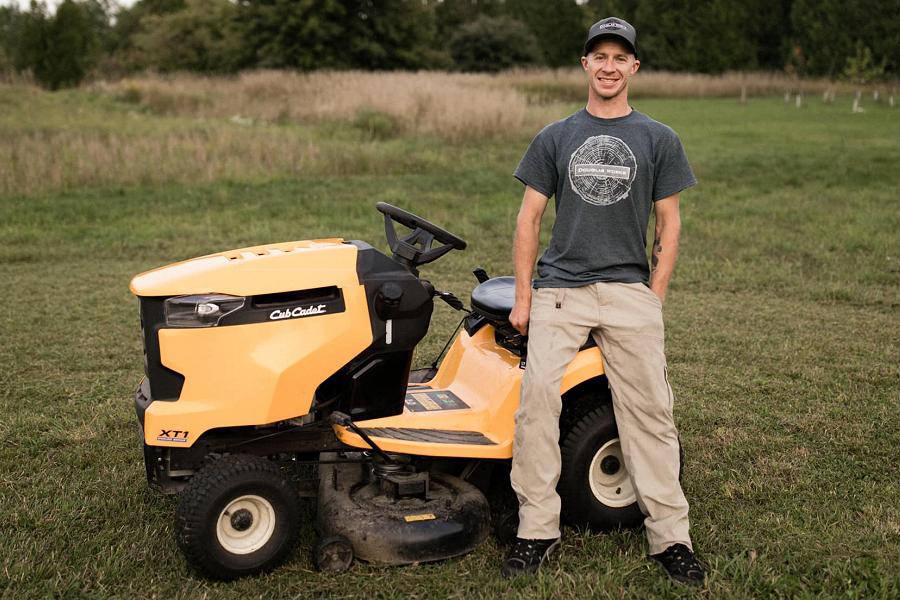
Douglas Works owner Christopher Nayler. (Photo: Douglas Works / Facebook)
Christopher Nayler owns and operates Douglas Works, located in the City of Peterborough.
Douglas Works offers residential and commercial landscaping, hardscaping, and property maintenance services for residential and commercial clients in Peterborough and the surrounding area.
Here’s an update on COVID-19 cases in Ontario as well as in the greater Kawarthas region.
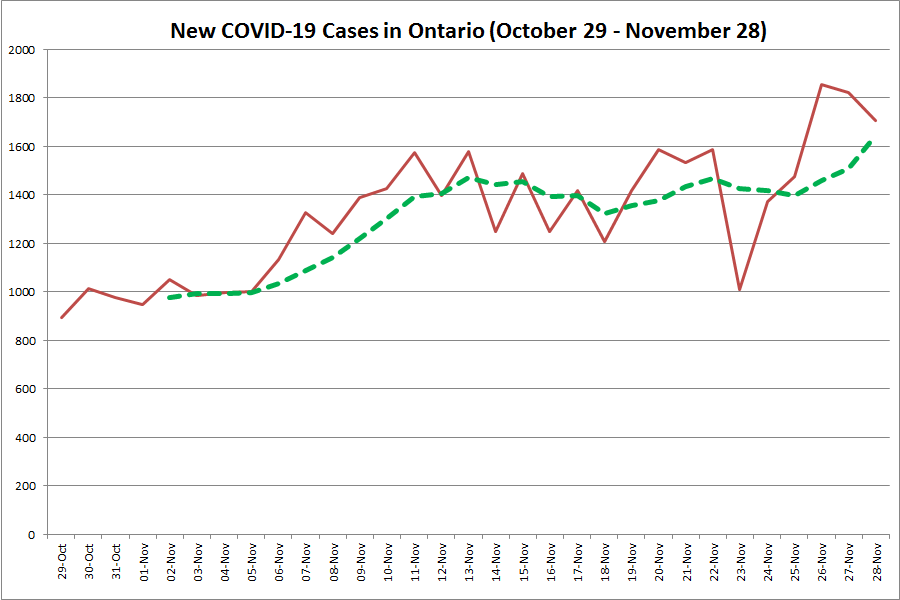
Ontario is reporting 1,708 new COVID-19 cases today, with the average number of daily cases over the past seven days increasing by 25 to 1,548.
Most of the new cases reported today are in Peel (503), Toronto (463), and York (185), with double-digit increases in Ottawa (79), Durham (73), Waterloo (63), Hamilton (60), Windsor-Essex (37), Halton (31), Simcoe Muskoka (30), Wellington-Dufferin-Guelph (30), Niagara (28), Middlesex-London (20), Thunder Bay (19), Southwestern Public Health (17), Eastern Ontario Health Unit (10), and Brant County (10), and smaller increases in Huron Perth (9).
The remaining 16 health units are reporting 5 or fewer new cases, with only 3 health units reporting no new cases at all.
Of today’s cases, 53% are among people under 40 years of age, with the highest number of cases (652) among people ages 20 to 39 followed by 505 cases among people ages 40 to 59. With 1,443 more cases resolved since yesterday, the percentage of resolved cases remains unchanged at 84.8%. The average positivity rate across Ontario is unavailable on weekends.
Ontario reported 24 new COVID-19 deaths today, including 7 in long-term care facilities. Hospitalizations decreased by 9 to 586, although this number does not include data from around 40 hospitals. There is 1 additional patient with COVID-19 in an ICU and 8 fewer patients on ventilators. A total of 53,959 tests were completed yesterday, and the backlog of tests under investigation has decreased by 17,495 to 38,724.
Advertisement - content continues below
In the greater Kawarthas region, there are no new cases to report today in Peterborough.
Reports are not available on weekends for Hastings and Prince Edward counties, Northumberland, Kawartha Lakes, or Haliburton. However, the Haliburton, Kawartha, Pine Ridge District Health Unit declared an outbreak on November 28 at the Canadian Centre for Addictions in Port Hope after a symptomatic staff person tested positive for COVID-19.
There are currently 76 active cases in the greater Kawarthas region, including 31 in Hastings and Prince Edward counties, 22 in Peterborough, 14 in Northumberland, 4 in Haliburton, and 5 in Kawartha Lakes.
Since the pandemic began in the greater Kawarthas region, there have been 211 confirmed positive cases in the Peterborough area (184 resolved with 5 deaths), 197 in the City of Kawartha Lakes (173 resolved with 32 deaths), 79 in Northumberland County (64 resolved with 1 death), 28 in Haliburton County (24 resolved with no deaths), and 128 in Hastings and Prince Edward counties (92 resolved with 5 deaths). The most recent death was reported in Peterborough on November 23.
Province-wide, there have been 114,746 confirmed cases, an increase of 1,708 from yesterday, with 97,319 cases resolved (84.8% of all cases), an increase of 1,443 from yesterday. There have been 3,648 deaths, an increase of 24 from yesterday, with 2,301 deaths in long-term care homes, an increase of 7 from yesterday. The number of hospitalizations has decreased by 9 to 586, although this number does not include data from around 40 hospitals. There is 1 additional patient with COVID-19 in an ICU and 8 fewer patients on ventilators. A total of 6,235,510 tests have been completed, an increase of 53,959 from yesterday, with 38,724 tests under investigation, a decrease of 17,495 from yesterday.
The provincial data in this report is pulled from Ontario’s integrated Public Health Information System (iPHIS) at 12 p.m. the previous day. Data from local health units is more current and is usually reflected in the provincial data the following day. There may be discrepancies between the Ontario data reported today (which is from yesterday) and the local health unit data reported today (which is from today).
Peterborough Public Health’s service area is the City and County of Peterborough and the Hiawatha and Curve Lake First Nations.
The health unit provides daily reports, including on weekends.
Confirmed positive: 211 (no change) Active cases: 22 (no change) Close contacts: 70 (increase of 4) Deaths: 5 (no change) Resolved: 184 (no change) Hospitalizations (total to date): 10 (no change)* Total tests completed: Over 36,700 (increase of 100) Institutional outbreaks: Fairhaven (no change)
*The health unit is no longer reporting the total number of hospitalizations.
Haliburton, Kawartha, Pine Ridge District Health Unit
The Haliburton, Kawartha, Pine Ridge District Health Unit’s service area is the City of Kawartha Lakes, Northumberland County, and Haliburton County.
The health unit provides reports from Monday to Friday, excluding statutory holidays. These numbers are from November 27.
Confirmed positive: 304, including 197 in Kawartha Lakes, 79 in Northumberland, 28 in Haliburton (increase of 6, including 2 in Kawartha Lakes, 3 in Northumberland, and 1 in Haliburton) Active cases: 23, including 5 in Kawartha Lakes, 14 in Northumberland, and 4 in Haliburton (no net change) Probable cases: 0 (no change) High-risk contacts: 88, including 11 in Kawartha Lakes, 71 in Northumberland, and 6 in Haliburton (increase of 22 in Northumberland) Hospitalizations (total to date): 16, including 11 in Kawartha Lakes, 4 in Northumberland, and 1 in Haliburton (no change) Deaths: 33 (no change) Resolved: 261, including 173 in Kawartha Lakes, 64 in Northumberland, 24 in Haliburton (increase of 6, including 1 in Kawartha Lakes, 4 in Northumberland, and 1 in Haliburton) Institutional outbreaks: None (no change)
Hastings Prince Edward Public Health
Hastings Prince Edward Public Health’s service area is Hastings County (including Bancroft) and Prince Edward County.
The health unit provides reports from Monday to Friday, excluding statutory holidays. These numbers are from November 27.
Confirmed positive: 128 (increase of 6) Active cases: 31 (increase of 4) Deaths: 5 (no change) Currently hospitalized: 1 (no change) Currently hospitalized and in ICU: 1 (no change) Currently hospitalized and in ICU on ventilator (total to date): 0 (no change) Resolved: 92 (increase of 2) New swabs completed: 2,626 (decrease of 2,991) Institutional outbreaks: None (no change)
Advertisement - content continues below
Province of Ontario
Confirmed positive: 114,746 (increase of 1,708) Resolved: 97,319 (increase of 1,443, 84.8% of all cases) Hospitalized: 586 (decrease of 9)* Hospitalized and in ICU: 156 (increase of 1) Hospitalized and in ICU on ventilator: 91 (decrease of 8) Deaths: 3,648 (increase of 24) Deaths of residents in long-term care homes: 2,301 (increase of 7) Total tests completed: 6,235,510 (increase of 53,959) Tests under investigation: 38,724 (increase of 17,495)
*Around 40 hospitals did not submit data for the daily bed census for November 27. The number of hospitalized patients may increase when reporting compliance increases.
New COVID-19 cases in Ontario from October 29 – November 28, 2020. The red line is the number of new cases reported daily, and the dotted green line is a five-day moving average of new cases. (Graphic: kawarthaNOW.com)COVID-19 tests completed in Ontario from October 29 – November 28, 2020. The red line is the number of tests completed daily, and the dotted green line is a five-day moving average of tests completed. (Graphic: kawarthaNOW.com)
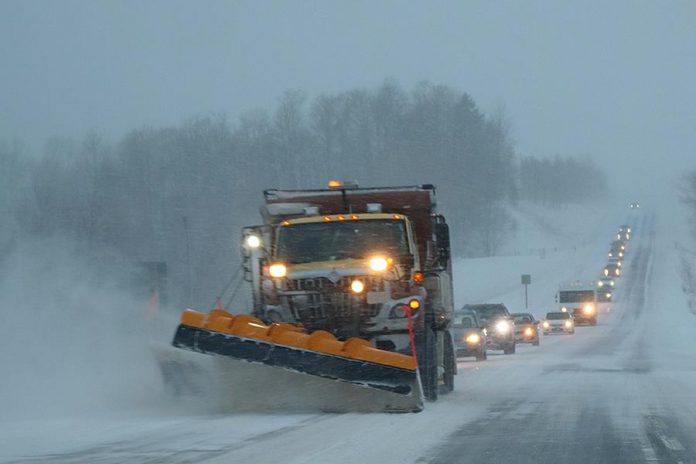
Environment Canada has issued a special weather statement for almost all of the greater Kawarthas region, forecasting a significant winter storm beginning Monday morning (November 30) and continuing until Wednesday.
A low pressure system is expected to track just east of Lake Erie and Lake Ontario on Monday, bringing rain, snow, and strong winds throughout southern Ontario. The low pressure system is expected to remain over southern Ontario until Wednesday.
Precipitation is expected to begin on Monday morning as rain or snow and change to snow on Monday evening.
Advertisement - content continues below
By Tuesday morning, snowfall amounts of 5 to 10 cm are possible in Peterborough County and the City of Kawartha Lakes, with 10 to 20 cm possible for Haliburton and Hastings County.
Snow will continue Tuesday into Wednesday. Additional snowfall amounts near 10 cm are possible in Peterborough County and the City of Kawartha Lakes, and near 15 cm for Haliburton and Hastings County.
However, total snowfall amounts are uncertain at this time.
Difficult travel conditions are expected as snow covered and icy roads are possible Monday night, Tuesday, and Wednesday.
Precipitation associated with this low pressure system is expected to move east of the area by Wednesday night.
This story has been updated as Environment Canada has expanded the special weather statement to include Peterborough County and the City of Kawartha Lakes.
Here’s an update on COVID-19 cases in Ontario as well as in the greater Kawarthas region.
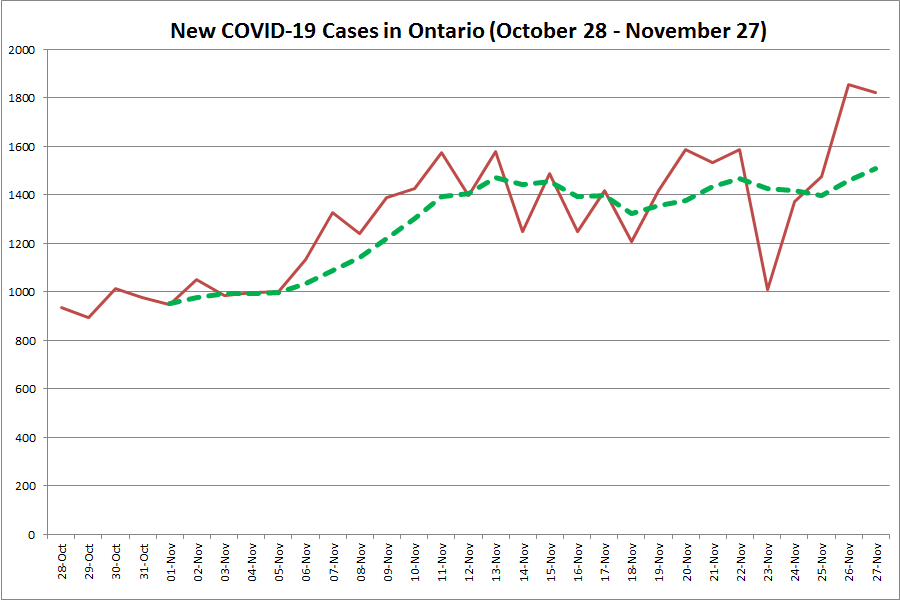
Ontario is reporting 1,822 new COVID-19 cases today, slightly less than yesterday’s record high of 1,855 cases. The average number of daily cases over the past seven days has increased by 34 to 1,523.
Most of the new cases reported today are in Toronto (566) and Peel (516), and York (145), with a substantial increase of cases in Waterloo (105) and Hamilton (102).
There have been double-digit increases in Halton (68), Windsor-Essex (57), Durham (48), Ottawa (46), Wellington-Dufferin-Guelph (25), Simcoe Muskoka (21), Niagara (21), Middlesex-London (20), Eastern Ontario Health Unit (13), Huron Perth (11), Thunder Bay (10), and Grey Bruce (10), with smaller increases in Southwestern Public Health (7) and Haldimand-Norfolk (6).
The remaining 15 health units are reporting 5 or fewer new cases, with 5 health units reporting no new cases at all.
Advertisement - content continues below
Of today’s cases, 52% are among people under 40 years of age, with the highest number of cases (688) among people ages 20 to 39 followed by 519 cases among people ages 40 to 59. With 1,510 more cases resolved since yesterday, the percentage of resolved cases remains unchanged at 84.8%. The Ontario government does not release the average positivity rate across Ontario on weekends.
Ontario reported 29 new COVID-19 deaths today, including 11 in long-term care facilities. Hospitalizations have increased by 54 to 595, with 4 additional patients with COVID-19 in ICUs and 2 fewer patients on ventilators. A total of 55,086 tests were completed yesterday, and the backlog of tests under investigation has increased by 1,978 to 56,219.
Hospitalizations due to COVID-19 have increased by 63.2 per cent over the past four weeks. (Graphic: Ontario COVID-19 Science Advisory Table)
In the greater Kawarthas region, there is one new case to report in Peterborough, with an additional 2 cases resolved.
Reports are not available on weekends for Hastings and Prince Edward counties, Northumberland, Kawartha Lakes, or Haliburton. On November 27, the Haliburton, Kawartha, Pine Ridge District Health Unit declared a workplace outbreak at Cameco Fuel Manufacturing on Dorset Street in Port Hope after a third employee tested positive for COVID-19.
There are currently 76 active cases in the greater Kawarthas region, including 31 in Hastings and Prince Edward counties, 22 in Peterborough, 14 in Northumberland, 4 in Haliburton, and 5 in Kawartha Lakes.
Since the pandemic began in the greater Kawarthas region, there have been 211 confirmed positive cases in the Peterborough area (184 resolved with 5 deaths), 197 in the City of Kawartha Lakes (173 resolved with 32 deaths), 79 in Northumberland County (64 resolved with 1 death), 28 in Haliburton County (24 resolved with no deaths), and 128 in Hastings and Prince Edward counties (92 resolved with 5 deaths). The most recent death was reported in Peterborough on November 23.
Province-wide, there have been 113,038 confirmed cases, an increase of 1,822 from yesterday, with 95,876 cases resolved (84.8% of all cases), an increase of 1,510 from yesterday. There have been 3,624 deaths, an increase of 29 from yesterday, with 2,294 deaths in long-term care homes, an increase of 11 from yesterday. The number of hospitalizations has increased by 54 to 595, with 4 additional patients with COVID-19 in ICUs and 2 fewer patients on ventilators. A total of 6,181,551 tests have been completed, an increase of 55,086 from yesterday, with 56,219 tests under investigation, an increase of 1,978 from yesterday.
The provincial data in this report is pulled from Ontario’s integrated Public Health Information System (iPHIS) at 12 p.m. the previous day. Data from local health units is more current and is usually reflected in the provincial data the following day. There may be discrepancies between the Ontario data reported today (which is from yesterday) and the local health unit data reported today (which is from today).
Peterborough Public Health’s service area is the City and County of Peterborough and the Hiawatha and Curve Lake First Nations.
The health unit provides daily reports, including on weekends.
Confirmed positive: 211 (increase of 1) Active cases: 22 (decrease of 1) Close contacts: 66 (no change) Deaths: 5 (no change) Resolved: 184 (increase of 2) Hospitalizations (total to date): 10 (no change)* Total tests completed: Over 36,600 (increase of 200) Institutional outbreaks: Fairhaven (no change)
*The health unit is no longer reporting the total number of hospitalizations.
Haliburton, Kawartha, Pine Ridge District Health Unit
The Haliburton, Kawartha, Pine Ridge District Health Unit’s service area is the City of Kawartha Lakes, Northumberland County, and Haliburton County.
The health unit provides reports from Monday to Friday, excluding statutory holidays. These numbers are from November 27.
Confirmed positive: 304, including 197 in Kawartha Lakes, 79 in Northumberland, 28 in Haliburton (increase of 6, including 2 in Kawartha Lakes, 3 in Northumberland, and 1 in Haliburton) Active cases: 23, including 5 in Kawartha Lakes, 14 in Northumberland, and 4 in Haliburton (no net change) Probable cases: 0 (no change) High-risk contacts: 88, including 11 in Kawartha Lakes, 71 in Northumberland, and 6 in Haliburton (increase of 22 in Northumberland) Hospitalizations (total to date): 16, including 11 in Kawartha Lakes, 4 in Northumberland, and 1 in Haliburton (no change) Deaths: 33 (no change) Resolved: 261, including 173 in Kawartha Lakes, 64 in Northumberland, 24 in Haliburton (increase of 6, including 1 in Kawartha Lakes, 4 in Northumberland, and 1 in Haliburton) Institutional outbreaks: None (no change)
Hastings Prince Edward Public Health
Hastings Prince Edward Public Health’s service area is Hastings County (including Bancroft) and Prince Edward County.
The health unit provides reports from Monday to Friday, excluding statutory holidays. These numbers are from November 27.
Confirmed positive: 128 (increase of 6) Active cases: 31 (increase of 4) Deaths: 5 (no change) Currently hospitalized: 1 (no change) Currently hospitalized and in ICU: 1 (no change) Currently hospitalized and in ICU on ventilator (total to date): 0 (no change) Resolved: 92 (increase of 2) New swabs completed: 2,626 (decrease of 2,991) Institutional outbreaks: None (no change)
Advertisement - content continues below
Province of Ontario
Confirmed positive: 113,038 (increase of 1,822) Resolved: 95,876 (increase of 1,510, 84.8% of all cases) Hospitalized: 595 (decrease of 54) Hospitalized and in ICU: 155 (increase of 4) Hospitalized and in ICU on ventilator: 99 (decrease of 2) Deaths: 3,624 (increase of 29) Deaths of residents in long-term care homes: 2,294 (increase of 11) Total tests completed: 6,181,551 (increase of 55,086) Tests under investigation: 56,219 (increase of 1,978)
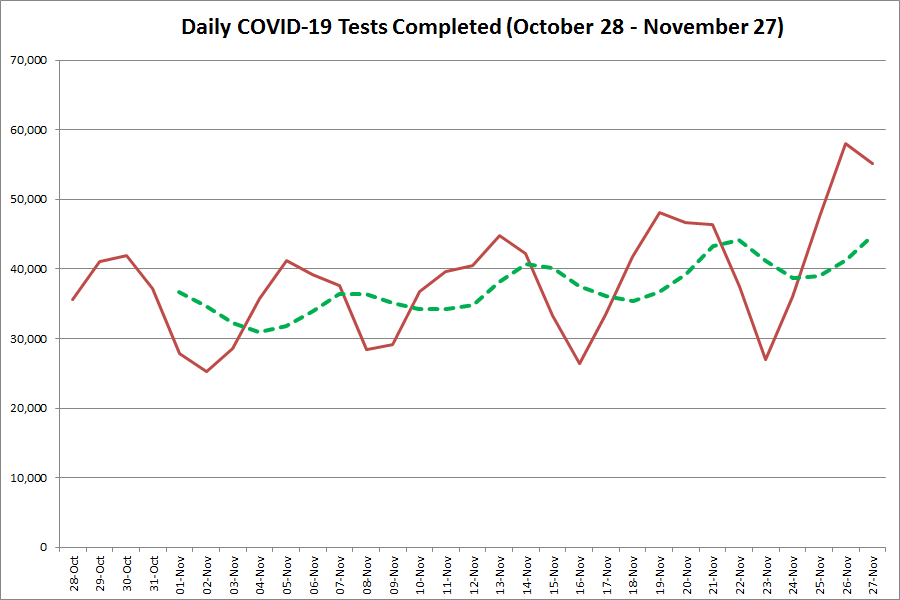
New COVID-19 cases in Ontario from October 28 – November 27, 2020. The red line is the number of new cases reported daily, and the dotted green line is a five-day moving average of new cases. (Graphic: kawarthaNOW.com)COVID-19 tests completed in Ontario from October 28 – November 27, 2020. The red line is the number of tests completed daily, and the dotted green line is a five-day moving average of tests completed. (Graphic: kawarthaNOW.com)
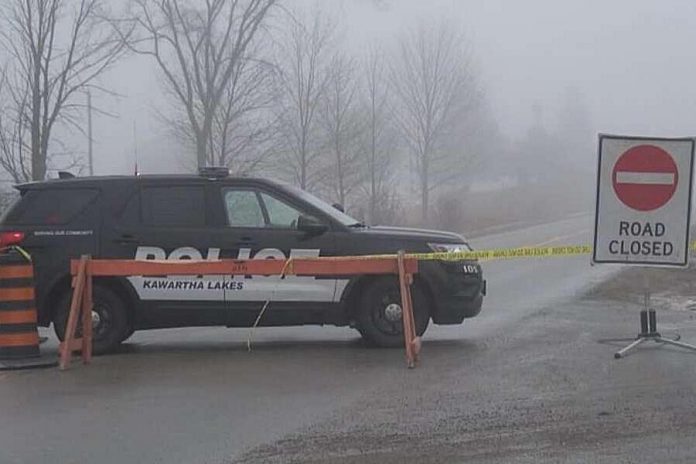
A Kawartha Lakes police vehicle blocks access to Pigeon Lake Road east of Lindsay after a police shooting on November 26, 2020 that resulting in a 33-year-old suspect and an OPP officer being seriously injured. The suspect's one-year-old son was found fatally shot in the man's pickup truck. (Photo: CBC)
Investigators with Ontario’s police watchdog have found a handgun in the pickup truck where a one-year-old boy died east of Lindsay on Thursday, according to an update released on Friday (November 27).
Police had opened fire on the driver of the truck, a 33-year-old suspect who had allegedly abducted the child, after the truck collided with an OPP cruiser and another vehicle, seriously injuring an OPP officer. The suspect was struck and airlifted to a Toronto hospital with serious injuries. No information has been released on the man’s condition.
Police later found the infant in the truck, dead of a gunshot wound. The province’s Special Investigations Unit (SIU) has not indicated whether the infant was killed by gunfire from police or from the handgun found in the truck.
A post-mortem on the child is scheduled for Saturday morning in Toronto. Along with the handgun from the truck, SIU investigators have collected three police-issued firearms. All four weapons will be examined at the Centre of Forensic Sciences in Toronto.
Advertisement - content continues below
“The SIU appreciates the public interest in this tragic case and is doing what it can to get answers to the public as quickly as possible while ensuring that the integrity of the investigation is not compromised,” the Friday update from the SIU reads. “We ask for the public’s continued patience.”
The tragedy unfolded early on Thursday morning, after police responded to a report of a domestic dispute involving a firearm and the alleged abduction of a child by his father at a home near Bobcaygeon in the Municipality of Trent Lakes.
Global News reports that one local resident said police chased a vehicle that sped away from the home, and another resident said three people came to his home looking for a safe haven.
According to the SIU, police located and attempted to stop the man’s pickup truck on Sturgeon Road in Kawartha Lakes but were unsuccessful. On Pigeon Lake Road, the truck collided with a police car and another vehicle.
A City of Kawartha Lakes OPP officer who was standing beside the police car was seriously injured in the collision. The officer is in a Toronto hospital in stable condition, according to the SIU.
Advertisement - content continues below
After the collision, there was an “interaction” between the driver and police officers, when three officers opened fire, striking the driver.
After police apprehended the injured man, his infant son was found in the pickup truck with a gunshot wound and was pronounced dead at the scene. According to the Canadian Press, the infant was in the backseat of the truck.
The SIU says the truck will be taken to the Centre of Forensic Sciences in Toronto for examination.
The SIU — a civilian agency that investigates death, serious injury or allegations of sexual assault in incidents involving the police — is urging anyone who may have information about this investigation to contact the lead investigator at 1-800-787-8529. The unit is also urging anyone who may have any video evidence related to this incident to upload that video through the SIU website at www.siu.on.ca.
This story has been updated to clarify wording about the infant’s death.
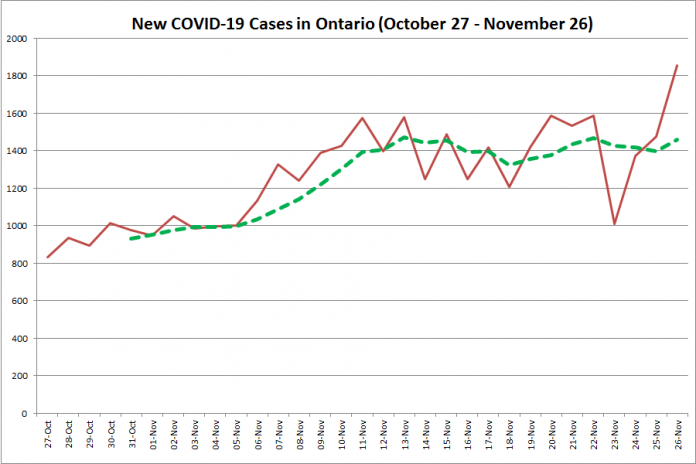
New COVID-19 cases in Ontario from October 27 - November 26, 2020. The red line is the number of new cases reported daily, and the dotted green line is a five-day moving average of new cases. (Graphic: kawarthaNOW.com)
Here’s an update on COVID-19 cases in Ontario as well as in the greater Kawarthas region.
Ontario is reporting a new record of 1,855 COVID-19 cases today, eclipsing by 267 the previous high of 1,588 reported on November 21. The average number of daily cases over the past seven days has increased by 62 to 1,489.
In the greater Kawarthas region, Hastings Prince Edward Public Health — which has reported 27 new cases in the past week with a local incidence rate of 16 cases per 100,000 people — will move into the province’s “Yellow-Protect” level effective 12:01 a.m. on Monday (November 30).
“The level of transmission in our region has increased quickly over the past week, requiring additional preventative measures,” says Dr. Piotr Oglaza, medical officer of health for Hastings Prince Edward Public Health. “To avoid further restrictions, I ask all residents to redouble their efforts at this critical time.”
With Peterborough Public Health having already moved to “Yellow-Protect”, only Haliburton, Kawartha, Pine Ridge District Health Unit — which has itself reported 26 cases over the past week, including 6 today — remains (for now) in the least restrictive “Green-Prevent” level.
Advertisement - content continues below
Most of the new cases reported today are in Peel (517), Toronto (494), York (189), and Halton (130), with double-digit increases in Hamilton (82), Waterloo (74), Durham (65), Ottawa (55), Windsor-Essex (52), Simcoe Muskoka (38), Wellington-Dufferin-Guelph (27), Niagara (20), Brant County (16), Huron Perth (14), Grey Bruce (11), Haldimand-Norfolk (11), Middlesex-London (10), and Southwestern Public Health (10), and smaller increases in Eastern Ontario Health Unit (9) and Haliburton, Kawartha, Pine Ridge District Health Unit (6).
The remaining 14 health units are reporting 5 or fewer new cases, with 4 health units reporting no new cases at all.
Of today’s cases, 52% are among people under 40 years of age, with the highest number of cases (686) among people ages 20 to 39 followed by 564 cases among people ages 40 to 59. With 1,451 more cases resolved since yesterday, the percentage of resolved cases has decreased by 0.2% to 84.8%. The average positivity rate across Ontario has decreased by 0.2% to 3.7%, meaning that 37 out of every 1,000 tests performed were positive for COVID-19 on November 26.
Ontario reported 20 new COVID-19 deaths today, including 13 in long-term care facilities. Hospitalizations have decreased by 15 to 541, with no change in the number of patients with COVID-19 in ICUs and 4 fewer patients on ventilators. A total of 58,037 tests were completed yesterday, and the backlog of tests under investigation has increased by 1,389 to 54,241.
There are 122 new cases in Ontario schools to report today, an increase of 34 from yesterday, with 99 student cases and 23 staff cases. There are 15 cases in licensed child care settings, an increase of 3 from yesterday, with 11 cases among children and 4 cases among staff.
Advertisement - content continues below
In the greater Kawarthas region, there are 18 new cases to report, including 6 in Peterborough, 6 in Hastings and Prince Edward counties, 3 in Northumberland, 2 in Kawartha Lakes, and 1 in Haliburton.
An additional 4 cases have been resolved in Peterborough, 4 in Northumberland, 2 in Hastings and Prince Edward, and 1 each in Kawartha Lakes and Haliburton.
Of the new cases in Ontario schools, 1 confirmed staff case has been reported at East Northumberland Secondary School in Brighton and 1 confirmed student case has been reported at Hillcrest Public School in Trent Hills.
There are currently 77 active cases in the greater Kawarthas region, including 31 in Hastings and Prince Edward counties, 23 in Peterborough, 14 in Northumberland, 4 in Haliburton, and 5 in Kawartha Lakes.
Since the pandemic began in the greater Kawarthas region, there have been 210 confirmed positive cases in the Peterborough area (182 resolved with 5 deaths), 197 in the City of Kawartha Lakes (173 resolved with 32 deaths), 79 in Northumberland County (64 resolved with 1 death), 28 in Haliburton County (24 resolved with no deaths), and 128 in Hastings and Prince Edward counties (92 resolved with 5 deaths). The most recent death was reported in Peterborough on November 23.
Since the pandemic began in the greater Kawarthas region, there have been 204 confirmed positive cases in the Peterborough area (178 resolved with 5 deaths), 197 in the City of Kawartha Lakes (173 resolved with 32 deaths), 79 in Northumberland County (64 resolved with 1 death), 28 in Haliburton County (24 resolved with no deaths), and 128 in Hastings and Prince Edward counties (92 resolved with 5 deaths). The most recent death was reported in Peterborough on November 23.
Province-wide, there have been 111,216 confirmed cases, an increase of 1,855 from yesterday, with 94,366 cases resolved (84.8% of all cases), an increase of 1,451 from yesterday. There have been 3,595 deaths, an increase of 20 from yesterday, with 2,283 deaths in long-term care homes, an increase of 13 from yesterday. The number of hospitalizations has decreased by 15 to 541, with no change in the number of patients with COVID-19 in ICUs and 4 fewer patients on ventilators. A total of 6,126,465 tests have been completed, an increase of 58,037 from yesterday, with 54,241 tests under investigation, an increase of 1,389 from yesterday.
The provincial data in this report is pulled from Ontario’s integrated Public Health Information System (iPHIS) at 12 p.m. the previous day. Data from local health units is more current and is usually reflected in the provincial data the following day. There may be discrepancies between the Ontario data reported today (which is from yesterday) and the local health unit data reported today (which is from today).
Peterborough Public Health’s service area is the City and County of Peterborough and the Hiawatha and Curve Lake First Nations.
The health unit provides daily reports, including on weekends.
Confirmed positive: 210 (increase of 6) Active cases: 23 (increase of 2) Close contacts: 66 (decrease of 1) Deaths: 5 (no change) Resolved: 182 (increase of 4) Hospitalizations (total to date): 10 (no change)* Total tests completed: Over 36,400 (no change) Institutional outbreaks: Fairhaven (no change)
*The health unit is no longer reporting the total number of hospitalizations.
Haliburton, Kawartha, Pine Ridge District Health Unit
The Haliburton, Kawartha, Pine Ridge District Health Unit’s service area is the City of Kawartha Lakes, Northumberland County, and Haliburton County.
The health unit provides reports from Monday to Friday, excluding statutory holidays.
Confirmed positive: 304, including 197 in Kawartha Lakes, 79 in Northumberland, 28 in Haliburton (increase of 6, including 2 in Kawartha Lakes, 3 in Northumberland, and 1 in Haliburton) Active cases: 23, including 5 in Kawartha Lakes, 14 in Northumberland, and 4 in Haliburton (no net change) Probable cases: 0 (no change) High-risk contacts: 88, including 11 in Kawartha Lakes, 71 in Northumberland, and 6 in Haliburton (increase of 22 in Northumberland) Hospitalizations (total to date): 16, including 11 in Kawartha Lakes, 4 in Northumberland, and 1 in Haliburton (no change) Deaths: 33 (no change) Resolved: 261, including 173 in Kawartha Lakes, 64 in Northumberland, 24 in Haliburton (increase of 6, including 1 in Kawartha Lakes, 4 in Northumberland, and 1 in Haliburton) Institutional outbreaks: None (no change)
Hastings Prince Edward Public Health
Hastings Prince Edward Public Health’s service area is Hastings County (including Bancroft) and Prince Edward County.
The health unit provides reports from Monday to Friday, excluding statutory holidays.
Confirmed positive: 128 (increase of 6) Active cases: 31 (increase of 4) Deaths: 5 (no change) Currently hospitalized: 1 (no change) Currently hospitalized and in ICU: 1 (no change) Currently hospitalized and in ICU on ventilator (total to date): 0 (no change) Resolved: 92 (increase of 2) New swabs completed: 2,626 (decrease of 2,991) Institutional outbreaks: None (no change)
Advertisement - content continues below
Province of Ontario
Confirmed positive: 111,216 (increase of 1,855) Resolved: 94,366 (increase of 1,451, 84.8% of all cases) Hospitalized: 541 (decrease of 15) Hospitalized and in ICU: 151 (no change) Hospitalized and in ICU on ventilator: 101 (decrease of 4) Deaths: 3,595 (increase of 20) Deaths of residents in long-term care homes: 2,283 (increase of 13) Total tests completed: 6,126,465 (increase of 58,037) Tests under investigation: 54,241 (increase of 1,389)
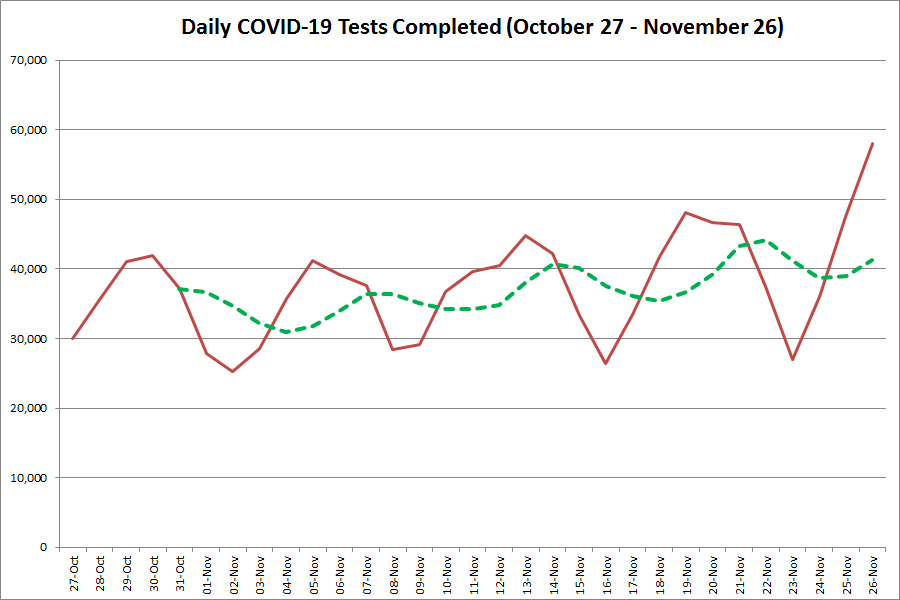
New COVID-19 cases in Ontario from October 27 – November 26, 2020. The red line is the number of new cases reported daily, and the dotted green line is a five-day moving average of new cases. (Graphic: kawarthaNOW.com)COVID-19 tests completed in Ontario from October 27 – November 26, 2020. The red line is the number of tests completed daily, and the dotted green line is a five-day moving average of tests completed. (Graphic: kawarthaNOW.com)
City of Peterborough staff are recommending the Evinrude Centre be renamed the Healthy Planet Arena, and are asking city council to bypass the city’s existing policy on naming rights in doing so.
Health and wellness retail chain Healthy Planet Canada is willing to pay $240,000 for a 10-year term of the naming rights for the Monaghan Road arena.
At its general committee meeting on Tuesday (December 1), city council will consider a report from staff that recommends council approve the sponsorship agreement with Healthy Planet outside of a request for proposals (RFP).
Advertisement - content continues below
The city’s policy on sponsorship, naming rights and advertising requires an RFP be issued either for an arrangement that is a naming right for a city building or when the value of the naming right is greater than $150,000 — both of which apply to the proposed sponsorship agreement with Healthy Planet.
“City staff are recommending approval of this naming rights opportunity outside of an RFP process,” reads the report from chief administrative officer Sandra Clancy. “Requests for Proposals are not typically done in the sponsorship sector where the selling of sponsorships is normally achieved through extensive conversations and relationship building, culminating in achieving a commitment for a long-term association with an asset when the fit is right for both the sponsor and the property owner (the City).”
The report adds that city staff are reviewing the city’s policy and will be bringing forward recommendations to update the policy’s RFP requirement.
The report says city staff had “in-depth conversations” with around 12 potential sponsors for the naming rights for the Evinrude Centre. Healthy Planet became a corporate sponsor with the city at the beginning of 2019. The company began conversations with city staff in September 2019 to “grow its existing sponsorship relationship”, according to the report.
Healthy Planet is a Canadian family-owned health and wellness retailer that began as a kiosk in a strip mall on Toronto’s Danforth Avenue in 1995 selling nutritional supplements. Since then, it has grown to operate 28 retail locations in Ontario, including a store in Brookdale Plaze in Peterborough that opened in 2018. The retailer now sells vitamins, health foods, supplements, and bath and beauty products.
“It is seeking the ability to target high-traffic facilities and engage with an active, recreation-minded community audience,” the report states, referring to Healthy Planet. “The arena naming right is a strong fit with its audience and product offering. City staff recommend this naming rights opportunity as a good fit for a sponsorship of a community recreation facility by a retail business that specializes in health and wellness products.”
Advertisement - content continues below
The Arenas, Parks and Recreation Advisory Committee has endorsed the sponsorship opportunity with Healthy Planet, according to the report.
The city already has arena pad naming rights agreements at the twin-pad Evinrude Centre, with Leon’s Peterborough and Freedom Mobile.
The report to council notes the $240,000 in revenue from the 10-year sponsorship agreement with Healthy Planet would be allocated to “the associated program areas to support their services and facilities”.
The Evinrude Centre is named after the boat motor brand produced in Peterborough by the Outboard Marine Corporation from 1928 until 1990. The city purchased the property at at 911 Monaghan Road from Outboard Marine for $300,000 in 1995 for the construction of the arena.
The report says the city “does not have a commitment to keep the current name indefinitely” and would recognize the history of Outboard Marine on that property through a plaque in the arena. The city is also considering other opportunities to display the history of the Outboard Marine workforce in the facility.
Here’s an update on COVID-19 cases in Ontario as well as in the greater Kawarthas region.
Ontario is reporting 1,478 new COVID-19 cases today, with the average number of daily cases over the past seven days increasing by 38 to 1,427. Health units in in the greater Kawarthas region are reporting 10 new cases today, with the number of active cases rising to 71.
Most of the new cases reported today are in Peel (572), Toronto (356), and York (111), with double-digit increases in Waterloo (64), Hamilton (59), Durham (47), Windsor-Essex (42), Halton (36), Wellington-Dufferin-Guelph (29), Ottawa (24), Niagara (23), Simcoe Muskoka (18), Middlesex-London (14), and Huron Perth (11).
Advertisement - content continues below
There are smaller increases in Eastern Ontario Health Unit (9), Grey Bruce (9), Hastings Prince Edward Public Health (7), Haliburton, Kawartha, Pine Ridge District Health Unit (7), Kingston, Frontenac and Lennox & Addington (7), Southwestern Public Health (7), and Brant County (6).
The remaining 13 health units are reporting 5 or fewer new cases, with 5 health units reporting no new cases at all.
Of today’s cases, 51% are among people under 40 years of age, with the highest number of cases (542) among people ages 20 to 39 followed by 434 cases among people ages 40 to 59. With 1,365 more cases resolved since yesterday, the percentage of resolved cases has increased by 0.1% to 85.0%. The average positivity rate across Ontario has decreased by 0.8% to 3.9%, meaning that 39 out of every 1,000 tests performed were positive for COVID-19 on November 25.
Ontario reported 21 new COVID-19 deaths today, including 14 in long-term care facilities. Hospitalizations have increased by 33 to 556, with 8 fewer patients with COVID-19 in ICUs and but 1 less patient on a ventilator. A total of 47,576 tests were completed yesterday, and the backlog of tests under investigation has increased by 7,902 to 52,852.
There are 88 new cases in Ontario schools to report today, a decrease of 74 from yesterday, with 70 student cases and 18 staff cases. There are 12 cases in licensed child care settings, a decrease of 10 from yesterday, with 6 cases among children and 6 cases among staff.
Advertisement - content continues below
In the greater Kawarthas region, there are 10 new cases to report, including 4 in Peterborough, 3 in Northumberland, 2 in Hastings and Prince Edward counties, and 1 in Kawartha Lakes. There are no new cases in Haliburton.
Three additional cases have been resolved in Hastings and Prince Edward counties and 1 additional case has been resolved in Peterborough. None of the reported new cases in Ontario schools and child care settings are in the greater Kawarthas region.
There are currently 71 active cases in the greater Kawarthas region, including 27 in Hastings and Prince Edward counties, 21 in Peterborough, 15 in Northumberland, 4 in Haliburton, and 4 in Kawartha Lakes.
Since the pandemic began in the greater Kawarthas region, there have been 204 confirmed positive cases in the Peterborough area (178 resolved with 5 deaths), 195 in the City of Kawartha Lakes (172 resolved with 32 deaths), 76 in Northumberland County (60 resolved with 1 death), 27 in Haliburton County (23 resolved with no deaths), and 122 in Hastings and Prince Edward counties (90 resolved with 5 deaths). The most recent death was reported in Peterborough on November 23.
Province-wide, there have been 109,361 confirmed cases, an increase of 1,478 from yesterday, with 92,915 cases resolved (85.0% of all cases), an increase of 1,365 from yesterday. There have been 3,575 deaths, an increase of 21 from yesterday, with 2,270 deaths in long-term care homes, an increase of 14 from yesterday. The number of hospitalizations has increased by 33 to 556, with 8 fewer patients with COVID-19 in ICUs and but 1 less patient on a ventilator. A total of 6,068,428 tests have been completed, an increase of 47,576 from yesterday, with 52,852 tests under investigation, an increase of 7,902 from yesterday.
The provincial data in this report is pulled from Ontario’s integrated Public Health Information System (iPHIS) at 12 p.m. the previous day. Data from local health units is more current and is usually reflected in the provincial data the following day. There may be discrepancies between the Ontario data reported today (which is from yesterday) and the local health unit data reported today (which is from today).
Peterborough Public Health’s service area is the City and County of Peterborough and the Hiawatha and Curve Lake First Nations.
The health unit provides daily reports, including on weekends.
Confirmed positive: 204 (increase of 4) Active cases: 21 (increase of 3) Close contacts: 67 (increase of 1) Deaths: 5 (no change) Resolved: 178 (increase of 1) Hospitalizations (total to date): 10 (no change)* Total tests completed: Over 36,400 (increase of 100) Institutional outbreaks: Fairhaven (no change)
*The health unit is no longer reporting the total number of hospitalizations.
Haliburton, Kawartha, Pine Ridge District Health Unit
The Haliburton, Kawartha, Pine Ridge District Health Unit’s service area is the City of Kawartha Lakes, Northumberland County, and Haliburton County.
The health unit provides reports from Monday to Friday, excluding statutory holidays.
Confirmed positive: 298, including 195 in Kawartha Lakes, 76 in Northumberland, 27 in Haliburton (increase of 4, including 1 in Kawartha Lakes and 3 in Northumberland) Active cases: 23, including 4 in Kawartha Lakes, 15 in Northumberland, and 4 in Haliburton (net increase of 4) Probable cases: 0 (no change) High-risk contacts: 66, including 11 in Kawartha Lakes, 49 in Northumberland, and 6 in Haliburton (net increase of 25) Hospitalizations (total to date): 16, including 11 in Kawartha Lakes, 4 in Northumberland, and 1 in Haliburton (no change) Deaths: 33 (no change) Resolved: 255, including 172 in Kawartha Lakes, 60 in Northumberland, 23 in Haliburton (no change) Institutional outbreaks: None (no change)
Hastings Prince Edward Public Health
Hastings Prince Edward Public Health’s service area is Hastings County (including Bancroft) and Prince Edward County.
The health unit provides reports from Monday to Friday, excluding statutory holidays.
Confirmed positive: 122 (increase of 2) Active cases: 27 (decrease of 1) Deaths: 5 (no change) Currently hospitalized: 1 (no change) Currently hospitalized and in ICU: 1 (no change) Currently hospitalized and in ICU on ventilator (total to date): 0 (no change) Resolved: 90 (increase of 3) New swabs completed: 5,617 (increase of 1,486) Institutional outbreaks: None (no change)
Advertisement - content continues below
Province of Ontario
Confirmed positive: 109,361 (increase of 1,478) Resolved: 92,915 (increase of 1,365, 85.0% of all cases) Hospitalized: 556 (increase of 33) Hospitalized and in ICU: 151 (decrease of 8) Hospitalized and in ICU on ventilator: 105 (decrease of 1) Deaths: 3,575 (increase of 21) Deaths of residents in long-term care homes: 2,270 (increase of 14) Total tests completed: 6,068,428 (increase of 47,576) Tests under investigation: 52,852 (increase of 7,902)
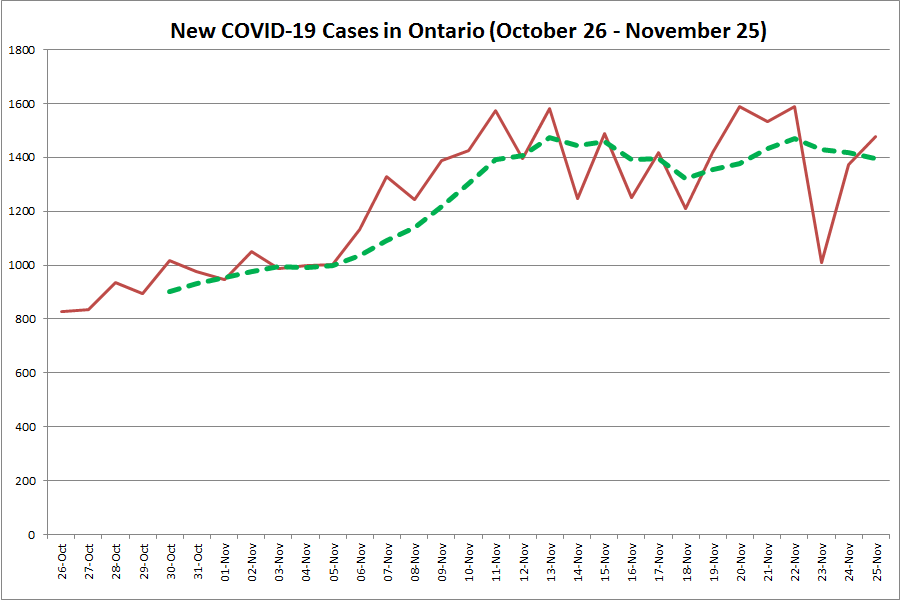
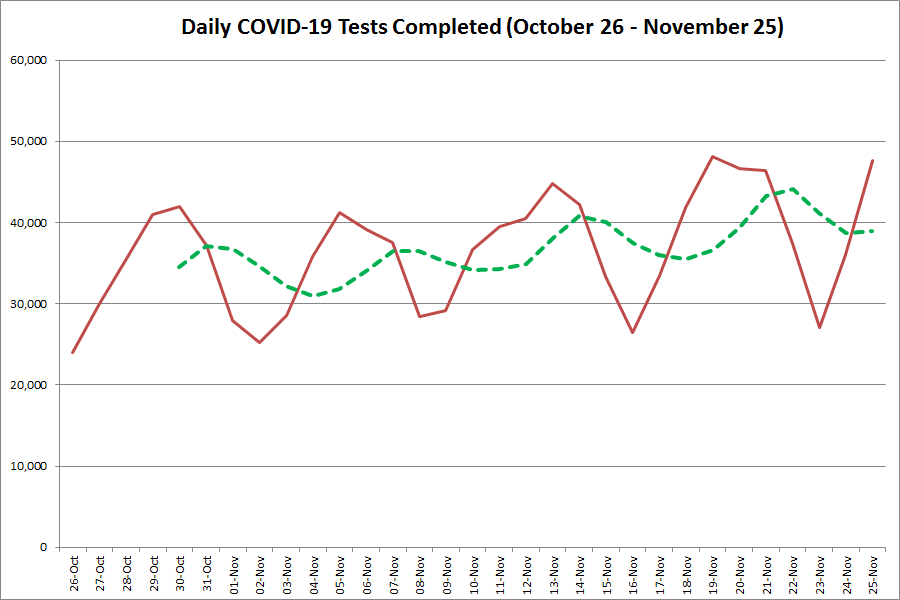
New COVID-19 cases in Ontario from October 26 – November 25, 2020. The red line is the number of new cases reported daily, and the dotted green line is a five-day moving average of new cases. (Graphic: kawarthaNOW.com)COVID-19 tests completed in Ontario from October 26 – November 25, 2020. The red line is the number of tests completed daily, and the dotted green line is a five-day moving average of tests completed. (Graphic: kawarthaNOW.com)
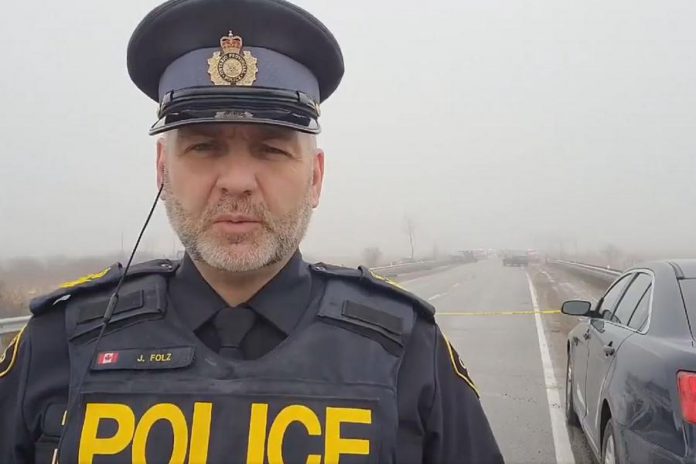
Kawartha Lakes OPP Sgt. Jason Folz in a Facebook video advising of the critical incident on the morning of November 26, 2020 on Pigeon Lake Road near Lindsay. It was later revealed that a young boy died and an OPP officer was seriously injured during the incident. A suspect has been apprehended and there are no concerns for public safety. (Screenshot)
A young boy is dead and an OPP officer has been seriously injured following an incident near Lindsay on Thursday morning (November 26).
The incident, which occurred on Pigeon Lake Road (Kawartha Lakes Road 17), is now under investigation by the province’s Special Investigations Unit (SIU).
“As a result of an interaction between a man and police, the man was shot and a police officer was seriously injured,” the SIU tweeted. “A young boy is deceased. More information to come later.”
Advertisement - content continues below
According to a tweet from OPP Commissioner Thomas Carrique, a suspect was apprehended and there are no concerns for public safety. Carrique also later tweeted the injured officer is in stable condition and receiving medical care.
Both the OPP and the SIU have released media releases with further details about the incident.
According to the OPP media release, at around 8:48 a.m. on Thursday morning, Peterborough County OPP responded to a call for service in the Municipality of Trent Lakes related to a domestic dispute involving a firearm.
When officers from Kawartha Lakes OPP attempted to stop the vehicle involved in the dispute on Pigeon Lake Road, the vehicle collided with an OPP cruiser. Police say an altercation then occurred between the man driving the vehicle and officers.
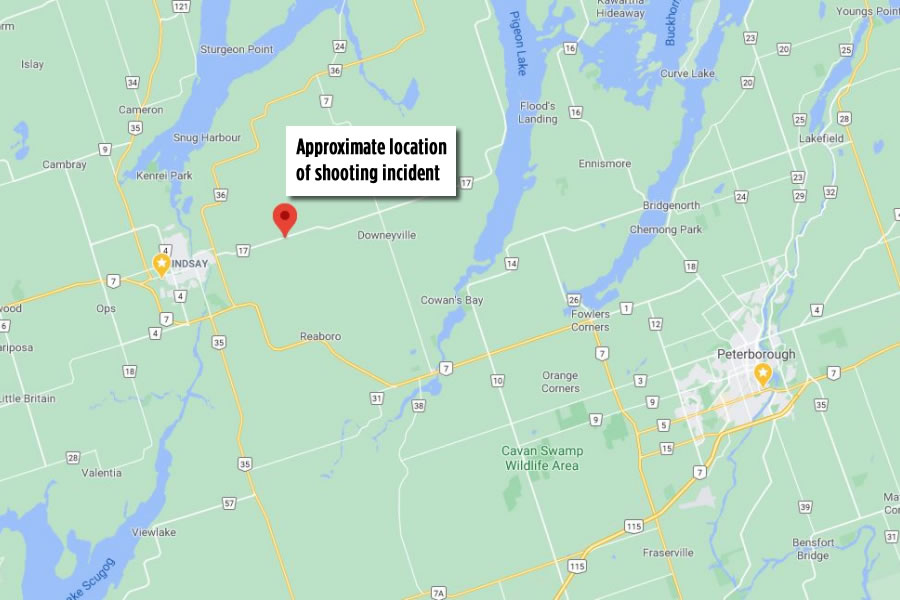
The incident occurred east of Lindsay on Pigeon Lake Road between Heights Road and Settlers Road. (Google Maps)
“The male was apprehended, with the assistance of members of the Kawartha Lakes Police Service,” the media release states. “This male was transported to a Toronto area trauma centre with serious injuries.”
A Kawartha Lakes OPP officer was also seriously injured during the incident and is being treated in Toronto.
Police state a child died at the scene as a result of the incident. The OPP media release provides no details of the nature of the altercation between the man and officers, how the officer was injured, the relationship of the child who died to the suspect, or how the child died.
Advertisement - content continues below
However, a media release issued by SIU provides further details.
According to the SIU, the OPP were responding to a report that a 33-year-old man had abducted his one-year-old son from the Municipality of Trent Lakes.
A short time later, the OPP located the man’s pickup truck on Sturgeon Road in the City of Kawartha Lakes and unsuccessfully attempted to stop the truck. On Pigeon Lake Road, the truck became involved in a collision with an OPP cruiser and a civilian vehicle. At that time, an OPP officer was standing outside of the cruiser and he sustained serious injuries.
“An interaction ensued between the 33-year-old vehicle driver and officers, and three officers discharged their firearms,” the SIU states. “The man was struck and airlifted to the hospital in grave condition.”
SIU investigating incident in the City of Kawartha Lakes. As a result of an interaction between a man and police, the man was shot and a police officer was seriously injured. A young boy is deceased. More information to come later.
The SIU states the one-year-old boy was inside the pickup truck and sustained a gunshot wound. He was pronounced dead at the scene.
At a media conference on Thursday afternoon, Monica Hudon with the SIU said it is unclear if the gunshot that killed the child came from the three officers.
“It’s too early for us to know why officers fired at the vehicle,” Hudson said. “And it’s too early for us to know exactly what transpired.”
The SIU is a civilian agency that investigates death, serious injury or allegations of sexual assault in incidents involving the police. Four investigators, two forensic investigators. and one collision reconstructionist from the SIU have been assigned to the case. At this time, three subject officers have been designated.
The SIU is urging anyone who may have information about this investigation to contact the lead investigator at 1-800-787-8529. Anyone who may have any video evidence related to this incident is asked to upload that video through the SIU website at www.siu.on.ca.
This story has been updated with further details from media releases issued by the OPP and the SIU.
kawarthaNOW.com offers two enews options to help readers stay in the know. Our VIP enews is delivered weekly every Wednesday morning and includes exclusive giveaways, and our news digest is delivered daily every morning. You can subscribe to one or both.
Submit your event for FREE!
Use our event submission form to post your event on our website — for free.
To submit editorial content or ideas, please contact us.