




















Home Blog Page 616

10 things you may not know about trilliums

The white trillium (trillium grandiflorum) is Ontario's official floral emblem. Although the trillium is a perennial plant, as a spring ephemeral it's very fragile, which is why picking it is a bad idea. It takes up to 10 years before the plant produces its first bloom, which lasts for around three weeks in the early spring. (Photo: Ontario Parks)

Trilliums are in bloom in forests and woodlands across Ontario, so expect to see many photos of the memorable flower across social media.

People are most familiar with the white trillium (trillium grandiflorum), which is Ontario’s official flower, but there are actually 50 species of trillium native to temperate regions of North America and Asia.

Here are 10 things you may not know about trilliums:


1. Trillium roots were once used to treat wounds and during childbirth

The trillium is also known as birthroot or birthwort, because of how the plants were used medicinally.

The roots of several species contain chemical compounds called sapogenins that act as astringents, antiseptics, coagulants, expectorants, and uterine stimulants. North America’s indigenous peoples used the roots to treat open wounds and inflammation, and during childbirth.

Another name for the trillium is the wakerobin — because the flowers appear in early spring before robins begin to appear.

The “tri” in the Latin word trillium means three, referring to the plant’s three leaves, three petals, and three stigmas (pollen receptors) in the flower.


2. If you pick a trillium bloom, the plant may not survive

Although the trillium is a perennial plant, as a spring ephemeral it’s very fragile.

The trillium blooms for a few weeks in the early spring, before the trees grow leaves, so it can get more sunlight. During this time, it collects all the nutrients in needs to survive until the following year.

If you pick the bloom, the plant won’t be able to collect sunlight and nutrients and it may take years to recover — or it may never recover.

Advertisement - content continues below


There’s a pervasive myth that it’s against the law in Ontario to pick trilliums.

The reasons for this belief may be because the trillium is Ontario’s official flower, or because picking the bloom can damage or kill the plant, or maybe because the removal of any vegetation is prohibited in Ontario provincial parks (where trilliums are often found).

In 2009, it did almost became illegal to pick trilliums in Ontario. That’s when former Peterborough-Kawartha MPP and rural affairs minister Jeff Leal introduced a private members’ bill called the Ontario Trillium Protection Act.

That legislation would have made it illegal to pick or dig up the white trillium. Doing so would have resulted in a minimum $500 fine. However, although the bill passed first reading, it never became law.


4. The trillium became Ontario’s official floral emblem in 1937

On March 25, 1937, the Province of Ontario chose the trillium as its official floral emblem (official flower).

The Floral Emblem Act contains a single line: “The flower known botanically as the trillium grandiflorum and popularly known as the white trillium is the floral emblem of the Province of Ontario.”

During the First World War, there was a movement for Canada to choose a national floral emblem — a flower that could be planted on the graves of Canadian servicemen overseas.

A special committee of botanists to the Ontario Horticultural Association recommended the trillium be selected as the national floral emblem. A national flower was never chosen, but Ontario subsequently adopted the trillium for its own provincial flower.

Advertisement - content continues below


5. The trillium has been the Ontario government’s official logo since 1964

A stylized version of the trillium has been the Ontario government’s official logo since 1964, when it was first created by the Progressive Conservative government of John Robarts.

The original trillium symbol and logotype — an “O” for Ontario with a stylized trillium inside it — was designed by Norman B. Hathaway and Wolfgang Letzin of former Toronto design firm Hathaway-Templeton.

An updated version was designed by Ernst Barenscher at Norman B. Hathaway Associates in 1972, at the request of the Progressive Conservative government of Bill Davis.

The Ontario government's trillium logo when it was created in 1964, when it was changed to the much-maligned "three men in a hot tub" version in 2006, and as it appears today.
The Ontario government’s trillium logo when it was created in 1964, when it was changed to the much-maligned “three men in a hot tub” version in 2006, and as it appears today.

Over the next 24 years, the logo pretty much remained the same. Then, in 2006, the Liberal government of Dalton McGuinty completely revamped the logo.

The new logo quickly became known as the “three men in a hot tub” logo — once you see it, you can’t unsee it — and was widely criticized both for its design and cost.

In 2019, the Progressive Conservative government of Doug Ford restored the logo to its original design with some variations.


6. Trilliums have a symbiotic relationship with ants

The seeds of the trillium are mainly distributed by ants, which are attracted to a fleshy structure attached to the seeds called the elaiosome.

The elaiosome is rich with nutrients, which the ants eat after they carry the seeds back to their nests.

The ants then discard the elaiosome-free seeds, either leaving them inside the earth (which protects the seeds from predators) or by ejecting them from their nests. The seeds eventually germinate and sprout into new plants.

This method of seed dispersal by ants is not unique to trilliums — it’s called myrmecochory and is used by many flowering plant species.

Advertisement - content continues below


7. White-tailed deer love to eat trilliums — especially the white ones

As any gardener in cottage country knows, white-tailed deer love to eat flowers and the trillium is no exception.

The large patches of trilliums that appear in Ontario woodlands in early spring make them a favourite food of the deer.

White-tailed deer are especially partial to the white trillium. They generally only eat the larger flowers, leaving smaller ones behind. The deer also help to disperse trillium seeds, but at much greater distances than ants.

In fact, many Ontario provincial parks use annual trillium surveys to understand the population density of white-tailed deer and their effect on the understory.


8. It takes a trillium plant up to 10 years to produce its first flower

Trilliums are very slow-growing plants.

The plant’s seeds normally take at least two years to fully germinate, with the plant itself taking between seven to 10 years to reach flowering size.

After the plant produces its first flower, it will bloom annually in early spring, with the bloom lasting for around three weeks.

Trilliums are phototropic plants, meaning that the blooms will bend towards the sun as it moves across the sky.

After the first bloom, a trillium will live another 10 to 13 years — but only if you don’t damage them.

Advertisement - content continues below


9. The drooping trillium is an endangered species in Ontario

There are five native trillium species found in Ontario — the white trillium, red trillium, pinted trillium, nodding trillium, and drooping trillium — but only the latter is endangered.

In Canada, drooping trillium only grows in southwestern Ontario in the warmer climate of the Carolinian forest. There were once six known locations in the province, but today there are only two: along the Sydenham River in Middlesex County and along the Thames River in Elgin County.

The greatest threat to the drooping trillium is habitat loss and degradation caused by urban development, or habitat alteration and damage due to recreational activities such as hiking and ATV use.


10. Trilliums can be infected by a virus-like bacteria

If you find a trillium with swaths of green colour in its petals, this means the plant is infected by a kind of bacterial parasite called a phytoplasma. Phytoplasmas spread like a virus, usually transmitted by sap-sucking insects or through infected seeds, and will kill the plant after several years.

Phytoplasmas were discovered in 1967 by Japanese scientists, and are the plant and insect versions of mycoplasmas. Mycoplasmas are a genus of pathogenic bacteria that lack a cell wall around their cell membranes. A species of mycoplasma is a significant cause of “walking” pneumonia in humans.


An earlier version of this story was published on May 23, 2020.

Ontario reports 3,369 new COVID-19 cases, including 27 in greater Kawarthas region

Here’s an update on COVID-19 cases in Ontario as well as in the greater Kawarthas region.

With less than three weeks before the stay-at-home order is set to expire, Ontario is reporting 3,369 new cases today, including 1,050 in Toronto and triple-digit increases in 7 other health units. However, the seven-day average of daily cases continues to decrease, falling by 104 today to 3,618.

There are 3,482 more cases of the B.1.1.7 UK variant, 6 more cases of the B.1.351 South Africa, and 127 new cases of the P.1 Brazilian variant.

Hospitalizations continue to slowly decrease, but ICU admissions now stand at a record high of 900. Ontario Hospital Association president and CEO Anthony Dale told CBC News today hospitals are “fighting every day” to avoid implementing a triage protocol — when health-care providers have to decide who receives treatment and who doesn’t.

Ontario is reporting 29 deaths today, with no deaths in long-term care homes and the seven-day average of new deaths unchanged at 27.

In the greater Kawarthas region, there are 27 new cases to report (including 9 in Peterborough, 8 in Hastings Prince Edward, 8 in Kawartha Lakes, and 2 in Northumberland) and an additional 28 cases resolved, with the number of active cases increasing by 1 to 250.

Advertisement - content continues below


Most of the new cases reported today are in Toronto (1,050), Peel (819), York (286), Ottawa (158), Durham (157), Hamilton (132), Halton (127), and Middlesex-London (107).

There are double-digit increases reported today in Waterloo (90), Niagara (89), Simcoe Muskoka (71), Wellington-Dufferin-Guelph (42), Windsor-Essex (41), Haldimand-Norfolk (26), Eastern Ontario (21), Sudbury (19), Southwestern (17), Porcupine (16), Leeds, Grenville & Lanark (16), Lambton (12), Brant (11), and Hastings Prince Edward (10), with smaller increases in Kingston, Frontenac and Lennox & Addington (9), Northwestern (7), Haliburton, Kawartha, Pine Ridge (7), Grey Bruce (7), and Huron Perth (6).

The remaining 7 health units are reporting 5 or fewer new cases, with all health units reporting at least 1 case.

Of today’s new cases, 61% are among people 39 and younger, with the highest number of cases (1,431) among people ages 20-39 followed by 913 cases among people ages 40-59 and 627 cases among people 19 and under.

With 3,964 more cases resolved since yesterday, the percentage of resolved cases has increased by 0.2% to at 90.2% — the 12th straight day the percentage of resolved cases has increased. The average positivity rate across Ontario has decreased by 0.1% to 7.3%, meaning that 73 out of every 1,000 tests performed were positive for COVID-19 on April 30. The average number of new variants of concern infections caused by a single infected individual has fallen by 0.04 to 0.89.

Ontario is reporting 29 new COVID-19 deaths today, with no new deaths in long-term care homes. Ontario has averaged 27 new daily deaths over the past week (no change from yesterday).

The number of hospitalizations has decreased by 49 to 2,152, but the number of patients with COVID-19 in ICUs has increased by 17 to a record high of 900, with the number of patients with COVID-19 on ventilators increasing by 5 to 637.

A total of 46,803 tests were completed yesterday, with the backlog of tests under investigation decreasing by 2,473 to 26,530.

A total of 5,247,684 doses of vaccine have now been administered, an increase of 107,700 from yesterday, with 373,559 people fully vaccinated with both doses of vaccine, an increase of 2,449 from yesterday.

The number of fully vaccinated people represents 2.54% of Ontario’s population, an increase of 0.02% from yesterday, with fully and partially vaccinated people representing 35.62% of the population, an increase of 0.73% from yesterday. An estimated 70-90% of the population must be immunized to achieve herd immunity.

Advertisement - content continues below


In the greater Kawarthas region, there are 27 new cases to report, including 9 in Peterborough, 8 in Hastings Prince Edward, 8 in Kawartha Lakes, and 2 in Northumberland. There are no new cases in Haliburton.

An outbreak at Adelaide Place in Lindsay was declared on April 30, and an outbreak at an unidentified child care facility in Quinte West was declared on May 1.

There has been 1 new ICU admission in Hastings Prince Edward,

There are 22 new regional cases of variants of concern, including 12 in Hastings Prince Edward, 5 in Kawartha Lakes, 3 in Peterborough, and 2 in Haliburton.

An additional 28 cases have been resolved, including 11 in Hastings Prince Edward, 7 in Peterborough, 6 in Kawartha Lakes, 2 in Northumberland, and 2 in Haliburton.

There are currently 250 active cases in the greater Kawarthas region, an increase of 1 from yesterday, including 84 in Hastings Prince Edward (18 in Quinte West, 47 in Belleville, 2 in Tyendinaga & Deseronto, 11 in Prince Edward County, 5 in Central Hastings, and 1 in North Hastings), 77 in Peterborough, 45 in Kawartha Lakes, 38 in Northumberland, and 6 in Haliburton.

Since the pandemic began in the greater Kawarthas region, there have been 1,231 confirmed positive cases in the Peterborough area (1,140 resolved with 14 deaths), 738 in the City of Kawartha Lakes (650 resolved with 56 deaths), 820 in Northumberland County (768 resolved with 14 deaths), 103 in Haliburton County (96 resolved with 1 death), and 938 in Hastings and Prince Edward counties (844 resolved with 9 deaths). The most recent death was reported in Peterborough on April 28.

The provincial data in this report is pulled from Ontario’s integrated Public Health Information System (iPHIS) at 4 p.m. the previous day, as well as from systems in Toronto, Ottawa, and Middlesex-London at 2 p.m. the previous day. Data from local health units is more current and is usually reflected in the provincial data the following day. There may be discrepancies between the Ontario data reported today (which is from yesterday) and the local health unit data reported today (which is from today).

Advertisement - content continues below


Peterborough Public Health

Peterborough Public Health’s service area is the City and County of Peterborough and the Hiawatha and Curve Lake First Nations.

The health unit provides daily reports, including on weekends, excluding statutory holidays.

Confirmed positive: 1,231 (increase of 9)
Total variants of concern cases: 445 (increase of 3)
Active cases: 77 (increase of 2)
Close contacts: 211 (increase of 11)
Deaths: 14 (no change)
Resolved: 1,140 (increase of 7)
Hospitalizations (total to date): 53 (no change)*
ICU admissions (total to date): 8 (no change)
Total tests completed: Over 50,100 (increase of 150)
Outbreaks: Empress Gardens retirement home in Peterborough, Unidentified congregate living facility #3 in Peterborough, Unidentified workplace #5 in Peterborough, Trent Champlain Residence: West Towers in Peterborough, Unidentified workplace #7 in Peterborough, Unidentified workplace #8 in Peterborough (no change)
Vaccine doses administered: 56,409 (increase of 12,806 as of April 29)
Number of people fully vaccinated: 4,211 (increase of 1,730 as of April 29)

*As of April 30, Peterborough Regional Health Centre is reporting 16 patients currently hospitalized with COVID-19 (no change) and a total of 62 patients transferred from other areas as a result of a provincial directive (no change).


Haliburton, Kawartha, Pine Ridge District Health Unit

The Haliburton, Kawartha, Pine Ridge District Health Unit’s service area is the City of Kawartha Lakes, Northumberland County, and Haliburton County.

The health unit provides reports from Monday to Saturday, excluding Sundays and statutory holidays.

Confirmed positive: 1,661, including 738 in Kawartha Lakes, 820 in Northumberland, and 103 in Haliburton (increase of 10, including 8 in Kawartha Lakes and 2 in Northumberland)*
Total variants of concern cases: 385, including 130 in Kawartha Lakes, 234 in Northumberland, and 21 in Haliburton (increase of 7, including 5 in Kawartha Lakes and 2 in Haliburton)
Active cases: 89, including 45 in Kawartha Lakes, 38 in Northumberland, and 6 in Haliburton (net decrease of 1)
Probable cases: 7, including 3 in Kawartha Lakes and 4 in Northumberland (no change)
Hospitalizations (total to date): 60, including 33 in Kawartha Lakes, 24 in Northumberland, and 3 in Haliburton (no change)**
Deaths (including among probable cases): 71, including 56 in Kawartha Lakes, 14 in Northumberland, and 1 in Haliburton (no change)
Resolved: 1,514, including 650 in Kawartha Lakes, 768 in Northumberland, and 96 in Haliburton (increase of 10, including 6 in Kawartha Lakes, 2 in Northumberland, and 2 in Haliburton)
Tests completed: 180,957 (increase of 427)
Vaccine doses administered: 64,953 (increase of 13,242 as of April 26)
Number of people fully vaccinated: 3,548 (increase of 140 as of April 26)
Outbreaks: Fenelon Court long-term care home in Fenelon Falls, Summersweet Custom Design & Build Inc. in Haliburton, Transition House shelter in Cobourg, Carressent Care Mary Street in Lindsay, Adelaide Place in Lindsay (increase of 1)***

*The health unit states that total counts and counts for individual counties may fluctuate from previously reported counts as cases are transferred to or from the health unit based on case investigation details and routine data cleaning.

**As of April 30, Ross Memorial Hospital in Lindsay reports 8 patients hospitalized with COVID-19 (decrease of 1).

***An outbreak at Adelaide Place in Lindsay was declared on April 30.


Hastings Prince Edward Public Health

Hastings Prince Edward Public Health’s service area is Hastings County (including Bancroft) and Prince Edward County.

The health unit provides daily reports, including on weekends, excluding statutory holidays.

Confirmed positive: 938 (increase of 8)
Confirmed variants of concern cases: 302 (increase of 12)
Active cases: 84 (decrease of 3)
Deaths: 9 (no change)
Currently hospitalized: 20 (no change)
Currently hospitalized and in ICU: 9 (increase of 1)
Currently hospitalized and in ICU on ventilator: 3 (no change)
Resolved: 844 (increase of 11)
Tests completed: 128,296 (no change)
Vaccine doses administered: 60,613 (increase of 746)
Number of people fully vaccinated: 4,047 (increase of 4)
Outbreaks: Unidentified workplace in Prince Edward County, Unidentified workplace in Belleville, QHC Belleville General Hospital, Unidentified workplace in Belleville, Unidentified congregate living facility in Belleville, Unidentified child care facility in Quinte West (increase of 1)*

*An outbreak at an unidentified child care facility in Quinte West was declared on May 1

Advertisement - content continues below


Province of Ontario

Confirmed positive: 466,733 (increase of 3,369)
COVID-19 variants of concern (VOC) cases: 69,442 of B.1.1.7 UK variant (increase of 3,482); 281 of B.1.351 South Africa variant (increase of 6); 772 of P.1 Brazilian variant (increase of 127)*
VOC R(t): 0.89 (decrease of 0.04 as April 27)**
7-day average of daily new cases: 3,618 (decrease of 104)
Positivity rate: 7.3% (decrease of 0.1%)
Resolved: 421,216 (increase of 3,964), 90.2% of all cases (increase of 0.2%)
Hospitalizations: 2,152 (decrease of 49)
Hospitalizations in ICU: 900 (increase of 17)
Hospitalizations in ICU on ventilator: 637 (increase of 5)
Deaths: 8,079 (increase of 29)
7-day average of daily new deaths: 27 (no change)
Deaths of residents in long-term care homes: 3,918 (no change)
Total tests completed: 14,152,641 (increase of 46,803)
Tests under investigation: 26,530 (decrease of 2,473)
Vaccination doses administered: 5,247,684 (increase of 107,700), 35.62% of Ontario’s population (increase of 0.73%)***
People fully vaccinated (two doses): 373,559 (increase of 2,449), 2.54% of Ontario’s population (increase of 0.02%)***

*While Ontario’s daily update still is not yet reporting this information, Public Health Ontario confirmed on April 23 that 36 cases of the B.1.617 variant, a so-called “double mutation” variant first identified in India, have been detected in Ontario.

**R(t) is a virus’s effective reproduction number, which is the average number of new infections caused by a single infected individual at a specific time (t) in a partially immunized population. To successfully eliminate a disease from a population, R(t) needs to be less than 1.

***An estimated 70-90% of the population must be immunized to achieve herd immunity.

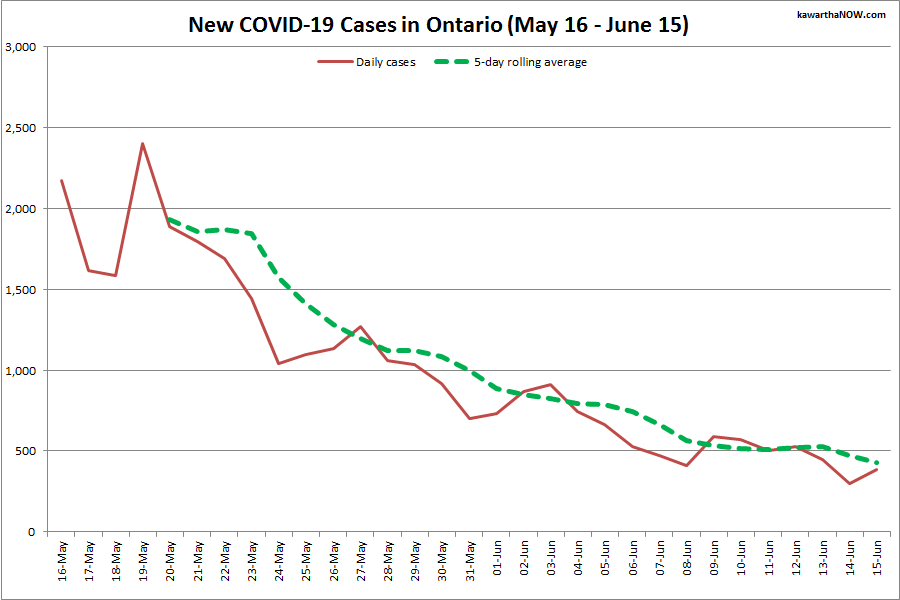
COVID-19 cases in Ontario from March 31 - April 30, 2021. The red line is the number of new cases reported daily, and the dotted green line is a five-day rolling average of new cases. (Graphic: kawarthaNOW.com)
COVID-19 cases in Ontario from March 31 – April 30, 2021. The red line is the number of new cases reported daily, and the dotted green line is a five-day rolling average of new cases. (Graphic: kawarthaNOW.com)
COVID-19 tests completed in Ontario from March 31 - April 30, 2021. The red line is the daily number of tests completed, and the dotted green line is a five-day rolling average of tests completed. (Graphic: kawarthaNOW.com)
COVID-19 tests completed in Ontario from March 31 – April 30, 2021. The red line is the daily number of tests completed, and the dotted green line is a five-day rolling average of tests completed. (Graphic: kawarthaNOW.com)
COVID-19 hospitalizations and ICU admissions in Ontario from March 31 - April 30, 2021. The red line is the daily number of COVID-19 hospitalizations, the dotted green line is a five-day rolling average of hospitalizations, the purple line is the daily number of patients with COVID-19 in ICUs, and the dotted orange line is a five-day rolling average of patients with COVID-19 in ICUs. (Graphic: kawarthaNOW.com)
COVID-19 hospitalizations and ICU admissions in Ontario from March 31 – April 30, 2021. The red line is the daily number of COVID-19 hospitalizations, the dotted green line is a five-day rolling average of hospitalizations, the purple line is the daily number of patients with COVID-19 in ICUs, and the dotted orange line is a five-day rolling average of patients with COVID-19 in ICUs. (Graphic: kawarthaNOW.com)
COVID-19 deaths in Ontario from March 31 - April 30, 2021. The red line is the cumulative number of daily deaths, and the dotted green line is a five-day rolling average of daily deaths. (Graphic: kawarthaNOW.com)
COVID-19 deaths in Ontario from March 31 – April 30, 2021. The red line is the cumulative number of daily deaths, and the dotted green line is a five-day rolling average of daily deaths. (Graphic: kawarthaNOW.com)
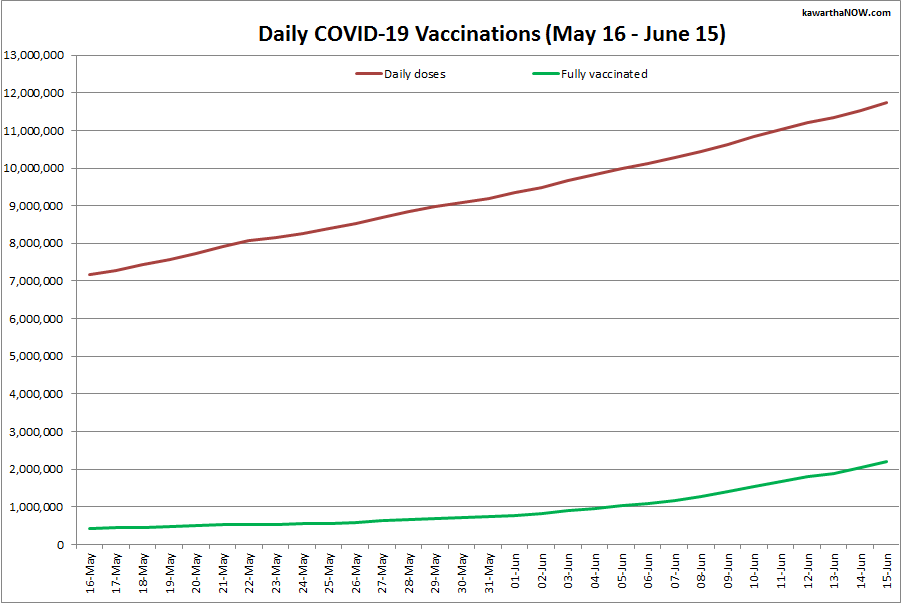
COVID-19 vaccine doses administered in Ontario from March 31 - April 30, 2021. The red line is the cumulative number of daily doses administered, and the dotted green line is a five-day rolling average of daily doses. (Graphic: kawarthaNOW.com)
COVID-19 vaccine doses administered in Ontario from March 31 – April 30, 2021. The red line is the cumulative number of daily doses administered, and the dotted green line is a five-day rolling average of daily doses. (Graphic: kawarthaNOW.com)


For more information about COVID-19 in Ontario, visit covid-19.ontario.ca.

Port Hope theatre icon Uwe Meyer has passed away

Uwe Meyer and his wife Andrea Wigmore Patterson. Meyer passed away peacefully at his home on April 24, 2021 at the age of 71. (Photo courtesy of the family)

Uwe Meyer, former long-time artistic director and general manager of the Capitol Theatre in Port Hope and a prolific playwright, passed away peacefully at his home on April 24. He was 71 years old.

Born in Bremen, Germany in 1950, Meyer began writing plays while studying theatre at Brock University in St. Catharines, Ontario. After graduating, Meyer spent three years working in academia at Brock University and the University of Windsor before embarking on a career as a production manager in theatres across Canada.

In the mid-1980s, Mayer decided to make the move into theatre management, first as artistic director of Victoria Playhouse in Petrolia, Ontario for two years, where he founded the Petrolia Summer Theatre, and then as artistic producer of the Gryphon Theatre in Barrie, Ontario for six years.

Advertisement - content continues below


In 1997, he moved to Port Hope where he met his future wife Andrea Wigmore Patterson and began working as artistic director and general manager of the Capitol Theatre. He continued in the role for 17 years, during which time he founded the Port Hope Festival Theatre.

A member of the Playwrights Guild of Canada, Meyer had his first play professionally produced in 1980 and, by the end of his career, had written almost 30 comedies, musicals, children’s plays and pantomimes produced and performed across North America.

His plays include Dating by the Book, The Caramel House, 1-900-DEE-LITE, The Second Time Around, Baby Bonus, Honeymoon for Three, Leapfrog, The “G” String Broke, and Since You Left Us.

As well as being a playwright, Meyer also directed dozens of professional productions, including several of his own while at the Capitol Theatre.

“He had the most fun writing and directing the Christmas naughty and nice Pantos (at the Capitol),” reads his obituary. “He will be fondly remembered for standing on stage at the beginning of every performance and asking the audience where they came from, with the winner who hailed from farthest away being rewarded with a free drink at the bar.”

Advertisement - content continues below


After retiring, Meyer volunteered as an on-air radio host at Northumberland 89.7 FM in Port Hope, where he created the shows Country Classics and Femme Friday.

“We at the station knew Uwe to be an aficionado of country music and more,” the not-for-profit community station wrote on Facebook after learning of his death. “His shows were always filled with not only great music but friendly banter that was immediately engaging. You couldn’t help but smile and love the guy.”

Meyer was also an avid gardener whose property was featured on the Architectural Conservancy of Ontario’s Port Hope Branch garden tour.

“He will be remembered by everyone who knew him for his intelligence, humour, talent, honesty and kindness,” reads his obituary. “Exit … stage left Uwe!”

A private family gathering will take place post-pandemic. The family requests donations in Meyer’s memory be made to the Heart and Stroke Foundation, the Northumberland Hills Hospital, or to the charity of your choice.

84-year-old Peterborough County man dies in tractor accident

An 84-year-old Peterborough County man is dead after a farming-related accident on Friday (April 30).

Peterborough County OPP say the man was driving a tractor on Asphodel 7th Line, between Centre Line and County Road 2 in Asphodel-Norwood Township, late Friday afternoon.

While driving the tractor, he was struck by a falling tree. The tractor remained in motion until it entered a ditch.

Advertisement - content continues below


The man was transported to a local hospital with life-threatening injuries, where he later died.

Police continue to investigate the accident and will not release the name of the man until his next of kin are notified.

Environment Canada issued a special weather statement for Friday for northwesterly winds gusting up to 80 km/h, warning “These strong winds will toss loose objects and may cause some tree branches to break.”

Ontario reports 3,887 new COVID-19 cases, including 25 in greater Kawarthas region

Here’s an update on COVID-19 cases in Ontario as well as in the greater Kawarthas region.

Ontario is reporting 3,887 new cases today, including 1,331 in Toronto and triple-digit increases in 7 other health units. The seven-day average of daily cases has decreased by 88 to 3,722.

There are 3,016 more cases of the B.1.1.7 UK variant and 31 more cases of the B.1.351 South Africa. The number of cases of the P.1 Brazilian variant continues to accelerate, with 144 new cases reported today for a total of 645.

Hospitalizations have decreased, including a very small decrease in the number of ICU admissions. However, there has been a large increase in the number of patients on ventilators. Ontario is reporting 21 deaths today, with no deaths in long-term care homes.

In the greater Kawarthas region, there are 25 new cases to report (including 12 in Hastings Prince Edward, 5 in Peterborough, 6 in Kawartha Lakes, 1 in Northumberland, and 1 in Haliburton) and an additional 40 cases resolved, with the number of active cases dropping by 21 to 249.

Advertisement - content continues below


Most of the new cases reported today are in Toronto (1,331), Peel (871), York (267), Durham (208), Hamilton (204), Ottawa (196), Niagara (156), and Halton (123).

There are double-digit increases reported today in Middlesex-London (85), Simcoe Muskoka (62), Wellington-Dufferin-Guelph (54), Waterloo (49), Windsor-Essex (46), Brant (37), Eastern Ontario (27), Haldimand-Norfolk (22), Southwestern (17), Haliburton, Kawartha, Pine Ridge (16), Hastings Prince Edward (13), Peterborough (13), Northwestern (12), Kingston, Frontenac and Lennox & Addington (10), and Lambton (10), with smaller increases in Porcupine (9), Sudbury (9), Algoma (6), Grey Bruce (6), and Huron Perth (6).

The remaining 6 health units are reporting 5 or fewer new cases, with all health units reporting at least 2 cases.

Of today’s new cases, 57% are among people 39 and younger, with the highest number of cases (1,577) among people ages 20-39 followed by 1,179 cases among people ages 40-59 and 639 cases among people 19 and under.

With 4,242 more cases resolved since yesterday, the percentage of resolved cases has increased by 0.1% to at 90.0% — the 11th straight day the percentage of resolved cases has increased. The average positivity rate across Ontario has decreased by 0.2% to 7.4%, meaning that 74 out of every 1,000 tests performed were positive for COVID-19 on April 29.

Ontario is reporting 21 new COVID-19 deaths today, with no new deaths in long-term care homes. Ontario has averaged 27 new daily deaths over the past week, a decrease of 2 from yesterday.

The number of hospitalizations has decreased by 47 to 2,201, with the number of patients with COVID-19 in ICUs decreasing by 1 to 883. However, the number of patients with COVID-19 on ventilators has increased by 12 to a new record high of 632.

A total of 53,074 tests were completed yesterday, with the backlog of tests under investigation decreasing by 2,911 to 29,003.

A total of 5,139,984 doses of vaccine have now been administered, an increase of 112,214 from yesterday, with 371,110 people fully vaccinated with both doses of vaccine, an increase of 2,707 from yesterday.

The number of fully vaccinated people represents 2.52% of Ontario’s population, an increase of 0.02% from yesterday, with fully and partially vaccinated people representing 34.89% of the population, an increase of 0.76% from yesterday. An estimated 70-90% of the population must be immunized to achieve herd immunity.

Advertisement - content continues below


In the greater Kawarthas region, there are 25 new cases to report, including 12 in Hastings Prince Edward, 5 in Peterborough, 6 in Kawartha Lakes, 1 in Northumberland, and 1 in Haliburton.

An outbreak at Carressent Care Mary Street in Lindsay was declared on April 29. An outbreak at an unidentified congregate living facility in Belleville was declared on April 30.

There have been 4 new ICU admissions in Hastings Prince Edward,

There are 13 new regional cases of variants of concern, including 5 in Peterborough, 3 in Northumberland, 3 in Hastings Prince Edward, and 2 in Kawartha Lakes.

An additional 40 cases have been resolved, including 12 in Peterborough, 10 in Hastings Prince Edward, 10 in Northumberland, 6 in Kawartha Lakes, and 2 in Haliburton.

There are currently 249 active cases in the greater Kawarthas region, a decrease of 21 from yesterday, including 87 in Hastings Prince Edward (17 in Quinte West, 50 in Belleville, 3 in Tyendinaga & Deseronto, 10 in Prince Edward County, 6 in Central Hastings, and 1 in North Hastings), 72 in Peterborough, 43 in Kawartha Lakes, 39 in Northumberland, and 8 in Haliburton.

Since the pandemic began in the greater Kawarthas region, there have been 1,222 confirmed positive cases in the Peterborough area (1,133 resolved with 14 deaths), 730 in the City of Kawartha Lakes (644 resolved with 56 deaths), 819 in Northumberland County (766 resolved with 14 deaths), 103 in Haliburton County (94 resolved with 1 death), and 930 in Hastings and Prince Edward counties (833 resolved with 9 deaths). The most recent death was reported in Peterborough on April 28.

The provincial data in this report is pulled from Ontario’s integrated Public Health Information System (iPHIS) at 4 p.m. the previous day, as well as from systems in Toronto, Ottawa, and Middlesex-London at 2 p.m. the previous day. Data from local health units is more current and is usually reflected in the provincial data the following day. There may be discrepancies between the Ontario data reported today (which is from yesterday) and the local health unit data reported today (which is from today).

Advertisement - content continues below


Peterborough Public Health

Peterborough Public Health’s service area is the City and County of Peterborough and the Hiawatha and Curve Lake First Nations.

The health unit provides daily reports, including on weekends, excluding statutory holidays.

Confirmed positive: 1,222 (increase of 5)
Total variants of concern cases: 442 (increase of 5)
Active cases: 75 (decrease of 7)
Close contacts: 200 (decrease of 19)
Deaths: 14 (no change)
Resolved: 1,133 (increase of 12)
Hospitalizations (total to date): 53 (no change)*
ICU admissions (total to date): 8 (no change)
Total tests completed: Over 49,950 (increase of 100)
Outbreaks: Empress Gardens retirement home in Peterborough, Unidentified congregate living facility #3 in Peterborough, Unidentified workplace #5 in Peterborough, Trent Champlain Residence: West Towers in Peterborough, Unidentified workplace #7 in Peterborough, Unidentified workplace #8 in Peterborough (no change)
Vaccine doses administered: 56,409 (increase of 12,806 as of April 29)
Number of people fully vaccinated: 4,211 (increase of 1,730 as of April 29)

*As of April 30, Peterborough Regional Health Centre is reporting 16 patients currently hospitalized with COVID-19 (no change) and a total of 62 patients transferred from other areas as a result of a provincial directive (no change).


Haliburton, Kawartha, Pine Ridge District Health Unit

The Haliburton, Kawartha, Pine Ridge District Health Unit’s service area is the City of Kawartha Lakes, Northumberland County, and Haliburton County.

The health unit provides reports from Monday to Saturday, excluding Sundays and statutory holidays.

Confirmed positive: 1,642, including 730 in Kawartha Lakes, 819 in Northumberland, and 103 in Haliburton (increase of 22, including 10 in Kawartha Lakes, 8 in Northumberland, and 4 in Haliburton)*
Total variants of concern cases: 378, including 125 in Kawartha Lakes, 234 in Northumberland, and 19 in Haliburton (increase of 5, including 2 in Kawartha Lakes and 3 in Northumberland)
Active cases: 90, including 43 in Kawartha Lakes, 39 in Northumberland, and 8 in Haliburton (decrease of 11, including 10 in Kawartha Lakes and 1 in Haliburton)
Probable cases: 7, including 3 in Kawartha Lakes and 4 in Northumberland (increase of 1 in Northumberland)
Hospitalizations (total to date): 60, including 33 in Kawartha Lakes, 24 in Northumberland, and 3 in Haliburton (no change)**
Deaths (including among probable cases): 71, including 56 in Kawartha Lakes, 14 in Northumberland, and 1 in Haliburton (no change)
Resolved: 1,504, including 644 in Kawartha Lakes, 766 in Northumberland, and 94 in Haliburton (increase of 18, including 6 in Kawartha Lakes, 10 in Northumberland, and 2 in Haliburton)
Tests completed: 180,530 (increase of 683)
Vaccine doses administered: 64,953 (increase of 13,242 as of April 26)
Number of people fully vaccinated: 3,548 (increase of 140 as of April 26)
Outbreaks: Fenelon Court long-term care home in Fenelon Falls, Summersweet Custom Design & Build Inc. in Haliburton, Transition House shelter in Cobourg, Carressent Care Mary Street in Lindsay (increase of 1)***

*The health unit states that total counts and counts for individual counties may fluctuate from previously reported counts as cases are transferred to or from the health unit based on case investigation details and routine data cleaning.

**As of April 30, Ross Memorial Hospital in Lindsay reports 8 patients hospitalized with COVID-19 (decrease of 1).

***An outbreak at Carressent Care Mary Street in Lindsay was declared on April 29.


Hastings Prince Edward Public Health

Hastings Prince Edward Public Health’s service area is Hastings County (including Bancroft) and Prince Edward County.

The health unit provides daily reports, including on weekends, excluding statutory holidays.

Confirmed positive: 930 (increase of 12)
Confirmed variants of concern cases: 290 (increase of 3)
Active cases: 87 (no change)
Deaths: 9 (no change)
Currently hospitalized: 20 (decrease of 1)
Currently hospitalized and in ICU: 8 (increase of 4)
Currently hospitalized and in ICU on ventilator: 3 (decrease of 1)
Resolved: 833 (increase of 10)
Tests completed: 128,296 (increase of 1)
Vaccine doses administered: 59,867 (increase of 1,155)
Number of people fully vaccinated: 4,043 (increase of 42)
Outbreaks: Unidentified workplace in Prince Edward County, Unidentified workplace in Belleville, QHC Belleville General Hospital, Unidentified workplace in Belleville, Unidentified congregate living facility in Belleville (increase of 1)*

*An outbreak at an unidentified congregate living facility in Belleville was declared on April 30.

Advertisement - content continues below


Province of Ontario

Confirmed positive: 463,364 (increase of 3,887)
COVID-19 variants of concern (VOC) cases: 65,960 of B.1.1.7 UK variant (increase of 3,016); 274 of B.1.351 South Africa variant (increase of 31); 645 of P.1 Brazilian variant (increase of 144)*
VOC R(t): 0.93 (decrease of 0.03 as April 26)**
7-day average of daily new cases: 3,722 (decrease of 88)
Positivity rate: 7.4% (decrease of 0.2%)
Resolved: 417,252 (increase of 4,242), 90.0% of all cases (increase of 0.1%)
Hospitalizations: 2,201 (decrease of 47)
Hospitalizations in ICU: 883 (decrease of 1)
Hospitalizations in ICU on ventilator: 632 (increase of 12)
Deaths: 8,050 (increase of 21)
7-day average of daily new deaths: 27 (decrease of 2)
Deaths of residents in long-term care homes: 3,918 (no change)
Total tests completed: 14,105,838 (increase of 53,074)
Tests under investigation: 29,003 (decrease of 2,911)
Vaccination doses administered: 5,139,984 (increase of 112,214), 34.89% of Ontario’s population (increase of 0.76%)***
People fully vaccinated (two doses): 371,110 (increase of 2,707), 2.52% of Ontario’s population (increase of 0.02%)***

*While Ontario’s daily update is not yet reporting this information, Public Health Ontario confirmed on April 23 that 36 cases of the B.1.617 variant, a so-called “double mutation” variant first identified in India, have been detected in Ontario.

**R(t) is a virus’s effective reproduction number, which is the average number of new infections caused by a single infected individual at a specific time (t) in a partially immunized population. To successfully eliminate a disease from a population, R(t) needs to be less than 1.

***An estimated 70-90% of the population must be immunized to achieve herd immunity.

COVID-19 cases in Ontario from March 30 - April 29, 2021. The red line is the number of new cases reported daily, and the dotted green line is a five-day rolling average of new cases. (Graphic: kawarthaNOW.com)
COVID-19 cases in Ontario from March 30 – April 29, 2021. The red line is the number of new cases reported daily, and the dotted green line is a five-day rolling average of new cases. (Graphic: kawarthaNOW.com)
COVID-19 tests completed in Ontario from March 30 - April 29, 2021. The red line is the daily number of tests completed, and the dotted green line is a five-day rolling average of tests completed. (Graphic: kawarthaNOW.com)
COVID-19 tests completed in Ontario from March 30 – April 29, 2021. The red line is the daily number of tests completed, and the dotted green line is a five-day rolling average of tests completed. (Graphic: kawarthaNOW.com)
COVID-19 hospitalizations and ICU admissions in Ontario from March 30 - April 29, 2021. The red line is the daily number of COVID-19 hospitalizations, the dotted green line is a five-day rolling average of hospitalizations, the purple line is the daily number of patients with COVID-19 in ICUs, and the dotted orange line is a five-day rolling average of patients with COVID-19 in ICUs. (Graphic: kawarthaNOW.com)
COVID-19 hospitalizations and ICU admissions in Ontario from March 30 – April 29, 2021. The red line is the daily number of COVID-19 hospitalizations, the dotted green line is a five-day rolling average of hospitalizations, the purple line is the daily number of patients with COVID-19 in ICUs, and the dotted orange line is a five-day rolling average of patients with COVID-19 in ICUs. (Graphic: kawarthaNOW.com)
COVID-19 deaths in Ontario from March 30 - April 29, 2021. The red line is the cumulative number of daily deaths, and the dotted green line is a five-day rolling average of daily deaths. (Graphic: kawarthaNOW.com)
COVID-19 deaths in Ontario from March 30 – April 29, 2021. The red line is the cumulative number of daily deaths, and the dotted green line is a five-day rolling average of daily deaths. (Graphic: kawarthaNOW.com)
COVID-19 vaccine doses administered in Ontario from March 30 - April 29, 2021. The red line is the cumulative number of daily doses administered, and the dotted green line is a five-day rolling average of daily doses. (Graphic: kawarthaNOW.com)
COVID-19 vaccine doses administered in Ontario from March 30 – April 29, 2021. The red line is the cumulative number of daily doses administered, and the dotted green line is a five-day rolling average of daily doses. (Graphic: kawarthaNOW.com)


For more information about COVID-19 in Ontario, visit covid-19.ontario.ca.

Vaccination ‘floodgates’ will open in Peterborough on May 17 when Pfizer supply doubles in size

Due to increasing supplies of the Pfizer vaccine, Ontario will be expanding vaccine eligibility to everyone 18 years and older by the end of May. Pictured are Peterborough-area residents 80 years of age and older receiving their first doses of the Pfizer vaccine at the COVID-19 immunization clinic at Evinrude Centre in Peterborough on March 21, 2021. (Photo: Jeannine Taylor / kawarthaNOW)

After weeks of delivering disappointing news regarding a shortfall in anticipated COVID-19 vaccine shipments to the Peterborough region, medical officer of health Dr. Rosana Salvaterra has optimistically circled May 17 on her calendar.

“Since Pfizer is doubling its overall supply to Ontario, we will start to see some of those larger shipments coming to Peterborough the week of May 17,” said Dr. Salvaterra during a virtual media briefing on Friday (April 30). “Take heart — as of that day we are doubling our Pfizer (availability) and we will be ramping up to a capacity of at least 1,000 people per day being immunized here.”

“I am very proud of residents here for their patience,” she added. “They are having to wait a few weeks longer (to get immunized). They can get an appointment but it won’t be for today and it won’t be for tomorrow. It’s going to be two or three weeks down the road. As of May 17th, we can open up the floodgates — we can ramp up to full capacity.”

Advertisement - content continues below


Those aged 55 and up can now begin booking vaccine appointments now, Dr. Salvaterra said, noting eligibility will expand to those 50 and older the week of May 3, 40 and older the week of May 10, 30 and older the week of May 17, and 18 and older come the week of May 24.

Encouraging news on the vaccination front didn’t stop there, with Dr. Salvaterra reporting that 56,409 people have received at least one dose — 52,143 of those Peterborough and area residents and the remainder residents from neighbouring health unit jurisdictions who secured an appointment in the Peterborough region. That total number represents an increase of 10,400 just over the past week.

Meanwhile, the number of people fully immunized with two doses doubled over the past week to 4,211, most of them seniors and First Nations members. According to Dr. Salvaterra, 75 per cent of area residents aged 60 and up have now received at least one dose, with vaccination coverage for the region having risen 8 per cent over the past week to more than 42 per cent.

Dr. Salvaterra noted the Peterborough region is continuing to get pre-arranged vaccine supply, which has enabled doses to continue to be administered locally over the past week.

“We are expecting our regular Moderna shipment today (Friday) or tomorrow,” she explained. “We get replenished with Moderna twice a month and, with Pfizer, it’s weekly. AstraZeneca is the one that’s missing in action. We don’t have any sight lines for that.”

“Our appointments have been based on those projections (of vaccine arrival) but we are not able to run clinics every day. We just don’t have enough vaccine. Everything changes May 17 when our Pfizer supply doubles.”

Advertisement - content continues below


Four city pharmacies — Costco Pharmacy at 485 The Parkway, High Street Guardian Pharmacy at 815 High Street, Walmart Pharmacy at 1002 Chemong Road, and Rexall at 1154 Chemong Road — ahave been booking vaccination appointments. However, due to the lack of AstraZeneca supply, they are not currently vaccinating people.

Meanwhile, with the local vaccination appointment call centre shutting down, as of May 3 area residents are directed to phone the provincial call centre at 1-833-943-3900 to book their COVID-19 vaccination appointments. The line will be open from 8 a.m. to 8 p.m., seven days per week. Eligible residents can also continue to book their appointments online by visiting ontario.ca/bookvaccine.

“Transitioning vaccine booking to the provincial vaccine booking call centre will streamline the process for Peterborough area residents as we already use the provincial online booking system,” said Dr. Salvaterra, adding local residents are encouraged to check Peterborough’s COVID-19 vaccine eligibility guidance document before booking an appointment.

This document provides the eligibility status of all groups listed in the Ontario COVID-19 vaccine distribution plan for Peterborough region clinics. If a group is eligible, the guidance document will direct residents to booking information.

For those groups that are not yet eligible to book a vaccine appointment, they are encouraged to sign up for the ‘Notify Me’ service at peterboroughpublichealth.ca/notifyme. This service notifies residents by email when it’s their turn to book a vaccine appointment.

As of Thursday (April 29) at 4:30 p.m., active cases stood at 82 in Peterborough city and county, Curve Lake and Hiawatha — up six from what was reported on Tuesday. Since Monday, 41 new cases have been detected.

The number of close contacts of positive cases being closely monitored by public health staff continues to show improvement and is now pegged at 219, down 28 from Tuesday.

Advertisement - content continues below


One new COVID-related death occurred this week, bringing to 14 the total number of local deaths from COVID-19 since March of last year. According to Dr. Salvaterra, that death is being associated with a workplace outbreak.

“It was a household member of someone who did contract COVID at their workplace,” she said. “It’s very sad and unfortunate that this person contracted COVID because someone brought it home.”

There are currently six active outbreaks in the region, five of those workplace-related.

As for the weekly anti-lockdown protests that have been taking place in Peterborough’s Confederation Park, another one is expected to take place tomorrow (Saturday).

With much chatter on social media about a counter-protest being held, Peterborough Police Services Chief Scott Gilbert strongly advised that members of both protest groups stay home.

“I appreciate that people are upset with what’s going on with the protest that keeps showing up in Confederation Park but don’t compound the problem by engaging in the protest,” said Chief Gilbert, adding “The best thing you can do is not give them any air time, not give them any attention, and just go about your business and stay safe.”

“We had one gentleman last Saturday in the park who was shouting his views that were contrary to those gathered in the park,” he added. “We had some members of the large demonstration tell us that we should get him out of there before he gets hurt. Free speech, I guess, only goes one way.”

Also commenting during Friday’s briefing were Peterborough-Kawartha MP Maryam Monsef, Peterborough Mayor Diane Therrien, Peterborough County Warden J. Murray Jones, and Peterborough board of health chair and Selwyn mayor Andy Mitchell.

Peterborough police charge 7 more people for last Saturday’s anti-lockdown protest

A recent anti-lockdown protest in front of Peterborough City Hall. (Photo: Tyler Berry / No More Lockdowns Peterborough Facebook group)

Peterborough police have charged seven more people in connection with the anti-lockdown protest held last Saturday (April 24) at Confederation Park in front of Peterborough City Hall.

All seven charges are under the Reopening Ontario Act, according to a media release.

So far, police have laid 15 charges related to Saturday’s protest, including one for Ontario independent MPP for Lanark-Frontenac-Kingston Randy Hillier and one for Maxime Bernier, former MP and leader of the federal People’s Party of Canada, both of whom spoke at the protest.

Advertisement - content continues below


Since January, police have identified and charged 21 people in connection with the ongoing weekly protests, laying 25 charges under the Reopening Ontario Act, three charges under City of Peterborough by-laws, and four charges under the Highway Traffic Act.

Another anti-lockdown protest is planned to take place at Confederation Park for this Saturday (May 1), with a counter-protest being organized.

Police say they are aware of the efforts to organize a counter-protest and “are planning accordingly,” according to Inspector Neil Collins of the Peterborough Police Service.

“We understand people are frustrated and urge everyone to conduct themselves in a peaceful manner,” Collins states in a media release.

Five communities in greater Kawarthas receive $13 million in joint federal and provincial funding

Trent Hills will receive the largest portion of the joint provincial and federal funding, with $7.5 million going towards the construction of the new multi-purpose Campbellford Recreation and Wellness Centre, which will include an NHL-sized rink and an aquatics centre with both a lane pool and smaller therapy pool, as well as a complete fitness centre. (Illustration: Municipality of Trent Hills)

Five communities in the greater Kawarthas region are among 15 across Ontario receiving a total of $44 million in joint provincial and federal funding to improve cultural and recreational facilities and green infrastructure.

The funding was announced on Thursday (April 29) as part of the federal Investing in Canada Infrastructure Program, which is cost-shared with provinces and municipalities.

Cavan-Monaghan Township, Trent Hills, Haliburton County, Minden Hills, and Dysart et al will collectively receive almost $13 million in joint provincial and federal funding for nine projects, with the municipalities contributing another $10.5 million.

Advertisement - content continues below


Trent Hills will receive the largest portion of the joint provincial and federal funding, with $7.5 million going towards the construction of the new multi-purpose Campbellford Recreation and Wellness Centre, which will include an NHL-sized rink and an aquatics centre with both a lane pool and smaller therapy pool, as well as a complete fitness centre.

The new facility, which will be operated jointly by YMCA Northumberland and the Municipality of Trent Hills, will replace the existing Campbellford Arena. Trent Hills is contributing $8.6 million to the project.

Trent Hills will also receive $1.9 million in joint provincial and federal funding to replace the treated water standpipe in the Village of Hastings.

Minden Hills will receive $1.7 million in joint provincial and federal funding for two projects: rehabilitating the Kinark Outdoor Centre and improving accessibility at the Minden Library and the Cultural Centre, the Lochlin Community Centre and Irondale Community Centre, and the Minden Curling Club building.

Cavan-Monaghan Township will receive $1.2 million for three projects: rehabilitating the historic Old Millbrook School, renovating the Millbrook Arena, and renovating the Bruce Johnston Branch of Cavan Monaghan Libraries.

The Municipality of Dysart et al will receive almost $220,000 to rehabilitate Rotary Beach Park in the village of Haliburton, and Haliburton County will receive almost $200,000 to upgrade the Haliburton County Rail Trail Corridor.

Details of each project are provided below.

Advertisement - content continues below


Municipality of Trent Hills – Construction of the Campbellford Recreation and Wellness Centre

Funding will support the construction of a new multipurpose recreation facility. Work includes building an NHL-sized rink, a lane pool, therapy pool, a fitness room, and multipurpose room. This will provide residents, and surrounding communities, with improved access to modern recreational facilities.

Municipality of Trent Hills – Replacement of the Hastings Treated Water Standpipe

The project will replace a standpipe along with 875 metres of water main to connect the new standpipe to the distribution system. The replacement will improve water pressure, support better fire protection and ensure a safe, secure and reliable water supply.

Township of Minden Hills – Kinark Outdoor Centre Rehabilitation

Project scope includes constructing an additional respite dorm; and improving the safety and accessibility of indoor and outdoor spaces like trails, waterfront areas, and classrooms. Other improvements will extend the service life of the dining hall and laundry facilities and provide winterization and accessibility to sleeping cabins. The project will increase the seasonal capacity of the facility and provide greater access to preventative respite for children with an Autism Spectrum Disorder.

Township of Minden Hills – Rehabilitation of Minden Hills Community Facilities for Accessibility

Project work will improve four facilities:

  • The Minden Library/Cultural Centre: upgrade the condition of retaining walls, stairs, ramps, the sidewalk and platforms around the Library and Cultural building; replacing guardrails and handrails.
  • The Lochlin Community Centre and Irondale Community Centre: upgrade accessibility by replacing the ramp and installing an automatic door operator.
  • Minden Curling Club Building: installing an elevator and air lock at the front of the building.

These improvements will provide the associated communities with safer and more accessible entrances to community spaces, meeting current Ontario Building Code standards, while extending the life of these facilities.

Advertisement - content continues below


Township of Cavan-Monaghan – Rehabilitation of the historically designated Old Millbrook School

Project work will include replacing the roof and windows with energy efficient alternatives; repairing damaged walls, floors, and doors; installing a new ventilation and air exchanger system; and installing battery-operated accessible doors. These improvements will provide year-round access to indoor space for various social groups and services, while improving access to quality community, cultural and recreational infrastructure.

Township of Cavan-Monaghan – Renovation of the Millbrook Arena to a multipurpose community hub

Project work consists of the rehabilitation of existing steel girders, beams, walls and floors; converting the concession stand into accessible washrooms; and replacing the existing roof with an energy efficient alternative. An air ventilation system will also be installed to improve air quality. Once complete this facility will provide a space for year-round sports programming and community social activities.

Township of Cavan-Monaghan – Revisioning the Bruce Johnston Branch as a Community Hub

This project will renovate the existing library to create a more accessible, functional, and energy efficient space. Work includes changing windows and doors, re-wiring the electrical system, relocating the public computer area and staff spaces, and renovating staff work zones to be more ergonomic, accessible, and functional. These renovations will provide a larger, more flexible space for clients and staff, improving the library experience and working environment.

Municipality of Dysart et Al – Rotary Beach Park Rehabilitation

Project work will improve overall park infrastructure, which includes repairing the surface of tennis, basketball, and pickle ball courts; improving the accessibility of pathways, docks, courts, and picnic areas; and rehabilitating the exterior of the storage building. Further improvements include installing a play structure, a rain garden, a bike rack, and creating an off-leash dog park. A tree study will also take place to ensure adequate management of shade, soil water retention, and erosion control. A WiFi network will also be established. These improvements will provide an accessible, modern, and safe recreation area for residents and visitors, while supporting various community, cultural and sporting events.

County of Haliburton – Upgrading of the Haliburton County Rail Trail Corridor

The project work includes improving 30 kilometres of trail with granular overlay; installing 15 benches, 500 meters of barrier, and informational signage to highlight trail history, the natural environment, and trail accessibility. This project will provide an improved recreational experience for users, while reducing annual maintenance costs.

Construction of Peterborough’s new Canadian Canoe Museum begins this fall with projected summer 2023 opening

An architectural rendering of the atrium of the planned new Canadian Canoe Museum in Peterborough, showing the reception and artisan workshop areas. This northeast view has Little Lake in the background. (Illustration: Lett Architects Inc.)

Plan B typically gets a bad rap — the inference being that it’s inferior to Plan A in scope and ambition, and therefore falls short of what was originally intended.

When an independent investigation undertaken in May 2020 revealed the original proposed site of the new Canadian Canoe Museum beside the Peterborough Lift Lock is contaminated with various chemicals including the carcinogen trichloroethylene (TCE), museum officials terminated a land lease agreement with Parks Canada in October. With Plan A scuttled, attention turned to Plan B.

On Wednesday night (April 28) via a virtual public meeting, an update was provided on the museum’s plans for its new home at 2077 Ashburnham Drive (the Johnson property) near Beavermead Park. What became quite clear is that, while the location has changed, all of the building features initially envisioned and planned for remain in place.

Advertisement - content continues below


As it turns out, Plan B is not all that different from Plan A and that alone has all involved with the project very excited.

“Sometimes there’s a bigger plan for us and we end up in places where we didn’t know we would end up,” said museum board chair Victoria Grant, admitting the discovery of contaminants on the original site “was a big shock to all of us.”

“But there was never a time when we said there isn’t going to be a (new) canoe museum. Once we made that decision (to end the land lease with Parks Canada), the canoes still needed a home.”

An architectural rendering of the exterior of the planned new Canadian Canoe Museum in Peterborough, facing Ashburnham Drive. (Illustration: Lett Architects Inc.)

Museum executive director Carolyn Hyslop said the search for an alternative site location began almost immediately with the end of the lease.

“We were guided through that process by the museum’s values and our project goals, which are ultimately to create a new home for 100 per cent of this collection that we care for in a safe and accessible building,” she said. “We needed to make sure we are on the water so that we can offer more on-water canoeing and kayaking programs. We also wanted a site that could be developed in the schedule that we needed.”

“And we also needed a site that could meet our budget, and that we could develop on the property in such a way that addresses the new realities we are all living with as we’re going through this pandemic. We have landed at a beautiful property that does all of this.”

Advertisement - content continues below


Of note in relation to what transpired at the original Parks Canada location, environmental geologist Thomas Grace (of Lindsay-based Thomas Grace and Associates) confirmed an initial phase of environmental site assessment work at the new location has shown “absolutely no indication of contamination.”

With construction of the new museum scheduled to begin this fall with the opening targeted for the summer of 2023, Hyslop says the total project cost remains in the range of $35 to $40 million with about 90 per cent of that in hand, including $2 million raised just over the past two months.

Earlier commitments to the project include $9 million from the Ontario government, $1.4 million from the federal government, and $7.5 million from the W. Garfield Weston Foundation — the largest ever one-time private gift to a local charitable organization.

Back in January, Peterborough city council gave its approval for the $1.575 million sale of the five-acre Johnson property to proceed subject to a number of conditions, including rezoning, project validation, and confirmation of site appropriateness. Wednesday’s public meeting met one of the required conditions of the approval process.

A rendering of the location of the planned new Canadian Canoe Museum in Peterborough, located to the south of the Parks Canada headquarters and to the north of Beavermead Park. (Illustration: Lett Architects Inc.)

As for the design and construction of the new museum, Lett Architects Inc. of Peterborough is working in collaboration with a number of partners, a number of them local. Managing principal Bill Lett explained an “integrated project delivery” approach has been adopted.

“In a typical project, we start by developing what we are going to design and build, and typically that only involves the owner and the architect,” Lett said. “Later on we look at the how and the who, adding players as we go. Things are very different in this process.”

“We talk about what we’re going to build, how we’re going to build it, and who is going to build it from the very beginning of the project. We have all the stakeholders on board right from the start. That makes this type of approach fundamentally different than a typical approach that we might take. The early engagement of trade partners, designers, owners, and contractors provides the opportunity for a much deeper level of collaboration.”

Advertisement - content continues below


Saying the building and property is being designed with the visitor experience front of mind, Lett says the goal is “to enhance what is currently great about this site,” noting connectivity to the existing Great Trail of Canada which traverses the property near the shore of Little Lake.

Hyslop added a key focus of the project “is to have as little impact environmentally as possible.”

“Working with our project partners, we want to develop a master plan that focuses on rehabilitation and restoration of the natural world that exists there,” she said, adding “We have this wonderful opportunity to actually enhance the site through our ownership and through the stewardship activities that we want to put in place.”

“We want to restabilize the shore — restore the shore — with plantings and other mechanisms so that it’s much more intact than what it is now.”

An architectural rendering of the terrace of the planned new Canadian Canoe Museum in Peterborough, near the shore of Little Lake and beside the Great Trail. (Illustration: Lett Architects Inc.)

As for the 65,000-square-foot building’s design, Lett said it’s “inspired by the (canoe) collection and the museum’s values. This building speaks about craft, construction and user experience.”

Major components of the building include a large naturally lit lobby and atrium, an environmentally controlled storage space encompassing the highest artifact conservation standards that will house the hundreds of canoes in the museum’s possession but not on display, and, of course, the exhibit galleries.

“When you walk into this place, authentic experience — not contrived — is really front and foremost,” said museum curator Jeremy Ward, noting the work of canoe restoration and building will be very visible for visitors.

Advertisement - content continues below


The 17,000-square-foot exhibit space, notes Ward, will feature seven exhibit “zones” tentatively titled as follows:

  • Headwaters — a central gathering space.
  • All My Relations — a celebration of the canoe in all its forms.
  • Connected By Canoe — an overview of how the canoe has connected people and their communities.
  • Design, Ingenuity and The Maker — “deconstruction” of the canoe “to get deeper meanings from it”.
  • Pushing The Limits — an exploration of how paddled watercraft have pushed people to do “incredible” things”.
  • Inspiration — an examination of canoeing as a transformative experience.
  • Temporary Exhibit Zone — a space that will be renewed on a yearly basis, with the first planned exhibit detailing the story of the Canadian Canoe Museum from its inception to the present.

“Another important theme you’ll encounter here is water,” added Ward. “The energy of water as it flows to the sea is going to carry you through the entire exhibit experience.”

An architectural rendering of the atrium of the planned new Canadian Canoe Museum in Peterborough, showing the museum's collection centre and store. (Illustration: Lett Architects Inc.)
An architectural rendering of the atrium of the planned new Canadian Canoe Museum in Peterborough, showing the museum’s collection centre and store. (Illustration: Lett Architects Inc.)

With the concept design and validation process set to be completed by June, planning and design of the museum and property will begin in earnest in July and carry on until October when shovels are expected to go to work on site.

It’s expected the required rezoning for the property will be in place come the end of July, following city council review and approval.

For more information about the new museum or to make a donation to the Inspiring Canada By Canoe Campaign, visit canoemuseum.ca or email info@canoemuseum.ca.

Questions related to the property’s rezoning can be sent to Peterborough development planning supervisor Brad Appleby at bappleby@peterborough.ca.

Ontario reports 3,871 new COVID-19 cases, including 44 in greater Kawarthas region

Here’s an update on COVID-19 cases in Ontario as well as in the greater Kawarthas region.

With the province announcing an acceleration of its vaccination plan, Ontario is reporting 3,871 new cases today, including 1,172 in Toronto and triple-digit increases in 9 other health units. The seven-day average of daily cases has increased by 27 to 3,810.

There are 2,589 more cases of the B.1.1.7 UK variant, 23 more cases of the B.1.351 South Africa, and 96 more cases of the P.1 Brazilian variant.

Hospitalizations have decreased, with a small increase in the number of ICU admissions and a larger increase in the number of patients on ventilators. Ontario is reporting 41 deaths today, with no deaths in long-term care homes.

Ontario has now completed more than 14 million tests and administered more than 5 million doses of vaccine.

In the greater Kawarthas region, there are 44 new cases to report (including 12 in Hastings Prince Edward, 10 in Peterborough, 10 in Kawartha Lakes, 8 in Northumberland, and 4 in Haliburton) and an additional 25 cases resolved, with the number of active cases rising by 27 to 270.

Advertisement - content continues below


Most of the new cases reported today are in Toronto (1,172), Peel (901), York (392), Durham (292), Ottawa (147), Halton (129), Simcoe Muskoka (117), Niagara (104), Hamilton (103), and Middlesex-London (101).

There are double-digit increases reported today in Waterloo (63), Windsor-Essex (52), Wellington-Dufferin-Guelph (46), Haldimand-Norfolk (25), Haliburton, Kawartha, Pine Ridge (21), Northwestern (19), Brant (19), Grey Bruce (18), Eastern Ontario (16), Lambton (16), Porcupine (15), Peterborough (15), Southwestern (14), Hastings Prince Edward (13), Kingston, Frontenac and Lennox & Addington (13), Renfrew (12), Thunder Bay (10), and Leeds, Grenville & Lanark (10), with smaller increases in Chatham-Kent (8) and Timiskaming (6).

The remaining 4 health units are reporting 5 or fewer new cases, with 1 health unit (Sudbury) reporting no new cases at all.

Of today’s new cases, 58% are among people 39 and younger, with the highest number of cases (1,528) among people ages 20-39 followed by 1,107 cases among people ages 40-59 and 715 cases among people 19 and under.

With 4,245 more cases resolved since yesterday, the percentage of resolved cases has increased by 0.2% to at 89.9% — the 10th straight day the percentage of resolved cases has increased. The average positivity rate across Ontario has increased by 0.4% to 7.6%, meaning that 76 out of every 1,000 tests performed were positive for COVID-19 on April 28.

Ontario is reporting 41 new COVID-19 deaths today, with no new deaths in long-term care homes. Ontario has averaged 29 new daily deaths over the past week, an increase of 1 from yesterday.

The number of hospitalizations has decreased by 33 to 2,248, but the number of patients with COVID-19 in ICUs has increased by 7 to 884 and the number of patients with COVID-19 on ventilators by 15 to 620.

A total of 56,939 tests were completed yesterday, with the backlog of tests under investigation decreasing by 2,832 to 31,914.

A total of 5,027,770 doses of vaccine have now been administered, an increase of 120,567 from yesterday, with 368,403 people fully vaccinated with both doses of vaccine, an increase of 3,237 from yesterday.

The number of fully vaccinated people represents 2.50% of Ontario’s population, an increase of 0.02% from yesterday, with fully and partially vaccinated people representing 34.13% of the population, an increase of 0.92% from yesterday. An estimated 70-90% of the population must be immunized to achieve herd immunity.

Advertisement - content continues below


In the greater Kawarthas region, there are 44 new cases to report, including 12 in Hastings Prince Edward, 10 in Peterborough, 10 in Kawartha Lakes, 8 in Northumberland, and 4 in Haliburton.

An outbreak at Transition House shelter in Cobourg was declared on April 28. There is 1 new hospitalizations in Hastings Prince Edward, 1 in Peterborough, and 1 in Northumberland.

There are 31 new regional cases of variants of concern, including 15 in Peterborough, 10 in Kawartha Lakes, 6 in Northumberland.

An additional 25 cases have been resolved, including 9 in Peterborough, 9 in Hastings Prince Edward, 4 in Northumberland, and 3 in Kawartha Lakes. An outbreak at Grafton Post Office in Grafton and an unidentified community outbreak in Belleville have been resolved.

There are currently 270 active cases in the greater Kawarthas region, an increase of 27 from yesterday, including 87 in Hastings Prince Edward (21 in Quinte West, 45 in Belleville, 3 in Tyendinaga & Deseronto, 7 in Prince Edward County, 9 in Central Hastings, and 2 in North Hastings), 82 in Peterborough, 49 in Northumberland, 43 in Kawartha Lakes, and 9 in Haliburton.

Since the pandemic began in the greater Kawarthas region, there have been 1,217 confirmed positive cases in the Peterborough area (1,121 resolved with 14 deaths), 724 in the City of Kawartha Lakes (638 resolved with 56 deaths), 819 in Northumberland County (756 resolved with 14 deaths), 102 in Haliburton County (92 resolved with 1 death), and 919 in Hastings and Prince Edward counties (822 resolved with 9 deaths). The most recent death was reported in Peterborough on April 28.

The provincial data in this report is pulled from Ontario’s integrated Public Health Information System (iPHIS) at 4 p.m. the previous day, as well as from systems in Toronto, Ottawa, and Middlesex-London at 2 p.m. the previous day. Data from local health units is more current and is usually reflected in the provincial data the following day. There may be discrepancies between the Ontario data reported today (which is from yesterday) and the local health unit data reported today (which is from today).

Advertisement - content continues below


Peterborough Public Health

Peterborough Public Health’s service area is the City and County of Peterborough and the Hiawatha and Curve Lake First Nations.

The health unit provides daily reports, including on weekends, excluding statutory holidays.

Confirmed positive: 1,217 (increase of 10)
Total variants of concern cases: 437 (increase of 15)
Active cases: 82 (increase of 1)
Close contacts: 219 (decrease of 14)
Deaths: 14 (no change)
Resolved: 1,121 (increase of 9)
Hospitalizations (total to date): 53 (increase of 1)*
ICU admissions (total to date): 8 (no change)
Total tests completed: Over 49,850 (increase of 100)
Outbreaks: Empress Gardens retirement home in Peterborough, Unidentified congregate living facility #3 in Peterborough, Unidentified workplace #5 in Peterborough, Trent Champlain Residence: West Towers in Peterborough, Unidentified workplace #7 in Peterborough, Unidentified workplace #8 in Peterborough (no change)
Vaccine doses administered: 56,409 (increase of 12,806 as of April 29)
Number of people fully vaccinated: 4,211 (increase of 1,730 as of April 29)

*As of April 29, Peterborough Regional Health Centre is reporting 16 patients currently hospitalized with COVID-19 (decrease of 2) and a total of 62 patients transferred from other areas as a result of a provincial directive (no change).


Haliburton, Kawartha, Pine Ridge District Health Unit

The Haliburton, Kawartha, Pine Ridge District Health Unit’s service area is the City of Kawartha Lakes, Northumberland County, and Haliburton County.

The health unit provides reports from Monday to Saturday, excluding Sundays and statutory holidays.

Confirmed positive: 1,645, including 724 in Kawartha Lakes, 819 in Northumberland, and 102 in Haliburton (increase of 22, including 10 in Kawartha Lakes, 8 in Northumberland, and 4 in Haliburton)*
Total variants of concern cases: 373, including 123 in Kawartha Lakes, 231 in Northumberland, and 19 in Haliburton (increase of 16, including 10 in Kawartha Lakes and 6 in Northumberland)
Active cases: 101, including 43 in Kawartha Lakes, 49 in Northumberland, and 9 in Haliburton (increase of 16, including 7 in Kawartha Lakes, 5 in Northumberland, and 5 in Haliburton)
Probable cases: 6, including 3 in Kawartha Lakes and 3 in Northumberland (increase of 4, including 3 in Kawartha Lakes and 1 in Northumberland)
Hospitalizations (total to date): 60, including 33 in Kawartha Lakes, 24 in Northumberland, and 3 in Haliburton (increase of 1 in Northumberland)**
Deaths (including among probable cases): 71, including 56 in Kawartha Lakes, 14 in Northumberland, and 1 in Haliburton (no change)
Resolved: 1,486, including 638 in Kawartha Lakes, 756 in Northumberland, and 92 in Haliburton (increase of 7, including 3 in Kawartha Lakes and 4 in Northumberland)
Tests completed: 179,845 (increase of 447)
Vaccine doses administered: 64,953 (increase of 13,242 as of April 26)
Number of people fully vaccinated: 3,548 (increase of 140 as of April 26)
Outbreaks: Fenelon Court long-term care home in Fenelon Falls, Summersweet Custom Design & Build Inc. in Haliburton, Transition House shelter in Cobourg (no net change)***

*The health unit states that total counts and counts for individual counties may fluctuate from previously reported counts as cases are transferred to or from the health unit based on case investigation details and routine data cleaning.

**As of April 29, Ross Memorial Hospital in Lindsay reports 9 patients hospitalized with COVID-19 (decrease of 1).

***An outbreak at Transition House shelter in Cobourg was declared on April 28. An outbreak at Grafton Post Office in Grafton has been resolved.


Hastings Prince Edward Public Health

Hastings Prince Edward Public Health’s service area is Hastings County (including Bancroft) and Prince Edward County.

The health unit provides daily reports, including on weekends, excluding statutory holidays.

Confirmed positive: 919 (increase of 12)
Confirmed variants of concern cases: 286 (increase of 6)
Active cases: 87 (increase of 3)
Deaths: 9 (no change)
Currently hospitalized: 21 (increase of 1)
Currently hospitalized and in ICU: 4 (decrease of 3)
Currently hospitalized and in ICU on ventilator: 4 (no change)
Resolved: 822 (increase of 9)
Tests completed: 128,295 (increase of 10)
Vaccine doses administered: 58,712*
Number of people fully vaccinated: 4,001 (increase of 24)
Outbreaks: Unidentified workplace in Prince Edward County, Unidentified workplace in Belleville, QHC Belleville General Hospital, Unidentified workplace in Belleville (decrease of 1)**

*Yesterday’s report indicated 65,804 doses had been administered. No explanation is given for the decreased number.

**An unidentified community outbreak in Belleville was declared resolved on April 29.

Advertisement - content continues below


Province of Ontario

Confirmed positive: 455,606 (increase of 3,480)
COVID-19 variants of concern (VOC) cases: 62,944 of B.1.1.7 UK variant (increase of 2,589); 243 of B.1.351 South Africa variant (increase of 23); 501 of P.1 Brazilian variant (increase of 96)*
VOC R(t): 0.96 (increase of 0.02 as April 25)**
7-day average of daily new cases: 3,810 (increase of 27)
Positivity rate: 7.6% (increase of 0.4%)
Resolved: 413,010 (increase of 4,245), 89.9% of all cases (increase of 0.2%)
Hospitalizations: 2,248 (decrease of 33)
Hospitalizations in ICU: 884 (increase of 7)
Hospitalizations in ICU on ventilator: 620 (increase of 15)
Deaths: 8,029 (increase of 41)
7-day average of daily new deaths: 29 (increase of 1)
Deaths of residents in long-term care homes: 3,918 (decrease of 1)
Total tests completed: 14,052,764 (increase of 56,939)
Tests under investigation: 31,914 (decrease of 2,832)
Vaccination doses administered: 5,027,770 (increase of 120,567), 34.13% of Ontario’s population (increase of 0.82%)***
People fully vaccinated (two doses): 368,403 (increase of 3,237), 2.50% of Ontario’s population (increase of 0.02%)***

*While Ontario’s daily update is not yet reporting this information, Public Health Ontario confirmed on April 23 that 36 cases of the B.1.617 variant, a so-called “double mutation” variant first identified in India, have been detected in Ontario.

**R(t) is a virus’s effective reproduction number, which is the average number of new infections caused by a single infected individual at a specific time (t) in a partially immunized population. To successfully eliminate a disease from a population, R(t) needs to be less than 1.

***An estimated 70-90% of the population must be immunized to achieve herd immunity.

COVID-19 cases in Ontario from March 29 - April 28, 2021. The red line is the number of new cases reported daily, and the dotted green line is a five-day rolling average of new cases. (Graphic: kawarthaNOW.com)
COVID-19 cases in Ontario from March 29 – April 28, 2021. The red line is the number of new cases reported daily, and the dotted green line is a five-day rolling average of new cases. (Graphic: kawarthaNOW.com)
COVID-19 tests completed in Ontario from March 29 - April 28, 2021. The red line is the daily number of tests completed, and the dotted green line is a five-day rolling average of tests completed. (Graphic: kawarthaNOW.com)
COVID-19 tests completed in Ontario from March 29 – April 28, 2021. The red line is the daily number of tests completed, and the dotted green line is a five-day rolling average of tests completed. (Graphic: kawarthaNOW.com)
COVID-19 hospitalizations and ICU admissions in Ontario from March 29 - April 28, 2021. The red line is the daily number of COVID-19 hospitalizations, the dotted green line is a five-day rolling average of hospitalizations, the purple line is the daily number of patients with COVID-19 in ICUs, and the dotted orange line is a five-day rolling average of patients with COVID-19 in ICUs. (Graphic: kawarthaNOW.com)
COVID-19 hospitalizations and ICU admissions in Ontario from March 29 – April 28, 2021. The red line is the daily number of COVID-19 hospitalizations, the dotted green line is a five-day rolling average of hospitalizations, the purple line is the daily number of patients with COVID-19 in ICUs, and the dotted orange line is a five-day rolling average of patients with COVID-19 in ICUs. (Graphic: kawarthaNOW.com)
COVID-19 deaths in Ontario from March 29 - April 28, 2021. The red line is the cumulative number of daily deaths, and the dotted green line is a five-day rolling average of daily deaths. (Graphic: kawarthaNOW.com)
COVID-19 deaths in Ontario from March 29 – April 28, 2021. The red line is the cumulative number of daily deaths, and the dotted green line is a five-day rolling average of daily deaths. (Graphic: kawarthaNOW.com)
COVID-19 vaccine doses administered in Ontario from March 29 - April 28, 2021. The red line is the cumulative number of daily doses administered, and the dotted green line is a five-day rolling average of daily doses. (Graphic: kawarthaNOW.com)
COVID-19 vaccine doses administered in Ontario from March 29 – April 28, 2021. The red line is the cumulative number of daily doses administered, and the dotted green line is a five-day rolling average of daily doses. (Graphic: kawarthaNOW.com)


For more information about COVID-19 in Ontario, visit covid-19.ontario.ca.

Become a #kawarthaNOW fan

34,404FollowersLike
25,960FollowersFollow
17,457FollowersFollow
4,871FollowersFollow
4,095FollowersFollow
3,210FollowersFollow

Sign up for kawarthNOW's Enews

Sign up for our VIP Enews

kawarthaNOW.com offers two enews options to help readers stay in the know. Our VIP enews is delivered weekly every Wednesday morning and includes exclusive giveaways, and our news digest is delivered daily every morning. You can subscribe to one or both.


Submit your event for FREE!

Use our event submission form to post your event on our website — for free. To submit editorial content or ideas, please contact us.