





















Jen Feigin, executive director of the Endeavour Centre, speaks about sustainable building approaches during the 2020 pilot of GreenUP's Girls Climate Leadership Camp at Peterborough's Ecology Park. The camp gave a small cohort of girls the opportunity to learn about the impacts of climate change, to develop strategies to support action in their households, and to meet inspiring women-identified climate leaders who are creating positive change in our community. (Photo: Ben Hargreaves)
The realities of climate change are a heavy weight to be passing on to our children.
Each week, GreenUP provides a story related to the environment. This week’s column is by Brianna Salmon, Executive Director of GreenUP.
I recently read an article about climate change by Dr. Britt Wray in The Walrus. In “Therapy for the End of the World,” Dr. Wray cites a study that mapped the opinions of more than 9,000 Canadians. 64 percent responded that they think climate change will start to harm people living in Canada within the next ten years.
The realities and choices that young people will be navigating as they get older will look very different than the choices my parents made, or than I am making today.
Advertisement - content continues below
I think a lot about how it feels to hold the weight of climate change; about how it impacts the work that I do, the way that I feel, and the things that I hope for. I also I think a lot about how it might feel to hold this weight as a child.
When I was eight, I did not think that a global disaster such as climate change was going to shape my future. I was already a teenager in the late ’90s when countries from across the world agreed to reduce their greenhouse gas emissions as part of the Kyoto Protocol. Confronting the realities of climate change — as a youth, a young adult, and even as a person edging toward my forties — has felt like a struggle.
For children, even as we engage with the issues in ways that are age-appropriate, the reality is not a gentle one. A parent interviewed in a recent article in the Washington Post recalls her eight-year-old telling her “my life would be better without climate change.” As a parent, she tries to validate those feelings, but admits that, “it’s sad, it’s hard.”
Malaika Collette is a local youth activist and high school student, and an alumnus of Kawartha Pine Ridge District School Board’s Youth Leadership in Sustainability Program. (Photo: Heather Doughty Photography)
In Dr. Wray’s article in The Walrus, youth climate activist Clover Hogan (who founded the youth organization Force of Nature), says “what [she] finds hardest is accepting that all the action in the world may not be enough to save humanity and so many other species.” But for Hogan, recognizing her grief helps her to “feel more authentic in [her] hope for the future,” to reveal what matters most, and to find the power to act.
For Malaika Collette, a local youth activist and high school student, the relationship between knowledge and action is a critical one.
Collette participated in the Kawartha Pine Ridge District School Board’s Youth Leadership in Sustainability Program, which deepened her understanding of climate science and politics, but also introduced her to climate solutions and local changemakers.
Advertisement - content continues below
Particularly when it comes to educating younger students, Collette emphasized “We can’t just talk about the science or the challenges. We need to talk about the solutions and opportunities for local action, so that children can have hope for the future.”
Indeed, despite the immense weight of this reality, we see that the global climate movement is being powered by child and youth activists, many of them girls.
Plan International recognizes that climate change “has a disproportionate impact on children, particularly girls”, because it “magnifies the inequalities they already suffer and their unequal access to health, sexual reproductive health and rights, education, participation, and protection.”
Participants in GreenUP’s first-ever Girls Climate Leadership Camp at Ecology Park in Peterborough meet with special guests Jen Feigin (executive director of the Endeavour Centre), Dana Jordan (local youth climate activist, alumnus of the Youth Leadership in Sustainability Program, and youth representative on The City of Peterborough Environmental Advisory Committee), and Brianna Salmon (executive director of GreenUP). (Photo: Ben Hargreaves
According to Plan, increasing “access to quality education and age and gender responsive climate information is essential in enabling girls to become leaders in climate action and to participate in climate change decision-making.”
At GreenUP, our children’s environmental and climate programs focus on education and curriculum but they also focus on action. For everyone, but especially for young people, we know that participating in climate solutions is a strategy for survival, for inclusion, and for wellness.
In 2020, GreenUP piloted a Girls Leadership Camp that gave a small cohort of girls the opportunity to learn about the impacts of climate change, to develop strategies to support action in their households, and to meet inspiring women-identified climate leaders who are creating positive change in our community.
Advertisement - content continues below
In 2021, we will be expanding our Girls Climate Leadership Program and creating new opportunities for action. Working with the Nourish Project, the Endeavour Sustainable Building School, and other local partners, we will offer hands-on opportunities for girls to learn about food security, low-carbon building, water protection, active transportation, and ecosystem restoration.
Our gender-responsive climate action program will create a safe (and fun!) space for girls to overcome gendered barriers to participation, and will equip them with the tools, connections, and capacity for action. While the climate crisis remains heavy, we know that girls can be a strong and powerful force for change.
This important programming is possible because of funding through the Community Foundation of Greater Peterborough, supported by a collaboration between Community Foundations of Canada and the Equality Fund, with support from the Government of Canada. This program is also supported by Watson & Lou, an awesome woman-led local business in downtown Peterborough.
On September 27, 2019, youth in Peterborough led a protest march to local federal political candidates’ campaign offices as part of The Global Climate Strike protest. This youth-led global protest movement took place in 4,500 locations in 150 countries and is one of the largest movements of its kind in history. (Photo: Leif Einarson)
In the coming months, GreenUP will be announcing more about our Girls Climate Leadership Program. Follow our social media accounts @PtboGreenUP or sign up for GreenUP’s e-newsletter for regular updates.
The first case of a variant of the COVID-19 virus in the greater Kawarthas region has been reported in a resident of Northumberland County, according to the Haliburton, Kawartha, Pine Ridge District Health Unit.
The health unit states it received the test results on Tuesday night (February 9) but does not yet know which of the COVID-19 variants the person is infected with. While all confirmed COVID-19 cases are being further tested for variants, the health unit states, it takes a few extra days for the results to be determined.
There are three known variants of the COVID-19 virus in Canada: a variant first identified in the United Kingdom in November 2020 (the B.1.1.7 variant), the South African variant identified in December 2020 (the B.1.351 variant), and a variant first detected in travellers from Brazil who arrived in Japan in January 2021 (the P.1 variant).
Advertisement - content continues below
The three variants of the COVID-19 virus have been identified as being a greater risk to people due to high rates of transmission.
“While it is unfortunate that we are seeing a case with the variant of concern, it is not unexpected,” says Dr. Ian Gemmill, the health unit’s acting medical officer of health, in a media release. “The three variants have been identified across Canada, and their high level of transmissibility has just meant it was a matter of time before we saw something locally.”
The health unit has notified the Northumberland County resident who has been infected with the variant. The person, who had previously been identified as a confirmed case, was already in isolation. All of the person’s high-risk contacts had also been previously contacted and are in isolation as well.
Dr. Gemmill says the identification of the variant in the community means that it is more important than ever that residents continue to be vigilant and follow the public health measures to help stop the spread.
Advertisement - content continues below
“Even though the provincial stay-at-home order is going to be lifted next week, I am pleading with people to continue to stay home to stop the spread,” he says. “Just because the order has been lifted, it does not change the virus, it does not change the epidemiology of the virus and it does not change the risk of spreading it to others.”
Dr. Gemmill is urging residents to continue to follow the public health advice of not having social gathering with others and not leaving home for non-essential reasons.
“Staying home is still the most prudent thing to do even with the order lifted,” he says.
Kawartha Lakes police have charged eight people over the past week with violating the province’s stay-at-home order, including six people charged after two traffic stops involving other offences.
On February 5, police observed a suspicious vehicle on Settlers Road. After stopping the vehicle, police determined the driver was unlicensed and had taken the vehicle without the consent of the owner. The driver was charged with driving without a licence under the Highway Traffic Act and was cautioned for taking a motor vehicle without consent under the Criminal Code.
During the investigation, police obtained the identities of the four occupants of the vehicle, and charged all four with failing to comply with the stay-at-home order. Each was issued a $880 ticket.
Advertisement - content continues below
On February 6, police observed a vehicle travelling on Lindsay Street South in Lindsay without its headlights on. After stopping the vehicle to speak with the driver, police detected a strong odour of cannabis. Two occupants were charged under the Cannabis Control Act, including a person under 19 years of age possessing cannabis.
During the investigation, police obtained the identities of the occupants of the vehicle, and charged two with failing to comply with the stay-at-home order. Each was issued a $880 ticket.
On February 9, police were called to investigate suspicious persons at a Lindsay Street North address. As a result of the the investigation, two people were charged with failing to comply with the stay-at-home order. Each was issued a $880 ticket.
The province’s stay-at-home order, made under section 7.0.2 order of the Reopening Ontario Act, remains in effect in Kawartha Lakes until Tuesday, February 16. The order requires people to stay at home unless making trips for essential purposes.
Caressant Care McLaughlin Road is a 96-bed long-term care home in Lindsay. (Photo: Caressant Care)
Here’s an update on COVID-19 cases in Ontario as well as in the greater Kawarthas region.
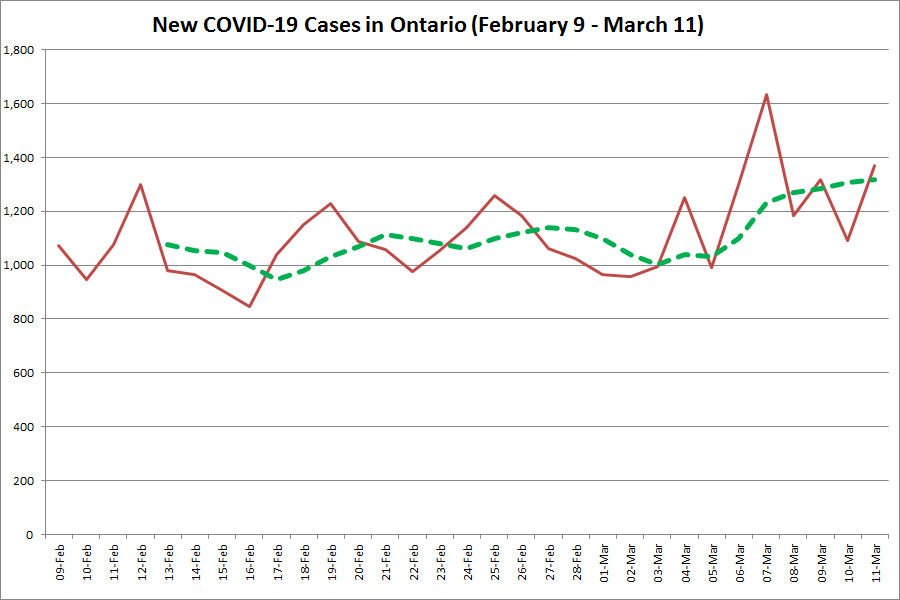
Today, Ontario is reporting 1,072 new cases, including 1 more case of the B.1.1.7 UK variant and no new cases of the B.1.351 South Africa or the P.1 Brazilian variant. The seven-day average of new cases has decreased by 14 to 1,353.
In the greater Kawarthas region, there are 5 new cases to report and 22 additional cases resolved, with the number of active cases across the region decreasing by 17 to 97. There has been 1 new COVID-related death in Kawartha Lakes, for the second day in a row.
Advertisement - content continues below
Most of today’s new cases are in Toronto (393), Peel (196), and York (125).
There are double-digit increases in Waterloo (47), Ottawa (40), Simcoe Muskoka (29), Hamilton (28), Halton (28), Windsor-Essex (24), Middlesex-London (22), Durham (21), Niagara (19), Chatham-Kent (16), Wellington-Dufferin-Guelph (14), and Brant (11), with smaller increases in Lambton (8), Thunder Bay (7), and North Bay Parry Sound (7).
The remaining 16 health units are reporting 5 or fewer new cases, with 4 health units reporting no new cases at all.
Of today’s new cases, 51% are among people 39 and younger, with the highest number of cases (388) among people ages 20-39, followed by 298 cases among people ages 40-59.
With 1,709 more cases resolved since yesterday, the percentage of resolved cases has increased by 0.2% to 92.9%. The average positivity rate across Ontario has decreased by 0.8% to 2.5%, meaning that 25 out of every 1,000 tests performed were positive for COVID-19 on February 9.
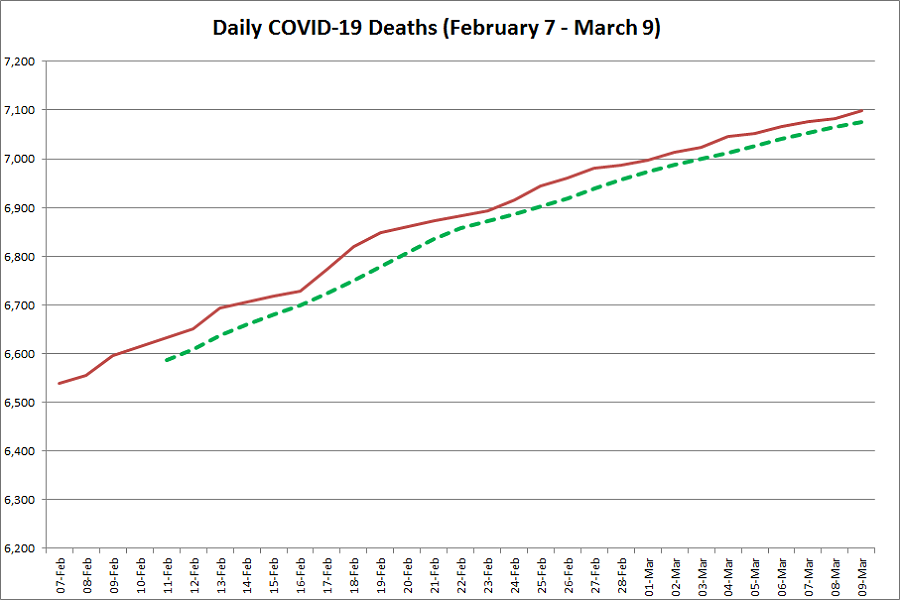
Ontario is reporting 41 new COVID-19 deaths today, including 13 in long-term care homes. Ontario has averaged 42 new daily deaths over the past week.
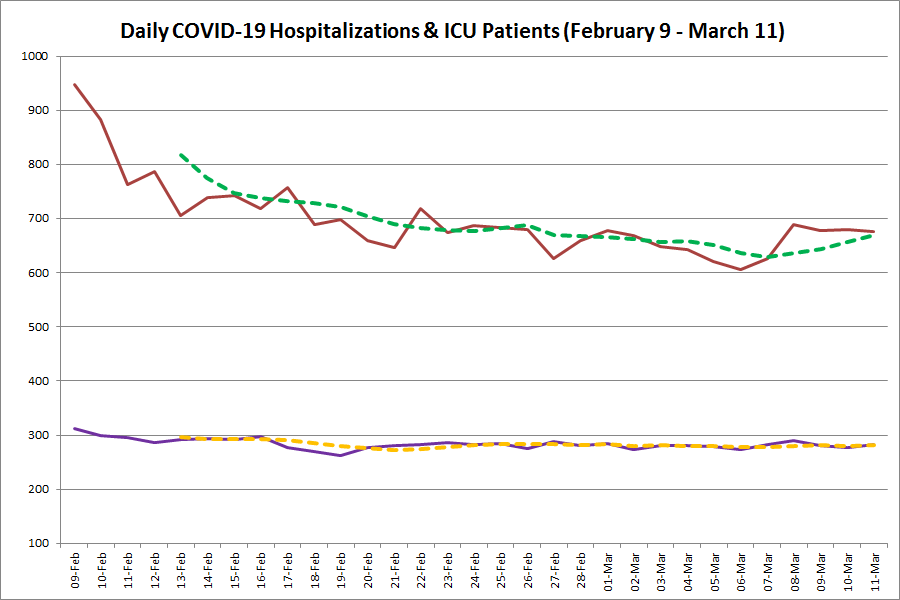
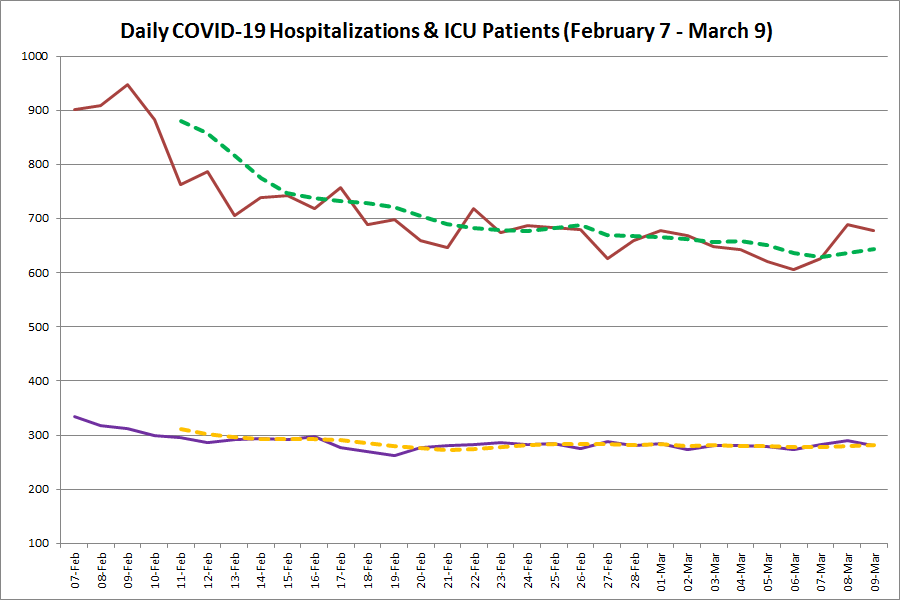
Hospitalizations have increased by 39 from yesterday to 948, with the number of patients with COVID-19 in ICUs decreasing by 5 to 313 and the number of patients with COVID-19 on ventilators increasing by 3 to 226.
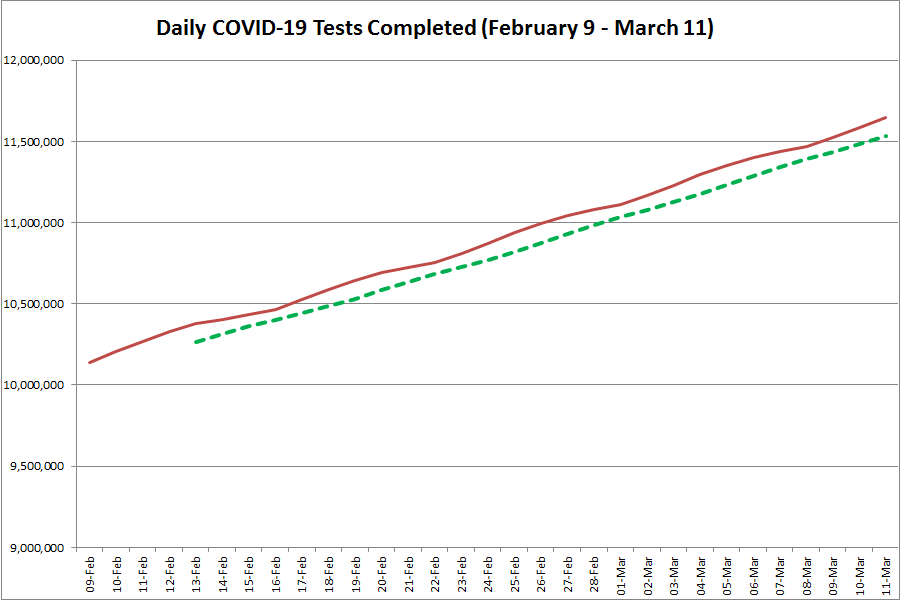
A total of 52,504 tests were completed yesterday, with the backlog of tests under investigation increasing by 8,452 to 41,725.
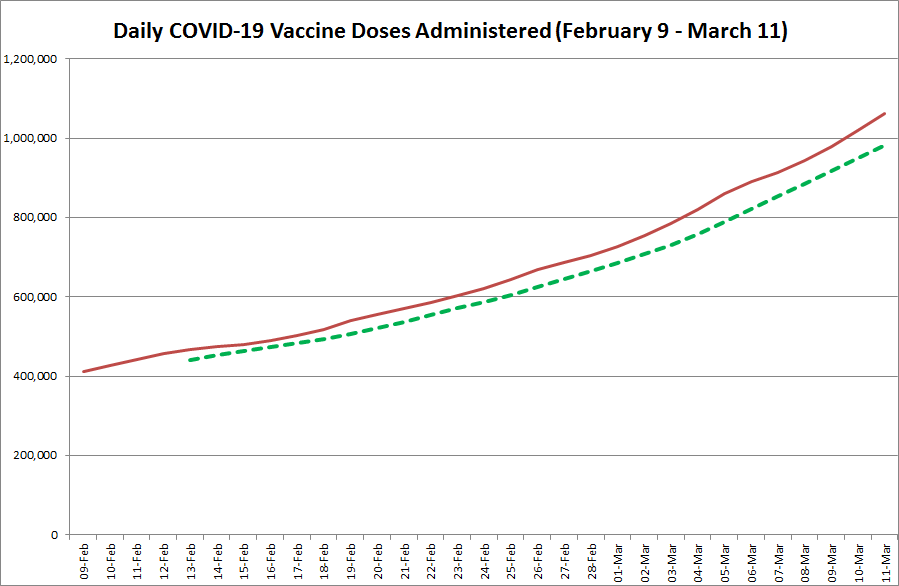
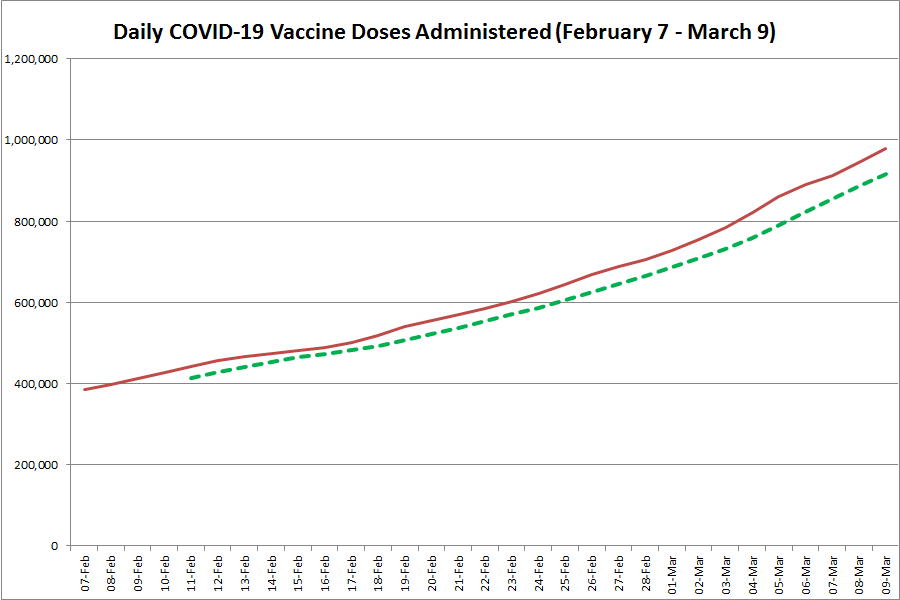
A total of 412,119 doses of vaccine have now been administered, an increase of 13,486 from yesterday, with 125,725 people fully vaccinated with both doses of vaccine, an increase of 10,196 from yesterday.
There are 31 new cases in Ontario schools, a decrease of 16 from yesterday, including 27 student cases and 4 staff cases. There are 25 new cases in licensed child care settings in Ontario, a decrease of 8 from yesterday, with 19 cases among children and 6 cases among staff.
Advertisement - content continues below
In the greater Kawarthas region, there are 5 new cases to report, including 2 in Peterborough, 1 in Northumberland, 1 in Haliburton, and 1 in Hastings Prince Edward. There are no new cases in Kawartha Lakes.
For the second day in a row, a resident at Caressant Care McLaughlin Road in Lindsay has died from COVID-19. Since the current outbreak at the long-term care home was declared on January 9, 13 residents have died from the disease. There are currently 23 active cases among residents and 12 active cases among staff.
There are 2 new hospitalizations in Northumberland.
An additional 22 cases have been resolved, including 11 in Kawartha Lakes, 5 in Peterborough, 4 in Northumberland, and 2 in Hastings Prince Edward. Outbreaks at Trent Valley Lodge long-term care home in Trenton, Hope St. Terrace long-term care home in Port Hope, and Warkworth Place long-term care home in Warkworth have been declared resolved.
There are currently 96 active cases in the greater Kawarthas region, a decrease of 17 from yesterday, including 45 in Kawartha Lakes, 27 in Northumberland, 14 in Peterborough, 9 in Hastings Prince Edward (3 in Quinte West, 5 in Belleville, and 1 in Tyendinga Mohawk Territory), and 1 in Haliburton.
Since the pandemic began in the greater Kawarthas region, there have been 563 confirmed positive cases in the Peterborough area (540 resolved with 9 deaths), 492 in the City of Kawartha Lakes (412 resolved with 48 deaths), 398 in Northumberland County (362 resolved with 9 deaths), 51 in Haliburton County (50 resolved with no deaths), and 377 in Hastings and Prince Edward counties (363 resolved with 5 deaths). The most recent death was reported in Kawartha Lakes on February 10.
The provincial data in this report is pulled from Ontario’s integrated Public Health Information System (iPHIS) at 12 p.m. the previous day. Data from local health units is more current and is usually reflected in the provincial data the following day. There may be discrepancies between the Ontario data reported today (which is from yesterday) and the local health unit data reported today (which is from today).
Peterborough Public Health’s service area is the City and County of Peterborough and the Hiawatha and Curve Lake First Nations.
The health unit provides daily reports, including on weekends, excluding statutory holidays.
Confirmed positive: 563 (increase of 2) Active cases: 14 (decrease of 3) Close contacts: 59 (increase of 2) Deaths: 9 (no change) Resolved: 540 (increase of 5) Hospitalizations (total to date): 24 (no change)* Total tests completed: Over 42,150 (increase of 100) Outbreaks: Peterborough Regional Health Centre, Peterborough Retirement Residence (no change) Vaccine doses administered: 976 (as of February 10)
*As of February 8, Peterborough Regional Health Centre is reporting 4 patients hospitalized with COVID-19 and 14 patients transferred from other areas as a result of a provincial directive.
Haliburton, Kawartha, Pine Ridge District Health Unit
The Haliburton, Kawartha, Pine Ridge District Health Unit’s service area is the City of Kawartha Lakes, Northumberland County, and Haliburton County.
The health unit provides reports from Monday to Saturday, excluding Sundays and statutory holidays.
Confirmed positive: 941, including 492 in Kawartha Lakes, 398 in Northumberland, and 51 in Haliburton (increase of 2, including 1 in Northumberland and 1 in Haliburton)* Active cases: 72, including 45 in Kawartha Lakes, 27 in Northumberland, and 1 in Haliburton (net decrease of 14) Probable cases: 3, including 2 in Northumberland and 1 in Kawartha Lakes (decrease of 1 in Northumberland) High-risk contacts: 179, including 89 in Kawartha Lakes, 70 in Northumberland, and 4 in Haliburton (net increase of 14)** Hospitalizations (total to date): 37, including 25 in Kawartha Lakes, 10 in Northumberland, and 2 in Haliburton (increase of 2 in Northumberland)*** Deaths (including among probable cases): 57, including 48 in Kawartha Lakes and 9 in Northumberland (increase of 1 in Kawartha Lakes) Resolved: 824, including 412 in Kawartha Lakes, 362 in Northumberland, 50 in Haliburton (increase of 15, including 11 in Kawartha Lakes and 4 in Northumberland) Tests completed: 131,326 (increase of 1,078) Institutional outbreaks: Caressant Care McLaughlin Road long-term care home in Lindsay, Central East Correctional Centre in Lindsay (two outbreaks), Regency long-term care home in Port Hope, Hyland Crest long-term care home in Minden, Extendicare Cobourg long-term care home, Extendicare Cobourg Landmark retirement home, Pinecrest Nursing Home in Bobcaygeon, Cobourg Police (decrease of 2)****
*The health unit states that total counts and counts for individual counties may fluctuate from previously reported counts as cases are transferred to or from the health unit based on case investigation details and routine data cleaning.
**This total includes an additional 16 high-risk contacts directly followed up through the Public Health Ontario contact tracing process that are missing the contacts’ county.
***As of February 10, Ross Memorial Hospital in Lindsay reports 1 patient is hospitalized with COVID-19 (an increase of 1 since yesterday).
***Outbreaks at Hope St. Terrace long-term care home in Port Hope and Warkworth Place long-term care home in Warkworth have been declared resolved.
Hastings Prince Edward Public Health
Hastings Prince Edward Public Health’s service area is Hastings County (including Bancroft) and Prince Edward County.
The health unit provides daily reports, including on weekends, excluding statutory holidays.
Confirmed positive: 377 (increase of 1) Active cases: 9 (decrease of 1) Deaths: 5 (no change) Currently hospitalized: 0 (no change) Currently hospitalized and in ICU: 0 (no change) Currently hospitalized and in ICU on ventilator (total to date): 0 (no change) Resolved: 363 (increase of 2) Tests completed: 50,939 (no change) Vaccines administered: 1,096 (no change) Institutional outbreaks: None (decrease of 1)*
*The outbreak at Trent Valley Lodge long-term care home in Trenton was declared resolved on February 10.
Advertisement - content continues below
Province of Ontario
Confirmed positive: 281,566 (increase of 1,072) 7-day average of new cases: 1,353 (decrease of 14) Resolved: 261,700 (increase of 1,709, 92.9% of all cases) Positivity rate: 2.5% (decrease of 0.8%) Hospitalized: 948 (increase of 39) Hospitalized and in ICU: 313 (decrease of 5) Hospitalized and in ICU on ventilator: 226 (increase of 3) Deaths: 6,596 (increase of 41) Deaths of residents in long-term care homes: 3,760 (increase of 13) Total tests completed: 10,137,627 (increase of 52,504) Tests under investigation: 41,725 (increase of 8,452) Vaccination doses administered: 412,119 (increase of 13,486) People fully vaccinated (two doses): 125,725 (increase of 10,196) Total COVID-19 variant cases: 228 of B.1.1.7 UK variant (increase of 1); 3 of B.1.351 South Africa variant (no change); 1 of P.1 Brazilian variant (no change)*
*Toronto Public Health reported a confirmed case of the P.1 Brazilian variant on February 8. The case is not yet included in the provincial data.
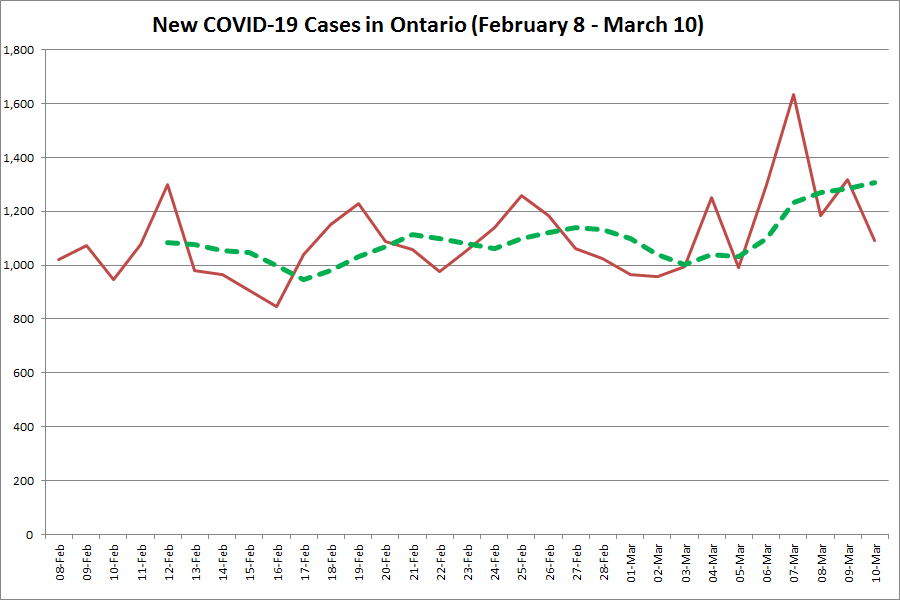
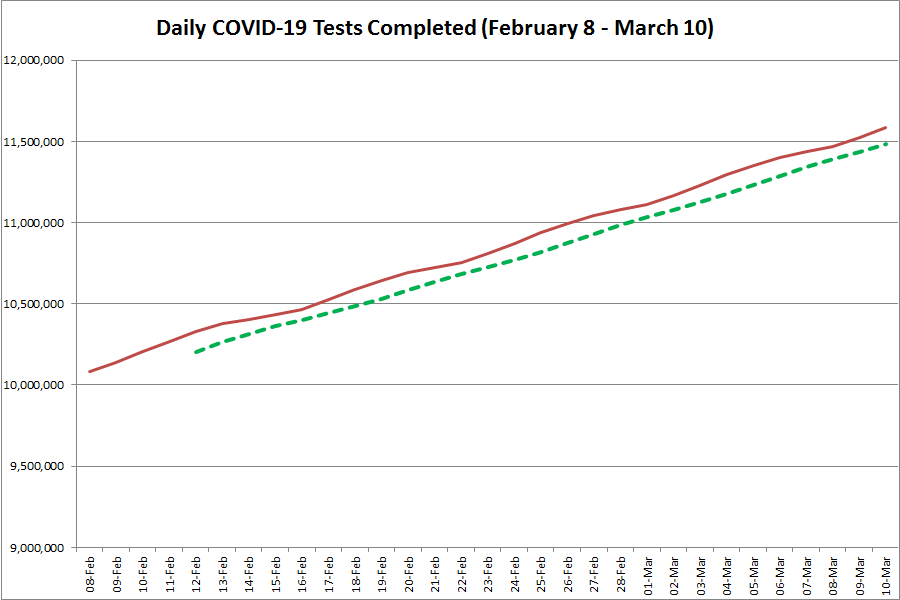
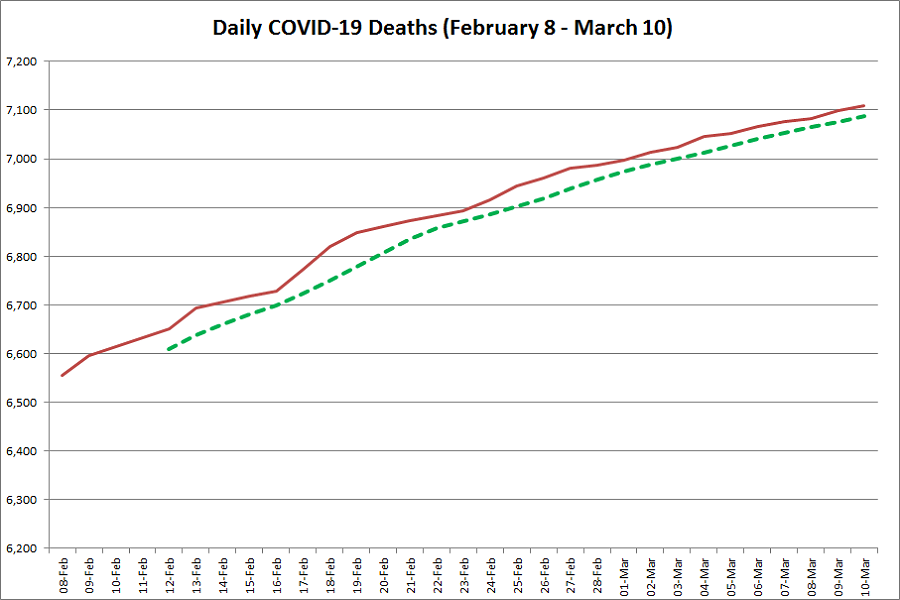
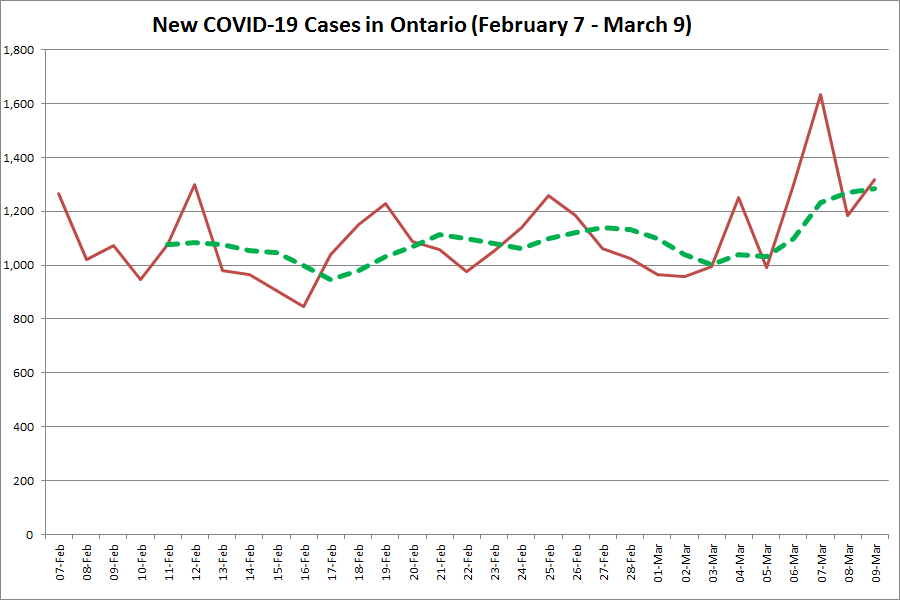
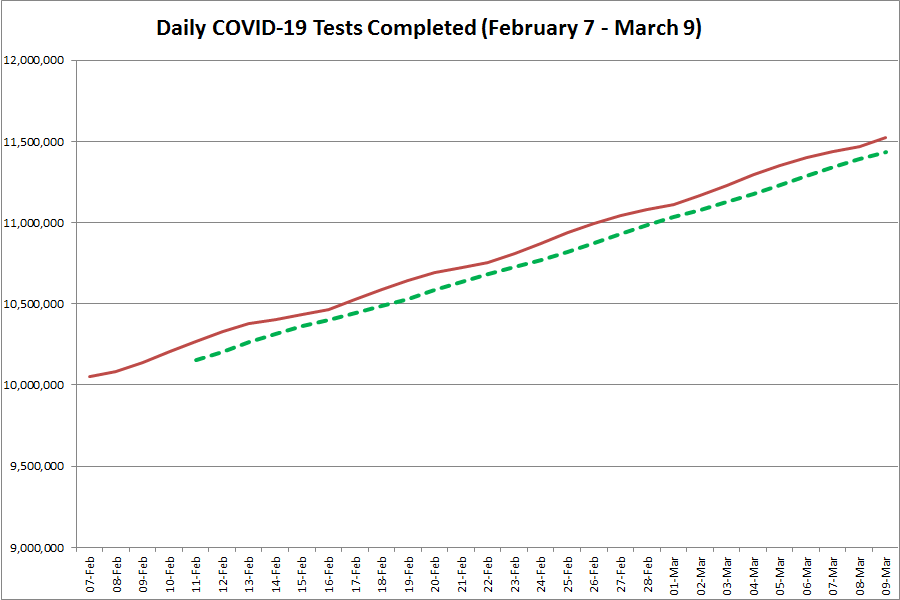
COVID-19 cases in Ontario from January 10 – February 9, 2021. The red line is the number of new cases reported daily, and the dotted green line is a five-day moving average of new cases. (Graphic: kawarthaNOW.com)COVID-19 tests completed in Ontario from January 10 – February 9, 2021. The red line is the number of tests completed daily, and the dotted green line is a five-day moving average of tests completed. (Graphic: kawarthaNOW.com)COVID-19 hospitalizations and ICU admissions in Ontario from January 10 – February 9, 2021. The red line is the daily number of COVID-19 hospitalizations, the dotted green line is a five-day moving average of hospitalizations, the purple line is the daily number of patients with COVID-19 in ICUs, and the dotted orange line is a five-day moving average of is a five-day moving average of patients with COVID-19 in ICUs. (Graphic: kawarthaNOW.com)COVID-19 deaths in Ontario from January 10 – February 9, 2021. The red line is the cumulative number of daily deaths, and the dotted green line is a five-day moving average of daily deaths. (Graphic: kawarthaNOW.com)COVID-19 vaccine doses administered in Ontario from January 10 – February 9, 2021. The red line is the cumulative number of daily doses administered, and the dotted green line is a five-day moving average of daily doses. (Graphic: kawarthaNOW.com)
The Tourism Resiliency Funding Program, offered by Peterborough & The Kawarthas Economic Development and Community Futures Peterborough, will provide up to $20,000 in non-repayable funding to tourism-dependent businesses (such as restaurants, museums, hotels and motels, and entertainment businesses) in the Peterborough region that have incurred eligible expenses created by the pandemic, such as the purchase of personal protective equipment and cleaning supplies for workers, hotel room defogging and disinfecting machines, HVAC upgrades, and more.
Do you own or operate a business in the Peterborough region that relies on tourism? Do you have expenses from making your business COVID-safe for customers?
If so, there’s still time to apply for up to $20,000 in non-repayable financial support under the Tourism Resiliency Funding Program, offered by Peterborough & The Kawarthas Economic Development and Community Futures Peterborough.
The deadline to apply for funding is 5 p.m. on Friday, February 12th.
Any business in the City or County of Peterborough, Hiawatha First Nation, or Curve Lake First Nation that relies on visitors or tourists for revenue is eligible for funding. These businesses could include restaurants, museums, hotels and motels, entertainment businesses, and more.
You can apply for funding between $2,500 and $20,000 to cover eligible one-time expenses your business has incurred (or will incur) from adapting to the pandemic. The expenses can be retroactive back to June 1, 2020 and up to December 31, 2021.
Eligible expenses include costs to implement health and safety protocols (such as purchase of personal protective equipment and cleaning supplies for workers), modifications to your business to accommodate physical distancing of customers (such as patio furniture, patio heaters, plexiglass dividers, hotel room defogging and disinfecting machines, double-door systems, HVAC upgrades), or digital upgrades to allow you to safely serve customers (such as virtual queue and timed-entry ticketing).
While the funding does not need to be paid back, your business must be able to contribute at least 20 per cent towards the expenses. For example, if your business spent a total of $10,000 on HVAC upgrades, your business must be able to cover $2,000 of the expense when applying to the Tourism Resiliency Funding Program for the remaining $8,000.
Not all expenses will be covered under the program. Ineligible expenses including marketing expenses (such as advertising or promotion), costs for marketing agencies or consultants, or expenses that have already been covered by other programs such as Digital MainStreet.
You can apply for funding for more than one type of eligible expense, but the maximum funding request for all expenses cannot collectively exceed $20,000. Taxes paid on expenses are eligible for funding.
If you’ve applied for funding under other support programs, you can still apply to Tourism Resiliency Funding Program — as long as the expenses have not already been funded under another program.
The deadline to apply for funding is 5 p.m. on Friday, February 12th. You can complete an online application form at peterboroughed.ca/funding.
Successful applicants will be notified the week of Monday, February 15th, and will be connected with Community Futures Peterborough.
For more information about the program, visit peterboroughed.ca/funding or contact Joe Rees, Economic Development Officer – Tourism Sector with Peterborough & The Kawarthas Economic Development, at 705-872-6852 (mobile) or at jrees@peterboroughed.ca.
This story was created in partnership with Peterborough & The Kawarthas Economic Development.
Toronto mayor John Tory listening to a reporter's question during a media briefing on February 8, 2021, when Toronto Public Health reported Canada's first known case of the Brazilian variant of COVID-19. (CPAC screenshot)
Here’s an update on COVID-19 cases in Ontario as well as in the greater Kawarthas region.
Today, Ontario is reporting 1,022 new cases — the lowest single-day increase (barring data issues) since November 5, when 1,003 cases were reported. The seven-day average of new cases now stands at 1,367.
Ontario is reporting 8 more cases of the B.1.1.7 UK variant and 2 new cases the B.1.351 South Africa variant. At a media conference yesterday, Toronto Mayor John Tory reported that city has recorded Canada’s first known case of the P.1 variant, commonly called the Brazilian variant. The infected person, who is hospitalized, recently travelled from Brazil.
In the greater Kawarthas region, there are 11 new cases to report and 8 additional cases resolved, with the number of active cases across the region remaining unchanged at 113. There has been 1 new COVID-related death in Kawartha Lakes.
Advertisement - content continues below
Most of today’s new cases are in Toronto (343), Peel (250), and York (128).
There are double-digit increases in Halton (42), Waterloo (41), Ottawa (25), Durham (25), Middlesex-London (24), Simcoe Muskoka (23), Niagara (18), Windsor-Essex (16), North Bay Parry Sound (13), Haliburton, Kawartha, Pine Ridge (13), Hamilton (12), and Wellington-Dufferin-Guelph (12), with a smaller increase in Chatham-Kent (9).
The remaining 18 health units are reporting 5 or fewer new cases, with 7 health units reporting no new cases at all.
Of today’s new cases, 51% are among people 40 and older, with the highest number of cases (382) among people ages 20-39, followed by 301 cases among people ages 40-59.
With 1,388 more cases resolved since yesterday, the percentage of resolved cases has increased by 0.2% to 92.7%. The average positivity rate across Ontario has decreased by 1.1% to 3.3%, meaning that 33 out of every 1,000 tests performed were positive for COVID-19 on February 8.
Ontario is reporting 17 new COVID-19 deaths today, including 7 in long-term care homes. Ontario has averaged 45 new daily deaths over the past week.
Hospitalizations have increased by 8 from yesterday to 909, with the number of patients with COVID-19 in ICUs decreasing by 17 to 318 and the number of patients with COVID-19 on ventilators decreasing by 3 to 223.
A total of 30,798 tests were completed yesterday, with the backlog of tests under investigation increasing by 22,580 to 33,273.
A total of 398,633 doses of vaccine have now been administered, an increase of 12,462 from yesterday, with 115,529 people fully vaccinated with both doses of vaccine, an increase of 9,366 from yesterday.
There are 47 new cases in Ontario schools, an increase of 44 from yesterday, including 34 student cases, 10 staff cases, and 3 cases among unidentified individuals. There are 33 new cases in licensed child care settings in Ontario, an increase of 11 from yesterday, with 21 cases among children and 12 cases among staff.
Advertisement - content continues below
In the greater Kawarthas region, there are 11 new cases to report, including 4 in Hastings Prince Edwards (with the first-ever case in the Tyendinga Mohawk Territory), 3 in Northumberland, 2 in Kawartha Lakes, and 2 in Peterborough. There are no new cases in Haliburton.
There has been 1 new COVID-related death in Kawartha Lakes.
An additional 8 cases have been resolved, including 3 in Peterborough, 3 in Kawartha Lakes, and 2 in Haliburton.
There are currently 113 active cases in the greater Kawarthas region (no net change from yesterday), including 56 in Kawartha Lakes, 30 in Northumberland, 17 in Peterborough, and 10 in Hastings Prince Edward (3 in Quinte West, 6 in Belleville, and 1 in Tyendinga Mohawk Territory). There are no active cases in Haliburton.
Since the pandemic began in the greater Kawarthas region, there have been 561 confirmed positive cases in the Peterborough area (535 resolved with 9 deaths), 491 in the City of Kawartha Lakes (401 resolved with 47 deaths), 397 in Northumberland County (358 resolved with 9 deaths), 50 in Haliburton County (50 resolved with no deaths), and 376 in Hastings and Prince Edward counties (361 resolved with 5 deaths). The most recent death was reported in Kawartha Lakes on February 9.
The provincial data in this report is pulled from Ontario’s integrated Public Health Information System (iPHIS) at 12 p.m. the previous day. Data from local health units is more current and is usually reflected in the provincial data the following day. There may be discrepancies between the Ontario data reported today (which is from yesterday) and the local health unit data reported today (which is from today).
Peterborough Public Health’s service area is the City and County of Peterborough and the Hiawatha and Curve Lake First Nations.
The health unit provides daily reports, including on weekends, excluding statutory holidays.
Confirmed positive: 561 (increase of 2) Active cases: 17 (decrease of 1) Close contacts: 57 (increase of 4) Deaths: 9 (no change) Resolved: 535 (increase of 3) Hospitalizations (total to date): 24 (no change)* Total tests completed: Over 42,050 (no change) Outbreaks: Peterborough Regional Health Centre, Peterborough Retirement Residence (no change) Vaccine doses administered: 517 (as of February 5)
*As of February 9, Peterborough Regional Health Centre is reporting 3 patients hospitalized with COVID-19 (a decrease of 1 since yesterday) and 17 patients transferred from other areas as a result of a provincial directive (an increase of 3 from yesterday).
Haliburton, Kawartha, Pine Ridge District Health Unit
The Haliburton, Kawartha, Pine Ridge District Health Unit’s service area is the City of Kawartha Lakes, Northumberland County, and Haliburton County.
The health unit provides reports from Monday to Saturday, excluding Sundays and statutory holidays.
Confirmed positive: 938, including 491 in Kawartha Lakes, 397 in Northumberland, and 50 in Haliburton (increase of 5, including 2 in Kawartha Lakes and 3 in Northumberland)* Active cases: 86, including 56 in Kawartha Lakes and 30 in Northumberland (net decrease of 3) Probable cases: 4, including 3 in Northumberland and 1 in Kawartha Lakes (increase of 1 in Northumberland) High-risk contacts: 165, including 83 in Kawartha Lakes, 62 in Northumberland, and 4 in Haliburton (net increase of 34)** Hospitalizations (total to date): 35, including 25 in Kawartha Lakes, 8 in Northumberland, and 2 in Haliburton (no change)*** Deaths (including among probable cases): 56, including 47 in Kawartha Lakes and 9 in Northumberland (increase of 1 in Kawartha Lakes) Resolved: 809, including 401 in Kawartha Lakes, 358 in Northumberland, 50 in Haliburton (increase of 5, including 3 in Kawartha Lakes and 2 in Haliburton) Tests completed: 130,248 (increase of 1,167) Institutional outbreaks: Hope St. Terrace long-term care home in Port Hope, Caressant Care McLaughlin Road long-term care home in Lindsay, Warkworth Place long-term care home in Warkworth, Central East Correctional Centre in Lindsay (two outbreaks), Regency long-term care home in Port Hope, Hyland Crest long-term care home in Minden, Extendicare Cobourg long-term care home, Extendicare Cobourg Landmark retirement home, Pinecrest Nursing Home in Bobcaygeon, Cobourg Police (no change)
*The health unit states that total counts and counts for individual counties may fluctuate from previously reported counts as cases are transferred to or from the health unit based on case investigation details and routine data cleaning.
**This total includes an additional 16 high-risk contacts directly followed up through the Public Health Ontario contact tracing process that are missing the contacts’ county.
***As of February 9, Ross Memorial Hospital in Lindsay reports no patients are hospitalized with COVID-19 (a decrease of 1 since yesterday).
Hastings Prince Edward Public Health
Hastings Prince Edward Public Health’s service area is Hastings County (including Bancroft) and Prince Edward County.
The health unit provides daily reports, including on weekends, excluding statutory holidays.
Confirmed positive: 376 (increase of 4) Active cases: 10 (increase of 4) Deaths: 5 (no change) Currently hospitalized: 0 (no change) Currently hospitalized and in ICU: 0 (no change) Currently hospitalized and in ICU on ventilator (total to date): 0 (no change) Resolved: 361 (no change) Tests completed: 50,939 (increase of 47) Vaccines administered: 1,096 (no change) Institutional outbreaks: Trent Valley Lodge long-term care home in Trenton (no change)
Advertisement - content continues below
Province of Ontario
Confirmed positive: 280,494 (increase of 1,022) 7-day average of new cases: 1,367 (increase of 40) Resolved: 259,991 (increase of 1,388, 92.7% of all cases) Positivity rate: 3.3% (decrease of 1.1%) Hospitalized: 909 (increase of 8) Hospitalized and in ICU: 318 (decrease of 17) Hospitalized and in ICU on ventilator: 223 (decrease of 3) Deaths: 6,555 (increase of 17) Deaths of residents in long-term care homes: 3,747 (increase of 7) Total tests completed: 10,085,123 (increase of 30,798) Tests under investigation: 33,273 (increase of 22,580) Vaccination doses administered: 398,633 (increase of 12,462) People fully vaccinated (two doses): 115,529 (increase of 9,366) Total COVID-19 variant cases: 227 of B.1.1.7 UK variant (increase of 8); 3 of B.1.351 South Africa variant (increase of 2); 1 of P.1 Brazilian variant (increase of 1)
COVID-19 cases in Ontario from January 9 – February 8, 2021. The red line is the number of new cases reported daily, and the dotted green line is a five-day moving average of new cases. (Graphic: kawarthaNOW.com)COVID-19 tests completed in Ontario from January 9 – February 8, 2021. The red line is the number of tests completed daily, and the dotted green line is a five-day moving average of tests completed. (Graphic: kawarthaNOW.com)COVID-19 hospitalizations and ICU admissions in Ontario from January 9 – February 8, 2021. The red line is the daily number of COVID-19 hospitalizations, the dotted green line is a five-day moving average of hospitalizations, the purple line is the daily number of patients with COVID-19 in ICUs, and the dotted orange line is a five-day moving average of is a five-day moving average of patients with COVID-19 in ICUs. (Graphic: kawarthaNOW.com)COVID-19 deaths in Ontario from January 9 – February 8, 2021. The red line is the cumulative number of daily deaths, and the dotted green line is a five-day moving average of daily deaths. (Graphic: kawarthaNOW.com)COVID-19 vaccine doses administered in Ontario from January 9 – February 8, 2021. The red line is the cumulative number of daily doses administered, and the dotted green line is a five-day moving average of daily doses. (Graphic: kawarthaNOW.com)
When public health units return to the colour-coded system of the province's COVID-19 response framework beginning February 16, 2021, you will once again be able to get a haircut and to dine inside a restaurant, with differing restrictions depending on the colour level. Only regions placed in the "Grey-Lockdown" level will have to follow restrictions similar to the current stay-at-home order.
Barring a dramatic upturn in the number of positive local COVID-19 cases, the Peterborough region will see an easing of pandemic-related restrictions next week as part of Ontario’s plan to slowly reopen the economy.
During a Peterborough Public Health media briefing held Tuesday (February 9), medical officer of health Dr. Rosana Salvaterra reported a total of 18 active cases of COVID-19 locally — 13 fewer than reported last Friday and reflective of a continued drop in cases seen since late December.
Dr. Salvaterra said the provincial government looks at various indicators before making any decision as to whether a particular region can loosen restrictions, as was the case Monday when the province announced that, effective Wednesday, three public health regions — Hastings Prince Edward Public Health; Kingston, Frontenac and Lennox & Addington Public Health; and Renfrew County and District Health Unit — would move back into the “Green-Prevent” level of the province’s COVID-19 response framework that was in effect prior to the province-wide shutdown implemented on Boxing Day.
Advertisement - content continues below
On Monday, the government also announced Ontario’s remaining public health units would be moved back into the COVID-19 response framework beginning next Tuesday (February 16) — except for Toronto, Peel, and York, where the stay-at-home order will remain in place until at least Monday, February 22nd.
Decisions on which colour-coded level each health unit moves into, from the least restrictive “Green-Prevent” level to the most restrictive “Grey-Lockdown” level, will depend on public health indicators in each health unit region.
“It’s really a composite picture that is required to make that decision,” Dr. Salvaterra said. “The province looks at our indicators such as far as our outbreak is concerned. They also look at capacity in terms of both public health and the hospital. They also look at what’s happening with outbreaks.”
“The most promising sign is our incidence rate has dropped to none for this week,” she added. “We need to be below 10 if we want to be in green. We have two outbreaks (at the Peterborough Regional Health Centre and Riverview Retirement Residence). If they continue to be well controlled and are declared over, that would be more reason why green would be an appropriate zone for us to emerge in. We’re trending towards green, but it will really depend on what happens between now and next week.”
Dr. Salvaterra added that if local indicators “had been better last week when the data was pulled from by the province”, Peterborough Public Health would have been among those transitioned to the Green-Prevent level.
“Things are looking a lot better this week, so if we keep this up I’m hopeful we will emerge at the green level,” said Dr. Salvaterra.
Should the Peterborough region be moved to the Green-Prevent level, there is a wide range of activities that would be again be allowed, along with increases in the number of people that can gather outdoors (25) and indoors (10).
The level also allows, in conjunction with existing mandated safety protocols and set maximum crowd number limits, for the reopening of indoor dining establishments, retail stores, meeting and event spaces, personal care services, movie theatres, and performing arts facilities. For a full list of what’s allowed and not allowed at the Green-Prevent level, visit ontario.ca/page/covid-19-response-framework-keeping-ontario-safe-and-open.
Advertisement - content continues below
“February 16th will be show time … it will be up to all of us to be diligent,” said Dr. Salvaterra. “With the threat of the variants of concern now circulating in parts of Ontario, we all need to ensure that the reopening does not become the beginning of a third wave.”
Speaking to the local vaccination rollout, Dr. Salvaterra noted that with Tuesday’s inoculation of long-term care residents at Extendicare Peterborough and Centennial Place in Millbrook, well more than 90 per cent of residents at all eight long-term care homes in Peterborough city and county agreed to receive, and have received, their first dose of the Moderna vaccine.
The next phase of the local vaccination program, added Dr. Salvaterra, will target retirement homes and congregate care settings.
As for the enforcement of COVID-19 restrictions, one charge against a retail store has been laid, confirmed Julie Ingram, Peterborough Public Health’s manager of environmental health.
“A charge was laid under the Reopening Ontario Act associated with non-compliance with masking requirements by a person responsible for the business or organization,” said Ingram.
“When it comes to a person who is responsible for a business or organization, they have an obligation to be aware of the rules and requirements. Masking is no secret at this point. There is an obligation to have a masking policy in place and comply as a business owner yourself, as well as having your staff comply. In this case it was a very obvious disregard for the regulation which is what prompted the charge.”
Also present and commenting during Tuesday’s briefing were Peterborough-Kawartha MP Maryam Monsef, Peterborough-Kawartha MPP Dave Smith, Peterborough Mayor Diane Therrien, Peterborough County Warden J. Murray Jones, Hiawatha First Nations Chief Laurie Carr, Peterborough Board of Health chair and Selwyn Mayor Andy Mitchell, and Peterborough Police Services Chief Scott Gilbert.
Dating during a pandemic has created a whole new set of challenges for those looking for love. Three couples share their experiences with developing relationships when we're all being encouraged to stay home and keep apart. (Stock photo)
It has been almost a year since the current age of lockdowns, physical distancing, social bubbles, and mask wearing first began. These restrictions place massive hurdles for those wanting to meet and date new people.
Just as the internet has been an asset for schools, workplaces, and keeping in touch with friends throughout COVID-19, it is also a huge asset for those looking to start a romantic relationship.
Here’s how three young couples have started relationships safely, despite the pandemic.
James and Amanda
James and Amanda went on three dates before the first provincial COVID-19 lockdown stopped them from going on their fourth. The couple spent the lockdown getting to know each other on FaceTime and are now living together. (Supplied photo)
One couple, who started seeing each other just before the first provincial lockdown, has spent the last year finding creative ways to date throughout the age of COVID-19.
James (age 28) and Amanda (age 25) met on the dating app Hinge in February 2020. A year later and they are now living together.
“We had our first date on March 1st,” James recalls. “Our second date was the following weekend, and then our third date was a few days before lockdown. Covid hit, and we were both upset because clearly, we were very into each other. We were like, ‘Go figure this happens — we finally meet somebody we’re interested in and a pandemic hits, and we can’t see each other.'”
The two then began video chatting as an alternative to in-person dates. James says they had extra time to talk with both parties home and not working, video chatting almost every night for between two and six hours.
“I have never spent so much time on video calls in my life,” James laughs. “I typically hate FaceTiming, but I’m honestly thankful for it. We were forced to get to know each other better and on a more personal level.”
James says without this time getting to know each other so intimately on FaceTime, he doesn’t think they would be living together now.
Advertisement - content continues below
The couple eventually started also meeting up safely for physically distanced, masked walks outside.
When the restrictions lightened up in the summer, James says they began seeing each other for at-home dates. They would do things like watch movies, order takeout, and play cards.
In October, James and Amanda took the next step in their relationship and moved in together. According to James, they felt ready since they had spent the past months getting to know each other so well.
However, COVID-19 was another contributing factor since they had been living with their parents. They didn’t want to put their families at risk by seeing each other when the virus heated up again.
“We love being together even in a lockdown scenario where we’re not going anywhere else,” James notes. “When we finally have the opportunity to go out to restaurants and bars or travel the world together, it’s only going to get better.”
James says he is not at all concerned about receiving judgment for meeting his girlfriend online.
“Nowadays, it’s just as common as meeting somebody anywhere else. Even my mom met her current husband online.”
As for their plans this Valentine’s Day, James says that he still plans to do something nice although they cannot go out.
“I’ll probably go out to the grocery store and bring home some flowers, light some candles, and cook some dinner. We’ll probably do what we’ve been doing throughout the pandemic — spend some time together and watch a movie.”
Advertisement - content continues below
Emma and Liam
Note: This couple has requested their real names not be used.
When Emma (age 25) and Liam (age 26) matched on the dating app Tinder last spring, Liam had just returned from school in the U.S. and was in a two-week quarantine.
The pair didn’t end up meeting in person for another two months. Now, they’re back to communicating purely online since Liam returned to school in September.
After two months of texting and phoning each other, the pair had to consider COVID-19 when finally meeting up for their first date. They got takeout and sat outside together at Del Crary Park in Peterborough.
The rest of the summer was spent within each other’s “social bubbles”, doing things like going to get ice cream or bringing takeout home and watching a movie together.
The pandemic has certainly made the start of this relationship different — the pair has yet to meet each other’s friends or family due to restrictions on social gatherings.
“It’s been so tricky,” Emma says. “It’s always had to be just one-on-one. I think that part of a typical relationship would be entirely different without covid.”
“We never went into a restaurant, which pre-covid was a pretty classic date,” she adds.
Nevertheless, they’ve made it work, even now that Liam has returned to school, and they are back to communicating purely online. According to Emma, they text and FaceTime nearly every day.
When COVID-19 subsides, Emma hopes things will become easier.
“I’m hoping when he comes home at the end of this year, things are lifted so we can meet each other’s family and go from there.”
Emma says she is sometimes hesitant to tell people she met Liam online.
“Dating online wasn’t a thing for my parents’ generation,” she points out. “When I first started dating Liam, I was hesitant to tell my mom how we met. When I did, she was worried about my safety.”
“It’s so normal now. I feel like everyone my age has at least tried it in some sense.”
Another way Emma and Liam are currently staying connected is by mailing each other packages.
“I sent him a little Valentine’s Day care package,” Emma says. “I hope it gets there in time. With the delays in shipping, everything I send takes twice as long as they say it will.”
Although they haven’t made official plans for Valentine’s Day, Emma expects they will spend some time eating chocolate together over FaceTime.
Matt and Jill
Matt and Jill were set up by family members in October 2020. The pair talked on Facebook for two weeks before meeting safely outside a Starbucks for their first date. (Supplied photo)
Although Matt (age 28) and Jill (age 25) didn’t meet through a dating app, the beginning of their COVID-era relationship relied on the internet.
Jill’s aunt and Matt’s mom are best friends — so when they were set up in October 2020, Matt and Jill initially connected on Facebook.
After chatting for a few weeks on Facebook, the couples’ first meet-up was in October at Starbucks. They stood outside, socially distanced, with their coffees, since the inside seating area was closed.
Unfortunately, it started to rain, and they had to finish the date by sitting in their cars.
“We had to battle through,” jokes Matt.
When things got more serious, they went on to plan dates such as walks through various conservation areas, drives, and dinner at restaurants.
The relationship progressed when Matt met Jill’s family on her birthday in November. The couple says they felt another lockdown would be coming, so they also arranged for Jill to meet Matt’s family.
Advertisement - content continues below
With the most recent lockdown, Matt and Jill are still permitted to see each other since Matt lives alone.
Matt and Jill’s typical date night during the lockdown consists of ordering takeout and watching TV — which, according to Matt, has recently meant getting Jill caught up on The Mandalorian.
Between dates, they try to call each other once a week and text each other daily.
“It’s been helpful to be in a relationship during these times,” Jill notes.
“Because we’re still new, we’re still learning about each other,” Matt adds. “Being single through a lockdown is okay, too. You can get through by keeping in contact with friends, but it’s nice to have this extra person to have those deeper conversations with.”
According to Matt, the end of the pandemic will be a welcomed change for the couple.
“I’m looking forward to being able to go on some other dates and to have Jill be able to meet friends of mine,” he explains.
This Valentine’s Day, Matt and Jill plan to get takeout, watch a movie, and go for a walk.
“Maybe I’ll get her some chocolates,” Matt adds, to which Jill responds, “I’ll take chocolates any day.”
A Peterborough man is facing a slew of charges, including arson, after an incident at a Peterborough-area convenience store and gas station on Monday night (February 8).
Peterborough County OPP state that, at around 8:45 p.m. on Monday, a man entered the convenience store on Highway 7 just east of Burnham Line. After refusing to pay the required amount for some items he wanted to purchase, the man became irate with the cashier.
After the man attempted to destroy a computer monitor and cash register, the employee fled the store to call 911. The man then exited the store and poured washer fluid and hand sanitizer over two gas pumps, before setting them on fire. He is also accused of setting a fire inside the convenience store.
Advertisement - content continues below
Police arrived at the location at around 9 p.m. and were able to arrest the suspect and extinguish the fires before any injuries occurred.
Several stores located within the building were also forced to close. A damage estimate is pending.
Murray O’Dette, 31, of Peterborough was arrested and charged with arson – disregard for human life, arson – damage to property, mischief – destroys or damages property, two counts of assault, mischief under $5,000, and theft under $5,000.
O’Dette is scheduled to appear for a bail hearing in the Ontario Court of Justice in Peterborough on Tuesday morning (February 9).
In "Fair Skin, Blue Eyes", the fourth episode of the second season of The CW Network's "Batwoman" series, Peterborough actor Linda Kash plays a villain who kidnaps street kids. (Screenshot)
Peterborough’s Linda Kash is the type of person whose presence radiates pure love. She sprinkles her exuberant enjoyment of life, like faery dust, on everything she touches to such an extent that she’ll make you believe in magic.
As such, it’s difficult to imagine Linda Kash playing an evil, sociopathic villain. That, however, is exactly what audiences will see when they watch episode four of the second season of Batwoman on The CW Network, premiering on Sunday, February 14th (Valentine’s Day no less).
“She is really flippin’ evil,” says Kash of the character she plays. “She steals children — she’s the candy lady — so she dupes kids with candy to come into her van. And kids aren’t stupid, so she has to be very manipulative.”
Advertisement - content continues below
“I’ve never done this genre before, so I didn’t actually know how overt to make the character’s evil,” she adds, “You look at the Joker, for instance, and Heath Ledger’s Joker is so overtly evil and he sort of indulges in his sickness, which is one way to go.”
Kash, however, with coaching from Toronto actor and director Jesse Collins, chose to approach the role differently.
“The thing about being an actor and playing evil characters is, first of all, they don’t think they’re evil,” explains the seasoned professional actor. “That was one of the things that I had to do when I was working on this character.”
VIDEO: “Fair Skin, Blue Eyes” episode promo
“Even when you’re doing a superhero thing, evil justifies,” Kash explains. “They always rationalize their behaviour. So I gave myself a reason. I gave myself a fictional past that justified why I was taking these street kids. So the character feels she’s doing something good for the community. She has to. I didn’t want her to indulge in the evil because I thought that would be too cartoony.”
Regardless of the industry, it can be difficult for people to leave their work at work. But for actors, it can be dangerous. Many have speculated a link between Heath Ledger’s death and his character immersion for his performance of The Joker in Christopher Nolan’s Batman film The Dark Night.
For Kash, however, character immersion has never been a problem.
Advertisement - content continues below
“I do not bring my work home … it’s never been the kind of actor I wanted to be,” says Kash of deep, prolonged method acting.
“I’ve always wanted pretend. I’ve always, always loved the idea that I get to play a character that is so far away from me. I get to visit a whole other world. I get to have a whole other intellect and character. And then, I get to go home. I get to be with my family and my cats and dogs. My life is too good to not separate the two.”
Strict COVID protocols on and off set made it a little more difficult than usual for Kash to strike that balance between character immersion and off time.
This knife was not made for spreading cream cheese on a bagel. Peterborough’s Linda Kash, who played the Philadephia Cream Cheese Angel in the 1990s, goes against type in the February 14, 2021 episode of The CW Network’s “Batwoman” series. (Screenshot)
“It was a little more serious than it usually is,” says Kash of shooting during a pandemic. “So there was an element of fun that was taken away. Because (as) actors, we’re so intimate, we’re ridiculous, we’re huggers. And that wasn’t the case. This was careful.”
Enhanced safety precautions, such as daily testing for all cast and crew — 250 COVID tests per day — and colour-coded “zones” determining which cast and crew members would be bubbled together on and off set, made Kash’s work feel safer than trips the grocery store.
Advertisement - content continues below
“I felt like I was on the set of MASH, there were tents all over the place,” she laughs describing the safety measures. “Picture one of the last scenes in E.T. There’s plastic hanging from the walls, layers and layers, and there was so much flippin’ Plexiglas everywhere.”
“It was such a well-oiled machine,” she explains. “I was in such good hands. It’s unbelievable: 22 episodes and no COVID. That’s hundreds and hundreds of people working together. It’s craziness. And yet, we can’t keep our incarcerated safe. We can’t keep our people who are stuck in retirement homes safe. It’s weird. It’s quite upsetting that Hollywood can make it work, and you realize it takes money.”
Though Kash has worked on hundreds of big-budget productions, with Academy award-winners such as Ron Howard, Batwoman represents her first foray into the superhero genre.
As well as her first role as a villain, “Batwoman” offered Peterborough’s Linda Kash her very first fight scene. Here she’s about to get punched out by Javicia Leslie, who portrays Ryan Wilder/Batwoman. (Screenshot)
“I had my very first hand-to-hand combat fist fight,” she points out. “I worked with a fight director. I’ve never actually taken a punch.”
“When I was finished that day, I was so filled with adrenaline and testosterone,” laughs the actor while making a fist. “It was the most fun I’ve ever had on set.”
When asked what’s her favourite part of the franchise, Kash didn’t think twice.
Advertisement - content continues below
“The new Batwoman, Javicia Leslie,” she replies. “This woman takes no prisoners. She’s created a beautiful Batwoman character that has lots of complexities. I think she’s a superstar.”
“So for me to be a part of this franchise, seeing this woman and how hard she worked — and she’s black and she’s a female and she’s bi and she’s beautiful and she’s powerful — it just made me feel really excited about where we’re going in this superhero genre. This Batwoman franchise is really going to match all those male-dominated narration stories that that we’ve all grown up with.”
Batwoman airs Sunday nights at 8 p.m. on The CW or can be streamed online with StackTV on Amazon Prime.
kawarthaNOW.com offers two enews options to help readers stay in the know. Our VIP enews is delivered weekly every Wednesday morning and includes exclusive giveaways, and our news digest is delivered daily every morning. You can subscribe to one or both.
Submit your event for FREE!
Use our event submission form to post your event on our website — for free.
To submit editorial content or ideas, please contact us.